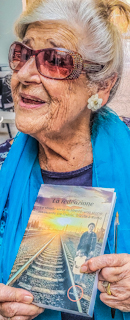
We met this lady quite by chance at a bookshop in Trieste, Italy.
At the end of WW2, there was conflict over who was to own Trieste – Yugoslavia or Italy or an independent state. During thus troubled period, many Italians fled from Trieste because life there was dangerous. Many Italians were killed by Yugoslav partisans.
This lady, then a small child, fled with her mother to Rome, and was one of the first refugees to arrive there.
The book she is holding is about that era, and she is the small child on the front cover.
Naturism used to be popular in the former Yugoslavia – a country I visited frequently during the 1970s and 1980s. In those years, I had many friends in Belgrade. In summer, many of them migrated to the Adriatic coast, particularly to Dubrovnik. I used to join them.
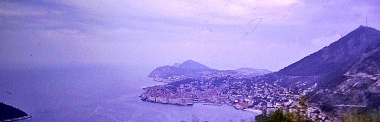
During one visit to Dubrovnik, my friends and I took a ferry to the island of Lokrum, which is less than a mile south of the centre of the historic part of the city.
After disembarking and climbing a short slope, we stopped at a direction sign with two panels, each pointing towards a different path. One bore the words “Ne nudismo”, and the other had only one word “nudismo”.
We followed the path indicated by the ‘nudismo’ sign. The path wound gently downhill through a shady forest, and reached a sandy beach in a small cove. We were about to spend some time bathing nude. My friend, who must have understood my apprehension, reassured me by saying:
“Don’t worry, Adam, there is always someone on the beach who looks uglier than you.”
Though a novelty, I enjoyed bathing without the encumbrance of swimming trunks and so on.
Another year, we spent a pleasant few days on the island of Mljet, which is about 38 miles northwest of Dubrovnik. In those days, the 1980s, no motor vehicles were allowed in the northern part of the island around the port of Polace, where we stayed. Mljet has a lake within it, and within the lake there is an island. Every day, we spent much time wandering around the lake, taking occasional dips, and hiring rowing boats. And all of this activity was carried out without clothes apart from sunglasses and sun hats.
In May 1984, I joined a tour to visit the People’s Socialist Republic of Albania, which was then highly secretive and completely repressed, under the control of its dictator Enver Hoxha, an admirer of Josef Stalin. We flew from London to Belgrade, and then changed ‘plane to fly from Yugoslavia’s capital to Titograd (now Podgorica) in Montenegro. We spent the night in a comfortable, modern hotel that overlooked a fast-flowing river. In each bedroom, the Montenegro tourist office had placed several coloured brochures that extolled the virtues of visiting that part of Yugoslavia.
One of the brochures contained a grainy coloured photograph of people on a beach – Montenegro has a long Adriatic coastline. If one examined this photograph carefully, it could be seen that it was a ‘nudismo’ beach. None of the holidaymakers were wearing any form of clothing. As the brochures did not interest me, I did not bother to keep them, but most of the others on the tour did.
The next morning, after a brief tour of Titograd in a Yugoslav coach, we were driven to the nearby border that separates Yugoslavia from Albania. The border post is next to Lake Scutari (Skadarsko Jezero/Liqeni i Shkodrës). We were asked to disembark as the coach could not enter Albania. Carrying our luggage we walked a short distance, and passed an Albanian soldier standing stock still, looking like a statue, and holding a gun.
Then we entered the Albanian frontier post, a spacious building containing comfortable armchairs, each with a lacy anti-macassar, and we were invited to sit down. On one wall, were the words in English that read:
“Even if we have to go without bread, we Albanians do not violate principles. We will not betray Marxism – Leninism.”
It was written in capitals using faded red letters that looked like those used to advertise films on the canopies above the entrances to cinemas. All of the letters were firmly attached to the wall except one. This was detachable as it had been glued onto a removable hatch cover, which must have provided access to services – plumbing or wiring – hidden within the wall.
We sat down, and then filled in the detailed custom declaration form that needed to know whether we would be importing, amongst a variety of other items, any ‘magnétophones’ or ‘frigidaires’. As I filled in my form, I wondered who, apart from diplomats, visited the country laden with goods such as these. Two by two, we were summoned up to be interviewed by the customs officers standing behind tables.
The customs officials were not particularly thorough, but there was one thing that they wanted to see, and confiscate. That thing was the brochure with the picture of a nudist beach in Montenegro. It was this poorly reproduced image that the Albanian officials were seeking in their attempt to prevent pornographic material from entering the Motherland. Whenever they found one, they confiscated it, but not before labelling it with its owner’s name.
When our tour of Albania reached its end, we returned to the same border post. To my surprise, each of the confiscated Montenegrin tourist brochures was returned to the person whose name was on it.
Sadly, Yugoslavia no longer exists, and happily, Enver Hoxha’s repressive regime that made Albania and the Albanians at least as isolated from the rest of the world as is North Korea today. As for nudist beaches, I have not been to one since my visit to Mljet in the 1980s. This is not because I am averse to nudism and naturism, but I do not enjoy spending time in the sun on beaches.
A picture of sunset over the Danube at Novi Sad, now in Serbia, posted on Substack, elicited memories of my visits to Yugoslavia in the 1980s. The following is an excerpt from my book “Scrabble with Slivovitz”, which describes my experiences of extensive travel in the former Yugoslavia during the 1970s and 1980s.
One result of the brief period of friendship between Tito’s Yugoslavia and Mao’s People’s Republic of China, which began in the late 1970s, was that the Chinese supervised the setting up of Chinese restaurants in three Yugoslav cities: Belgrade, Novi Sad, and Sarajevo. My friends in Belgrade rated the one in Novi Sad as being the best of the three. The first time that I went there, I travelled by train with Raša, Dragan, and some other friends to Novi Sad, which is about 100 Km north of Belgrade in the Vojvodina, an administratively autonomous region of Serbia.
The restaurant, the Secuan (Szechuan), served extremely good food. What made it particularly remarkable was that this high quality Chinese cuisine was prepared by Serbians. There was not one Chinese person working in the restaurant; all the Chinese personnel had been recalled to China some years before. However, the people running the restaurant had learnt from them the secrets of Chinese cooking, and they were able to produce dishes, which I am certain that many native Chinese would have found to taste authentic. At the Secuan, they understood the principles that underlie Chinese cooking, and were able to recreate it without having access to supplies of many specifically Chinese ingredients with the possible exception of soy sauce.
We ordered everything on the menu and washed down the food with numerous alcoholic drinks. After the meal, we stepped out into the damp chilled, afternoon air, and wandered around the town centre. When Dragan caught sight of a sign announcing the presence of a ‘Bar London’, he said to me,
“It would be surrealist if you take us for a drink in London.”
So, we descended into the cellar that served as a bar, and drank yet more booze. Then, we returned to the station to catch a train back to Belgrade. By now, I was feeling a little queasy after so much food and drink. The train was crowded and draughty, and we had to stand all the way. Despite feeling unwell during most of the journey, I was not put off the idea of visiting the Secuan on a future occasion.
On one of my many subsequent visits to Novi Sad I travelled with Raša and Dragan in Goran’s car. This was no ordinary car as its handbrake failed to work. Goran and another person were sitting in the front seats. When we had to make a hill start, and there were quite a few of these in Belgrade, the driver, Goran, had to use his two feet to control the clutch and brake pedals, and his neighbour had to lend his left foot to operate the accelerator. We stopped at Stara Pazova, which is half way between Belgrade and Novi Sad, because Dragan said that we needed we needed some ‘benzina’. This was not petrol for the car, but alcohol for us. We entered a café and had a few glasses ofpelinkovac, a stiff alcoholic drink made in a factory in the Vojvodina. Luckily, on that day there was not much traffic on the largely straight road along which we were travelling, and we did not encounter any policemen.
Every time that I visited Belgrade, I made a pilgrimage with friends to eat the Secuan, and each time we ordered everything on the menu. Once, I tried the Chinese restaurant in Belgrade. It was fancier looking than the one in Novi Sad, but the cooking was not nearly as good. I see from the Internet that the Secuan still exists, but it is now no longer the only Chinese restaurant in Novi Sad.
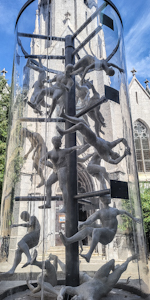
The Lutheran church in central Trieste was built in an austere late gothic style between 1871 and 1874. Outside its west end, in Largo Odorico Panfili, there is a tall cylinder surrounded by transparent glass or plastic. Within the cylinder there are models of people. This artwork is a monument to a tragic era.
The monument called “Momentum”, designed by Jasmine Iannì and Giuseppe Sabatino, is dedicated to the memory of those Italians who fled from areas that had been Italian but had been incorporated into Tito’s Yugoslavia at the e d of WW2. These territories included Istria, Fiume, Dalmatia, and Zadar .
Well, I knew about these refugees, but not about something else commemorated by the monument. What I had not known about were the ‘foibe’ killings – massacres of Italians living in the formerly Italian territories that became part of Yugoslavia. These were, it is said, carrued out by Tito’s communist partisans. According to Wikipedia (https://en.wikipedia.org/wiki/Foibe_massacres):
“The estimated number of foibe victims is disputed, varying from hundreds to thousands,according to some sources 11,000or 20,000…”
I was horrified to learn about this. I had read that many anti-communist Yugoslavs and other opponents of Tito had been killed or imprisoned at the end of WW2. In the 1980s, I knew the wife of a man who had been imprisoned by Tito in 1945 because he was “the wrong kind of communist”, and was still behind bars in the mid-1980s.
However, until I saw the monument inTrieste today in September 2026, I did not know about the Italians who had been massacred simply because overnight in 1945, they were suddenly living in the wrong place.
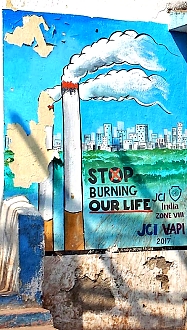
I have had two friends who were chain smokers. Each smoked in excess of 100 cigarettes per day. One was a man who lived in Yugoslavia, and another, a lady, who lived in Wales.
Seen at Vapi in Gujarat
I used to travel around Yugoslavia with my Serbian friend, and we often shared hotel rooms. As soon as he woke in the morning, he had his first cigarette, and last thing at night, after cleaning his teeth, he had to have another. One year when I met him, he told me that his doctor had told him to give up smoking. He decided not to give up completely, but to limit himself to one cigarette per hour. While he did this, he was permanently distracted because every few minutes he had to look at his watch to discover how much longer he had to wait before he could light the next cigarette. Eventually, he abandoned the effort, and returned to chain smoking.
My Welsh friend, let us call her ‘F’, smoked at least as many cigarettes as my friend in Yugoslavia, if not more. Each summer, we used to spend a few days with her at her home in Wales. When the windows were open, as they were often in summer, you could smell cigarette smoke as far away as 50 feet from the house. The place seemed to be surrounded by a cloud of cigarette fumes.
One year, F accompanied us on a long-haul flight. She knew that she would be unable to smoke during the 11 hours we were on board. Realising this, she quilted smoking overnight – she was a very determined woman. Within 24 hours, she went from smoking over 100 cigarettes per day to none at all.
To her credit, she never resumed smoking. She told us that one of the benefits of having given up was that she did not need to have the walls within her house repainted every year because they were no longer becoming discoloured by smoke from the cigarettes.
Both F and my Yugoslav friend are no more. Interestingly, neither of them suffered from, or died of lung cancer. I miss both of them.
My birthday is on VE Day (8th of May). In 1990, I celebrated it in the former Yugoslavia. That year, I was driving around Serbia in a rented car with my friend from Belgrade, Raša Raičević. His birthday was the day following mine. Before I rented the car, my friend Raša, a very wise fellow, advised me to rent a car from one particular company because its cars carried Slovenian registration plates, rather than Serbian. This proved to be sound advice.
On the seventh of May, Raša and I booked into the comfortable accommodation provided at the beautiful Prohor Pčinjski monastery in the hills of southern Serbia. We decided to stay there two nights in order to celebrate our birthdays.
My birthday wish was to drive into the autonomous region of Kosovo and Metohija, which was populated by a high percentage of Albanians. Then as now, I was greatly interested in all matters connected with Albania and the Albanian diaspora. Both Raša and I had separately visited the area in the 1970s. We were both keen to see it again.
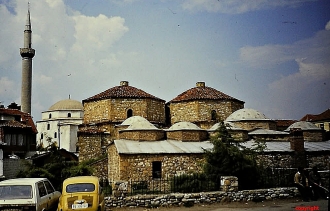
Old hammam in Prizren, Kosovo
Raša, a Serbian, had some reservations about driving into Kosovo, where there had been some unpleasant violent incidents between the Serbian and Albanian communities some months earlier. However, he decided that he would accompany me for two reasons. One was that our car bore Slovenian plates, not Serbian. The other related to his excellent command of the English language. He said he would only speak in English in Kosovo, not a word of Serbian.
We set off, driving through the relatively empty Serbian countryside. The boundary of Serbia and Kosovo was at the summit of a low mountain pass. As soon as we entered Kosovo, we discovered that, unlike the part of Serbia we had just left, the countryside of Kosovo was relatively crowded with people, by the road side and in the fields. The landscape was liberally dotted with recently constructed homes and other buildings. This was quite different from what we recalled of our earlier visits.
We drove into Priština (Prishtinë), the capital city of the autonomous region. The main road was filled with a sea of people. We inched forward. The crowds parted slowly to allow us to proceed. Raša advised, nay forbade, me to sound the car’s horn. He did not want to upset anyone. I had never before driven through such crowds. Four years later, I did it again, but in the central market area of Bangalore in India. There, I and other motorists sounded horns incessantly, but nobody paid the slightest notice to them.
We parked in the centre of the city in a car park that looked like it was the site of a large, demolished building.
I was keen to buy recordings of Kosovan Albanian music for my ever-growing collection of music from all over Yugoslavia. The best supplier turned out to be a tiny kiosk that sold cigarettes, magazines, and newspapers. I bought about fifteen cassettes, the kiosk’s entire stock, but had no bag to carry my haul. The enterprising shop keeper saw my plight. He opened a couple of cartons that each contained twenty packs of cigarettes and emptied the packs onto his small counter. Then, he carefully packed my cassettes into the cartons.
After lunch in what seemed to be the grandest hotel in the city, we drove to see the beautiful Serbian Orthodox monastery at Gracanica. Then we wended our way back towards Serbia, stopping for coffee at Gnjilane (Gjilan). There, I spotted a kebab shop that used a logo identical to the well-known McDonalds ‘M’. When I pointed this possible breach of ‘copyright’ to my friend, he shrugged his shoulders and said:
“This is Kosovo. Anything goes.”
We reached Prohor Pčinjski, where we ate a lavish and tasty dinner. The following day, Raša’s birthday trip was a drive through parts of Yugoslavian Macedonia. After passing some rice paddy fields, we were stopped by a policeman with a speed measuring device. He fined me the equivalent of £1 Sterling for speeding. My friend was fined half of that for not wearing a seatbelt. Otherwise, we had a good day, visiting an attractive small town, Kratovo, and the Roman ruins at Stobi by the River Vardar.
The following day, we drove back into Kosovo, stopping at the small town of Prizren. On both the 1990 and my 1975 visits, Prizren captured my heart more than any other place in Kosovo. Recently taken photographs I have seen show that it is still a delightful place.
From Prizren we drove to a dramatic pass that led from Kosovo into southeastern Montenegro. We spent the night in Rozaje, a small Montenegrin market town. Thus ended a memorable double birthday celebration.
Soon after we visited Kosovo together, it was time for me to fly back to England. Raša accompanied me to Belgrade airport. Just before I entered the secure departure area, I waved to him and experienced a weird sensation. I felt that Raša knew that we would never meet again.
My sensation was not without basis. Soon after I left Yugoslavia, the country began its painful dismemberment. Visiting my friends in Belgrade and elsewhere in Yugoslavia became inadvisable. Sadly, by the time that uneasy peace began to reign again in what was once Yugoslavia, Raša had passed away.
VE Day marked the end of hostilities between the Axis and Allied powers in Europe on the day that was to become my birthday a few years later. The imposition of socialist regimes in Central and Eastern Europe that followed did not put an end to festering sores that had been troubling the Balkans and elsewhere since the decline of the Ottoman and Austro Hungarian empires, which had already begun at the beginning of the twentieth century. This was certainly the case in what was Yugoslavia. During the ‘reign’ of Marshal Tito, a semblance (or maybe more) of unity was achieved in his country. However, after his death, as if recovering from a general anaesthetic, old unresolved conflicts reawakened. President Milošević did little to resolve these, but instead helped to exacerbate them. Hailed by some Yugoslavs, mostly Serbs, as the new hero of Yugoslavia, this assessment was not shared by many, especially the Albanian folk in Kosovo.
All said and done, I cannot forget the warmth, hospitality, and friendship shown to me by ordinary people living in the former Yugoslavia, Serbians, Croatians, Bosnians, Albanians, and many others during the 1970s and 1980s. They did not deserve what befell them during much of the 20th century.
Read more about Yugoslavia as it used to be in my book “SCRABBLE WITH SLIVOVITZ”, which is available from Amazon:
I have not visited anywhere in the former Yugoslavia since 1990. What follows is an account of one of my earlier visits to that now non-existent country sometime during the mid-1970s.
One of the earliest trips that I made to Yugoslavia was to visit Lake Ohrid in Macedonia. It began in Greece, where I was staying with my family and some of our friends from London. One of them, Hugh, and I left the comfort of the luxury hotels in which we were staying in Athens, and travelled by train to Edessa. We had to spend a night there before continuing to Florina in the north-east corner Greece. On the next day, when both of us had just about recovered from a dreadful bout of food poisoning caused by the injudicious over-consumption of undercooked pork kebabs that had been served on the train between Athens and Edessa, we boarded a small (two carriage) train. It took us slowly from Florina towards the Greek border village of Neo Kafkasos.
Hugh and I were the only passengers on the train when it stopped at the station on the Greek frontier. It was early afternoon and very warm. The only signs of life were the flies that spent much of the time swarming around us when they were not actually settling on our skin. Nothing happened for a long time. Then suddenly, another short train reversed into the station on the track next to ours, and stopped parallel to our carriage. It had come from the direction of Yugoslavia and bore the insignia of that country’s railway company. It stopped so that the carriage door of our wagon was exactly opposite one of its carriage doors. A uniformed man, a Yugoslav border guard, entered our carriage and escorted us across the short gap between the two trains.
Our new train rumbled north into Yugoslav Macedonia. All that I remember of Bitola, where we disembarked, was viewing a minaret in the distance as we approached the town at snail’s pace. We boarded a bus bound for the city of Ohrid almost immediately after getting off the train, and so saw nothing of Bitola. As the afternoon light began to fade, we crossed the mountains to the east of the town and arrived in the town of Ohrid after nightfall.
In the town of Ohrid
We camped on the shore of Lake Ohrid in a campsite about one and a half kilometres north of the town. My original reason for visiting the place was that the lake was shared by Yugoslavia and its neighbour, the then almost impenetrable Albania. Little did I realise before arriving at Ohrid that I was going to be staying in one of the most beautiful spots in Yugoslavia. A line of white marker buoys bobbed about in the water about halfway across the lake, marking the boundary between Yugoslavia and Albania, whose distant shore shimmered in the heat haze. Although I was intrigued by the sight of these, the Yugoslav side of the lake was full of delightful attractions for the visitor. Many years later when I visited Albania in 1984, I travelled along the Albanian shore from Lin to Pogradec, and discovered that it was not nearly as picturesque as the Yugoslav.
Whilst Hugh was content to spend the day basking in the sun beside the lake and eating watermelons, I spent my time exploring the city of Ohrid and its environs. The city was full of charm. Many of its narrow streets were lined with traditional Balkan dwellings. In some cases, their upper storeys projected beyond their lower ones, causing their facades to look like reversed staircases. In summer, so I read, the inhabitants used the upper light and airy storeys, and in winter they retreated to the more solidly built lowest storey where it was warmer and the animals were housed.
The city has an historic fortress; Roman ruins; some old orthodox churches containing beautiful frescos, many of them depicting the male saints wearing white robes decorated with black crosses; and at least one mosque with its minaret. I ate plenty of delicious grilled meats freshly prepared on braziers above glowing charcoal. Fortunately, I had not become averse to this kind of food, as I believe Hugh had, after our unfortunate experience on the Greek train. And I enjoyed numerous Turkish coffees.
Using the excellent local bus services, I visited the village of Struga at the north end of the lake, and, far beyond that, the town of Debar. This small town, which is about three kilometres from Albania, was full of men dressed in typical Albanian folk costumes – white flannel jackets and trousers, both trimmed with black edgings. This was exciting for me, as I was (and still am) passionately interested in Albania and the Albanians. I bought a couple of traditional shoulder bags made of rough textured woven fibres, most probably wool, and brought them home as souvenirs. The road that ran along the shore south from Ohrid led to the monastery of Sveti Naum, which I will describe soon.
Every day, I used to walk from the campsite into the town of Ohrid either to spend the day there or to embark on an excursion. At the end of the day, often after dinner in the evening, I walked back. There was little traffic on the road and no artificial street lighting. After sunset, it was lit only by the moon and stars. The main hazard that I faced at that time of day was meeting with bicycles travelling towards me. They were quite silent, and none of them used lamps at night. They seemed to loom up in front of me suddenly as if materializing from thin air. That gave me hardly any time to dart out of their way.
One hot afternoon, I was walking back from Ohrid to the campsite when one of its employees waved to me from outside the street entrance to his home. He invited me into his courtyard, where a fly-infested donkey was tethered, and then into his home. I entered a room in which his family, mostly women and girls, were seated on cushions ranged around its walls. Then, he asked me whether I would like some milk. Immediately, I visualised a condensation-covered glass of ice-cold milk straight from the ‘fridge, and accepted his offer. I was unprepared for what was handed to me. The glass of cream coloured milk was warm as were its contents. The milk, which I am certain had just been freshly collected from a cow (or maybe the donkey that I had seen outside), tasted strange to me. After taking one sip, I felt quite nauseous. Hoping that I would not vomit, I held the glass politely, smiled at those around me, and after a while, looked at my watch, and prepared to leave.
Some years later when I encouraged my friends, Robert and Margaret Harkness, to drive to Greece via Ohrid.We spent one night at the same campsite where Hugh and I had stayed many years earlier. Before we retired for the night, an elderly campsite worker approached me and greeted me like an old friend. It was the same man who had invited me into his home and offered me milk. I was touched that he had remembered me from my earlier visit and by his warm greeting.
This was written some years ago, and published in my book “SCRABBLE WITH SLIVOVITZ – Once upon a time in Yugoslavia”.
It is available from Amazon (paperback and Kindle):
IN THE 1980s, I used to make regular visits to see my friends who lived in the part of Yugoslavia, which is now the independent Republic of Bosnia. The influence of the Turkish occupation of the region for many years was very evident – from Turkish coffee to fine mosques.
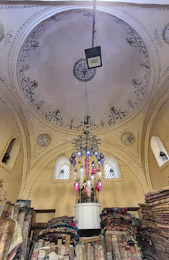
Many years before I began travelling to Bosnia, Üsküplu Gazi Yahya Paşa (died 1506) was appointed Ottoman governor of Bosnia in 1480. He also held other important positions in the empire. He married a daughter of Sultan Beyazit II. He was philanthropic. One of the many things he did for Istanbul was to build a school which stands in Kadirga, a part of Fatih district of the city. This building with two domes still stands and was recently restored by the local municipality.
The former school now houses a shop that sells traditionally designed objects – everything from earrings to large woven carpets. The walls and domes of the interior of the building have been painted so as to recreate the place’s original decor.
This building is one of a huge number wonderful relics of the Ottoman Empire, which can be found whilst strolling around Istanbul. Fortunately, many of these old buildings have informative labels attached, with information both in English and Turkish.
ONE YEAR DURING THE 1980s, I was in Belgrade, then the capital of Yugoslavia, on New Year’s Eve. I was staying with my good friend Raša Raićevič. He suggested that we should see in the new year at a friend’s flat I New Belgrade.
Before we set off from his flat in the older part of the city, Raša warned me to keep away from windows and off the terrace as the midnight hour approached. In the 1980s, many retired military people resided in New Belgrade, and quite a few of them possessed firearms. It was customary in those days to fire the guns at the moment a new year commenced. The risk was that ricocheting bullets might break windows or hit people out on their terraces and balconies. Fortunately, we survived the evening without mishaps, and spent the first few hours of the new year at another friend’s home, a long taxi ride away from New Belgrade.
Many years later, sometime after 2006, we were in Bangalore over New Year. My wife and I stayed at home with my recently widowed mother-in-law, who was too frail to attend a party. Everyone else in the family went out to celebratory parties.
The three of us, who remained at home, decided that we would sit together until midnight. However, by about 10 pm on the 31st of December, we all fell asleep. It was only when our daughter phoned us at 3 am that we realised we had slept through the transition from one year to the next.
My New Year’s Eve spent in Belgrade was a complete contrast to that which we slept through in Bangalore. This evening, we plan to have a slap-up dinner followed by drinks under the stars high above the city of Bangalore. I hope that all of you, dear readers, will have a great 2024.
OFTEN WHEN ONE IS SEARCHING for something, something, which you were not looking for, comes to light. A day or so ago, one of my old passports was discovered. It is an old-fashioned, blue-covered book with barely a trace of the wording and crest that used to be on the cover. I used to carry my passport in a trouser pocket, which rubbed against it and gradually denuded the cover. The ten-year document expired on the 19th of March 1990. This was a couple of months before I made my last trip to what was still known as ‘Yugoslavia’. Soon after that, civil wars erupted, and the country became divided into smaller independent units.
The passport gives my height but not my eye colour, which used to be recorded in earlier passports. It contains eight Hungarian visa stamps (one is illustrated above), all issued in London except for one which was affixed in Belgrade. There is also a Bulgarian visa stamp, which was issued in March 1983. In addition to these visa stamps, for which I was charged roughly $10 each, there are many border stamps – entry and exit. Most of these are for Hungary and Yugoslavia, which I visited frequently throughout the 1980s. In those days, Brits did not need a visa to enter Yugoslavia.
One of the border stamps is of special interest. It was issued when I entered Yugoslavia at Bozaj on the 5th of June 1984. Bozaj, now in the Republic of Montenegro, was a Yugoslav border post on the shore of Lake Shkodra. The stamp was placed in my passport a few minutes after leaving the Albanian border post, also beside the lake, at Han-i-Hotit. It was here that an Albanian entry stamp was put in my passport two weeks earlier when I visited the country, which was then even far more mysterious than North Korea is to us today. In 1984, the Stalinist regime headed by Enver Hoxha was still in place. The two weeks spent in Albania were both fascinating and unusual to say the least. I have described that holiday in my book “Albania on My Mind.”
In addition to the visas and stamps issued by socialist countries, there is one Greek entry and one exit stamp, both issued at Athens airport in August 1981. It seems that I was in Greece from the 11th to the 17th. Another stamp issued on the 13th by the Piraeus branch of the National Bank of Greece takes up most of one page and has something to do with money and traveller’s cheques, but my Greek is not up to translating it.
The accidental finding of this old passport brings back many happy memories of travelling in parts of Europe that have now changed beyond recognition – for better or for worse.