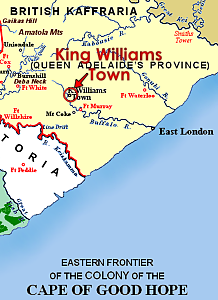
In a previous posting ( https://activeauthor.substack.com/p/why-did-my-great-grandfather-leave ), I discussed the reasons that my great-grandfather Franz Ginsberg (1862-1936) left Germany in 1880 to settle in King Williams Town (‘King’) in the eastern part of the Cape Colony in what is now South Africa. This article describes how Franz became a successful industrialist within a few years of arriving in southern Africa. Eventually, he manufactured three items that were in daily use in nineteenth century southern Africa: matches, candles, and soap. His achievements in industry were eventually accompanied by his ever-increasing involvement in politics. But first, let me introduce the man, Jakob Rindl(1853-1937), with whom Franz worked at first in southern Africa.
By 1882, Jakob Rindl was an established professional photographer in King. Jakob, who was born in Engelsberg (now ‘Mosnov’ in the Czech Republic) ran a photographic studio some of whose pictures bore the words ‘J Rindl, Photographer, King Williams Town, South-Afrika’, Africa being spelled the German way with a ‘k’. Young Franz worked with Jakob, who was nine years older than him. How and where they met has been forgotten. All that I know is that my late uncle Felix Bloch, Franz’s grandson, once told me that Jakob was already established in South Africa when Franz arrived. Felix also told me that Franz was at first apprenticed to a draper in Germany. The draper did not treat him well, and he soon left, and then became apprenticed to a court photographer in Berlin. Both Franz and Jakob were German speakers, and this may have appealed to the numerous German settlers in the area, who wanted photographic portraits, maybe to send back to their relatives in Europe. A report[i] on the Kaffrarian Agricultural Show held in King early April 1884 shows that portraits were Jakob’s forte:
“Photographs were in the competition only for colonial scenery, and hence Mr Rhindl [sic] was not a competitor, but his frame of portraits was worthy of attention, a better collection of portrait photographs being rarely seen.”
While working with Jakob, Franz experimented with colour photography. When I first learnt of this, I was surprised, but then I discovered that by the 1880s many people were looking into ways of producing true colour photographs rather than hand-tinted black and white images. No one, including Franz, managed to perfect a technique that worked until about 1892, when a Jew from Luxembourg Gabriel Lippmann (1845-1941), who won the Nobel Prize for Physics in 1908, hit upon a method that worked.
Photography is both an art and a science. The scientific side of it involves both physics and chemistry. Franz, who is unlikely to have attended university before setting sail for Africa but had a father who was well-versed in science, was able to ‘dabble’ in colour photography. This shows that he had an innate flair for chemistry. This was a skill which would prove useful in many of his manufacturing endeavours. Almost everything that he produced, usually on an industrial scale, involved processes that required a knowledge of, or at least a masterly ‘feel’ for, chemistry.
In May 1885, an advertisement announced Jakob’s move from Cathcart Street to new premises in Downing Street[ii]. Franz’s name does not appear in this announcement. This suggests that the relationship between Jakob and Franz was that of employer and employee. This situation, if it existed as such, was not destined to last much longer. For, in July 1885 the town of King was about to become the home of a new factory, and Franz would soon be the leading light in this enterprise.
Just after Jakob shifted to Downing Street, readers of the Cape Mercury (‘Mercury’), a local newspaper in King, would have read:
“A MATCH factory will shortly be established in this town, the necessary machinery being now on its way. Mr. Stray of Stray and Toenesson, is starting it, and hopes to be able to find employment for a good number of hands. The kind made will be the Locomotive brand of Tandstickors. … The factory will be on the outskirts of the town.[iii]”
Tändsticka (plural Tändstickor) is the Swedish word for a match, or type of match. Safety matches were patented by Johan Edvard Lundstrom of Sweden in1855. H Rider-Haggard (1856-1925), author of King Solomon’s Mines who lived and worked in South Africa in the late 1870s, uses the Swedish word in his story Long Odds:
“It was so dark that I could not see anything, though I could smell a great deal, so I lit a match. It was a ‘tandstickor’ match, and burnt slowly and dimly, and as the light gradually increased I made out …”
In 1886 when this was published – a year after the advertisement was published, the Swedish word was in common use. On the 21st of July 1885, newspaper readers in King learnt that the promoters of the local Match Manufactory were going to be “Messrs Toenessen and Ginsberg”. Their offices were situated near to Jakob’s photographic studio in Downing Street.
By mid-December 1885 the factory was operating at full speed, as was reported in a local newspaper:
“The match factory is now in operation, and cannot get through with the orders, consequently further labour saving machinery is being imported. Twenty lads are employed, and the manufacturers wish to double the number at wages, which are gauged according to ability. The other day a visitor saw 375,000 matches tipped in one hour.
By the way, why do Colonial manufacturers not adopt a Colonial insignia for their wares? Kaffraria has a coat of arms, now disused since its absorption in the Colony; why not revive the emblem of independence, even if it is on a bottle of local made sweets or a box of Kaffrarian matches.”
Three points come to mind. The first is that the potentially hazardous business of making matches requires competence in applied chemistry. Franz appeared to have had this. Second, maintaining the complex machinery, which was imported from Europe to make matches on an industrial scale, required someone with mechanical skills. Toenessen had this. He had been awarded prizes in King for manufacturing goods that required this skill – for example: lock-making, door plates, and later weaponry. In 1894, Messrs Stray and Toenessen advertised their skills as practical engineers:
“Stray & Toenessen … are prepared to undertake all kinds of work connected with machinery, locks, lamps…”
The third, is ‘Colonial Manufacture’. That is to say, the manufacturing of goods within the colony. One thing that encouraged this was that the duty applied to imported manufactured goods did not apply to goods manufactured in the Colony. The promotion and protection of colonial industry was to become an important concern of Franz during his lifetime. Franz and Toenessen began manufacturing matches during 1885. They were able to exhibit matches at the Port Elizabeth Exhibition held at the end of that year.
By January 1886, Franz had not only begun making matches but also another product, ink. Its manufacture needed chemical knowledge. His Kaffrarian Ink Factory also had its offices in Downing Street.
Average life expectancy for someone born in 1862 was much shorter than that of someone born now. Therefore, there was a need to achieve success earlier in life than now. Even taking this into account, Franz had made a significant leap in his career ‘trajectory’ by 1886, remarkably early in his life (when he was only about twenty-three years old).
The capital costs involved in setting up a match factory and a separate ink-making plant must have been considerable. I feel that it is unlikely that Franz would have arrived in South Africa with much money – his father with twelve children to support probably had little spare cash. Also, however successful Rindl’s photography business might have been, there would have probably been little that Franz would have been able to invest. It is possible that he had saved some money, and/or maybe, Toenessen had sufficient capital to start the match factory with Franz. Franz might well have had to approach a financial house like a bank for finance. If this was the case, whoever lent Franz the money must have felt, quite correctly as it turned out, that he was a good bet.
The match factory soon began doing well. In April 1886, Franz and Toenessen carried off prizes at the annual Kaffrarian Agricultural Show. In addition to winning “…the prize for the best collection of Colonial Matches, £2-2s.”, they also hosted a stand showing the full process of manufacturing matches. As if this was not enough, Franz and a Mr Klinkhardt won a prize for the manufacture of plant pots using local clay. These pots, which were very much below the prices of imported ones, were, in the opinion of the show’s judges likely to sell well. Elsewhere in the same show, in its ‘Art Department’, Franz was awarded yet another prize. This one was for photography. According to the newspaper reporter writing in the Cape Mercury:
“Messrs. Rindl & Ginsberg took the prize of £1 – 10s. for portraits, which were certainly as fine as can be produced in the Colony, both in taste and photographic excellence.”
The prize for portraits shows that Franz was still associated with Jakob Rindl, and that his name had been added to Jakob’s in connection with the photographic studio. Franz’s triumphs at the 1886 show demonstrate that he had his fingers in many pies, but none of them suffered because of his ‘multi-tasking’. In addition, this twenty-four-year-old man was creating much new employment in the town.
Four months after his successes at the Agricultural Show, Franz attended a meeting held at the town’s Council Chamber to consider the advisability of forming a Gold Prospecting Company, to be called the ‘Pioneering Gold Prospecting Company’. Its proposed aim was to prospect for gold and other minerals in the district around King. Franz was a member of the ‘Provisional Committee’, which included other members of the town’s business community. Two weeks after this, he was elected to Board of Directors of The King Williams Town Pioneer Prospecting Company. Impressive as this assimilation into the town’s business hierarchy may seem, it was not enough for him to get an invitation as a guest to an important ball, organised by the town’s Freemasons, held a few days after the meeting[iv].
Even a successful venture can hit snags. This was the case with Franz. At the beginning of 1887, Franz and Mr Toenessen published the following announcement[v]:
“DAMAGED MATCHES. SOME of the Matches damaged in the course of manufacture which we advertised for some time ago, are still being sold. We shall be happy, not only to exchange perfect goods, but will pay the carriage on such matches. GINSBERG & TOENESSEN”
This problem appears to have been resolved, but others loomed. For example, the street lighting near the factory was defective and the ill-lit streets made a perfect place for ‘Natives ’ to drink away their woes. In connection with the lighting problem, Franz and Toenessen requested the Town Council of King to:
“…to have the bottom of Wood Street repaired, and lamps erected in Buffalo Road or Victoria Street, which was a thoroughfare used by drunken Natives.” To which the Mayor commented that the drunken ‘Natives’ could be arrested. At the following Council Meeting, Franz and his partner’s request was partially turned down. The Council resolved not to “…enlighten the darkness…” of the locality, but instead they allocated a sum not exceeding £20 for mending the main roads and bye-ways[vi].
By 1890, Franz had diversified his product range. This is illustrated by the following announcement that he published in the local press:
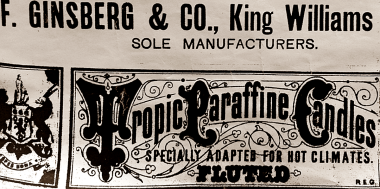
“Notice OUR MR. GINSBERG having returned after a lengthy visit to England, Germany and Sweden, we beg to notify to the public that the work in our factories will be carried on WITH ALL LATE IMPROVEMENTS, and in a most efficient manner, so that we can guarantee the quality of our matches and candles as SECOND TO NONE.”
This shows that Franz had added candles to the household essentials that he was producing on an industrial scale. Like matches and ink, candle-making requires some appreciation of applied chemistry, which Franz certainly possessed. The advertisement also shows that Franz travelled abroad. He was to do this a great deal, as I shall describe later.
A description of the candle factory exists in a scrapbook[vii] which belonged to Franz and is now stored in the archives of King’s Amathole Museum:
“In the candle factory I saw the various greases and tallows being boiled, after which, by means of powerful hydraulic presses, the oils are extracted from them. After crystallising, the fats are put into tins and placed in hot chambers, heated by steam, where further oil is extracted from them. They then go to the candle moulding machines, of which I saw a great number at work. Another room was occupied by girls who were deftly making boxes, each one to hold a dozen candles, and in the next room wood boxes were being made for packing the candles in. The work in the candle factory is carried on night and day, and to shew its capacity, I was informed that it could produce 35,000 to 40,000 candles a week. A great deal of water is required in this factory, which is supplied from an artesian well on the premises, and a steam pump, which I saw at work, was raising 1,800 gallons per hour. Mr Ginsberg however desires a more ample supply, and with that object in view has purchased a drill with which he is now boring to a greater depth, and in a short time hopes to have a pump which will raise 4,000 gallons per hour.”
The same writer then continues to comment on another of Franz’s factories:
“In the match factory, which is nearby, I saw the various operations of this industry being carried on, and was rather surprised to be informed by Mr Ginsberg that the labour alone in this industry represents 75 percent of the total cost, and the proof of this was not far to seek, for I found about 130 people employed here, which is a very large number in comparison to the work turned out, the production of the factory being about 1,800 to 2,000 gross of boxes per week.”
The writer ends his piece by discussing yet another of Franz’s enterprises, his soap-making business:
“The soap works belonging to the same firm, have the capacity of about 18 tons of soap per week, so that altogether Messrs. Ginsberg and Co. may be said to be very largely interested in Colonial industries, and have done their share towards developing them. I was given to understand they are prepared to go in for further extension, but are holding back at present until they see what is going to be the result of the approaching Customs Convention.”
The Convention, held in 1898 and mentioned above, was concerned with eventually harmonising customs regulations between the four separate parts of South Africa: the two British colonies and the two then independent Boer republics.
The references to artesian wells as a means of gaining an adequate supply of water for his factories, is an early indication of Franz’s concerns about water resources. Later, I will describe his involvement in a major water supply improvement scheme for King. His use of artesian wells was publicly praised[viii]:
“Messrs Ginsberg & Co. are to be congratulated on the success of their boring operations. Not a few persons were sceptical over the matter, or at least that the borer would have to be sent to an extreme depth, but the firm has tapped a good supply at a depth of little over 180 feet. This enterprise will doubtless lead to other artesian wells in the town, and make householders independent of the present service for irrigation purposes. Government is encouraging well-boring, more especially among the country people, by supplying machines at half cost. It will be a pleasure to report that the Natives are giving attention to this simple method of irrigating land, or obtaining a healthy supply of water in their communes.”
Franz’s factories were consuming water at a high rate. Had this come from the municipality, his firm would have had to pay for it. After paying the initial outlay to bore the wells and obtain the pumps, the water itself cost the firm nothing.
Franz added yet another product to the range of household goods that he manufactured. This was another item whose manufacture made good use of Franz’s practical skills in applied chemistry. By March 1893, he had begun making soap. This was only seven years after the future Lord Leverhulme (founder of what is now the Unilever company) opened his first soap-making factory in the UK.
At the 1899 King ‘Agricultural and Industrial Society Show’, Franz’s company was awarded £5 prizes for each of the following categories of exhibits: soap, candles and matches. Year after year, his company’s products won prizes at similar shows. In 1907, the local newspaper, reporting an annual show, wrote:
“GINSBERG & Co. have two stalls. On one, is displayed samples of their “XXX Pale Soap”, an article made out of colonial products. This soap is growing rapidly in popularity and in many quarters is completing successfully with blue mottled. The second stall in the form of a kiosk, on which are several new lines that Messrs. Ginsberg and Co. are pushing. One of these is “Electra Soap”, made up in attractive cartons containing three bars. Another new line is the “Mining Candle”, which is daily growing in popularity. The feature of this candle is that it is very hard, and calculated to resist a very hot atmosphere, therefore highly suitable in mines. Messrs. Ginsberg’s other lines in candles and soaps are also nicely displayed...”
Conspicuous by their absence are matches. By 1907, Franz was no longer producing them.
I have described how my great-grandfather, Franz Ginsberg, became a successful industrialist. Within about 10 years after having left Germany as a young man, he had become one of the leading businessmen in King Williams Town. In a future essay, I will outline how he combined his commercial activities with a profound involvement with politics, both at local and national levels.
This is an abbreviated excerpt from my detailed biography of Franz Ginsberg, “SOAP TO SENATE: A GERMAN JEW AT THE DAWN OF APARTHEID”. The book/kindle is availabl from Amazon.
[i] CM: Cape Mercury, publ. King Williams Town: 5th April 1884
[ii] CM: 30th May 1885.
[iii] CM: 18th July 1885.
[iv] CM: 21st August 1886
[v] CM: 4th Jan 1887
[vi] CM: 4th & 11th May 1889
[vii] A newspaper cutting dated 22nd November 1895, copied me by Stephanie Victor , a curator at the Amathole Museum
[viii] Undated and unidentified newspaper clipping from Franz Ginsberg’s scrapbooks in the Amathole Museum