My birthday is on VE Day (8th of May). In 1990, I celebrated it in the former Yugoslavia. That year, I was driving around Serbia in a rented car with my friend from Belgrade, Raša Raičević. His birthday was the day following mine. Before I rented the car, my friend Raša, a very wise fellow, advised me to rent a car from one particular company because its cars carried Slovenian registration plates, rather than Serbian. This proved to be sound advice.
On the seventh of May, Raša and I booked into the comfortable accommodation provided at the beautiful Prohor Pčinjski monastery in the hills of southern Serbia. We decided to stay there two nights in order to celebrate our birthdays.
My birthday wish was to drive into the autonomous region of Kosovo and Metohija, which was populated by a high percentage of Albanians. Then as now, I was greatly interested in all matters connected with Albania and the Albanian diaspora. Both Raša and I had separately visited the area in the 1970s. We were both keen to see it again.
Raša, a Serbian, had some reservations about driving into Kosovo, where there had been some unpleasant violent incidents between the Serbian and Albanian communities some months earlier. However, he decided that he would accompany me for two reasons. One was that our car bore Slovenian plates, not Serbian. The other related to his excellent command of the English language. He said he would only speak in English in Kosovo, not a word of Serbian.
We set off, driving through the relatively empty Serbian countryside. The boundary of Serbia and Kosovo was at the summit of a low mountain pass. As soon as we entered Kosovo, we discovered that, unlike the part of Serbia we had just left, the countryside of Kosovo was relatively crowded with people, by the road side and in the fields. The landscape was liberally dotted with recently constructed homes and other buildings. This was quite different from what we recalled of our earlier visits.
We drove into Priština (Prishtinë), the capital city of the autonomous region. The main road was filled with a sea of people. We inched forward. The crowds parted slowly to allow us to proceed. Raša advised, nay forbade, me to sound the car’s horn. He did not want to upset anyone. I had never before driven through such crowds. Four years later, I did it again, but in the central market area of Bangalore in India. There, I and other motorists sounded horns incessantly, but nobody paid the slightest notice to them.
We parked in the centre of the city in a car park that looked like it was the site of a large, demolished building.
I was keen to buy recordings of Kosovan Albanian music for my ever-growing collection of music from all over Yugoslavia. The best supplier turned out to be a tiny kiosk that sold cigarettes, magazines, and newspapers. I bought about fifteen cassettes, the kiosk’s entire stock, but had no bag to carry my haul. The enterprising shop keeper saw my plight. He opened a couple of cartons that each contained twenty packs of cigarettes and emptied the packs onto his small counter. Then, he carefully packed my cassettes into the cartons.
After lunch in what seemed to be the grandest hotel in the city, we drove to see the beautiful Serbian Orthodox monastery at Gracanica. Then we wended our way back towards Serbia, stopping for coffee at Gnjilane (Gjilan). There, I spotted a kebab shop that used a logo identical to the well-known McDonalds ‘M’. When I pointed this possible breach of ‘copyright’ to my friend, he shrugged his shoulders and said:
“This is Kosovo. Anything goes.”
We reached Prohor Pčinjski, where we ate a lavish and tasty dinner. The following day, Raša’s birthday trip was a drive through parts of Yugoslavian Macedonia. After passing some rice paddy fields, we were stopped by a policeman with a speed measuring device. He fined me the equivalent of £1 Sterling for speeding. My friend was fined half of that for not wearing a seatbelt. Otherwise, we had a good day, visiting an attractive small town, Kratovo, and the Roman ruins at Stobi by the River Vardar.
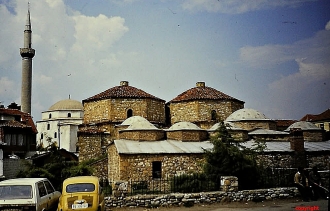
The following day, we drove back into Kosovo, stopping at the small town of Prizren. On both the 1990 and my 1975 visits, Prizren captured my heart more than any other place in Kosovo. Recently taken photographs I have seen show that it is still a delightful place.
From Prizren we drove to a dramatic pass that led from Kosovo into southeastern Montenegro. We spent the night in Rozaje, a small Montenegrin market town. Thus ended a memorable double birthday celebration.
Soon after we visited Kosovo together, it was time for me to fly back to England. Raša accompanied me to Belgrade airport. Just before I entered the secure departure area, I waved to him and experienced a weird sensation. I felt that Raša knew that we would never meet again.
My sensation was not without basis. Soon after I left Yugoslavia, the country began its painful dismemberment. Visiting my friends in Belgrade and elsewhere in Yugoslavia became inadvisable. Sadly, by the time that uneasy peace began to reign again in what was once Yugoslavia, Raša had passed away.
VE Day marked the end of hostilities between the Axis and Allied powers in Europe on the day that was to become my birthday a few years later. The imposition of socialist regimes in Central and Eastern Europe that followed did not put an end to festering sores that had been troubling the Balkans and elsewhere since the decline of the Ottoman and Austro Hungarian empires, which had already begun at the beginning of the twentieth century. This was certainly the case in what was Yugoslavia. During the ‘reign’ of Marshal Tito, a semblance (or maybe more) of unity was achieved in his country. However, after his death, as if recovering from a general anaesthetic, old unresolved conflicts reawakened. President Milošević did little to resolve these, but instead helped to exacerbate them. Hailed by some Yugoslavs, mostly Serbs, as the new hero of Yugoslavia, this assessment was not shared by many, especially the Albanian folk in Kosovo.
All said and done, I cannot forget the warmth, hospitality, and friendship shown to me by ordinary people living in the former Yugoslavia, Serbians, Croatians, Bosnians, Albanians, and many others during the 1970s and 1980s. They did not deserve what befell them during much of the 20th century.
Read more about Yugoslavia as it used to be in my book “SCRABBLE WITH SLIVOVITZ”, which is available from Amazon: