The barons or Barrons buried in a village in Cambridgeshire

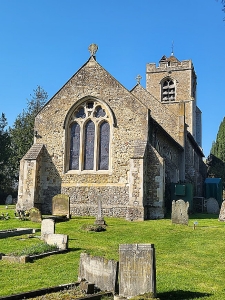
COMBERTON IS A DELIGHTFUL small village not far from Cambridge. A graveyard surrounds its parish church of St Mary, which stands south of the village. While looking around the graves in the churchyard, I came across a stone with the following inscription carved in it:

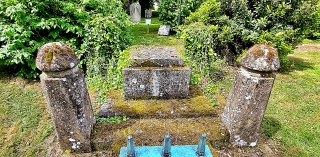
In memory of the Barrons of the Manor of Birdlines 1400 – 1805, over 60 of whom lie buried here. Six within the church. R.I.P.

I wondered about the Manor of Birdlines, and resorted to the Internet. After the Norman Conquest, Comberton was divided into three manors. One of these was Birdlines (also spelled as ‘Berdlines’, ‘Birdling’, and ‘Burdelins’). By 1300, the manor became owned by the Chambers family of Epping, following a marriage, Then, in 1514, the manor was sold to the Bishop of Winchester. Thus, it became part of the Savoy Hospital Estates, which were established by King Edward VI’s charter. The manor’s lands were allotted to London’s St Thomas Hospital, and its governors became titular Lords of the Manor. They continued in this role until 1974. All this information and much more can be found at https://www.british-history.ac.uk/vch/cambs/vol5/pp175-189 .

The memorial to the Barrons of Birdline

There is a Birdline manor house in Comberton. It was built in the eighteenth century on the site of an earlier one. What puzzled me was why the “Barrons of Birdline” continued to be buried in Comberton’s churchyard and church until 1805. I cannot explain that yet,  but I wondered if, after that date, the “Barrons” no longer lived in the village. Or was the word ‘Barron’ on the memorial a family name, rather than a misspelling of the word ‘Baron’, which I had assumed when seeing it? A little more research revealed that there was a Barron family in Comberton. A website (https://ancestors.familysearch.org/en/G3LT-KYN/richard-barron-1560-1618) gives the following information:

When Richard Barron was born about 1560, in Comberton, Cambridgeshire, England, United Kingdom, his father, Thomas Barron Snr, was 21 and his mother, Jeane Bonner, was 21. He had at least 1 son with Margaret Meads Feato BRUMSTED. He died in April 1618, in Comberton, Cambridgeshire, England, at the age of 59.

Having discovered this, I now favour the idea that the monument commemorates not the barons of Birdline but members of the Barron family, who lived in the manor.

A man, a printing press, a village

THE PRINTER AND bookseller William Caxton (c1422 – c1491) is believed to be the person who brought the first printing press to England. I do not often think about him, but when we were driving from London to Cambridge, he sprung to mind when I saw a road sign pointing to a place (in Cambridgeshire) called Caxton. I wondered whether this place was in any way connected with the printer Caxton.

St Andrew, Caxton, Cambridgeshire

Caxton is a small village with some lovely old houses, a pub called The Chubby Frog, and a mediaeval church: St Andrews. The church is a little way out of the village. When we arrived at the place of worship, we saw that there was a sign inviting all to enter to enjoy a coffee morning. We entered, and were made to feel welcome before being served cups of coffee. We spoke with a couple of friendly church wardens, and asked them about any link between their village, Caxton, and the famous fifteenth century printer. The told us that there was no connection between them. Later, I found out that the village’s name was noted as ‘Caustone’ in the 1086 Domesday book.

As for the printer, nobody is certain where he was born, but it has been suggested that it was somewhere in Kent, possibly near (or in) Tenterden or near Hadlow. According to Wikipedia:

One of the manors of Hadlow was Caustons, owned by the Caxton (De Causton) family.

Now, De Causton is like the old name of Caxton village, Caustone’. I wonder whether it is remotely possible that the family in Kent might once have lived in what is now Caxton. Just wondering …

DOUBLE-HEADED EAGLE ON A DRAIN PIPE

THE DOUBLE-HEADED EAGLE symbol, which dates back to ancient Babylon, and is used as the national symbol of Russia, Serbia, Albania, and other places, can be found in England. This example is on the drain pipe of The Museum of Archaeology and Anthropology in Cambridge. The building stands on the corner of Pembroke Street and Tennis Court Road. The double-headed eagles on the drain pipe can be viewed from Tennis Court Road. I have not yet found out why this symbol was chosen to decorate the drainage pipe.

Inspired by the Bauhaus in Cambridge

PORTUGAL PLACE IS a narrow winding lane that runs east from Bridge Street in Cambridge. It contains many picturesque old cottages and in the midst of them is one that looks as if its design was inspired by the Bauhaus school of design. Occupying numbers 5 to 7 Portugal Place it is a wonderful example of Modernist architecture.

Until 1933, numbers 5, 6, and 7 Portugal Place were Victorian cottages. In 1933. The three cottages were sold by auction to Samuel Bostock. In 1935, the publisher Gordon Fraser (1911-1981) bought the properties, and demolished them. In their place, he had the present Modernist edifice constructed, which was completed by 1939. The new building served as a bookshop and a gallery for prints.

Today, this well-lit, spacious place is home to an art gallery called ArtSpace 5-7. It hs been in this Modernist building for at least 10 years. Although I have been visiting Cambridge regularly since the 1960s, I had never walked along Portugal Place until May 2025. Finding this elegant Modernist building in that tiny thoroughfare was a wonderful surprise.

A church with injuries in a village in Cambridgeshire

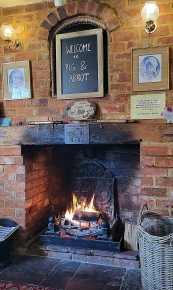
WE OFTEN VISIT the excellent Pig and Abbot pub in the tiny village of Abington Piggots in south Cambridgeshire because it has good food and a homely atmosphere. Near the pub stands the parish church of St Michael and All Angels, parts of whose structure date to the twelfth century. It contains many interesting features including a seventeenth century pulpit combined with a reading desk and a clerk’s desk. This is made from timber panelling including some carvings and is probably Flemish in origin. Fascinating as this is, there are two unusual features, which were pointed out to us by a church volunteer when we visited the church in April 2025.

The north door of the nave, which faces the entrance on the south side of the church, has two small squarish holes in it. And if you look carefully at the stone archway that marks the boundary between the nave and the chancel, you can see that a small chunk of masonry is missing. The holes in the door were most likely caused by the sharp tip of a spear or of a pikestaff. The missing chunk of masonry is most likely the result of musket shot having been fired at the archway. It is believed that the damage to the door and the archway was done in the time of Oliver Cromwell, when he had ordered the removal of decorative features from churches, Interestingly, a few panes of mediaeval stained glass remain intact high up in a window in the north wall of the nave. Clearly, Cromwell’s men missed these while they were destroying the rest of the stained glass.

The damage to the church reminded me of our recent trip to Beverley in Yorkshire when we were shown damaged caused by a bullet fired from a Luftwaffe aeroplane during WW2. (see https://adam-yamey-writes.com/2025/04/06/pierced-by-a-bullet-while-praying-in-the-pews/). Clearly nothing is sacred, not even in a church.

Graffiti of historic interest in a church in Cambridgeshire

LITLINGTON IS A SMALL village in the south of Cambridgeshire. Its parish church, St Catherine’s, dates from about 1150. Between then and the 15th century, it underwent many modifications. As in many old buildings, people have inscribed graffiti into the church’s stone walls. One stone in one of the south windows has some especially interesting graffiti.

The neatly carved inscription (in Latin), which refers to the great sailor Sir Francis Drake (c1540 – 1596) reads:

“Francis Drake, knight, about to set sail in the thirty-seventh year of the reign of the most august and serene princess Elizabeth, by the grace of God Queen of England, France and Ireland, defender of the faith. 1595. Always the same. The same always. John Sherman, April the tenth.”

The date refers to the year of Drake’s final voyage, from which he never returned (he was ‘buried’ at sea near Portobelo (now in Panama)). Drake had set out from Plymouth in September 1595 to carry out activities against the Spanish in Puerto Rico and other places in and around the Caribbean.

John Sherman lived in Litlington, as did his son-in-law, Robert Bownest, who died during Drake’s final voyage. In “A History of the County of Cambridge and the Isle of Ely: Volume 8” (published in 1982), we can read:

“John Sherman died in 1599, having transferred his manor and other purchased lands in 1597 to his eldest son William”

John’s father, William, was a wealthy landowner in Litlington. What is not clear is whether this John Sherman wrote the inscription and if he participated in in Drake’s ill-fated expedition of 1595, as did his son-in-law.

Tiny details such as the inscription I have described help to make visits to places in England really interesting, and, in a way, help to give vitality to what are otherwise simply historical events.

They say lightning never strikes the same place twice

THE ONLY PERSON I know who has been struck by lightning and lived to tell the tale was one of my fellow dental students at University College Hospital Dental School. He was a keen golfer, as many dentists are, and was hit while out on the golf course.

Years after that, I was told a joke that concerns lightning. It goes like this. The businessman and the bishop were out on the golf course. The businessman made a lousy shot, and said:

“Jesus, I missed.”

The bishop said:

“You should not take the Lord’s name in vain.”

Then, there was a rumble of thunder, and the bishop was struck dead by lightning. A voice boomed out from the heavens above:

“Oh blast, I missed.”

Now, to get to the point of this essay. A few days ago (in March 2025), we visited the wonderful gardens at Anglesey Abbey in Cambridgeshire. In it there are plenty of trees, but one of them, a redwood, is particularly interesting. All the remains of the tree is part of its tall trunk, and that is not intact: it has dramatic longitudinal splits. This is because it was struck by lightning. However, it was not struck once, but twice (in 1987 and then again in 1999). So much for the old saying: ‘lightning never strikes the same place twice’.

A hamlet with a memorable name in Cambridgeshire

ONE OF MY FAVOURITE uncles used to be highly amused by the name of a place found on maps of eastern England. The place is Six Mile Bottom. The first time I heard him mention the place was when I was about six years old. As far as I can recall, I never visited the place until today (17 March 2025). As we were passing near it, we took a small detour to see it. There is not much to see, but at least I have at last been there.

Six Mile Bottom is a hamlet in the Cambridgeshire parish of Little Wilbraham, which is not far from Cambridge. The place was so named in 1801 because it is six miles from Newmarket and rests in a ‘bottom’ (an old name for a valley).

Before the 1790s, there was only one building in the place. In 1802, a large dwelling was built close by. One of its earliest residents was Augusta Leigh, who was a half-sister of the celebrated Lord Byron. Otherwise, Six Mile Bottom cannot boast of any other noteworthy former or current residents. There was a railway station at the hamlet, which served passengers between the 1860s and 1967. The hamlet still has a single-track railway running past it and boasts of two level-crossings.

During our brief visit to Six Mile Bottom, we parked outside the only shop, the Six Mile Bottom Spar grocery store. Across the road from it, there a carved stone cross, which serves as a war memorial. This monument records the names of the 16 men from Six Mile Bottom, who died during WW1. A side road leads across one of the hamlet’s level crossings to the Church of St George, which is constructed in brick and flint. Its foundation stone was laid in 1933, and the edifice was built by 1935. Mrs Favell Helen Hall, who laid the stone, was the widow of Major Alexander Cross Hall (1869-1920), who served in both the Second Anglo-Boer War and WW1 (www.iwm.org.uk/memorials/item/memorial/82010). The Major’s father, William Henry (Bullock) Hall (1837-1904), was the first-class cricketer and military historian, who changed his surname from Bullock to Hall when he inherited two Cambridgeshire estates from his uncle General John Hall of Weston Colville and Six Mile Bottom. The major lived and died at Great Rollright in Oxfordshire. Our brief visit to Six Mile Bottom today has satisfied my curiosity about the place whose name used to amuse my uncle. I am not sure that I would bother making a detour to see this hamlet too often. Maybe, once is enough.

A cavity in a Cambridge College

DURING A RECENT visit to Cambridge, I noticed a hemispherical cavity into which an electric doorbell push button had been fitted. it was at Peterhouse College. I posted a picture of it on Facebook and received the following range of replies and reactions to it. Here they are in the order they appeared:

“My guess is there used to be a handle in there to operate a mechanical bell. There would have been a brass escutcheon plate, dished like the hole to accommodate the clenched hand grasping the handle. There seems to be a void behind the current bell button, the linkage probably went through there. You can see a shadow either side, rather like a bow tie, where the escutcheon was.”

“.. pull a cord or chain?”

“That will summon David Jason.”

“A square bell in a round hole”

“This was my husband’s college (about 45 years ago). I’m sure he’ll remember this well.”

“Yes, but I would expect the bar or chain operating the original to come straight out of the back of the cone, and there’s no hint of that.”

The range of comments was from frivolous to informative. I find that posting interesting items on Facebook often elicits useful information about them. By judicious posting and cross-checking information provided, Facebook can become a useful research tool.