IN THE 1980s, I used to make regular visits to see my friends who lived in the part of Yugoslavia, which is now the independent Republic of Bosnia. The influence of the Turkish occupation of the region for many years was very evident – from Turkish coffee to fine mosques.
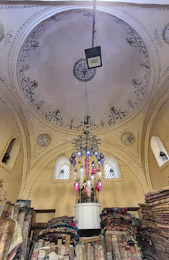
Many years before I began travelling to Bosnia, Üsküplu Gazi Yahya Paşa (died 1506) was appointed Ottoman governor of Bosnia in 1480. He also held other important positions in the empire. He married a daughter of Sultan Beyazit II. He was philanthropic. One of the many things he did for Istanbul was to build a school which stands in Kadirga, a part of Fatih district of the city. This building with two domes still stands and was recently restored by the local municipality.
The former school now houses a shop that sells traditionally designed objects – everything from earrings to large woven carpets. The walls and domes of the interior of the building have been painted so as to recreate the place’s original decor.
This building is one of a huge number wonderful relics of the Ottoman Empire, which can be found whilst strolling around Istanbul. Fortunately, many of these old buildings have informative labels attached, with information both in English and Turkish.
ONE YEAR DURING THE 1980s, I was in Belgrade, then the capital of Yugoslavia, on New Year’s Eve. I was staying with my good friend Raša Raićevič. He suggested that we should see in the new year at a friend’s flat I New Belgrade.
Before we set off from his flat in the older part of the city, Raša warned me to keep away from windows and off the terrace as the midnight hour approached. In the 1980s, many retired military people resided in New Belgrade, and quite a few of them possessed firearms. It was customary in those days to fire the guns at the moment a new year commenced. The risk was that ricocheting bullets might break windows or hit people out on their terraces and balconies. Fortunately, we survived the evening without mishaps, and spent the first few hours of the new year at another friend’s home, a long taxi ride away from New Belgrade.
Many years later, sometime after 2006, we were in Bangalore over New Year. My wife and I stayed at home with my recently widowed mother-in-law, who was too frail to attend a party. Everyone else in the family went out to celebratory parties.
The three of us, who remained at home, decided that we would sit together until midnight. However, by about 10 pm on the 31st of December, we all fell asleep. It was only when our daughter phoned us at 3 am that we realised we had slept through the transition from one year to the next.
My New Year’s Eve spent in Belgrade was a complete contrast to that which we slept through in Bangalore. This evening, we plan to have a slap-up dinner followed by drinks under the stars high above the city of Bangalore. I hope that all of you, dear readers, will have a great 2024.
OFTEN WHEN ONE IS SEARCHING for something, something, which you were not looking for, comes to light. A day or so ago, one of my old passports was discovered. It is an old-fashioned, blue-covered book with barely a trace of the wording and crest that used to be on the cover. I used to carry my passport in a trouser pocket, which rubbed against it and gradually denuded the cover. The ten-year document expired on the 19th of March 1990. This was a couple of months before I made my last trip to what was still known as ‘Yugoslavia’. Soon after that, civil wars erupted, and the country became divided into smaller independent units.
The passport gives my height but not my eye colour, which used to be recorded in earlier passports. It contains eight Hungarian visa stamps (one is illustrated above), all issued in London except for one which was affixed in Belgrade. There is also a Bulgarian visa stamp, which was issued in March 1983. In addition to these visa stamps, for which I was charged roughly $10 each, there are many border stamps – entry and exit. Most of these are for Hungary and Yugoslavia, which I visited frequently throughout the 1980s. In those days, Brits did not need a visa to enter Yugoslavia.
One of the border stamps is of special interest. It was issued when I entered Yugoslavia at Bozaj on the 5th of June 1984. Bozaj, now in the Republic of Montenegro, was a Yugoslav border post on the shore of Lake Shkodra. The stamp was placed in my passport a few minutes after leaving the Albanian border post, also beside the lake, at Han-i-Hotit. It was here that an Albanian entry stamp was put in my passport two weeks earlier when I visited the country, which was then even far more mysterious than North Korea is to us today. In 1984, the Stalinist regime headed by Enver Hoxha was still in place. The two weeks spent in Albania were both fascinating and unusual to say the least. I have described that holiday in my book “Albania on My Mind.”
In addition to the visas and stamps issued by socialist countries, there is one Greek entry and one exit stamp, both issued at Athens airport in August 1981. It seems that I was in Greece from the 11th to the 17th. Another stamp issued on the 13th by the Piraeus branch of the National Bank of Greece takes up most of one page and has something to do with money and traveller’s cheques, but my Greek is not up to translating it.
The accidental finding of this old passport brings back many happy memories of travelling in parts of Europe that have now changed beyond recognition – for better or for worse.
MANY YEARS AGO, I used to visit Yugoslavia frequently. I stayed with friends in both Sarajevo and Belgrade. During almost every stay in Belgrade, several friends and I used to travel to the town of Novi Sad to eat good Chinese food in a restaurant called Szećuan. We used to order, and consume everything on its menu. This food was washed down with copious amounts of alcohol.
After one if these boozy lunches, we began walking to the railway station and as we passed a pub called Bar London, my friend Miša said to me: “It would be surrealist if you take us for a drink in this bar”. We had one or more ‘for the road’, and then staggered towards the station.
This memory was aroused by coming across the Restaurante Londres in central Funchal (Madeira). We ate dinner there. The food was excellent. For the first time in my life, I ate limpets. These aquatic snails were grilled in their shells with butter and garlic – they tasted wonderful. The other dishes we tried were so good that we have booked there again.
Returning to the past, if I recall correctly, there was also a restaurant or bar called London in central Belgrade, but oddly I never entered it.
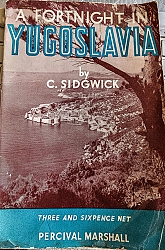
I FOUND A SHELF of rather tatty looking second-hand books for sale outside an antique shop in Great Dunmow (Essex). Each was being sold for 50 pence. Among them, I picked up a copy of a slender volume by Christopher Sidgwick with the title “A Fortnight in Yugoslavia”. Having visited the former Yugoslavia numerous times between 1973 and 1990, I was curious to see what was written about it when the guidebook was published in July 1955. This was only about 7 years after the country detached itself from Soviet Russian domination. In relation to this, the author wrote:
“Since the war ended, the Yugoslavs have I think been acting in perfect character. They are not a people … to be impressed by other people’s size. The war brought them victory on the side of Russia … and they set out with immense courage to re-form their way of living on copybook communist lines. But before long, of course, they found that the printed dogma of Marx did not turn out at all as they were led to expect: and instead of cooking the argument, as other communists have frequently done … their honest Yugoslav common sense came conveniently to hand: when Tito, in Moscow, realised that he was now to toe the line as a satellite country, to live in virtual starvation, while the country’s raw materials were sent off to Russia … he said to Stalin: ‘Rubbish! In that case, we might as well still be under the Habsburgs!’”
Under Tito’s leadership, Yugoslavia went its own distinct way. In his text, Sidgwick asked:
“Is the country a dictatorship? In the sense that it is nothing like Hitlerite Germany, nihilist at root, the answer is ‘no’. In the sense that it is a one-party country, with the state controlling the police, the radio, the press, and education, the answer must of course be ‘yes’.”
Further on, he added:
“… it is clear that broader and broader opinion, differing from the party line, is being permitted and even encouraged.”
And this was as early as 1955. By the time I began visiting Yugoslavia, liberal and alternative voices were becoming quite prevalent.
Although Sidgwick did not discourage the individual traveller, he believed that there was much to be said in favour of organised group travel. Visas were then required, and could be obtained for 11 shillings (55 p) at the Yugoslav Consular Department in Kensington (48 Phillimore Gardens). In 1955, £1 sterling would buy you about 840 Yugoslav dinars, and on entering the country, “…any note exceeding 100 dinars in value is liable to be confiscated from you, so don’t buy higher-value notes even at a good rate of exchange: it’s black money.”
Amongst things you were advised to pack in 1955 were: sunglasses; toilet soap (“cost up to 7/6 (37.5p) a tablet”); half a pound of tea; ear-plugs (“invaluable while travelling or while waiting for the dance-band to close down for the night”); pipe tobacco; an inflatable cushion; and a universal bath plug.
Regarding food in Yugoslavia, Sidgwick mentioned that pancakes were good, and:
“… they have no disgusting dishes – frog, snails, and so on – and local national dishes are always worth trying. Ražniči is veal on toothpicks. Ćevapčići is meat and little mince rissoles. Djuvec is a Serbian edition of Irish stew, highly seasoned with paprikas.”
Well, I have eaten frog in Yugoslavia and I had friends who harvested snails for gastronomic reasons. Sidgwick added:
“Meal-service is almost always slow by our standards, largely, I think because Yugoslavs themselves are in the habit of taking their time over food, enjoying it as a social occasion. In busy restaurants it is unwise to expect to get through dinner in less than ninety minutes.”
I have always eaten well in Yugoslavia, and with my many Yugoslav friends every meal was a joyous social occasion.
The guidebook dedicates most of its travel advice to Croatia and the Dalmatian coast (pages 32 to 51). The rest of the country was described between pages 51 and 62. In the short section on Serbia (pages 58 to 60), Sidgwick wrote:
“To describe Serbia in a page or two is like describing London on a cigarette card: insulting to the inhabitants”
He did it to keep the book short, and I suspect, because in the 1950s few British travellers to Yugoslavia ventured much further inland than the coastal regions.
Who was Christopher Sidgwick? He lived from 1915 until 1978. He wrote several guidebooks to places such as Germany and Greece. His “German Journey” was published in 1936 and his guide to Greece in 1974. “German Journey” was one of several books written by British writers who visited Nazi Germany to find out about Hitler’s regime and the effect it was having on the country. Unlike others, who judged the country mainly by what had been shown them in Berlin and reported favourably on the regime, Sidgwick wanted to avoid “… ‘thinking that what is seen in the capital […] is representative of that country’” (quoted from “Britain and the Weimar Republic” by Colin Storer). This is probably why he reported on a visit to Dachau’s concentration camp before WW2.
Sidgwick also wrote “Manhunt in Dalmatia”, published in 1959. Amongst his many other books, he wrote “Whirlpools on the Danube”, which was published by in 1937. This was reviewed in the journal of the Royal Institute of International Affairs by no less a historian than Carlile Aylmer Macartney (1895-1978), a specialist in the history and politics of Central Europe. I guess from this that Sidgwick must have been a significant traveller and observer in his time.
Finally, although I paid only 50 pence (in Great Dunmow) for this book about a country that exists no longer, its cheapest price on bookfinder.com is 20 times as much. My own recollections of the country and its people are published in my book “Scrabble with Slivovitz”, which is available from lulu.com, bookdepository.com, and Amazon (https://www.amazon.co.uk/Scrabble-Slivovitz-Once-upon-Yugoslavia/dp/1291457593).
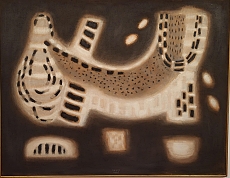
THE ESTORIC COLLECTION in London’s Highbury houses a fine permanent exhibition of modern Italian artworks, mainly creations of the so-called Futurists. In one of the galleries, I spotted the name of an artist who was born in a town, which I have visited, in the northeast of Italy: Gorizia. When the artist Anton Zoran Music (1909-2005) was born, Gorizia was part of the Austro-Hungarian empire. After WW1, the town became part of the Kingdom of Italy within the region of Venezia-Giulia. Soon after WW2, the eastern part of the region became absorbed into the Yugoslav republic of Slovenia (now an independent state). When that happened, the border between Italy and Slovenia ran through the eastern part og the town, the part in what was then Yugoslavia (a country I visited often between 1973 and 1990) became named ‘Nova Gorica’. Most of Gorizia, an attractive old town, is on the Italian side of the border.
Slovenians still live on both sides of the border. Music, actually Anton Zoran Musič (pronounced mus-ich) was born into a Slovene-speaking family. Zoran, who went to schools in Maribor, studied art at the Academy of Fine Arts in Zagreb between 1930 and 1935. His first one-man exhibition (outside Yugoslavia) in Venice in 1943, where he had moved. Soon after this, he was arrested by the German Gestapo and then sent to Dachau concentration camp. After WW2, he moved to Ljubljana (in Yugoslavia), but soon shifted to Venice, where he lived (on and off) for the rest of his life. His career after the War was successful: he received several prestigious prizes for his artistic creations.
The Estorick displays five of Music’s paintings. They were created between 1951 and 1983 and illustrate his versatility as a painter. All the paintings hanging are between abstract and figurative in style, but slightly nearer the latter than the former. I had seen his paintings on previous visits to the Estorick, but until my most recent viewing of his art, I had not been aware of how many aspects of his life mesh with things that interest me.
SPLIT IN FORMER Yugoslavia, now in Croatia, is a city that developed in the ruins of a great establishment, the Roman Diocletian’s Palace. Likewise with the city of Ely in Cambridgeshire: it developed within the remains of another great establishment, the large Abbey of Ely, which was dissolved by King Henry VIII in 1539. By 1541, after having its charter renewed by the king, its then bishop, Thomas Goodrich (1494-1554), instigated an orgy of iconoclasm, to which I will return soon.
In 1975, I visited the city of Prizren in the former Yugoslavia, now in Kosovo (Kosova). I was impressed by what I saw in one of the place’s fine mediaeval churches. The caretaker showed me that the frescos on the walls inside the building were badly damaged, but only up to a certain height above the ground, Above this, they were as intact as one could hope for paintings of that age. He explained to me that many centuries ago, the Ottoman soldiers were ordered to destroy the figurative images depicted on the walls. They used the tips of their spears to do the job, but they only destroyed what they could reach from the ground (i.e., without using ladders). Sadly, the iconoclasts working under the orders of Henry VIII and Bishop Goodrich were more diligent in their destructive activities.
Under Goodrich’s orders, first the shrines to Anglo-Saxon saints were mutilated. Then, the vandals attacked all the stained glass and many of the statues in the cathedral, before getting to work on the large Lady Chapel on the north side of the body of the church.
The spacious, airy, light-filled, Lady Chapel is at first glance a magnificent example of 14th century gothic architecture, which was created in 1321. The excellent article in Wikipedia (https://en.wikipedia.org/wiki/Ely_Cathedral) describes an important and interesting aspect of the chapel:
“Below the window line, and running round three sides of the chapel is an arcade of richly decorated ‘nodding ogees’, with Purbeck marble pillars, creating scooped out seating booths. There are three arches per bay plus a grander one for each main pillar, each with a projecting pointed arch covering a subdividing column topped by a statue of a bishop or king. Above each arch is a pair of spandrels containing carved scenes which create a cycle of 93 carved relief sculptures of the life and miracles of the Virgin Mary. The carvings and sculptures would all have been painted.”
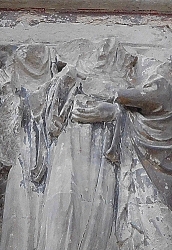
When we entered the Lady Chapel, we were in so much awe of its beauty that we did not at first notice something, which a church official soon pointed out to us. In each of the booths or alcoves lining the walls, the statues are either missing their heads or their faces have ben erased crudely. The deliberate damage to these statues was ordered by Bishop Thomas Goodrich. He also removed some of the larger statues that once adorned this fine chapel. It was seeing this destruction that reminded me of my trip to Prizren so long ago.
After looking at the Lady Chapel, we explored other parts of the cathedral, where I found other examples of statues that had lost either their faces or their heads. The iconoclasm that occurred in the so-called Reformation, which began in the 1530s, can be seen in many English churches, especially with regard to the acres of stained glass that were wantonly destroyed during that period of religious reform. Maybe, this destructive era should also be known as the ‘de-formation’. Some valuable examples of the pre-Reformation stained-glass can be seen in Ely Cathedral’s fascinating Stained-Glass Museum, which is well worth visiting. Incidentally, apart from European stained glass from across the centuries, the museum has recently acquired a fine example of stained glass from the USA, depicting a black African American.
Although I have concentrated on aspects of destruction, there is plenty of Ely Cathedral left for the visitor to enjoy, including fine gothic and pre-gothic (Norman) architecture. Many mediaeval and Tudor buildings that were once part of the abbey still exist and are now part of the daily life of modern Ely, just as some parts of Diocletian’s Palace in Split are still in use today. Some of these buildings in Ely are used by Kings School Ely, which was one of about 12 schools founded by Henry VIII. These few schools were the only part realised of a more ambitious plan to build many more schools and other new establishments.
We spent a whole day in Ely but could easily have stayed longer without being able to see all of its attractions. Prior to our departure for the city, a friend had told us that it was an unlikeable place not worth visiting. We discovered how wrong he was.
ALBANIA. BULGARIA, AND YUGOSLAVIA are countries that I visited in the 1970s and 1980s. I visited the former Yugoslavia the most and acquired a smattering of Serbo-Croat, the main language spoken in that fascinating part of the Balkans. My limited knowledge of this language helped me get by in Bulgaria. My poor Serbo-Croat seemed to be well understood in Bulgaria. During my first visit to Albania in 1984, although we were prevented from communicating with the locals, there were plenty of examples of the Albanian language in the form of propaganda posters and political slogans written with numerous pebbles on the sides of mountains.
Until 1990, my vocabulary of words from various Balkan languages was of limited use to me whilst I was practising dentistry in England, first in north Kent then, after 1994, in London.
In the mid-1990s, I began treating patients who were refugees from parts of the then violently disintegrating Yugoslavia. Many of my new patients were from Bosnia and Herzogovina. Some of them had little command of the English language and were grateful that they were being treated by someone who knew ‘where they were coming from’, as the saying goes, and who knew some words of their own language. Sadly, some of them hearing me repeating what little Serbo-Croat I knew, assumed that I was fluent. I attracted a faithful following, some of whom were charming and a small minority, the opposite, On the whole, even the most difficult of my ex-Yugoslav patients were grateful and brought me gifts, often strong home-brewed alcohol sent from Bosnia, as a mark of their gratitude. One dear lady even brought me a pair of earrings that her uncle in Sarajevo had made specially for my wife.
Some years later, I began treating Albanian-speaking refugees from Kosova, a region of the former Yugoslavia that had and still has a population, which is mainly of Albanian heritage. Many of the recent arrivals from that country, who came to my surgery for dental care, had minimal or no English. My knowledge of Albanian was extremely limited. I could greet them with ‘diten e mire’ (‘good day’) or wish them ‘mirupafshim’ (‘good bye’), when they left my surgery, but I could say little else of any practical use. However, if I said ‘rrofte partia socialiste e shqiperise’ (‘long live the Socialist Party of Albania’) or ‘lavde shoku Enver Hoxha’ (praise Comrade Enver Hoxha’), which I had learnt from propaganda posters in Albania back in 1984, this caused many of my Kosovan patients to smile.
Now that I have been retired for a few years, many of the new arrivals to this country from the troubled Balkans have settled down and contribute positively to life in the UK. Only today, whilst waiting in the street for take-away coffees, we were joined by three other customers, workmen dressed in overalls. Seeing my furry ex-Soviet Army hat, they struck up a conversation. They were all from Serbia and were delighted that I knew some words of their language, if ‘samo malo’ (‘only a little’). I decided not to show off my knowledge of Serbian swear words that my friends in Belgrade had taught me long ago, and which I shall not share with you.
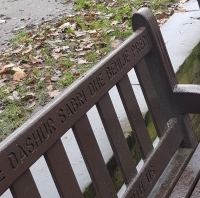
Just before reaching the café, we had been taking exercise in Holland Park. This park, like many others in London, has wooden benches, often inscribed with words to commemorate lost member(s) of a family. I was idly looking at a row of benches opposite the curious “Annunciation” sculpture, a structure consisting of horns and cogs, when I spotted one with words that are not English:
“Detikuar prinderve tane te dashur sabri dhe behije preci”
I recognised this as being in Albanian. Google translates this as:
“Dedicated to our dear parents Sabri and Behije Preci”
Until today, I had not seen a park bench with an Albanian dedication. Seeing this typically British form of memorial made me feel that members of communities that have had to flee from their war-torn homes in the Balkans are beginning to feel that Britain is now also a place they can call ‘home’, whose public amenities they are helping to cherish.
IN THE EARLY 1980s, I travelled to the island of Mljet, which is off the Dalmatian coast of what was then Yugoslavia. It was notable for at least two features. One was that most of the island was out of bounds to motorised traffic. The other was that nudism was both tolerated and encouraged.
I had been introduced to nude bathing a year or two earlier when I visited Dubrovnik with some friends from Belgrade. We used to take a ferry from the city to the nearby island of Lokrum. At the island’s ferry station there was a sign. One arrow pointed to the ‘nudismo’ beach and the other to the ‘ne nudismo’ beach. The first time we headed for the nudismo beach, I expressed concern about my modesty. One of my Yugoslav friends told me:
“Don’t worry, there’s always someone on the beach who looks worse than you.”
Surprisingly, these words reassured me.
Our party on Mljet included four people from the British Isles, including me, and three Yugoslavs. One of us Brits and the Yugoslavs were well-versed in nude bathing, but two of us ‘Brits’, including me. were relative novices.
Recently, my wife and I visited the gardens of Anglesey Abbey in Cambridgeshire. This lovely place is home to several outdoor sculptures. One of these is a naked youth carved in white stone. Someone, most probably a visitor, had placed a pair of sunglasses on the sculpture, rendering the youth no longer fully nude. Seeing this reminded me of our holiday in Mljet.
My friend from London and I joined in the nudity that was expected on Mljet, maybe a little anxiously at first but we soon got to enjoy it. After a few days on the island, one of my Yugoslav friends pointed out that unlike the rest of our party, neither of us ‘novices’ were ever completely nude. Either we wore only a sun hat, or a wristwatch, or even just a pair of sunglasses like the statue at Anglesey Abbey.
It is odd what can trigger far-off memories. That statue with the sunglasses did manage to remind me of the wonderful times I spent in Yugoslavia, a country that no longer exists.
I WISH THAT I had taken a photograph of it when I was visiting Tirana, the capital of Albania, in 1984, the last year of the life of its long term dictator and admirer of Josef Stalin, Enver Hoxha (1908-1965). I managed to get at least one photograph of a statue of Stalin in Albania, the only European country that still displayed monuments to this by then mostly discredited Soviet dictator. However, in May 1984, I failed to take a picture of something I have never seen outside Albania or in Albania when I revisited it in 2016. What I failed to record on film was the sight of men walking along the streets with heads of flowers whose stems they were holding between their teeth. Their lips were hidden behind the blooms. I mentioned seeing this to several people who have visited Albania, and none recall seeing flowers being carried that way. So, I was beginning to wonder whether my memory was playing tricks as time passed.
A few days ago, I was browsing the bookshelves in an Oxfam charity shop when I noticed a travelogue that contained a few pages about the author’s experience of Albania, which he visited several decades before my first encounter with the country. I was thrilled and relieved that my memory had not failed me when I read the following words he wrote:
“The inhabitants of Tirana love music and flowers. You can see men going around with roses in their mouths. They seem to use them as an extra buttonhole.”
These words, translated from German, were published in the “Frankfurter Zeitung”, a German newspaper, on the 29th of June 1927. They were written by its journalist, the Austrian novelist Moses Joseph Roth (1894-1939), better known as ‘Joseph Roth’. The book in which I found his articles on Albania is “The Hotel Years”, edited and translated by Michael Hoffmann and published in 2015. The anthology of Roth’s writings covers countries, to mention a few of them, including Austria, Hungary the USSR, Germany, Yugoslavia, and Albania.
Roth visited Albania in 1927 and published six articles about it between May and July that year. He mentioned the love of music in Tirana. This observation relates to both the mandolins played mainly by Albanians who had unaccountably, in his opinion, returned to their country after having lived abroad, mainly in the USA, and to military bands. During his sojourn in the capital, he notes the seemingly endless army exercises and parades that are carried out throughout the day.
By Cora Gordon, 1927
With regard to the Albanian army, it was his impression that they were poorly equipped:
“Now the army has Austrian rifles and Italian ammunition, bullets that jam, magazines that can’t be clicked in, British knapsacks that can’t be secured with Italian straps, covers for field-shovels and no field-shovels with which to dig trenches, Italian officers who don’t know commands in Albanian, …”
And, he asks:
“For whom do they exercise? Surely not for their country? Because half the country is unhappy with their government – for reasons of idealism.”
Reading this, made me wonder why Roth was sending reports from Albania between the end of May and the end of July in 1927. Near the end of his largely unflattering description of the country and its people, he wrote:
“Albania is beautiful, unhappy, and for all its current topicality, boring.”
Although Albania is anything but boring for me, I was curious about its “current topicality” during those months in 1927. Roth’s readers probably knew, but that was long ago.
I looked at various issues of the “Times” newspaper of London and other sources to discover what might have interested the world’s press in Albania at the time that Roth wrote his articles. On Monday, the 6th of June, the Times noted that diplomatic relations between Albania and its neighbour Yugoslavia had broken down. On the 27th of May, Mr Juraskovitch, an interpreter at the Yugoslav legation in Tirana, was arrested and his house was burnt down (www.jstor.org/stable/25638310?seq=1). Naturally, the Yugoslav government objected. On the 31st, Tzena Beg, an Albanian representative in Belgrade, explained to the Yugoslavs that Juraskovitch was an Albanian citizen and that compromising documents had been found in his possession. Mr Sakovitch, the Yugoslav chargé d’affaires, disclaimed all knowledge of this and demanded the release of Juraskovitch. Hussein Beg Vrioni, the Albanian Minister for Foreign Affairs, said that his case was purely an internal matter. On the 4th of June, the Yugoslav legation was withdrawn from Tirana. The following day, the Albanian government declared that it was taking the case to the League of Nations.
On the 5th of June, the “Times” noted that many Albanians feared that this diplomatic incident would create anxiety and unrest in the country, and many felt that the flames were being fanned by a third party with a great interest in Albania, Italy. According to “The Annual Register, Vol. 169- for 1927” Italy had:
“…sent to Berlin, Paris, and London a Note calling attention to alleged preparations on the part of Yugoslavia for an immediate invasion of Albanian territory. The crisis had arisen as the result of the arrest by the Albanian police of a certain Jurascovich, charged with espionage on behalf of the Yugoslav Government. Refusal to release the alleged spy led to the withdrawal of the Yugoslav Minister from Tirana, and to the Italian Note. The matter was, however, satisfactorily settled between Italy and Yugoslavia.”
Eventually in November 1927 after much Italian antagonism to the French and their cordial relations with Yugoslavia:
“ … the Italian Government published the text of an Italo -Albanian Treaty of defensive alliance.”
This was not the first attempt to forge an alliance between Italy and Albania as is illustrated from the following quote from “The Annual Register”:
“Relations with Italy and Albania were disturbed at the end of 1926 by the first Tirana Treaty and became more strained in March, 1927, when the Italian Government addressed a Note to the Great Powers (Germany, Great Britain, and France) accusing Yugoslavia of military preparations against Albania.”
Thus, Albania was being dragged gradually into the strong influence that Italy held on it until the Second World War had begun.
Roth travelled to Albania around about, or just after the Juraskovitch affair had begun. This might have been one reason for his visit. Another thing that might have attracted his attention, which was reported in the “Times” of the 10th of June 1927, was the growing unrest of many Albanians, particularly in the north, resulting from dissatisfaction with the government of Ahmed Zogu. However, by mid-July, a couple of weeks before Roth’s last article about Albania, the two countries, Albania and Yugoslavia, had come to a more or less satisfactory settlement of the Juraskovitch affair.
My surmise is that Roth came to Albania not out of curiosity but in connection with the diplomatic incident and the strained relationship between Albania and its Slav neighbour. My impression is that the urbane Roth cared little for what he observed during his time in Albania. His description of his arrival sets the tone for much that appears in the anthology of his Albanian travel writings:
“ … the hut, like so many attractions these days, has a guest book; sitting over the book is a man in a black uniform, rolling himself a cigarette, and this is the Albanian border police. A master of the alphabet, but unused to writing, he sits there whiling away the time of new arrivals by painstaking scrutiny of their passports … I cut short his study by offering to set down my name for him … Workmen are repairing the road. There are always two hunched over together … they collect little scoops of sand on their tiny shovels or in their bare hands, pour it into scars and potholes, sprinkle a few stones on top … and stamp it down with their bare feet …”
Roth also remarks on the telegraph wires linking Durres with Tirana. They were:
“… strung not on masts, but on crooked trees, which have been lopped and cropped. They used to stand by the wayside, a home to birds … now they are redesignated as telegraph poles … equipped to transmit journalistic reports – the twitterings of political sparrows – to Europe…”
Whereas Roth’s descriptions of Albania in 1927 are hardly flattering to the country, some other travellers, who visited it that year, published a far more flattering account in the same year. The travellers were Jan Gordon (1882-1944) and Cora C Gordon (née Turner;1879-1950), who wrote and illustrated a book called “Two Vagabonds in Albania”. It is amongst the best books I have read about the country. Unlike the critical and disapproving Roth, they take a delight in what they observed and convey that beautifully in their text and the illustrations they created.
Roth would be amazed by the changes that have occurred in Albania since his visit in 1927. I was also staggered by the changes I saw between my first visit in 1984, when I saw men with flowers in their mouths and motorised vehicles were few and far between, and 2016 when Tirana had become a modern city with traffic congestion and tall buildings to rival those found in any of the world’s large cities.






 yamey
yamey 