Unknown's avatar

About yamey

Active author and retired dentist. You can discover my books by visiting my website www.adamyamey.co.uk .

No refusal

TAXI NO RESUSAL[2493]


UBER DRIVERS IN MADRAS are, so I have been told, unaware of a customer’s desired destination when they accept a job. It might be a short ride or even an out of town destination. We discovered a consequence of this earlier this year when we were advised that the most reasonable way to make the three-hour journey from Madras to Pondicherry was to hire an Uber cab.

The first three drivers, who offered us rides, phoned us to ask where we wanted to go. When we told them, they cancelled our rides. On our fourth attempt, an Uber arrived. He was happy to drive us to Pondicherry because, as we found out three hours later, he had a friend he wanted to visit there.

In Bombay, the taxis are nicknamed ‘kali pili’, which refers to their black and yellow body paint colours. Most of the cabbies are argumentative and some of them seem reluctant to work, making complaints like “too much traffic” or “that’s too far”. Eventually, one finds a cab that is willing to carry out one’s wishes, often complaining all the way. Maybe, that is because their metered fares are so reasonable for the passenger. Driving in Bombay’s traffic cannot be too much fun, especially if one is getting paid poorly to do so.

Further south in Bangalore, popular transport for those who prefer to avoid using urban buses include Uber and Ola cabs as well as three-wheeled autorickshaws.

Bangalore’s Ubers and Olas are unreliable.  Often, they accept a ride and minutes before they are about to arrive at the pickup point, they cancel. I imagine that often they get stuck in the city’s slow moving or often static congested traffic and feel they are wasting their time trying to reach their passenger waiting beyond the traffic jam. Whatever the reason, these app-linked car services are not nearly as reliable as they are in Bombay or London.

Autorickshaws (‘tuk tuks’) are the best method for getting through the congested thoroughfares of Bangalore.  Their plucky drivers can take risks with their small vehicles that larger cars are unable to attempt. These manoeuvres are daring and can be hair-raising for the passengers, but they get you to your destination relatively quickly. I love the drivers’ sneaky tactics, but others do not. Once, I was travelling in an autorickshaw with two American ladies on a busy main road in the centre of Bangalore. They shrieked with terror as our vehicle sped adventurously between a bus and a heavy lorry that were rapidly moving close together.

One autorickshaw driver, whose command of English was good, told me that he had been a truck driver before driving the three-wheelers to earn his living. He explained that an autorickshaw driver needs to use all of his six senses and to ‘feel the traffic’ with his body. It is my observation that most drivers of these small fragile vehicles have lightning reflexes and nerves of steel. Yet, as they weave effortlessly and excitingly through the traffic, many of them chatter away on their mobile ‘phones.

Hiring an autorickshaw in Bangalore is always an adventure. The vehicles are fitted with taximeters, which are supposed to determine the fair. They are used occasionally but not often. The driver will start by suggesingt an often outrageous fare, which is the starting point for haggling.  Or, some drivers will agree to use the meter determined fare plus some extra Rupees in addition.

Some autorickshaw drivers without much to do will offer foreigners something like:

“Come with me. I’ll take you anywhere for only 10 Rupees.”

Sounds tempting, does it not? Do not succumb to this unbelievable offer because if you do, you will soon discover the catch. The naive passenger will be invited to visit the driver’s friend’s/cousin’s/brother’s  store, where if you buy something, the driver will be rewarded with something like: school books for his children, or a kilo of rice for his starving family, or a new shirt, etc.

Some autorickshaw drivers will set off for a journey in Bangalore, and then after a few minutes, will ask the passenger whether, on the way, they want to do some shopping at a shop the driver recommends. That is, at a shop that will offer the cabbie a commission or a gift when the passenger makes a purchase. A determined refusal is required to ensure that your journey will not include an unwanted, time-wasting detour for shopping.

On the whole, autorickshaws are a great way of getting around Bangalore.

Calcutta is filled with rugged but battered yellow Ambassador taxis. These are slowly being replaced by newer vehicles with blue and white body paint. One thing they share is the wording “No Refusal” painted on the exterior of their doors. The cab driver, who stops to pick up a passenger, is not supposed to refuse to take you wherever you want. Most of the drivers comply with this.

Black Cab taxi drivers in London and other places in the UK are, by law, required to take you anywhere within the area they can legally operate. Like the drivers in Calcutta, the British cabbie is supposed to adhere to the “No Refusal” concept, and often, but by no means always, cabbies comply.

Interesting as all this is, present conditions during the current pandemic mean that not too many cabs are being hailed at the present in London. While the ‘lockdown’ is in force, even in its present slightly diluted form, I feel sorry when I see an empty Black Cab with its ‘For Hire’ sign illuminated cruising the almost empty streets in the hope of finding a customer.

Defeated by snow and meeting Churchill’s widow

WHEN I WAS SIXTEEN, that was in 1968, I made two memorable trips. The first was a youth hostelling trip in Wales and the other, which followed soon after that, was my first visit to Paris.

PARIS Clouds over the Beacons_800 BLOG

Three good friends of my age and I travelled by train to Chepstow in South Wales. Our plan was to walk from one youth hostel to the next, carrying our baggage in rucksacks.

 From Newport, we struggled along footpaths by the east bank of the River Wye until we reached the village of St Briavels. The youth hostel was housed in parts of the place’s mediaeval castle, whose construction began in the early 12th century.

We were assigned beds in a dormitory. At night I struggled to make myself comfortable in the shroud-like sheet sleeping bag that was required by guests staying in British youth hostels. In those days, I used to find it difficult falling asleep in places away from home. St Briavels was no exception. In the middle of the night I felt the urge to go to the loo, but because I was anxious about walking across the dark castle courtyard to the hostel’s only toilets, I remained becoming increasingly uncomfortable until day broke.

The eight mile hike from Newport to St Briavels had been a hard, tiring ‘slog’. We were not looking forward to doing something similar the next day. We walked a few miles until we reached a main road, and then boarded a local bus. At this point, dear readers, you need to know that in 1968 youth  hostels were only supposed to be used only by travellers making their way under ‘their own steam’ (i.e by walking, cycling, canoeing, horse-riding etc.), but not by motorised transport.

We reached the small town of Crickhowell and walked from there towards an isolated youth hostel on the edge of the Brecon Beacons mountain range. The Nantllanerch youth hostel, which only functioned between 1966 and 1969, was about a mile from the house where its warden lived. We were the only people staying in this un-manned hostel miles away from anywhere. It had no electricity and the chemical toilets were attached to septic tanks. Lighting was via gas lamps fuelled from a cylinder. This delightful place was also supplied with an out-of-tune upright piano. We stayed there for two nights, using the day between them to climb one of the nearby peaks. I had never climbed a mountain or a significant hill before. Every time I saw what I hoped was the summit, it proved to be a ridge behind which there was another gruelling climb. After that experience, I decided that Everest was not for me. However, a few years later, I did climb, or rather scramble up, Mount Ventoux in the south of France.

We left Nantllanerch and used public transport to reach Brecon, where we spent another night in a youth hostel. Then, again disobeying the rules, we travelled a long way using public transport to Great Malvern, where we spent another two nights. On the day between them, we completed a lovely walk along the ridges connecting the peaks of the Malvern Hills. I fell in love with Great Malvern and have revisited this mainly Victorian resort often.

Every time one left a youth hostel, the warden was required to stamp our Youth Hostel Association booklets with the hostel’s official stamp. On leaving Great Malvern, we notice that the warden had placed the hostel’s stamp upside down in each of our booklets. We wondered why. Long after we had returned to London from Great Malvern, we discovered the reason. An upside-down stamp was to warn the wardens of other youth hostels that the bearer of this stamp had caused trouble or breached a rule. The warden at Great Malvern must have realised that our itinerary as recorded by the hostels in which we had stayed could not have been undertaken without making use of motorised transport along the way.

I loved my first youth-hostelling trip and felt sure that my first trip to Paris, which followed it, would be an anti-climax. But I was wrong. I  travelled with my family to Paris on the Night Ferry train, which was boarded in the evening at Victoria station in London. There were two platforms at the station dedicated to the Night Ferry trains. To enter them, one needed not only tickets but also passports. Our family occupied two neighbouring compartments. My sister and I shared one of these. It was equipped with two berths, one above the other, and a basin with water taps.

The Night Ferry travelled to Dover, where the sleeping cars, such as we occupied, ran along rails into those in the hold of a cross-channel ferry. We all remained in our compartments. After a while, our carriages were pulled out of the ferry and onto the rails at the French port of Dunkirk. I could not sleep a wink. I stared through the glass of the window of our compartment throughout the night. There was not much to see during the sea crossing, but things improved at Dunkirk, where our carriage was shunted around a huge floodlit marshalling yard for what seemed like several hours. As dawn broke, we set off through France towards Paris.

Paris was a wonder, an ‘eye-opener’ for me. I loved everything about it, especially the metro with its curious pervasive characteristic smell and some of its trains that whooshed along on rubber tyres instead of metal wheels. In those far off days, the entrances to station platforms were provided with doors, ‘portillons’, which closed automatically just before a train left the station. These were supposed to prevent passengers from rushing to board the train just before its doors closed. Once, I got caught behind a closed portillon just after my parents and sister had passed through on to the platform. For a moment, I felt panicked, but the family waited for me to be liberated. Above ground, some of the metro stations were decorated with art-nouveau metal work. I loved this because I was already very keen on this artistic style.

We stayed in a small hotel on the Ile St Louis, a peaceful oasis separated from the rest of Paris by the River Seine. It was the nicest place I have stayed in the city. On my first visit, I loved the bookshops on Place St Michel and the well-stocked record shops nearby. We did a great deal of sight-seeing including a visit to the Louvre. What I remember most about this world-famous collection was rather mundane. We had left our coats at a garde-robe near one of the entrances. By the time we had paid our respects to the Mona Lisa and many other great works of art, we had forgotten where we had left our belongings. We spent longer looking for our coats than we had done admiring artworks.

My parents, who were not keen on visiting places that were neither churches nor museums, did take us up the Eiffel Tower, but only to its lowest viewing platform. What impressed me there were the lifts that climbed at an angle rather than vertically. My first visit to Paris was followed by many more, always enjoyable and always eliciting in me the same sense of wonder as my first.

We returned to London on the Night Ferry, arriving at Victoria in the morning. After we had stepped down onto the platform, my mother pointed to a lady disembarking from the next carriage to ours and said to us excitedly:

“Look, there’s Lady Churchill.”

It was Winston’s widow. I had been at the Hall School in Belsize Park when in early 1965, my class gathered around a small black and white TV to watch Winston’s funeral, ‘live’, as it happened.

The next year, following the success of our first hostelling trip in Wales and nearby, my three friends and I decided to go back to Wales on another hostelling trip. The first hostel on our itinerary was at Capel-y-Ffyn in the Brecon Beacons National Park, just north of the ruins of Llanthony Abbey. We booked in and woke up the next morning to discover that the ground was covered with a thin layer of snow. Then, fate struck.

 I had promised to telephone my over-anxious mother every day. So, I went to the village telephone box and rang her. She told me that she had heard that there was snow falling in Wales. I told her how little we had seen. She replied that we were to return to London immediately. I do not know what she was imagining. She might have thought that snow in Wales was likely to be as dangerous as blizzards in the Arctic.

My friends and I knew that my mother’s orders were never to be questioned. It was with great sadness that we packed up (while the snow was melting) and returned to London. My mother’s over-anxiety had wrecked our adventure.

Years later, my wife and I were entertaining the mother of one of my friends on the sabotaged trip. Then in her late eighties, she could still remember being amazed at the time when she heard how my mother had reacted to the news of snow falling in Wales.

To my great relief, my three disappointed friends remained friendly with me despite my vicarious role in greatly abbreviating what promised to be a great trip. Sadly, of the three one died a few years ago. A spot of snow never put him off risking his life more excitingly during his colourful career. Nor, did it deter the rest of us from doing many things that would have given my late mother cause for great anxiety.


Photo showing clouds over the Brecon Beacons in south Wales

Fading with time

SINCE THE IMPOSITION OF ‘LOCKDOWN’ in the UK, use of public transport has been discouraged, as has wandering too far from home when taking exercise. While not exactly ‘confined to barracks’, the distance that we have been allowed to move away from home has been limited, more or less to the amount of distance that we can manage to walk (or, not in my case, cycle) comfortably, without exhausting ourselves. This meant that for many weeks we have been walking around our local area. A friend of ours in Dublin told us, half-jokingly, that during the Irish lockdown, he felt that he had got to know every blade of grass in his neighbourhood. I understood what he was saying.  For me, greater familiarity with our immediate locality has not bred contempt for it, but the opposite. We have been walking along small streets we never knew existed and discovering interesting details in those thoroughfares that we thought we knew so well.

HORNTON 2 BLOG

I have been walking along Sheffield Terrace, which leads off Kensington Church Street, two or three times a week for the last 25 years, yet it was only yesterday that I noticed a small square metal plate on the wall of a house in that thoroughfare. It recorded the fact that the author GK Chesterton was born in that house on the 29th of May 1874. A few doors away on the same street, there is a much larger and far more obvious plaque commemorating that the founder of the Church Army, Prebendary Wilson Carlile (1847-1942) had lived there. I had often noticed this memorial, but I had never noticed the far more discreet memorial to Chesterton, which looks like a simple grey wall tile from a distance.

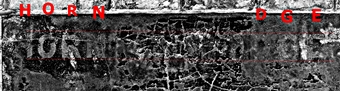
Sheffield Terrace leads to the northern end of Hornton Street, which is marked on 19th century Ordnance Survey maps as ‘Campden House Road’.  Hornton Street leads south and downhill towards High Street Kensington. Once again, this is a street along which I have walked several times a week over a period of at least 25 years. Various roads lead off Hornton Street. The short Pitt Street is one of these. On the corner of Pitt and Hornton Streets, there is a faded rectangular sign that I have always assumed carried the words ‘Hornton Street’. However, I had not looked at it closely enough until yesterday.

I do not know what made me examine the faded sign closely, but I am glad that I did. Some of the letters on it have disappeared. The following are just about visible, and even more so on enhanced digital photographs: H, O, R, N, …, D, G, E. The last three letters are not ‘E, E, T’, which you would expect to see if the sign had read ‘Hornton Street’. I wondered if the sign had originally read ‘Hornton Lodge’. I went home and searched for ‘“Hornton Lodge” Kensington’ on Google.

One of the most useful things that came up amongst the Google search results was an offer on eBay for two pages of the issue of “Country Life” magazine, dated 21st of March 1968. These pages contain an article about Hornton Lodge on Pitt Street. The article bore the title “Serene Vision of a Modern Interior”. It describes the interior of a house built in 1948 on a bomb site and owned by Mr and Mrs James Melvin. The house, a long rectangular building, was called Hornton Lodge. The fading sign is all that remains of the house described in the magazine. Currently, builders are erecting a new building on the part of the plot nearest to the corner where the sign can be found. This new construction is, according to a planning application submitted in December 2019 by Nash Baker Architects, to replace an:

“… early post war semi-detached property … constructed circa 1948-49, on the site of a former villa known as ‘Hornton Lodge’. The architect/owner, James Melvin, was a partner in major architectural firm: Gollins Melvin Ward Partnership. However, at the time it was constructed, the firm was in its infancy, and this project was a modest family home for a young architect and his family; designed with modernist intentions during a time of austerity.”

I found references to a ‘Red House’, also referred to in at least one item, maybe erroneously, as ‘Hornton Lodge’.  The Red House was built by Stephen Bird in 1835. It was also known as ‘Hornton Villa’. This was not the property on Pitt Street demolished by a bomb in WW2 because it stood across Hornton Street opposite the western end of Holland Street, which is south of Pitt Street. A future president of the USA, Herbert Hoover, lived at that address between 1907 and 1918. Hornton Villa, The Red House, was demolished in in the 1970s, and on its site stands the architecturally undistinguished Customer Service Centre of the Royal Borough of Kensington and Chelsea.

There is more evidence of a Hornton Lodge, quite distinct from the Hornton Villa, mentioned above. Joseph Foster’s “Men-at-the-bar : a biographical hand-list of the members of the various Inns of Court, including Her Majesty’s judges, etc.” (published in 1885) published the address of a barrister Richard E Webster (1842-1915; called to the Bar in 1868), Lord Alverstone, as “Hornton Lodge, Pitt Street, Kensington W”. He became Attorney General between 1885 and 1886.  Even earlier than that, “Allens West London Street Directory” (published in 1868) lists a Theodore Aston as living at Hornton Lodge.

Close examination of a sign that I have passed and seen many thousands of times, assuming it bore a simple faded street name, has revealed that I had never looked at it carefully enough before. The constriction of my field of activities to a small part of London has, to my surprise, heightened my powers of observation rather than blunted them, which could have easily happened when visiting the same locality repetitively.

Soon, the faded sign on the corner of Pitt Street will either be removed or become even more illegible. I am glad I noticed its clue to the past before either of those things happen.


My sporting life

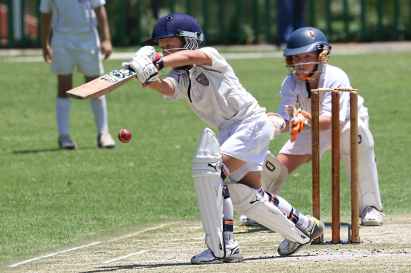
THE ONLY SPORTS PRIZE I have ever won was at a sports day held by my primary school in Golders Green sometime before 1960. I was in a relay race. Our team members were awarded a green badge. I have no idea whether we were first or just in one of the three fastest teams. Since that glorious day, my sporting ‘achievements’ have been anything but glorious.


boys in white shirt and white pants playing baseball


Once, while playing football at the Hall School, which I attended from 1960 to ’65, I did manage to score a goal. The ball was coming my way, I put out my foot, and the ball bounced off it, into a poorly guarded goal. The only problem was that I had scored an own goal. My fellow team-mates were not amused.

I entered my senior school, Highgate School, in 1965, four hundred years after its establishment by Sir Roger de Cholmeley in the final months of his life. On the second day of my first term, I had to take part in a game of football watched by senior boys and teachers, who wanted to assess the playing skills of the boys new to the school. It was a very rough experience. The other players struck me as being very aggressive.  Twenty-four hours later, two senior boys, both much taller than me and dressed in the black blazers that only prefect wore, approached me. Very apologetically, they informed me that I was not good enough to play in our house football teams. They asked me to choose another sport instead of football. The choices included Eton Fives, which I had never come across before, and cross-country running. I chose the latter because I had heard of running.

It turned out that I had made a good choice. On most sports afternoons (Wednesdays and Saturdays), cross-country running was unsupervised. I used to change into my school running gear and wander over to the school tuck shop (a confectionery store) to buy some sweets. Then, I used to cross Hampstead Lane and enter the grounds of Kenwood, where we were supposed to run. After a respectably long enough leisurely ramble through the park, eating my sweets and maybe talking with someone else who was ‘going for a run’, I returned to the changing room, and got ready to go home. Showering was unnecessary because I never worked up a sweat nor roamed through muddy parts of the park.

Once a year, our housemaster (pastoral carer), Mr Bowles, took his boys for a run. This was a more strenuous event than my usual outings. We followed him off the paths and into the wilder parts of the park. Once, he stopped and turned to me, saying:

“Yamey, how is it that there is no mud on you?”

I replied:

“Mr Bowles, I don’t know. Anyway, I thought that the point of this was to get exercise, not to get muddy.”

He took this surprisingly well. Although he was the only teacher in the school not to have a degree from Oxford or Cambridge, he had more common sense that the rest of the staff put together.

Summer terms gave rise to another problem: cricket. This sport terrified me. I was constantly worried that I would be hit and badly injured by a hard cricket ball flying at speed. Also, I was useless at catching balls, hard or soft. So, when the school began recruiting pupils to be umpires, I volunteered. For a few days, I attended umpiring classes. Each of the new umpires was given a small pocket-sized blue covered book of the rules of cricket. None of it made any sense to me, but one thing stuck firmly in my mind: the umpire’s decision is final.

Fully ‘qualified’, I began my umpiring career. One of the umpire’s duties is to count the number of balls that have elapsed in each over of six balls. I had been advised that a good method of doing this was to place six coins in one hand and then after each ball ahs been bowled, to transfer a coin from one hand to the other. The only problem was that often during an over I forgot in which direction the coins should have been passed. Was it from left to right or vice-versa? Usually, the scorers pointed out when I had miscounted.   Often, the players questioned my decisions. My response was to withdraw the rule book slowly from my pocket and ask the petulant players:

“Have you read the very latest rules?”

This usually worked. On one occasion, the bowling team shouted “howzat” jubilantly. Without any idea why they did that, I declared that the batsman was ‘out’. This caused an uproar, but I knew that the umpire’s decision is always final, and I stuck to it.  Many of my decisions, I must now confess, were based on trying to get the game finished so that I could go home early enough. Had I been more scrupulous and better informed and more interested in cricket, the games that I umpired would have stretched on well after 5pm, which would have messed up my daily routine. At this point, it is only fair that I offer my apologies to anyone who felt aggrieved as a result of my umpiring activities.

Mr Bowles realised that sports was unlikely to do me any good at all. In the last two years of school, he allowed me to visit exhibitions in central London instead of getting in everyone’s way on the playing fields of Highgate. For example, during this period, I visited the exhibition about the Bauhaus three times at the Royal Academy.

When I was about 13 years old, an uncle, who was a keen bodybuilder, gave me a set of weights and a metal bar on to which these heavy metal discs fitted. It was a kind, well-meaning gesture. However, it was not a gift that appealed to me. It lay idle in my bedroom until a friend, who was keen on rowing, asked to borrow them. I lent them to him and was not perturbed that they were never returned.

At University College London, there was no requirement for me to do any kind of sport. So, I did not. While I was doing my PhD, I became good friends with my supervisor Robert and his wife Margaret. For thirty years after finishing my doctorate, I used to visit them at their home near Slough. They had a tennis court in their extensive grounds. Margaret was a fine tennis player, usually winning the finals of the tennis tournament played at the annual Physiology Department sports day held at Shenfield in Hertfordshire.

Whenever I visited Robert and Margaret, I was ‘roped in’ to playing doubles with Robert and Margaret and one other, usually their Irish son-in-law. I was reasonably good at serving and returning, but only if the ball flew towards where I happened to be standing. Margaret told me that I might have become quite a good player if I had bothered to run around the court when I saw where the ball was heading.

One weekend afternoon in early May 1984, while I was on the court with Margaret and Robert, I felt something slip inside one of my knees. As we walked back to the house for afternoon tea, I felt that I could not straighten my leg properly. I did not mention this to anyone for a good reason. It happened a few days before I was about to fly to Yugoslavia to begin a two-week tour of neighbouring Albania. I had been wanting to visit Albania for many years, ever since I was about 15 years old. I did not want to risk seeking medical advice just in case I was told not to travel. I decided that whatever the condition of my leg, I would travel to Albania. I believed that should my leg continue to trouble me, I could seek medical help in the country that had intrigued me for years.

After arriving in Albania and a few alcoholic drinks at various meals, my leg ceased to trouble me. One member of our group fell ill when we were visiting a hunting lodge in rural Albania. This lodge near Lezhë had been built in the 1930s for Count Ciano, Mussolini’s son-in-law. As if by magic, when the lady on our tour began feeling poorly, a doctor and two nurses dressed in white uniforms suddenly appeared to assist her. I imagine that our tour bus was followed closely by a medical team.

I mentioned the story of my leg because, contrary to all I have been told, I have noticed that sporting activities are not entirely beneficial. During the 35 years that I practised dentistry, I had several patients a week, who entered my surgery limping. Almost all of them had injured their knees or other body parts while attempting to ‘keep fit’.

Now, I do not want you to think that I am a slovenly ‘couch potato’, whose main form of exercise is breathing. I climb up and down the 50 steps leading to our flat and walk two to three miles a day on average. I walk mainly for enjoyment. If walking helps to keep me fit, that is a bonus.

So now, patient reader, you have been apprised of the secrets of my sporting life.

PS: you will be amused to learn that for a long time I thought that a ‘six-pack’ was a package of six cans of beer or lager. Now that I am better informed, I have looked in the mirror but fail to see any sign of my six pack; it remains hidden.

Photo by Patrick Case on Pexels.com

Time flies

I DO NOT KNOW ABOUT YOU, but I am finding that time hurtles past during the so-called ‘lockdown’, which severely limits our movements and activities to our local environments. Although I needed little stimulus to do so because I find it enjoyable, it has made me look back into my past more than ever before. This morning (19th of May 2020) on BBC Radio 4, the author Ian McEwan spoke eloquently and with great insight about the perception of time and how it changes during a period of forced inactivity such as long-term prison sentences and our present virus-induced predicament. I was heartened to learn that he and I agree about the effects of ‘lockdown’ on the perception of time’s passage. Having got that ‘off my chest’, I will return to yet more nostalgia. I am going to write about my recollections some of the first ever holidays I enjoyed. These happened when I was well under ten years old. So, my memories may be a little hazy and, also, influenced by what I remember being told about these trips when I was a bit older.


Hermanus_1024 BLOG


In 1955, when I was three years old, my parents took me to South Africa. We travelled by sea. During the voyage, we crossed the Equator. I have seen photographs taken on board of me dressed in a sheet. When we crossed the Equator, so I was told by my mother, the children on board took part in a fancy-dress party. Unprepared for this, but always resourceful, my mother used a sheet from our cabin to dress me up as a Roman in a toga. Sadly, these photographs have been lost.

On arrival in Cape Town, I faintly recall something that I did on the dockside. There were tracks like tram lines embedded in the ground, along which huge cranes moved. I inserted my tiny foot into the groove of one of these, and then could not remove it. I imagine that my mother, who was excessively anxious about my well-being when I was very young because my birth had been fraught with difficulties, must have been very concerned that her precious child (that is me, folks) would be crushed by a crane on the move. My foot was extracted and with no long-term effects.  

Two other recollections of the trip to South Africa relate to our stay in Port Elizabeth, where my father’s mother and sister lived. One faint memory is my concern about the sinister look of the cacti on display in a greenhouse in a park. Another relates to being offered and rejecting smoked salmon – I was an unadventurous eater until my late teens.  

I cannot remember visiting King Williams Town (‘King’) in the Eastern Cape in 1955, but about 60 years later I discovered that we did. Several years ago, I was researching at the British Library, leafing through old issues of the “Cape Mercury”, a newspaper published in King. In one of the issues published in 1955, I discovered an article describing our visit to King. The reason we went there was to visit my great grandmother Hedwig Ginsberg, my mother’s grandmother. As she was the widow of a Senator and herself a prominent citizen of King, her social life and that of her son Rudolph, a Mayor of King, was recorded in the paper’s gossip columns. Our visit to King was described. I quote from what I discovered:

Mrs Yamey … whom many of you will have met in her single days. They now have an adorable little son, Adam, aged three.”

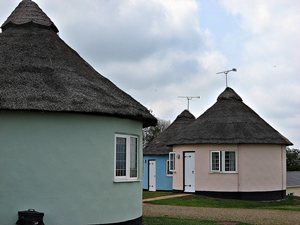
Another trip that I recall vaguely was less exotic. It was to Winterton-on-Sea in Norfolk (UK). I was taken there by my uncle and aunt and their then young daughter. I recall staying in a round hut. Although I did not know it then, the round hut was based on the design of the South African rondavel, a circular hut with a conical roof. Many years later, I re-visited Winterton-on-Sea. The resort colony of rondavel-like dwellings was still being used by holidaymakers. The place, set amongst sloping sandy dunes, had originally been set up by people from South Africa, but had long since changed hands.

My parents were not keen on seaside holidays. However, I can remember two that we made when I was very young. In each case we travelled with friends, who lived in Kent. Arthur Seldon was one of my father’s first friends and collaborators when he came to London from South Africa in the late 1930s. His wife Marjory, who was born on the very same day as my mother, was one of my mother’s closest friends. The Seldons had three sons, one of whom has become quite prominent in public life.

One year, we accompanied the Seldons to the North Sea beach resort, Noordwijk in the Netherlands. This must have been in the second half of the 1950s, just over a decade since the end of WW2. I remember that we kept moving our beach blanket from one patch of sand to another. This was done whenever my mother heard neighbouring holidaymakers speaking in German. During WW2, my mother had worked for the Red Cross in Cape Town. As the war drew to a close, she read Red Cross reports of the atrocities being uncovered in recently defeated Germany. I suppose she thought that there was a good possibility that any adult speaking German in the late 1950s might well have once been at the very least a Nazi sympathiser.

One day when walking back from the beach, I stepped on a nail protruding from some driftwood. I remember an unusual sensation as the nail penetrated the sole of my foot, but it was not pain. My mother, always anxious about me, rushed me to a local doctor, who gave me an injection for tetanus, something I had never heard of at that tender age.

The other holiday with the Seldons was in Bognor Regis on the south coast of England. We had hired a two-storey house for the stay. I remember my mother checking it out before we decided who was going to sleep where. She decided that the Yamey family, mine, was to take the ground floor. The Seldons, she decided, were to occupy the first floor. She had discovered that the windows on the upper floor had low sills, making it easy for people to fall from them. This was not a risk that she was prepared to take. It seemed that it did not bother her to worry about the Seldons risking falling out of these windows. And, as far as I know, it did not worry the Seldons, who survived.

Sometime in the 1950s, we visited Hilversum in Holland. It was the home of one of our live-in helps, Truus Vollmer. She stayed with us for two years and became good friends. Her father worked for Radio Hilversum. Every now and then, he made gramophone records for me. They played at 78 rpm and were unusual because they played from close to the central label outwards towards the edge of the disc. The recordings included sounds of trams, trains, buses, and other forms of transport. One of the records, which I played often, included a recording of the Dutch St Nicholas Day song, with the words:

“Sinterklaas Kapoentje,

Leg wat in mijn schoentje,

Leg wat in mijn laarsje,

Dank je Sinterklaasje!”

During our visit to Hilversum, which I remember dimly, Mr Vollmer tried to record my voice. This was later presented to me on one of his records. I was extremely shy as a small boy. The recording starts with the voices of various adults (some with Dutch accents) and my mother, saying:

Come on, Adam … Say something … Why not sing something? … Come, say something … Come along … It’s not difficult … Don’t be shy … etc.”

Eventually, my voice can be heard saying sulkily:

I don’t want to”, and nothing else.

We made several trips to Holland at that time. We always stopped for lunch in Rotterdam, where we ate in the restaurant of a large department store, the Bijenkorf. If I remember correctly, my parents enjoyed eating club sandwiches there. To my knowledge, they never ate them anywhere else.

After 1960, when we stayed close to the sea in Cyprus, our family visited the seaside rarely, and never by design. My mother could not swim, and the sight of water made her uneasy – she was extremely prone to seasickness. My father did enter the sea occasionally, but never for long. The seaside was not my parents’ ‘thing’, nor is it mine.

Well, as I mentioned at the beginning, time feels as if shoots past during the ‘lockdown’. It seems but a few minutes since I woke up in the morning to listen to the latest news of doom and gloom on the radio, but now it is mid-afternoon. Years ago, when I was at school, a 45-minute Latin lesson seemed to last a whole day and I dreaded the occasional double-length Latin lessons we had to endure. Now, it seems that 45 minutes passes in a flash and even a three hour wait in an airport departure lounge seems to shoot past. Yes, our perception of time is a curious thing.


Picture showing rondavels at Winterton -on-Sea

Death of a theatre

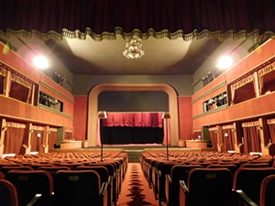
ON SATURDAY THE 17th MAY 2020, an act of cultural barbarism was performed in Tirana, the capital of Albania. The National Theatre of Albania in the heart of the city was demolished. It is unclear who ordered this demolition of a much-loved cultural monument located in a part of the city where property prices are high. The theatre was built in 1939 during the period that the Italians, under Mussolini, were ruling Albania. It was originally a cinema designed by the architect Giulio Berte, but later its screen was replaced by a stage.

TIR 4 BLOG

In 2016, my wife and I visited Tirana and attended a dramatic performance at the National Theatre. I have described this in my book “Rediscovering Albania”:

“…we visited the National Theatre, a building that dates back to before Communist times. A Pirandello play (Play without a Script) was to be performed in Albanian that evening. The charming ladies clustered around the ticket desk assured us that we would enjoy it because it was going to be full of song and dance. We bought a couple of tickets … The rectangular auditorium of the National Theatre was delightfully old-fashioned, with many drapes and an upper gallery that extended around three sides of it. Everything was red including the plush upholstery of the comfortable seats. Although we did not understand a word of it, the Pirandello play was acted beautifully. The expressive acting was so good that we were able to get a rough idea of what was going on. Some years earlier in London, Lopa and I once attended a performance of Gogol’s Government Inspector acted by a Hungarian troupe entirely in Hungarian, and on another occasion a play from Kosovo in Albanian, during the course of which one of the actors threw a fake chicken at me! On both of those occasions and also in Tirana, great acting compensated for our inability to understand the words. If the actions of actors move me more than their words, I feel this is a sign of truly skilful acting. As the great Constantin Stanislavski said: “The language of the body is the key that can unlock the soul”. This is exactly what the actors in Tirana achieved. The audience was appreciative, and, unlike at the opera, hardly anyone used their mobile ‘phones during the show.”

That has now disappeared. So, has also the unusually attractive appearance of Tirana as it was when I first visited it in 1984 during the dictatorship of the faithful follower of Joseph Stalin, Enver Hoxha. In those repressive times, Tirana was a quiet city with only one high-rise building, the 12-storey Hotel Tirana. Of course, back in 1984, times were tough for the average Albanian citizen. They remained quite difficult during the decade following the ending of Communist rule in 1991. Even now, many Albanians prefer to increase their prosperity by seeking work abroad.

When we visited Tirana in 2016, I found it to be a far busier place than it was in 1984. The traffic was busy – a sign that motoring, an option not available to most Albanians during the dictatorship, had become popular and also affordable. Some of the charm of pre-1991 Tirana remained, but many picturesque old buildings, examples of traditional Turkish and Balkan vernacular architecture, had disappeared (or were about to). In their place, there were many high-rise buildings of little or no architectural merit. I suspect that whoever ordered the demolition of Tirana’s historic, much-loved National Theatre has in mind to construct yet another aesthetically unpleasing edifice.

If as Shakespeare said, “All the world is a stage”, then the demolition of this theatre in Tirana is yet another tragedy enacted on that stage.

Peter and Dora

I WAS STAYING IN BELGRADE with my friends Peter and his wife. Peter said to me that because it was just over the border from (the former) Yugoslavia and neither of us had been there before, we should make a short trip to Hungary. That way, we could ‘tick off’ another country as having been visited. I agreed to accompany him. This was in 1981 when Hungary was still in the Soviet bloc.

B BUDA pioneer PF GOOD

British people required a visa to enter Communist Hungary. The Hungarian embassy in Belgrade was in Krunska, a leafy street near the Hotel Slavija. I entered and filled in a form. One of the questions on it related to the colour of an applicant’s car. It gave several options like ‘red’, ‘blue, or ‘green’, and one translated from the Hungarian as ‘drab’. I suppose that ‘drab’ was a mistranslation of the Hungarian word for ‘grey’ (the Hungarian for ‘grey’ is ‘szürke’ and for ‘drab’ is ‘sárgásszürke’).   After filling the form, I walked to a counter by a small window in the wall. It was covered by an opaque green cloth curtain. I waited. After a few moments, the curtain was pulled open sharply by a lady behind it and the counter.  I handed her my passport and the application form. My passport was full of bits of paper that I wanted to preserve safely. The lady plucked these out of the passport and handed them to me, saying:

“This I do not need.”

I picked up my passport with its new multi-coloured Hungarian visa stamp a couple of days later.

Peter and I boarded an overnight train from Belgrade to Budapest. Very soon, Peter fell asleep. After passing the station of Subotica in northern Serbia (Vojvodina), we reached the Hungarian border station at Kelebia. The train halted at the floodlit station for a long time. Apart from a few men in uniform, the platforms were eerily empty. Hungarian border guards entered the train. They carried satchels with shoulder straps. Each satchel was fitted with a hinged wooden lid that served as a small desk. Peter was sleeping deeply when two border officials entered our compartment. It was with great difficulty that the three of us, the two officials and I, managed to get him to open his eyes. Once he was awake, the guards took our passports. They looked at our passport photographs and then at our faces, and then back at the photos, then at our faces, and so on. This procedure was repeated several times until they were satisfied that our ‘mugshots’ were true likenesses of Peter and me. Then, they placed each passport on to the little desks attached to their satchels and pounded them with rubber stamps.

Some years later, the late Arpad Szabo, a philosopher in Budapest and a good friend, told me what he did when he was travelling out of East Germany (the former DDR) by train. The border guards in that country were particularly tough and very thorough. They entered his compartment and began prodding and opening the passengers’ baggage. When they approached his bag, he told them:

“Be careful with my luggage: I am smuggling an East German out of your country.”

The guards failed to appreciate the humour.

We arrived in Budapest Keleti Station early in the morning with no idea where we were going to stay. Someone directed us to a small window in a booth in the station. It was an official agency for arranging accommodation in people’s homes. We registered and were handed a scrap of paper with the address of our hosts. Without knowing the layout of the city, we hailed a taxi, which drove us across one of the Danube bridges to Obuda, a suburb north of Buda. Our accommodation was with a couple, who lived in a flat high up in a modern tower block. They were friendly but spoke no English. Somehow, I managed to communicate with them my interest in folk music. They recommended a singer called Katalin Madarász and told me that there were good record shops in Vaci Utca (Vaci Street), a shopping street in central Pest.

We made our way to Vaci Utca, where we found the Anna Café. This eatery served the most delicious cakes and savoury snacks in the form of open sandwiches. We found the record shops that we had been told about and that afternoon I bought the first of many Hungarian folk and classical LPs that are still in my enormous collection. I ate a toasted sandwich in a Café named Martini. It was there that I was able to add the words ‘meleg szendvics’ (hot sandwich) to my minute knowledge of Hungarian, a language outside the Indo-European language family.

I fell in love with Budapest, with the unfamiliar (to me) vocabulary of the Hungarian language, the food, and the friendly people we met. Peter and I explored many things in the city including a visit to the Young Pioneers’ Railway that ran in the Buda Hills. This was run and operated smoothly by youngsters, mostly teenagers, dressed in uniform. We visited Szentendre, a village north of Obuda, the Hampstead of Budapest. Not only is this place picturesque, but also it has a significant community of people with Serbian ancestry as well as a Serbian Orthodox church.  

One evening, Peter wanted to visit a night club. In the early 1980s, Budapest seemed devoid of life after dark, but we found that the Hotel Astoria boasted a night club. This was entered through a discreet, almost hidden, street entrance and then up a staircase. We entered a darkened room full of people seated at tables. Soon, the cabaret, such as it was, began. The highlight of the rather unadventurous show was a magician performing tricks. The audience was subdued but showed its appreciation by genteel clapping.  The people seated around us did not look as if they were used to visiting night clubs; they looked dowdy and provincial. I am quite sure that what was on offer at the Astoria was not what Peter was hoping for.

I do not know whether Peter ever visited Budapest again, but I did often. My appetite for Hungary was truly whetted by my first brief visit. I made another trip the following year, but not before doing some careful ‘contact tracing’ as they say in the current pandemic crisis. I wanted to meet Hungarians in their homes.  One of my many contacts was supplied by my PhD supervisor’s wife, Margaret.

Margaret, gave me the contact details of Dora Sos.  Dora was trained as a chemist in Hungary. Just before WW2 started, her company sent her to the UK on a business trip. When the War broke out, she was stuck in Britain and detained as an ‘enemy alien’. Soon, she was released from internment because she was not regarded as being a threat to the security of the UK. She was sent to work in a chemical laboratory in the Slough Trading Estate, just west of London. There, she met and assisted Margaret in her work connected with extracting valuable elements from household and other metal goods donated for the war effort. Dora and Margaret became close friends. During her stay in Britain, Dora was given a British passport.

After the war, Dora returned to Budapest and began working in a laboratory there. Every now and then, the British embassy invited her and other holders of British passports to parties. One evening, she arrived at the embassy, but the Hungarian guards at its door prevented her from entering. She was arrested and her British passport confiscated. She was told never to visit the embassy again. This would have been during the harsh times, when Stalin was still alive and before the failed 1956 Hungarian Uprising.

Working in the laboratory soon became difficult and unpleasant. Every night, everything, all notebooks and other paperwork, had to be locked up. An atmosphere of secrecy and suspicion reigned. As Dora had lived in the West, she was regarded as being unreliable by the state. She left and became an interpreter: she was fluent in Hungarian, German, and English.

Some years later, restrictions eased a little in Hungary. Dora was permitted to visit Holland, which she did using her Hungarian passport. She made her way straight to the British Embassy at The Hague and told them about her British passport. After checking her story, the ambassador issued a replacement. He told Dora that in the future when she wanted to travel, she should travel somewhere with her Hungarian passport and then she could pick up her British passport at the British embassy at that place. And, when she was about to return to Hungary, she was to hand it into the nearest British embassy at the end of her trip. This worked well for her. A British passport was subject to far fewer visa requirements and travel restrictions than a Hungarian one.

By the time I first met Dora in her flat in Buda, she had stopped travelling abroad. In her seventies, she was still busy working as an interpreter. Because young Hungarians had to study Russian as a foreign language at school, few learnt German or English. This meant she was in high demand. At international technical conferences, she told me, she was able to make simultaneous translations for people speaking in German to those who only understood English and vice versa. It is not a common skill to be a three-way simultaneous translator.

Every time I visited Budapest, I used to spend time with Dora, usually in her flat. A chain smoker, she used to have frequent bouts of uncontrollable coughing.  She was a good cook. Her speciality was chicken paprika, which she served with home-made pasta, which she extruded through a perforated metal disc straight into a pot of boiling water.  I used to write to her before I arrived in Hungary, asking if there was anything she wanted from the West. Invariably, she asked for the latest editions of technical dictionaries, which she needed for her translation work. She did not ask for works of literature forbidden in Hungary, like the works of Solzhenitsyn. She enjoyed trying to smuggle those illicit books into her country after her occasional trips abroad.   She told me that whenever she returned to Hungary, the customs officials would ask her if she was carrying any ‘Solzhi’ in her baggage.

While writing this, I remembered a joke I was told in Hungary. Two policeman’s wives were discussing the flats where they lived. One said boastingly:

“We’ve got Persian carpets on our floors.”

The other said:

“We’ve got Rembrandts on our walls.”

To which the first replied:

“Gosh how awful. How do you kill them?”

Enough of that. There was little for the average Hungarian to laugh about living in Communist Hungary. I recall seeing a shop where foreign goods could be obtained with hard currency (US Dollars, UK Pounds, Deutschmarks, Swiss Francs, etc.). Crowds of Hungarians pressed their noses towards the shop’s windows, staring at things that they might never afford. These goods, which were otherwise unobtainable in Hungary, included tins of Coca Cola, imported alcohol, western cigarettes, and electronic equipment that was no longer the latest in the world outside the ‘Iron Curtain’.

For several years after the ending of Communist regimes in Eastern and Central Europe, I did not return to Hungary. In the late 1990s, after our daughter was born, we drove to Hungary and stayed with some young friends in Budapest. Under Communism, Pest, which to some extent resembles 19th century Paris, lacked the ‘buzz’ of a city like Paris or London. After the end of Soviet control of Hungary, Budapest sprung to life as if it had come out of a coma or recovered from a general anaesthetic.

I wanted to introduce my wife to Dora. I tried ringing the number I had for her a few times, but there was never an answer. So, one morning we took a tram to the place where Dora had her flat. We entered the building and used the ancient lift to reach Dora’s floor. Her front door opened onto a gallery overlooking an inner courtyard where rugs were hung on wooden stands and beaten by their owners to rid them of dust.  Dora’s name was no longer on the small plate next to the doorbell. I rang the bell. Nobody answered it. I never saw or heard from or of Dora again. Maybe, her chain smoking had finally got the better of her.

As for Peter, whose suggestion in Belgrade led to my love affair with Hungary, I lost contact with him for many years. About two years ago, we re-established contact via Facebook. Last year, after he and I had returned from our separate trips to India, we arranged to meet up again face to face. I was really looking forward to seeing this highly witty and intelligent friend of ours again. A few weeks before the rendezvous, he sent me an email telling me that he was unwell and that we would need to delay our meeting until he recovered. Sadly, he never did.


Picture shows Peter seated in the Young Pioneer’s Train at Buda

A chance meeting

BRIDIE WAS OUR DAUGHTER’S babysitter for several years. She also collected her from school and looked after her until one of us returned from work. Although she was well over 80 when we first employed her, Bridie was a very sprightly, energetic woman.

LondonUnderground_GoldersGreenStation


She had been brought up in the wilds of western Ireland. Every day, she used to walk several miles over the hills to go to school. She moved to England as a very young lady. On arrival in Britain, she was at first given shelter by the Salvation Army. She had to promise them she would become teetotal. She kept this promise.

One day, Bridie told us an interesting story. When she was young before WW2, she worked as a maid for a Jewish family in north London’s Golders Green.  She wore uniform. There was one uniform for daytime and a different one for the evenings.

When Bridie was not working for us or ironing for our friends, the Wilsons who had introduced her to us, she used to roam around London taking advantage of her free bus pass (given to Londoners over 60 years old).

One day, Bridie visited Golders Green. When she was waiting for a bus to take her home, an elderly gentleman in the queue said to her:

“Excuse me, but are you Bridie?”

“I am,” she replied.

“Well, you looked after me when I was a child sixty years ago”

Bridie realised that the man was from the family, for whom she had worked in Golders Green before WW2.

A bus approached. The man asked her:

“Are you getting on?”

Bridie nodded, thinking he had asked a different question. The man jumped on the bus, leaving Bridie standing by the bus stop. Had she heard his question correctly,  he would have waited behind to reminisce with her: an opportunity lost for ever.

Ever since hearing about Bridie’s chance encounter, I have always considered her story as being rather sad.


Picture of Golders Green bus staion (Wikipedia)

Of doctors and Denmark

ONE OF MY TWELVE FIRST cousins, having just read my recent piece about Finchley Road in north London, reminded me about a hospital close to that road,  where she and her parents had received medical care. This reminded me that I had also been treated at that hospital many years ago. So, here is what you have all been waiting for: undergoing surgery in St Johns Wood.

One night early in 1962, I decided to see what it would be like sleeping on the floor with only the carpet between me and the floorboards in my bedroom. I have no idea what made me want to try that. I woke up the next morning, feeling a mildly uncomfortable sensation in my abdomen. It was not a feeling that I had ever experienced before. At first, I imagined that it had something to do with spending a night on the floor, but something made me decide to tell my mother about it. She was concerned about it and made an appointment to see our GP, Dr Clough, who had his consulting room in the ground floor of his home on Finchley Road, close to Golders Green Underground Station.

Dr Clough was a kindly man, a family friend. His waiting room had a large fish tank as well as the usual collection of well-thumbed magazines. His home was directly beneath an outdoor section of the Northern Line. Trains rumbled overhead every few minutes.

The doctor examined me and rapidly concluded that I had a ‘grumbling’ appendix. He told us that it should be removed, but there was no hurry to have the surgery carried out. He recommended a surgeon, who operated at the private St John and Elizabeth Hospital (a Roman Catholic institution) in St Johns Wood, not far from its Underground Station.

BLOG A Hospital_of_St_John_and_St_Elizabeth_(geograph_3306120) wikipedia

This station, which had, and still has, scraggy palm trees growing near its entrance, was close to the ground floor surgery of our ageing Jewish dentist, Dr Samuels, who was a refugee from Nazi Germany. His waiting room did not have a fish tank, but its floor was covered with luxurious oriental carpets, and the magazines in it were issues of the glossy paged Country Life. Dr Samuels’ surgery was in a block of flats, Wellington Court on the corner of Wellington Road (part of Finchley Road) and Grove End Road, on which the St John and Elizabeth Hospital is located.

I was installed in a private room with, to my great delight, a television for my exclusive use. My delight stemmed from the fact that we did not have a television at home. There were also chairs for visitors. The seat of one of these, which was nicely upholstered, could be removed to reveal a commode.

On the day before my operation, I was taken to a bathroom and told that after I had bathed, I was to call for a nurse by tugging on a cord attached to a bell-pull. There were several cords dangling near the bath. I pulled one at random. Then, I peered out of the slightly open bathroom door and saw a frenzied scene. Nurses were running hither and thither, some of them carrying oxygen cylinders. My nurse returned to the bathroom and told me that by mistake I must have pulled a cord attached to the fire alarm.

The operation went without hitch. I do not recall feeling much pain after it. I was kept in my private room for almost a week. Everyday, I watched as much television as I could. As I had been instructed not to get out of bed unless nature called and the television was far too old to be equipped with a remote control, I had to ring for a nurse each time I wanted to watch a different TV channel. When I pressed the bell button, a nun with a white apron (many of the nurses were nuns) would arrive and switched the channel. (The first time I ever saw a television with a remote control was in December 1963 in a hotel in Baltimore (USA). The controller was attached to the television by a long cable).

Many people including my parents and close family, visited me in hospital. Although this was very kind of them, I always hoped they would not stay long because while they were in my room I had to have the television – the best thing about being in hospital – switched off. It always amused me when a visitor sat on the seat that concealed my commode. I wondered what he or she would think or do had they known what was beneath them.

During the Easter holiday, which occurred a few weeks after I had left the hospital and gone back to school, we set out on a driving holiday to Denmark. We drove to Harwich, where I watched our car being loaded into the hold of the ferry in a rope basket lifted by a crane on the quayside.  We drove through Germany, a country in which my parents preferred not to linger longer than needed. We spent one night in a German hotel. It was there that we experienced sleeping under quilts (duvets) for the first time in our lives. We all thought they were a marvellous alternative to sheets and blankets.

In Denmark, we spent several days on a farm near Toftlund, which is about 23 miles north of (formerly ‘West’) Germany. The farm was owned by one of our former au-pair girls and her husband. My sister and I spent several glorious days mingling with the animals on the farm, mostly cows and pigs. This experience made this holiday one that I remember with great fondness. My mother, who saw danger everywhere, was most concerned that I should not be injured by any of the cows’ horns. She was worried that should a horn impact me, it might cause my recently healed surgical scar to split open. She had no need to be anxious. The weather was so cold that we were wrapped in several layers of clothing including thick duffel coats held closed with wooden toggles.

Our hostess’s father was an interesting fellow. He showed me houses in Toftlund that bore two kinds of house numbers, one blue with white figures, and the other red with white numerals. Between 1864 and 1920, Toftlund had been in what was then German ruled territory. One kind of house number had been affixed by the German authorities, the other by the Danish.  This made a great impression on my young mind. Since then, I have always looked out for small details, souvenirs of historic eras, like these.

My mother was so impressed by the duvets (‘dune’ in Danish) under which we had slept both in Germany and Denmark that she bought four down filled duvets in Denmark along with covers for them. These were transported on the back seat of our Fiat 1100. My sister and I sat on them for the rest of our holiday, which took us to Odense and Copenhagen before we returned to London.

We spent the Easter weekend in Copenhagen. Almost everything was closed and the temperature outside was very low. We wandered around trying to keep warm. The only warm place that was open were the tropical houses in a botanical garden.

Our return trip was not without incident. We broke down in the German border town of Flensburg just after leaving Denmark. Some electrical component needed replacing. We had to wait about four hours for a replacement part from a company I had never heard of before: Bosch. Well, I was about to become ten years old. So, perhaps it was not surprising that I was unfamiliar with the names of German companies. Whenever I hear the name Bosch or the French word for the German invaders during WW2, Boches, I always remember our four hour wait, parked next to an inlet of the sea in an industrial landscape.

We returned to London. My scar had not burst open. Our four blue cloth covered duvets filled with duck down were intact. After our return to London,  we never again used blankets and the hitherto tiresome job of laying beds was replaced by the relatively simple task of spreading the duvets over the beds. I believe that we were amongst the first households in the UK to use duvets.

Of the four duvets we brought to London from Denmark, I kept and used one of them for about 48 years. Reluctantly,  we disposed of it because over the years it had lost most of its feathers. I have got so used to sleeping under duvets that when I stay somewhere which had tightly tucked sheets and blankets, I have to untuck them fully.

Since my youthful experiment of sleeping on the floor, I have only repeated it when camping. And, when in a tent, I like to separate myself from the ground with a fully inflated air mattress. On the one occasion when I had no air mattress, I barely slept and barely escaped contracting pneumonia, but that is another story.

An appendix usually follows a story or text but in this case, it is at the start of my story. I have lost a short and, apparently, useless evolutionary intestinal vestige, my appendix.  Thinking about its loss and the good time I had at the St John and Elizabeth Hospital, has triggered a chain of memories of an era long past. I hope that I will not be deprived of any more parts of my anatomy, especially whatever keeps alive my recollections of the past, many of which I enjoy sharing with anyone who is interested.


Picture of Hospital of St John and Elizabeth (from Wikipedia)


Before Cyprus was divided

MY ONLY VISIT TO CYPRUS was in 1960. I was eight years old and Cyprus was all one country. We went to Kyrenia, where my father was attending a conference in the town’s best hotel, the centrally Dome Hotel. We were all put up there.

It was not my father’s first visit to Cyprus. He had gone out there for a week in the early 1950s to give advice to a large Greek industrial firm based there. When he arrived at the airport in Nicosia,  the immigration officials threatened to forbid him from entering Cyprus because he did not have a yellow fever certificate.  The company for whom he was going to work had sent people to meet Dad. Not wanting to waste my father’s time and the company’s money, the officials assured them that they would make sure they would get my father vaccinated during his stay.

After a week, it was time for my father to leave. As he had not received the yellow fever ‘jab’, he asked his hosts about it.  He was told:

“Don’t worry, we sent someone from the company to be injected instead of you. We didn’t want you to waste your time.”

By 1960, the yellow fever certificate was no longer required to enter Cyprus.  We flew from London to Athens. As we stepped out of the cool aircraft onto the steps leading down to the tarmac, my face was hit by a blast of very hot air. I thought that this was being emitted by the aircraft engines. It was not. It was that never before had I stepped out of an air-conditioned space into outside air with a temperature over 30 Celsius.

GREECE 60s HBY Athens

We stayed in Athens a few days before flying to Nicosia. It was the beginning of the Greek Easter weekend when my mother realised she had left our travellers cheques in a small shop, which had closed by the time she discovered the loss. We went to a police station to report the problem. After taking many details including the names of her four grandparents,  they recorded the loss, but did little else.

My recollections of Cyprus are but few. The Dome Hotel had a swimming pool, which none of us used. Instead, we took trips to Six Mile Beach outside Kyrenia. This was a stretch of sand that looked idyllic at first sight. However, very soon after arriving, our would be covered with small specks of sticky black tar. Thinking back on this, I am surprised that we kept on returning to that beach.

Of the food we ate, I remember little except that we ate a surplus of thick stemmed richly flavoured spring onions (scallions).

My mother found a shoemaker in Kyrenia. She ordered a pair of sandals. This required daily,  lengthy visits to the craftsman. She was quite demanding and expected perfection. I suppose that there were many adjustments she wanted before she was satisfied. I enjoyed the visits to the cobbler because he listened to a radio station, which broadcasted a children’s programme in English.

We made several car trips from Kyrenia. At least twice, we drove along a winding mountain road to Nicosia. It took well over an hour each way back in 1960. We also took a trip  to visit the picturesque ruins of the 13th century Bellapais Abbey.  Although it is only just over 3 miles from Kyrenia, the roads were so poor in 1960 that this journey proved to be quite lengthy, as was an excursion to an archaeological site near Famagusta.

From Nicosia,  we returned to Athens, where we spent a few more days. Before leaving London, I had learnt about Archimedes and his legendary bath in which he is supposed to have been inspired to derive is principle of buoyancy. I was convinced that this famous bath was in Athens. I managed to persuade my parents to hire a taxi to drive around Athens in search of the bath.

Having explained to our taxi driver the nature of our quest, he gamely drove us around the city, stopping frequently to ask locals whether they knew where we could find the bath. Eventually, the driver revealed that he was Jewish. When he discovered that we were his coreligionists, he took us not to see the bath of Archimedes but, instead, to his synagogue. Some years later, I  discovered that our quest had been in vain because, if this bath ever existed, it was likely to be in Syracuse in Sicily.

Fifteen years following our stay in Kyrenia,  Cyprus became divided into two parts: one governed by a Greek administration and the other became governed by Turkish administration.  Kyrenia, where we stayed, is now in the Turkish part of Cyprus and is called Girne. The Dome Hotel still welcomes guests. Maybe, one day after the air is clear of coronavirus particles, I will revisit Cyprus and that hotel.

Photo taken in Athens, 1960