
The price rises
the tension’s growing:
the excitement of an auction


The price rises
the tension’s growing:
the excitement of an auction


From worlds far apart,
Two folk come together:
Cupid’s bow does its job
When our daughter was a little girl in junior school, the members of her class were asked to name the greatest Briton in history. She nominated Queen Victoria. Her choice was based on the following facts: her mother’s parents were born in India and my parents were born in South Africa. When Queen Victoria reigned, she argued, both countries were part of the British Empire. This, she felt, made it more likely that both her parents would study in England and meet. Without Victoria, she concluded, my wife Lopa and I might never have met, and she would not have existed. Well, maybe she was right. I believe that the reason we met was due to two men who gave us career’s advice: Professor Lewis Wolpert in London and Major General SL Bhatia in Bangalore.
As I approached the time when I had to choose a university undergraduate course, I had no idea which subject to select. I was interested in biology, physics, and chemistry, but had no interest in studying medicine, or even dentistry, which I studied many years later. Careers advice at my secondary school was not helpful.
My South African-born parents knew many South Africans living in London. One of these was my father’s close friend, the late Cyril Sofer, a sociologist. It was through the Sofer family that we met Lewis Wolpert, who was born in South Africa. First, he trained to become a civil engineer. By the time I first met him, he had become an eminent biologist, specialising in cell and developmental biology.
Wolpert, on learning that I was having difficulties choosing a course of study, kindly invited me to his office in Middlesex Hospital in central London. He spent about an hour with me, listening to what I had found interesting in the science subjects I had studied at school. Having heard me out, he suggested that I study physiology at university. This subject would, he thought, encompass all that interested me so far. He told me that the best places to study physiology were Cambridge and University College London (‘UCL’). Of these, he considered the physiology department at UCL to be the best. I was pleased to hear this.
About five years before meeting Wolpert, my father and I had visited UCL because a friend of the family, the art-historian Leopold Ettlinger, worked there. All that I can remember of this visit was walking across the lawns in UCL’s elegant Front Quadrangle and thinking how beautiful it seemed. So, when Lewis Wolpert suggested that I apply for admission to UCL, I was happy about that.
At about the time I was discussing my academic future with Wolpert in London, a young lady, my future wife Lopa, was discussing the same thing with another eminent scientist 5000 miles away in Bangalore. The scientist, Major General SL Bhatia (1891-1982), had known Lopa’s mother’s father from when he studied medicine in Bombay. The two medics became close friends. When Lopa’s mother Chandra was born, Bhatia became the equivalent of Chandra’s god-father.
Chandra’s father died young having succumbed to blood poisoning while treating one of his patients. His friend Bhatia had a glittering career in science, medicine and the Indian Army. It was during his retirement that Lopa met him at his beautiful old-fashioned bungalow in Bangalore. Bhatia had studied medicine not only in India but also at St Thomas’s Hospital in London during the second decade of the 20th century. While in London, he had conducted research with leading physiologists. Like Wolpert had done for me in London, Bhatia recommended that Lopa, who was not keen on studying medicine at that time, pursue a course of physiology at UCL, because he knew it to have a fine reputation in that subject.
One morning in October 1970, I arrived at the Physiology Department at UCL, having travelled from my home in north-west London. I was one of nine students who had been accepted for the course. Lopa was one of the others. She had travelled over 5000 miles to join the department. We were greeted by the department in the Starling Room, named after a famous physiologist who had worked at UCL. This common room is where I met the young lady who was eventually to marry me.

In the bar at the Bangalore Club
Our wedding reception in Bangalore was held in 1994 at the Bangalore Club, a prestigious ex-colonial institution in the heart of Bangalore. Although he could not attend, Major SL Bhatia was the first Indian President of that elite club. Before that, all the Presidents had been British. Bhatia’s widow was at the wedding. She claimed, not without some reason, that it was she and her late husband, who were responsible for getting Lopa and me together.

Just as our daughter is eternally grateful to Queen Victoria for bringing Lopa and me together, I am equally thankful to Professor Wolpert and Major General Bhatia for getting our paths to cross. I cannot acknowledge them for what was to follow; Cupid and his arrows are to be thanked for that.
Picture sources: semanticscholar.org (Bhatia) & retractionwatch.com (Wolpert)
The word GOGOTTE is pronounced ‘go-got’
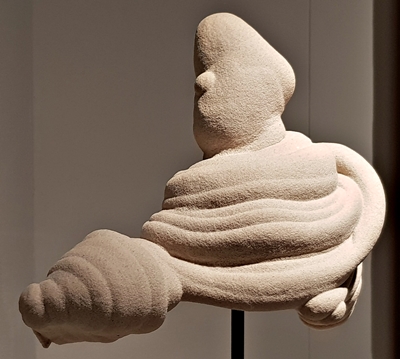
Quartz and chalk were fused
millions of years ago
to create gogottes
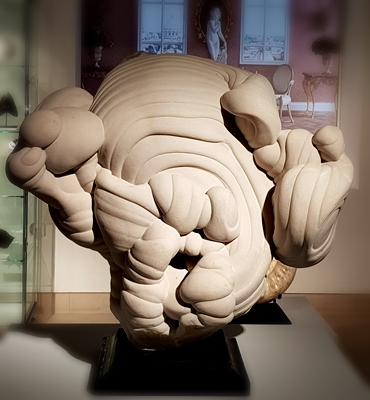
These two gogottes were from Fontainbleu. They were on sale at Christies auction house in London
If you were alive then, what were YOU doing on Friday, the twenty-second of November in the year 1963 ???
My father was a visiting academic in the Economics Department at the University of Chicago during the last three months of 1963. Between September and December of that year, we lived in a flat in a two-storey house with a wooden fire escape near the university. Our address was 5608 South Blackstone Avenue. My sister and I (aged 11) attended the nearby University of Chicago Laboratory Schools (the ‘Lab School’).
I was excited to discover that our rented flat had a television, albeit one which was defective. The image it produced was double. One could see what was being broadcast but everything had a shadow, which made the image seem out of focus. Whichever way one fiddled with the indoor aerial, the image never improved. None of this mattered much to me because in London, where we lived usually, we had no television at all.
In addition to attending the Lab School, I had to keep up with the work that I was missing because I was not at school in London. Soon after returning from the USA, I had important examinations to sit. So, getting time to watch TV was difficult. I decided that the only way I could get a decent long session in front of the TV was to be sufficiently unwell for my parents to allow me to miss school.
I bought a copy of the weekly voluminous TV Guide for the Chicago area. It was the issue that covered Friday 22nd November 1963. I do not remember how I persuaded my parents that I was too unwell for school that day, but I did. My sister, aged 7, was deposited at the Lab School by my father on his way to the university. Much later that morning, my mother, a sculptress, set off for the studio where she worked during the day. I was left at home alone, ready to spend several hours watching the TV programmes I had selected from the TV Guide.

You can imagine my disappointment when the TV set had warmed up after I had switched it on. Instead of the TV programmes that I was looking forward to watching, there were non-stop news programmes on every channel. President John F Kennedy (‘JFK’) had just been shot in Dallas, Texas. Not only had one of America’s most charismatic presidents been assassinated, but also my day of uninterrupted TV viewing had been wrecked.
My sister returned from school in the mid-afternoon. She told us that her class had been led out of the classroom to the school’s assembly room. There, they saluted the US flag before being told of the tragedy in Dallas.
On the Saturday morning, while I was struggling with my Latin assignment from London, my sister and some guests who were staying with us, the art historian Leo Ettlinger and his wife, were watching our TV in another room. Suddenly, my sister came running into the room where I was trying to study, and my mother was doing something domestic. She announced that while she was watching TV, she saw Jack Ruby shooting dead the prime assassination suspect Lee Harvey Oswald. My mother and I rushed to the TV. We were just in time to see the footage of Oswald’s murder being replayed.
Although, as an 11-year-old, I had negligible interest in politics or news in general, JFK’s demise made me feel depressed. I am not sure why. Maybe, it was because his death had significantly dampened the mood of Americans in general.
Years later in the mid-1970s I visited some American friends, fellow graduate students, who lived in Pill, a suburb of Bristol in Somerset. One evening, we went to a theatre in the centre of the city. I do not recall the name of the play, but I can remember what it was about. The people on stage, actors, related what the characters, who they were portraying, recounted about what they were doing at the moment they learnt of JFK’s assassination.
Now, you, dear reader, know what I was doing on that fateful day.
[Image source: wikipedia]
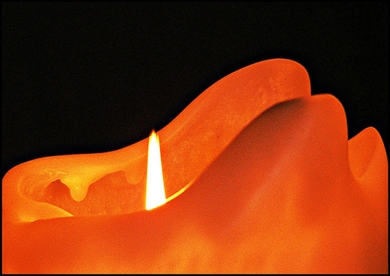
Festival of light
Illuminate the house:
today is Diwali
In August 2003, the middle of winter in South Africa, we made a long tour around the Cape Province, visiting small places that figured in the history of my family’s sojourn (beginning 1849) in South Africa. Here is an account of our journey to Hogsback in the Eastern Cape. The writer JRR Tolkien is supposed to have been inspired by the landscape near Hogsback, but not all are agreed on this. The author was born in South Africa (in Bloemfontein), but left the country aged less than three years.
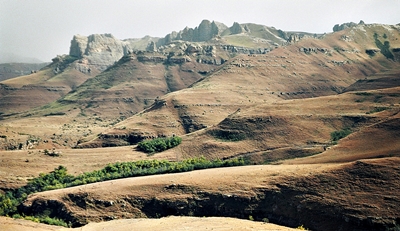
Between Barkly East and Dordrecht
We sped on from Barkly East to Dordrecht. It was at Dordrecht in 1884 that my great grand uncle Sigmund Seligmann with his partner, another Jewish gentleman, Moss Vallentine opened their first business, a retail store. Later, he opened a general store in Barkly East, where his nephew, my mother’s father, became the town’s only Jewish Mayor.

Dordrecht Museum
Dordrecht, a smallish place, still has several nineteenth century buildings including one with an elegant arcade supported by cast-iron pillars that serves as a museum. Andre Coetzee, the museum’s curator, pointed out an old shop opposite the museum that he believed had originally been Seligmann’s. He seemed very certain that this was the building, but he could not show me any evidence to confirm this.
The rain and snow continued to shoot past us, propelled by a fierce wind. Between Dordrecht and Queenstown, we crossed a plain that was quite different to anywhere we had been so far. The plain was quite literally dotted with thousands of ‘black’ peoples’ dwellings, some with rondavels as out-houses. There were few fences. People and animals wandered across the road. The countryside was much less manicured than any other inhabited places we had so far visited in the Cape. Derelict cars were frequently seen. We were in Chris Hani District that includes the town of Queenstown and was under the Apartheid regime part of one of the so-called ‘Homelands’.
Queenstown is not an attractive town but has a lively buzz and good shops. A sign in the town centre advised motorists to pay for parking at a “mobile parking meter”. This meter turned out to be a person who hangs around the parking area carrying a machine on which he or she records your arrival and departure times and based on these determines how large a parking fee needed to be collected. We found a wonderful spice shop run by a Pakistani man. He had a special table on which he can make spice mixtures to order and, also, had ready-made mixtures including one, very strong in flavour apparently, called “Mother-in-law Masala”. We visited a large branch of Woolworths as many people had commended this chain store to us. We were disappointed: it was like Marks and Spencer’s used to be in the UK many years ago.
We drove via Whittlesea to the tiny village of Seymour. A road marked incorrectly on our map as “narrow but with tarmac, not for four-wheel drive vehicles alone”, led from Seymour up the side of a mountain to Hogsback. This road proved to be the worst surface that I have ever driven on. Compared to it, Joubert’s Pass (near Lady Grey), was a motorway. It got progressively worse as we painfully slowly approached Hogsback.
The road had everything against it and us. There were potholes, and deep furrows where streams of water had eroded the gravel. Bare rock showed through the road and made steps that had to be carefully negotiated. Worst of all were large rounded boulders, which were difficult to drive around as the narrow road was bounded either by ditches or by walls of rock. We were lucky that we neither capsized the car nor grounded it, nor damaged the sump or some other vulnerable part of its under surface. Navigating around or across some of these dangerous obstacles reminded me of performing a particularly difficult surgical dental extraction. Just as I had to take care not to damage a hidden nerve or blood vessel during an extraction, I had to drive to avoid injuring some important part beneath the car. Had we broken down on this deserted, barely frequented road, we would have been in big trouble. There was no mobile ‘phone coverage in the area. Hair raising to say the least: I still shudder when I remember this journey. Later, a cousin in Cape Town told me that when he had used this road, he had grounded his vehicle and thereby damaged its fuel line. Things improved at the end of the road. We were amused to see a road sign at the Hogsback end of this road that advised “Road not recommended for caravans.”
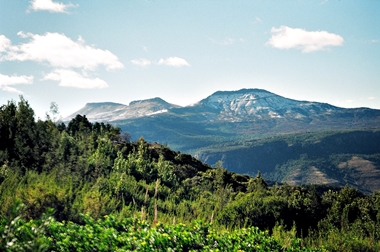
A view from Hogsback
We found our accommodation: a collection of cottages called The Edge. The name refers to the position of the cottages which is at the very edge of the summit of the Hogsback ridge over which can be seen a view of the coastal plain over a thousand feet below. Our cottage was large but unheated except for a small, inadequate fireplace poorly located in one corner of the cottage remote from the bedrooms. We ate an excellent curry made by Dion and Shane who own a restaurant near our cottage. All night the snow fell, and the wind howled.
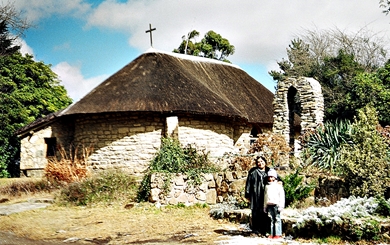
A church in Hogsback
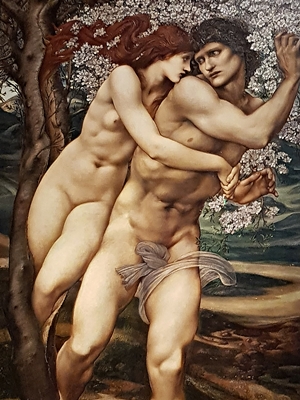
Until 24th February 2019, there is an excellent exhibition of the works of the Pre-Raphaelite artist Edward Burne-Jones (1833-98) at London’s Tate Britain.
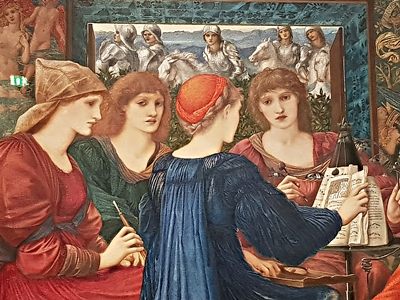
For Victorian art
looking back to the past
Burne-Jones does excel
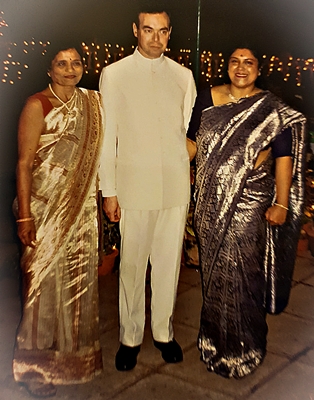
I married in Bangalore in January 1995. A week or so before the marriage, I was introduced to Mr Krishnan, a tailor who worked in his home near to Cunningham Road in the heart of Bangalore. He was an elderly, dignified gentleman, and a good craftsman.
Mr Krishnan made me a suit for the wedding ceremony, a white Nehru suit with a high collar. a bandh gala. This kind of garment pre-dates India’s post-independence leader Jawaharlal Nehru; it derives from the Mughal years. The one that Mr Krishnan made me was precision fitting. I could breath in it, but it would not tolerate even the slightest increase in my girth. The same was true for a western style suit that he made for me at the same time.
A year later, we returned to Bangalore. Happiness in marriage and over-indulgence at meals had resulted in a change in my dimensions, notably an increase in my girth. We returned to Mr Krishnan with the suits he had made, which no longer fitted me. Fortunately, being a skilful tailor, Mr Krishnan had left plenty of material in the seams of the clothes in order to enlarge them.
Mr Krishnan measured me carefully, noting down my dimensions in a large book. When he had finished my wife asked him:
“Out of interest, how much has my husband increased in size?”
Mr Krishnan replied:
“Madam, I can not tell you that because I have lost your husband’s original measurements.”
Not only was Mr Krishnan a great tailor but also, he was a master of tact.

Flowers in the heart
of a leafy plant:
pleasure in a flower pot
This extract from “REDISCOVERING ALBANIA” by Adam Yamey describes a part of Albania where much weaponry was manufactured during the Communist era (1944-91).

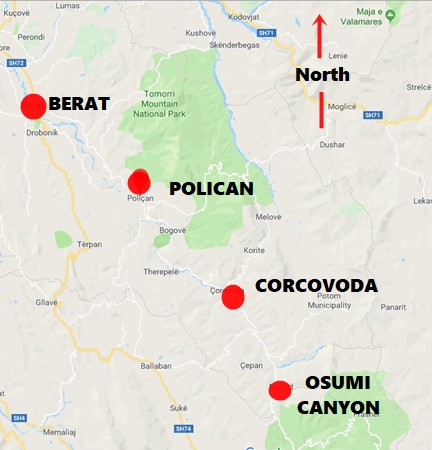
“We followed the River Osumi upstream [from Berat], passing an isolated working military camp with camouflaged concrete buildings. The road wound up the valley crossing numerous tributaries of the Osumi. Next to many of these small bridges there were construction sites, which were associated with the building of the Trans Adriatic Pipeline. This will carry gas from Kipoi (just east of the Greek city of Alexandropolis) to Seman (a few kilometres north of Vlorë on the Adriatic). From there, it will go under the sea and resurface at the southern Italian coast south east of Lecce. This gas-carrying modern ‘Via Egnatia’ (or maybe it should be called ‘Via Igniter’) will follow the valley of the Osumi, then curve around Berat, before heading westwards towards the sea. It is part of a huge project to transport gas from Azerbaijan to western Europe.
The town of Poliçan was a pleasant surprise. We were expecting to find a drab place because of its industrial heritage. Far from it: Poliçan was a cheerful, vibrant place. We parked at the top end of the sloping triangular piazza named after the large mountain (Tomorr: 2,416 metres), which dominates the area around Berat and Poliçan. The piazza, is a right-angled triangle in plan. Its two shorter sides were lined with well-restored, freshly painted Communist-era buildings with shops and cafés. We joined the crowds drinking under colourful umbrellas outside cafés on the Rruga Miqesia, which runs off the piazza towards the town’s cultural centre and Bashkia (both built in the Communist period). It was about 11 am on a working day. There seemed to be many people with sufficient time for sitting leisurely in cafés or just strolling up and down the street. A girl, who ran a mobile ‘phone shop (on her own), sat with friends at a table in a café near to the shop, and only left them if a customer entered her showroom. A long out of date poster on a building advertised a meeting in Tirana for adherents of the Bektashi sect.
Near the upper end of the triangular piazza, there was a new marble monument commemorating Riza Cerova (1896-1935). He was born just south of Poliçan, and became a leading protagonist in the ‘June Revolution’ of 1924, when supporters of Fan Noli forced Ahmed Zogu to flee from Albania. For a brief time, Noli became Albania’s Prime Minister. However, at the end of 1924, aided by the Yugoslavs and Greeks, Zogu made a counter-coup, and then assumed control the country. Soon after this, he had himself crowned ‘King Zog’. Following Noli’s defeat, Cerova joined the German Communist Party, and later returned to Albania where he led anti-Zogist fighters. He died during an encounter with Zog’s forces.

Poliçan was important during the Communist period. It was home to an enormous arms and ammunition factory, the KM Poliçan, which was opened in 1962. This produced its own versions (the ASH-72 and ASH-82 series) of the Kalashnikov gun as well as other munitions. The factory lies amidst cultivated terraced fields on the slopes of a natural amphitheatre away from, and beneath, the southern edge of the town. Workers used to approach the factory from the town by a long staircase. We counted at least twenty-five industrial buildings in the complex, many of them with broken or missing windows. None of the numerous rusting ventilators on these edifices were emitting smoke, and there were no signs of life. The slopes surrounding the factory below were dotted with concrete and metal entrances to underground stores and tunnels. During the unrest of 1997, KM Poliçan was temporarily taken over by criminal gangs while the city was in ‘rebel’ hands. The factory is still used, but mainly to de-activate out-of-date Albanian weaponry. It was difficult to imagine that the peaceful scene, which we observed from a track overlooking it, had such an explosive history.
We travelled southwards through cultivated countryside and past occasional forests, always following the sinuous course of the Osumi. At the edge of Çorovodë, the administrative capital of the Skrapar District, we saw a tourist information poster beside a squat hemispherical Hoxha-era concrete bunker. It portrayed an Ottoman era bridge, which we hoped to see later. In the town’s main square, there was a socialist-realism style monument: a pillar topped by a carved group: one woman with three men. One of them was holding a belt of machine gun ammunition. The base of the monument had ‘1942’ carved in large numerals. On the 5th of September 1942, Skrapar became the first district in Albania to be liberated from the occupying fascist forces. There was a bronze statue of Rizo Cerova in a small park next to the square. Elegantly dressed in a jacket with waistcoat, he is shown holding a rifle in his left hand. His face looked left but his tie was depicted as if it were being swept by wind over his right shoulder.
We ate a satisfying lunch in a large restaurant next to the park, the Hotel Osumi. It backed onto a fast-flowing tributary of the Osumi. After eating, we entered a café a little way upstream to ask for directions to the Ottoman bridge that we had seen on the tourist poster. We were surprised to discover a ‘black’ man at a table, chatting with several Albanians. He spoke perfect English, which was not surprising because he was born in Tennessee (USA). He was teaching English in Çorovodë under the auspices of the Peace Corps. With pencil and paper to hand, he was compiling his own map of the town. When we told his companions that we were trying to find the old bridge, they advised us that it was only accessible with a rugged four-wheel drive vehicle.
Driving further southwards, we reached the spectacular Canyon of the Osumi (Kanioni i Osumit, in Albanian). It is about twenty-six kilometres long, deep, and narrow. At places where the road came close to the edge of the canyon, we obtained good views. From above, it looked as if the cultivated rolling fields and pastureland had been cracked open. The crack’s walls were steep sided, with dramatic striations of whitish rock. Far beneath us at the bottom of this fissure, the River Osumi flowed around its many bends. Standing at the canyon’s precipitous edge, we could only hear birdsong and water rustling over the river’s stony bed far below us.

Retracing our steps to Berat, we passed an abandoned building with a fading circular coloured sign painted on it. It depicted a grey cow standing between a woman in a white dress, who was writing on a clipboard, and a man in a white coat such as doctors wear. In the background, a man in an overcoat holding a shepherd’s crook, was leading a flock of sheep towards the grey animal and its attendants. Around the edge of the picture, we read the words ‘Stacioni Zooteknise’, which literally translates as ‘zoo technical station’. The building with its peeling plaster and patches of exposed brickwork had once been an animal husbandry centre.”
Adam Yamey’s book REDISCOVERING ALBANIA is available from Amazon, bookdepository.com, lulu.com, and is on Kindle
 yamey
yamey 