Plenty of bridges

LONDON IS BLESSED with an abundance of open spaces where one can exercise and enjoy reasonably fresh air. In addition to parks, woods, the banks of the Thames, and squares with gardens, the towpaths alongside canals provide visually fascinating places to walk, run, or cycle. These canals  used to be important routes along which freight could be transported right across England before they were rendered practically redundant by the advent of the railways. Despite this, they have been maintained and give great pleasure to many people including my wife and me.

Today, the 6th of November 2020, we walked along a branch of the Grand Union Canal from Golborne Road (near Portobello Road), where I practised dentistry from 1994 until about 2001, to Paddington Basin, which only became accessible to casual visitors in about 2000, when it was redeveloped. We began our walk in Meanwhile Park at the base of Trellick Tower, a tall block of flats designed in brutalist style by Ernő Goldfinger and opened in 1972. The pleasant community park, created in 1976, runs alongside a short stretch of the Paddington Arm of the Grand Union Canal, which was opened for use in 1801. We walked across the narrow park and onto the towpath. Although we have walked along this often, what attracted me this time in addition to the variety of barges and waterfowl was the variety of bridges that cross the canal and its towpath. I shall concentrate on these in this essay.

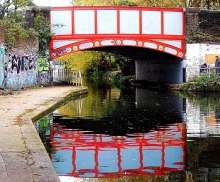
The first bridge we walked beneath is that carrying the Great Western Road over the canal. This is a cast-iron, single-arched bridge with the Union Tavern at its northern end. It looks like a Victorian design. Heading east, after walking beneath the sweeping curve of the Westway, an elevated motorway (the A40), the first bridge we encountered was that which carries the Harrow Road over the canal. This iron bridge with brick abutments is shorter than the previous one because the canal narrows temporarily as it passes beneath it.  A few yards east of this, there is another bridge that crosses the canal to reach an old, derelict building that must have been a factory in the past. The bridge, known as the ‘Pipe Bridge’, has a roof and is completely enclosed with translucent panelling. It looks as if it was built in the last few decades and leads from the factory to a solid brick wall which serves as its abutment on the south bank of the canal.

Four hundred yards east of the Pipe Bridge, after passing the green space around the Church of  St Mary Magdalene, we pass beneath a concrete footbridge with iron railings and decorative lamp posts that links Delamere Terrace and Lords Hill Road with Blomfield Road across the canal. The approach to the bridge from Delamere Terrace is an elegant helical ramp.  This fairly modern crossing is known as the ‘Ha’Penny Bridge’ (i.e. half penny).

The towpath runs south east and alongside Delamere Terrace and reaches the building that houses the Canal and River Trust, the former Toll House. This is next to another bridge, a delicate-looking cast-iron structure with masonry abutments topped with distinctive lamp stands. This carries Westbourne Terrace Road (laid out in the early 1850s) over a constricted section of the canal. East of this the canal enters a vast triangular expanse of water, the junction of three waterways: the Paddington Branch from west London, its continuation towards Paddington Station, and the Regents Canal that leads to Camden Town and further east.

The poet Robert Browning, who lived near to this junction area, or possibly Lord Byron, is credited with christening this district as ‘Little Venice’, the name by which it is known today (https://londoncanals.uk/2010/01/17/the-history-of-the-place-name-known-as-little-venice-and-the-facts-that-are-ignored/). With its willow trees, colourful barges, a wealth of waterfowl, and some floating refreshment outlets, Little Venice is a popular place for tourists both local and from further afield. The small island in the middle of the watery space, inhabited only by birdlife, is called Browning’s Island.

We leave Little Venice by walking south east along the next section of the Paddington Branch canal. Soon, we reach another bridge, an undistinguished structure that carries the Harrow Road over us and another short, constricted section of the canal. The next 450 yards of the towpath on the west side of the canal has been redeveloped recently and is lined with eateries both on the shore and on boats moored  alongside the shore.

After walking beneath a concrete bridge, the Westway Viaduct, carrying the Westway high above us, we soon reach a fascinating footbridge over the canal. The span across the water is approached by both curving staircases and spiral ramps. This suspension bridge is supported by cables fanning out from a tall pole on the eastern side of the canal. It is known as the ‘Harrow Road’ footbridge. Despite an extensive search of the Internet, I have not yet discovered who designed this structure, which is a visual delight in comparison with the next bridge we reach, an inelegant concrete span, which carries Bishops Bridge Road.

Shortly before the direction of the canal turns from south east to due east, we need to cross it over a curious looking modern footbridge that runs beneath what looks like a double wall of glass panels. This, the Station Bridge (Paddington Basin), leads from the east side of Paddington Station to a footpath leading to North Wharf Road. It was completed in 2004 by the Langlands and Bell partnership (www.langlandsandbell.com/work/).

Having crossed this distinctive bridge, we are now on the final stretch of this blind ending branch of the Paddington Arm of the canal. Next, we encounter another suspension footbridge with perforated metal panels along both sides of its footway over the water. This bridge leads to a car park next to a twentieth century block, part of St Mary’s Hospital. This is the Paddington Basin Footbridge designed by Sidell Gibson Architects.

A few yards further east, we cross a short blind-ended inlet by means of a short bridge known as The Rolling Bridge. Designed by the Thomas Heatherwick Studio and completed in 2005, this bridge curls up into a circle to allow boats to enter or leave the inlet. Routinely, this pointlessly complex yet interesting bridge is opened briefly at noon on Wednesdays and Fridays and at 2pm on Saturdays.

On Fridays at noon, or when necessary, the last bridge over the Paddington Arm, a few feet away from its eastern terminus, can be seen in action. At rest, the Fan Bridge (aka Merchant Square Bridge) looks unexceptional. However, when it is raised to allow passage of vessels it is extraordinary. As the bridge rises, it splits into sections resembling five blades of a pen knife when they are all opened, or a lady’s fan.  The bridge is twenty feet long, was designed by Knight Architects, and completed in 2014. We were lucky enough to see this bridge open and then to watch it closing. You can watch this happening on my video at https://youtu.be/UGQERbGo_jU .

Beyond the Fan Bridge, the canal ends abruptly. Trellick Tower, where we began our perambulation was a landmark in modern architecture when it was built. The Fan Bridge, constructed 42 years later, is another exciting development in design. In between the tower block and the unusual bridge, we passed beneath or over several canal crossings representing various points in the history of bridge design, many of them adding beauty to a lovely waterway that provides pleasure for many people.

A walk in the West End

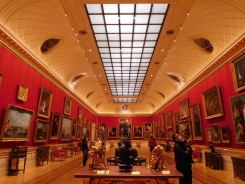
The largest gallery in the Wallace Collection

BRAVING THE INCLEMENT weather, we walked from Kensington to the Wallace Collection in London’s West End. After walking along the north side of Hyde Park, we crossed Bayswater Road (actually ‘Hyde Park Place’) and walked along the short Albion Street. The novelist William Makepeace Thackeray (1811-1863), who was born in India (Calcutta) and the author of “Vanity Fair” lived at number 18. His home was close to the still extant Tyburn Convent (located near the famous spot where criminals were hanged). He wrote of the area where he lived (‘Tyburnia’):

“The elegant, the prosperous, the polite Tyburnia, the most respectable district of the habitable globe.” (www.stjohns-hydepark.com/moreaboutus/2016/4/21/history-of-st-johns)

From Albion Street, we turned right to walk east along Connaught Street, named after George III’s nephew and son-in-law Prince William Frederick, Earl of Connaught (d. 1834), and laid out in the King’s reign (1760-1820). Archery Close leads off the street to a cobbled mews. It is so named because it was next to the former cemetery (now a housing estate called ‘St George’s Fields’) of St George’s Church in Hannover Square, which used to be used as a practice ground for archers. A few yards east of the close, we reach Connaught Square.

The square, whose brick-built elegant terraced houses surround a private garden, began to be developed in 1821. Near to the north east corner of the square, number 14 was home to the Italian ballet dancer Marie Taglioni, Comtesse de Voisins (1804 –1884), who was born the daughter of an Italian choreographer, Filippo Taglioni and his Swedish wife the ballerina Sophie Karsten, in Stockholm. In England, Marie taught social dancing to society ladies and children. The former British Prime Minister, Tony Blair, has also owned a house in this pleasant square.

Number 1 Connaught Street, which is on the corner of Edgware Road is now a branch of the Maroush Lebanese Restaurant chain. It is housed in an attractive building whose facades are topped with balustrades. On a map surveyed in the 1930s, which also shows St Georges Fields still as a disused cemetery, marks this building as a bank (Westminster Bank).  After traversing the busy Edgware Road, formerly the Roman Watling Street, the continuation of Connaught Street becomes Upper Berkeley Street, named after Henry William Berkeley (1709-1761), who was part of the Portman family who developed the area.

Number 33 Upper Berkeley Street has a distinctive neo-Byzantine frontage and looks like the entrance to a religious building. It is an entrance to the West London Synagogue whose main entrance is nearby on Seymour Street. This synagogue was established on its present site in 1870. Its congregation is allied to Reform Judaism. Its architects were Messrs Davis and Emmanuel (https://archiseek.com/2013/the-new-west-london-synagogue/). Rabbis, who have served at this synagogue have included a Holocaust survivor, Hugo Gryn, and Julia Neuburger.

Number 20 Upper Berkely Street was home to the first British woman to qualify as a medical practitioner, Elizabeth Garrett Anderson (1836-1917). She lived (and practised briefly) at number 20 from 1860 to 1874. She established her practice around the corner at 69 Seymour Place, which opened as the ‘St Mary’s Dispensary for Women and Children’. Nearby at number 24 (‘Henry’s Townhouse’), we reach the house where the banker and clergyman, Henry Thomas Austen (1771-1850), brother of the novelist Jane Austen, lived between 1800 and 1804 (http://jasna.org/persuasions/printed/number20/caplan.pdf).

After passing Great Cumberland Place and Wallenberg Place (created in the 1780s and badly damaged during WW2), an elegant crescent on the east side of the road, we pass Montagu Street that leads north to Montagu Square where my father’s colleague and co-author, the Hungarian born Peter Bauer (1915-2002), used to live.  Further east, Upper Berkeley reaches the northwest corner of Portman Square.

Opposite this corner is Home House, once the home of the Courtauld Institute (for history of art), now the home of a private club. It was built in 1773-76 for Elizabeth, Countess of Home (c1703-1784), a Jamaican born English slave-owner, and designed mainly by Robert Adam, who also created its beautifully decorated interiors and a fantastic helical staircase. A block of flats called ‘Fifteen’ with art deco front doors is next door to Home House and opposite an entrance to the square’s private gardens. This gate, normally locked, happened to be open. So, we snuck into the garden to take a brief look. As we emerged, and slammed shut the gate, a man emerging from Fifteen, noticed us and told us that it was good that we had closed the gate, because he said:

“It’s good to keep the riff-raff out of our square.”

I replied:

“We are the riff-raff.”

He laughed and we began conversing. He lives in Fifteen, which was built in the 1930s, and told us that its interior is decorated like the original ‘Queen Mary’ liner, in art deco style. He confirmed my memory that the store front that houses Air Algerie  and the National Bank of Kuwait on the east side of the square used to be part of the shop front of the Daniel Neal children’s clothing store, which closed in 1977. My late mother always pointed it out when we drove past it in the 1960s, but I cannot recall ever having entered it.

Continuing east from the square along Fitzhardinge Street, we pass Seymour Mews. A plaque on the corner of these two roads commemorates the site of the birthplace of Captain Thomas Riversdale Cloyes-Fergusson who was awarded a Victoria Cross medal posthumously after dying, aged 21, at the Battle of Paschendaele on the 31st of July 1917 during WW1. His medal is currently on display at Ightham Mote in Kent, the former home of his parents. Incidentally, the well-preserved Tudor Ightham Mote house is a lovely place to visit.

Walking another 200 feet eastwards brings us to our destination Manchester Square. Before describing its main attraction, let us look at number 14, now called ‘Milner House’. This was the home of Alfred Milner (1854-1925), who was an important colonial official in southern Africa. He was Governor of the Cape Colony from 1897 to 1901, a period that included the 2nd Anglo-Boer War. Then, he was successively Administrator of the Transvaal and Orange River Colony (1901-1902), Governor of the Transvaal and Orange River Colony (1902-1905), and then Secretary of State for the Colonies (1919-1921). Milner was in no little way responsible for the outbreak of the conflict between the British and the Boers that began in 1899, one of whose aims was to establish an unbroken British corridor that ran from Cairo to The Cape. Another of its aims was to have the gold mines of the Rand and other parts of the Transvaal under British rule.

One of Milner’s neighbours on the square was Sir Richard Wallace (1818-1890), who, unlike his neighbour Milner, did much good for mankind. He was the illegitimate son of the 4th Marquess of Hertford and educated in Paris, where he also worked. In 1870, when his father died, Richard inherited his collection of European art. Wallace added greatly to the collection, often purchasing fine works of art. During the Siege of Paris (September 1870-January 1871), Wallace, who was living in the city, performed many acts of charity including contributing much money to the needy of Paris and organising two ambulances. In 1872, he paid for the erection of fifty public drinking fountains, which are now known as ‘Wallace Fountains’ and can be found all over Paris. One of these distinctive fountains stands outside the entrance to Hertford House, his London home on Manchester Square where his art collection is now housed in what is called ‘The Wallace Collection’.

From the outside, Hertford House is imposing rather than attractive. It was built between 1776 and 1778 for the 4th Duke of Manchester. In 1797, the 2nd Marquess of Hertford acquired the building and modified it considerably. Richard Wallace and his wife, Julie Amélie Charlotte (daughter of Bernard Castelnau, a French officer), lived there whenever they were in London from 1870 onwards. The Wallace Collection contains over 5500 works of art collected by the first four Marquesses of Hertford and Richard Wallace. These include more than 6 paintings by Rembrandt, and others by great names including Vermeer, Bols, Poussin, Frans Hals, Canaletto, Velasquez, Boucher, Watteau, Fragonard, Lawrence, Hobbema, Cuyp, Maes, and many others equally well-known.  Richard’s widow bequeathed it to the nation in 1897.

I first visited the Wallace Collection with my father when I was less than ten years old. I remember being extremely bored by the huge numbers of Paintings on display but fascinated by the large collection of weapons and armour that occupies several rooms. Now, many years later, I am thrilled by the wealth of paintings that can be enjoyed in the beautifully decorated rooms of the house. The splendour of the interior décor of the rooms contrasts greatly with the exterior of the building that gives no hint of the treasures within.  Along with the collection of artworks at Kenwood House in Highgate, the Wallace Collection is one of the finest (formerly) private art collections open to the public in London.

After seeing the collection and having coffee in Hertford House’s vast covered internal courtyard, we retraced our steps by walking back to Kensington. We felt satisfied that we had had a good walk along streets and through parkland after having enjoyed an enriching artistic experience at the Wallace Collection.

A short stroll in Kensington

BEDFORD GARDENS IN Kensington is a short street connecting Kensington Church Street at its eastern end and Campden Hill Road up the hill at its western end. The facades of many of the buildings along this thoroughfare are at least partly hidden behind foliage that can be very luxuriant in the warmer seasons of the year. We have walked along this street frequently, but it was only recently that we noticed two commemorative blue plaques, which record that someone famous lived in the buildings to which they are affixed.  Also, we looked at one building, which has no commemorative plaque, but does merit at least one.

77 Bedford Gardens

A rich network of leafy wisteria branches covers the façade of number 4 Bedford Gardens on the north side of the road. Partly hidden by this vegetation, there is a circular blue commemorative plaque that informs the viewer that the composer Frank Bridge (1879-1941) lived there. He did so for many years in this house that was built in the late 1830s (www.rbkc.gov.uk/virtualmuseum/general/default.asp). What little I have heard of his compositions has not appealed to me.

Further along the road and on its south side, there is a blue plaque on number 27. It tells us that William Beveridge (1879-1963), “architect of the Welfare State”, lived in this elegant brick house from 1914 to 1921. During this period of his life, this Liberal politician left the Board of Trade in 1919 to become Director of the London School of Economics, a post he held until 1937, a year or so before my father arrived at that institution as a post-graduate student from Cape Town.

Many years ago, if my memory serves me correctly, a friend of mine, who was studying history of art at the Courtauld Institute, spent several weeks as a lodger in the home of the art historian John Pope-Hennessy (1913-1994). I remember visiting my friend there once back in the 1970s. The famous art historian, whom I did not meet, lived for some years in Bedford Gardens (www.kensingtonsociety.org/wp-content/uploads/Annual-Report-1994.pdf) at number 41 ( according to a letter published in the “Times Literary Supplement” of October 29 1976). If there is a commemorative plaque for Pope-Hennessy on Bedford Gardens, I have not yet found it.

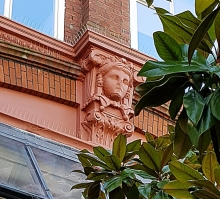
One house in Bedford Gardens that deserves a commemorative indication is a tall brick building with large studio windows on several of its five storeys. Built in 1882, it bears the numbers 77 and 79.  A sculpted head, looking like a classical Greek or Roman carving, is mounted centrally in the façade above the first-floor windows. This building was once used as artists’ studios; it might still be used by artists. According to an incomplete list (https://en.wikipedia.org/wiki/Bedford_Gardens,_London) of notable people who resided in Bedford Gardens, number 77 was used by the artists Robert Colquhoun (1914-1962), Robert MacBryde (1913–1966), Jankel Adler (1895–1949), and John Minton (1917-1957). Ronald Searle (1920-2011) also had a studio there but lived in nearby Bayswater and then Notting Hill (http://ronaldsearle.blogspot.com/2012/07/at-home-with-searles.html).

Minton lived at number 77 from 1943 to 1946 along with Colquhoun and his partner MacBryde (https://artuk.org/discover/artists/minton-john-19171957#). Colquhoun served as an ambulance driver in the Royal Army Medical Corps during WW2, but after suffering injuries in 1941, he moved to London where he shared studio space and his life with MacBride. The pair, who met at Glasgow School of Art in the 1930s, where their lifelong romantic relationship began, shared a house with Minton and after 1943 also with Jankel Adler ( http://www.blondesfineart.com/robert-colquhoun-artist). The parties these artists held at 77 Bedford Gardens were well-known in the artistic circles of London in the 1940s.

Kensington became a popular place with artists from all over Britain from the end of the nineteenth century onwards as this quote from a website (https://historicengland.org.uk/listing/the-list/list-entry/1442898) illustrates:

“The late C19 saw a sharp rise in the number of artists’ studios in London, particularly in Camden, Hampstead, St Johns Wood and Kensington and Chelsea … Speculative studio development … started in the late 1860s in Camden, moving to Kensington in the 1870s, with the Avenue, Fulham Road built by Charles Freake (Grade II), and reaching a peak in the 1880s and 90s. By 1914, when the market virtually dried up, there were some 150 properties of this type in London ranging from pairs to groups of as many as thirty. Of these, approximately sixty multiple studios in Kensington and Chelsea contained 293 individual units. Consequently the number of artists recorded in these studios is extraordinarily high, counting many artists of great merit.”

77 Bedford Gardens was one of these developments. Today, few artists apart from the most successful of them could either afford a studio in this street or to live there. The accommodation in this short thoroughfare is now at the higher end of the property market. However, it costs nothing to stroll along this attractive little road, along which quite a few famous people have lived, and it is a pleasant thing to do.

A fountain with a history

I LOVE WALKING IN LONDON because there is so much to see. Even when walking along a street that is familiar to me, a route that I have tramped many hundreds of times before, I see things that I have never noticed before. These are details that have been staring me in the face for years, but which I have unconsciously chosen to ignore. Then, I notice them and wonder why it has taken me so long to do so. During the strict phase of the covid-19 ‘lockdown’ when our walks have had to be confined to our neighbourhood, the number of interesting hitherto unnoticed details that I have ‘discovered’ for the first time has been enormous. Today for the first time, I walked along a road in Kensington, one which until now I have only driven, or been driven, along.

BLOG F1

Marloes Road runs south from Wright’s Lane (which links it with High Street Kensington) to the busy Cromwell Road.  It joins the latter a few yards west of a large branch of Sainsbury’s supermarket chain. This non-descript temple of retailing stands on the site of the long-since demolished West London Air Terminal, which was operational between 1957 and 1974. It served British European Airways passengers, who checked-in there before travelling by bus to Heathrow Airport. Today, there is no sign of, or memorial to, the building, which had six storeys above the terminal concourse.

On the west side of Marloes Road, I spotted a Victorian drinking fountain embedded in the wall of a building. This now non-functional water source bears the date 1893 and a plaque that reads:

“Lord from thy blessed throne

The griefs of earth look upon

God Bless the Poor

Teach them true liberty

Make them from strong drink free

Let their homes happy be

God Bless the Poor”

This was erected near the gates to St Mary Abbots Workhouse in February 1894 by the Church of England Temperance Society, no doubt to encourage the thirsty to reach for water rather than ale or gin. Constructed mainly with white Portland stone, the fountain was designed by the long-lived architect T Philips Figgis (1858-1948). His other works include two with which I am familiar. One of these is the domed Kennington Underground Station on the Northern Line. The other, which I have never entered but have often seen, is St Ninians (Presbyterian) Church in Golders Green. Its name has always intrigued me. I have yet to meet someone named Ninian. Built in 1911, soon after Golders Green began growing in earnest, the church has been re-named as Shree Swaminarayan Hindu Temple and was used as a Hindu temple between 1982 and 2013. The same sect of Hinduism was responsible for erecting the spectacular Shree Swaminarayan Mandir in Neasden, close to a well-known temple of commerce, IKEA on the North Circular Road,

As for the St Mary Abbots Workhouse to which the fountain designed by Figgis was attached, this has an interesting history. From about 1726, Kensington had a parish workhouse. This was located on Gloucester Road just south of Kensington Gore, the eastern continuation of High Street Kensington. In 1849, this was replaced by a new building on Marloes Road (which was then a part of Wrights Lane). This was under the care of the Kensington parish of St Mary Abbot. The workhouse, constructed in Marloes Road to the designs of Thomas Allom (1804-1872) in a combination of Jacobean and Elizabethan styles, must have been an impressive sight to behold.

Between 1871 and 1992, the former workhouse became part of St Mary Abbot’s Hospital. The hospital was one of four that closed when the newly built Chelsea and Westminster Hospital opened on Fulham Road in 1993. The site occupied by the former hospital and its predecessor, the workhouse, is now part of Kensington Green, an upmarket gated community protected by high security. Part of the palace-like edifice designed by Allom remains standing, but I could not see it from Marloes Road because it is surrounded by other buildings.

I would not have come across of any this information had I not spotted the well-conserved drinking fountain whilst casually strolling along Marloes Road. I took photographs of it just in case it proved interesting, which, certainly, it has turned out to be. Thus, a disused water source has given rise to a fount of historical knowledge.

Far from the maddening crowd

THROUGHOUT THE ‘LOCKDOWN’, our wise leader, Mr Johnson, has encouraged us to take exercise, to get out and breathe some fresh air. And, we have been following that sound advice, walking in our neighbourhood anything from two to five miles every day. Since the ‘lockdown’ has been eased recently, we have been driving out of London far enough to escape from the hurly-burly of the city.  Our latest excursion took us out westwards to a village on the River Thames called Hurley, which is upstream from the small town of Marlow. We chose our destination, the starting point for a riverside walk, almost randomly and had no idea what to expect when we arrived.

HU 12 temple lock

Temple Lock

Hurley is a gem of a village. A ford across the River Thames might well have existed at Hurley before the Norman Conquest of 1066. Many of the older buildings near the river and including the heavily restored Norman church formed part of a Benedictine priory that was established by Geoffrey de Mandeville, who died in about 1100 and was one of the richest men during the reign of William the Conqueror. His pious action at Hurley was strongly influenced by his second wife, Lescelina. The monastery was ‘dissolved’ during the great Dissolution of religious institutions carried out by Henry VIII, Some of the buildings including the priory’s cloisters have been picturesquely incorporated into newer buildings, most of which are used as dwellings.

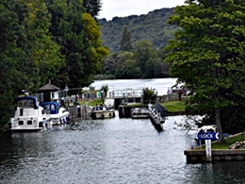
A wooden bridge crosses a stream of the river to reach an island where Hurley Lock is located. We watched pleasure boats being lowered in the lock that allows ships to avoid the weir nearby. At the end of the island, another wooden bridge crosses back onto the right bank of the Thames. We walked beside the river, enjoying glimpses of it between trees whose branches dipped down towards the water. In addition to boats of all sizes from canoes to large cruisers and barges, the water is populated by ducks, andgeese. We also spotted plenty of insects that rest on the water’s surface and flit about hither and thither: water boatmen and pond skaters. Much of the path was flanked by deciduous woodland, mostly private property.

Another bridge, a long sweeping wooden structure took us to the left bank of the river. A short distance downstream from it, we reached Temple Lock. The river was so busy that boats had to queue up to wait for admission to the lock. With the river on our right and fields on our left, some with grazing cattle and sheep, we headed towards Marlow. The path was flanked by a profusion of wildflowers, many of them being ‘serviced’ by a rich variety of different kinds of insects. Before reaching Marlow, we had good views of Bisham Abbey across the river. The former Abbey was built in about 1260 as a manor house for the Knights Templar. Now, much of it remains, and is used as one of the UK’s National Sports Centres.  Close by, the reflection of the tower of All Saints Church, Bisham, shimmers in the water of the river that flows close to its western end. The tower was built in the 12th century, and, later, in the 16th century other parts were added to the original church.

Soon after seeing Bisham’s church, the elegant suspension bridge across the Thames at Marlow came into view. The present bridge was built between 1829 and 1832 and designed by William Tierney Clark (1783-1852), who also designed Hammersmith Bridge. The famous Chain Bridge in Budapest (Széchenyi lánchíd), which is a larger version of Marlow Bridge, opened in 1849 was also designed by WT Clark. It was built by the Scottish engineer Adam Clark (1811-1866).

A slightly sensuous statue of a naked woman, apparently a nymph, can be seen near the Marlow Bridge. This early 20th century sculpture (1924) commemorates Charles Frohman (1856-1915), an American who was a famous theatrical manager who was drowned in the sinking of the Lusitania in May 1915. According to a notice next to the statue, it was erected on the spot from which Frohman used to enjoy watching the Thames.  Apart from the bridge and the statue, there was little in Marlow’s High Street that attracted us, and we walked back to Hurley the way we came. On the way back, we caught good views of Harleyford Manor, a handsome Georgian home on a grassy rise overlooking the Thames. Designed by Robert Taylor (1714-1788) for its owner William Clayton (1718-1783), a Member of Parliament for Bletchingley and then Great Marlow, it remained in the Clayton family until 1950. Currently, this protected building houses offices.

We returned to Hurley, having had a hugely enjoyable stroll along the river and plenty of fresh air. We met numerous people along the way, all of them greeting us friendlily. Many of them had dogs, and almost all of them took care to maintain ‘social distancing’. We drove away from Hurley and about half an hour later we were caught up in the hurly burly of London traffic, which was moving at barely snail’s pace around the Hammersmith one-way system. Annoying as it was, it was worth enduring after having had such a wonderful day by the river, so far from the maddening crowds.


A place of greater safety

RICHMOND-UPON-THAMES WAS NOT a place that I would have associated with refugees until we went for a walk with some friends along the Thames footpath on the right bank of the river. We started at Richmond Bridge and headed towards Twickenham. Richmond Bridge is a handsome stone structure built by 1777. It was the eighth bridge to be built across the Thames and is now the oldest surviving bridge crossing the river.

B 5

Octagonal Room at Orleans House

A leafy footpath runs alongside the river in which pleasure boats and waterfowl can be seen. Soon we arrived at a carved stone monument, a twisted polygonal structure on which words have been carved in three languages: English, French, and Flemish. The base of the elegant but simple monument has the words “The Belgian Village on the Thames” and above them, the dates “1914-18”. Nearby, there are a couple of information panels describing the history of a Belgian settlement on the river between Richmond and Twickenham during WW1. A Belgian village? You might well wonder; I did.

On the 7th of October 1914, Charles Pelabon, a French engineer who had been working in Belgium arrived in Britain with some of his workers. By the start of 1915, he had set up a munition factory in a disused roller-skating rink in East Twickenham. The factory soon employed as many as 6000 workers, mostly recruited from the vast numbers of Belgian refugees who had fled their country after war had broken out. This led to the establishment of a sizeable Belgian community, with shops and Belgian schooling, between Twickenham and Richmond. Sadly, almost all physical traces of the community have disappeared. Where the factory once stood is now covered by blocks of privately owned apartments. Standing next to the elegantly designed monument, it is hard to imagine that this almost rustic stretch of the river was a hive of industrial activity and filled with people speaking in French and Flemish.

Currently, our government is holding out the offer of homes in the UK for up to many residents of Hong Kong. I wonder whether we will see the establishment of ‘Hong Kong Village(s)’ to accommodate ‘refugees’ from a part of China that is undergoing potentially serious changes to its hitherto special status.

Further along our walk, we reached the park surrounding Marble Hill House. This neat looking Palladian villa set back from the river was constructed between 1724 and 1729 and designed by the architect Roger Morris (1695 -1749). It was built for Henrietta Howard (1689-1767), who had been the mistress of the then future King George II. When she ceased to be the mistress of King George II, Henrietta bought land beside the river and built Marble Hill House, using the substantial financial settlement she received from the King.

Crossing a small lane, one leaves the grounds of Marble Hill and enters the smaller grounds of Orleans House, or, at least what, remains of it. The house was a fine Palladian villa built for the politician and diplomat James Johnston (1635-1737) in 1710 to the designs of the architect John James (c1673-1746). In 1720, an octagonal room in the baroque style, designed by James Gibbs, was added. This was used to entertain George II’s Queen Consort, Caroline of Brandenburg-Ansbach (1683-1737). She regarded Johnston with ‘great favour’.

Between 1813 and 1815, Johnston’s house was home to another royal visitor, a refugee from France, Louis Philippe I (1773 -1850), the Duc d’Orléans. Soon after the execution of his father in 1893, he left France. Later, he returned to France where he reigned as King Louis-Philippe I, the last king of France, between 1830 and the year of revolutions all over Europe, 1848. A print by the French artist Pingret shows the King and Queen Victoria visiting Louis Philippe’s former home at Orleans House some years after his coronation. It was the first time that a British and French monarch had been together on British soil for 500 years (see: http://www.bbc.co.uk/ahistoryofthe…/…/NrKCqDE8Q-arYJHipxLXDQ). Although most of the house was demolished in 1926, the octagonal room was saved. I noticed a fragment of masonry in the grounds close to the remains of the house. It bears a crest on which there are two fleur-de-lys symbols. In the 21st century, a new arts centre, including an art gallery, was built that incorporates the octagonal room, which has been restored to its former glory.

Further along the river near a disused ferry landing stage, we came across the home of yet another refugee, the composer and conductor (Sir) Andrzej Panufnik (1914-1991). Born in Warsaw, Panufnik, a leading light in the Polish classical music community, ‘defected’ to the West in 1954 having become uncomfortable with the politically dominated cultural environment in Poland. He settled in Britain, becoming a British citizen in 1961. After marrying Camilla Jessel in late 1963, the couple bought the house near Twickenham that overlooks the Thames and now bears a light blue circular commemorative plaque with a red Polish eagle on it.

We returned to Richmond Bridge following the riverside path. We watched a plucky little dog rush into the water only to make a hasty retreat when swans hissed at him. Despite the birds’ unwelcoming threats, he dashed into the water several more times. We arrived back at Richmond Bridge after having enjoyed a pleasant stroll and seeing three places that have provided people from Europe with ‘a place of greater safety’, these being the words used by Hilary Mantel as the title of one of her novels.

Along the canal

THE PADDINGTON ARM of the Grand Union Canal connects Paddington Basin to Bull’s Bridge at Hayes. It was opened in 1801 and was an important transport route before the growth of railway usage in England. Today, it is used mainly for leisure. People enjoy walking, running, and cycling along its well-maintained towpaths. Others keep long canal boats, known as ‘narrow boats, on the water. Some live in these vessels, others use them to move slowly through Britain’s antique but still usable canal network.


BLOG CANAL


During my teens, I used to explore London with three good friends and an excellent guidebook to London’s quirkier sights, “Nairn’s London” written by Ian Nairn. We walked along the banks of the River Thames, which were undeveloped and somewhat sinister in the late 1960s. In those days, there were stretches of riverside that had barely altered since the era of Charles Dickens.  Nowadays, there are few if any stretches of the Thames in London, which have not been made ‘visitor friendly’.

One day, the four of us decided to walk along the Grand Union Canal, starting our exploration at Camden Lock, now a crowded, popular tourist area. We followed the Regents Canal to the point where it enters the Maida Vale Tunnel, and then re-joined it where it emerged. From Little Venice, we continued westward along the Paddington Arm. For most of the way, we saw nobody else on the towpath. As we headed further west, the canal began running through a dreary semi-industrial neighbourhood. Just before we reached the road bridge that carries Ladbroke Grove over the canal, we saw a gang of young men in leather jackets, who looked at us menacingly. They were busy throwing a motorcycle into the canal. We did not like the look of them and decided that we had seen enough of the canal.

Years later, we joined other friends on a boat trip that began at Camden Lock and continued along the canal to Greenford, a suburb in the far west of London. The trip was very picturesque as far as Ladbroke Grove, but the remaining long stretch was less exciting. West of Ladbroke Grove, the canal winds past industrial buildings and the gardens at the back of residential houses. Later, we accompanied the same friends on a boat trip that took us east from Camden Lock. This was a far more interesting ride as its route includes many fascinating built-up urban areas of east London, which have a richer history than the suburbs of west London. It included a visit to the Olympic Games park that was being constructed at the time.

Today, my wife and I re-visited the Paddington Arm, walking the short stretch between the Harrow Road bridge and the point where, long ago, my friends and I saw the young men throwing a motorbike into the water. We did not see anything like that but had to contend with the almost continuous stream of cyclists sharing the towpath. Most of them were courteous, but a few inconsiderate wildly pedalling folk seemed to think that they were taking part in the Tour de France. Given that it was a Sunday afternoon, it was not too busy to make walking along the towpath anything but enjoyable.

Defeated by snow and meeting Churchill’s widow

WHEN I WAS SIXTEEN, that was in 1968, I made two memorable trips. The first was a youth hostelling trip in Wales and the other, which followed soon after that, was my first visit to Paris.

PARIS Clouds over the Beacons_800 BLOG

Three good friends of my age and I travelled by train to Chepstow in South Wales. Our plan was to walk from one youth hostel to the next, carrying our baggage in rucksacks.

 From Newport, we struggled along footpaths by the east bank of the River Wye until we reached the village of St Briavels. The youth hostel was housed in parts of the place’s mediaeval castle, whose construction began in the early 12th century.

We were assigned beds in a dormitory. At night I struggled to make myself comfortable in the shroud-like sheet sleeping bag that was required by guests staying in British youth hostels. In those days, I used to find it difficult falling asleep in places away from home. St Briavels was no exception. In the middle of the night I felt the urge to go to the loo, but because I was anxious about walking across the dark castle courtyard to the hostel’s only toilets, I remained becoming increasingly uncomfortable until day broke.

The eight mile hike from Newport to St Briavels had been a hard, tiring ‘slog’. We were not looking forward to doing something similar the next day. We walked a few miles until we reached a main road, and then boarded a local bus. At this point, dear readers, you need to know that in 1968 youth  hostels were only supposed to be used only by travellers making their way under ‘their own steam’ (i.e by walking, cycling, canoeing, horse-riding etc.), but not by motorised transport.

We reached the small town of Crickhowell and walked from there towards an isolated youth hostel on the edge of the Brecon Beacons mountain range. The Nantllanerch youth hostel, which only functioned between 1966 and 1969, was about a mile from the house where its warden lived. We were the only people staying in this un-manned hostel miles away from anywhere. It had no electricity and the chemical toilets were attached to septic tanks. Lighting was via gas lamps fuelled from a cylinder. This delightful place was also supplied with an out-of-tune upright piano. We stayed there for two nights, using the day between them to climb one of the nearby peaks. I had never climbed a mountain or a significant hill before. Every time I saw what I hoped was the summit, it proved to be a ridge behind which there was another gruelling climb. After that experience, I decided that Everest was not for me. However, a few years later, I did climb, or rather scramble up, Mount Ventoux in the south of France.

We left Nantllanerch and used public transport to reach Brecon, where we spent another night in a youth hostel. Then, again disobeying the rules, we travelled a long way using public transport to Great Malvern, where we spent another two nights. On the day between them, we completed a lovely walk along the ridges connecting the peaks of the Malvern Hills. I fell in love with Great Malvern and have revisited this mainly Victorian resort often.

Every time one left a youth hostel, the warden was required to stamp our Youth Hostel Association booklets with the hostel’s official stamp. On leaving Great Malvern, we notice that the warden had placed the hostel’s stamp upside down in each of our booklets. We wondered why. Long after we had returned to London from Great Malvern, we discovered the reason. An upside-down stamp was to warn the wardens of other youth hostels that the bearer of this stamp had caused trouble or breached a rule. The warden at Great Malvern must have realised that our itinerary as recorded by the hostels in which we had stayed could not have been undertaken without making use of motorised transport along the way.

I loved my first youth-hostelling trip and felt sure that my first trip to Paris, which followed it, would be an anti-climax. But I was wrong. I  travelled with my family to Paris on the Night Ferry train, which was boarded in the evening at Victoria station in London. There were two platforms at the station dedicated to the Night Ferry trains. To enter them, one needed not only tickets but also passports. Our family occupied two neighbouring compartments. My sister and I shared one of these. It was equipped with two berths, one above the other, and a basin with water taps.

The Night Ferry travelled to Dover, where the sleeping cars, such as we occupied, ran along rails into those in the hold of a cross-channel ferry. We all remained in our compartments. After a while, our carriages were pulled out of the ferry and onto the rails at the French port of Dunkirk. I could not sleep a wink. I stared through the glass of the window of our compartment throughout the night. There was not much to see during the sea crossing, but things improved at Dunkirk, where our carriage was shunted around a huge floodlit marshalling yard for what seemed like several hours. As dawn broke, we set off through France towards Paris.

Paris was a wonder, an ‘eye-opener’ for me. I loved everything about it, especially the metro with its curious pervasive characteristic smell and some of its trains that whooshed along on rubber tyres instead of metal wheels. In those far off days, the entrances to station platforms were provided with doors, ‘portillons’, which closed automatically just before a train left the station. These were supposed to prevent passengers from rushing to board the train just before its doors closed. Once, I got caught behind a closed portillon just after my parents and sister had passed through on to the platform. For a moment, I felt panicked, but the family waited for me to be liberated. Above ground, some of the metro stations were decorated with art-nouveau metal work. I loved this because I was already very keen on this artistic style.

We stayed in a small hotel on the Ile St Louis, a peaceful oasis separated from the rest of Paris by the River Seine. It was the nicest place I have stayed in the city. On my first visit, I loved the bookshops on Place St Michel and the well-stocked record shops nearby. We did a great deal of sight-seeing including a visit to the Louvre. What I remember most about this world-famous collection was rather mundane. We had left our coats at a garde-robe near one of the entrances. By the time we had paid our respects to the Mona Lisa and many other great works of art, we had forgotten where we had left our belongings. We spent longer looking for our coats than we had done admiring artworks.

My parents, who were not keen on visiting places that were neither churches nor museums, did take us up the Eiffel Tower, but only to its lowest viewing platform. What impressed me there were the lifts that climbed at an angle rather than vertically. My first visit to Paris was followed by many more, always enjoyable and always eliciting in me the same sense of wonder as my first.

We returned to London on the Night Ferry, arriving at Victoria in the morning. After we had stepped down onto the platform, my mother pointed to a lady disembarking from the next carriage to ours and said to us excitedly:

“Look, there’s Lady Churchill.”

It was Winston’s widow. I had been at the Hall School in Belsize Park when in early 1965, my class gathered around a small black and white TV to watch Winston’s funeral, ‘live’, as it happened.

The next year, following the success of our first hostelling trip in Wales and nearby, my three friends and I decided to go back to Wales on another hostelling trip. The first hostel on our itinerary was at Capel-y-Ffyn in the Brecon Beacons National Park, just north of the ruins of Llanthony Abbey. We booked in and woke up the next morning to discover that the ground was covered with a thin layer of snow. Then, fate struck.

 I had promised to telephone my over-anxious mother every day. So, I went to the village telephone box and rang her. She told me that she had heard that there was snow falling in Wales. I told her how little we had seen. She replied that we were to return to London immediately. I do not know what she was imagining. She might have thought that snow in Wales was likely to be as dangerous as blizzards in the Arctic.

My friends and I knew that my mother’s orders were never to be questioned. It was with great sadness that we packed up (while the snow was melting) and returned to London. My mother’s over-anxiety had wrecked our adventure.

Years later, my wife and I were entertaining the mother of one of my friends on the sabotaged trip. Then in her late eighties, she could still remember being amazed at the time when she heard how my mother had reacted to the news of snow falling in Wales.

To my great relief, my three disappointed friends remained friendly with me despite my vicarious role in greatly abbreviating what promised to be a great trip. Sadly, of the three one died a few years ago. A spot of snow never put him off risking his life more excitingly during his colourful career. Nor, did it deter the rest of us from doing many things that would have given my late mother cause for great anxiety.


Photo showing clouds over the Brecon Beacons in south Wales

A walk in Greece

LEAR TEMPE BLOG

The River Pineios, which drains into the Aegean Sea near Stomio, runs along a ten kilometre, often very narrow, at times almost a thin cleft, the Vale of Tempe in Central Greece. Ancient legend has it that the valley was cut through the rocks by Poseidon’s trident. The Vale was believed to be the haunt of Apollo and The Muses. Other mythical characters are said to have visited in this valley. Whatever the truth of all these, the mythological associations and beauty of the Vale attracted the attention of the writer/artist Edward Lear (1812-1888), who was touring what is now Greece in May 1849. He was very keen to visit it.

In 1851, Lear published an illustrated account of his travels in the Western Balkans, “Journals of a Landscape Painter in Albania”. Although most know Lear best as a composer of verse, much of it humorous, he regarded himself as a painter primarily. He was without doubt a good painter and sketcher, but this is not what gave him lasting fame. The title of his book included the word ‘Albania’. This is appropriate because much of his travelling in the Balkans was done in what is now Albania and parts of central Greece that used to be important centres of Albanian people during the existence of the Ottoman Empire. Lear’s book on Albania is one of the loveliest books ever written about the country.

After seeing the spectacularly located monasteries at Meteora (close to the River Pineios), Lear wrote on 16th May 1849:

I had been more than half inclined to turn back after having seen the Meteora convents, but improvements in the weather, the inducement of beholding Olympus and Tempe … prevailed to lead me forward.”

On the 18th of May Lear recorded:

“…I set off with Andrea, two horses and a knapsack, and a steeple-hatted Dervish, at whose convent in Baba, at the entrance to the Pass of Tempe, my night’s abode is to be.”

Baba is described in the Seventh Edition of “Handbook for Travellers in Greece” (published by John Murray in 1901) as:

A pretty Turkish village. On the opposite side of the river stands the ruined fort of Gonnos, which commanded the entrance to the defile.”

The village of Gonnoi close to the southern end of the Vale is, I imagine, named after this fort. The long out-of-date guidebook pointed out that in Greek ‘tempe’ means ‘cutting’ or ‘chasm’.

On the next day, Lear noted:

The early morning at Baba is more delightful than can be told. All around is a deep shadow, and the murmuring of doves, the whistling of bee-eaters and the hum of the bees fills this tranquil place.”

After visiting the village of Ampelakia near the southern entrance to Tempe, Lear moved towards his goal, the Vale. He wrote:

“…I went onward into Tempe, and soon entered the celebrated ‘vale’ – of all places in Greece that which I had most desired to see. But it is not a ‘vale’, it is a narrow pass – and although extremely beautiful, on account of the precipitous rocks on each side, the Peneus flowing deep in the midst, between the richest overhanging plane woods, still its character is distinctly that of a ravine or gorge.”

After much wonderful descriptive writing, Lear concluded:

Well might the ancients extol this grand defile, where landscape is so completely different from that of any part of Thessaly, and awakes the most vivid feelings of awe and delight, from its associations with the legendary history and religious rites of Greece.”

Lear continued:

As it was my intention to pursue the route towards Platamona…”

‘Platamona’, or Platamon, to which Lear referred is a small seaside town on the coast of the Aegean Sea. It is overlooked by Mount Olympus and within sight of the mountains Pella and Ossa. It is some miles south of Katerini.  It played an important role in my life.

Every summer, my PhD supervisor Robert Harkness (died 2006) and his wife Margaret (died 2003) drove their caravan across Europe to Platamon, where they camped for about eight weeks on rough ground near the sea. I travelled out from England to Platamon with them on one occasion and did the return journey on another. Travelling via France, Germany, Austria, and the former Yugoslavia, the journey took almost ten days. During one of my visits to Platamon, in 1977, I mentioned that I was keen to follow in Edward Lear’s footsteps by visiting the Vale of Tempe. Robert and Margaret were keen that I should do this.

The modern road along which we drove, the Athens-Thessaloniki National Highway, ran high above the gorge along one of its edges. From this road, there was little if anything that could be seen of the Vale. Looking at today’s maps, it is evident that that road still exists, but a newer highway travels in a straighter route in a long tunnel, marked on the map as “Platamon Tunnel”. The latter only opened in 2017. It shortens the journey from Thessaloniki to Athens by several hours.

Robert and Margaret drove me to a spot near the southern end of the Vale and left me there, planning to meet me again when I reached the northern end of the gorge. I had no idea where exactly the Vale began and if there was a footpath in it that I could walk along. I began walking up through a sloping field to two men who were sitting there looking after their goats.

My Modern Greek was limited to a very rudimentary vocabulary. Using sign language, pointing at my feet, and mentioning the name ‘Tempe’, I managed to convey to these gentlemen my question about how to walk through the Vale. They pointed to a railway embankment high above where we were. I understood, or at least believed I did, that one had to walk along the railway track to see the Vale.

I climbed up to the embankment and began walking on a narrow gravelly path next to the railway track. Soon, a long passenger train with carriages belonging to various different European national railways passed me quite slowly. I could see from signs attached next to the doors of the carriages that this train was an express that connected Athens with Munich.  I continued walking in the direction of the Vale. The track was on an incline and the further I walked, the higher the embankment was above the terrain below it.

Eventually, the track entered a curved cutting lined on each side with jagged rocks. Suddenly, I heard something behind me. I forced myself against the rocky wall of the cutting just in time to avoid being crushed by a diesel locomotive travelling at a high speed. The engine sped past and I continued walking, somewhat nervously.

The track emerged from the cutting and traversed a high sided embankment at the far end of which there was the entrance to a dark tunnel. Seeing that ahead, I decided that it would be dangerously foolish to proceed any further along the track, the main railway line connecting Athens with the rest of Europe.

I stood on the embankment and looked around. To my right, I could see the River Pineios far below in what looked like an attractive narrow valley. I decided that as I was not prepared to risk my life in a dark tunnel, I needed to get off the railway track. So, with some trepidation I sat down and slid down the steep embankment until I reached its base far below.

At the bottom of the embankment, far below the railway line, I found myself on a level footpath that ran along an embankment that led down to the river. It became clear to me that this path was once the foundation for an old railway that had been replaced by the one which I had just left. As I walked along, I realised that this old railway bed was what the two gentlemen had meant by walking along the railway track.  The path wound its way through the depths of the Vale following the course of the river. The scenery down in the valley did not disappoint. It could not have differed much from what it was like when Edward Lear walked along the Vale 129 years earlier.

After a while, I reached what must have once been a railway station. I had arrived at the old railway station of Aghios (Saint) Paraskevi. This was part of a group ecclesiastical buildings. A suspension bridge for pedestrians ran from near it across the river to the other shore. Away from the river, there were some picturesque pools. The whole area was luxuriant with many trees, some with branches hanging over the stream.

The religious compound was not present when Lear walked the Vale. The old railway was built in 1910 as was the present church of Aghios Paraskevi (that stands on the site of a 13th century church). The bridge that I crossed was constructed in the 1960s. Before that, pilgrims could only reach the church by boat (see: https://www.johnsanidopoulos.com/2012/07/st-paraskevi-in-valley-of-tempe.html).

About two kilometres further on, the Vale reached its northern end. I found Robert and Margaret sitting in their Land Rover in a car park, enjoying hot tea from a thermos flask. I cannot remember whether I told them about my lucky escape whilst walking along the railway in the rocky cutting, but if I did not, which is likely because I would not wanted them to have been worried, now it is far too late. My two dear friends are now no more than fond memories, and the Pineios still flows through the Vale of Tempe.

Illustration is one of Lear’s pictures of the Vale of Tempe in 1848