
The painter and poet Edward Lear and a railway in Greece

Reading about a place sometimes makes one want to visit it. Such was the case with a picturesque valley in northern Greece, about which I had read in one of the travel journals written by Edward Lear (1812-1888). Here is what I wrote about the place that Lear had described when I visited it in the early 1970s with my PhD supervisor Robert Harkness and his wife Margaret. What follows is a slightly modified excerpt from my book “Between Olympus and Aegean”.
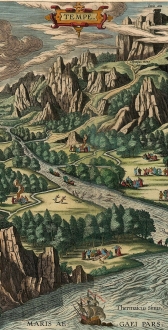
Halfway between Larissa and Platamon – both in northern Greece – the main road winds high above a deep gorge between the slopes of Mount Olympus and Mount Ossa. Passing through this place, the Vale of Tempe, our Land Rover laden with terracotta urns recently purchased in Larissa, brings to mind John Keats’ poem “Ode on a Grecian Urn”, which he wrote in 1819 and includes the words:

What leaf-fring’d legend haunts about thy shape

Of deities or mortals, or of both,

In Tempe or the dales of Arcady?

It was not through Keats’ words that I first heard of this place, but it was those of Edward Lear. In his “Journal of a Landscape Painter in Greece and Albania”, published in 1851, he wrote in his entry for the 9th of September 1848:

To see the classic vale of Tempe, the sacred mountain of Athos and the romantic Yannina have always been among my wishes; and I had long ago determined on making, previously to returning to England, a large collection of sketches illustrative of the landscape of Greece.”

And so, it also became my wish to see the vale. I was already familiar with Lear’s sketches that I had seen in a huge album in one of the libraries at University College London. My friends, Robert and Margaret, with whom I was travelling in Greece, gave me a 19th century engraving based on one of his Balkan sketches for my 21st birthday. Lear’s drawings are at least as good as his nonsense rhymes, for which he is well known. 

            The main road between Larissa and Platamon ran high above Tempe. Even from its edge one could see little or nothing of the gorge far below it, and certainly not what Lear would have been able to see when he visited it. One afternoon, Robert and Margaret kindly drove me to the southern end of the Vale of Tempe, and left me by the roadside. Then, they drove to its northern end, where they said that they would wait for me as I tried to retrace Lear’s footsteps along the depths of the gorge.

            When my friends drove away, I looked around to see whether I could find a track or path that ran along the base of the gorge. I saw two rustic looking men sitting high on a slope above me. I climbed up to them and with a combination of miming, which involved pointing at my feet, and repeating the word ‘Tempe’ I managed to make them understand that I wanted to walk along the gorge. They pointed up at the railway track high above us, and I understood that I was to walk along this.

            Soon after I reached the single tracked railway, I heard a train approaching me from the south. I stepped aside to allow the Athens to Munich Express to rumble past me. When this long train had sped ahead, I followed it at my own pace. After a short distance the track entered a cutting between two walls of rock. When I was halfway along this, a diesel engine came hurtling towards me. In the nick of time, I flattened myself against the rocky wall to avoid being mowed down. I continued forward, somewhat shaken. Soon after the track emerged from the cutting, I saw the entrance to a tunnel not far ahead of me. It was dark; its far end was not visible. After my near miss in the cutting, I decided that I would not enter the tunnel.

            I stood on the track near to the tunnel’s entrance and looked around. To one side there was a steep slope leading upwards. On the other, there was a slightly less steeply inclined slope leading towards the narrow base of the gorge. Cautiously I made my way down the slippery slope, grabbing hold of shrubs to slow down my descent. Soon, I reached a level path running just above a stream that ran along the base of the gorge.  It was, I realised, the bed of a long since demolished railway track. This was the railway that my informants had intended that I follow. The railway track that I had been following was its modern replacement. Suddenly I was walking in an idyllic landscape that must have hardly changed since Lear visited it.

            After a while, I reached what must have once been a railway station, but was now a place, maybe with religious connections, where visitors were able to obtain refreshments and to drink from a spring that issued nearby. I have since learnt that this place was called Agia Paraskevi and that the old railway station was opened in 1910. The suspension bridge close to this, which I crossed, was built in about 1960, and was replaced a few years ago.

Soon after leaving this delightful place, I reached the car park at the northern end of the gorge, where Robert and Margaret were waiting for me. They listened with great interest as I related my adventures including my narrow escape in the railway cutting.

[My book “Between Olympus and Aegean” is available from Amazon: https://www.amazon.co.uk/Between-Olympus-Aegean-Adam-Yamey/dp/1291882685/ ].  About the book:

Ants, bacon, collagen, and chlorine. These are not the first words that usually spring to mind when thinking about summers in Greece. The holidays that Adam Yamey spent in this country in the 1970s and 1980s with the professor and his wife were far from ordinary. This book provides an affectionate portrait of two remarkable people with whom the author spent many unconventional vacations. It also describes how the author travelled with them through a Europe which has undergone many transformations since these trips were made. Adam’s book is richly illustrated with his own photographs, many of them showing places that time has changed beyond recognition.

A walk in Greece

LEAR TEMPE BLOG

The River Pineios, which drains into the Aegean Sea near Stomio, runs along a ten kilometre, often very narrow, at times almost a thin cleft, the Vale of Tempe in Central Greece. Ancient legend has it that the valley was cut through the rocks by Poseidon’s trident. The Vale was believed to be the haunt of Apollo and The Muses. Other mythical characters are said to have visited in this valley. Whatever the truth of all these, the mythological associations and beauty of the Vale attracted the attention of the writer/artist Edward Lear (1812-1888), who was touring what is now Greece in May 1849. He was very keen to visit it.

In 1851, Lear published an illustrated account of his travels in the Western Balkans, “Journals of a Landscape Painter in Albania”. Although most know Lear best as a composer of verse, much of it humorous, he regarded himself as a painter primarily. He was without doubt a good painter and sketcher, but this is not what gave him lasting fame. The title of his book included the word ‘Albania’. This is appropriate because much of his travelling in the Balkans was done in what is now Albania and parts of central Greece that used to be important centres of Albanian people during the existence of the Ottoman Empire. Lear’s book on Albania is one of the loveliest books ever written about the country.

After seeing the spectacularly located monasteries at Meteora (close to the River Pineios), Lear wrote on 16th May 1849:

I had been more than half inclined to turn back after having seen the Meteora convents, but improvements in the weather, the inducement of beholding Olympus and Tempe … prevailed to lead me forward.”

On the 18th of May Lear recorded:

“…I set off with Andrea, two horses and a knapsack, and a steeple-hatted Dervish, at whose convent in Baba, at the entrance to the Pass of Tempe, my night’s abode is to be.”

Baba is described in the Seventh Edition of “Handbook for Travellers in Greece” (published by John Murray in 1901) as:

A pretty Turkish village. On the opposite side of the river stands the ruined fort of Gonnos, which commanded the entrance to the defile.”

The village of Gonnoi close to the southern end of the Vale is, I imagine, named after this fort. The long out-of-date guidebook pointed out that in Greek ‘tempe’ means ‘cutting’ or ‘chasm’.

On the next day, Lear noted:

The early morning at Baba is more delightful than can be told. All around is a deep shadow, and the murmuring of doves, the whistling of bee-eaters and the hum of the bees fills this tranquil place.”

After visiting the village of Ampelakia near the southern entrance to Tempe, Lear moved towards his goal, the Vale. He wrote:

“…I went onward into Tempe, and soon entered the celebrated ‘vale’ – of all places in Greece that which I had most desired to see. But it is not a ‘vale’, it is a narrow pass – and although extremely beautiful, on account of the precipitous rocks on each side, the Peneus flowing deep in the midst, between the richest overhanging plane woods, still its character is distinctly that of a ravine or gorge.”

After much wonderful descriptive writing, Lear concluded:

Well might the ancients extol this grand defile, where landscape is so completely different from that of any part of Thessaly, and awakes the most vivid feelings of awe and delight, from its associations with the legendary history and religious rites of Greece.”

Lear continued:

As it was my intention to pursue the route towards Platamona…”

‘Platamona’, or Platamon, to which Lear referred is a small seaside town on the coast of the Aegean Sea. It is overlooked by Mount Olympus and within sight of the mountains Pella and Ossa. It is some miles south of Katerini.  It played an important role in my life.

Every summer, my PhD supervisor Robert Harkness (died 2006) and his wife Margaret (died 2003) drove their caravan across Europe to Platamon, where they camped for about eight weeks on rough ground near the sea. I travelled out from England to Platamon with them on one occasion and did the return journey on another. Travelling via France, Germany, Austria, and the former Yugoslavia, the journey took almost ten days. During one of my visits to Platamon, in 1977, I mentioned that I was keen to follow in Edward Lear’s footsteps by visiting the Vale of Tempe. Robert and Margaret were keen that I should do this.

The modern road along which we drove, the Athens-Thessaloniki National Highway, ran high above the gorge along one of its edges. From this road, there was little if anything that could be seen of the Vale. Looking at today’s maps, it is evident that that road still exists, but a newer highway travels in a straighter route in a long tunnel, marked on the map as “Platamon Tunnel”. The latter only opened in 2017. It shortens the journey from Thessaloniki to Athens by several hours.

Robert and Margaret drove me to a spot near the southern end of the Vale and left me there, planning to meet me again when I reached the northern end of the gorge. I had no idea where exactly the Vale began and if there was a footpath in it that I could walk along. I began walking up through a sloping field to two men who were sitting there looking after their goats.

My Modern Greek was limited to a very rudimentary vocabulary. Using sign language, pointing at my feet, and mentioning the name ‘Tempe’, I managed to convey to these gentlemen my question about how to walk through the Vale. They pointed to a railway embankment high above where we were. I understood, or at least believed I did, that one had to walk along the railway track to see the Vale.

I climbed up to the embankment and began walking on a narrow gravelly path next to the railway track. Soon, a long passenger train with carriages belonging to various different European national railways passed me quite slowly. I could see from signs attached next to the doors of the carriages that this train was an express that connected Athens with Munich.  I continued walking in the direction of the Vale. The track was on an incline and the further I walked, the higher the embankment was above the terrain below it.

Eventually, the track entered a curved cutting lined on each side with jagged rocks. Suddenly, I heard something behind me. I forced myself against the rocky wall of the cutting just in time to avoid being crushed by a diesel locomotive travelling at a high speed. The engine sped past and I continued walking, somewhat nervously.

The track emerged from the cutting and traversed a high sided embankment at the far end of which there was the entrance to a dark tunnel. Seeing that ahead, I decided that it would be dangerously foolish to proceed any further along the track, the main railway line connecting Athens with the rest of Europe.

I stood on the embankment and looked around. To my right, I could see the River Pineios far below in what looked like an attractive narrow valley. I decided that as I was not prepared to risk my life in a dark tunnel, I needed to get off the railway track. So, with some trepidation I sat down and slid down the steep embankment until I reached its base far below.

At the bottom of the embankment, far below the railway line, I found myself on a level footpath that ran along an embankment that led down to the river. It became clear to me that this path was once the foundation for an old railway that had been replaced by the one which I had just left. As I walked along, I realised that this old railway bed was what the two gentlemen had meant by walking along the railway track.  The path wound its way through the depths of the Vale following the course of the river. The scenery down in the valley did not disappoint. It could not have differed much from what it was like when Edward Lear walked along the Vale 129 years earlier.

After a while, I reached what must have once been a railway station. I had arrived at the old railway station of Aghios (Saint) Paraskevi. This was part of a group ecclesiastical buildings. A suspension bridge for pedestrians ran from near it across the river to the other shore. Away from the river, there were some picturesque pools. The whole area was luxuriant with many trees, some with branches hanging over the stream.

The religious compound was not present when Lear walked the Vale. The old railway was built in 1910 as was the present church of Aghios Paraskevi (that stands on the site of a 13th century church). The bridge that I crossed was constructed in the 1960s. Before that, pilgrims could only reach the church by boat (see: https://www.johnsanidopoulos.com/2012/07/st-paraskevi-in-valley-of-tempe.html).

About two kilometres further on, the Vale reached its northern end. I found Robert and Margaret sitting in their Land Rover in a car park, enjoying hot tea from a thermos flask. I cannot remember whether I told them about my lucky escape whilst walking along the railway in the rocky cutting, but if I did not, which is likely because I would not wanted them to have been worried, now it is far too late. My two dear friends are now no more than fond memories, and the Pineios still flows through the Vale of Tempe.

Illustration is one of Lear’s pictures of the Vale of Tempe in 1848