A walk in Greece

LEAR TEMPE BLOG

The River Pineios, which drains into the Aegean Sea near Stomio, runs along a ten kilometre, often very narrow, at times almost a thin cleft, the Vale of Tempe in Central Greece. Ancient legend has it that the valley was cut through the rocks by Poseidon’s trident. The Vale was believed to be the haunt of Apollo and The Muses. Other mythical characters are said to have visited in this valley. Whatever the truth of all these, the mythological associations and beauty of the Vale attracted the attention of the writer/artist Edward Lear (1812-1888), who was touring what is now Greece in May 1849. He was very keen to visit it.

In 1851, Lear published an illustrated account of his travels in the Western Balkans, “Journals of a Landscape Painter in Albania”. Although most know Lear best as a composer of verse, much of it humorous, he regarded himself as a painter primarily. He was without doubt a good painter and sketcher, but this is not what gave him lasting fame. The title of his book included the word ‘Albania’. This is appropriate because much of his travelling in the Balkans was done in what is now Albania and parts of central Greece that used to be important centres of Albanian people during the existence of the Ottoman Empire. Lear’s book on Albania is one of the loveliest books ever written about the country.

After seeing the spectacularly located monasteries at Meteora (close to the River Pineios), Lear wrote on 16th May 1849:

I had been more than half inclined to turn back after having seen the Meteora convents, but improvements in the weather, the inducement of beholding Olympus and Tempe … prevailed to lead me forward.”

On the 18th of May Lear recorded:

“…I set off with Andrea, two horses and a knapsack, and a steeple-hatted Dervish, at whose convent in Baba, at the entrance to the Pass of Tempe, my night’s abode is to be.”

Baba is described in the Seventh Edition of “Handbook for Travellers in Greece” (published by John Murray in 1901) as:

A pretty Turkish village. On the opposite side of the river stands the ruined fort of Gonnos, which commanded the entrance to the defile.”

The village of Gonnoi close to the southern end of the Vale is, I imagine, named after this fort. The long out-of-date guidebook pointed out that in Greek ‘tempe’ means ‘cutting’ or ‘chasm’.

On the next day, Lear noted:

The early morning at Baba is more delightful than can be told. All around is a deep shadow, and the murmuring of doves, the whistling of bee-eaters and the hum of the bees fills this tranquil place.”

After visiting the village of Ampelakia near the southern entrance to Tempe, Lear moved towards his goal, the Vale. He wrote:

“…I went onward into Tempe, and soon entered the celebrated ‘vale’ – of all places in Greece that which I had most desired to see. But it is not a ‘vale’, it is a narrow pass – and although extremely beautiful, on account of the precipitous rocks on each side, the Peneus flowing deep in the midst, between the richest overhanging plane woods, still its character is distinctly that of a ravine or gorge.”

After much wonderful descriptive writing, Lear concluded:

Well might the ancients extol this grand defile, where landscape is so completely different from that of any part of Thessaly, and awakes the most vivid feelings of awe and delight, from its associations with the legendary history and religious rites of Greece.”

Lear continued:

As it was my intention to pursue the route towards Platamona…”

‘Platamona’, or Platamon, to which Lear referred is a small seaside town on the coast of the Aegean Sea. It is overlooked by Mount Olympus and within sight of the mountains Pella and Ossa. It is some miles south of Katerini.  It played an important role in my life.

Every summer, my PhD supervisor Robert Harkness (died 2006) and his wife Margaret (died 2003) drove their caravan across Europe to Platamon, where they camped for about eight weeks on rough ground near the sea. I travelled out from England to Platamon with them on one occasion and did the return journey on another. Travelling via France, Germany, Austria, and the former Yugoslavia, the journey took almost ten days. During one of my visits to Platamon, in 1977, I mentioned that I was keen to follow in Edward Lear’s footsteps by visiting the Vale of Tempe. Robert and Margaret were keen that I should do this.

The modern road along which we drove, the Athens-Thessaloniki National Highway, ran high above the gorge along one of its edges. From this road, there was little if anything that could be seen of the Vale. Looking at today’s maps, it is evident that that road still exists, but a newer highway travels in a straighter route in a long tunnel, marked on the map as “Platamon Tunnel”. The latter only opened in 2017. It shortens the journey from Thessaloniki to Athens by several hours.

Robert and Margaret drove me to a spot near the southern end of the Vale and left me there, planning to meet me again when I reached the northern end of the gorge. I had no idea where exactly the Vale began and if there was a footpath in it that I could walk along. I began walking up through a sloping field to two men who were sitting there looking after their goats.

My Modern Greek was limited to a very rudimentary vocabulary. Using sign language, pointing at my feet, and mentioning the name ‘Tempe’, I managed to convey to these gentlemen my question about how to walk through the Vale. They pointed to a railway embankment high above where we were. I understood, or at least believed I did, that one had to walk along the railway track to see the Vale.

I climbed up to the embankment and began walking on a narrow gravelly path next to the railway track. Soon, a long passenger train with carriages belonging to various different European national railways passed me quite slowly. I could see from signs attached next to the doors of the carriages that this train was an express that connected Athens with Munich.  I continued walking in the direction of the Vale. The track was on an incline and the further I walked, the higher the embankment was above the terrain below it.

Eventually, the track entered a curved cutting lined on each side with jagged rocks. Suddenly, I heard something behind me. I forced myself against the rocky wall of the cutting just in time to avoid being crushed by a diesel locomotive travelling at a high speed. The engine sped past and I continued walking, somewhat nervously.

The track emerged from the cutting and traversed a high sided embankment at the far end of which there was the entrance to a dark tunnel. Seeing that ahead, I decided that it would be dangerously foolish to proceed any further along the track, the main railway line connecting Athens with the rest of Europe.

I stood on the embankment and looked around. To my right, I could see the River Pineios far below in what looked like an attractive narrow valley. I decided that as I was not prepared to risk my life in a dark tunnel, I needed to get off the railway track. So, with some trepidation I sat down and slid down the steep embankment until I reached its base far below.

At the bottom of the embankment, far below the railway line, I found myself on a level footpath that ran along an embankment that led down to the river. It became clear to me that this path was once the foundation for an old railway that had been replaced by the one which I had just left. As I walked along, I realised that this old railway bed was what the two gentlemen had meant by walking along the railway track.  The path wound its way through the depths of the Vale following the course of the river. The scenery down in the valley did not disappoint. It could not have differed much from what it was like when Edward Lear walked along the Vale 129 years earlier.

After a while, I reached what must have once been a railway station. I had arrived at the old railway station of Aghios (Saint) Paraskevi. This was part of a group ecclesiastical buildings. A suspension bridge for pedestrians ran from near it across the river to the other shore. Away from the river, there were some picturesque pools. The whole area was luxuriant with many trees, some with branches hanging over the stream.

The religious compound was not present when Lear walked the Vale. The old railway was built in 1910 as was the present church of Aghios Paraskevi (that stands on the site of a 13th century church). The bridge that I crossed was constructed in the 1960s. Before that, pilgrims could only reach the church by boat (see: https://www.johnsanidopoulos.com/2012/07/st-paraskevi-in-valley-of-tempe.html).

About two kilometres further on, the Vale reached its northern end. I found Robert and Margaret sitting in their Land Rover in a car park, enjoying hot tea from a thermos flask. I cannot remember whether I told them about my lucky escape whilst walking along the railway in the rocky cutting, but if I did not, which is likely because I would not wanted them to have been worried, now it is far too late. My two dear friends are now no more than fond memories, and the Pineios still flows through the Vale of Tempe.

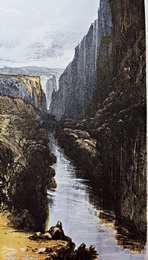
Illustration is one of Lear’s pictures of the Vale of Tempe in 1848


Buying a postage stamp in Bangalore

MERRY CHRISTMAS!

ALL I NEEDED WAS A POSTAGE STAMP. I could have walked around the corner to the post office in nearby Museum Road, but I chose to do otherwise. I found that there is a post office in Shivajinagar, a busy district in central Bangalore that contains many places of interest with ‘local colour’.

I asked directions to the post office from a couple of men standing in their tiny silver shops on the corner of Jewellery Street and Ebrahim Saheb Street. One of the men pointed in one direction and the other at the opposite. After some discussion, these kind gentlemen decided that I should head towards the large mosque at the top end of Commercial Street.

The Jumma Masjid stands at one end of Commercial Street on a traffic filled lane. A wider street lined with shops and market stalls leads from this centre of Muslim worship to St Mary’s Basilica whose tall spire dominates the skyline. The church and its grounds were exuberantly decorated with Christmas decorations. A portrait of Mother Teresa overlooks the busy courtyard in front of the church. A stall was selling gawdy decorations including a model of Father Christmas playing a brass coloured saxophone.

One side of the square outside of the church compound was lined with stalls selling decorative Christmas items, ranging from paper stars to models of Nativity cribs.

A building with indo-arabesque domes lines part of another side of the square. This is Russell Market, an indoor food bazaar. The picturesque building was built by the British in 1927.

Russell is not the only market in Shivajinagar. On my rambles today, I came across a couple of other food markets. These are not housed in buildings like the Russell Market, but in simple shacks. Years ago while wandering in Shivajinagar, I came across an open air bazaar specialising in spare parts for automobiles. I have not been able to find this chaotic jumble of motoring spares again, but I have been told it still exists.

HKP Road leads away from the Square that contains Russell Market. I had never been along this road before. The first thing that caught my eye was the covered Beef Market, which bears the date 1932. Near its entrance I saw butchers working on huge pieces of unrefrigerated beef. There is another beef market, which I have visited before, at Johnson Market at the south of the city centre.

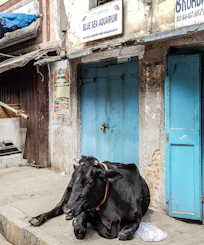
Outside the Beef Market, there were numerous cages containing birds for sale as pets. Proceeding a few yards away from the Beef Market, I had to step aside to avoid bumping into a live cow occupying most of the pavement outside a shop called “Blue Sea Aquarium”. This was close to a shop specialising in repairing sewing machines, both electrical and pedal operated.

After crossing a canal, or maybe, judging by its smell, an open sewer, I spotted an old house with ornate shades over its windows. I photographed it.

The old house is opposite a tiny post office, which I entered. Three men were sitting behind the counter in a disordered office space. Eventually, one of them attended to me. After weighing my letter and scrutinising the address on its envelope, I was handed a 5 Rupee stamp. Using glue from a pot on the counter I affixed the stamp.

I had already handed over twenty Rupees, but received no change. When I had stuck on the stamp, I asked for my change. The post office employee who had sold me the stamp seemed surprised. One of his colleagues rummaged around in a drawer, and handed me ten Rupees. Neither I nor the post office had five Rupees to give the correct change. I felt it was worth losing 5 Rupees at this transaction because my journey to reach it had been far more interesting than had I walked to the post office nearest to where I was staying.

After leaving the post office, I began walking back along HKP Road. A motor scooter pulled up alongside me. It was being driven by a man. Behind him sat his child and his wife in full burqa. He said that he had seen me taking a picture of his old house. I told him that I am interested in the old buildings of Bangalore. He told me that his house was over 100 years old and that I should visit his clothing shop in Commercial Street.

Sighting the high Himalayas

TODAY, WE WERE LUCKY. When we awoke at about 630 am, the sky was almost cloudless. There was no mist. We headed for breakfast at Bakers Café on MG Marg. We took a table by a window with a view of the hills that face Gangtok. To our great delight, we could see the snow covered slopes of Mount Kanchenjunga far beyond the nearer hills. Even though the great peak was partially obscured by clouds, we had managed to see it at last. Until 1853, this mountain was believed to be the highest on the planet. More accurate surveying showed it to be the third highest, K2 also known as Chhogori.

After breakfast, we strolled along MG Marg and then its continuation, New Market. At the far end of the latter, the hitherto fully built up thoroughfare began to be punctuated with greenery, trees and other plants.

After a short ascent, we reached the Ropeway station. It is the halfway point of s cable car service that runs from a much higher station to a far lower one. Currently, the service only runs from the midway station to the lowest one. We boarded one of the two red cable cars to make the descent. Unlike other cable cars I have been on, each cable car has its own cable instead of being on a continuous loop. When the car reaches a station, its driving cable reverses its direction of motion.

The views during the descent are dramatic. The usually tall buildings of Gangtok appear to have been built on step like terraces cut into the sides of the steep slopes of the terrain on which the city is situated. The cable car glides high above a winding road along which an unending stream of small local taxis flows. Looking left and right the tree covered hills surrounding the city offer exciting vistas. The return journey, the ascent, was less dramatic, but enjoyable nevertheless.

We dawdled back the way we had approached the cable car station, enjoying the warm sunshine. Many people were walking around including a significant number of police men and women carrying lathis and short sticks. Wearing berets and dark blue uniforms, they appeared to be milling around casually and without seeming menacing. Every now and then, we saw porters carrying what looked like heavy loads. They wear a thick padded strap over their foreheads. These straps are attached to cords that are tied around what is being carried on the porters’ backs. As they walk, the porters incline their heads slightly forward. This kind of portering looks like a tough way of earning a living.

The shops on MG Mar were open, but those lining the steps leading down to Lal Bazaar were shuttered up, closed. In Gangtok some businesses close on Thursday and others on Saturday. Today, it is Thursday. Fortunately, the excellent, albeit somewhat scruffy, Potala Restaurant in Lal Bazaar was open. I enjoyed a good number of delicately flavoured delicious beef filled steam momos.

After lunch we visited the Organic Market, which is housed in a curved gallery, one of the floors of the so-called Super Market, which is not a supermarket but a multi-storey covered market. Next, we strolled along some of the elevated pedestrian walkways that run above the National Highway, the main thoroughfare of Gangtok.

Before returning to our hotel, we stopped in a small café for beverages. It had a range of breads and pastries that equalled that you would expect to find in large European cities. This was not an isolated example. Gangtok abounds with well stocked bakeries.

The temperature had begun to drop when we reached our hotel, where we sttled down for a siesta.

PS We were fortunate to sight Kanchenjunga on the 28th November, the anniversary of the independence of Albania. Sadly, that country had just experienced a terrible earthquake.

Foolish on foot

Taxi!_240


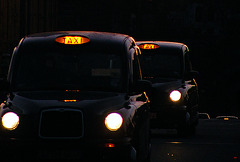
Years ago, I had friends who lived south of Hampstead Heath in South End Green, near where the writer George Orwell lived during the 1930s. I often visited my friends there and usually stayed with them until long after public transport ceased working late at night – those were the days long before 24 hour bus services. In those days, I was a student with limited means. Taxi and minicab rides to my home in Hampstead Garden Suburb to the north of Hampstead Heath were costly and if used too often would eat too deeply into my meagre funds.

So, often I used to walk through the darkness to my home, a distance of well over 2 miles. Most of this walk was across the wooded stretches of Hampstead Heath. Even back in the 1970s, this vast expanse of urban woodland was far from safe. Murders and attacks were not unknown. My parents and others would have been horrified to learn that I was risking my life to save paying a cab fare. Was I scared? The answer was both yes and no. I was concerned because of the news stories I had read. Yet, on the other hand I was not so afraid.

I felt that anyone encountering me on my nocturnal wandering deep in the secluded heart of Hampstead Heath might have had one of two reactions. Either he or she might have imagined that I was up to no good and possibly on the prowl for victims and would therefore steer clear of me, or that the person  whom I encountered was up to no good. If he or she was ill-intentioned, the person would have still had to be a little bit cautious because I might have turned out to be more than a match for him or her. This reasoning would have done me no good had the person I met been severely evil. 

Fortunately, luck was on my side. I never encountered anyone, innocent or evil, on my nocturnal strolls. However, I would never even dream of making this kind of journey across Hampstead Heath again, and would not advise anyone else to attempt it because London has become more dangerous than it was in the 1970s and before.

One step, then another

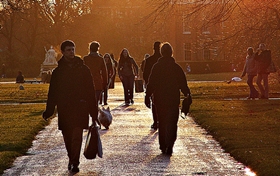
Walking in the park_640


One foot then another

The world passes by

How I enjoy walking


You can walk almost anywhere except on water when it is not frozen. And, the joy of this form of physical activity is that no special equipment is needed.

During the first few decades of my life, I used to walk long distances routinely. I would never wait for a bus, but would walk from stop to stop until the bus and I met in the same place. Then, I might have boarded it unless I was close to my destination. Today, I am lazier, and will wait for the bus.

Walking (without staring at a mobile telephone) is a wonderful way of seeing new things. You might walk the same route repeatedly but if you keep your eyes and mind open, you are bound to spot things that you never noticed before. 

In recent years, I have begun writing books, articles, and, now, blogs. I often find that leaving my work desk, switching off the PC, and then taking a walk is perfect for sorting out my ideas. As I walk along, thoughts circulate in my mind and these result in improvements in whatever I am writing. 

Apart from any medical benefits, using Shank’s Pony (moving along with one’s own two feet – walking) gives me great pleasure.

Self absorbed

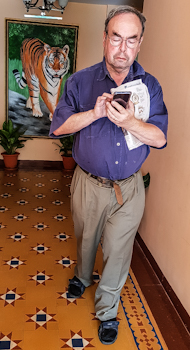
Two of several aspects of contemporary life irritate me. One of them is self-righteous cyclists in London, who disregard red traffic signals and risk fatalities. Another thing I find upsetting is people who walk along in the street with their eyes glued to the screens of their ‘smart’ phones.

Some of these phone obsessed pedestrians catch sight of fellow pavement users and take steps to avoid collisions. Many others do not. They are so very intimately involved with their screens that they seem unaware of their immediate surroundings and other people using the pavement.

Walking along with your eyes focussed on the phone is just like driving a car blindfolded. It is both foolish and selfish. It is foolish because you might trip on an uneven paving stone or fall into a hole. It is selfish because your inattention to fellow human beings causes them inconvenience.

And, what if the thoughtless phone user collides with another pedestrian? The phone user will blame the innocent victim of his or her selfishness for not looking where he or she was going. Actually, it is the phone obsessed pavement hog who is at fault on every occasion.

So, please walk with your eyes on the world around you, and not on the tiny phone screen in your palm.

Here ends my rant!