Hotel Lokomotiv

IT WAS 1982 WHEN THE ‘IRON CURTAIN’ still divided Soviet-controlled Europe from Western Europe most effectively. I was heading off towards Budapest from England in order to meet my friend and budding author the late Michael Jacobs, who was  becoming a renowned travel writer.


SOPRON 1

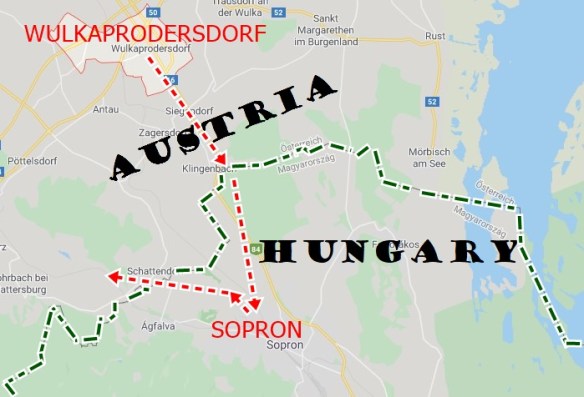
Before setting out on this trip, I had noticed that there was a railway line that began in Austria, crossed over the Iron Curtain into Western Hungary, and after running a short distance through Hungary, it crossed back into Austria. Intrigued, I checked whether it carried passengers, and found that it did. This, I decided would be the way that I would try to enter Hungary.

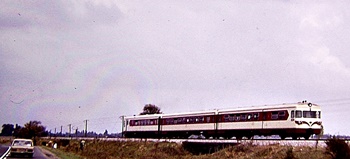
On reaching Vienna’s Westbahnhof, I travelled through the city to the Südbahnhof, where I caught a train that took me to Wiener Neustadt. When I disembarked, I noticed a diesel powered passenger rail bus standing on a siding. It was painted in a livery that I did not recognise. It was not the livery of OB (the Austrian State Railway), or of MAV (the Hungarian State Railway).  Two men wearing black leather jackets were standing next to it. I asked them in German whether this was the train to Sopron (just over the border in Hungary). With hand gestures, they motioned me on board. Soon, the two men boarded the train. One was its driver. We set off. I was the only passenger as the train drifted through vineyards and fields. After a short time we stopped at a small village called Wulkaprodersdorf.

The driver and his assistant disembarked, and so did I. From where I stood next to the ‘train’, I could see men in blue overalls working in a distant field. The two train men stood smoking and chatting to each other in Hungarian. An old steam engine with the logo ‘GySEV’ stood on a plinth, a memorial to times gone by. The rustic scene reminded me of lines from the poem ‘Adlestrop’ by Edward Thomas:

The steam hissed. Someone cleared his throat.

No one left and no one came

On the bare platform. What I saw

Was Adlestrop — only the name


And willows, willow-herb, and grass,

And meadowsweet, and haycocks dry,

No whit less still and lonely fair

Than the high cloudlets in the sky.


And for that minute a blackbird sang…

Just change Adlestrop for Wulkaprodersdorf, and you will know how I felt waiting there.

After a while, all of the workers in the field converged on the train and boarded it. I joined them in the now full train, and we set off towards Hungary.  To my surprise, we sailed past the rows of barbed wire fences, the sandy tracks, the watchtowers, the military men with dogs, without stopping. I had crossed the ‘Iron Curtain’ and entered Hungary without showing my passport. This was quite unlike any other time that I had travelled to Hungary by train.

The single carriage train pulled into Sopron’s station alongside a platform that had a barbed wire fence running along it. When I stepped out onto the platform, two uniformed guards came to meet me. How they knew that I was on the train was a mystery to me. They took me to an office, where their superior examined me and my visa, before stamping my passport. As the officials seemed friendly, I decided to ask them where I could find a private room to stay. Instead of directing me to the state tourist office, which usually arranged accommodation for foreigners, the official told me to come with him. He drove me to a house on the edge of Sopron, and told me to wait in its garage.

After a few minutes, he returned with a lady, who then took me to her house. Somehow, she managed to explain to me that I could rent a room from her, but I had to leave at 8 am in the morning. I rented her room for two nights.

On the following morning, I decided to try to ring Michael Jacobs at the number he had given me where he was staying in Budapest. I found a coin-box public telephone, but was completely flummoxed by the instructions which were only written in Hungarian. Undaunted, I entered Sopron’s fin-de-siècle central post-office. The large public hall was surrounded by desks each with signs above them in Hungarian. I looked for a desk with a sign that resembled ‘telephone’ or even ‘telefon’, but saw nothing remotely similar. While I was looking, a man in a suit and tie came up to me and announced in passable English:

Today is my day for helping foreigners. How may I help you?”  

I told him that I was trying to ring a number in Budapest, and he took me to a desk where I parted with a not inconsiderable amount of cash, only to discover that the call could not be made.

After that disappointment, my ‘helper’ asked:

You like wine?

I replied that I did.

Come with me then,” he said, leading me to a group of well-dressed middle-aged men.

“Visitors from Austria,” he said, leading me and his visitors to a minibus bearing the livery of OB, Austrian Railways. We drove through Sopron, and my new friend explained that he was hosting some Austrian railway officials who were visiting for the day.

We arrived at a wine cellar in a historic building in the heart of Sopron, and sat at wooden tables in a cellar with a vaulted ceiling. By now, I was getting quite hungry. My new friend sat me beside him, and for the rest of the time ignored his Austrian guests. In front of us there wooden platters with salami slices and what looked grated cheese. Greedily, I put a handful of this grated matter in my mouth, and sharp needles shot up towards my eyeballs. The ‘cheese’ was in fact freshly grated horse-radish! Wine was served, and all of us partook of it liberally.

During our drinking session, my friend said to me:

It is Vunderful. So Vunderful. You could have visited Paris; you could have visited Rome; you could have visited New York.  But you have come to our little Sopron. That is so Vunderful. So Vunderf…”

Eventually, it was time for the Austrians to return home. They piled into their minibus, and we waved farewell to them. Then, my Hungarian friend led me to a rather tatty looking faded green minibus, an East European model, and we entered. My host, an official of GySEV (Győr-Sopron-Ebenfurti Vasút) – the mainly Hungarian-owned railway company which had brought me into Hungary – drove me to a shabby hotel.

Hotel Lokomotiv,” he announced proudly, “now we drink more.”

By now, I had had enough wine, but insufficient food. I drank Coca Cola or its Hungarian equivalent whilst my friend continued drinking wine – all afternoon. After the sun had set, I decided that I should return to my room.

I will take you there,” he said slurring.

As we began walking through the town, I had to support my staggering friend, and also guide him through his own town. When we had nearly reached where I was staying, he said:

Next time you are in Sopron, you will stay in my house. I will put wife in another room. You will sleep in my bed.”

With that, we parted company.

I never took up his offer because the next time I visited Sopron, I was already married.

By train through Hungary and a slice of watermelon

I USED TO VISIT HUNGARY regularly in the 1980s before the end of Communist rule in that country. Sometimes I drove, other trips I travelled by rail.

BLOG KAP 1 KAPOSVAR 85 Hotel Kapos

In 1985, I boarded a train at London’s Victoria Station. As I was settling  down in my seat, a couple accompanying an older man asked me if I could look after on the journey to Hungary. He was their relative and only spoke Hungarian. My knowledge of that language was limited to a vocabulary of less than 100 words including ‘fogkrem’ meaning toothpaste and ‘meleg szendvics’ meaning heated (toasted) sandwich, and ‘menetrend’ meaning timetable and ‘kurva’, which you can look up yourself! I agreed to do my best to look after the gentleman.

After taking the ferry across the English Channel,  we boarded an express train bound for Budapest. The gentleman and I were in the same couchette compartment along with some young people.

We stopped in Brussels early in the evening. A late middle-aged Belgian couple entered our compartment, and we set off eastwards. After nightfall, the Belgian couple left us. Several minutes later, they returned. They had changed their clothes. They had dressed in pyjamas and silk dressing gowns. Clearly, they were either unfamiliar with travel in 2nd class couchettes or had formery been used to travel in 1st class Wagon Lits sleeping cars.

We arrived at Hegyeshalom, a Hungarian border town close to Austria. As I was planning to visit southern Hungary, I disembarked there. So did the man who I was ‘looking after’. He was met by some of his family. Although they spoke no English,  they expressed their gratitude for me, and kindly offered to drive me to Győr, where I wanted to catch another train.

At Győr, they helped me find my train. I boarded a basic looking local train bound for Keszthely on Lake Balaton. After a while, the train stopped in the middle of the countryside and everyone except me disembarked.  I looked out of the train. We were not at a station. Someone saw me and signalked that I should also leave the train. We all boarded buses that had been laid on to substitute for the train that could not proceed further because of track repairs. 

After a ride through flat agricultural terrain, we reached a small station,  where we boarded another train, which carried us to Kesthely, arriving at about 4 to 5 pm.


I looked around the station at Kesthely and for some unaccountable reason I decided that I did not want to stay in the lakeside resort. I looked at a timetable and discovered that a train would be leaving soon, bound for Kaposvár, which was on the way to the southern city of Pécs.

A Hungarian couple with one child ‘got wind’ of my plan to join the train to Kaposvár, and took me into their care. I boarded the train with them and travelled in their company as the train followed the southern shore of Lake Balaton.

My ‘minders’ left the train at the lakeside station at  or near Balatonlelle. Before they disembarked,  they asked a man, a stranger to them, in our compartment to look after me. He spoke only Hungarian.

As the train wound its way inland through hills south if Lake Balaton, the sun set and it became too dark to see the countryside through which we were moving slowly.  Although there were light fittings with light bulbs in our compartment, they were never turned on. The two of us travelled in total darkness. We tried conversing, but with little meaningful success.

We both left the train at Kaposvár station. Darkness reigned. I had no idea where or even whether there was a hotel (szálloda) in the town. However, my latest ‘minder’ led me to a large state run hotel, the Kapos.

The young receptionist spoke good English. She asked me if I had any books in English. I did. I gave her one that I had already finished. She was very happy.

After a heavy meal in the hotel’s large restaurant (etterem), I  retired to my room. The hotel had poor sound insulation. There was a party somewhere in the building and my room seemed to be throbbing with the loud music.

After a while, there was a knock on my door. I opened it and found a waitress holding a plate with an enormous slice of watermelon. She muttered something about  ‘recepció’. I realised that the watermelon was a thank you gift from the receptionist.

I took the watermelon into my room and stared at it. Then and still now, I cannot stand eating watermelon.  I could not throw it away because it was bound to be discovered and that would have seemed very ungrateful on my part. So, after a bit of thought, I carried the slice of fruit downstairs to the receptionist to whom I had given the book. I thanked her, and then explained, telling a ‘white lie’, that I was allergic to watermelon.  She seemed to believe me.

That night, I found it difficult to sleep partly because of trying to digest my heavy dinner and the noise from the party.

On the following day, I took another train to Pécs having stayed in a city I had never heard of before.


Picture of Hotel Kapos in Kaposvar in 1985

Eating on a train


OHRID BITOLA 77 Train from Medzhitlija


IN THE SUMMER OF 1973, I was on holiday in Greece. Our family and that of ‘K’, a good friend of mine were guests of an extremely wealthy Greek. We had been put up in luxury hotels. We stayed in the George V Hotel in Athens and K’s family were put up by the sea at a luxurious resort at Vouliagmeni. Before leaving England for our Greek holiday, K agreed to accompany me on an excursion north from Greece to a lake in southern Yugoslavia, Lake Ohrid, a body of water now shared by Northern Macedonia and Albania. I was curious to gaze at the then very mysterious Albania across the water from Yugoslavia and K was just being a ‘good sport’ in agreeing to join me.

One day in Athens, K and I left our very comfortable accommodation and arrived at the railway station from which northbound trains departed. The route between Athens and Thessalonika was long and slow, the train having had to wind its way across mountain ranges.

Every twenty minutes, an attendant arrived at our compartment carrying a tray with pork kebabs, lumps of cooked pork on thin wooden skewers. The barely warm meat was delicious. Each skewer seemed better than the previous one. We kept on buying them each time the attendant arrived.

After several hours and many skewers, K said that he had eaten enough of them and he was not feeling too well. My reaction to this was that being an inexperienced traveller compared to me, his stomach was weak compared to mine. I continued munching the delicious kebabs as the journey continued.

At a small place, which was probably Platy, in northern Greece, our train left the main route and headed along a branch line towards Edessa, where we disembarked. Before leaving the station, we had to have our tickets endorsed by a railway official so that we could continue our journey the following day. As soon as we disembarked, K thrust his ticket into my hand and rushed to evacuate his bowels in a field of ripe corn next to the railway.

We booked into a small hotel, the Olympus, in Edessa, where we paid the Drachma equivalent of £1 Sterling for a room with two beds. I gave K some of my anti-diarrhoea tablets, and he ate some plain yoghurt for supper. At this point, I was still thinking how sad it was that my friend’s stomach was so delicate. Surprised to be hungry after having devoured so many pork ‘souvlaki’ on the train, I ate a normal supper.

The beds in the hotel were very short. My feet projected beyond the bed end. I slept well. The next morning, K was feeling much healthier. However, I was not. I had a terrible pain in my stomach which made it difficult for me to stand up straight. I took some of my tablets and tried without much success to enjoy a bowl of plain yoghurt upon which there was a puddle of oil.

We returned to the railway station and boarded the train which took us westwards to the small town of Florina. We had a short stay, a few hours, in Florina, where I recall buying a roll of toilet paper. The daily train, a single motorised carriage, from Florina to the border with Yugoslavia departed in the early afternoon. K and I were the only passengers. At the border, the Greek carriage drew up next to a Yugoslav motorised train with several carriages on the neighbouring track. A Yugoslav soldier instructed us to move from the Greek to the Yugoslav train and then we set off northwards through southern Yugoslavia, crossing a flat plain with well-tended fields.

We disembarked at Bitola, once known as ‘Monastir’, and transferred to a long-distance bus. As the sun set, this carried us north westward over the mountains towards the historic city of Ohrid on Lake Ohrid.

It was dark by the time we arrived at the campsite on the lakeshore about a mile north of Ohrid city. Both of our stomachs had settled down. For the next few days, I explored the beautiful sights along the lake and enjoyed the local food, much of which was in the form of kebabs. K, having been made wary as a result of our experiences with the Greek railway ‘souvlaki’, avoided this kind of food, preferring to feed himself at our campsite.


Picture taken in 1977 shows the train in Yugoslavia between the Greek border and Bitola

Hotel Tirupati

The Hotel Tirupati in New Jalpaiguri (NJP) is a few minutes walk from an important railway junction in West Bengal. Its rooms are comfortable but the hotel has several curious features.

The bedrooms we occupied on two separate occasions contain more lights, each with their own switch, than I have seen anywhere in similarly sized rooms. The lighting included unshaded blue and red light bulbs and a recessed ceiling lamp which bathed the room in a subdued eery blue light.

The rooms in the hotel are arranged around galleries overlooking a covered central light well. The ground floor of the light well, a central courtyard, contains a large effigy of the Hindu deity, the elephant-headed Ganesh (see image above). It forms part of the hotel’s large Hindu shrine. At least twice a day, bells are rung and a pooja is performed. I have not come across this before in my over 25 years of visiting India and its hotels.

The most curious feature of this hotel in NJP is the presence of CCTV cameras not only in the bedrooms but also in their ensuite bathrooms. I never dared to find out their purpose and whether these were in use!

Toy Train to Darjeeling

My mother’s father, who died young in the early 1930s was Mayor of Barkly East, a small town in the Eastern Cape (South Africa). He was the driving force in bringing the railway over the mountains from Lady Grey to Barkly East. This was the most expensive (in terms of cost per mile) stretch of railway ever built in South Africa. It included a series of switchback stretches to allow the trains to ascend or descend the steep mountain slopes.

Today we travelled on a narrow gauge mountain railway with at least 5 switchbacks. It is the so called ‘Toy Train’ that runs incredibly slowly between New Jalpaiguri and Darjeeling which is in the foothills of the Himalayas, more than 2000 metres above sea level.

We took almost two hours to travel the first about three miles. This was mainly because of a seemingly interminable wait for a signal man to arrive to allow our train to cross a river near Siliguri. Soon after we began moving, we passed tea gardens and began our several hour slow ascent towards Kurseong, Ghum, and Darjeeling.

The train follows the route of NH55, crossing over it frequently at unguarded level crossings. The serpentine course of the railway is designed to lengthen its route in order to reduce the gradients that need to be tackled.

The wheels squeal and shriek as the carriages wind around the tight curves of the tracks. The engine’s horn blasts very frequently to clear the path for the train.

The views from the train are spectacular. The carriages pass extremely close to buildings, plants along the side of the track, and steep drops. Passing through towns on the route, sometimes we were so close to shops beside the track that it would have been easy to snatch goods from them. Leafy branches sprung through the open carriage windows, shedding leaves and flowers.

The flora along the route was very varied. We passed a multitude of colourful flowers including magnificently exuberant poinsettias.

Because of our slow start we travelled the last three and a half hours in darkness as the sun set long before we arrived at our destination.

Our enjoyment of this superb railway journey was enhanced by having conversations with a businessman from Bangalore and a couple from Lincolnshire in the UK.

Even though it is very slow, a trip on the Toy Train is thoroughly recommendable.

Scene in a ticket office

BUDAPEST KEL PU 83 Farewell 2

I used to visit Budapest in Hungary frequently in the 1980s during the Communist era. I had many good Hungarian friends there. They were very hospitable to me.

One day, I happened to visit the advanced booking office at Budapest’s grand Keleti (Eastern) Station. I have no recollection of where I was planning to go, but that is not relevant to the true story that follows. The smallish rectangular room was lined with about ten (or more) counters at each of which there was a booking office official. 

A young Soviet Russian soldier entered the room. He was in an immaculately smart uniform and looked proud. He went up to the first counter and spoke to the person behind it. After about a minute, he was instructed to go to the next counter. Once again, he spoke to the official behind the window at the counter. And, after a few minutes, he was directed to the next counter. This went on until he had visited each counter in the room and reached the last one. At the last one, the official indicated that he should leave the room as he was in the wrong room for obtaining tickets for Soviet military personnel.

You might have thought that the official at the first counter he visited would have directed him to the correct place, but no. So great was the average Hungarian’s disdain for the Soviet soldiery that was keeping their country under the thumb of the Soviet Union that the officials in the booking office conspired together to waste the young Soviet soldier’s time and humiliate him. It was a beautiful example of passive resistance.

A surprising place

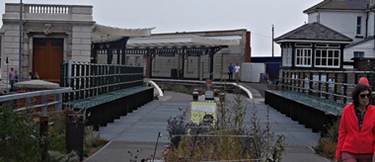
F48 Folkestone Habour Station


After getting off the train at Folkestone Central station in Kent, you might wonder why you had bothered to travel there. The way from the station to the town centre is far from preposessing.

Until 2001, trains used to run along a branch-line through the centre of Folkestone along its pier to Folkestone Harbour Station, where passengers could embark on one of the many regular cross-Channel ferries shuttling between Britain and France. Between 2001 and 2009, special tour trains like the Simplon-Orient Express  used the station. In 2014, the line was closed. With the opening of the Channel Tunnel and the closure of Folkestone Harbour Station and the line leading to it, Folkestone declined in importance. Knowing this, I expected the town to be very depressing, but a recent visit proved me to be completely wrong.

You might be wondering what prompted us to visit this formerly important  seaport. What caught our eyes was an article about how Folkestone has become a town of art filled with open-air sculptures and other artworks. It has what one of its publicity brochures describes as “The UK’s largest urban contemporary art exhibition“. And, most of the art on display is permanently resident in the town. The works are by a large range of artists including,amongst the better-known: Yoko Ono, Tracy Emin, Cornelia Parker, and Antony Gormley. The artworks are to be found in locations all over the town, but are in their greatest concentrations within the picturesque historic centre and along the attractive sea front.

The long pier along which trains used to run and the disused platforms of Folkestone Harbour Station (see illustration) have been beautifully restored and have become a wonderful leisure area with lovely walkways, artworks, and a variety of refreshment stalls. The restoration has been done very sensitively and beautifully. 

The centre of Folkestone is, unlike the area surrounding it, full of life and ‘buzz’. There are many art galleries and eateries as well as a contemporary art centre, the Folkestone Quarterhouse. The Quarterhouse is well worth entering if only to see Ben Allen’s spectacular The Clearing (an architectural installation that has to be seen to be believed) on the building’s first floor.

What we particularly liked about Folkestone is that despite being chock-full of art, it does not feel pretentious. It is a place that people can enjoy the joys of the seaside (nice beaches and fine sea front) as well as, if you feel in the mood, the delights of contemporary art in charming settings. We spent about six hours in Folkestone. Next visit, we will stay there for a couple of nights.

Much more information available here: 

https://www.creativefolkestone.org.uk/folkestoneartworks/

Poetry

Steaming_240


I have never been able to enjoy reading poetry and enjoy it. However, if it is read out aloud by someone else, I usually love what I hear.  Poetry is like music made with words.

Here is a poem that I have enjoyed ever since I was a young teenager. It is Adlestrop by Edward Thomas (1878-1917). He was killed in France during WW1. His poem captures the essence of the world that reveals itself gradually when a train stops at a small country station.


Yes. I remember Adlestrop—

The name, because one afternoon

Of heat the express-train drew up there

Unwontedly. It was late June.

The steam hissed. Someone cleared his throat.

No one left and no one came

On the bare platform. What I saw

Was Adlestrop—only the name

And willows, willow-herb, and grass,

And meadowsweet, and haycocks dry,

No whit less still and lonely fair

Than the high cloudlets in the sky.

And for that minute a blackbird sang

Close by, and round him, mistier,

Farther and farther, all the birds

Of Oxfordshire and Gloucestershire.