Indian way of worship

Over and over again, I am impressed by the “Indian-ness” of worshipping in India. I will illustrate what I mean by this by describing a small Orthodox Christian chapel I visited on Bazaar Road in the Mattancherry district of Cochin (“Kochi”) in Kerala.

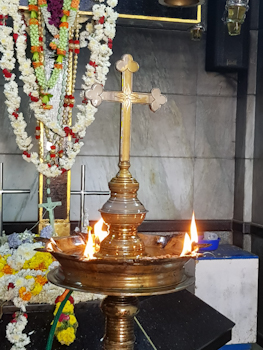
Outside the chapel, there stands a carved stone stand with indentations for oil lamps (diyas). It looks just like any diya stand that you could find in a Hindu temple, except that it is surmounted by a Christian cross.

The crucifix that stood above a small high altar within the chapel was draped with flower garlands (malas). Again, these are commonly found draped around effigies of Hindu deities.

I saw a brass diya stand with burning oil lamps directly in front of the crucifix. Like the lamp stand by the entrance, this one was also topped with a Christian cross.

If one were to replace the crucifix with an effigy of a Hindu deity and were to remove the crosses from the diya stands, the chapel would become identical to a Hindu temple.

The use of diyas and also agarbati sticks (incense sticks) is not confined to Hindu temples. I have seen them used in Christian as well as Islamic (especially Sufi) and Jain places of worship.

At a Sufi shrine at Sarkej Rauza on the edge of Ahmedabad in Gujarat, I have seen tulsi leaves being sold. These are commonly associated with Hinduism, but the vendor in the Sufi shrine told me that they were also used by worshippers who came to the shrine.

I have seen threads tied around the trunks of peepal trees by pious Hindu women hoping to have their wishes granted. I have also seen threads tied by women around pillars in Moslem shrines for the same reason.

Hinduism was probably one of the earliest religious belief systems to become evident in the Indian subcontinent. Christianity and Islam were relatively recent arrivals. Many Hindus converted to these two religions, but, I imagine, they were reluctant to abandon their Hindu heritage completely. Hence, the Hindu-ness or Indian-ness of some aspects of other religions in India.

What do you expect?

We have been staying in a medium priced, by no means cheap or low-budget, guest house at a popular place in the southwest of India.

For several mornings, there was no hot water coming from the taps in our bathroom. Usually, the problem was resolved after mentioning the it to the man looking after our guest house. We were paying an amount per night at which it was reasonable to be able to have hot water without first having to ask for it.

One morning, we asked a fellow guest, an Indian, whether there was hot water in his bathroom. He said that there was none. When we said to him that in accommodation of this calibre hot water should be available as a matter of routine, he said: “There must be a problem. These things happen occasionally.” After a few moments, he added: “What do you expect? This is India.”

His bland acceptance of low standards and feeling that these were to be expected of his country do little to move India forward in a positive way.

Coffee with ginger

Cochin is a port on the Malabar coast. It provided a haven and home for people from all over the world, including Arabic traders. Now, it attracts foreign tourists from all over the world. This article is about a legacy of the Arab settlers.

I have occasionally drunk coffee flavoured with cardamom in Arabic restaurants. This drink is identical to Turkish coffee but is subtly tinged with cardamom.

An article, published on 28th December 2018 in the Hindu Metroplus (Cochin edition), alerted us to the existence of Kava Kada, a tiny café next to the Mahalari Masjid (mosque) in the Mattancherry district of Cochin in Kerala (India). The café is literally a hole-in-the-wall in the side of the masjid, a few feet away from the main minaret.

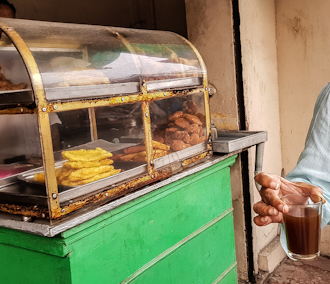
A small, aged glass counter-top display cabinet contains a few fried snacks including batter covered fried bananas. There are a couple of very low benches for customers to sit on. The owner of the café stands behind the counter surrounded by metal pots and a gas stove.

This tiny outlet is famed for its Arabian style ‘kava’. This coffee is served in small thick-walled glasses. I have never tasted coffee like this. At first, I thought I was drinking biryani flavoured sweetened coffee. It was delicious. Quite unlike any other coffee that I have drunk, this kava is flavoured with dry ginger, cloves, sugar, cardamom, black pepper, and other spices.

The café is located close to a bustling intersection of two main roads. Cars, two-wheelers, autorickshaws, and small trucks whizzed passed us a few inches away from where we were sitting. Two goats wandered past, seemingly unconcerned by the traffic.

The coffee shop was set up long ago by the now aged Kochumuhammad, who, as a boy, was taught by Arab migrants how to prepare the special kava. For the past 20 years, the shop has been run by one of his 26 grandchildren, a man called Riyaz.

We spent about 10 minutes sipping our coffee, which is good for the throat, so an autorickshaw driver told us. During our brief stay, there was a steady stream of customers buying kava.

I am very grateful to the intern Amala Rose Boben, who wrote the newspaper article, for alerting us to this fascinating little coffee house.

Disabled drivers

During our very recent stay in the Cochin/Ernakulam region of Kerala in the south of India, we encountered two drivers with disabilities.

The first was in central Ernakulam. He was the chauffeur working for a friend. His right arm was encased in surgical plaster of Paris from above his elbow to his finger tips. He drove well despite having only one functioning arm. Luckily for him, he was driving a car with automatic gear changing.

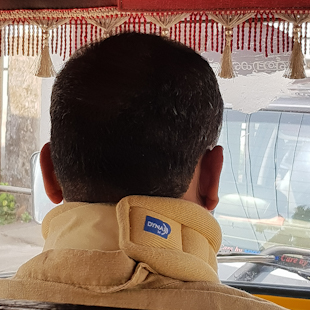
We met the second driver twice in picturesque Fort Cochin. He wore a surgical support collar around his neck. It was khaki in colour and matched his khaki autorickshaw driver’s uniform jacket.

The first time we were driven by him, we noticed his collar, but made no reference to it. The next time he stopped to pick us up, we asked him about the collar, guessing that he might have been involved in accident. We were not expecting his explanation.

The poor fellow related that when his wife had deserted him for reasons that he did not tell us, he had tried to commit suicide. Fortunately, his attempt failed because now his wife has returned to him.

Tired

The Kochi Muziris Art Bienniale is back again. We have attended two of the three previous biennales, those in 2014 and 2016.

The biennales run from mid December to the end of the following March. A joy of this biannual exhibition is that artworks are displayed in many heritage buildings that are not normally accessible to the public. Visitors get a chance to view many fascinating buildings that form part of the history of the port of Cochin.

Today, we visited the main base of the Biennale, which is housed in the buildings of the former Aspinwall company compound.

Works by many artists are on display in the various spaces within the extensive compound. This year most of the works on display are either video installations and/or conceptual art. There are a few works that are otherwise. I was disappointed by this year’s showing as compared with what I saw in previous years’ biennales. The selection of artworks seems unexciting, tired.

However, one work in this year’s show at Aspinwall stands out way ahead of the rest. It is “More Sweetly Play the Dance” made in 2015 by the South African artist William Kentridge.

Moving images are projected onto eight large screens. These images are both drawn (as in cartoons) and photographic. A procession of figures, both drawn and photographed, move from one screen to the next, travelling through a drawn landscape that changes continuously in subtle ways. The motion projected on the screen is accompanied by a brilliant musical soundtrack that is inspired by African music. The result is a spectacular audio visual experience that is both joyous and slightly sinister. I felt that the ‘white’ Kentridge was portraying the experiences of South African Black people, both their joys and their tragedies. His work, on display in a large warehouse with a tiled ceiling at Aspinwall, is truly artistic at all levels of appeal, from the sensual and emotional to the intellectual. It is a positive contrast to much of the other art on display at Aspinwall, which requires explanation before it might possibly be enjoyed.

I look forward to visiting many of the other places connected with the Bienniale. I hope that I will be seeing art that grabs me emotionally as well as intellectually.

PS Since writing this, I have visited many other parts of the Biennale. Some of these, especially the places housing the works of current art students (The Students Biennale) and the artworks in the TKM Warehouse, are outstandingly good. If you are in Cochin for a limited time, skip Aspinwall and head for Mattancherry where the most exciting works are on display.

Over the counter

The French philosopher Voltaire is believed to have written:

Doctors are men who prescribe medicines of which they know little, to cure diseases of which they know less, for human beings of which they know nothing.”

I was at a party in Athens, Greece, in the early 1980s when I suddenly became aware of bilateral back pain and nausea. Luckily, there was a medical doctor amongst the guests. He diagnosed a kidney or bladder infection and wrote a prescription for bactrim. The tablets were very effective and rapid acting.

A year or so later, I was flying to Greece via Rome in Italy when I experienced a recurrence of the symptoms. As I had quite a long stopover in Rome, I took the opportunity to visit a pharmacy, but this time without a prescription. To my great surprise and relief, the pharmacist sold me some bactrim without requiring a prescription.

In the UK, it is not possible to obtain antibiotics and most other medications without a prescription. There are also rules determining how much non prescription medication can be bought at any one time.

In India, which I visit often, I have never been asked for a prescription to obtain any kind of medication. One just asks for the medicine or tablets required, and then following payment they are handed over the counter. Quite a few of the medications I have needed in India have been clearly marked as prescription only medicines, but these words are ignored by the pharmacy salespeople.

Having been trained as a dentist I have some knowledge of pharmacology. So, I feel that I am unlikely to abuse the ease of obtaining medicines in India, but I worry about others with less knowledge than me.

The freedom of being able to obtain medications without having to first get a prescription has mixed blessings. On the one hand, if you are certain that you need a particular drug or simply need a repeat of what you have been taking, not needing a prescription can save you time and money that visiting a doctor entails. On the other hand, self diagnosis and self treatment is not without risk.

What Voltaire wrote many years ago is less true today than it was then. But, still, even after so many advances have been made in medical science , a great deal of ignorance about the human body remains.

Art gallery

Bangalore in south India is not blessed with many tourist attractions. I will describe one of them, which gives me great pleasure.

Almost 10 years ago, a branch of the National Gallery of Modern Art (NGMA) opened in Bangalore. Even if you have little interest in modern art this place is worth seeing. Part of the collection, which changes regularly, is housed in the former Manikyavelu Palace, a 19th century edifice which has been superbly restored.

The palace is linked to an elegantly simple contemporary building in which some of the permanent collection is displayed. The collection includes works mainly by Indian artists but there are also a few by European artists. Most of the artworks were created in the 20th and 21st centuries. There is a good selection of paintings by Bengali artists.

The new building also houses well curated temporary exhibitions. Currently, there is a wonderful exhibition of paintings and drawings by the artist Khanderao, who was born in Gulbarga. His early works were beautifully executed topographical scenes. He is also a superp portraitist. Like other great modern artists, for example Picasso, Khanderao has moved into abstraction, which he deals with beautifully.

A water feature separates the palace and its modern extension from another contemporary complex. This includes an auditorium, a library, a café, and a gallery shop.

The verdant gardens of the NGMA contain several modern sculptures.

The NGMA is, in my opinion, one of the loveliest attractions that Bangalore offers visitors and residents alike.

Talking turkey

Until I was about fifteen, our family usually ate Christmas lunch at my aunt’s home with other relatives and friends. The centrepiece of the meal was often roast goose. My mother’s brother Felix used to try to entertain us youngsters with a story about Turkey Lurkey and his chums Goosey Loosey, Ducky Lucky, and Chicken Licken. He meant well, but his story, repeated annually, elicited groans from young and old alike.

One year, 1963, I was in Manhattan with my sister and parents on Christmas Day. That Christmas, I ate sirloin steak for lunch.

Many times during my late twenties and throughout my thirties, I spent Christmas in the English countryside with my PhD supervisor, his wife, and family. They served turkey for evening dinner on Christmas Day. They used to cook enormous birds capable of generously feeding twenty or more folk, yet there was never more than about ten or eleven of us around the festive table.

Everyone except me preferred white meat. One year, when I was asked my preference, I chose brown meat. My host cut off and then placed a whole turkey leg on my plate. It looked like an enormous club, such as might have been used by Fred Flintstone.

After 1994, I often spent Christmas in India. One Christmas Day, I fancied French onion soup rather than festive fare. A couple of years running, we ate Christmas lunch at Sunnies restaurant, which blazed the trail for fine dining with European food in Bangalore. The Christmas menu included the best turkeys I have ever eaten; they were juicy and very tasty. The turkeys at Sunnies were Butterballs specially imported from the USA.

Finally, I will tell you about an unusual Christmas Day ingredient, which I encountered at a place in Bangalore , which I will not name to save causing embarrassment. Several large roasted turkeys were being served at a buffet lunch. After I had enjoyed a serving of turkey, a friend of mine brought me his daughter’s plate, which contained a sizeable piece of uneaten Turkey meat and … a perfectly roasted large cockroach.

MERRY CHRISTMAS TO YOU ALL!