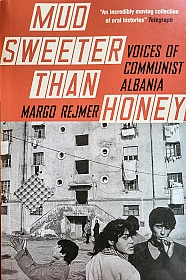
Mud sweeter than honey: Albania under Enver Hoxha

IN MAY 1984, I visited Albania, which was then still under the rule of its Stalinist dictator Enver Hoxha (1908-1985). The year before, I had spent a fortnight in Bulgaria. My impression was that Bulgaria was much less vibrant than Albania. In Albania, which had to be visited in an organised group tour, we were treated well, shown a great deal, and were fed well. I knew that by 1984, Albania was far more sealed off from the rest of the world than North Korea is today. Several things were curious about our visit. First, we were not allowed to converse with any Albanians apart from our three official guides or ‘minders’, and other Albanians were unable to converse with, or even approach, us. Secondly, we were watched carefully, even followed by plainclothes agents. Thirdly, and most strangely, whenever we ate a meal, we were kept out of sight of Albanian onlookers. Either we dined in a private room, or our tables were surrounded by curtains or screens, which separated us from other diners and staff in hotels or restaurants.

Our Albanian hosts successfully showed us some of their country’s beautiful towns, countryside, and other attractions. Their aim was to show us westerners what an ideal country Enver Hoxha and his regime had created. And to some extent, I was fooled by what I saw. Many years later, I visited the country (in 2016), and met people who told me that what I had seen was carefully stage managed – a sort of Potemkin village on a grand scale. One person told me that three days before visitors (foreign or state officials) visited the village to which he had been exiled, the town would be cleaned up, the usually empty shops would be stocked, and other things would be arranged to give the place the appearance of prosperity. And as soon as the visitors had passed through, everything would be returned to its normal depressing condition.

After returning from my second trip to Albania, I read a biography of Enver Hoxha written by Blendi Fevziu, and published in 2016. In it, I discovered something that really shocked me. He wrote that by 1984, when I was being wined and dined royally by our Albanian hosts, most Albanians were starving because of a man-made famine that had begun a couple of years earlier. It was no wonder that whenever we ate, we and our food was kept out of sight of all but the most trusted waiters and staff.  

Even when I was in Albania in 1984, I was aware that Hoxha’s regime, like many others run by dictators, was home to prison camps for those who were alleged to have upset the dictator and his paranoid security services. As Margo Rejmer shows in her excellent book “Mud Sweeter Than Honey”, it did not take much to land up in one of Hoxha’s hellish prison camps, and many people suffered this fate.

Rejmer interviewed many people who had lived during Hoxha’s long reign. She successfully demonstrated that every Albanian from the humblest peasant to the highest state official lived in a constant state of fear. Up to one in three people were employed as informers for Hoxha’s secret police – the Sigurimi. It was even dangerous to express one’s thoughts to close members of one’s family. The paranoid dictator ruled, as did Stalin, by endlessly imprisoning or killing anyone that could even slightly be considered a threat to him. Rejmer’s book illustrates this very well and also describes the unbelievable cruelty that prisoners had to suffer in the camps, where they were made to do unpleasant unpaid work, especially in mines.

I am very glad that Rejmer’s book had not yet been written in 1984, because had I read it then, I am certain I would never have set foot in Albania. It is a highly readable, compelling book about the horrific era during which most Albanians had to suffer. My only criticism of it is that she tends to concentrate on people who suffered badly under the regime. However, I suppose it was difficult for her to find anyone who honestly thought that Hoxha had created the paradise, the existence of which our tour guides hoped to persuade us in 1984.

PS My memories of the 1984 visit to Albania are recorded in my book “Albania on My Mind” (https://www.amazon.co.uk/Albania-My-Mind-Adam-Yamey/dp/1291111476/)

Introducing my NEW BOOK ABOUT MY TRAVELS IN INDIA

SOME SOUVENIRS FROM MY VISITS TO INDIA DURING THE PAST 30 YEARS

 —  A new book with a curious title  —

True love drew me to India. Since my first trip there in late 1993, I have visited the country more than fifty times.

After I married Lopa in London in October 1993, we travelled to her native land, India, a few weeks later. From the moment I first landed on Indian soil, my eyes opened wide with amazement, and ever since then, India has filled me with a delightful sense of wonder. 

You might be curious about the book’s title. This relates to a chance one-off sighting (in the 1990s) of a padlock made by an Indian company with the same name as that of Germany’s former Führer. From that day onward, whenever I have been in India and seen a shop or market stall selling locks, I have always looked to see whether any of this company’s locks are on sale.

To discover some of the many things that endear me to India and whether I ever managed to find one of these curiously named locks, you need to read my new book. Illustrated with my photographs, it contains over one hundred short prose vignettes, which can be enjoyed by both those who are familiar with the country and those who are not.

Paperback: https://www.amazon.co.uk/HITLER-LOCK-OTHER-TALES-INDIA/dp/B0CFM5JNX5/

Kindle: https://www.amazon.co.uk/HITLER-LOCK-OTHER-TALES-INDIA-ebook/dp/B0CG3DX1LP/

Impressions of India in preparation

At the moment, I am preoccupied with carrying out the final editing of my latest book, which I have described briefly below. When I publish it, which I hope will be soon, I will post more about it here in my blog and elsewhere.

A lock made by Hitler; Bollywood encounters; jackals on the golf course; teamakers and politicians; banyans and monkeys; Gandhi’s optician; coracles and crocodiles; and Denmark in India: these are just a few of the topics covered in Adam Yamey’s collection of 101 intriguing vignettes of life in India. This book with illustrations is the author’s love letter to India, a country he has been visiting frequently for almost 30 years.

When Kensington was a country town

ANYONE FAMILIAR WITH London will know that except for some parkland, the city is a built-up urban environment all the way west from Marble Arch to Acton and further beyond. This is also the case from Hyde Park Corner to Heathrow Airport. However, this has not always been the situation.

When John Rocque (1709-1762) drew his detailed, accurate maps of London in the 1740s, Paddington was a small village separated by open countryside from what was then London. In those days, Kensington was a village reached from London by a country road flanked on its northern edge by Hyde Park. And from Kensington to Hammersmith would have been a ride along a road running between a series of agricultural fields and orchards. And to the north of Hammesrsmith, Shepherds Bush was an open space around which there were only a few well-separated houses. And as for Notting Hill Gate, Rocque did not even bother to name this road junction in the middle of the countryside.

By 1826/27, when  C & J Greenwood published their detailed map of London, Earls Court was still a country hamlet; Kensington a small town; and there was barely any development around what is now Notting Hill Gate. However, by 1826 Paddington was beginning to grow and was no longer separated from Marylebone by open countryside. Additionally, the northern edge of the eastern end of Bayswater Road was losing its rural nature and being built upon.

In brief, as the 19th century progressed, London spread west. As it did so, urban development covered what had been open countryside and places that had been separated from London began to become part of it. Places like Kensington, Earls Court, Shepherds Bush, Hammersmith, and places further west were no longer separated by open countryside. Instead, they became engulfed by the expanding metropolis.

My book “BEYOND MARYLEBONE AND MAYFAIR: EXPLORING WEST LONDON” describes in detail how the villages and towns to the west of Park Lane and what is known as ‘The West End’ became engulfed by London’s westward growth. It reveals the history of these places; what they are like today; and what remains of their existence before they became joined to London, as it spread from Mayfair and Marylebone to Heathrow and beyond.

BEYOND MARYLEBONE AND MAYFAIR: EXPLORING WEST LONDON

By Adam Yamey

is available as an illustrated paperback and Kindle from Amazon:

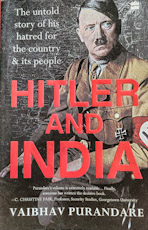
Hitler and India

MANY BOOKSHOPS IN INDIA carry copies of “Mein Kampf” by Adolf Hitler, translated into English. They are not hidden away from view but are displayed openly in bookshelves alongside books with less offensive texts. The books are not old and tatty, but look brand new, suggesting that they are bought frequently and replaced by new stock. Why this book should still be on the shelves in India so many decades after it was first published has always puzzled me. So, when I saw a book “Hitler and India” published by the historian Vaibhav Purandare in 2021, I bought a copy. I was hoping that it might help me understand the prevalence of “Mein Kampf” in Indian bookshops.

Purandare’s book is an easy read and quite interesting. He points out very effectively that Hitler had no love for Indians. Furthermore, he felt that it was right that the British rather the Indians than should rule India. And, in his opinion, he felt that should Germany ever rule India, the Indians would yearn for the return of what he considered to be the too lenient rule of the British. Hitler wrote that: “I would, despite everything, still far rather see India under English than under some other rule …”
Hitler had no desire to support those fighting for the freedom of India because, believe it or not, prior to WW2 he hoped that Britain and Germany might eventually become allies. Purandare also details how Indians in Germany suffered at the hands of the Nazis and their security forces. It was only after Britain and the Soviet Union became enemies of Germany that he entertained the idea of providing limited assistance to those, like Subhas Chandra Bose, who were fighting to free India from the British. Even then, the assistance he authorised was very limited. He did ship Bose out to Japan, but there was little more to his help than that. It must be remembered that he only did this as a way to undermine the British war effort; he did not believe that an independent India was either feasible or desirable. All of the foregoing is well described in the book.

Unfortunately, what the book failed to do is what I hoped when I purchased it. It brings me no closer to understanding why “Mein Kampf” appears in so many Indian bookshops, and evidently sells. What Purandare does make clear is that Hitler’s book contains passages that are insulting to Indians. As for its appeal to Indian bookshop browsers, his book has not brought me any closer to understanding it.

Remembering an old friend in London’s Marylebone

MY FRIEND MICHAEL Jacobs (1952-2014) studied history of art at A Level (university entrance examinations) and then later at university. Later, he became a prolific author. When we were in our late teens, we used to visit Hampstead’s second-hand bookshops together. A few days ago (early September 2022), I was walking along Marylebone’s New Cavendish Street when I spotted something that reminded me of one of our bookshop visits in the late 1960s.

There is a building on the northeast corner of New Cavendish Street and Wimpole Street, which caught my eye. As I passed it, I spotted a small plaque giving the architect’s details. It reads: “BANISTER FLETCHER & SONS ARCHITECTS AD 1912” Sir Banister Flight Fletcher (1866-1953) trained at London’s Kings College, University College, the Royal College of Art, the Architectural Association, and Paris’s École des Beaux-Arts. In 1889, he became a partner in the architectural firm founded by his father: Banister Fletcher & Sons. In addition to designing buildings, Banister Fletcher (and his father) wrote a book of great importance.

The book, “A History of Architecture on the Comparative Method”, which was first published in 1896, was republished several times during the 20th century. It was the standard reference work in English on the history of architecture.

Seeing the name Banister Fletcher on the building in Marylebone reminded me of an afternoon in Hampstead during the late 1960s. We were rummaging around the somewhat disorderly collection of books in Francis Norman’s bookshop in Perrins Lane when Michael discovered a copy of Banister Fletcher’s history of architecture, a book that was well-suited for the bookshelf of a student of the history of art. Michael bought it at an extremely reasonable price.

Until I spotted the building on New Cavendish, I had always associated the name Banister Fletcher with that afternoon with Michael in Hampstead. The building I saw is the first example of a structure that I have been able to associate with the author of the history purchased by my late friend.

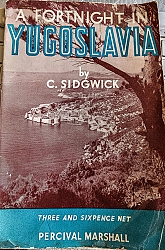
A fortnight in Yugoslavia in the 1950s

I FOUND A SHELF of rather tatty looking second-hand books for sale outside an antique shop in Great Dunmow (Essex). Each was being sold for 50 pence. Among them, I picked up a copy of a slender volume by Christopher Sidgwick with the title “A Fortnight in Yugoslavia”. Having visited the former Yugoslavia numerous times between 1973 and 1990, I was curious to see what was written about it when the guidebook was published in July 1955. This was only about 7 years after the country detached itself from Soviet Russian domination. In relation to this, the author wrote:

“Since the war ended, the Yugoslavs have I think been acting in perfect character. They are not a people … to be impressed by other people’s size. The war brought them victory on the side of Russia … and they set out with immense courage to re-form their way of living on copybook communist lines. But before long, of course, they found that the printed dogma of Marx did not turn out at all as they were led to expect: and instead of cooking the argument, as other communists have frequently done … their honest Yugoslav common sense came conveniently to hand: when Tito, in Moscow, realised that he was now to toe the line as a satellite country, to live in virtual starvation, while the country’s raw materials were sent off to Russia … he said to Stalin: ‘Rubbish! In that case, we might as well still be under the Habsburgs!’”

Under Tito’s leadership, Yugoslavia went its own distinct way. In his text, Sidgwick asked:

“Is the country a dictatorship? In the sense that it is nothing like Hitlerite Germany, nihilist at root, the answer is ‘no’. In the sense that it is a one-party country, with the state controlling the police, the radio, the press, and education, the answer must of course be ‘yes’.”

Further on, he added:

“… it is clear that broader and broader opinion, differing from the party line, is being permitted and even encouraged.”

And this was as early as 1955. By the time I began visiting Yugoslavia, liberal and alternative voices were becoming quite prevalent.

Although Sidgwick did not discourage the individual traveller, he believed that there was much to be said in favour of organised group travel. Visas were then required, and could be obtained for 11 shillings (55 p) at the Yugoslav Consular Department in Kensington (48 Phillimore Gardens). In 1955, £1 sterling would buy you about 840 Yugoslav dinars, and on entering the country, “…any note exceeding 100 dinars in value is liable to be confiscated from you, so don’t buy higher-value notes even at a good rate of exchange: it’s black money.”

Amongst things you were advised to pack in 1955 were: sunglasses; toilet soap (“cost up to 7/6 (37.5p) a tablet”); half a pound of tea; ear-plugs (“invaluable while travelling or while waiting for the dance-band to close down for the night”); pipe tobacco; an inflatable cushion; and a universal bath plug.

Regarding food in Yugoslavia, Sidgwick mentioned that pancakes were good, and:

“… they have no disgusting dishes – frog, snails, and so on – and local national dishes are always worth trying. Ražniči is veal on toothpicks. Ćevapčići is meat and little mince rissoles. Djuvec is a Serbian edition of Irish stew, highly seasoned with paprikas.”

Well, I have eaten frog in Yugoslavia and I had friends who harvested snails for gastronomic reasons. Sidgwick added:

“Meal-service is almost always slow by our standards, largely, I think because Yugoslavs themselves are in the habit of taking their time over food, enjoying it as a social occasion. In busy restaurants it is unwise to expect to get through dinner in less than ninety minutes.”

I have always eaten well in Yugoslavia, and with my many Yugoslav friends every meal was a joyous social occasion.

The guidebook dedicates most of its travel advice to Croatia and the Dalmatian coast (pages 32 to 51). The rest of the country was described between pages 51 and 62. In the short section on Serbia (pages 58 to 60), Sidgwick wrote:

“To describe Serbia in a page or two is like describing London on a cigarette card: insulting to the inhabitants”

He did it to keep the book short, and I suspect, because in the 1950s few British travellers to Yugoslavia ventured much further inland than the coastal regions.

Who was Christopher Sidgwick? He lived from 1915 until 1978.  He wrote several guidebooks to places such as Germany and Greece. His “German Journey” was published in 1936 and his guide to Greece in 1974. “German Journey” was one of several books written by British writers who visited Nazi Germany to find out about Hitler’s regime and the effect it was having on the country. Unlike others, who judged the country mainly by what had been shown them in Berlin and reported favourably on the regime, Sidgwick wanted to avoid “… ‘thinking that what is seen in the capital […] is representative of that country’” (quoted from “Britain and the Weimar Republic” by Colin Storer). This is probably why he reported on a visit to Dachau’s concentration camp before WW2.

Sidgwick also wrote “Manhunt in Dalmatia”, published in 1959. Amongst his many other books, he wrote “Whirlpools on the Danube”, which was published by in 1937. This was reviewed in the journal of the Royal Institute of International Affairs by no less a historian than Carlile Aylmer Macartney (1895-1978), a specialist in the history and politics of Central Europe. I guess from this that Sidgwick must have been a significant traveller and observer in his time.  

Finally, although I paid only 50 pence (in Great Dunmow) for this book about a country that exists no longer, its cheapest price on bookfinder.com is 20 times as much. My own recollections of the country and its people are published in my book “Scrabble with Slivovitz”, which is available from lulu.com, bookdepository.com, and Amazon (https://www.amazon.co.uk/Scrabble-Slivovitz-Once-upon-Yugoslavia/dp/1291457593).

Beyond London’s West End: the story of west London

BEFORE THE YEAR 1800, the West End was truly the western end of London. West of Mayfair and Marylebone, there was countryside: woods, fields, private parks, farms, stately homes, villages, and highwaymen. After the beginning of the 19th century, the countryside began to disappear as villages grew and coalesced and the city of London expanded relentlessly westward. What had been rural Middlesex gradually became the west London we know today.  My new book, illustrated with photographs and maps, explores the past, present, and future of many places, which became absorbed into what is now west London: that is London west of Park Lane and the section of Edgware Road south of Kilburn. Some of the places described will be familiar to many people (e.g., Paddington, Kensington, Fulham, and Chelsea). Other locations will be less known by most people (e.g., Acton, Walham Green, Crane Park, Harmondsworth, and Hayes). Many people have seen the places included in my book when they have looked out of the windows of aircraft descending towards the runways at Heathrow, and many of them will have passed some of these places as they travel from Heathrow to their homes or hotels. My book invites people to begin exploring west London – a part of the metropolis less often on tourists’ itineraries than other areas. “Beyond Marylebone and Mayfair: Exploring West London” is aimed at both the keen walker (or cyclist) and the armchair traveller.  

Beyond Marylebone and Mayfair: Exploring West London is available as a paperback from Amazon here:

https://www.amazon.co.uk/BEYOND-MARYLEBONE-MAYFAIR-EXPLORING-LONDON/dp/B0B7CR679W/:

The road to Wigan Pier and …

WIGAN PIER WAS made famous by the author George Orwell, who published his “The Road to Wigan Pier” in 1936. Recently, we were staying in Widnes (Cheshire), which is not far from Wigan, a town that was in Lancashire when Orwell wrote his book. So, we decided to see Wigan Pier for ourselves.

A quick glance at a map reveals that Wigan is not on the sea, which is where most piers are to be found. The town is inland, and the so-called Wigan Pier is neither a pier nor on the seaside. It is on a part of the Leeds and Liverpool Canal in central Wigan. It was originally a landing stage where locally mined coal was loaded onto barges.

The name ‘Wigan Pier’ might have originated when a train carrying excursioners to the seaside was delayed at Wigan and they saw a structure that looked like a pier, as the following (from http://www.wiganarchsoc.co.uk/content/Projects/WiganPier.htm#Folklore )  described:

“…not long after leaving Wallgate Station, an excursion train from Wigan to Southport, was delayed on the outskirts of Wigan and passengers saw a long wooden structure that reminded them of Southport Pier. This structure would have been the 1,050 yard long wooden gantry … It was built in the late 1880s and carried a double line of rails from Lamb and Moore’s Newtown Colliery high across the River Douglas, the canal and the Wigan to Southport Railway line, to Meadows Colliery by Frog Lane … It certainly would have been easy to see this wooden gantry from a train heading towards Southport.”

I cannot say whether or not this is the true origin of the name, but it is a good story.

We took a road to Wigan Pier and after going around the town’s one-way system and several roundabouts, passing a huge Asda store a couple of times, we arrived at a series of old warehouses labelled Wigan Pier, and parked next to the canal. The Orwell visitor centre, which we were led to believe existed, is no more. A passer-by, with whom we chatted, told us that any memorials to Orwell and his book had disappeared a few years ago. Likewise, the collieries: these have been closed down long ago. Where they were there are housing estates, factories, and shops.

The warehouses close to where the coal used to be loaded many years ago, were inaccessible. They are being redeveloped to create a leisure ‘hub’. This will include (according to hoardings surrounding the old buildings): a beer tap house; conferences; live music; canal tours; festivals; a food hall; and an ‘artisan deli’. I am not sure what is meant by an artisan deli, but whatever it is, I am sure that should George Orwell ever make his way back along the road to Wigan Pier, he would be truly astonished by it.

A house where music has been played for many centuries

Burgh House, Hampstead, London

Burgh House stands high above the southwest end of Well Walk in north London’s historic village of Hampstead. Here is a little bit about it, an extract from my new book about Hampstead:

“… Burgh House is entered from a steep side street called New End Square. The house, built in 1704, is close to the Hampstead Well Spa (see below). According to Bohm and Norrie, the House is named after its 10th owner, The Reverend Allatson Burgh (1769-1856), who was the vicar of St Lawrence Jewry in the City of London. Burgh, who was keener on music than looking after his parishioners, neglected both them and his house. Thomas Barratt wrote:

“Mr. Burgh was a rector in the city, and the composer of a work on church music, published by Longmans. Burgh House is depicted on five pieces of the Wedgwood service, made in 1774, for Catherine II., Empress of Russia.”

Between 1858 and 1884, Burgh House became the headquarters of the Royal East Middlesex Militia. After having been put to a variety of uses, the house became used as a cultural centre in 1979. It now contains a small art gallery, a café, a shop, and a Hampstead Museum. The Reverend Burgh would have been pleased to know that today his former home also hosts many fine concerts of classical music.

From the bottom of the garden of Burgh House, the ‘Wells Tavern’ pub can be seen dominating the view along the gently inclined Well Walk. Known as ‘The Green Man’ until 1850, when it was rebuilt and renamed the ‘Wells Tavern’, a pub has stood on his spot since at least 1762. The pub’s name reflects one of the reasons that Hampstead became popular in the 17th century.  Apart from enjoying clean air, people were attracted to the mineral water springs issuing chalybeate (iron-rich) water that were beginning to be exploited in Hampstead at that time…”

My book is called

“BENEATH A WIDE SKY: HAMPSTEAD AND ITS ENVIRONS”

YOU CAN BUY the paperback or ebook (Kindle) from Amazon:

https://www.amazon.co.uk/dp/B09R2WRK92