A peaceful scene at an ancient place in India

As it is difficult to judge a book by its cover, here is a brief excerpt from my latest book “Road to Heaven – a passage through India”. It describes what we saw at one of the ruined gateways to Mandu in Madhya Pradesh.

Mandu is a huge hill fort at about 2400 feet above sea level, and 1200 feet above the surrounding plains. This irregularly shaped, undulating plateau extends from east to west for between approximately 3.7 and 5 miles, and from north to south, it measures 3 to 3.7 miles. Deep ravines cut into the steep, and in places vertiginous, cliff-like, slopes sweep almost vertically down to the plains below,

Here is the excerpt:

 Our journey continued along a rough track that ended abruptly and without a warning sign at the edge of a high cliff that dropped down precipitously to the plain far below. The view from the cliff edge was spectacular. We could see a couple of lakes or reservoirs amongst the fields and trees, but the horizon was obscured by haze. To our left, there were the impressive, crenellated  walls of the hill fort and one of its seven gateways. We had reached the fortress-like stone Tarapur Gate at the southwest corner of the plateau. A staircase leads up from it to a walkway that runs along the remains of the high walls.  Near the bottom of this, an old stone roadway, now in a parlous condition, made two right-angle turns before passing beneath an arch and continuing as a rocky track that wound its way down to the plains below, clinging precariously to the steep slope of the drop at the edge of the plateau. Of this path, Yazdani wrote:

“… the fall of the hill beyond the outer arch of the gate is very precipitous, and although there are traces of a paved path descending to the plains, it is very difficult to believe that heavy artillery or chariots could be brought up this way, for the garrison could easily have crushed them by rolling down heavy stones. History, however, records that the Fort was invaded several times from this direction …”

While we were looking around, a straggling parade of farm animals, many cows and goats, made its way quietly through the gateway, and down the rocky track. They were accompanied by a couple of herders. The right-angle turns in the gateway were probably designed to make it easier for those guarding it to control entry to the hill fort. Apart from the farmers and their animals, we were the only people at the Tarapur Gate. It was in a part of Mandu which felt more remote than the rest of the hill fort.

After leaving the gateway, we drove through a hamlet where I noticed a man seated on the ground, weaving a cane basket. Further on, we passed women in saris carrying bundles of straw on their heads. We drove northwards through luscious countryside, passing many country folk chatting and working outside their simple homes. Then, after passing the Jami Masjid in Mandu village, we reached …

[ My book is available as a paperback from Amazon:

https://www.amazon.co.uk/dp/B0HBN8BZG2 ]

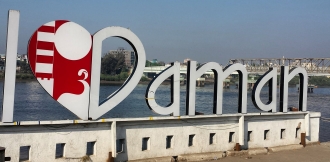
Tea and dining in Daman (India)

YOU MIGHT WONDER why we spent a few days Daman in 2018.

Enclaves have always fascinated me. For many years before that, I had been interested in Daman, which had been until 1961 a tiny Portuguese possession, an enclave surrounded by Gujarat, on the west coast of India.

Even though my wife is of Gujarati heritage, neither she nor I had ever visited Gujarat before 2018, and Daman was one of the places on our itinerary.

The small district of Daman, now a part of the Union Territory of Daman and Diu (that also includes Dadra and Nagar Haveli) is surrounded by Gujarat and the Arabian Sea. The city of Daman lies on both sides of the mouth of the Daman Ganga River. From 1559 until 1961, when it became incorporated into the Republic of India, Daman was a Portuguese colony. The Portuguese captured Daman from the rulers of the Gujarat Sultanate. Daman was one of several Indian coastal colonies of Portugal. Other important colonies included (moving from north to south): Diu, Cambay, Bassein, Chaul, Goa, Anjediva Island, Cannanore, Calicut, Cochin, Quilon, and Galle (now in Sri Lanka). For a while, Portugal’s naval fleet used these bases not only for trade but also to regulate access of other nation’s boats to the valuable spices that could be obtained from the Indian subcontinent. The Portuguese in the 16th century wanted to create a monopoly of the spice trade. They imported spices via the Cape of Good Hope. Their Muslim rivals imported them via Egypt and Venice. So, to stifle this competition, the Portuguese established bases along the coast of East Africa and the Arabian Gulf (for a while they held Hormuz Island at the mouth of the Persian Gulf).

Daman city is divided by a river into two parts: Nani Daman and Moti Daman. Although in Gujarati ‘nani’ means small and ‘moti’ means large, Nani Daman is larger than Moti Daman.

Here is how we spent one of our evenings in Daman:

After visiting the fortress in Moti Daman, we headed back to Nani Daman. The sun was setting, and there was not much traffic. Eventually, an autorickshaw (‘auto’) already crammed full, with four passengers, stopped to pick us up. Two of the passengers moved to the front of the vehicle squatted hazardously on either side of the driver, and we squeezed onto the narrow passenger seat next to the other two passengers. After a short distance, the auto stopped. The two men squatting beside the driver disembarked and walked ahead of us. We drove on, weaving our way around a police check post, and then stopping again when we had passed out of sight of it. The two men, who had disembarked, retrieved their positions beside the driver, and we continued across the river to Nani daman. The driver explained to us, in Gujarati (which my wife understands), that the two men had to walk ahead of us past the check point in order that the auto would not be stopped because of being overloaded.

Later that afternoon, we returned to the bazaar in Nani Daman. We bought bananas and oranges from one of the many women squatting on the pavement surrounded by piles of neatly arranged fruit and vegetables. Amongst these, there were vendors with mountains of garlic bulbs and ginger roots, and others with tidy little mounds of fresh green chillies.

We took tea at two different tea-stalls near the bus stand (bus station). One served a strong tea favoured with ginger, lemon and cardamom. The other provided a very milky, sugary tea, whose taste resembled like caramel. Everywhere in Daman, and, we were to discover, all over Gujarat, tea is served in tiny cups, that can be finished in two or three swallows. It is invariably sugary. These minute cups provide ‘sugar bursts’ (as our daughter describes them) rather than quenching thirst. Often, two men will share a tiny cup of tea. Half of the tea is poured into a tiny saucer, and one of the men then slurps it noisily. The other man drinks the rest of the tea from the cup. Tea shared this way is known as ‘cutting chai’.

The tea provided at tea-stalls is prepared by vigorously boiling milk containing handfuls of tea leaves or tea powder, and usually much sugar. Grated ginger and/or powdered cardamom might also be added to this bubbling mixture. When the milky tea mixture has been boiled sufficiently, it is strained either through a fine (plastic) sieve or through a cloth. The damp residue in the cloth is then squeezed using the hinged metal handles of a ‘sansi’, which is a pair of hinged tongs (used for lifting heavy pots off the fire or cooker). Every tea-maker produces a differently tasting tea. Some of them have high reputations amongst local people for the tea they produce.

After our teas, we waited for Daman’s only newsagent to open his stall. Newspapers arrive in the evening, so there is no need for the newsagent to be open at other times during the day. We ate dinner at the Gurukripa Hotel. Even between the frequent power outages, the dining room was so dark that the waiters brought portable electric reading lamps so that guests can read the menu. We asked to keep ours throughout the meal so that we could see what we were eating. Both the service and the food were above average. When we left the hotel at 9.30 pm, the streets were deserted. An hour earlier, they had been as busy and bustling as in a large city.

Despite the late hour, quite a lot of shops and food stalls on wheeled barrows were still open. On our walk back to our hotel, we passed a parking area containing at least twelve Ambassador taxis, with black bodies and yellow roofs. Although they do not conform with current trends in car design and economic fuel consumption, these vehicles, which are ‘descendants’ of the British Morris Oxford (series III model), are ideally suited for rough terrain and the hazards of driving in India. They are, it seems, almost indestructible, but many taxi drivers are replacing them by newer, more fuel-efficient types of cars.

This is a short, adapted extract from my book “TRAVELS THROUGH GUJARAT, DAMAN, AND DIU”, which is available from Amazon. I hope to post other extracts from my book in the near future.

A shop selling booze in Kerala (India)

AT PRESENT I am working on the text of my forthcoming travel book, which will be called “Road to Heaven -A passage through India”. Here is a brief excerpt from the chapter about Fort Kochi (Fort Cochin) in Kerala:

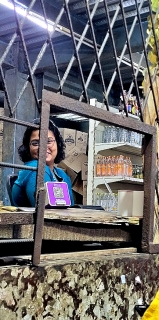
No description of Fort Kochi would be complete without describing a visit to the Kerala State Beverages store, a state government run alcoholic drinks store – the only place in Fort Kochi (apart from some expensive restaurants and hotels), where bottles of spirits can be purchased. Located some distance away from the centre of Fort Kochi in a residential suburb with many trees, this establishment has two floors beneath its rooftop terrace. The ground floor has barred windows, a metal grille, behind which the storekeepers work, surrounded by a crowded collection of piled up crates containing bottles of booze. A crowd of (mostly) men gather around a small aperture in the grille, and buy bottles of beer and small bottles of spirit. This part of the shop looks depressing, as if someone wants to give the message that alcohol is evil, and you need to be desperately in need of it to approach the place. We were directed to the upper floor, which was a complete contrast to what was below it. Bottles of alcohol, gins, brandies, liqueurs, and whiskys, both Indian and imported, were nicely displayed, as in any well-organised supermarket. Customers select what they want, and pay at a cash desk. The drinks that were on sale on this floor were different from, and much more expensive than what was available from behind the barred windows on the ground floor. Buying one’s own booze is far cheaper than ordering it in a bar or restaurant in Kerala.

Work in progress on a new book about travelling in India

Adam Yamey derives great enjoyment from his many travels in India. His forthcoming book (now being edited), “ROAD TO HEAVEN: A passage through India” will transport you on a journey that includes his recent adventures in Karnataka, Maharashtra, Rajasthan, Gujarat, Madhya Pradesh, Kerala, and Tamil Nadu.

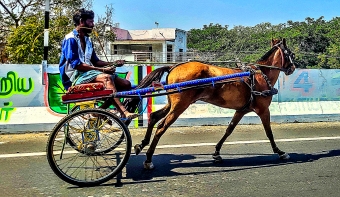
On a highway in Tamil Nadu

Adam will not only describe what he saw and experienced on his tour in late 2025 and early 2026, but he also includes accounts and observations of the places he visited made by earlier visitors (for example, the Emperor Jahangir and the author EM Forster). In addition, he will provide the reader with much information about the formerly British colonial (now ‘elite’) clubs of India, institutions which are barely mentioned in most travel books about the country.

As for ‘The Road To Heaven’ mentioned in the title, you can discover much about it and a host of other attractions and places of interest by reading Adam’s book, which will illustrated with his photographs and some maps. Adam is hoping that the book will be published within a few weeks.

Drafting an introduction to a book about England – your comments, please!

I am writing a book about visiting places in England. Here is a part of the introduction to the book. As it is only a draft, please feel free to comment on it, and also to let me know whether it would entice you to want to read further. What I have written is below this photograph.

This is what I have written:

There are plenty of remarkable places in England. For as the author Daniel Defoe (1660-1731) wrote in his “A Tour Through the Whole Island of Great Britain”:

In travelling thro’ England, a luxuriance of objects presents itself to our view: Where-ever we come, and which way soever we look, we see something new, something significant, something well worth the travellers stay, and the writer’s care…”

What Defoe wrote so many years ago in the mid-1720s, is still true today. My book is about exploring a selection of places in England, especially many of them that are not on tourists’ usual itineraries. I have written about locations, which have intrigued me.  Although some of them will not be familiar to most readers, I hope they will be found to be interesting. I have visited most of them since the onset of the covid19 pandemic in early 2020.

For about 10 years prior to 2020, we did not own a car. When the covid19 lockdown regulations began to ease a little in the UK, and greater freedom of movement was permitted despite the high prevalence of the infectious disease, we felt the need to roam around – to ‘escape’ from our neighbourhood. However, we had become uneasy about using public transport. So, in May 2020, when car showrooms reopened, we acquired a car, and began making day trips into the countryside. At that time, staying in hotels etc was not allowed. After a few months, it became possible to stay in hotels, guest houses, and so on.

Before the onset of the pandemic, we had, like so many others, chosen to holiday out of England, believing places abroad to be more interesting than our own country. During the pandemic, we were compelled to travel within its confines. And having travelled extensively in England during the last 5 years, we have discovered that the country is as least as interesting as many lands across the sea on the mainland of Europe. This book gives an account of some of the places we have been to in England since May 2020, and a few that we had already seen before the pandemic.


A friendly encounter in a cathedral in Pondicherry (India)

Between late 2024 and early 2025, we spent 88 days travelling 4000 miles through India. I have published an account of this fascinating odyssey in my book, “88 DAYS IN INDIA: A JOURNEY OF MEMORY AND DISCOVERY”, which is available from Amazon (https://www.amazon.co.uk/dp/B0FKTFBFM2). Here is a very brief excerpt from the book. It describes what happened when we were sitting in a cathedral in the formerly French colony of Pondicherry.

HERE IS THE EXCERPT:

We sat inside the spacious cathedral’s cool interior within reach of the draught
coming from a fan attached to one of the pillars supporting the long nave’s high,
barrel-vaulted ceiling. As we were relaxing in the cooling breeze, a small group
of Indians entered, and went to the front pews, where they knelt and prayed in
front of the high altar. Amongst them was a young couple dressed in their finest.
Each of them had lavish flower garlands (malas) around their necks. As they
walked away from the front of the church towards where we were seated, we
asked them if they had just married. They told us that that was the case. They
had been married in another church and wanted to pray in the cathedral. These
friendly people invited us to join them in the church’s sunlit entrance while
photographs were being taken of them, of us, and of us with them. They asked
us for our blessing.

Opposite the cathedral on a corner plot, we entered a large bookstore. Tables
covered the floor. They were laden with books, mostly new, but not arranged in
any obvious order. Along one side of this vast hall, there were ..
.

END OF EXCERPT

Writing for pleasure or for profit? That is the question.

I DERIVE GREAT enjoyment from writing. I enjoy researching the background material that will form the basis of what I will write. Then, I find it satisfying attempting to put my ideas into words because it helps me understand my subject matter and it is challenging to find ways of expressing my thoughts in ways that others will understand what I am ‘getting at’.

Azimganj, West Bengal, India

When my text is ready, I find it both challenging and interesting formatting the it and any illustrative material so that they ready for printing in book form. Designing the covers for the book and eBook is yet another pleasurable activity. The resulting production might not always be as satisfactory as what is sometimes produced by commercial publishers, but at least it is what I have conceived in my own mind: all my own work!

In the unlikely event of any of my books becoming ‘best sellers’, I would be both flattered and very happy. However, I write and publish for pleasure, not for profit. What matters most to me, and pleases me most, is knowing that at least a few people will read my books, and I hope gain something from them, be it information, enjoyment, or enlightenment.

And, just in case you are interested, my latest book, “88 Days in India: A Journey of Memory and Discovery”, is available in paperback (and Kindle) from Amazon:https://www.amazon.co.uk/dp/B0FKTFBFM2

A busy market in a street in west London

CROWDS OF TOURISTS swarm to west London’s Portobello Road Market, especially on weekends. But how many of these visitors from all over the world know anything about the history of the place?

Here is an excerpt from my book “BEYOND MARYLEBONE AND MAYFAIR: EXPLORING WEST LONDON”. Beginning with Kensington and Paddington, it describes London from west of Park Lane and the Edgware Road to (and including) Heathrow Airport, and from Wembley south to Chelsea.

Here is an extract from the chapter dealing with Portobello Road:

“Before the mid-19thcentury Portobello Lane, as it was then called, was to quote the historians Florence Gladstone and Ashley Barker (writing in1924):“‘… one of the most rural and pleasant walks in the summer in the vicinity of London’, and within living memory it led ‘through fields to Kensal Green… cornfields and meadow land on each side… ‘”

Well, Portobello Road is no longer bucolic. It is lined with buildings along its length. Currently, it begins with a short section that leads off Pembridge Villas. It is here that you can stop for a drink at the Sun in Splendour pub, which was built in the early 1850s.Afterrunning a few yards westwards, Portobello Road heads off in a north-westerly direction, which it maintains with barely any deviation for the rest of its length. Number 22 was the first London home of the writer George Orwell. He lived there as a lodger in the winter of 1927. After crossing Chepstow Villas, the road slopes downwards and soon after this the market area commences. On most weekdays, much of the market is dedicated to daily needs, mostly food. On Fridays and Saturdays, the number of stalls and the variety of goods on offer increases dramatically. In normal times (i.e., when there is no pandemic),Portobello Road is choked with crowds of people from all over the world on Saturdays. In the 1860s, the Metropolitan Line (now the ‘Hammersmith and City Line,) was built. It crosses Portobello Road …”

To discover more about London, from west of Park Lane and the Edgware Road to Heathrow Airport, buy a copy of my book/kindle from Amazon website, e.g..:

Your comments about this introduction to a new book about India would be very welcome

I am at present writing a book about my recent travels in India. I would be most grateful if you would read through this draft of my opening paragraph, and send me your observations about it. Would you want to read further? The paragraph is beneath this photograph taken in Jaipur.

Early one morning in February 2025, our British Airways Boeing 777 jet began moving away from the oddly designed, apparently ‘eco-friendly’, Terminal Two at Bangalore’s International Airport. As the aeroplane taxied smoothly towards the runway, I watched the parched airport terrain and its assortment of buildings, some painted with red and white checkerboard patterns, slipping past. Then with a certain suddenness heralded by an increase in the noise of our jet engines, we accelerated along the runway. Soon, we became detached from the soil of India. As the aircraft rose higher and higher, random memories flashed through my mind. These included eating laal maas on a rooftop in Jaisalmer; a distraught restaurant owner in Jodhpur; a Dutch cemetery on the Coromandel Coast; hawkers wandering up and down a railway carriage in West Bengal; riding through Bangalore in a Jesus autorickshaw; blessing a newly married couple in Pondicherry; tasting homemade nolen gur in Murshidabad; attending an aarti on the Ganges; eating ravioli in Auroville; the ghost of Tipu Sultan; and much more. After flying over the west coast of India, all these experiences and a whole host of others that we had enjoyed during our 88 day stay in India (between November 2024 and February 2025) became, like the Indian coastline over which we flew, distant memories which I hope will remain etched permanently in my mind. In the pages of this book, I will revive these and a whole host of other reminiscences and explore them in detail. I want my readers to enjoy and understand what we experienced during our almost three month long stay in India.