A CROWD OF CROOKS is out to steal your money, but they vary considerably in skill. Today, I received the following email bearing the triangular logo of the DVLA (Driver and Vehicle Licensing Agency). It was addressed to my email address not to me, the licence holder, by name. It reads as follows:
_________
𝗬our 𝘃ehicle is no 𝗹onger 𝘁axed.
Dear myemailaddress@hotmail.com,
𝐃VLA have been notified electronically about you latest 𝐩ayment for your 𝐯ehicle tax failed because there is not enough 𝐦oney on you debit card.
We sent you a 𝐃VLA bill, and we still haven’t received 𝐩ayment.
Acknowledge that it’s illegal to drive your 𝐯ehicle until you’ve taxed it.
𝗧ax 𝘆our 𝘃ehicle – 𝗦TART 𝗡OW >
Notice: Un-taxed vehicles risk a fine of up to £240. 𝗬our 𝘃ehicle is no 𝗹onger 𝘁axed.
Many of the letters in the email were in bold type. The words ‘START NOW’ is a hyperlink, which I did not click. Initially, I was concerned, but only for a few seconds. This obvious scam contains something in common with many other scam emails that try to worry the reader into believing that something momentous might happen if the instructions in the email are ignored. That common factor, which is well-illustrated above is bad use of the English language. For example, in this case:
“𝐃VLA have been notified electronically about you latest 𝐩ayment …”,
and
“Acknowledge that it’s illegal to drive your 𝐯ehicle until you’ve taxed it.”
Neither of these mistakes would have been made by the DVLA, nor would that organisation have signed itself as “@GOV.UK, Vehicles Service Manager”
Also, the DVLA would know my name and would address me by that, rather than by my email address. Just in case you missed the erroneous wording of the email, you might become suspicious of the sender’s email address: pashegm@hotmail.com, which does not look like the kind of email address that the official DVLA would use.
So, there is a great need to brush up on your use of the English language if you wish to succeed, you contemptible bunch of damnable scammers.
In brief, this scam email was hardly convincing, and the dishonest sender deserves to reap a poor reward, if any, for his or her pathetic attempt to rob me of cash or, worse, sensitive banking or similar details. So, please read all emails carefully before making an error that you might easily regret.
I have received news of two books about Albania. One, an intriguing novel, is written by American born Kim Malaj. The other, a collection of Albanian folk tales is written by her husband, Arti Malaj, who was born and brought up in Albania. I look forward to reading them in the future. Why not give them a try, and let me know how you enjoyed them?
THE NOVEL:”CASTLE OF TESKOM” by Kim Malaj
‘Shiny ember rocks are fuel for time; the dull rocks are a fool’s dime.’An old nursery rhyme, or so they think. Itra and Danae stumble across an ancient secret kept hidden behind a reflection in time near their Albanian home. A faded memory and cryptic messages have propelled them to risk an encounter with foes from Greek mythology, altering their perception of Albanian folklore and reality. Itra and Danae grapple with events set in motion centuries ago and must choose toprotect and serve or risk having the secret exposed. Will love, loyalty, and lineage be enough to hold them together, or will they lose their way in auniverse they are only beginning to understand?
THE FOLK TALESNORTHERN ALBANIAN FOLKTALES, MYTHS AND LEGENDS
by Arti Malaj
Generations of Northern Albanian are known as great storytellers. They shared many folk tales, myths, and legends with their descendants. The collected short stories include mysterious legends of lost treasures, mystical tales of mountain fairies, superhuman powers, century-old witches, blood feuds, and more written by a twelfth-generation Albanian. The lands described in the stories are still visible today, and locals share a sense of wonder and respect the mysteries that hide beneath. Northern Albania is a true treasure of raw natural beauty and a hidden gem in Southeastern Europe.
A WIDE FOOTPATH runs south from Piccadilly along the eastern edge of Green Park. We have walked along this many times, but it was not until a few days ago that we noticed a small alleyway leading east from the footpath about 190 yards south of Piccadilly. This unmarked footway, which is barely wide enough for two people to pass each other, passes under a building and emerges opposite the Stafford Hotel on St James Place, a short cul-de-sac with a dogleg, which leads off St James Street. St James Place, whose construction began in 1694, is an attractive short street lined with many fine buildings, some of which I propose to describe. What made this lovely quiet road interesting for me was that several fascinating people have been associated with it. I will begin with a relatively recent inhabitant.
Number 9 was home to Sir Francis Chichester (1901-1972), who circumnavigated the world single-handedly in 1966/67. He lived here from 1944 to 1972. He sailed in his boat named Gypsy Moth IV. In 1929, Sir Francis attempted another exploit, to fly from New Zealand to Australia in his ‘plane, a de Havilland Gypsy Moth. He made the first ever flight from New Zealand to Australia. He was also the first person to land a ‘plane on both Norfolk and Lord Howe islands. If you want to see his historic boat, then you need to get down to Greenwich, where it is on display close to the much larger Cutty Sark.
There is another building in St James Place, which associated with water transport. The elegant number 20, an 18th century building, has been the London Club House of the Royal Ocean Racing Club since 1942. The Club was founded in 1925. Between 1822 and 1857, the building housed the servants who worked in number 21, which was demolished during WW2 (www.british-history.ac.uk/survey-london/vols29-30/pt1/pp511-541#h3-0019).
Not far from Chichester’s house is number 4. This is the house from which the short-lived Polish born pianist and composer, Frederick Chopin (1810-1849), departed to give his last public performance at the Guildhall on the 16th of November 1848 (www.chopin-society.org.uk/articles/chopin-britain.htm). It was held:
“… in aid of a Polish charity, came at the end of a difficult six-month British sojourn, which had included concerts in Manchester (one of the largest audiences he ever faced), Glasgow and Edinburgh… Finally back in London, the composer-pianist spent three weeks preparing for what turned out to be his final recital by sitting wrapped in his coat in front of the fire at St James’s Place, attended by London’s leading homeopath and the Royal Physician, a specialist in tuberculosis. A week after the concert, he was on his way home to Parisian exile and death the following year.” (www.londonremembers.com/memorials/frederic-chopin-st-james-s-place).
Before discussing the most curious inhabitant of St James Place, I will discuss one of its famous residents, the writer and politician Joseph Addison (1672-1719), who founded “The Spectator” magazine in 1711. According to Peter Cunningham in his “Handbook of London” (published in 1850), Addison was living in St James Place by 1710. I am sure that we did not see any memorial celebrating this on any of the buildings in the street. Cunningham wrote, quoting from another source:
“Addison’s chief companions before he married Lady Warwick (in 1716) were Steele, Budgell, Philips, Carey, Davenant, and Colonel Brett. He used to breakfast with one or other of them at his lodgings in St James Place …”
His companions listed above were probably sympathetic to Addison’s Whig politics. However, Cunningham gives no indication of Addison’s address. He frequented the St James Coffee House in nearby St James Street, as he recorded in issue number 104 of his “Spectator”:
“That I might begin as near the fountain head as possible I first of all called in at St. James’s, where I found the whole outwardroom in a Buzz of Politics. The Speculations were but very indifferent towards the Door, but grew finer as you advanced to the upper end of the room, and were so very much improved by a knot of Theorists who sate in the inner Room, within the steam of the Coffee Pot, that I there heard the whole Spanish Monarchy disposed of; and all the line of Bourbons provided for in less than a Quarter of an Hour.” (https://www.british-history.ac.uk/survey-london/vols29-30/pt1/pp459-471#h3-0014)
The coffee house was at number 87 St James Street. It was demolished to make way for a new building, erected 1904/05.
Wikipedia (https://en.wikipedia.org/wiki/St_James%27s_Place) lists many other notable residents of St James Place, including Oscar Wilde and Lord Randolph Henry Spencer-Churchill, but omits one very interesting person, William Huskisson (1770-1830), whose residence at number 28 is commemorated by a plaque. This records him as having been a ‘statesman’. He was that as well as a financier and several times a Member of Parliament. He lived in Paris between 1783 and 1792 and witnessed the French Revolution. Although he had an active political life, what makes him remarkable was the manner of his death.
Against the better judgement of his physician, Huskisson attended the opening of the Liverpool and Manchester Railway on the 15th of September 1830. Thomas Creevey (1768-1838) related the story in a letter written to a Miss Ord on the 19th of September 1830:
“Jack Calcraft has been at the opening of the Liverpool railroad, and was an eye-witness of Huskisson’s horrible death. About nine or ten of the passengers in the Duke’s car had got out to look about them whilst the car stopt. Calcraft was one, Huskisson another, Esterhazy, Billy Holmes, Birch and others. When the other locomotive was seen coming up to pass them, there was a general shout from those within the Duke’s car to those without it, to get in. Both Holmes and Birch were unable to get up in time, but they stuck fast to its sides, and the other engine did not touch them. Esterhazy, being light, was pulled in by force. Huskisson was feeble in his legs, and appears to have lost his head, as he did his life. Calcraft tells me that Huskisson’s long confinement in St. George’s Chapel at the King’s funeral brought on a complaint that Taylor is so afraid of, and that made some severe surgical operation necessary, the effect of which had been, according to what he told Calcraft, to paralyse, as it were, one leg and thigh. This, no doubt, must have increased, if it did not create, his danger and [caused him to] lose his life.”
(quoted from “The Creevey papers; a selection from the correspondence & diaries of the late Thomas Creevey, M.P., born 1768 – died 1838. Edited by Sir Herbert Maxwell”)
Thus, Huskisson achieved the dubious distinction of becoming one of the first widely reported casualties in a railway accident. The ‘Duke’ mentioned above was the Duke of Wellington and the engine that caused Huskisson’s death was the “Rocket”, a pioneering locomotive designed by Robert Stephenson in 1829. I wonder why his demise was not noted on the commemorative plaque.
Huskisson’s former home has a superb front door flanked by iron lampstands each with its own conical torch flame snuffer. St James Place has plenty of fine 18th century buildings as well as some newer ones. These include the Stafford and Dukes Hotels, which are late 19th and early 20th century in appearance. Number 26 St James Place, a mid-twentieth century building, bears a Civic Trust Award. It is a block of flats built 1959/60 to the designs of the architect Denys Lasdun (1914-2001), who also designed the National Theatre on the South Bank. It replaced an 18th century house that was destroyed by bombing in WW2. Although not unpleasing, it stands in stark contrast to the far more elegant older buildings near it.
Even greater contrast to its surroundings is the building on the northern corner of St James Place and St James Street. This avant-garde metal-clad structure, the Target Building, designed by Rodney Gordon (1933-2008) and completed in 1984, is opposite William Evans gun shop and houses the Stern Pisarro art gallery on its ground floor. One of the galleries owners, Lélia Pissarro, is a great-granddaughter of the Impressionist artist Camille Pissarro (1830-1903). The gallery specialises in Impressionist art amongst other things. While on the subject of art galleries, it would be easy to walk past number 6 St James Place without noticing a small plate on its front door that says ‘Agnews Est 1817’. Between 1877 and 2013, this gallery, which deals in the highest quality works of fine art (e,g. Caravaggio, Rubens, Rembrandt, and Velasquez) was on Old Bond Street. Then, it relocated to number 6.
St James Place is only 180 yards in length, but as can be seen from the small selection of buildings I have chosen to describe, it is choc-full of historical associations. I am pleased that we discovered the tiny alley that led from Green Park to this fascinating cul-de-sac. And, finally, if you find that you are getting tired of staying at the Ritz Hotel, you would do well to book into one of the two hotels discreetly located in St James Place.
[PS I have not dealt with Spencer House because I hope to write about it in the future]
One of the daughters of my former PhD supervisor was about to get married. As a friend of his family, I was asked to be one of the four ushers at the service, which was to be held at St Giles and St Andrews, better known as ‘Stoke Poges Church’, whose graveyard has been immortalised by the poet Gray in his “Elegy Written in a Country Churchyard”. The church stands on land that was once owned by William Penn (1644-1718) after whom the American state of Pennsylvania is named.
Stoke Poges Church
As an usher, I was required to wear formal ‘black tie’. So, not possessing such clothes, I had to hire the necessary formal attire. I went to a branch of Moss Brothers, who hire clothing, and was fitted out with all the trimmings, morning suit, trousers, waistcoat, shirt, bow tie, and a top hat, but no cummerbund. Getting a top hat that fitted properly presented great difficulty to the assistant at the clothes hire shop. He looked at my head knowledgeably with an air that suggested to me that he was an experienced clothing fitter. After a moment’s contemplation, he decided that I needed a certain size. The hat he chose by eye was far too small. It wobbled uneasily on the crown of my head. He selected another size. At this stage, I was still impressed that he appeared to be able to judge head size by eye. The next hat was far too large. It slipped right over my ears. I became less impressed with the fellow. Eventually, he found one that almost fitted my head; its rim rested on the tops of my ear lobes. That was the best he could do. I hired this and all the rest of the required ‘gear’.
Just before the wedding, I got dressed in my formal wear at the bride’s parents’ home. I had endless difficulties trying to get dressed in the two-piece waistcoat, which seemed to separate into two separate items whatever I did. One of my fellow ushers managed to get this on to me correctly as well as to fasten my bow tie (another skill I have yet to master). Sadly, I do not possess any pictures of me in this ‘get up’. Then, we set off for the church.
Of the four ushers, two were Christian and two were Jewish. The two Christians were on duty outside the church. The two ushers inside the church were Jewish by birth. I was one of them and the other was Victor, a friend of the bride. Victor, whom I had not seen for several decades, was one of my classmates at primary school in Golders Green back in the 1950s. My duty as usher was to help people find a seat in the church and to hand out leaflets, which I referred to as ‘programmes’ until one lady with a plummy voice told me sternly:
“They’re not programmes, dear; they’re Orders of Service, don’t you know.”
Well, you learn something every day.
About 25 years later, I communicated with Victor, whom I had not seen since the wedding, via the LinkedIn website. We agreed to meet for lunch at an Italian restaurant near London’s Charing Cross Station as Victor was coming up to London from his home on the south coast. I arrived at the restaurant a few minutes before Victor. When he came through the door, I recognised him. He had aged but was still recognisably Victor, even though his hair which had been red when we were children was no longer that colour. Red hair, or ‘orange’ as I used to call it as a child, fascinated me in my young days. I greeted him, and he shook my hand, saying:
“Hmmm … you are not the person I was expecting to meet.”
I was not sure whether to feel pleased or upset that he had mixed me up with someone else from his past.
A BUILDING ON THE CORNER of Lancaster Road and Basing Street, a few yards east of Portobello Road, looks as if it was once a church. Attached to its brickwork is a plaque commemorating the fact that the building was once used by the reggae artist Bob Marley (Robert Nester Marley:1945-1981). While we were looking at the building, a friendly passer-by stopped and chatted to us, confirming that the building had once been used as a church, but also as a waxworks studio and, maybe, a synagogue for a time.
Whereas many Jewish people used to live near the building before WW2 (www.rbkc.gov.uk/pdf/Colville%20March%20Newsletter3.pdf), notably in nearby Powis Square, I can find no evidence that there was ever a synagogue where the church-like building stands. A detailed map, surveyed in the 1890s, reveals that this building was a ‘Congregational Chapel’. It was ‘The Lancaster Road Congregational Church Notting Hill’ and is described in “A Book of Metropolitan Churches and Church Enterprise” by William Pepperell, which was published in 1872. The Reverend Pepperell describes the origin of the chapel as follows:
“The foundation-stone of this chapel was laid by Samuel Morley, Esq., M.P., in July, 1865, when, although so recent, the whole of that part of North Kensington in which it is situated was open field, with here and there a dotting of new buildings commenced, and new streets laid out. At the present time the occupied suburbs extend quite a mile beyond it either North or West. The congregation worshipping here first assembled in smaller numbers in Westbourne-hall, where they kept together for between two and three years, always with a view to a separate building as opportunity offered … The form of service is what is understood as Congregational, and the Congregational Hymn-book is used. An organ well suited to the dimensions of the building is efficiently employed by Mr. Charles Wetton, Jun., in aid of the devotional singing, which seems to lose nothing of its congregational life and character by the presence of the instrument.”
The authoritative British-history.ac.uk website confirms the date when the chapel was established and makes no mention of it ever having been used as a synagogue. It does state that the building was designed by James Rankin of St Marylebone and is now used for commercial purposes, its interior having been completely remodelled.
I could not find the chapel marked on a detailed map surveyed in 1914. This is not surprising because in the early part of the 20th century, the chapel became home to the workshop of Gems Waxworks (“Colville Conservation Area Appraisal”, published by RBKC in 2014). It was at this workshop that the model of the serial killer John Christie (1899-1953), who had a flat at 10 Rillington Place in Notting Hill (located at where is now Bartle Close and Andrews Square), was prepared (www.golbornelife.co.uk/colvillenewsletter1.pdf) in the 1950s for Madame Tussaud’s exhibition in Baker Street.
By 1970, the former chapel had reincarnated as the ‘Basing Street Studios”, established by Christopher Blackwell, founder of Island Records (began in 1959). In 1970, Led Zeppelin recorded his album “Led Zeppelin IV” at the studios. The same year, Jethro Tull recorded his “Aqualung” album at the same place. At one point in 1973, Bob Marley and the Wailers were using the studios at the same time as the Rolling Stones. Bob Marley lived for a year at the studios in 1977 (www.timeout.com/london/blog/15-places-in-london-with-a-bob-marley-connection-051116). Early in that year he recorded his album “Exodus” there. Before that, in 1973, he recorded his album “Catch a Fire”, also at Basing Street. In addition to the works already mentioned, many other well-known songs and albums, including Queen’s “We are the Champions” and Band Aid’s “Do they know It’s Christmas”, were recorded at these studios.
In 1983, Trevor Horn (born 1949) and Jill Sinclair (1952-2014), of SARM studios, acquired the recording establishment in the former chapel. The plaque on the outside of the building was placed there by the Nubian Jak Community Trust, which is:
“… an African and Caribbean community organisation that provides products and services to the generic population of the UK and internationally” (http://nubianjak.org/).
Their plaque not only celebrates Bob Marley’s use of the former chapel and his fellow musicians Bunny Wailer and Peter Tosh, but also the memory of Jill Sinclair. When the plaque was unveiled by her widowed husband, he said:
Currently, SARM is based on nearby Ladbroke Grove.
Having seen this building and looked into its history, I feel sure that the Congregationalists who used to sing in the chapel long ago would be pleased to know that the building remained a place of song, even if what was sung there is somewhat different to what they used to sing.
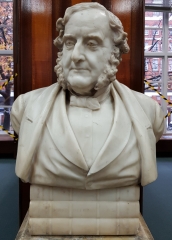
A WHITE STONE BUST depicting a man wearing a jacket and a waistcoat is perched on a pile of books carved in the same material and stands on a marble pedestal in the centre of the open access bookshelves in the public lending library on Hornton Street in London’s Kensington. His face has copious mutton-chop sideburns but neither moustache nor beard. The person depicted is James Heywood (1810-1897), who founded the first public library in Kensington in about 1870. His sculptural portrait in the library was created by Middlesex born James Adams-Acton (1830-1910), some of whose other busts include representations of Emperor Caesar Augustus, John Wesley, and ‘Pharaoh’s daughter’ (www.artuk.org/discover/artists/adams-acton-john-18301910).
Heywood, who was born in Manchester, was a man of many achievements (www.gracesguide.co.uk/James_Heywood). Son of the banker Nathaniel Heywood, James studied at the universities of both Edinburgh and Geneva before joining the family bank at Manchester. On inheriting a large sum from his uncle, he left the bank and matriculated at Trinity College Cambridge in 1829, where he continued to study but did not graduate. In 1838, he was admitted to the Inner Temple in London, where he was called to the Bar but did not practise as a barrister. In that same year, James became a founder member of the Manchester Geological Society. The next year, he was one of the founders of the Manchester Athenaeum, which provided reading rooms and lectures.
“James Heywood, Esq of Trinity College, Cambridge, residing at 17 Cork Street, London, Barrister of the Inner Temple, author of a Report on the Geology of the Coal District of South Lancashire, published in the Transactions of the British Association, & also of a Report on the state of the population in Miles Platting, Manchester, published in the Journal of the Statistical Society of London; a gentleman much attached to science, being desirous of becoming a Fellow of the Royal Society, we the undersigned, do, from our personal knowledge, recommend him as deserving of that honor, & as likely to be a useful & valuable member.”
So, by 1839, Heywood was residing in London. In addition to his scientific work, he was involved in politics. Between 1847 and 1857 he represented the constituency of Lancaster Northern. He was a member of the Whig/Liberal Party. In 1859, he moved to Kensington (Kensington Palace Gardens), where in about 1870 he established Kensington’s first free public library at Notting Hill Gate. Heywood was a Unitarian. His home in Kensington was close to the current location of a Unitarian church, which was only established on this site in 1887. However, before that, in 1867, the Unitarians began meeting in Kensington at Sir Isaac Newton’s old home, now demolished, in Church Lane. The history of the Kensington Unitarians, found at www.kensington-unitarians.org.uk/images/EssexChurchInKensington_forInternet.pdf reveals that:
“The congregation was growing under the Chairmanship of James Heywood, MA, FRS, MP, ‘one of Kensington’s most distinguished citizens’…”
The church moved to its present site near the Mall Tavern in the 1880s.
The free library, which Heywood created in Kensington and was opened on the 15th of August 1874, was located at ‘106, High Street, Notting Hill”, according to “The Catalogue of Mr James Heywood’s Free Public Library”, published in 1879 (and viewable on Google Books). The ‘High Street’ is now named ‘Notting Hill Gate’. If the numbering was the same then as it is today, then 106 would have been on the north side of the street just west of Pembridge Road, roughly between where Tescos and Mark and Spencers Simply Food stores stand currently. Today, the Notting Hill Gate branch of Kensington’s public libraries stands on the corner of Pembridge Road and Pembridge Square.
Heywood’s library was open seven days a week and before receiving a book, an applicant had to fill in a form with the following wording:
“I REQUEST TO READ
Name of books ….
Date …. Signature of applicant .…”
Reading books in the library was free of charge but borrowing them required a monthly payment of sixpence (2.5 p) and one penny (about 0.5 p) per book borrowed. The catalogue included a very respectable variety of books and periodicals. I was pleased to note that there was a book about Albania, “Travels in Albania and Other Provinces of Turkey” by Lord Broughton, Baron John Cam Hobhouse Broughton (1786-1869), who accompanied Lord Byron on his trip through the Balkans at the beginning of the 19th century.
Given his important contribution to the development of public libraries in Kensington, it is entirely appropriate that James Heywood is commemorated in the main branch of the library system of the Royal Borough of Kensington and Chelsea. It is also worth noting that like his pioneering establishment in Notting Hill High Street, the library is not entirely free for borrowers. Although books may be borrowed free of charge, other items including DVDs can only be borrowed after making a payment.
THIS IS NOT ABOUT our current plague, the covid19 pandemic, but an earlier one that occurred occasionally in the 19th century. In many countries today, millions of people live with plague and disease and might even accept it as a part of daily life. Fortunately, until recently this was not the case in the UK. However, in the 19th century when diseases and their transmission were less well understood than currently, living conditions in the UK were considerably less healthy than today, disease was rife, and life expectancy was not great. While walking amongst the picturesque steeply sloping back streets of Hampstead village in North London in late November 2020, we spotted a carved stone plaque high on a wall of a house, currently Heathside Preparatory School, on New End (at the point where the street makes a right angle and becomes north-south instead of east-west).
The plaque reads:
“This building was erected by voluntary contributions for a dispensary and soup kitchen. It was intended as a thank-offering to Almighty God for his special mercy in sparing this parish during the visitation of cholera in the year 1849. The site was purchased in 1850 and the building completed in 1853.
He shall deliver thee from the noisome pestilence. Thomas Ainger M.A. incumbent”
As you will discover soon, not everyone in Hampstead was spared from cholera in 1849. One of those, who was afflicted, not in 1849 but five years later, unwittingly made a great contribution to science.
Thomas Ainger (1799-1863), who was born in Whittlesea, Cambridgeshire and studied at Cambridge University, was awarded ‘perpetual curacy’ of St Mary’s Hampstead in 1841, a position he held until his death (http://hampsteadparishchurch.org.uk/data/magazines_2013.php?id=897). He was:
“An energetic parish priest and poor-law guardian; helped to found schools and a dispensary; enlarged his church and promoted the building of new churches in the district around Hampstead.” (https://venn.lib.cam.ac.uk/).
Today, we can have injections that radically reduce the chances of suffering from cholera, but that was not the case back in 1849, when the mechanism by which the disease spreads was not yet understood. One case of the disease that significantly helped to further knowledge of its spread occurred in Hampstead in 1854.
Dr John Snow (1813-1858), who led the way in hygiene and anaesthesia, suspected that cholera was spread via drinking water. He demonstrated that cases of the disease were clustered around particular water sources. During an outbreak of cholera in 1854 in London’s Soho district, which was centred around a pump in Broad Street, now Broadwick Street, he found that by removing the handle from the pump so that the locals could no longer draw their drinking water from there, the local outbreak of cholera was brought to an end. The pump in Broad Street was only three feet away from a leaking cess pit and its water was contaminated by waste matter (www.ph.ucla.edu/epi/snow/broadstreetpump.html). Snow theorised that the cause of cholera was not as previously thought a ‘miasma’ in the air, but something in drinking water. Now, let Stephanie Snow continue the story (International Journal of Epidemiology, 2002; vol.31: pp 908–911):
“In 1849, the London Medical Gazette had suggested that in regard to Snow’s theory, the experimentum crucis [i.e. critical experiment] would be that the water conveyed to a distant locality where cholera had been hitherto unknown produced the disease in all who used it. One of the cholera victims Snow had traced through his Broad Street investigation was a widow who lived in Hampstead. She had a regular delivery of water from the Broad Street pump as she preferred its taste. Her last delivery was made on 31 August and by 2 September, having drunk the water, she had died from cholera. Snow regarded this as ‘the most conclusive’ of circumstances in proving the connection between the water pump and the cholera outbreak.”
The widow had lived at ‘West End’, which until the 19th century was that name of what is now West Hampstead.
The plaque in New End suggests that Hampstead Parish was ‘spared’ from the cholera in 1849. That was almost true. In that year, Hampstead had 8 deaths from cholera per 10,000, whereas many areas of London reported between 100 and 200 deaths from cholera per 10,000 (www.ph.ucla.edu/epi/snow/publichealth118_387_394_2004.pdf). The rate of cholera fatalities in its area was determined by the location of its drinking water supply. The uppermost rates of deaths from cholera in 1849 were exceedingly high compared with even the highest rates of covid19 infection anywhere in the UK during the second half of 2020.
John Snow had been alerted to the existence of the widow in Hampstead by Reverend Henry Whitehead (1825-1896), a vicar in London’s Soho district, who was at first sceptical of Snow’s theory of the water-borne transmission of cholera (http://www.ph.ucla.edu/epi/snow/whitehead.html) and favoured the idea that cholera existed as an airborne ‘miasma’. Although Snow and Whitehead differed on their ideas on the transmission of cholera, they decided to work together. Peter Daniell and David Markoff provide more detail (www.choleraandthethames.co.uk/cholera-in-london/cholera-in-soho/) about the widow in Hampstead:
“Whitehead was able to tell Snow about a widow living in Hampstead, who had died of cholera on the … 2nd September [i.e. 1854], and her niece, who lived in Islington, who had succumbed with the same symptoms the following day. Since neither of these women had been near Soho for a long time, it was impossible that they could have contracted the disease through breathing in the polluted air of the area. Intrigued, Dr Snow rode up to Hampstead to interview the widow’s son. He discovered from him that the widow had once lived in Broad Street, and that she had liked the taste of the well-water there so much that she had sent her servant down to Soho every day to bring back a large bottle of it for her by cart. The last bottle of water—which her niece had also drunk from—had been fetched on 31st August, at the very start of the Soho epidemic. This was just the sort of evidence he needed to prove the argument of the miasmatists wrong.”
If we had not noticed the plaque in Hampstead, I doubt that I would have become aware of the West End widow’s role in the unravelling of the method of transmission of cholera. Below the plaque and on the same wall, there is a pink granite object, which looks like a broken drinking fountain. This bears the date ‘1859’, five years after the large outbreak in Soho, and I hope that people did not contract cholera by drinking from it. It was in that year, that Joseph Bazalgette (1819-1891) began his programme of improving London’s sewerage system. This helped to reduce the out breaks of cholera, but there was at least one more in the East End of London in 1866.
EVERY SCHOOLDAY MORNING between 1965 and 1970, I boarded a single-decker, route 210 bus at Golders Green Station. First, we travelled up North End Road southwards to Jack Straws Castle, near Whitestone Pond. Then rounding the Hampstead war memorial, our direction changed from south to north-east as the bus travelled along the straight Spaniards Road, just a few yards more than half a mile in length. Invariably, the bus slowed down near the Spaniards Inn, where the road narrows because of the presence of a disused, historic tollhouse directly across the road from the inn. During my five years of travelling this route, I never wondered about the history of the Spaniards Inn, the tollhouse, and the area around them. Now, many years after leaving Highgate School, to which I was heading every morning on the 210, my interest in historical matters has been fired up, as has my desire to share that with anyone who has time to read what I write.
Spaniard’s Inn on right, tollhouse on left
Spaniards Road and its eastern continuation beyond the tollhouse, Hampstead Lane, have long comprised an important route connecting Highgate and Hampstead. Spaniards Road, unlike Hampstead Lane, runs level without inclines or declivities. It runs along a ridge between the south and north facing slopes of Hampstead Heath. At its western end near the former Jack Straws Castle pub, it reaches the highest point in Hampstead, about 440 feet above sea level. At its eastern end by the Spaniards Inn, it is three feet lower. East of the inn, Hampstead Lane descends considerably and only begins to rise again within about three hundred yards of the centre of Highgate Village.
The tollhouse, the cause of an almost continuous traffic bottleneck, narrows the road width considerably so that it is only broad enough to admit one vehicle at a time. The tollhouse was built in the 18th century to collect tolls from those passing through the western entrance to the Estates of the Bishops of London, which they owned for almost 1400 years. Because of its tendency to slow the traffic, the idea of demolishing it or moving it a few yards from the road was mooted in the last century. The debate about shifting the tollhouse even reached the House of Lords, where on the 2nd of February 1966, Lord Lindgren (George Lindgren: 1900-1971) suggested:
“My Lords, to move this building two yards would, I think, be a tremendous waste of time, effort and labour. In actual fact, the lorries going by day by day remove the brick, and if we leave it long enough it will not be there.”
Luckily, the small building remains intact and although not particularly attractive, it adds to the charm of the area.
The Spaniards Inn, across the narrow stretch of road from the tollhouse, is believed to have been established in about 1585. It stands on the old boundary between Finchley and Hendon. Today, the Inn is in the Borough of Barnet and the tollhouse is in that of Camden. In former days, the inn marked the entrance to the Estates of the Bishops of London. The building that houses the inn is 17th century brickwork with some wooden weatherboarding, which is best viewed from the pub’s carpark. It is according to the historicengland.org.uk website:
“An altered building, but one that still has great character.”
The origin of the pub’s name is not known for certain. One suggestion is that the building was once owned by a family connected with the Spanish Embassy. Another is that at some stage, the house was taken by a Spaniard and converted to a house of entertainment. Edward Walford, writing in the 1880s, relates that whilst the Spanish Ambassador to King James I (ruler of England from 1603 to 1625) was residing there, he complained:
“…that he and his suite had not seen very much of the sun in England.”
The Spaniards Inn was the scene of an event during the Gordon Riots in mid-1780. The causes of the riots were several, but they included anti-Catholic sentiments following the passing of an act of Parliament passed in 1778, which ‘emancipated’ the Roman Catholics. At that time, Kenwood House, which is just east of the Spaniards Inn was one of the homes of William Murray, 1st Earl of Mansfield (1705-1793), an important lawyer, reformer (his reforms included objections to slavery), and politician. He was Lord Chief Justice when the act was passed and just prior to the outbreak of rioting, he had treated a Catholic priest leniently in a court of justice. A group of rioters attacked and burned Mansfield’s home in Bloomsbury Square:
“The furniture, his fine library of books, invaluable manuscripts, containing his lordship’s notes on every important law case for near forty years past … were by the hands of these Goths committed to the flames; Lord and Lady Mansfield with difficulty eluded their rage, by making their escape through a back door … So great was the vengeance with which they menaced him, that, if report may be credited, they had brought a rope with them to have executed him: and his preservation may be properly termed providential.”
Not happy with burning down Mansfield’s London home and its owner’s escape from their clutches, rioters set off towards Kenwood where they planned to destroy his rural retreat. They made their way to the Spaniards Inn, which was then kept by a publican called Giles Thomas. This shrewd fellow was quick to assess the reason for the rabble’s arrival and being a man of quick thinking, he opened his house and his cellars to the mob, offering them unlimited refreshment before they continued to undertake their planned work of devastating Kenwood House. As soon as they began enjoying Thomas’s generous hospitality, the canny publican sent a messenger to a local barracks to raise a detachment of the Horse Guards. At the same time, he arranged for other rabble-rousers to be supplied with liberal amounts of strong ale from the cellars of Kenwood House. A Mr William Wetherell, who was on the spot, encouraged the rioters to adjourn to the Spaniards Inn. By the time that the military arrived, the rioters were in no fit state to either resist the soldiers or to carry out their planned attack on Mansfield’s residence, which was a good thing not only for Mansfield but also for posterity because by 1780, the house had already been worked on by the architect Robert Adam, who had made improvements of great artistic value.
The Spaniards Inn stands amongst a cluster of historic buildings. Its next-door neighbour is a plain building, Erskine House (also once known as ‘Evergreen Hill’). This stands on the site of an earlier house of the same name built in about 1788. It was the home of the lawyer and Whig politician Thomas Erskine (1750-1823), Lord High Chancellor of Great Britain between 1806 and 1807. By all accounts, he was a brilliant man. He was involved in many important trials. One of these that attracted me because of my interest in Indian history was during the impeachment proceedings (in 1785) against Warren Hastings after his time as Governor General of Bengal. Mr Stockdale, a publisher in Piccadilly, issued a pamphlet by John Logan which defended Hastings, and following that was tried for libel expressed against the chief opponents of Hastings, Charles Fox and Edmund Burke. Stockdale was defended successfully by Erskine in a case that helped to pave the way to the passing of the Libel Act 1792, which:
In addition to being involved in many other important cases, Erskine was an animal lover as well as a great wit. For example, when he saw a man on Hampstead Heath hitting his miserable-looking sickly horse violently, so Edward Walford recorded, he admonished the cruel fellow. The latter replied:
“Why, it’s my own; mayn’t I use it as I please?”
Hearing this, Erskine began beating the miscreant with his own stick. When the victim remonstrated and asked him to stop using his stick, Erskine, who could not suppress making a witty remark, said:
“Why, it’s my own; mayn’t I use it as I please?”
Erskine’s former home was located between the Spaniards Inn and a house, which still stands today, Heath End House, which was occupied by Sir William Parry (1790-1855), the Arctic explorer. The sign on its outer gate reads ‘Evergreen Hill’. Later, it was a home of Henrietta Barnett (1851-1936) and her husband Canon Samuel Barnett (1844-1913). Both were deeply involved with the creation of Hampstead Garden Suburb. Although I lived in the ‘highly desirable’ Suburb, I would have much preferred to have lived in the Barnett’s lovely house by the Spaniards Inn. Had I lived there in amongst that historic cluster of houses, maybe I would have walked to school instead of boarding the 210 bus in Golders Green.
EXACTLY A YEAR AGO, at the end of November 2019, we were staying at the Tollygunge Club in south Calcutta. Every morning after breakfast, I would set out for a morning walk on the golf course as the air temperature began to climb rapidly towards 30 degrees Celsius. Being careful to avoid the golfers and their shots, I wandered away from the club buildings towards the far reaches of the luxuriant course. On my way, I passed the numerous obese dogs that hang around the club waiting for careless human snack eaters to drop bits of food. Further on, apart from the occasional players, I greeted the white egrets, which hastened away as I approached them. Then, as the club buildings grew smaller as I walked away from them, I often came across the jackals that sun themselves on the bunkers and putting greens. As I aimed my camera towards them, they would look at me suspiciously before slinking slowly into the clumps of bushes and shrubs dotted about in the grounds. Some mornings, I watched horses being taken for exercise and every morning I encountered people, both slender and not so sleek, either running or walking, usually viewing the screens on their mobile telephones. That was a year ago. And after leaving Calcutta, we told our friends and family there that we were sure to be back again in a year’s time.
It is said that one should not count one’s chickens before they hatch. Little did we know back then in Calcutta that a year later at the end of November 2020 we would not be in Calcutta in the Indian winter warmth, but in Bushy Park (near Twickenham) on a misty morning when the air temperature was about 3 degrees Celsius. We had visited Bushy Park about a month or so earlier in bright sunshine when the large carpark was almost full of cars. Today, on the last day of November, the carpark was less than a quarter full and the mist almost hid the tops of the tallest trees. The damp air felt bitterly cold, a feeling enhanced by the gloomy grey sky overhead that became visible as the mist dispersed.
Despite the greyness and cool air and our frozen hands, we enjoyed a brief walk in the Woodland Gardens, which are surrounded by a fence to stop the entry of the local wildlife, not jackals as in Calcutta but numerous deer, formerly the prey of the aristocratic hunters of yesteryear. A stream winds through the woodland area, widening sometimes to become like a pond. No egrets here, but plenty of ducks, gulls, and a few Egyptian Geese. Nor were there any golfers with their caddies and trolleys. Instead, there were plenty of parents, mostly younger than us, with their infants in buggies, and also some grandparents. Instead of being able to retire to the Shamiana bar, after the walk, for a coffee or, more likely in Calcutta, a tea, we headed for a small window in the otherwise closed Bushy Park Pheasantry Café to buy hot drinks to take away. The wooden tables and chairs under the trees nearby were, as a notice put it: “Out of Bounds”, just as Calcutta is for us now, because of the blasted covid19 pandemic.
Methods are being employed to attempt to reduce the spread of the virus both here in the UK and in India. Much emphasis is put on trying to minimise association with other people. We try to do this as much as possible, but this does not stop us from getting out and about. In contrast, many of our friends and family in India have been far more cautious than many in the UK, hardly leaving their home for weeks and months on end. I am not at all sure that we could manage to remain inside our flat for so long especially if the weather here was as warm and sunny as it is in India. We wrap up warmly and venture out into the cold whenever possible and that has helped to keep us feeling sane during this frightening plague. As a Norwegian said on BBC Radio 4 some weeks ago:
“There is no such thing as bad weather. There is just bad clothing.”
I HAVE ALWAYS ENJOYED browsing the shelves and piles of books in second-hand/antiquarian bookshops. During my adolescence in the 1960s, I bought many old travel guidebooks, such as were published before WW2 by the likes of Baedeker, Michelin, Murray, and similar. These items were not highly valued by collectors in the ’60s and were very reasonably priced. This was just as well because my spending power was not great at that time. My self-imposed rule was that I would not buy anything priced over £1 (Sterling). One of my prized purchases in that time was a pre-WW1 Baedeker’s guide to Egypt. I paid six shillings (30 pence) for this already rare edition in the second-hand department of Dillon’s university bookshop, which faces the Engineering Department of University College London. This shop is now a branch of the Waterstones chain of booksellers.
Most of the bookshops that I visited regularly were in or near Hampstead, which in the 1960s had at least eight second-hand booksellers. There was one shop that I visited occasionally on the corner of Fleet and Agincourt Roads. Once I entered it and found a copy of Murray’s Handbook to Northern Germany, which was published in the late 1880s. I was fascinated by this book which described Germany long before it was divided into East and West Germany, which is how it was in the 1960s. It also covered parts of the USSR (e.g. Kaliningrad, once ‘Königsberg’) and of Poland (e.g. Danzig, now ‘Gdansk’) that were formerly parts of the German Empire. I looked inside its cover to discover its price. My heart sank. It was priced at one pound and ten shillings (£1.50). It was well beyond my budget. I could not decide whether I should break my £1 rule … only this once, but I did not. Reluctantly, I left the book behind in the shop. I had never seen a copy of this book before, and as I walked away, I wondered whether I would ever see another.
When on foreign travels with my parents, I went into second-hand bookshops and discovered some treasures, which I could afford. For example, in Madrid, I picked up several Michelin guides that had been published before WW1 when motoring was in its infancy. In Italy, which we visited annually during my childhood, I acquired several guides published before WW2 and during Mussolini’s era by the Touring Club Italia (‘TCI’). Some of these covered places that had been parts of Mussolini’s empire, such as Libya and Somalia. One TCI guide covered Friuli-Venezia Giulia, when large parts of what was to become western Slovenia were under Italian rule and the Adriatic coast as far as Rijeka was also part of Italy. This guide also included the Adriatic town of Zadar in Croatia, which was the Italian enclave, called ‘Zara’, before WW2. One treasure, which was subsidised by my parents, was the TCI guide to Greece, which was published just prior to the Italians’ abortive invasion of Greece. My copy includes notes added by its former owner, an Italian soldier. Interestingly, he had traced his route into northern Greece on the book’s map. From this, it was evident that he had travelled through central Albania before entering Greece.
In the 1980s, I was still avidly collecting old books including travel guidebooks. From 1982, when I had passed my driving test and began owning cars, I used to drive to see friends all over the UK and elsewhere. Often, I visited friends in Cornwall. My route, which tended to avoid motorways, took me through many small towns, all of which I explored with a view to discovering second-hand bookshops. Honiton in Devon used to contain several well-stocked antiquarian booksellers. On one trip I entered one of them at the bottom of a hill at the western end of the town and made an exciting discovery. Yes, you have probably guessed it already. In that shop, I found another copy of the old Murray’s guide to Northern Germany. Nervously, I looked for its price. By now, I had abandoned the idea of limiting my spend to £1, which in the 1980s would have been insufficient to buy any of the old guidebooks that attracted my interest. The volume I found was £7, which was remarkably good value in the 1980s. I snapped it up and paid for it with pleasure.
Nowadays, if I see an out-of-print book that interests me, I seize the opportunity to buy it, if, after checking the price on-line, it is not outrageously costly.
Finally, whilst talking about old guidebooks, I must mention an artwork created for me by the lady who would eventually marry me. Long before we were wed, she knew of my collection of guidebooks and was also a keen amateur potter. One day, she presented me with a wonderful gift. It was a box made of fired clay, which was shaped to look like a row of Baedeker guidebooks. This still occupies a prominent position on one of our many overcrowded bookshelves.