The kiss

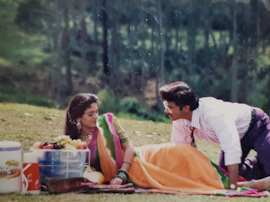
SHE LAY ON A RUG on the well-trimmed lawn of the Ootacamund (Ooty) Golf Club, propped up by one of her elbows. Dressed in a colourful sari, her long black hair was partly hidden by a picnic box filled to the brim with fruit. There was a thermos flask and a cylindrical container for warm food next to and in line with the fruit filled box.

Soon, a bespectacled young man with well coiffured hair and dressed in a white shirt with brown trousers began crawling towards the lady’s feet. Then, he manoeuvred his body over her knees and towards her face. Then, just as he was about to kiss her, both of these figures lowered themselves so that their heads were hidden from view by the picnic box, the hot food storage and the thermos flask.

This amorous couple were neither alone nor unobserved. Apart from my wife and me, local women carrying unwieldy bundles of wood on their heads passed by. Also, the couple were surrounded by a large film crew with lights and cameras.

Soon after their heads disappeared from sight, they reappeared as the film director came running towards them. He talked to them and they repeated what we had just watched after a man with a clapperboard bearing the film name “Andaz” had stood close to them for a few seconds.

“Andaz”, a Bollywood film, was released in April 1994. By chance we had stumbled on this outdoor film shooting in January 1994 during our honeymoon, part of which was spent in Ooty.

In 1994, and certainly until quite recently, intimate displays of affection were not included in Bollywood and other Indian films. What we saw in rehearsal was one of many ways from which film audiences would be saved from seeing an intimate moment. At the moment the audience would expect the male actor was about to plant a kiss on the young lady, they disappear from sight behind the picnic items. Nowadays, the audiences in India get to watch the intimate moment, often in surprising detail for someone, like me, used to watching the older more prudish Bollywood productions.

Although my love of Bollywood films began around 1994, seeing this scene being shot only increased my affection for them. My addiction to Bollywood films began in 1993 when in London some Maharashtrian friends of my wife-to-be insisted that watching the Bollywood film “Sholay” (1975) was important for acclimatising me to the Indian milieu I was about to marry into.

Although many of the latest Bollywood films are extremely good, my preferences is for the older ones. Though often with very complex plots, they have, I believe, an enjoyable innocence that transports the audience temporarily away from the harsh realities of the world beyond the walls of the cinema. Many of the more recent films do the opposite: they remind the audience of the problems they are facing.

A narrow escape

IN AUGUST 2011, MY WIFE was invited to attend a Loreto House school reunion in Calcutta (Kolkata). As I had never been to the city before, I accompanied her. While my wife took part in the daily activities with some of her former schoolmates, I explored and fell in love with Calcutta.

Throughout our five day visit to the city, the monsoon rain fell heavily and incessantly. I walked around Calcutta, often wading through filthy water that submerged my feet and lapped around my ankles. This hardly affected my enjoyment of the delightful decaying city, in some respects India’s own distinctive version of old Havana in Cuba.

One day, I visited Jorasanko, the palatial residence of the Tagore family, whose members included not only the Nobel Prize winner Rabindranath but also artists such as Abanindranath and Gaganendranath.

After seeing around the fascinating rooms of Jorasanko, I sploshed through the flooded streets towards the Hooghly River. On my way, I walked along a busy street lined with shops and filled with crowds of people. A steady stream of rickshaws pulled by thin sinewy men and each laden with two or three passengers made its way through the busy throng. The huge wheels of these vehicles keep the passengers high above the water flooding the streets.

I noticed that some shops, often clothes and textile merchants, were giving hot food to some passersby. At one of these shops, I asked about the food distribution. It was explained to me that during Ramadan, it was considered to be a virtuous thing to feed the poor.

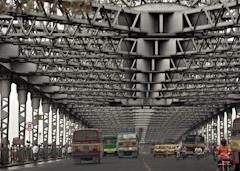
Eventually, after crossing a wide road clogged with slow moving heavy traffic, I stepped onto the Howrah Bridge, a gigantic steel bridge, a Meccano lovers dream, which traverses the River Hooghly. It was constructed between 1935 and early 1943.

At first, the bridge crosses over a large market that runs along the riverbank. Then, after a few yards, it is over the water. I walked along the downstream facing pedestrian walkway, dodging many porters carrying heavy and bulky loads on their heads. I took numerous photographs until I was two thirds of the way across the bridge and met a policeman with an ancient rifle slung over his back. Politely, he informed me that photography was forbidden on the bridge. By then, I had sufficient images stored in the memory of my camera.

Once over the river, I headed through the streaming rain and thick crowds to a boat station close to the Howrah railway terminus. My plan was to travel on a river bus downstream to a landing stage not far from Park Street.

I bought a ticket which was printed on very poor quality paper, that had to be kept dry to avoid it falling to pieces. I asked someone on the floating platform at the water’s edge if the boat that was approaching was heading for my planned destination. I received what I believed was an affirmative reply, and then boarded a relatively empty boat with plenty of free seats. We set off.

To my surprise, the boat headed upstream rather than downstream. Soon, we passed beneath the Howrah Bridge. We sailed a long way upstream away from the city centre. The banks of the river were lined with unattractive industrial buildings and these were punctuated by occasional bathing ghats.

I disembarked at the boat’s first stop. Had it not been raining so heavily, I would have exited the boat station to take a look around the area. Instead, I bought another flimsy ticket to return to Howrah. This time, I asked several people at which of the two floating embarkation pontoons I should board the downstream boat. I waited close to the water while a large crowd of fellow passengers gathered behind me. I wanted to be sure of embarking first.

The boat approached where we were all standing. I could see from afar that it was packed to the gills with people. When the boat was about 18 inches away from the pontoon, I felt a great push from behind me and I was catapulted across the water towards the approaching vessel. Luckily, I was able to grab something on the boat and this saved me from falling into the water and being crushed between the boat and the pontoon.

The boat was stuffed with people. I am sure that sardines are less tightly packed in tins. I wanted to try to take a photograph to capture an image of this crowd, but I could not because so great was the pressure exerted by those around me that I was unable to raise my hands from beside my body.

I looked around and noticed there were few life saving flotation items. Had our boat sunk, few on board would have survived.

It was a great relief to disembark at Howrah. I was drenched, somewhat shaken, and hungry. I decided to take a taxi to Flurys in Park Street, a European style tea room that served what I was yearning at that moment: toasted club sandwiches.

I boarded a battered yellow Ambassador taxi in a car park near the railway station. We moved forward into a mass of other similar taxis. The crowded taxis were so close to each other that it felt that they were all welded together. It took almost an hour for my driver to skilfully manoeuvre his taxi a couple of hundred yards on to the bridge.

At last, we arrived at Park Street, where, slightly drier because of sitting for ages in the taxi, I settled down at a table in Flurys. I ordered my sandwich and savoured the peaceful atmosphere in the tea room.

On my third visit to Calcutta at the end of 2019, we visited Flurys but, sadly, we were disappointed to find that its food and service was no longer as good as before. Fortunately, the scruffy Nizams at New Market, which serves parathas stuffed with meat and omelettes, remains as good as it was in 2011 and many years before.

Despite my near escape from severe injury or worse, my enthusiasm for Calcutta and its people continues to grow and grow.

A writer’s confession

HIG 2 BLOG

NOBODY IS PERFECT, not even yours truly.

I was a pupil at London’s Highgate School when I was studying to take state examination, then known as ‘O Levels, taken by 16 year olds. I was studying for 9 subjects, but decided to drop one of them, German. Its grammar was beginning to defeat me and to jeopardize my chances of success in the other 8 subjects.

German was not the only language that was causing me trouble as I approached the O Level exams. Unknown to me and possibly unnoticed by our English teacher, Mr B, my command of written English was insufficient for me to pass the English Language O Level exam. It was the only O Level that I failed. I passed the other subjects, but without displaying much academic excellence.

My failure to achieve the pass marks in English Language cannot be blamed on anyone except me, but there were factors that predisposed me to downfall.

During the examination, I attempted an essay that asked the candidate to discuss whether or not it was fair that pop musicians often earned more than nurses. Being by nature somewhat contrarian, I decided to write an essay in defence of the high remuneration of pop musicians. This idea, to which I no longer subscribe, expressed with poor grammar and spelling, cannot have made the person marking my paper feel sympathetic to me.

The other predisposing factor was our teacher Mr B. He was far more interested in using class time analyzing the poetry of Ted Hughes and Philip Larkin than ensuring that all of his charges were proficient in basic skills such as grammar and essay writing.

Failing English Language did not prevent or delay my commencing the subjects in which I was to prepare for the A Level examinations that were required for admission to university.

One of my three A Level subjects was biology. The senior biology teacher was Mr S, affectionately known by his first name George. He set us three essays per week. On Saturday mornings, we had a double-length period (one and a half hours) with him. During this, he went through our essays, pointing out their good points and bad ones. The essays of one student, ‘P’ were particularly dreadful. His spelling was awful as was his punctuation: there was none except a full stop at the end of each foolscap page. And, to my annoyance and surprise, P passed English Language O Level at the same time as I failed.

Six months after failing my English Language O Level, I took the exam again. I passed with a good grade. I believe that I had learnt a great deal about essay writing from George’s Saturday essay critiquing sessions. I shall always be grateful to him.

On Saturday mornings, parents thinking of sending their sons to Highgate were shown around the school. The biology laboratory, where the essay classes were held, was on the tour. George, who was a genial old fellow, allowed us to relax during the Saturday morning classes. However, he always told us that if we heard the door to the laboratory being opened, we were all to act as uf we were concentrating on something serious while the parents peered in.

On Friday afternoons, we had a three hour practical class during which, for example, we dissected the parts of dogfish not required by fishmongers. Friday lunchtimes found George drinking in one of Highgate Village’s numerous quant pubs.

George used to arrive at the Friday afternoon practical classes having drunk far too much. For the first hour of the class, he was a menace, arguing with anyone unwise enough to approach him. After about an hour, he used to sit down and fall asleep. The last two hours of the class were supervised superbly by George’s deputy, Mr Coombs.

George was a wonderful teacher. He inspired his pupils’ enthusiasm for biology. Like my PhD supervisor, Robert Harkness, his range of interest extended from microscopic intracellular detail to the whole organism. Once, when walking to the Dining Hall with George, he stooped down and picked up a fallen tree leaf. He asked us what kind of tree had produced it. None of us knew. He said:

“That’s the trouble with you youngsters. You know all about DNA, but you cannot recognise a leaf from a plane tree.”

George was, as far as we knew, probably celibate. When we reached the part of the biology syllabus that dealt with human reproduction, he told us:

“You know all about this. You can read up the details in the book.”

I have wandered from my starting topic somewhat. Maybe, you were beginning to believe that I was trying to distract you from my sad performance in English and from thinking that, given my record, I have great ‘chutzpah’ writing and publishing books.

Picture shows coat of arms of Highgate School, founded in 1565

A small town in South Africa

B 11 Barkly East evening BLOG


MY MOTHER AND THREE OF HER four siblings were born in King Williams Town (South Africa) in the home of their grandfather Franz Ginsberg, who became a Senator in the South African parliament in 1927. They spend the first few years of their lives in the tiny town of Barkly East in the Eastern Cape. Their father, who ran a general store, was also the town’s Mayor until he died in the early 1930s.

My mother migrated to England in 1947. Her sister, my aunt, and one of her brothers arrived in England in the 1950s. Both of them had vivid memories of their childhood in Barkly East, which they happily shared with me.

In 2003, we made a trip to South Africa in order to see places associated with my ancestors, who migrated there from Europe during the 19th century. We hired a car to travel between these scattered places. One of them was Barkly East.

Before leaving England, I discussed Barkly East with my aunt and noted what she told me. During one of these discussions, she drew a sketch map of Barkly East,  marking on it various places she recalled. I took her map to South Africa with me.

Barkly East was established in 1874. In 1885, my maternal grandfather’s uncle Sigmund Seligmann, who came to South Africa from Ichenhausen in Bavaria in about 1865. His nephew, my mother’s father, took over Seligmann’s store in the first decade of the 20th century and ran it along with Mr Blume.

Barkly East was an important commercial centre for the many sheep farmers and wool producers in the district. It began to decline greatly when the usage of motor vehicles increased and farmers were able to reach the far larger centre the town of East London.

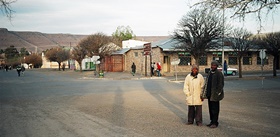
When we arrived in Barkly East in 2003, we found a town with almost empty streets that gave little or no feeling of its once prosperous past. It looked like a place on its ‘last legs’, a bit like London is now during the Coronavirus ‘lockdown’.

On our first day we visited the office of local newspaper,  the Barkly East Reporter,  which was then run by the two Mollentze brothers. They welcomed us and told us a lot about Seligmann’s shop, a place where you could buy everything from a needle to a tractor.

I showed my aunt’s map to the brothers. Despite the fact that she had left the town on the early 1930s, they said her map was very accurate.

Using her map, we found the location of her father’s store, which burnt down in the 1960s. The firm’s wool storage warehouse still stood. It was near to the small street where my mother and her siblings spent the first few years of their lives. It stands next door to the house once owned by Mr Blume.

We were keen to see inside my mother’s childhood home. A young man, probably a teenager,  was sweeping the front porch. His name was Frikkie. We explained our interest in the house. Without hesitation, he showed us around the house despite his parents being at work in their café located near a bridge named after my mother’s father.

It made my spine tingle wandering around the building where my mother was a child. Not having seen it before I was unaware that many internal changes had been made to the building since my mother’s family sold it after my grandfather,  the Mayor of Barkly East, died at an early age.

After my mother’s family left Barkly East, their large house was used for a time as a nursing home before being reconverted to a family residence. My aunt’s two children visited Barkly East in late 2019. They found the old family home, but were unable to enter it. Currently, it houses the offices of the local branch of the African National Congress (ANC). How the tide has changed! In my mother’s childhood, the only non-Europeans who would have entered the house were domestic servants.

We also visited the tiny museum in Barkly East,  where we were welcomed by its curator. Like other curators of local museums in other small South African towns we visited, the curator in Barkly East was concerned about their future in the light of lack of both funding and footfall. She told us about the six or so Jewish families in Barkly East. The last of these, the Bortz family, to leave the town had moved elsewhere a few years before our visit.

The curator said that the Bortz family home had stood empty since they left. Then, after rummaging in a drawer,  she showed us a small metal object in the palm of her hand, and said:

“I know I shouldn’t have done it, but I prised this off the frame of the front door of their empty house long after they left. I took it for the museum. Had I left it there, it would have been taken by someone else eventually. Are you able to tell me what it is?”

It was an empty mezuza, a casing for a prayer scroll that Jewish people attach to the doorframes of their homes and sometimes also within them.

On the last day of our visit to Barkly East,  we visited its extensive cemetery, overlooked by a sad looking shanty town. The small Jewish cemetery containing 11 graves, mostly damaged but identifiable was surrounded by a fence, separated from the resting places of white skinned gentiles. Even after death, apartheid exerted its unsavoury influences. The graves of non-Europeans were in a part of the cemetery well separated from the final resting places of the Europeans.

We left Barkly East, the place where my grandparents enjoyed dinner parties, fly fishing, tennis, and golf, as the snow began to fall on the town. We met many lovely people there during our brief but moving visit to the place where my mother lived for the first decade of her life. I am only sad that she died 23 years before our visit. I would have loved to talk with her about what we saw so long after her childhood.


Illinois Central

A TRAM RIDE IN the northern Portuguese city of Porto (Oporto), home of the drink ‘port’, evoked memories of Chicago in Illinois.

In Porto, we travelled along the riverbank towards the seaside in a very old tram. Most of its seats had reversible backrests so that a passenger was able to choose to sit facing the direction of travel or face the opposite direction. These seats had a mechanism beneath each of them that allowed the seat backs to be shifted manually. On close examination I noticed that the mechanisms had been manufactured in the USA.

Seeing these seats in 2010 reminded me of Chicago in autumn 1963. My father had been invited to spend three months at the University of Chicago. We sailed across the Atlantic in the then almost new SS France (launched 1962). Sadly, this wonderful ship no longer exists. It was sold to be turned into scrap metal by shipbreakers at Alang in Saurashtra (Gujarat, India) a few years ago in 2008.

We had high hopes of Chicago, naively expecting to be put up in ‘swish’ accommodation. The first floor (American 2nd floor) flat we were lent was far from swish. There was nothing wrong with it, but we were expecting something more up to date and in harmony with our preconceptions about America being at the ‘cutting edge’ of living standards. 5608 South Blackstone Avenue was a dowdy two storey house with a highly dubious looking wooden fire escape, which would have been the first thing to go up in flames had the house caught fire. I have recently learnt that our temporary home and its neighbours have been replaced by newer buildings.

At night, the air was filled with the sound of police car sirens almost continuousl and the occasional lengthy rumble of long freight trains passing close by on the railway that followed the shoreline of Lake Michigan.

This railway line near our home was used not only used by freight trains but also by passenger trains, both inter-city and local.

Our nearest station, a few minute walk from our flat was named ‘55th-56th-57th Streets’ and was both close to a superb Science Museum and served by the suburban trains of the Illinois Central Railroad. These rather antiquated trains carried us to the then terminus, Van Buren Street in downtown Chicago. The trains were electrically powered receiving current from overhead wires.
Often whilst waiting on the platform at our local station, trains heading towards or from Indiana, operated by the Chicago South Shore and South Bend Railroad, would hurtle past us.

What interested me then, aged 11 years old, were the backs of the seats in the train carriages. They were reversible just like those on the trams in Porto, which I was to see about 37 years later in Porto.

It is curious the way that seeing one thing can trigger old memories to come to the forefront of one’s mind.

Picture of reversible tram seats in Porto from TripAdvisor

A slice of lemon

TU 5 Genuine old Dutch architecture BLOG


MY FATHER WAS BORN in Cape Town in South Africa.  His childhood was spent in the small town of Tulbagh not far from Cape Town.  His father had a general store in Tulbagh. The family lived across the yard behind the shop in a house on Church Street.

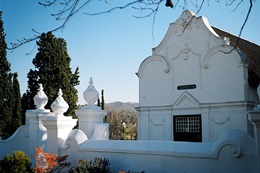
In 1969, Tulbagh suffered a devastating earthquake.  The town’s authorities decided to rebuild the houses in Church Street to make them resemble the original appearance of the sort of houses that Dutch settlers built when they first arrived in the Cape.

Some years after the earthquake,  my father paid a visit to Tulbagh. He said that his former home in Church Street in neither resembled the place where his family had lived nor had ever looked like it did after its ‘restoration’ following the earthquake. In addition,  he felt that the town looked far smaller than it did when he was a child.

In 2003, I visited Tulbagh with my wife and daughter. We stayed in a bed and  breakfast in one of the picturesque houses on the restored Church Street,  a few doors away from my father’s childhood home.

We visited the house where my father once lived. It was another bed an  breakfast. Had I known it was, I would have booked a room there. The landlady showed us around. She had no idea that her back garden had been part of the yard behind my grandfather’s shop on the next street.

There was a lemon tree laden with lemons growing in the back garden of my father’s former home. We asked our host if we could pick a couple of lemons, one for my father and the other for his only surviving sibling, my aunt Elsa. She agreed.

Before leaving South Africa, wr managed to buy an official school tie as used in Tulbagh High School,  where my father studied (in Afrikaans, rather than his mother tongue English) until he entered Cape Town University.

In 2003, it was  12 years since the official ending of apartheid laws. These laws included prohibition of inter-racial intimate relationships. We expected that by 2003 we would have seen, if not many at least a noticeable noticeable number of mixed-race couples. I think that in the one and a half months we spent in South Africa we saw only three. The members of two of the couples were not born in South Africa. It was only in Tulbagh that we met a young ‘white’ Afrikaner with his arm around a ‘black’ African girl. They were both studying at Tulbagh High School.

When we returned to Cape Town, we gave Elsa the lemon that had been growing in the back garden of her childhood home in Tulbagh. She showed little interest in it and put aside.

A day or so later, Elsa was preparing gin and tonic for us at sunset. She need a lemon. Her eyes fell on the lemon that we had brought from Tulbagh. She seized it, and cut slices of it to drop into our drinks. So much for sentimentality!

As for the High School tie, we presented that to my father when we got back to London. He thanked us, then said:

“ I don’t need that. I left the school long ago.”

Park of memory

REGIMES RISE AND FALL, as was the case of the Roman, Ottoman, and British empires. Each has left a physical legacy in the form of buildings, works of art, and a plethora of monuments. In India, a part of the both the former Mughal and British Empires, visitors flock to see their tangible remains.

In the late 1980’s, it was turn of the Soviet Empire to decline and fall. In many of its former ‘colonies’, its citizens hastily tried to erase its physical traces. Statues were toppled and monuments destroyed. Some of these artefacts were removed from public view by governmental authorities (maybe because they feared a possible return of Russian domination?)

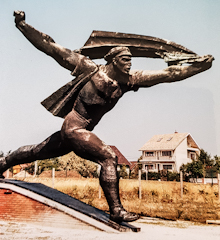
For good or evil, the Soviet Empire has had a profound influence on what followed in its wake. Whatever one thinks about the Soviet Empire, it has become a significant part of 20th century history and it is a shame to try to erase memory of it. This was also the opinion of the Hungarian architect Ákos Eliőd, who designed the Szoborpark (Memento Park) in the countryside near Budapest.

The Szoborpark opened to the public in 1993. About 6 years later, we drove to Hungary from London. We stayed with a good friend of ours, Ákos, a pioneer of Hungarian rock music, and his family in his home in the outskirts of the hilly Buda section of Budapest. It was Ákos who alerted us to the existence of the Szoborpark.

One sunny day, we drove to the park. It was a wonderful place containing a collection of the Soviet era statues and monuments gathered from all over Hungary. It was/is a treasure trove for those who like or are fascinated by socialist realism art forms, an aesthetic that I like. We spent a couple of enthralling hours in the hot sun, wandering about this open air exhibition.

I took many photographs of the Szoborpark, which I have ‘unearthed’ recently. One of them is of wall plaque celebrating Béla Kun (1886-1938) son of Samu Kohn, a non obervant Jewish lawyer. He was the dictator of a short-lived communist regime that terrorised Hungary for a few months in 1919. With its downfall, Kun fled to the USSR, where he organised the Red Terror campaign in the Crimea in 1921. He was executed in 1938, a victim of Stalin’s anti-Trotskyist purges.

Many years after seeing the Szoborpark, my wife and I visited Albania in 2016, more than 3 decades after the downfall of its highly repressive Marxist-Leninist regime piloted for 40 years by its dictator Enver Hoxha.
Interestingly, all over the country there were still numerous monuments erected during the dictatorial era. Many of them were in need of tidying up or cleaning, but they were still there despite being daily reminders of what was a difficult and fearful time for most Albanian citizens.

We believed that the endurance of these monuments erected during difficult times was due to at least two factors. One of these is that many of them were put up to celebrate heroic feats of Albanians carried out against their German invaders during WW2. The other is that despite Hoxha’s repressive regime, many things were done to move Albania from being a Balkan backwater in the former Ottoman Empire to getting nearer to being a 20th century European state.

This is not to say that statues of Enver Hoxha, Lenin, Marx, and Stalin (the mentor and hero of Enver Hoxha) were not pulled down in Albania. They were, but fortunately a few have been preserved by an art gallery in the country’s capital Tirana.

In countries like Hungary and the former Czechoslovakia, the arrival of the Soviet Army and the Russian domination of their countries was not felt by most citizens to have been even remotely beneficial. Obliteration of memories of this era were not surprising in places like these.

To conclude, I am glad that I have neither lost nor obliterated the photographs I took at the Szoborpark so many years ago.

New York! New York!

IN THE SUMMER OF 1992, I began planning a trip to the USA. It was going to be the first trip that I had made to that country since 1963, when our family lived in Chicago for the last three months of that year. While we were in Chicago, President JF Kennedy was assassinated. Most of my 1992 trip was to stay with friends who lived in Manhattan. I was also going to stay in Boston with some other friends. When my cousin Anthea heard that I was going to be in New England, she suggested that I looked up some cousins of my father, who lived in Providence, Rhode Island.

NY 1 Near 42nd Street_ (2) BLOG SIZE

I was keen not to waste a moment in Manhattan. So, unusually for me, I spent many hours of my spare time at home reading numerous guidebooks to New York. Each of these detailed tomes contained a section on keeping safe in New York. Each one of these explained what to do WHEN you get mugged rather than IF you get mugged. It seemed to me that getting mugged in New York was an inevitable experience for tourists in the city. The more I read, the more anxious I became. As the date of departure drew closer, my inclination to cancel my trip increased steadily. However, my desire to visit New York was greater than my fear of the dangers described in my guidebooks. I decided that should I get mugged, as seemed inevitable, I did not want all my money to be taken. I wanted to be left with some so that I could make my way back to where I was staying after the robbery had taken place. I decided that a safe place to hide my ‘emergency’ cash would be inside my sock beneath the sole of a foot. This is what I did every day in Manhattan, but, fortunately, the guidebooks were not entirely accurate: I was not mugged.

Plenty of beggars tried to entice me to put money into the paper cups they held out hopefully. Once, I succumbed and threw a coin into one of these cups, and its owner shouted:

“Is that all? I was hoping for a hundred Dollars,” adding a few seconds later, “well, it’s a start.”

I loved Manhattan. I loved the quick wittedness of almost everyone I met. I felt as if I was taking part in a Woody Allen comedy, but the things said by New Yorkers were often far cleverer and funnier than any of Woody’s lines.

One purchase I wanted to make in New York was a padded winter jacket. When I entered one shop, I explained what I wanted. When I told the salesman that I wanted both outside and inside pockets, he exclaimed:

“Hey, what are ya? Some kind of secret agent?”

He sold me a superb jacket, which I used until a couple of years ago.

My father had told me to look up one of his first cousins, who lived in Manhattan. She lived high up in an apartment on Fifth Avenue. Its windows overlooked The Metropolitan Museum and Central Park. After dinner, I announced that I would walk the few blocks to where I was staying. She was dead against this and insisted I went by taxi. As she and her husband were seeing me off, she said:

“Press the elevator button marked ‘taxi’.”

I boarded the lift, found the button, and pressed it. The lift descended and when the doors opened on the ground floor, I could see a taxi waiting just outside the doors to the apartment block. I was amazed. I had never encountered such a thing before. I felt like a country bumpkin marvelling over the wonders of the big city. This button that summoned taxis seemed to me an example of what made ‘America great’.

It was fun visiting my friends in Boston back in 1992. However, after the excitement and uniqueness of Manhattan, I was not as trilled by the city as many other visitors are.

I took a train from Boston to Providence. It was the time of the famous ‘Fall’ colours. The journey afforded me with a great opportunity to view the outstanding display of autumn leaf colours, which far exceeded my expectations. I had no idea about what sort of time I would be spending with my newly discovered cousins in Providence. My main worry was that they would not take me sightseeing. So, I told them that I would be arriving on a train that reached Providence in the late afternoon but boarded one which arrived in the middle of the day. That allowed me a few hours to look around before I met them.

After spending a few hours on my own in Providence, I returned to the station platform, and then walked up the stairs to the waiting area where I had planned to meet my relatives. I had no idea what any of them looked like. They had no idea about my appearance. I entered the waiting area and found that a lot of people were seated there. I scanned the faces and spotted an elderly lady sitting with two young boys. I fancied that the face of one of these looked like I did when I was only a few years old. Then, I thought that I was being silly, but I was right. I approached the elderly lady, the grandmother of the two boys and introduced myself. Greta, widow of one of my father’s cousins, said she had noticed me and thought that I had a family resemblance to her late husband. She drove us to her daughter’s home in a large American saloon car, swinging the steering wheel with gusto whenever a change of direction was required. My cousin’s family did take me sightseeing. I particularly remember the roads in an Italian neighbourhood. The median road markings were in the three colours of the Italian flag.

I enjoyed my trip to the USA in 1992. My next visit to Manhattan was in 2007. Things had changed a lot since 1992. The city seemed to have lost its edgy, almost electric feel. Gone were the men on the pavements with their paper cups and witty comments. Also missing, were the endless stream of dubious characters walking, often menacingly, along the corridors of the Subway trains. Although Manhattan had probably become a safer place for its inhabitants, I felt that it had become almost twee in comparison to what I had found so exciting in 1992.

Sadly, now in April 2020 as I write this piece, New York City is facing one of its greatest, if not greatest, crises: a viral epidemic that is trying to outdo the Spanish Flu that occurred at the end of WW1. May it return to normal as soon as possible.

The Gay Hussar

THE USAGE OF THE WORD ‘GAY’ to refer to same sex relationships dates back to the 1960s.

Before this time, back in 1953, Victor Sassie opened a Hungarian restaurant in Greek Street in London’s Soho district. It closed a few years ago in 2018.

Apart from serving Hungarian specialities, the Gay Hussar was a popular meeting place for politicians.

My father was often invited to meet his colleague, friend, and occasional co-author the Hungarian born (Lord) Peter Bauer at the Gay Hussar. Dad was not too keen on the fare at the restaurant because he found it too rich and a bit heavy. I only ate there once. I thought that the cooking in Hungary was better than that on offer in Greek Street.

The Gay Hussar was not the only Hungarian eatery in Soho. The other was Csarda in Dean Street. This closed long before the Gay Hussar. It is one of my few minor regrets that I was never able to eat at the Csarda.

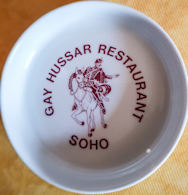
The ‘unearthing’ of an ashtray from the Gay Hussar is what prompted me to write about this no longer existing restaurant.