This lengthy – you have been warned – essay describes the adventures of some German Jewish migrants to southern Africa during the nineteenth century, and how their activities led to my mother’s father coming to South Africa, where she was born.
A typical pattern of migration from one country to another is that if one member of a family is successful in his or her new home, other members of the family will follow. Such was the case for Jews who moved to South Africa. After Heinrich Bergmann arrived in South Africa from Germany in 1849 (see: https://activeauthor.substack.com/p/a-letter-written-from-cape-town-in), relatives such as his brother and his cousin Jakob Seligmann followed in his footsteps. Sigmund Seligmann (1856-1939), Jakob Seligmann’s younger brother, also arrived in the Cape Colony. As will be described, Sigmund invited his cousin Klothilde Rieser’s son Emanuel Rieser to follow him. Later, Sigmund invited his nephew Iwan Bloch (1886-1931), my grandfather, to take over his department store in Barkly East at the beginning of the twentieth century. I found Sigmund’s story interesting. I hope you will.

Some years ago, I received two fascinating documents which provided much of the information below. One of these, which I call Klothilde’s Diary, consists of a photographic album with handwritten entries of events that were important to my great-great-grandmother Klothilde Rieser (1841-1921). The other document is the unpublished autobiography of Sigmund Seligmann, shown to me by his granddaughter. Both Sigmund and Emanuel figure importantly in the history of my mother’s side of the family. In this essay, the emphasis is on Sigmund’s story.
Sigmund was born in Ichenhausen, Bavaria, in 1856, the twelfth of the 18 children born of Hale (née Springer) and Isak Rafael Seligmann. Of these 18, 15 survived to adulthood. By 1872, two of his elder brothers, Julius and Daniel, had migrated to Illinois in the USA; and his brother Jakob, as described above, was in South Africa.
On 3 September 1872, a month before his 16th birthday, Sigmund Seligmann left Ichenhausen and began a journey to the USA. He travelled from Hamburg on the steamer Thuringia, which called in at Le Havre on its way to Hoboken in New Jersey, where he disembarked. After a ten-day sea voyage, Sigmund made his way to Springfield in Illinois. From there, he travelled to the tiny settlement of Rienzi, where his brother Julius had a farmstead. He described this place as consisting of:
“… a shop, a blacksmith forge and a doctor’s house and a few other buildings. About a mile or more from there stood a lovely schoolhouse, to which the children of the surrounding countryside went. I was sent there also for a short time. I took my food with me in a tin bucket…”
I have an old cadastral map of the Cotton Hill District of Sangamon County which shows exactly where Julius Seligmann and his family lived during the time when his brother Sigmund stayed with him. Today, Rienzi no longer exists; it lies submerged beneath a man-made lake. Sigmund learned English quickly, and by December 1872 he had a job “… collecting taxes…” by which he probably meant recovering debts. However, he did not enjoy his life in the USA, and began returning homewards on 16 January 1874. Sigmund travelled home by way of Cincinnati and Philadelphia. In both places he had relatives, who had migrated from Germany.
Soon after Sigmund’s return to Bavaria, he decided, for reasons that he did not state in his autobiography, to move to South Africa. It was most probable that he did so because members of his family were already becoming established there. He arrived in Rouxville, where he:
“… obtained employment with a Mr Wiarda, a gentleman of German extraction, who traded in Rouxville in the Orange Free State.”
He worked six days a week from sunset to sundown, and rested on Sundays. Near the end of his two years stay with Wiarda, an important event in Germany was also celebrated in faraway Rouxville. This was the 80th birthday of Kaiser Wilhelm, which occurred on 22 March 18, 1877.
Sigmund’s detailed description of the celebration of the Kaiser’s 80th birthday reveals much about the Germans living in Rouxville at that time:
“For some time prior to the day, we Germans planned a great celebration and got together to organize the festivities. There was shop owner Mr Meier, his employee Amman Zinn, my own boss Mr Wiarda, two Seligmanns, two Hellmans, two Rosenfells[sic],a Reichenberger and a Bergmann.”
Of the persons that Sigmund listed, he was related (by the Seligmann line) to Jakob Seligmann, Jakob and Julius Rosenfels, and Ludwig Bergmann. Sigmund continued his description of the festivities as follows:
“We were all ‘Germans’ irrespective of the fact that the majority were of the Jewish persuasion! One of our concerns was that we had no German beer. Then we heard of a trader whose several ox spans were en route from the coast laden with goods amongst which there was a crate with 36 bottles of Bavarian beer. These ox wagons arrived in Rouxville just in time, on the eve of our party. They got a rousing welcome! The party was held in the room of my boss Mr Wiarda, and was very successful; we enjoyed it greatly. I heard the new German anthem sung for the first time, ‘Deutschland, Deutschland, über Alles…’. I was much moved and felt very proud…”
Soon after this celebration, Sigmund left Mr Wiarda and Rouxville and took up employment with Mr Oelschig, a German – probably not Jewish, in Lady Grey, which was in the Cape Colony. It was:
“… a place even smaller than Rouxville; but, unlike Rouxville, it had beautiful trees and lovely gardens.”
What Sigmund said about the difference between these places in 1877 was still true when we visited them in 2003.
In about 1880, Sigmund was offered a partnership in a failing trading business owned by a Mr Dunker, a German in Lady Grey. He discussed this offer with Mr Oelschig, who said:
“It is six years since you were home and saw your family. Take a trip home. Visit your mother… You can be back in October for the wool season, and I intend to give you a share of the profits in addition to your regular wage.”
During Sigmund’s brief stay in Germany, he used part of his time to buy merchandise for Mr Oelschig. These would become the first goods that Oelschig had ever imported from Germany. Sigmund also invited his cousin’s son Emanuel Rieser to accompany him back to South Africa. Emanuel’s mother Klothilde, who was then living in Augsburg, wrote in her Diary:
“My dear son Emanuel left on Saturday 25 April 1881 (eve of Rosh Hashanah) for Africa. May God hear my prayers … for good fortune, blessings and a long life for him.”
This entry was typical of many that she made each time a member of her family set off for South Africa or visited her from there.
When Sigmund arrived in Cape Town, he left Emanuel there because, being an employee, he was not able to offer him employment. Emanuel moved to Paarl, where he got a job, which Sigmund describes as follows:
“He was given a two-horse wagon, which was loaded up with household goods. He had to drive this to the farms in the vicinity and exchanged the goods for ostrich feathers.”
Many years later, Emanuel’s son, the artist Dolf Rieser, wrote the following in his unfinished autobiography:
“Many other original stories told by my father come to mind. When he was very young he took all sorts of jobs. At the age of about seventeen he was employed on an Ostrich farm. In those days the wing and tail feathers were very much sought after and fetched high prices. He knew nothing about these grotesque birds at the time. When walking one day from the farmhouse veranda to his lodgings, he suddenly received an enormous punch between the shoulder blades that threw him over and tore his shirt and jacket. The bird that had attacked him then sat on top of him trying to hit him. Now an enraged Ostrich can quite easily kill a man with his four enormous toe claws, but luckily for my father these birds can only hit upwards or straight ahead and not downwards. The farmers shouted to my father from the veranda not to get up and they pulled the bird off him. In order to pluck the feathers from these birds a stocking was put over their head to stop them seeing what was happening, as otherwise they would attack.”
All went well until, as Sigmund Seligmann pointed out:
“Suddenly, out of the blue, the demand for ostrich feathers ceased. The birds were not worth feeding and one often read in the newspapers how the farmers let the ostriches go free into the bush…”
A great slump in the demand for ostrich feathers occurred in the mid-1880s. Emanuel became unemployed.
A few months after Emanuel lost his job, Mr Oelschig required extra help and, following Sigmund’s recommendation, he employed Emanuel Rieser. Later, after Sigmund had left Oelschig, Emanuel became one of the three persons who ran Mr Oelschig’s firm after he retired from it.
In 1883, Sigmund was offered an equal-share partnership in Oelschig’s firm which was doing very well at the time. For various reasons that included worries about anti-Semitism and also Oelschig’s extravagant lifestyle, Sigmund declined it. At the end of the year, in December, Sigmund felt that it was time to move on, and left Oelschig on friendly terms.
Before continuing with the description of Sigmund’s life after leaving Lady Grey, we will return to Klothilde’s Diary because it describes how, one after another, each of her remaining three children left her, and then later Germany. All were bound for South Africa. First:
“My daughter Paula left on Old Year’s Eve for Africa… Augsburg, 1 January 1885.”
Only six weeks later:
“My dearly beloved daughter Paula became engaged to Mr Michaelis Arnholz on 15 February 1885 in Rouxville. Augsburg, 18 March 1885.”
Was this a case of love at first sight, or something a little less random? I feel that it was the latter. Mr Arnholz was from Pomerania, far away from southern Germany where the Riesers lived. Paula and Michaelis were married in Rouxville on the 1st of April 1885. Two years later another unmarried Rieser girl, Hedwig, headed southwards. She went to Rouxville to join her sister Paula, and then a few months later she became engaged to another Jew from Germany, who was living in South Africa. In 1888, Klothilde’s youngest child Jakob set sail for the Cape Colony. Thus, one by one Emanuel Rieser’s siblings followed him out to South Africa.
Returning to Sigmund Seligmann’s story, we meet Moses (‘Moss’) Vallentine, a British-born Jew, who was working in Lady Grey at the same time as Sigmund Seligmann. They were friends, and became collaborators in a new business when Sigmund left Mr Oelschig in December 1883. As Moss had little capital, Sigmund took him on as an employee, offering him a share in any profits that they might generate. Sigmund planned to open a trading business based on his experiences in the USA:
“During my two year stay in the United States, mainly on farms, I gained insight and knowledge of the needs of the American farmers and knew that those of the Boers farmer would be very similar. But I preferred to sell German goods.”
Sigmund knew that he could have bought goods more cheaply from the USA than from Germany, but he favoured the latter for reasons that he did not state. Sigmund wrote:
“German export to South Africa was not yet well-established and I believe I substantially contributed to its growth.”
After Sigmund and Moss had completed a buying trip in Germany and England, where they purchased building materials for a new shop, during early 1884, they returned to the Eastern Cape. In September 1884, the new shop – a small affair – was opened in Dordrecht, which is about 70 miles directly south of Lady Grey. It was so great a success that Moss felt that he could afford to send for his fiancée Amelia Victoria Green, who was in London, to come out to join him in Africa. They married soon after her arrival.
According to the novelist Olive Schreiner (1855-1920), who lived in Dordrecht in 1871, the place was:
“… a miserable village on the side of a hill without trees and with no water. A poor little hotel and everything speaks of poverty and want of enterprise…”
Despite Sigmund’s injection of enterprise 14 years later, Dordrecht had not changed much by the time that we visited it in 2003.
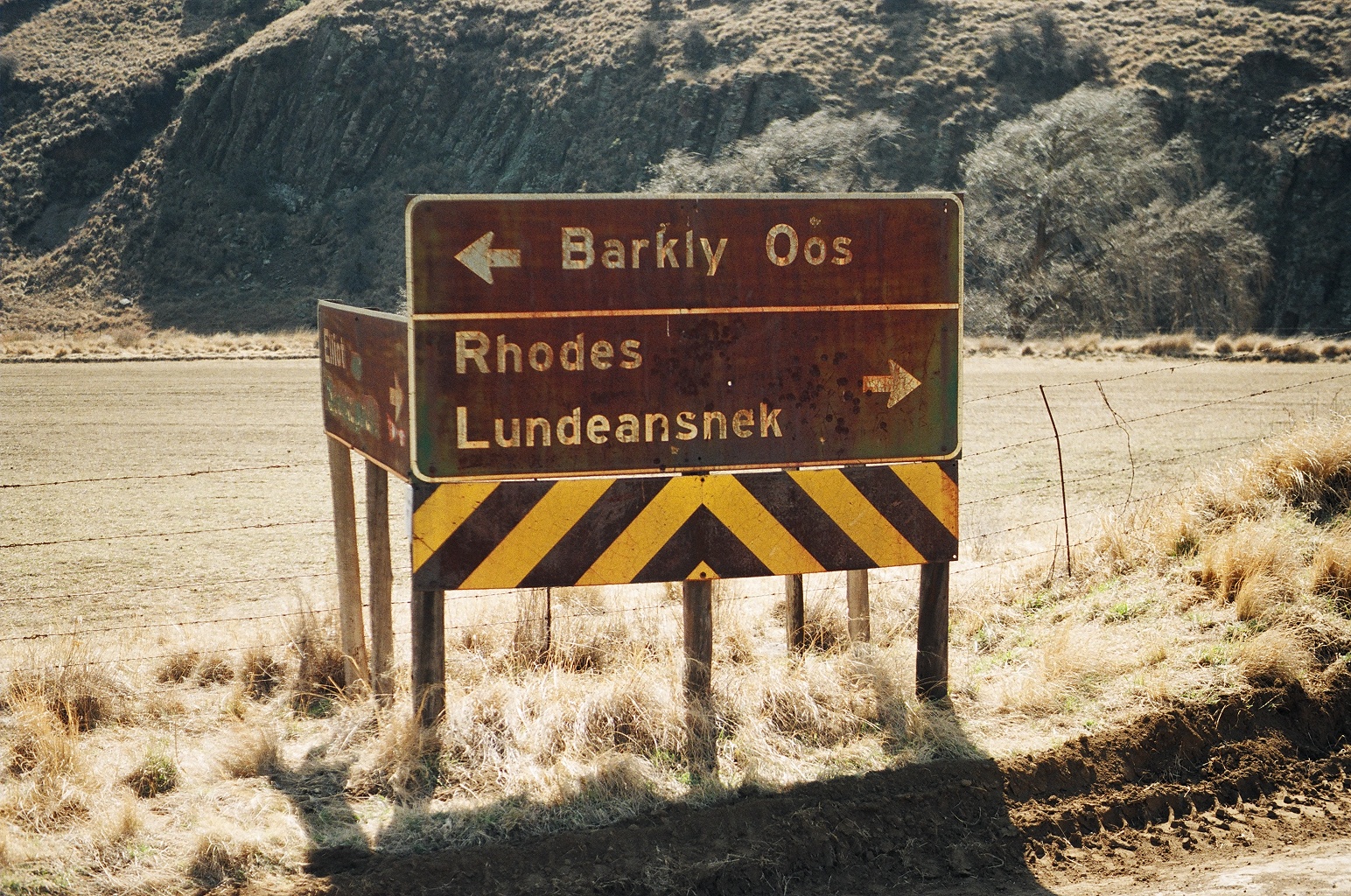
During Sigmund’s stay in Lady Grey, many of Oelschig’s customers -farmers – relocated to the new town of Barkly East. It was 6000 feet above sea-level, and had been established on the lands of Rocky Farm in 1874. In the knowledge that he would have a good number of friends in Barkly East, Sigmund decided to open his own new shop in that newish town, which is about 50 mountainous miles southeast of Lady Grey. He began setting up shop in November 1885. His first accommodation for it was a corrugated iron shed that he bought at an auction in the Indian Ocean port of East London. He had it erected on a plot of land that he had bought. The store was a success even before it opened properly:
“The only goods from the Dordrecht shop I carried with me in my wagon were several dozen Christmas Cards, very artistic ones, printed on velveteen. Barkly East had seen nothing like it! While the carpenter was putting up shelves in one part of the building, I displayed the Christmas Cards on a packing crate and was inundated with customers. They were still milling about as several ox-carts brought all my other merchandise.”
Soon after the shop opened in 1886, Sigmund needed an assistant. He engaged Moss Vallentine’s brother Jacob (‘Jack’), who was then unemployed in Lady Grey. By 1889, the corrugated iron building was replaced by a larger and sturdier single-storied brick building. Soon after this, Sigmund opened a branch store in Moshesh’s Ford, which:
“… lay further into the mountains, approximately a 3-hour ride away, across the Kraai River.”
On the last day of 1889, Sigmund married Ernestine Perlmutter , who was born in Radziejew in Poland and had travelled out from Ichenhausen to South Africa that year. She was a daughter of Heimann Perlmutter – a Cantor in the synagogue of Ichenhausen. Soon after Sigmund married, his assistant Jack married Ernestine’s sister Helene, who was later to perish in the Holocaust.
Sigmund and Ernestine’s first child, Reinhold, was born in Barkly East in November 1892. A second child, Mathilde (‘Sissy’), was born in 1894. By this time, Sigmund’s business was doing so well that he had sufficient work to need more helpers. This, and Jack’s unexpected death in 1897, resulted in Sigmund inviting three of his nephews from Germany to help him in South Africa. They were Jakob Krämer, Moritz Rosenberger, and Julius Cornelius. The first two were grandchildren of Sigmund’s father Isak Rafael Seligmann. Julius was Sigmund’s nephew by marriage. He was the brother of Frieda Cornelius, who married Jakob Krämer.
After the death of Jack and the arrival of his nephews in 1897, Sigmund decided that his children ought to be educated in Germany rather than South Africa, and that it was a good time to return to Germany. He decided that his nephews should take over the running of his business ‘S Seligmann & Co.’
Sigmund and his family travelled to Germany in May 1898, and settled in Munich, from where he maintained an interest in the running of his firm by helping to buy German goods for the shops in South Africa. A patriotic German, but a naturalized British citizen, Sigmund volunteered as a helper in a military hospital in Munch during WW1. His son, Reinhold, like so many Jews in Germany volunteered for military service as soon as the Great War began. He was awarded the Iron Cross, 2nd Class for his services to Germany. As part of his duties whilst in France, Reinhold became one of the first people involved in aerial reconnaissance.
Sigmund died in Munich in 1939, by which time the rest of his family had reached Palestine, where they lived throughout WW2 and after that. The business that he left behind in South Africa continued to flourish in the hands of his three nephews. After a while, they were joined by some of his other nephews. Amongst these was Iwan Bloch, my grandfather, about whom I will tell you another day. Because he moved to South Africa, my mother and her siblings were born in that country.
This is an abbreviated extract without annotations from my book “Exodus to Africa”, which is available from Amazon.