My ancestor who escaped from prison in South Africa in 1878

This describes the colourful life of Jakob Seligmann (1846-1906), who arrived in South Africa from Germany while his cousin, my great-grand-uncle, who migrated to the Cape Colony in 1849, Henry Bergmann (see: https://activeauthor.substack.com/p/a-letter-written-from-cape-town-in ) was still alive. Jakob made a name for himself in the tiny town of Rouxville in what was then the Orange Free State, and then had to flee from southern Africa …

Rouxville was established in 1863 across the Orange River. It is some 23 miles north of Aliwal North, where Henry Bergmann lived, and 25 miles southeast of Smithfield. It was founded to resolve some problems associated with the postal service in Aliwal.
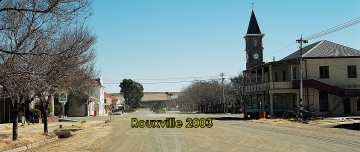
The establishment of Rouxville presented new opportunities for traders. I believe that Henry Bergmann may have had some interests in the new settlement. His cousin Jakob Seligmann and Leopold, a brother of Ludwig Reichenberger, who was working with Henry Bergmann in Aliwal, were both from Ichenhausen in Bavaria and amongst the earliest settlers in Rouxville. In 1873, Leopold married Henry Bergmann’s niece Mathilde Rosenfels who was a first cousin once removed of Jakob Seligmann. Her brothers, Julius, Max, and Jakob Rosenfels, also set up shop in Rouxville. By that time, both Jakob Seligmann and Leopold Reichenberger had both been significantly involved in the foundation of the new town.

The town of Rouxville was established officially in 1863, but it took several years to become the seat of a Magistrate – a ‘Landdrost’. The reason for this delay was opposition by the neighbouring town of Smithfield, north-east of Rouxville and across the Caledon River. One of the reasons given by Rouxville for wanting its own Magistracy was the difficulty of getting criminals to trial when the River Caledon was flooding.

In 1869, the town of Rouxville sent its first petition to obtain its own Magistracy to the Volksraad . Leopold Reichenberg, who was to become the town’s post-master, was among its 108 signatories.  A second petition, containing 60 signatures, followed the first, and was written by Leopold Reichenberg in 1870. His petition included the information that already in 1870 Rouxville could boast of having three shops, a bakery, a slaughterhouse and two hotels with bars, and there were plans for much more growth. After Rouxville had been granted a magistracy, a committee of burghers was constituted to advise the Magistrate. The committee whose role was to ensure the execution of the town’s regulations included Leopold Reichenberg, who had become a ‘Heemraad’ , and Henry Bergmann’s cousin Jakob Seligmann. 

Between the town’s founding date and 1876, the land on which it was built, Zuurbult Farm, was Church land. Until 1876, the town of Rouxville was run by a Committee of Management, which was independent of the Church. Between 1873 and 1876, the Church purchased all rights of management of the town from this Committee.  Jakob Seligmann, vested with Power of Attorney, acted as an agent charged with selling the rights and claims of the Committee on the town to the Church . This is the first evidence that I have of Jakob’s involvement in the town’s legal proceedings.

I learnt from various documents in the National Archives of South Africa that Jakob acted as a ‘General Agent’ in Rouxville. This meant that he undertook legal work such as conveyancing properties, supervising contract writing, drawing up wills, and also defending the accused in court. His name appears frequently in the register of revenue stamps sold in Rouxville. He also appears often in the Register  of criminal cases kept by the Police Station of Rouxville in 1877 and 1878, the latter proved to be a critical year in Jakob’s life.

The police Register contains summaries of cases presided over by the Magistrate of Rouxville. Some of those recorded for 1877 show Jakob acting in his role as an advocate. From the examples that I have seen, it seems that Jakob was good at his job. He defended those in the dock well.

Other cases showed Jakob in a less favourable light.

One of the cases in the police records shows that Jakob’s life did not run smoothly. On 30 March, 1877, he was standing outside his house in Rouxville speaking with a Mr Bachman from Paarl when, out of the blue, he was attacked by Mr Reed. The attacker asked Jakob whether he had made a deal with a Mr Chase, and then began hitting him with a whip. Mr Bachman managed to disarm Reed, but as he testified in court this did not put an end to the attack . Mr Reed, the accused, was found guilty, and both bailed and fined £50. Jakob had been saved by Bachman from serious injury, and maybe also from death. What Jakob had done to annoy Reed is not recorded.

On 2 November 1877, the Police Station Register records that in mid-August 1877 a prisoner, named Leuris, in Rouxville’s jail was accused of stealing the rations of a fellow inmate. That inmate was Jakob Seligmann. This happened during one of several occasions when Jakob was locked up in jail. The stolen rations had been left uneaten by Jakob, who received his food whilst in jail from elsewhere. It was likely that his food was brought to him by his wife. She was Hendrina (né Hendricks), a Christian lady of Dutch descent from Graaff Reinet. Jakob had married her in 1873.

Most Jewish men, including many of my mother’s relatives, who arrived in South Africa during the first six or seven decades 19th century, preferred to marry Jewish women, but they were in ‘short supply’ below the Equator during that time. Often, they married Jewish ladies from Germany who sailed out to Africa specially to be wed . Jakob Seligmann was unusual amongst the South African German Jews of the time; he married someone whom he had met in South Africa and who was not Jewish.

Almost a year after the Reed incident, in September 1878, the Police Register recorded that Chief Constable Henry Röttchers had been accused of being drunken and disorderly whilst on duty. During his trial it emerged that he had left the door of the jail unlocked . Worse than this, Jakob appeared to have had the run of the place: he was able to unlock the door and was not confined to his cell . Röttchers was found guilty and fined 15 Shillings Sterling. Clearly, security arrangements at Rouxville jail were far from satisfactory.

Jakob was incarcerated several times. Once when Leuris stole his rations in August 1877. He must have been released after that because only four days before the Röttcher incident on 31 August 1878, Jakob – at that date a free man – was in court defending someone who had been accused of hitting a ‘white’ farmer. Therefore, Jakob must have been incarcerated again in the last few days of August ‘78.

Two months later on  9 October 1878, the Gouvernements Courant, a newspaper published in Bloemfontein  reported a jailbreak in Rouxville. Sometime during the night of  5 October and the early morning of the next day Jakob Seligmann escaped from the jail at Rouxville.  A ‘wanted’ notice was published in the same issue of this newspaper, both in Dutch and in English. It reveals why Jakob was being held:

“WHEREAS PRISONER JACOB SELIGMANN, charged with the crime of FORGERY and FRAUD, did, in the night of the 5th and 6th of October, 1878, escape out of the Prison at Rouxville, with the assistance of one or more persons, Notice is hereby given, that a REWARD OF TWENTY-FIVE POUNDS STERLING will be given…”

The authorities were concerned that Jacob Seligmann would try to escape from the Orange Free State. On  10 October, a letter was sent from Bloemfontein to Natal, the neighbouring British colony. It was believed by the authorities that Jakob might head for the coast of Natal, the closest seashore to the landlocked Orange Free State. The letter begins by saying that a copy of the warrant of Seligmann’s arrest was attached, and it continues to say that Jakob was being held in jail awaiting trial at the Circuit Court in late November.

It was the second time that Jakob had been in jail in 1878. The first was three months beginning in May, and the second had begun in late August . The letter included the information that Seligmann had been accused of defrauding several persons of a large amount of money. By mid-October, ten days after Jacob had escaped from prison, the police authorities in Natal had been ordered to look out for the escapee. In November 1879, the authorities in Natal wrote to the Home Secretary of the Orange Free State, reporting that efforts made to apprehend Seligmann were in vain.

At first, I had little idea why Jakob was in trouble, but eventually I ‘unearthed’ an informative document. This revealed that on 28 of June 1877, the High Court of Justice of the Orange Free State ordered the sequestration of Seligmann’s assets , following the issue of a bankruptcy against him by Nathaniel Adler  & Co. of Port Elizabeth. The sequestration order affected all his assets including household possessions.  An inventory of these included two children’s bedsteads and one baby’s cradle. Jakob’s family needed these items because by June 1877, Jakob and Hendrina had two small infants and a five-month-old baby .

After his escape, Jakob disappeared from South Africa. By the time that he disappeared from prison and reappeared across the Atlantic, he and Hendrina had produced four sons, the eldest of which was only 6 years old and the youngest a baby.  They all appear in the yellowing pages of the 1880 Census of the USA: they were living in Springfield in Sangamon County, Illinois .

It puzzled me how Jakob – a wanted man – and his young family managed to reach the USA from South Africa without being captured. Two clues are contained in an unpublished account of a long trip that Jakob’s son Arthur (born 1878) made from the USA to Europe and South Africa in late 1904 and early 1905. Arthur never mentions his father’s colourful past in South Africa anywhere in his detailed, but dryly written, travel diary. He wrote that he arrived at Victoria Station in London, and:

“…was soon located at Kleins Hotel  in Finsbury Square as this Hotel is a very old German house and a great rendezvous for the German Commercial travellers. It is the same hotel that my father stopped at when he visited London during his journey from South Africa to America about 30 years ago.”

In connection with this hotel, Arthur mentions his father but not the rest of the family. Elsewhere, he wrote:

“Upon my arrival in Graaff Reinet, … I made inquiries about the whereabouts of the Bartletts and soon an elderly gentleman introduced himself as Mr Bartlett, and I was then certain that it was Uncle Richard who 26 years ago escorted mother and the four of us boys including myself as far as Mount Stuart  previous to our departure to Port Elizabeth where we embarked on the steamer for America.” 

As the family is not mentioned in connection with Kleins Hotel in London and Jakob is not mentioned in connection with the journey to Port Elizabeth, I speculate that Jakob, a fugitive, might have found it safer to travel to the USA separately, without his young family who would have made their own way there .

In contrast to the mystery about of Jakob’s movements in late 1878 and early 1879, the reason that he chose to go to Illinois is less enigmatic. First, he had at least two brothers already living there: Julius (born 1843) who married in Illinois in 1869; and Daniel (born 1854). Secondly, he would have learnt something about life in Illinois while he was still in South Africa from another of his brothers Sigmund (1856-1939), who had lived with Julius in Illinois (see: https://activeauthor.substack.com/p/sigmund-migrated-from-germany-to ) briefly before coming to Rouxville whilst Jakob was still there.

The lives of both Jakob and his ill-fated cousin Henry Bergmann illustrate that life in a new country had its pitfalls.  Both of them would have enjoyed the less constrained atmosphere of South Africa compared with that which they had left behind in Germany, but they also discovered that life could throw up unexpected difficulties.
Remembering a forgotten adventure during WW2 in German occupied France

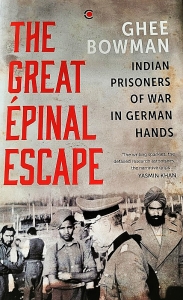
DURING WORLD WAR II, many Indian soldiers fought with the British in North Africa and on many other battlefronts. Vast numbers of allied soldiers were taken prisoner by the Germans in North Africa, and these prisoners of war (‘POWs’) included several thousand Indians. The POWs were taken first to Italy, and then to prison camps in German occupied territory. One of the prison camps that contained many Indians was in the French town of Epinal. In May 1944, allied aircraft heavily bombed the town as part of a programme to damage French the railway system that was being used by the Germans. During this attack, the camp housing the Indians was badly damaged, and many Indian POWs escaped. At least 500 of them found their way to safety in Switzerland, and a few fought with the French resistance. This almost forgotten episode is described in “The Great Epinal Escape”, a book written by Ghee Bowman (1961-2025).

The book details how and where the Indians were taken prisoner; who they were; their journeys from Africa to Epinal; and their lives in the camps. Then, in meticulous detail, it recounts how the escapees found their way to freedom in Switzerland and the help they received from French people on their difficult journeys. This assistance was given by ordinary people, who knew that if they were discovered to be helping escaped POWs, they would face horrendous punishments, including execution.

Bowman’ scholarly but extremely readable book is the only account in English of this great escape story. Whereas the daring escapes of British POWs from German prison camps have been related in books and films, the Epinal escape, probably the greatest escape of POWs during WW2, seems to have been ignored both by British and Indian historians. The reasons for this are discussed in Bowman’s final chapter.

I bought my copy of this book about an almost forgotten episode during WW” in Bangalore (India), and I have enjoyed reading it.

How I avoided an awful fate

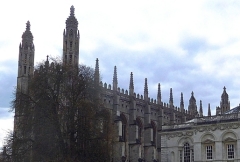
Chapel of Kings College, Cambridge

CAMBRIDGE IS A CITY which I have visited often since I was a child. My first recollection of the place was visiting Gonville and Caius College to meet my father’s long-term collaborator, the Hungarian born economist Peter Bauer (1915-2002). Later, after 1965, during my childhood and adolescence, we used to visit Cambridge to spend time with my father’s friend from his student days in Cape Town (South Africa), the social scientist Cyril Sofer (died 1974) and his wife Elaine. At first, I used to visit them with my family and when I was in my teens, I used to stay with them in their large Victorian house near Selwyn College. It was Elaine, who first introduced me to the joys of the drink known as ‘Bloody Mary’.Further travels to Cambridge followed when a childhood friend of mine attended Clare College to study for his bachelor’s degree. Through him, I met his good friend, now a well-known writer, Matthew Parris.

Many more visits to Cambridge followed my graduation at University College London in 1973. Although I remained in London to study for a higher degree, some of those who had graduated with me moved to Cambridge to pursue further studies. Three out of the nine of us, who graduated in physiology in 1973, embarked on doctoral theses in the city’s university. One of these was Lopa, who is now my wife. While she was at Cambridge, we were still ‘just good friends’, as the saying goes.

On one of my visits to see Lopa, I stayed in a house in Owlstone Road, which is south of the historic centre of Cambridge. A mattress was set up for me in a ground floor room with a street facing window. The room had been recently occupied by a female student, who had moved elsewhere. This sojourn in the city was during the time when the so-called Cambridge Rapist was assaulting young women, always within their homes, at an alarming rate. He carried out his attacks between October 1974 and April the following year.

Apparently, he followed potential victims to their homes and noted down their addresses in a notebook.The rapist carried out his first rape on the 18th of October 1974. Then another on the first of November, and yet again on the 13th of that month (https://en.wikipedia.org/wiki/Peter_Samuel_Cook). The latter was carried out within Homerton College, now a part of Cambridge University. He struck again on the 13th of February 1975, and then, unsuccessfully, on the 5th of May.

I slept soundly at Owlstone Road when I was staying there for a night or two. One morning, I woke up and saw police vehicles out in the road. It was the 8th of December 1974 and the rapist had raped a woman in the house next door to where I was staying, having broken into its ground floor room, which mirrored that in which I was sleeping. What none of us knew until after the perpetrator, Peter Samuel Cook, was eventually caught during his attack on Owlstone Croft’s nurses’ hostel in June 1975, was that the villain had listed the house in which Lopa was living with some other young ladies in his notebook of potential targets. The young lady who had occupied the room where I spent a couple of nights was in the rapist’s list of future victims.

Cook, who had knifed at least one of his victims, was a violent person and might have been awfully annoyed with me had he broken into the room where I was sleeping and found me, a man, instead of one of his intended female targets. Subsequent visits to the wonderful city of Cambridge have not, I am pleased to relate, been so potentially hazardous. Cook was jailed for life and died in Winchester Prison in 2004.

Accidentally killed

BROMPTON CEMETERY IS in west London. Richly populated with memorials to the dead, it is a remarkably lively place on a sunny day, being filled with walkers, cyclists, and picnickers. The bodies of people from all walks of life and from many nations lie at rest beneath the many stones in the cemetery, which was first opened in 1840. During our recent visit, I spotted two memorials to men with a military career. Each of them was particularly eye-catching.

The first of these is a pink granite slab resting on stone cannon balls made of grey granite. A pile of similar canon balls is arranged like a pyramid on top of the stone. I felt that it is a particularly fitting design for a soldier’s gravestone. One of the cannon balls is carved with the word ‘BEYROUT’ and another with ‘PORTUGAL’. This is the memorial to General Alexander Anderson (1807-1877), of the Royal Marine Light Infantry. The monument was restored in about 2016. A document relating to its restoration (https://www.rbkc.gov.uk/idoxWAM/doc/Other-1833173.pdf?extension=.pdf&id=1833173&location=Volume2&contentType=application/pdf&pageCount=1) informs that three of the cannon balls are engraved “Syria”, “Beyrout” (i.e. Beirut), and “Gaze” (i.e. Gaza). However, I photographed one bearing the word “Portugal”, which is not mentioned in the document. The monument was erected by Anderson’s friend Richard Eustace, MD, who lived from 1833 to 1908 (www.bmj.com/content/2/2490/865.2). Eustace entered the Royal Navy as a surgeon in 1854.

Anderson became a Companion of the Order of the Bath in June 1869 (www.thegazette.co.uk/London/issue/23503/page/3179/data.pdf).  His obituary in the London “Morning Post”, which shows why he was awarded this high honour, includes mention of Portugal:

“He obtained his first commission as second lieutenant in the Royal Marine Forces in May, 1823, and had during half a century seen much active service. He served with the army of occupation in Portugal, and was for some time quartered at Fort St. Julian. He served at the battle of Navarino in 1827, and at the commencement of the action boarded with his men one of the Turkish ships and captured the flag. … He served throughout the campaign on the coast of Syria in 1840-41 … was at the attack and capture of Beyrout; the bombardment and surrender of St. Jean d’Acre; the surrender of Jaffa, and was a volunteer in the expedition against Gaza. … He had received the war medal with two clasps, also the Turkish silver medal from the Sultan, and when a colonel, received the good-service pension. He became colonel-commandant in November, 1859; major-general in March, I860; lieutenant-general in November, 1866 ; and general in April, 1870.” (www.newspapers.com/newspage/396245337/)

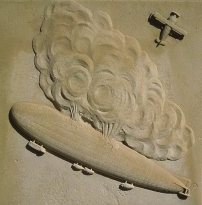
A memorial, less original in design than that of Anderson, also caught my attention with its bas-relief depicting an old-fashioned biplane heading away from a large flying zeppelin from which clouds of smoke are billowing. The grave marks the resting place of Flight-Sub-Lieutenant Reginald Alexander John Warneford (1891-1915). The stone bears the words:

“Accidentally killed 17 June 1915”

Given the year he died and his rank, it was hard to imagine what kind of accident caused him to die during a war when most fatalities were not described as ‘accidents’.

Warneford was born in Darjeeling (India), son of an engineer working for the railways in British India (https://en.wikipedia.org/wiki/Reginald_Warneford). He was educated first in England and then in Simla, back in India. His father:

“…taught him the law of the jungle; to read the moon and stars across the wide Indian night skies; to be able to study cloud formations. Rex rode on the footplates of the service engines, rode the work elephants and hunted tigers.” (http://kes1914.net/the-boys/reginald-rex-warneford-vc/ – a highly informative web page)

 At the outbreak of WW1, he joined the British Army and then was soon transferred to the Royal Naval Air Service to be trained as a pilot. He was a good student even if somewhat overconfident. Soon, he became involved in hunting down and intercepting German Zeppelin airships that were being sent to attack London and other targets in the UK.

On Sunday, the 6th of June 1915, Warneford was sent in a Morane Saulnier L monoplane to intercept the heavily armed and well-powered LZ37, a 521-foot-long German zeppelin, which had just taken off from Belgium and had got lost in the fog over the English Channel. German radio signals, intercepted by the British, discovered that the airship had been ordered to return to base. Warneford was sent out to find and attack it. He reached the airship when it was 10,000 feet over Bruges. Warneford rose to 11,000 feet and dropped six bombs onto the Zeppelin, which burst into flames. The hot air from the explosion caused Warneford’s ‘plane to go into a spin and damaged its fuel line. Warneford managed to land in a field behind enemy lines. After rapidly repairing the damage, he managed to fly back to safety, not before landing to refuel at a French base en-route. On the 8th of June, he was awarded the prestigious Victoria Cross for gallantry. Just before that, he was also awarded:

“Chevalier de la Legion D’Honneur with its automatic companion, the Croix de Guerre’ that had been recommended by General Joffre.” (http://kes1914.net/the-boys/reginald-rex-warneford-vc/).

Modestly, he told a friend that in comparison to his grandfather, who had constructed railways in India:

“Bringing down the LZ37 was just routine and over in a flash. But building a railway, that was something.”

Returning to duty after his heroic activity, Warneford’s next mission was to take a new Henry Farman F27 biplane on a test flight. He took off from Paris on the 17th of June 1915 with an American reporter as a passenger. At 2000 feet, the aircraft began to disintegrate and fall downwards. It turned upside down at 700 feet and both pilot and passenger, who were not strapped in, fell to the ground. The reporter died instantly but Warneford survived. However, he died on his way to a hospital.

Had Warneford died whilst attacking a Zeppelin or during any other military encounter, his death would not have been regarded as accidental. As his death was a consequence of an unforeseen disaster, I suppose that calling it an accident is appropriate.

These graves I have described are two of many I saw that attracted my attention. I might well describe some of the others at a later date.

A narrow escape

IN AUGUST 2011, MY WIFE was invited to attend a Loreto House school reunion in Calcutta (Kolkata). As I had never been to the city before, I accompanied her. While my wife took part in the daily activities with some of her former schoolmates, I explored and fell in love with Calcutta.

Throughout our five day visit to the city, the monsoon rain fell heavily and incessantly. I walked around Calcutta, often wading through filthy water that submerged my feet and lapped around my ankles. This hardly affected my enjoyment of the delightful decaying city, in some respects India’s own distinctive version of old Havana in Cuba.

One day, I visited Jorasanko, the palatial residence of the Tagore family, whose members included not only the Nobel Prize winner Rabindranath but also artists such as Abanindranath and Gaganendranath.

After seeing around the fascinating rooms of Jorasanko, I sploshed through the flooded streets towards the Hooghly River. On my way, I walked along a busy street lined with shops and filled with crowds of people. A steady stream of rickshaws pulled by thin sinewy men and each laden with two or three passengers made its way through the busy throng. The huge wheels of these vehicles keep the passengers high above the water flooding the streets.

I noticed that some shops, often clothes and textile merchants, were giving hot food to some passersby. At one of these shops, I asked about the food distribution. It was explained to me that during Ramadan, it was considered to be a virtuous thing to feed the poor.

Eventually, after crossing a wide road clogged with slow moving heavy traffic, I stepped onto the Howrah Bridge, a gigantic steel bridge, a Meccano lovers dream, which traverses the River Hooghly. It was constructed between 1935 and early 1943.

At first, the bridge crosses over a large market that runs along the riverbank. Then, after a few yards, it is over the water. I walked along the downstream facing pedestrian walkway, dodging many porters carrying heavy and bulky loads on their heads. I took numerous photographs until I was two thirds of the way across the bridge and met a policeman with an ancient rifle slung over his back. Politely, he informed me that photography was forbidden on the bridge. By then, I had sufficient images stored in the memory of my camera.

Once over the river, I headed through the streaming rain and thick crowds to a boat station close to the Howrah railway terminus. My plan was to travel on a river bus downstream to a landing stage not far from Park Street.

I bought a ticket which was printed on very poor quality paper, that had to be kept dry to avoid it falling to pieces. I asked someone on the floating platform at the water’s edge if the boat that was approaching was heading for my planned destination. I received what I believed was an affirmative reply, and then boarded a relatively empty boat with plenty of free seats. We set off.

To my surprise, the boat headed upstream rather than downstream. Soon, we passed beneath the Howrah Bridge. We sailed a long way upstream away from the city centre. The banks of the river were lined with unattractive industrial buildings and these were punctuated by occasional bathing ghats.

I disembarked at the boat’s first stop. Had it not been raining so heavily, I would have exited the boat station to take a look around the area. Instead, I bought another flimsy ticket to return to Howrah. This time, I asked several people at which of the two floating embarkation pontoons I should board the downstream boat. I waited close to the water while a large crowd of fellow passengers gathered behind me. I wanted to be sure of embarking first.

The boat approached where we were all standing. I could see from afar that it was packed to the gills with people. When the boat was about 18 inches away from the pontoon, I felt a great push from behind me and I was catapulted across the water towards the approaching vessel. Luckily, I was able to grab something on the boat and this saved me from falling into the water and being crushed between the boat and the pontoon.

The boat was stuffed with people. I am sure that sardines are less tightly packed in tins. I wanted to try to take a photograph to capture an image of this crowd, but I could not because so great was the pressure exerted by those around me that I was unable to raise my hands from beside my body.

I looked around and noticed there were few life saving flotation items. Had our boat sunk, few on board would have survived.

It was a great relief to disembark at Howrah. I was drenched, somewhat shaken, and hungry. I decided to take a taxi to Flurys in Park Street, a European style tea room that served what I was yearning at that moment: toasted club sandwiches.

I boarded a battered yellow Ambassador taxi in a car park near the railway station. We moved forward into a mass of other similar taxis. The crowded taxis were so close to each other that it felt that they were all welded together. It took almost an hour for my driver to skilfully manoeuvre his taxi a couple of hundred yards on to the bridge.

At last, we arrived at Park Street, where, slightly drier because of sitting for ages in the taxi, I settled down at a table in Flurys. I ordered my sandwich and savoured the peaceful atmosphere in the tea room.

On my third visit to Calcutta at the end of 2019, we visited Flurys but, sadly, we were disappointed to find that its food and service was no longer as good as before. Fortunately, the scruffy Nizams at New Market, which serves parathas stuffed with meat and omelettes, remains as good as it was in 2011 and many years before.

Despite my near escape from severe injury or worse, my enthusiasm for Calcutta and its people continues to grow and grow.

A narrow escape

Ladbroke monument


My first job as a dentist was in a lovely practice in the Medway Towns. After having worked there for eleven years, I married and then lived in London. As it became tiring commuting by car between Kensington and north-east Kent, I changed practices. I worked for about nine months in north-west London in a practice where I was not happy. Then, I moved to another practice near Portobello Road. After about four years, the owner of that practice decided to open another branch in Maidenhead, Berkshire. I thought it would be interesting to work in a brand-new practice, and as Maidenhead was served by a good rail connection from Paddington, which is near my home, I decided to move to the new practice, where I treated its very first patient.

Usually, I boarded a local train that left Paddington a few minutes past eight in the morning. Just over half an hour later, I used to disembark at Maidenhead station, which was a couple of minutes’ stroll from the practice. Of the patients whom I treated there, the less said the better. My best memory of the place was that it was near a wonderful sandwich shop. The people who worked there had no idea about portion size control. So when I ordered my favourite sandwich, filled with prawn mayonnaise, it contained so much filling that I could hardly get my mouth around it.

One Monday evening, I returned to Paddington a little earlier than usual. Not being in a great hurry, I bought a ticket for the following Monday’s journey to Maidenhead.

On the following day, Tuesday the 5th of October 1999, I arrived at Paddington early as usual. Having already bought my ticket the evening before, I was able to take the train that left a few minutes earlier than the one I usually boarded. It left just before 8 am. The train I normally travelled on left a few minutes after 8 am.

I arrived at Maidenhead and began working. In those days, I used to have a radio running in my surgery. I heard a news bulletin that mentioned that there had been a terrible rail crash. I thought nothing of it until I returned to Maidenhead station that afternoon. I discovered, to my annoyance, that no trains were running as far as Paddington. They were all terminating west of Paddington at Ealing Broadway, where, fortunately, there is an Underground line which allowed me to continue my homeward bound journey.

It was only when I reached London that I learned more details about the crash. The train that I normally boarded every morning, the one which left a few minutes past 8 am, had collided head-on with a high-speed express train coming in the opposite direction on the same set of rails. Later, it was reported that 31 people had died and over 500 were injured. Most of the victims, killed and injured, were on board the train that I missed taking because I had bought my tickets on the night before.

There is a monument to those who died in the crash. It is near the large Sainsbury supermarket on Ladbroke Grove. Whenever I see this simple stone monument or think about the incident, I shudder. One of the names on that memorial could have easily been mine.