Waiting, waiting, waiting,
Always delay’d
Why did we fly Ryanair?

Waiting, waiting, waiting,
Always delay’d
Why did we fly Ryanair?
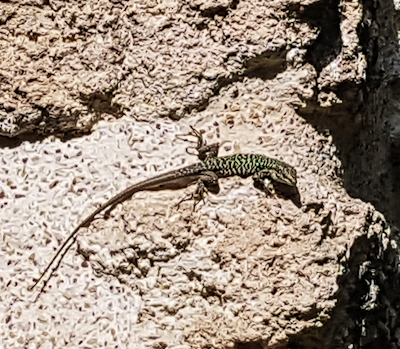
Reptile on a wall
Hot stone in Palermo
The warmth of Sicily

Palermo in the rain
A sea of umbrellas
Bad weather today

Palermo
It is 2018, and I am eating ice cream in Italy after the ladies in my family have just visited a shop selling brassieres.
60 years earlier, aged 6, I was doing the same thing. We used to visit Florence annually during my childhood. Every year, my mother used to buy her bras in Florence at a shop close to an excellent ice cream shop called “Perché no?” (IE Why not?). After every visit to the bra store, I was rewarded with an ice cream.
Now, here in Palermo, the same thing has happened six decades later?
Nothing changes.
While I was a PhD student, there was another person, ‘Ali’, doing research for his doctoral thesis in our lab. He was a devout Muslim from one of the Gulf States. During Ramazan, he fasted as required. This he could handle easily but abstaining from cigarettes during the hours of fasting was a trial for him.
Our PhD supervisor, whom we called ‘Doc’, and his wife both worked alongside us in the lab. They were not only first-rate scientists but also warm-hearted people. Doc’s wife played in an above average amateur philharmonic orchestra. Several times a year, the orchestra put on public concerts. These were held in halls in the area about 20 to 30 miles west of central London. Doc’s wife used to invite us students to attend these concerts if we wanted. This invitation included spending a night at her family home.
An early evening meal was always served before the concert. Often, soloists were invited to share this pre-concert repast with other guests including whichever student(s) turned up.
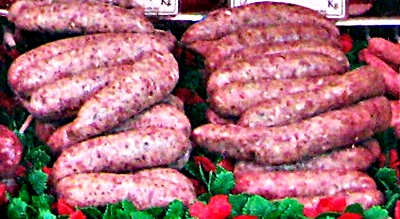
On one occasion, Ali and I attended one of these meals. The main course was an English (and Scottish) dish called Toad in the Hole. This consists of sausages cooked in Yorkshire Pudding batter. When the ovenproof dish containing this speciality arrived at the table, the sausages were invisible. They were all concealed beneath the surface of the steaming hot batter.
‘Doc’ mentioned that although most of the sausages were pork, in deference to Ali they had included one or two beef sausages. However, neither he, nor his wife, nor the cook could remember where in the dish they had placed the beef sausages.
‘Doc’ was not only highly intelligent, but was also extremely practical. For example, he was a competent plumber and mechanic as well as a superbly skilled biologist. Often, he used to say: “I wonder why they waste time teaching children Latin and Greek. They should be teaching them plumbing and carpentry.” I digress. Doc’s solution to the problem of detecting the beef sausages kindly added for Ali, who did not eat pork, was as follows. Using a big knife, he cut grid lines across and through the meat-containing batter. Then, he lifted each of the resulting cubes of the Toad and examined the cross-sections of the sausages that his knife had cut through. Because the beef sausages were redder in cross-section than the pork, he was able to serve Ali his religiously acceptable food.
It was very thoughtful of Doc and his wife to think of Ali’s dietary restrictions, and to deal with the problem the way they did. This was typical of the couple’s great kindness. The devout Ali was gracious enough to eat his specially prepared portion of the dish without complaining that the pork and beef had been cooked together.
To see a recipe, one of many, for Toad in the Hole, click HERE
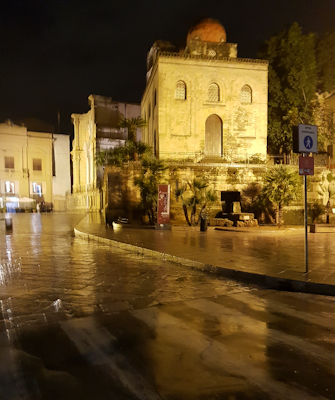
Moorish influence in Sicilian church architecture of the Norman era can be explained by the presence of Moorish craftsmen in Norman Sicily.

‘D’ had terrible teeth. Not only were they broken, but they were also worn down in such a way that they looked like an aged rodent’s teeth.
He had worked for many years in a place where there were high levels of atomic radiation. Naturally, he was concerned about how much radiation he had been exposed to over the years. On one of his many visits, he asked me somewhat irritably: “How many more x-ray pictures do you need to take?”
I replied: “I have enough pictures to take out your bad teeth, but not enough to save them.”
D seemed reasonably satisfied with my answer. At least, he never raised the subject again.
Some weeks later, D’s wife, who was also one of my patients, asked me why her husband had to make such an enormous number of visits to my surgery. I explained that the repair work was extensive and complicated, each tooth requiring several appointments. She replied quickly:
“If he were a dog with so many problems, I’d have had him put down ages ago.”
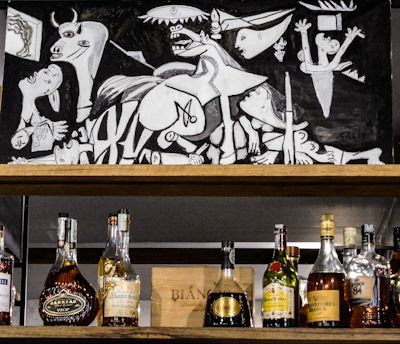
A picture based on Guernica by Picasso in a bar in Palermo, Sicily. Booze and bombing, an odd juxtaposition.

There is a decorative drinking fountain on the Broadwalk in London’s Regent’s Park. The fountain looks like a typical Victorian gothic structure, which it is. Closer examination reveals bas-relief panels that depict: a bull standing by a palm tree; a lion next to a palm tree; and the head of a man wearing an oriental hat. This fountain would not look out of place in Bombay, which is full of structural souvenirs of the Victorian era. This should not surprise you when you learn that the fountain was a gift of Sir Cowasjee Jehangir Readymoney (1812-78) from Bombay.

Cowasjee, who was born in Bombay, received little education before becoming a warehouse clerk in Duncan, Gibb & Co. in that city. In 1837, he moved into a more lucrative job. Nine years later, he opened his own business. In 1866, he became a Commissioner of Income Tax in Bombay. Later he became a Justice of the Peace.

Readymoney lived up to his name, becoming very wealthy. He invested huge amounts of money into a wide variety of good causes including social housing (similar to that erected by Peabody in the UK) in Bombay, The University of Bombay and an Indian Institute in London. A year after being made a member of the Order of the Star of India in 1871, he was made a Knight Bachelor of the UK. These honours were awarded to recognise his great philanthropic contributions.

The fountain in Regent’s Park, which no longer issues water, was erected in 1869, nine years before Readymoney’s death. His main residence was in Bombay’s Malabar Hill district.

Dr Thomas A Quilliam, who died in 2008, taught me general human anatomy during my first year as a dental student at University College London (‘UCL’). His teaching method was quite unlike anything I had encountered before.
At our first meeting with him, Quilliam told us that as he was lazy, he preferred the students to give the lectures whilst he sat and listened at the back of the lecture theatre. He was not kidding, because this is exactly what happened.
We had anatomy ‘lectures’ five days a week and did dissections of a human cadaver on several afternoons. Each week, several students were assigned particular topics chosen from the syllabus. Each student was required to compose a twenty-minute talk on his or her topic, as well as designing simple diagrams, which could be drawn quickly on examination scripts, to illustrate it. For example, I can remember being asked to talk about the lymphatic drainage of the mammary glands. You might well wonder whether this was ever any use during my 35 years in dental practice. I am not sure that it was.
At each class in the lecture theatre, three students gave their presentations. Before that, Quilliam would treat us to short extracts from (usually) American medical education films. I can remember one with the thrilling title “The surgical anatomy of the kidney”. We would watch the first few minutes, before Quilliam switched off the projector. Then, each of the three students who had prepared for that day, gave their presentations. Most students, even the shyest in the class, did a good job, and made useful drawings and diagrams. Some enterprising students even prepared informative models of the anatomical structure they were describing. Every now and then, Quilliam, who sat at the back of the banked seats in the lecture theatre, used to ask a question to clarify what the speaker was saying. If the student answered “maybe” or “perhaps”, Quilliam would say: “That’s a typical University College answer.” Actually, it was. When I was studying physiology at UCL, we were taught to question everything and be reserved about stating that something was a certain fact.

There were 50 students in my year. In all, we must have had at least 150 hours of ‘lecture’ sessions. As three students gave talks each session, this meant that everyone on the course had to prepare about nine topics from the syllabus. This ensured that everyone was likely to encounter at least one of his or her own topics in the final written or viva-voce examination.
You might be thinking that Quilliam really was a bit lazy, but you would be wrong. What his method achieved was very clever, and an important preparation for the clinical environment. Not only did his method avoid hours of having to listen to the same person giving the same lectures that he might have given year after year, but it also taught us to communicate ideas. Quilliam’s method of making us, the students, give presentations was a good training in the art of presenting unfamiliar topics clearly and comprehensibly. In dentistry, especially nowadays (and even when I entered practice), patients like to be kept informed about the nature of their problems and how they can be resolved.
 yamey
yamey 