
At the high altar
Promises are now made
That no one may alter

At the high altar
Promises are now made
That no one may alter
The Arberesh of Sicily are a group of people descended from Albanians, who left the Balkans in the 15th century to escape from the Ottomans.
Palermo, the capital of Sicily, is separated from the rest of the island by a crescent of mountain ranges. After the occupation of Sicily by the Arabs in the 9th century, the Bishop of Palermo moved his seat to Monreale, a small hill town southwest of the city. There, he built a cathedral and then, later, after the Arabs had been expelled, the Normans built a Benedictine monastery. Monreale, which overlooks the metropolis, is now a suburb of Greater Palermo but in mediaeval times it was almost 5 miles away from the old walled city.
Albanian refugees landed along the coast of Sicily during the 15th century while the Ottomans were fighting in Albania, ably resisted for many years by George Kastrioti Skanderbeg (1405-68). Some Albanians landed near Palermo about twenty years after the death of Skanderbeg. In 1488, the Archbishop of Monreale granted them some vacant, disused, plague-ravished land across the mountains about 5 miles south of Monreale. They were told to make the most of it, and they did so very successfully. In exchange for this ‘gift’ of land, the Albanian settlers were required to recompense the Archbishop with taxes raised on what they were able to produce.

The settlers established a town on the south-east facing slope of Monte Pizzuta. Originally named Piana dei Greci, it is now known as Piana degli Albanese (‘Piana’). With a present population of about 7,000, most of the people speak an archaic form of Albanian known as Arberesh, as their mother tongue. They are also fluent in Italian and Sicilian.

Bilingual signs (Italian/Arberesh) in Piana
In 2014, I published a book, “From Albania to Sicily”, which describes the Arberesh communities in Piana and several other villages in western Sicily. In October this year, while staying in Palermo, we re-visited Piana for a day and a night.
The bus from Palermo to Piana winds through the mountains separating Piana from the capital. As we travelled along the sinuous road with its many hairpin bends, I looked at the slopes strewn with greyish boulders and pondered the difficulty of the terrain through which the Albanian settlers had to struggle in an era long before there were decent roads. Then, I remembered the landscape of wild, steep mountain ridges in south western Albania, south of Vlora. Travelling through the wild terrain south of Palermo must have seemed no different to what the settlers had left behind in Albania.

San Demetrio Megalomartire
On arrival in Piana, I popped into the lovely cathedral of San Demetrio Megalomartire. This church has an iconostasis such as you would expect to find in an Eastern Orthodox church. It is home to worshippers who practise the Byzantine rites. The first inhabitants of Piana, who originated mainly in south-western Albania and the Morea (Peloponnese) were Greek Orthodox Christians. The Archbishop of Monreale allowed them to continue to worship according to the Byzantine rites, but they had to adopt the Pope in Rome, rather than the Patriarch in Constantinople, as their spiritual leader.
In 2016, we visited Himara in Albania. This beautiful seaside resort was one of the places where the Arberesh lived before escaping to Sicily. The old part of the town, high above the coastal resort, is largely abandoned, but it resembles closely the historic centre of Piana. Incidentally, Piana has a street named Via Himara, and, also, a restaurant called Valle Himara.
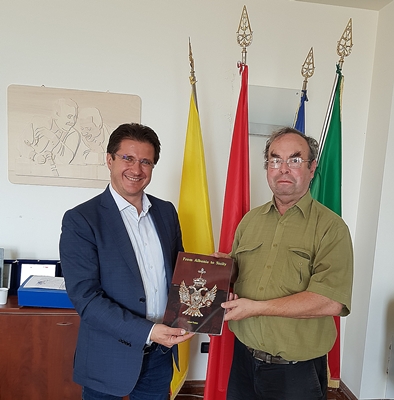
One of the reasons for our recent visit to Piana was to present a copy of my book to the town’s excellent library that occupies two storeys above Piana’s centrally located Extra Bar, which is famed for its fine canoli. We were invited to meet Ing. Rosario Petta, the town’s Mayor, who showed great interest in my volume, and even suggested that it ought to be translated into Italian.
During our visit, we met many people who remembered us from our earlier stay in Piana. They greeted us like old friends, an indication that the Arberesh have not abandoned the Albanian traditions of friendship and hospitality. They have also not forgotten other traditions they brought with them from Albania. Although they dress like other Italians for daily activities, no opportunity is lost to change into colourful, decorated traditional Arberesh/Albanian costumes. This is particularly the case at Easter time, when visitors from all over Italy flock to Piana to see great numbers of people wearing this garb.
Eric Hobsbawm remarked that the people of Piana, “… had a reputation for rebelliousness …” He quotes the words of GM Trevelyan who said that Piana “… was the hearth of freedom in Western Sicily.” I wondered why of all the towns in Sicily, Piana was one of the most rebellious. GM Trevelyan puts it down to some kind of inheritance. Maybe, those Albanians, who preferred living freely rather than under the yoke of the Ottomans and also chose to leave their homes in the Balkans in the 15th century, were perhaps endowed with something, maybe even genetic, which engendered in them a love of freedom and equality. Who can say?
The Arberesh in Piana played an important role in assisting Garibaldi in his invasion of Sicily in 1860, the beginning of a series of events that led to the Unification of Italy. When GM Trevelyan visited the town sometime before 1912, he met leading citizens of the town, “… in their circolo, where a very intelligent and just pride is taken in the history of the revolution of 1860 and the highly creditable part played in it by the ‘Albanians’ of Piana.” Garibaldi, who began his campaign to liberate and unify the Italians in Sicily, proclaimed to the Sicilian Arberesh who fought with him that: “Avete combattuto come leoni” (i.e.: they had fought like lions).
During our recent visit to the library in Piana, we met a group of highly educated librarians, who showed great interest in my book. When we began discussing Garibaldi in Sicily, they, like several people we met in Palermo, displayed unfavourable sentiments about the Unifier of Italy. They all felt that the liberation of Sicily and its incorporation into Greater Italy was a bad thing for the island. What had once been a prosperous part of the Italian lands became impoverished whilst the previously impoverished north of Italy became increasingly wealthier. Many of the people we met in Piana and Palermo suggested that the liberator Garibaldi, a northern Italian, had not only liberated Sicily from the Bourbons, but had also ‘liberated’ much of Sicily’s wealth including the contents of the vaults of the island’s banks. I have yet to check the veracity of these surprising slurs on Garibaldi’s reputation.
Returning to Piana, this delightful little hillside town is an attractive, peaceful place to stay. There is accommodation in the town and in the countryside around it. You can explore the old town with its steep streets as well as the interesting Nicola Barbato Museum, the lake, and several old churches. Energetic visitors can enjoy breathing fresh mountain air on the slopes of Mount Pizzuta and other nearby peaks. If you speak Albanian (or Italian), you will have no difficulty communicating with the hospitable Arberesh. Although the Arberesh language differs from Albanian, Albanian-speakers can easily converse with the Arberesh. If, however, you are hungry for Balkan food, Piana will disappoint.

Various restaurants in Piana, including the first-rate Antica Trattoria San Giovanni, serve wonderful Sicilian fare. Signor Salemi, who established the Antica Trattoria, was a child in May 1947. He was present at a large public political gathering on the 1st of May at Portella della Ginestra (close to Piana), when members of a gang of bandits led by the bandit Salvatore Giuliano opened fire on the unarmed people, massacring about 12 folk including children as young as he was and a baby. But, that is a tragic story that I will save for another time.
Wherever you go in Piana, you will see the Albanian double-headed eagle and Albanian flags. Road direction signs and other public notices are frequently bilingual: Arberesh and Italian. In the Cathedral, I noticed a huge poster recording the 550th anniversary of the death of the original settlers’ compatriot, Skanderbeg. The people of Piana retain their ancestral homeland, Albania, close to their hearts.
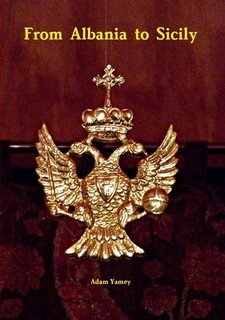
LEARN MORE ABOUT THE ARBERESH BY READING
“FROM ALBANIA TO SICILY”
by Adam Yamey.
Available on Amazon and bookdepository.com

The house of God reaches
upwards to meet with
the cloudy firmament
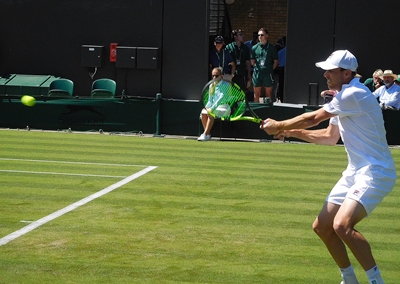
Power, skill, tactics,
tennis on the closely clipped lawn:
game, set, and match
A short reflection on the use and origin(s) of birds with two heads

On a Hindu temple in Bangalore, Krnataka, India
The earliest archaelogical evidence of the existence of double-headed eagle (‘DHE’) or any other bird with two heads (each with its own neck) is in Bablylonian remains dating back to 3000-2000 BC.
The DHE is and has been used as a heraldic symbol by, for example: the Scythians, the Hittites, the Seljuk Turks, the Kingdom of Mysore (in India), pre-Columbian America, Cormwall (UK), Byzantium, the Holy Roman Empire, the Russian Empire, and several states in the Balkans. The Balkan states that use the DHE include: Albania, Montenegro, and Serbia.

Map showing some of the many places where the double-headed eagle has been employed
I find the DHE to be a fascinating symbol because unlike, forexample, the cross, Star of David, and swastika, it is not a simple geometric construction, which could be created by random ‘doodling’. Also, it is not naturalistic like the commonly used such as a lion, single headed eagle, bear, fish, and hound.
There is a Hindu mythological creature, a bird with two heads, the Gandaberunda, which has been adopted by the Government of Karnatak (formerly Mysore) as its state emblem. The origins of this creature are obscure, but it has been described in the ancient Hindu texts, the Vedas.
The DHE is an imaginary creature, a product of human thought. The Babylonians not only portrayed the DHE, but also other double-headed creatures.
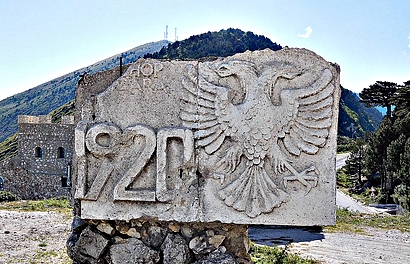
The Albanian double-headed eagle on the summit of the Llogara Pass in Southern Albania
I would like to SPECULATE that the origin of the DHE was Mesopotamia. From there, I imagine it spread through what is now Turkey to Europe, and across the Indian Ocean to India. If the DHE, or something similar appears in the Vedas, it would be interesting to know if this was by chance or as a result of some forgotten connection between Mesopotamia and the Indian sub-continent.
SICILY and GUJARAT are both places where the invaders have borrowed architectural style from the conquered.
Invaders adopting the architecture of the invaded
I have just returned from a trip to Palermo, the capital of the iskland of Sicily. This island has been invaded by different peoples numerous times. Visiting it made me reflect on aspects of my recent visit to Gujarat
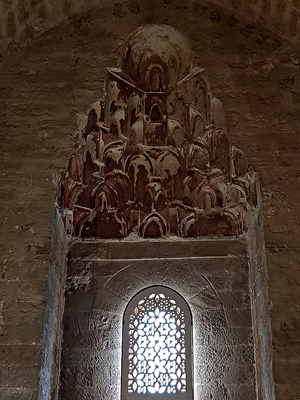 The Zisa Palace built by the Normans near Palermo (Sicily)
In the 9th and 10th centuries (AD), Sicily was ruled by Muslim Arabs. They were displaced by Christian Norman invaders in the 11th century. Little remains of buildings erected during the Arab occupation, but people of Arabic origin remained behind in Sicily when the Normans arrived.
The Normans built castles, churches, and cathedrals in Sicily. Many of these may be viewed today. What interested me about them is that these structures contain many architectural features typical of Arabic architecture. I suspect that the Normans must have employed Arabic craftsmen during the construction of their…
View original post 249 more words
I became such close friends with my former PhD supervisor, ‘Doc’, and his wife ‘Wink’, that I accompanied them on their long summer holidays in Greece.

Camping at Platamon in 1977
Every year they drove down to northern Greece with their caravan, which they towed with their aged Land Rover. I accompanied them on several journeys during the late 1970s. Also, I used to join them at their favourite camping spot, a patch of uncultivated land just south of Platamon in northern Greece. This scrub-covered sandy area is now covered by a village known as Nea Pori.
On one occasion, I arrived at Platamon on a train, which I had boarded in Belgrade. It must have been almost 11 o’ clock at night when I disembarked. I was hoping that I would find my friends camping in their usual spot.
As I walked from the station through the village on my way to the camping spot, I passed the grocery shop that Doc and Wink always used. Its owners were sitting at a small table on the street outside it. They recognised me and invited me to join them in a drink. I was handed a tiny glass, such as one might use for shots of strong spirit, and they filled it with beer. We knocked glasses together and I downed the tiniest portion of beer that I have ever drunk. Then, they told me that my friends had arrived and were camping in their usual place. I walked there through the darkness, and saw them fast asleep under the awning. As silently as possible, I erected my tent and went to sleep. Fortunately, I did not disturb them.
The railway station was at the north end of the centre of Platamon, well beyond the shops that Doc visited. Whenever we drove into Platamon, Wink would rush to it because there was a small newsagent’s stall near it. She was hoping to find a copy of an English newspaper. She did occasionally but it was always a few days out of date. Apart from her, there were few others in Platamon who would have wanted to read an English paper.
By the time that we returned from Platamon, the sun would have been setting for a while, and it was time for our sundowners and olives. Doc used to prepare supper (dinner, if you prefer). He often fried the fresh fish which we had just bought in Platamon. He was a good cook. The fish or meat, if we were eating that, was often accompanied by a mixture of vegetables that included onions, aubergines, peppers (green or red), and tomatoes. It never contained garlic because he did not like it. These were stirred together in a pot until they were cooked.
Doc referred to this dish as ‘veggie mush’ (pronounced ‘moosh’). When I told him that the dish, which he believed to be his own creation, resembled the classic French dish ratatouille, I could see that he was flattered that his own creation could be compared to something enjoyed by gourmets.
The sky at Platamon was frequently cloudless. Where we were camping there was little ambient light so that the night sky could be seen easily. We used to stand looking up at the star-filled canopy that covered us. Shooting stars shot over us frequently, momentarily altering the map of celestial objects that twinkled down at us. Doc would stand with me and point out the various constellations. He showed me how to identify the North Star. We stood in a glorious silence that was only occasionally interrupted on some evenings. Otherwise, we could neither hear the sea, the sound of whose waves were lost in the dunes that were between us and it, nor the trains that ran along the tracks a few hundred yards to the west of us.
In the second half of the 1990s, I worked in a dental practice in West London, not far from Ladbroke Grove. It was also not far from a home or shelter for mentally-compromised people. In those days, patients with psychiatric problems mixed with the other people in the local community. Many of these people attended our practice as dental patients.
‘P’, one young man, a schizophrenic so he told me, was a regular patient of mine. Usually, treating him presented no problems other than those relating to the technical details of sorting out his dental problems.
One morning, P attended my surgery. He sat in the chair, which I then set to the reclining position. Lying down, he said to me, out of the blue and without any prompting:
“Mr Yamey, I have decided to become a homosexual.”
At a loss as to how to respond adequately, I said:
“That’s nice.”
Then in a strong voice, P exclaimed:
“Mr Yamey, I love you.”
“Thank you,” I responded lamely, adding: “Let’s get on with your treatment now”.
At that moment, my dental assistant, ‘Gemma’, walked into the surgery, ready to assist me with the treatment I was about to provide P. Within seconds, P began unzipping the fly on his trousers.
“Put that away immediately,” I ordered, “otherwise we will have to summon the Police.”
P followed my instruction and behaved perfectly normally throughout the rest of the treatment session.
When the appointment was over, P sat up from the reclining position, and placed a pile of low denomination coins on the armrest closest to me.
“That’s a tip for you, Mr Yamey.”
I thanked him, and then returned the coins, knowing that he could ill afford to waste money on me.
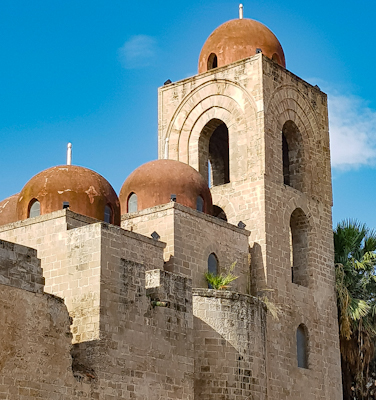
The Normans took over Sicily from its Arab rulers. The early mediaeval church architecture adopted by the Norman builders shows the influence of Arab design.
In Gujarat (India), the Muslim invaders began building mosques in the style of local Hindu temples, just as the Normans built in the way that they found when they arrived in Sicily.

The timeless Mediterranean washes the shores of an ancient land, Sicily.
Here in Cefalu, the Normans built a magnificent cathedral after taking over the island from its Arab rulers.
Sicily has been invaded many times, each invasion adding to the variety of culture and traditions on this piece of land that separates the western part of the Mediterranean from the eastern part.

 yamey
yamey 