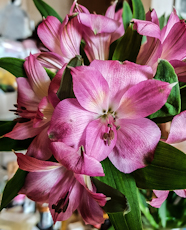
Long lasting

A bunch of flowers

Brings endless happiness

And plenty of  good cheer


Back in the early 1990s when I was practising as a dentist in Kent and owned a house in Gillingham, my future wife and I visited the local superstore, the Savacentre. Its name has nothing to do with the River Sava that meets the River Danube near Belgrade in Serbia. The shopping mall in Kent is pronounced “saver-centre”.

We wanted to buy some flowers and approached a florist within one of the wide corridors of the mall. He had some blooms of a kind we had never noticed before. We asked him what they were, and his answer sounded like “owlstromeriya”.

We bought a bunch of these attractive flowers and asked him how long we should expect them to survive in a vase. He answered:
“No worries there. They’re good lasters.”

And, he was right.

Alstroemeria, or Lily of the Incas, are native to South America but I guess many of those on sale in the UK are grown elsewhere.

Eye wash in Sarajevo

In the late 1970s and throughout the 1980s, I used to visit the former Yugoslavia, where I had and still have many friends. Often, I stayed in Sarajevo (now in the Republic of Bosnia and Hercegovina), with Marija and her family. Here is something that happened on one of my visits. The account comes from my book about Yugoslavia, “SCRABBLE WITH SLIVOVITZ”.

Cross eyed_500

Marija, my host in Sarajevo, lived alone in her flat. Her husband, although an ardent communist, had fallen foul of Tito’s regime. Since the late 1940s, he had spent most of his life in prison. Many years after my last visit to Sarajevo, Liljana told me that her father used to be released from jail occasionally for short periods only to be re-arrested and re-incarcerated soon after. I was not clear about what he had done to deserve this. He must have been the ‘wrong kind’ of communist. Maybe, he had been a Stalinist and/or a supporter of Cominform. This organisation’s headquarters were in Belgrade from 1947 until 1948, the year when Yugoslavia’s relationship with Stalin’s Soviet Union began to go sour and the country was expelled from Cominform. It is possible that it was Stalin’s militant antagonism to Yugoslavia in the late 1940s that helped Tito to unify his ethnically diverse population.

During one of my visits Sarajevo, I noticed that the white part of one of my eyes had become completely red. It was a little uncomfortable as well. I hoped that no one would notice it; I wanted to avoid any fuss. So, I set off one morning to find a pharmacy, hoping to buy an eyewash, something like the British product ‘Optrex’.

As there was no way that I could possibly have explained what I wanted using my rudimentary knowledge of Serbo-Croatian, I decided that I would have to try to act out what I wanted. I wandered along the chilly snow covered streets, puzzling over how to do this. In the end, I felt too shy to try to attempt the necessary charade. I hoped that with the passage of time my eye would heal.

When I returned to Marija’s flat that evening, she immediately noticed my eye. In French, and sounding worried, she said that I might have caught something that sounded to me like ‘retinit’, a disorder about which I knew nothing. She succeeded in alarming me greatly by saying that there was an epidemic of whatever this was in Sarajevo, and that many people were being blinded by it. Next morning, she told me, she would take me to see a friend of hers, an ophthalmic specialist, at the university hospital. This also worried me. I remembered the depressing looking hospital that I had seen many years earlier when I was visiting Peć in Kosovo. My enduring image of that place was of its pyjama-clad inmates leaning out of upper-floor windows and hauling baskets of food up on ropes from their relatives, who were waiting outside the building on the ground below. The hospital in Sarajevo was nothinglike that.

I was introduced to the lady ophthalmologist, who then seated me in a special high-backed chair. A white-coated nurse approached me, carrying a syringe fitted with a long, broad-gauge needle. I must have winced in anticipation because Marija said,
Ne t’inquiétes pas. C’est seulement une piqûre.” (Don’t worry. It’s only an injection)
An injection … in my eye: I did not like the thought of that. She
laughed again, and said,
Regardez, le dentiste a peur d’avoir une piqûre!” (See, the dentist is afraid of having an injection)

Eventually, the nurse managed to squirt some liquid onto the surface of my eye, rather than into its interior, as I had feared was going to happen. The ophthalmologist examined it with her special equipment. It turned out, to my great relief, that I had an attack of conjunctivitis, which could be easily cured with the eye-drops that she gave me. After the clinical examination, we retired into her office. She rang for an assistant, who returned with cups of Turkish coffee and a dish filled with little cubes of lokum (Turkish delight).


I have lost touch with Marija and her family. All I know is that her daughter and son-in-law along with their child emigrated to the Seychelles shortly before Yugoslavia erupted into a self-destructing civil war.

A city divided

GORIZIA 90 onion domes

In August 1990 before the downfall of Yugoslavia, I made one of my many visits to Italy. On this particular visit, I stayed with  Italian friends, who lived in Tolmezzo in the north-east corner of Italy close to its borders with Austria and Slovenia, which in those far off days was part of Yugoslavia.

There was a town near to Tolmezzo that had interested me for a long time because the border between Italy and Yugoslavia ran through it dividing it into the Italian town of Gorizia and the Yugoslav town of Nova Gorica. Prior to the end of WW2, the place was entirely in Italy because Italy included a large part of what was to become the Yugoslav republic of Slovenia. I was curious to see this divided town.

I drove into central Gorizia and discovered a typical small north-eastern Italian city – attractive, but unexceptional. I wandered amongst the city’s back streets trying to see where they ended and then became part of Yugoslavia. My quest was disappointing because the border ran through eastern suburban districts of Gorizia, beyond which there was open countryside.

After looking at the Italian part of the city, I drove south of it to the nearest border crossing, which was located in the middle of open country away from Gorizia. I parked my car and strolled up to the Italian border post, who showed no interest in me or my passport. 

I walked across a short stretch of no-mans-land to the Yugoslav checkpoint, where my passport was stamped and I was waved on. I had arrived in the middle of nowhere, it seemed. I spotted a bus stop and asked people waiting there if the bus would take me to Nova Gorica. I was told it would.

When the local bus arrived, I was able to buy a ticket with money I had kept after previous holidays in Yugoslavia. 

We drove what seemed like a long way through the country side, eventually arriving in the aesthetically unexceptional centre of Nova Gorica. Unlike attractive Gorizia, which was established many centuries ago, the relatively unnattractive Nova Gorica was established as a new town in 1947 after the Paris Peace Treaty left the important market town of Gorizia outside the border of Yugoslavia. The new town had been built a little away from the border, which is why I did not find any streets in Gorizia that ran into Nova Gorica. It was not like Berlin, where the Wall sliced through pre-existing streets, bringing them to a sudden dead end. 

I disembarked, found a coin-operated telephone box and made a quick call to one of my many good friends in far-off Belgrade. Then, with some of my remaining Yugoslav money, I purchased a box of the superb cherry brandy chocolates called ‘Griotte’, which used to be made in Croatia by the Kraš confectionery company, and are still made today. I wanted to give them to my hosts in Tolmezzo.

I returned to the bus stop and travelled back to the Yugoslav  border post. Both the Yugoslav and the Italian border officials waved me and my box of chocolates from one country to the next without any problems.

Thinking back on this brief international journey lasting no more than two hours, I realise that it was the very last time that I visited Yugoslavia. I had visited Serbia (and other parts of Yugoslavia) earlier in 1990, which is why I still had some Yugoslav Dinars. Since then, I have made one trip to Slovenia, several years after the break up of the Yugoslav Federation.


Picture shows central Gorizia (Italy)


Romania over the river

DJERDAP 90 Rasa Smijlka Dam

In May 1990, I drove around Serbia, then in (the now ‘former’) Yugoslavia. At first we followed the River Danube eastwards coming close to Romania, a country I have yet to visit. I wrote a book, “SCRABBLE WITH SLIVOVITZ“, which describes my impressions of Yugoslavia as I found it on numerous visits to the country between 1973 and 1990. Here is an excerpt from the book describing how I glimpsed Romania from a short distance – it was so near, yet so far:

Beyond Tekija, the river, which had been flowing north-eastwards, made an almost ninety-degree turn, and then began heading southeastwards. The island of Adakaleh has lain hidden beneath the waters flowing around this bend ever since 1970, when a dam was constructed further downstream. In 1878, the Congress of Berlin redistributed the formerly Ottoman Balkan territories between Austria-Hungary, Serbia, Bulgaria, and other countries. However, the tiny island of Adakaleh was overlooked during the proceedings of this complicated conference. It was not assigned to any of the countries that were grabbing the spoils from the ‘Sick Man of Europe’. Thus, it remained a part of the Ottoman Empire, albeit an isolated enclave. At first, it was a personal possession of the Sultan, and then it became part of Turkey. In 1923, it became Romanian territory. Until its evacuation in 1970, its small population was entirely Turkish. Most of them returned to Turkey, but a few settled in Romania. If I had to admit to having any regrets in my life, one of them would be not having visited that fascinating island before it
was submerged. Incidentally, the word ‘kaleh’ that forms part of the two names Adakaleh and Kalemegdan (in Belgrade) is the Turkish word for‘fortress’.

We drove a little further downstream, and arrived at the dam which wasresponsible for submerging Adakaleh, the fortress at Golubac, and Lepenski Vir. The Đerdap Dam (also known as the ‘Iron Gates Dam’) was a joint venture between Romania and Yugoslavia. It became functional in 1972. We parked the car, and walked almost up to the Yugoslav end of the massive hydroelectric barrage. The forest of pylons, under which we stood, emitted an eerie crackling sound; our hair felt as if it was standing on end and we began to sense a dull headache. There was truly electricity in the air. After gazing at this marvel of modern technology, we stepped back in time. A few Km further downstream, we visited the Roman ruins at Diana, from where we had a very good view of a village on the Romanian shore.

The town of Kladovo was our next stop. From its promenade beside the Danube we could easily see people walking along the opposite riverbank in the much larger Romanian town of Drobeta-Turnu Severin…


SCRABBLE WITH SLIVOVITZ

BY ADAM YAMEY

IS 

available here: 

https://www.bookdepository.com/SCRABBLE-WITH-SLIVOVITZ-Once-upon-time-Yugoslavia-Adam-YAMEY/9781291457599

and also on Amazon as well as Kindle


The photo, taken in 1990, shows my travelling companions and in the background the Đerdap Dam and the distant Romanian bank of the Danube

A country that exists no more

OHR 78 OHRID Sunsetting over Albania


The picture depicts the sun setting over Albania as viewed from the Yugoslav shore of Lake Ohrid. When I took the picture, I was standing in Yugoslavia. Now the sun has set forever over Yugoslavia: that country exists no more. What made me interested in Yugoslavia and the Balkans? Here is my reply.


Hergé, the Belgian creator of the cartoon character Tintin, must be held responsible for my fascination with the Balkans. From the age of 7, when my father first presented me with one of his books, I became fascinated by the drawings of Syldavia and Borduria in some of the albums. These were two imaginary countries that the Belgian cartoonist invented to depict what he had seen during his visits to the Balkans. They attracted me than all of the other exotic settings of Tintin’s adventures.

My parents were fundamentally opposed to any totalitarian regime, be it right or left wing. They refused to venture behind the so-called Iron Curtain. Furthermore, they were even reluctant to buy anything made there on the basis that any purchase would give financial support to a regime that opposed the capitalist way of life. Their avoidance of countries, which were under the control of communists, and my fascination by Hergé’s cartoon drawings of south-eastern Europe made me yearn to visit them. As soon as I was old enough to travel alone, I gave in to my yearning.

I chose to visit Yugoslavia first for two reasons. First of all, it seemed more accessible than its neighbours; visas were not required and it appeared to have a less oppressive regime than some of the other Balkan countries. Secondly, I was already becoming fascinated by its mysterious neighbour, the tiny hermetically sealed country of Albania. I believed that by visiting certain areas in Yugoslavia I would manage to catch close-up glimpses of this almost completely impenetrable place.

My early visits to Yugoslavia, which commenced in the late 1960s, were made on my own or with other visitors to the country. These were fascinating enough to make me want to see more, but differed little from simple tourism.  Soon, I began meeting Yugoslavs. Many of them, especially in Belgrade and Sarajevo, became good friends. My visits to their country began to assume more of a social nature than simply touristic. I believe that as the years passed and I made ever more visits, I began to experience the country more profoundly, and with far greater affection, than the average tourist. My book “SCRABBLE WITH SLIVOVITZ” contains a trail of memories of the experiences I enjoyed whilst visiting a country that no longer exists.


“SCRABBLE WITH SLIVOVITZ”

is available as a paperback: HERE and on Amazon Kindle


Foreign exchange

CAKOR 75 Summit


A chance encounter in the former Yugoslavia has stuck in my memory

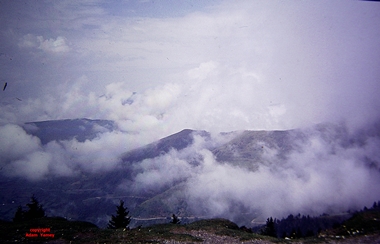
Sometime in 1975, I travelled from Peć (now in Kosovo) to Titograd (now in Montenegro) by bus. I chose to take the route that went via the wild and difficult Ĉakor Pass that traverses the mountain range shared by northern Albania and Montenegro, where I was heading. We reached the highest point on the pass after driving around a seemingly endless series of tight hairpin bends, and stopped there to give the driver a break.

While I was wandering around the treeless, grassy summit, admiring the views into the valley into which we would be descending, a grubby little boy approached me. He said something to me in a language, which I did not recognise as being Serbo-Croat. It was probably Albanian. Somehow, he made it clear to me that he wanted foreign coins. I thought that he was either a beggar, or more likely, just a curious youngster pleased to have chanced upon a foreigner. I gave him a few British coins, and then he rummaged around in his pocket. After a moment, he handed me a few Yugoslav Dinar coins, and left. He was no beggar, after all, but simply a young fellow with a well-developed sense of fairness.

After leaving the Ĉakor, we wound through the mountains to Andrijevica, a small Montenegrin town, which was enshrouded in rain and mist. Then, we descended gradually via a series of deep wooded canyons towards Titograd. All I saw of the town on that occasion was its bus station.


Picture shows view from the summit of  the Ĉakor Pass

Where two countries kiss

KAZAN 90 The Danube narrows

Steep cliffs encroaching

The stream gathers speed

The Iron Gates loom ahead


The Iron Gates is a narrow defile or gorge through which the River Danube flows. One side of this attractively impressive canyon is formed by Romania and the other by Serbia. At one point, the two countries come so close to each other that they seem as though they are kissing. Where they come closest, there is a hydroelectric dam that was built during the Communist era.

My picture was taken from the Serbian shore in 1990, when Serbia was still part of Yugoslavia.

Stay away from the windows

HAPPY NEW YEAR!

Many years ago sometime during the 1980s, I spent New Year’s Eve in Belgrade, which was then the capital of a country that no longer exists: Yugoslavia.

I was staying with my good friend Raša. He enjoyed a good party. We set out to attend one in New Belgrade, which was built after WW2 on the left bank of the River Sava, a tributary of the Danube.

The air was chilled when we left Dorčol, the old part of the city where Raša lived. There was an odour in the wintry air that I always remember: the smell of the smoke from the lignite that was burned in central heating units in the city.

As we travelled in the tram towards New Belgrade, my friend explained that many retired military personnel lived in New Belgrade. Many of these people kept guns and rifles in their flats.

Raša advised me to keep off the balcony and well away from windows as the last midnight of the year approached. The reason for this was that as the new year began, drunken people would begin firing their weapons to celebrate. There was a good chance both of being struck by poorly aimed bullets and by others that ricocheted when they struck walls and so on.

Midnight came and went, but I cannot remember hearing any gunshots. Maybe I had imbibed too much vodka and other highly alcoholic drinks such as sljivovitz and loza!

Now, Yugoslavia is only a fond memory as is my friend Raša. I last saw him in May 1990. He passed away several years later after having done much work to help refugees caught up in the civil wars that tore Yugoslavia apart.

Fools Crusade: war in the Balkans

REVIEW OF “FOOLS CRUSADE” 

by

DIANA JOHNSTONE


When the Berlin Wall was destroyed in 1989 and the USSR ceased to be a world power opposing the West and the USA, Yugoslavia, which had been considered a bulwark between the West and the Soviet Empire, ceased to be of importance to the West (by which I mean the USA and its NATO allies). Furthermore, the ending of the Soviet Empire removed the chief obstacle to the expansion of the USA’s global imperial ambitions.


FOOL 1

This excellent book by Diane Johnstone describes how the West was both misled by irredentist nationalistic groups in the former Yugoslavia, and how it allowed itself to deliberately misinterpret facts which did not suit its own aims. The aim of the West was to demonise Serbia for a multitude of reasons, some of which were self-serving. Western military and financial aid was given to anti-Serbian factions for ‘humanitarian’ reasons, to counter the atrocities allegedly perpetrated by the Serbs against, for example, the Catholic Croats, the Bosnian Moslems and the Kosovar Albanians. In each of these examples, there were undoubtedly atrocities perpetrated by both sides: Serbs killing Albanians or Bosnians AND vice-versa. However, much of the Western media only chose to recognise killings carried out by the Serbs, or those that might have been carried out by them but were never proven.


Sad to relate, but the Serbs have long had a poor reputation regarding what would now be called ‘genocide’.  In 1912 the renowned future colleague of VI Lenin, Leon Trotsky, who was then reporting as a journalist for Kievskaya Mysl, a paper published in Kiev, wrote (excerpts chosen by me):

During the war, I had an opportunity – whether it was a good one or a bad one is hard to say – to visit Skopje (Üsküb) a few days after the Battle of Kumanovo. In view of the nervousness caused in Belgrade by my request for a laissez-passer and the artificial obstacles put in my way at the War Ministry, I began to suspect that those in charge of military events did not have a clear conscience and that things were probably happening down there that were hardly in keeping with the official truths released in government communiqués…

…The atrocities began as soon as we crossed the old Serbian border. We were approaching Kumanovo at about five PM…

…Whole Albanian villages had been transformed into columns of flames – in the distance, nearby, and even right along the railway line. This was my first, real, authentic view of war, of the merciless mutual slaughter of human beings. Homes were burning. People’s possessions handed down to them by their fathers, grandfathers and great-grandfathers were going up in smoke. The bonfires repeated themselves monotonously all the way to Skopje…

…Four soldiers held their bayonets in readiness and in their midst stood two young Albanians with their white felt caps on their heads. A drunken sergeant – a komitadji – was holding a kama (a Macedonian dagger) in one hand and a bottle of cognac in the other. The sergeant ordered: ‘On your knees!’ (The petrified Albanians fell to their knees. ‘To your feet!’ They stood up. This was repeated several times. Then the sergeant, threatening and cursing, put the dagger to the necks and chests of his victims and forced them to drink some cognac, and then… he kissed them. Drunk with power, cognac and blood, he was having fun, playing with them as a cat would with mice. The same gestures and the same psychology behind them. The other three soldiers, who were not drunk, stood by and took care that the Albanians did not escape or try to resist, so that the sergeant could enjoy his moment of rapture. ‘They’re Albanians,’ said one of the soldiers to me dispassionately. ‘Hell soon put them out of their misery.’ ” [from: http://www.albanianhistory.net/1912_Trotsky/index.html,%5D

And so it went on back in 1912. In those days, the Serbs were not the only people involved in atrocities such as Trotsky described; the Turks, Bulgarians, and Macedonians, and others were far from innocent.

Before, international ‘humanitarian’ assistance in the form of NATO troops could be provided to the so-called oppressed minorities in Yugoslavia in the 1990s, it was necessary to encourage the break-up of the federation into smaller nation states such as Bosnia, Croatia, and Slovenia. This way, conflicts that should have correctly have been considered as civil wars within Yugoslavia suddenly became international disputes in which it was deemed suitable to provide international military aid.

The break up of Yugoslavia was aided and abetted by the West, for example by Germany. Germany during WW2 championed the formation of an independent Croatia and an enlarged Albania that included large parts of Kosovo. In the 1980s and 1990s, Germany, no longer led by the Nazis but instead by social minded liberals including the Green Party, encouraged the re-formation of what had been achieved in the early 1940s. The (mainly Roman Catholic) Croats and Slovenians were considered by the Germans and others in the West as being ‘civilised’ Europeans, whereas the (mainly Orthodox) Serbs were considered as uncivilised barbarians. Even worse, the Serbs, thanks to their poor public relations compared to those of the Bosnians, Croats, and Albanians, became considered as the new ‘Nazis’ of Europe – purveyors of ‘genocide’ and a new ‘holocaust’. Undoubtedly, the Serbs were responsible for some inexcusable murderous activities in Kosovo during the late 1990s

Johnstone goes to great pains to demonstrate that not only has the word ‘humanitarian’ become corrupted in its usage, but also the far more emotive words ‘genocide’ and ‘holocaust’. In the famous and horrible Serbian ‘massacre’ at Srebrenica, not only were the Bosnian women and children spared by the Serbs, but also wounded men. This does not happen in true genocide. Furthermore, in the case of this particular unfortunate incident, it seems, she wrote, that the Serbian massacre of the Bosnians might well have been engineered by the leader of the Bosnian Moslems in order to gain further ‘humanitarian’ (i.e military and financial) aid from the West.

What was in it for the West? Why was the bombing of Serbia so important or even necessary? Had Yugoslavia been allowed to continue as an independent multi-cultural country as it had been prior to the downfall of the USSR, it might not have been amenable to the expansionist, power hungry designs of the West, for which you should read ‘USA’. One of these designs was the construction of an oil pipe-line from the Black Sea to the Albanian port of Vlora on the Adriatic coast. This would allow oil from the Caspian to avoid travelling along the already congested Bosphorus, and also to use the larger tankers which the port of Vlora would easily accommodate. It is therefore not surprising the the USA have built Camp Bondsteel near to Uroševac in Kosovo, conveniently located to guard the proposed pipe-line.

Even if only 5% of what Johnstone claims in her meticulously annotated text is true, then what she writes should send shivers down the spine of anyone who values the true, old-fashioned meanings of words such as ‘freedom’, ‘independence’, ‘humanitarian’, and that favourite American word ‘liberty’ as well as ‘genocide’ and ‘holocaust’. Johnstone successfully demonstrates how the citizens of the West were duped into believing a simplistic version of events in the Balkan peninsular, and were then bamboozled into thinking that aiding forces hostile to the West (eg Croatian fascists and Islamic mujahidin in Bosnia) and bombing Serbia would somehow resolve the problem. Instead of resulting in a humanitarian victory, the West wittingly and unwittingly magnified the suffering of the ordinary person, Serb and otherwise, in the former Yugoslav territories.

This is a book that is a must-read if you are interested in Balkan matters and/or the growing malevolent influence of the USA on world affairs. The author writes well, and apart from achieving her main aims, gives a remarkably lucid view of the complex history of the country that was once known as ‘Yugoslavia’.

Adam Yamey is the author of SCRABBLE WITH SLIVOVITZ, a nostalgic look at life in Yugoslavia before its break-up began in 1991. His book is available (paperback and Kindle) on Amazon and bookdepository.com, and also directly from the publisher by clicking HERE

A nest in Macedonia

In about 1977, I travelled to Greece overland with my PhD supervisor (‘Prof) and his wife (‘Wink’). Every year they towed a caravan across Europe to their favourite camping spot near Platamon on the coast of northern Greece. They were averse to camping overnight in campsites. They preferred to camp ‘wild’ at spots of their own choosing. Their journey involved three nights in the former Yugoslavia, a country where camping outside official campsites was against the law. However, over the years they had found several places in Yugoslavia where they could camp ‘wild’. Prof and Wink were always anxious when they travelled through that country, constantly worrying that their illegal camping activities would get them into trouble. Let’s join them on the last few hours before leaving southern Yugoslavia (in what is now Macedonia) and an official campsite, where circumstances forced us to stay one night. Here are two extracts from a book, which I have not yet published.

OHRID 0

Picnic north of Ohrid in Macedonia, 1977. The author is standing

“After lunch, we drove onwards towards the town of Ohrid that lies on the eastern shore of the lake bearing the same name. As the sun began to set, we faced a problem. Prof and Wink had never travelled to Ohrid before and knew of no places where we could camp ‘wild’. Driving along, we could see nowhere suitable to do so. Cautiously, I recommended the town’s campsite. I had stayed there a few years earlier with my friend Hugh. It was a lovely spot next to the lake shore. Reluctantly, Prof agreed that this would have to be where we should spend the night. At the entrance of the camping grounds, we had to surrender our passports in order that the camp could register our presence to the police. Prof was reluctant to let go of his passport, but when the officials assured him that they did not need it for long, he gave in.

While supper was being prepared, I took a stroll around the campsite. An elderly employee of the campsite approached me and greeted me like an old friend. When I shook his outstretched hand, I remembered who he was. I had met him the first time I camped in Ohrid for a week in the late 1960s. On that visit, I used to walk from the campsite to the town in order to do sightseeing or to catch buses from it to other places in the area.  At the end of each day, I used to walk back to the campsite, where Hugh had sunbathed all day. On one of these return journeys, this man, who greeted me so many years later, had seen me on the road and had invited me into his home to meet his family. I was touched that he recognised me…”

OHRID 1 1973

Ohrid in 1973

“… we continued our journey towards Greece on the following morning. We left Ohrid and drove across the mountains east of Lake Ohrid to Resen, where we did not stop. Had we not been in so much of a hurry to leave Yugoslavia – Wink and Prof always felt more than a little uneasy being there – I would loved to have visited the nearby Lake Prespa, which, like Lake Ohrid, shares its waters between Yugoslavia (now Macedonia or FYROM or Northern Macedonia) and Albania. Unlike the bigger Ohrid, Prespa also shares its water with Greece. In fact, the frontiers of the three Balkan countries meet in the middle of the lake. We crossed another mountain pass after leaving Resen, and then descended into the plain in which the town of Bitola stands.

We parked near a large mosque in Bitola, and then began wandering around an open market. Prof stopped by a stall selling green grapes. There were flies crawling all over them. He took out a notebook and pencil, and then pointed at a fly on one of the grapes. He was hoping to learn the local word for that particular kind of fly; he was always trying to improve his vocabulary in the languages that he encountered en-route. He even carried a miniature tape recorder in which he recorded people pronouncing words in, usually, Modern Greek. He used to listen to these recordings and try to repeat them in order to improve his pronunciation. The seller of the grapes, seeing Robert’s interest in his wares, was hoping to make a sale but could not understand what the foreigner was asking. Both parties were left unsatisfied.

OHRID 2 BITOLA 77 Train from Medzhitlija

The road from Bitola to Medzhitilija on the Yugoslav side of the Greek border in 1977

After leaving Bitola we drove southwards across a flat cultivated plain until we reached the Yugoslav customs post at Medzhitilija. We waited in a queue of vehicles until we drove under the wooden canopy over the roadway adjacent to the border officers’ cabin. Before handing our documents to the official waiting alongside the car, Prof looked up into the eaves of the steeply pitched roof and began pointing at something. The customs officer looked up and then at Prof, who was frantically leafing through a small well-worn Serbo-Croatian pocket dictionary.

“I wonder what the Yugos call a house-martin’s nest,” Prof kept muttering.

The officer looked him, puzzled rather than impatient.

“For heaven’s sake, let’s get on,” Wink shouted at her husband from her perch behind us. 

She, even more than Prof, was keen to leave the communist country where, on previous trips, they had had minor though worrying brushes with authority.

Minutes later, we were driving south along a Greek road …”