I have not visited anywhere in the former Yugoslavia since 1990. What follows is an account of one of my earlier visits to that now non-existent country sometime during the mid-1970s.
One of the earliest trips that I made to Yugoslavia was to visit Lake Ohrid in Macedonia. It began in Greece, where I was staying with my family and some of our friends from London. One of them, Hugh, and I left the comfort of the luxury hotels in which we were staying in Athens, and travelled by train to Edessa. We had to spend a night there before continuing to Florina in the north-east corner Greece. On the next day, when both of us had just about recovered from a dreadful bout of food poisoning caused by the injudicious over-consumption of undercooked pork kebabs that had been served on the train between Athens and Edessa, we boarded a small (two carriage) train. It took us slowly from Florina towards the Greek border village of Neo Kafkasos.
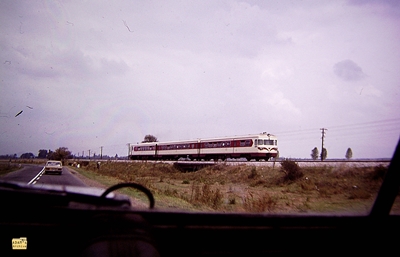
Hugh and I were the only passengers on the train when it stopped at the station on the Greek frontier. It was early afternoon and very warm. The only signs of life were the flies that spent much of the time swarming around us when they were not actually settling on our skin. Nothing happened for a long time. Then suddenly, another short train reversed into the station on the track next to ours, and stopped parallel to our carriage. It had come from the direction of Yugoslavia and bore the insignia of that country’s railway company. It stopped so that the carriage door of our wagon was exactly opposite one of its carriage doors. A uniformed man, a Yugoslav border guard, entered our carriage and escorted us across the short gap between the two trains.
Our new train rumbled north into Yugoslav Macedonia. All that I remember of Bitola, where we disembarked, was viewing a minaret in the distance as we approached the town at snail’s pace. We boarded a bus bound for the city of Ohrid almost immediately after getting off the train, and so saw nothing of Bitola. As the afternoon light began to fade, we crossed the mountains to the east of the town and arrived in the town of Ohrid after nightfall.

We camped on the shore of Lake Ohrid in a campsite about one and a half kilometres north of the town. My original reason for visiting the place was that the lake was shared by Yugoslavia and its neighbour, the then almost impenetrable Albania. Little did I realise before arriving at Ohrid that I was going to be staying in one of the most beautiful spots in Yugoslavia. A line of white marker buoys bobbed about in the water about halfway across the lake, marking the boundary between Yugoslavia and Albania, whose distant shore shimmered in the heat haze. Although I was intrigued by the sight of these, the Yugoslav side of the lake was full of delightful attractions for the visitor. Many years later when I visited Albania in 1984, I travelled along the Albanian shore from Lin to Pogradec, and discovered that it was not nearly as picturesque as the Yugoslav.
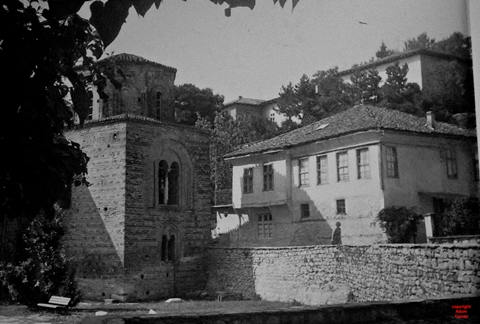
Whilst Hugh was content to spend the day basking in the sun beside the lake and eating watermelons, I spent my time exploring the city of Ohrid and its environs. The city was full of charm. Many of its narrow streets were lined with traditional Balkan dwellings. In some cases, their upper storeys projected beyond their lower ones, causing their facades to look like reversed staircases. In summer, so I read, the inhabitants used the upper light and airy storeys, and in winter they retreated to the more solidly built lowest storey where it was warmer and the animals were housed.
The city has an historic fortress; Roman ruins; some old orthodox churches containing beautiful frescos, many of them depicting the male saints wearing white robes decorated with black crosses; and at least one mosque with its minaret. I ate plenty of delicious grilled meats freshly prepared on braziers above glowing charcoal. Fortunately, I had not become averse to this kind of food, as I believe Hugh had, after our unfortunate experience on the Greek train. And I enjoyed numerous Turkish coffees.
Using the excellent local bus services, I visited the village of Struga at the north end of the lake, and, far beyond that, the town of Debar. This small town, which is about three kilometres from Albania, was full of men dressed in typical Albanian folk costumes – white flannel jackets and trousers, both trimmed with black edgings. This was exciting for me, as I was (and still am) passionately interested in Albania and the Albanians. I bought a couple of traditional shoulder bags made of rough textured woven fibres, most probably wool, and brought them home as souvenirs. The road that ran along the shore south from Ohrid led to the monastery of Sveti Naum, which I will describe soon.
Every day, I used to walk from the campsite into the town of Ohrid either to spend the day there or to embark on an excursion. At the end of the day, often after dinner in the evening, I walked back. There was little traffic on the road and no artificial street lighting. After sunset, it was lit only by the moon and stars. The main hazard that I faced at that time of day was meeting with bicycles travelling towards me. They were quite silent, and none of them used lamps at night. They seemed to loom up in front of me suddenly as if materializing from thin air. That gave me hardly any time to dart out of their way.
One hot afternoon, I was walking back from Ohrid to the campsite when one of its employees waved to me from outside the street entrance to his home. He invited me into his courtyard, where a fly-infested donkey was tethered, and then into his home. I entered a room in which his family, mostly women and girls, were seated on cushions ranged around its walls. Then, he asked me whether I would like some milk. Immediately, I visualised a condensation-covered glass of ice-cold milk straight from the ‘fridge, and accepted his offer. I was unprepared for what was handed to me. The glass of cream coloured milk was warm as were its contents. The milk, which I am certain had just been freshly collected from a cow (or maybe the donkey that I had seen outside), tasted strange to me. After taking one sip, I felt quite nauseous. Hoping that I would not vomit, I held the glass politely, smiled at those around me, and after a while, looked at my watch, and prepared to leave.
Some years later when I encouraged my friends, Robert and Margaret Harkness, to drive to Greece via Ohrid. We spent one night at the same campsite where Hugh and I had stayed many years earlier. Before we retired for the night, an elderly campsite worker approached me and greeted me like an old friend. It was the same man who had invited me into his home and offered me milk. I was touched that he had remembered me from my earlier visit and by his warm greeting.
This was written some years ago, and published in my book “SCRABBLE WITH SLIVOVITZ – Once upon a time in Yugoslavia”.
It is available from Amazon (paperback and Kindle):
https://www.amazon.co.uk/Scrabble-Slivovitz-Once-upon-Yugoslavia/dp/1291457593/