EXTRACTING TEETH IS still a significant part of the job of a dentist.
When I qualified as a dentist in 1982, I joined the practice in Rainham (Kent) run by Julian U. He was a generally competent dentist and very skilful when it came to extracting teeth. If, as it happened from time to time, I was having difficulty removing a tooth, he would come into my surgery to apply his skill and experience to the problem at hand. Whenever he did this, he would work on the offending tooth, but would stop when he knew I would be able to complete the operation.
Julian could have easily finished the job himself, but he left it to me to do this for a good reason. He knew that if I removed the tooth, the patient would believe that it was my skill that contributed to the successful conclusion of the operation and therefore would not lose confidence in me.
Later in the day, after the patient had left, Julian would explain to me why I had had difficulties and how to avoid repeating the problem. He was a great mentor as I began my career in dentistry.
The NHS used to pay a standard fee for an extraction. If an extraction proved to be particularly difficult, involving bone removal for example, the practitioner could write to the NHS explaining why the operation was not simple and enclosing a radiograph (xray image) of the tooth in question. In these cases, the NHS used to pay a larger fee than the standard one.
On one occasion when I had not taken a radiograph prior to an extraction because I had assumed it would be simple, the operation proved to be very difficult. After completing it, I applied for the supplementary fee but did not receive it because I had not submitted a preoperative radiograph. I was furious not only because I had not been adequately remunerated for my effort but also because my word had been doubted.
Some months later, a distressed couple brought their infant to my surgery. The child had chewed on a keyring and it had got stuck between two teeth. Carefully, I cut through the ring and thereby removed it from the kid’s teeth.
Still smarting from my failure to convince the NHS that my extraction of a few months earlier was truly difficult, I wrote up my keyring removal and applied for a fee for this unusual procedure. I explained that neither had I taken a radiograph (because it was unnecessary) nor was I able to send them any evidence, such as the remains of the keyring because the parents had wanted to keep them. I waited patiently for the NHS to reply, which they did. To my great surprise, they believed my story without me sending any evidence and paid me a decent fee. Nowadays, it would be unwise to perform any extraction without having taken a preoperative radiograph. This is not for the purposes of seeking enhanced remuneration but to protect the practitioner should the patient decide to make a complaint against the dentist. Sad to say, but by the time I retired, preventive dentistry acquired a new meaning. In addition to preventing dental disease in patients, it has also come to mean preventing the dentist from litigation and defending him or her when malpractice is alleged.
LONDON IS BLESSED with an abundance of open spaces where one can exercise and enjoy reasonably fresh air. In addition to parks, woods, the banks of the Thames, and squares with gardens, the towpaths alongside canals provide visually fascinating places to walk, run, or cycle. These canals used to be important routes along which freight could be transported right across England before they were rendered practically redundant by the advent of the railways. Despite this, they have been maintained and give great pleasure to many people including my wife and me.
Today, the 6th of November 2020, we walked along a branch of the Grand Union Canal from Golborne Road (near Portobello Road), where I practised dentistry from 1994 until about 2001, to Paddington Basin, which only became accessible to casual visitors in about 2000, when it was redeveloped. We began our walk in Meanwhile Park at the base of Trellick Tower, a tall block of flats designed in brutalist style by Ernő Goldfinger and opened in 1972. The pleasant community park, created in 1976, runs alongside a short stretch of the Paddington Arm of the Grand Union Canal, which was opened for use in 1801. We walked across the narrow park and onto the towpath. Although we have walked along this often, what attracted me this time in addition to the variety of barges and waterfowl was the variety of bridges that cross the canal and its towpath. I shall concentrate on these in this essay.
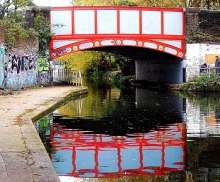
The first bridge we walked beneath is that carrying the Great Western Road over the canal. This is a cast-iron, single-arched bridge with the Union Tavern at its northern end. It looks like a Victorian design. Heading east, after walking beneath the sweeping curve of the Westway, an elevated motorway (the A40), the first bridge we encountered was that which carries the Harrow Road over the canal. This iron bridge with brick abutments is shorter than the previous one because the canal narrows temporarily as it passes beneath it. A few yards east of this, there is another bridge that crosses the canal to reach an old, derelict building that must have been a factory in the past. The bridge, known as the ‘Pipe Bridge’, has a roof and is completely enclosed with translucent panelling. It looks as if it was built in the last few decades and leads from the factory to a solid brick wall which serves as its abutment on the south bank of the canal.
Four hundred yards east of the Pipe Bridge, after passing the green space around the Church of St Mary Magdalene, we pass beneath a concrete footbridge with iron railings and decorative lamp posts that links Delamere Terrace and Lords Hill Road with Blomfield Road across the canal. The approach to the bridge from Delamere Terrace is an elegant helical ramp. This fairly modern crossing is known as the ‘Ha’Penny Bridge’ (i.e. half penny).
The towpath runs south east and alongside Delamere Terrace and reaches the building that houses the Canal and River Trust, the former Toll House. This is next to another bridge, a delicate-looking cast-iron structure with masonry abutments topped with distinctive lamp stands. This carries Westbourne Terrace Road (laid out in the early 1850s) over a constricted section of the canal. East of this the canal enters a vast triangular expanse of water, the junction of three waterways: the Paddington Branch from west London, its continuation towards Paddington Station, and the Regents Canal that leads to Camden Town and further east.
The poet Robert Browning, who lived near to this junction area, or possibly Lord Byron, is credited with christening this district as ‘Little Venice’, the name by which it is known today (https://londoncanals.uk/2010/01/17/the-history-of-the-place-name-known-as-little-venice-and-the-facts-that-are-ignored/). With its willow trees, colourful barges, a wealth of waterfowl, and some floating refreshment outlets, Little Venice is a popular place for tourists both local and from further afield. The small island in the middle of the watery space, inhabited only by birdlife, is called Browning’s Island.
We leave Little Venice by walking south east along the next section of the Paddington Branch canal. Soon, we reach another bridge, an undistinguished structure that carries the Harrow Road over us and another short, constricted section of the canal. The next 450 yards of the towpath on the west side of the canal has been redeveloped recently and is lined with eateries both on the shore and on boats moored alongside the shore.
After walking beneath a concrete bridge, the Westway Viaduct, carrying the Westway high above us, we soon reach a fascinating footbridge over the canal. The span across the water is approached by both curving staircases and spiral ramps. This suspension bridge is supported by cables fanning out from a tall pole on the eastern side of the canal. It is known as the ‘Harrow Road’ footbridge. Despite an extensive search of the Internet, I have not yet discovered who designed this structure, which is a visual delight in comparison with the next bridge we reach, an inelegant concrete span, which carries Bishops Bridge Road.
Shortly before the direction of the canal turns from south east to due east, we need to cross it over a curious looking modern footbridge that runs beneath what looks like a double wall of glass panels. This, the Station Bridge (Paddington Basin), leads from the east side of Paddington Station to a footpath leading to North Wharf Road. It was completed in 2004 by the Langlands and Bell partnership (www.langlandsandbell.com/work/).
Having crossed this distinctive bridge, we are now on the final stretch of this blind ending branch of the Paddington Arm of the canal. Next, we encounter another suspension footbridge with perforated metal panels along both sides of its footway over the water. This bridge leads to a car park next to a twentieth century block, part of St Mary’s Hospital. This is the Paddington Basin Footbridge designed by Sidell Gibson Architects.
A few yards further east, we cross a short blind-ended inlet by means of a short bridge known as The Rolling Bridge. Designed by the Thomas Heatherwick Studio and completed in 2005, this bridge curls up into a circle to allow boats to enter or leave the inlet. Routinely, this pointlessly complex yet interesting bridge is opened briefly at noon on Wednesdays and Fridays and at 2pm on Saturdays.
On Fridays at noon, or when necessary, the last bridge over the Paddington Arm, a few feet away from its eastern terminus, can be seen in action. At rest, the Fan Bridge (aka Merchant Square Bridge) looks unexceptional. However, when it is raised to allow passage of vessels it is extraordinary. As the bridge rises, it splits into sections resembling five blades of a pen knife when they are all opened, or a lady’s fan. The bridge is twenty feet long, was designed by Knight Architects, and completed in 2014. We were lucky enough to see this bridge open and then to watch it closing. You can watch this happening on my video at https://youtu.be/UGQERbGo_jU .
Beyond the Fan Bridge, the canal ends abruptly. Trellick Tower, where we began our perambulation was a landmark in modern architecture when it was built. The Fan Bridge, constructed 42 years later, is another exciting development in design. In between the tower block and the unusual bridge, we passed beneath or over several canal crossings representing various points in the history of bridge design, many of them adding beauty to a lovely waterway that provides pleasure for many people.
DRIVING ALONG THE NORTH Circular Road, I noticed a long wall over the top of which I could see what looked like the pinnacles of a Gothic revival garden folly. We were driving past Gunnersbury Park in West London and did not have time to stop. So, the next day, we drove back to the park and spent some time exploring it. What we found was a fascinating estate consisting of beautiful park land and a series of architectural delights. This is hardly far from where we live, but it was the first time that we had visited it. Had I not noticed what I did when on the North Circular Road, I am not sure that we would not have considered making a trip to find out what lies behind the wall next to which queues of slow moving traffic can often be seen.
The first impression one gets on entering Gunnersbury Park with its wealth of trees including many Cedars of Lebanon is that you are inside the grounds of a great house such as you can find at, for example, Ham House and Osterley Park. That impression is justified because Gunnersbury Park is basically what is left of the grounds of a mansion built in the Palladian style for the lawyer and politician Sir John Maynard (1604-1690) between 1658 and 1663. It was designed by the architect John Webb (1611-1672). Maynard died at Gunnersbury Park.
Between 1762 and 1786, Gunnersbury Park was used as a summer residence by Princess Amelia (1711-1786), who was King George III’s aunt (https://historicengland.org.uk/listing/the-list/list-entry/1000808). In 1761, she had bought the estate from George Furness (after 1688-1756). His father had been a ‘factor’ in the East India Company. George was a British merchant and politician as well as being an art collector. He was a Member of Parliament between 1720 and 1756 and had bought the property in 1739 from John Hobart (1693-1756), 1st Earl of Buckinghamshire, a British politician. Furness improved the grounds by employing the famous gardener William Kent (1685-1748). I am not sure how much of his original design has survived the passage of time.
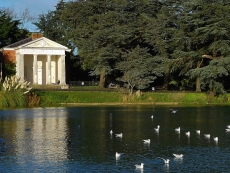
Princess Amelia, the second daughter of King George II, did much to improve the grounds, by landscaping, arranging planting, and by adding ornamental buildings, which still add to the charm of the place. These buildings include the bath house and a neo-classical temple, which overlooks a circular pond.
The princess held fabulous parties at Gunnersbury. In “Handbook to The Environs of London” by James Thorne, which was published in 1876, the politician and intellectual Horace Walpole (1717-1797), author of the Gothick novel “The Castle of Otranto”, who attended some of these parties, is quoted thus:
“Ever since the late king’s death, I have made Princess Amelia’s parties once or twice a week … I was sent for again to dine at Gunnersbury on Friday, and forced to send to town for a dress-coat and a sword. There were the Prince of Wales, the Prince of Mecklenburg, the Duke of Portland, Lord Clanbrassil … The Princess, Lady Barrymore, and the rest of us, played three pools at Commerce till ten … While we were at the Dairy, the Princess insisted on my making some verses on Gunnersbury. I pleaded being superannuated. She would not excuse me. I promised she should have an Ode on her next birthday, which diverted the Prince; but all would not do.”
The next morning, Walpole composed three verses for the Princess. One of them (quoted in a letter from Walpole to HS Conway dated 18th of June 1786) reads as follows:
“Oh! Why is Flaccus not alive,
Your favourite scene to sing?
To Gunnersbury’s charms could give
His lyre immortal spring.”
Walpole admitted in his letter to Conway that his poem was not one of his best. He wrote:
“If they are but poor verses, consider I am sixty-nine, and was half asleep, and made them ex-tempore – and by command!”
Following the death of the Princess, the Palladian mansion was demolished in 1801. Its contents were sold by auction and the 205 acres of its grounds were divided into lots and sold at the same time. Most of their area was bought by Alexander Copland (1774-1834), who built a new house, which forms the basis for the present building, which now houses a museum, which is currently closed because of the covid19 pandemic. Copland, a builder and business partner of the architect Henry Holland (1745-1806), was a son of Alexander Copland and his wife Barbara (née Smirke). The Alexander, who bought Gunnersbury was a cousin of the architect Robert Smirke (1780-1867), whose brother, also an architect, Sydney Smirke (1797-1877) designed the Orangery, which was built at Gunnersbury Park in 1836, and has been restored beautifully.
Copland built The Large Mansion (now the museum). Either Stephen Cosser or Major Alexander Morrison, a retired East India Company officer who bought the plot from him, built the so-called ‘Small Mansion’ to the east of the Large Mansion, which is currently in a poor state of repair. A gardener explained to us that it was supposed to be cared for by one London borough whereas the Large Mansion was under the care of another. In 1828, the part of the estate with the Small Mansion was bought by Thomas Farmer, who lived there as Copland’s neighbour until 1835.
In 1835, Copland’s Large Mansion was bought by the banker Nathan Mayer Rothschild (1777-1836). After his death a year later, his widow Hannah (née Barent-Cohen; 1783-1850) used Gunnersbury Park as her second home and employed the architect Sidney Smirke to make alterations to it (https://family.rothschildarchive.org/estates/37-gunnersbury). Following Hannah’s death, her oldest son Lionel Rothschild (1808-1879), the first ever practising Jew to become a Member of Parliament, took over the property and enlarged its park as well as improving the house’s facilities. After his death and that of his widow Charlotte, the estate moved into the possession of their youngest son Leopold de Rothschild (1845-1917).
In 1889, Leopold purchased the Small Mansion and thereby reunited the two parts of the original Gunnersbury estate. Under the ownership of the Rothschild family, many improvements were made to the grounds, some of which I will mention soon. After Leopold died in 1917, the estate was broken up and parts were sold off. In 1925, both mansions and about 185 acres of attached grounds were purchased for public use by the then Boroughs of Acton and Ealing. Now, the park and its mansions are maintained by the boroughs of Ealing and Hounslow.
The Large Mansion is elegant but not as attractive as the one which was demolished long ago and can be seen in old drawings. Nearby, the temple that overlooks a pond is delightful and reminded me of some of the garden architecture at Stourhead (in Wiltshire). Wandering around the garden, you will come across the Gothic revival architectural features I saw when driving past Gunnersbury Park on the North Circular Road. These are built around ‘Princess Amelia’s Bath House’, a garden folly built in the 1780s. Not far from this, there are very picturesque ‘Gothick’ ruins near to the estate’s farm buildings. These might be the remains of the dairy mentioned above in the quote from Horace Walpole or possibly later additions to the grounds constructed by an owner who bought the Princess’s estate. One source (https://brentfordandchiswicklhs.org.uk/publications/the-journal/journal-10-2000/princess-amelias-bath-house/) suggests that what is now called the ‘Bath House’ might have been the dairy in Amelia’s time at Gunnersbury. Whatever its history, lovers of romantic Gothic revival ruins will get great pleasure from what can be seen at Gunnersbury Park.
The Orangery stands next to a large pond. This structure was built whilst the Rothschilds owned the estate. It was constructed in 1836, designed by Sidney Smirke. The family were responsible for another water feature on their estate. It has a name that intrigued us: the Potomac Pond. This almost circular water body is surrounded by a fence and almost hidden by the trees and other vegetation growing around its perimeter. It is only accessible to members of a local angling club. The Rothschilds had purchased a former clay pit and converted it into the pond. One of the claypit’s kilns was rebuilt to create a Gothic revival tower on its shore. This lovely folly, which would look at home in a painting by the German Caspar David Friedrich (1774-1840), might have once been used as a boathouse.
I have described a few of the features that make it well worthwhile to visit Gunnersbury Park, whose history is not exactly simple. The place is so near to London and the M4 motorway, yet it feels so far away. If it were not the background roar of the traffic and the low flying aeroplanes descending towards Heathrow Airport, fewer than usual these days, it would be hard to believe you were not deep in the countryside.
THE RIVER WESTBOURNE may be known by few, but seen by many, living in, or visiting, London. Much of this tributary of the River Thames is hidden from view; it runs underground. The river rises in West Hampstead, passes through Kilburn and beneath Bayswater Road, flows through Kensington Gardens and Hyde Park, then runs into the Thames near the gardens of The Royal Hospital Chelsea, home of the annual Chelsea Flower Show, (close to the Bull Ring Gate bus stop).
Italian Gardens with 3 arched pump house and behind it on the right, the Queen Anne Alcove
What I will refer to as ‘The Serpentine’ is really the combination of the Long Water (in Kensington Gardens) and the contiguous Serpentine (in Hyde Park). It occupies part of the valley of the River Westbourne and is thus the only part of this river that most people can see. The Serpentine was created between 1730 and 1733 for Queen Caroline (1683-1737), wife of King George II. The body of water was formed by linking several existing ponds fed by the River Westbourne and by water pumped from the Thames. Today, some of the water is supplied from borewells in Hyde Park. Prior to the creation of the Serpentine, two of the ponds were separated by a building called ‘Price’s Lodge’. The “Daily Post” dated 20th of April 1733 reported that:
“The old Lodge in Hyde Park, together with part of the grove, is to be taken down in order to compleat the Serpentine River.”
Price’s Lodge, formerly known as ‘the Cheesecake House’ was a place where the nobility riding around Hyde Park could purchase refreshments (https://georgianera.wordpress.com/tag/prices-lodge/). The newspaper quoted above refers to ‘The old Lodge’, which might possibly been a separate building from Price’s Lodge, which might have still been in existence and being used as a boat house in 1801, but it was no longer standing later that century.
We begin our stroll at the end of the Serpentine just across Bayswater Road close to Lancaster Gate Underground Station. It was here that after flowing beneath Bayswater Road that the River Westbourne flowed into the Long Water section of the Serpentine. The so-called Italian Gardens consists of four large basins or reservoirs, each with eight sides. There is a fountain in the centre of each of them and another in the middle of them. The reservoirs are set on a platform adorned with sculptures and a statue of Edward Jenner, of vaccination fame. The platform is about eight feet above the water level of the rest of the Serpentine. At the north end of the platform with the reservoirs and fountains, there is a decorative building with a central single chimney and roofed with Italianate tiles. Facing the fountains, the building has a loggia, a convenient shelter during a rain shower. Behind the loggia there is a large room housing machinery to pump the water that shoots out of the fountains.
Between the Italian Gardens and Bayswater Road, there is a relatively new café, The Italian Gardens Café, which overlooks the fountains. The café is next to a neo-classical structure which contains a concavity lined with wood panelling. Made in 1705, designed by Christopher Wren (of St Pauls Cathedral fame) and bearing the crest of Queen Anne (reigned 1702-1714), this is the Queen Anne Alcove. This decorative building was moved to its present site from near Kensington Palace in 1868.
The four reservoirs, which make the Italian Gardens delightful, were built in 1861 and were intended to act as filter beds for the Serpentine. The loggia-cum-engine house was designed by Robert Richardson Banks (1812-1872) and Charles Barry (1823-1900). The sculptural features, including urns and nymphs, through which water flows from the Gardens into the Serpentine, were designed by John Thomas (1813-1862).
Moving on from the Italian Gardens southwards along the east side of the Long Water, you can, if you are lucky, spot birds such as herons and cormorants standing in the water near the opposite shore. After a short stretch along which the lake is well hidden from the path by vegetation you reach an open space in the centre of which there is a huge sculpture made of travertine stone, “The Arch”, presented to the park by its creator, Henry Moore (1898-1986), in 1980. Looking through the arch and across the Serpentine you can see the equestrian sculpture “Physical Energy” by the Victorian sculptor GF Watts. The two sculptures are in line with Kensington Palace, of which there is an unobstructed view from the Moore artwork. “The Arch” is irregularly shaped because it is based on the for of an animal bone that the sculptor had in his possession. A path leads away from the Serpentine to the Serpentine Sackler art gallery, which is often worth visiting. However, we will ignore that and continue to follow the Long Water in a south easterly direction.
Soon, we reach an elegant masonry bridge with five arches spanning the water. This was built in the 1820s to the designs of John Rennie junior (1794-1874), son of John Rennie, who designed the first Waterloo Bridge. The foot path around the Serpentine passes under each end of the bridge through semi-circular stone lined tunnels. The bridge marks the boundary not only between Kensington Gardens and Hyde Park but also between the Long Water and the Serpentine.
Walking along what has become the north shore of the water because of the bend in the Serpentine, you will pass numerous waterfowl of various shapes and sizes, including swans, gulls, ducks, coots, moorhens, geese, and cormorants. Step carefully to avoid their squidgy droppings along the footway. As you approach the modernistic Serpentine Bar and Kitchen (designed as ‘The Dell’ by Patrick Gwynne [1913-2003] and built in 1964) at the eastern end of the lake, you will pass two boat houses and a shed where in normal times, small pedal-operated boats may be hired by visitors. Look away from these boat houses towards the parkland north of the water and you will spot a roughly hewn monumental stone, a granite boulder. This is the Norwegian War Memorial, presented by the Norwegian Navy and Merchant Fleet in 1978. On one side it bears the words:
“You gave us a safe haven in our common struggle for freedom and peace”,
and on another:
“Worked and shaped by forces of nature for thousands of years”, which refers to the stone itself.
The Serpentine Bar and Kitchen is at one end of the Serpentine. Walking around the back of it, you will notice a small monument that marks the spot from which a supply of water to the Abbey of Westminster was granted by King Edward the Confessor (reigned 1042-1066). Further along the path, heading south, we cross a balustraded bridge with arches facing the Serpentine. Water from the lake flows under the path and emerges from beneath it just before it falls over a cascade (made in 1820) into the luxuriantly vegetated ‘Dingley Dell’. South of the bridge, there is an ornamental urn, the Queen Caroline Memorial, beneath which there is the following inscription:
“To the memory of Queen Caroline wife of George II for whom the Long Water and the Serpentine were created between 1727 . 1731.”
The path around the Serpentine begins heading west along the south shore of the lake. It is flanked by many trees including weeping willows. Eventually, we reach the Lido. The Lido includes a café and an outdoor bathing area, where bold swimmers, who are not averse to pondweed and sharing the water with waterfowl, can swim in the unheated water of the Serpentine. The front of the café is supported by a row of pillars with Doric capitals. A plaque attached to the wall facing the water commemorates the once leader of the Labour Party George Lansbury (1859-1940), who created the bathing area in about 1930. When the situation is normal, when there is no covid19 pandemic, swimmers use the bathing area throughout the year whatever the temperature of the water.
After enjoying a refreshment at the Lido, we move towards Rennie’s mighty bridge, passing first the Diana Memorial Fountain, opened by the Princess’s mother-in-law, Queen Elizabeth II, in 2004. This curiously designed water feature consists of two streams of water that flow down curved slopes and meet each other at the lower end of the fountain closest to the Serpentine. Near this, there is a huge, rather unattractive, sculpture of a bird with a long beak. Titled “Isis”, this artwork was created by Simon Gudgeon in 2009. Its circular base has bands of metal inscribed with the names of supporters of the Look Out Hyde Park appeal.
A short stretch of foot path takes one from Isis to the beautiful bridge across the Serpentine. After emerging from the tunnel under the bridge, we find ourselves back in Kensington Gardens and alongside the Long Water section of the Serpentine, walking in a north-westerly direction. Looking away from the water, you will spot a single storey building with three arches each topped with triangular pediments. Built in 1734-35, this is Queen Caroline’s Temple, which might have been designed by William Kent (1685-1748). Opposite it and across the water you get a fine view of Henry Moore’s sculptural arch.
Further on, the pathway runs alongside the water, affording a good view of the distant Italian Gardens and many waterfowl perched on a series of wooden posts crossing the water. Looking away from the water, you will see a statue of Peter Pan standing above a collection of children and animals. Peter Pan is a character created by the author James Barrie (1860-1937), who lived on Bayswater. The statue was created in 1912 by the artist George Frampton (1860-1928).
A few yards further, and we come alongside the western edge of the Italian Gardens. Looking west, you can see a distant obelisk, a memorial to the explorer John Hanning Speke (1827-1864). Near the north west corner of the Gardens, there is a cute sculpture of two bears embracing each other. This metal artwork is placed upon a disused stone drinking fountain. A plaque attached to it notes that it commemorates the 80th anniversary of The Metropolitan Drinking Fountain & Cattle Trough Association, which was founded in 1859. If you get thirsty reading this plaque, then help is close at hand at the lovely Italian Gardens Café.
Finally, one more brief note about Queen Caroline, for whom the Serpentine was created, and which now provides much joy to many Londoners and others. When she inquired of Sir Robert Walpole (1676-1745) the cost of enclosing the publicly owned St James Park to secure it for her exclusive use, he replied:
“Only three crowns”
By this, Walpole, the Prime Minister, meant the Crowns of England, Scotland, and Ireland because what she was asking was politically impossible.
SINCE THE FOURTH OF JULY 2020, the anniversary of the day Britain lost a large American colony and when our worldly wise Prime Minister deemed it safe for all of us to be liberated from the constraints of ‘lockdown’ and encouraged us to ‘eat out to help out’, a policy that appears to have helped to spread the covid19 virus as well as restaurant owners, we have been roaming around the countryside, discovering what a beautiful country we inhabit. What has struck me when driving from A to B is the number of exceptionally attractive, yet not well-known, villages we have passed through. The village of Comberton in Cambridgeshire was one of these, which we nearly drove past without examining it. However, as time was on our side and it looked so lovely, we stopped there for a few minutes and took a stroll around.
We parked next to an oddly shaped small village pond in which clumps of reeds were growing. A small family of ducks wound its way between the vegetation, occasionally disappearing from view. At the far end of the pond, there is an old low brick wall. Behind it, there is a long two-storey house with a brick roof and decorative chimney stacks. Before describing some of the other lovely buildings in the village, let me give you a flavour of its history.
Sometime between 4000 BC and 2500 BC, someone dropped a polished Neolithic stone axe near where the village stands today. Somewhat later, the Romans built a villa near Comberton. Even later, the village’s name began to evolve, as is described on the village’s website (http://www.comberton.org/home/about-comberton/history-of-comberton/):
“A lot is said about the name of the village and its origins. It is believed that the name is of Celtic origin, possibly named after a landowner by the name of Cumbra. The Domesday Book (1086) has it recorded as Cumbertone. According to William Kip’s map of the area in 1607 Comberton is spelt as it is today and interestingly Barton is spelt Berton”
The village has several churches, which we will visit in the future. One of these is St Mary’s, is in the Early English style with later modifications. Another still extant place of worship is used by non-Conformists. There have been associations between non-Conformism and Comberton since as early as the 17th century. The Puritan William Dowsing (1596-1668), an iconoclast, visited the village in March 1643, and recorded:
“‘We brake downe a crucifix and 69 superstitious pictures we brake downe, and gave order to take downe 36 cherubims, and the steps to be taken down by March 25.’”
Prior to 1772, when a new road, a turnpike (now the A228), was built, Comberton was on the road connecting Oxford with Cambridge. Apart from the usual activities found in villages, such as butchery, bakery, saddlery, harness-making, inn keeping, blacksmithing, and so on, the place had one industry for a while. That was in the 19th century when Comberton became a small centre for mining coprolite, fossilised dung. This material used to be ground in a mill to produce a powder that made a good crop fertiliser. Judging by the good state of the houses and the high-quality cars parked near them, the inhabitants of Comberton appear make their living in reasonably well-paid jobs. Were I to have had a profitable career in or near Cambridge, this village might have been a good place to live.
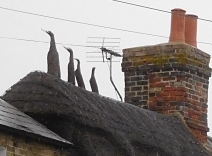
Every village is unique, but many share the same features. In Comberton, we saw several houses with well-maintained thatched roofs. However, we also saw something I had never noticed before. Some of the houses had what you might describe as ‘hybrid’ roofs: partly thatched and partly tiled. One house near the village pond had something we have seen on thatched roofs in many other villages. That is, the ridge of the thatch is decorated with animals made of thatch. Here in Comberton, this one roof was adorned with thatch sculptures of four birds with long necks, that made me think they are supposed to be depicting geese rather than ducks or swans.
The village pond, which is across the road from a dental surgery and ‘Millionhairz’, a hairdresser’s salon, is encircled by an attractive low, neatly built stone wall that curves around the water in a visually pleasant way. On the green next to the pond, there is a timber post that supports a sign (erected 1977) with the name of the village and a two-sided picture above it. On one side, a priest is depicted handing fishes to three people with outstretched arms. This refers to years long past when herrings were handed out to the poor in the village soon before Easter. The other side of the picture above the village name depicts a farmer ploughing his field with a plough drawn by a horse. Behind the farmer high on a hill, there is a white coloured wooden windmill. This reminds us that once Comberton had two working mills.
Our visit to Comberton lasted no more than ten minutes partly because we had to reach somewhere to meet my cousin and because the weather was miserable: grey, cold, and wet. However, what little we saw of this delightful place made us realise that it was well worth stopping en-route to our destination. We have already driven through so many intriguing villages on our excursions through the English countryside. I would have liked to spend time in all of these, and hope to return to some of them in the future. I would rather spend time wandering around picturesque villages than sitting for hours in traffic jams, as happens so often these days.
ENTIRELY JUSTIFIABLE FURORE over recent unlawful police killings of Afro-American citizens in the USA has heightened awareness of the history of unjust treatment of ‘people of colour’ under colonialism and slavery during years long passed. It was only after enjoying an afternoon in the lovely gardens of Anglesey Abbey near the city of Cambridge that I learned that this delightful place was once owned by someone whose fortune was at least partially derived from exploitation of India and elsewhere by the East India Company. But first some history of the house, whose gardens we enjoyed despite the rain and gloomy grey late October skies.
Between 1536 and 1541, King Henry VIII disbanded the monasteries, abbeys, and other religious institutions in England. One of these was an Augustinian priory established near Cambridge by Richard de Clare in 1212. This was originally founded as the Hospital of St Mary during the reign of Henry I (that is between 1100 and 1135). The site of this religious establishment became the property of John Hynde, an important judge, who died in 1550. The religious buildings having been largely demolished, the next owner of the place, the Fowkes family who acquired it in 1595, built a Jacobean style house where the priory used to stand. The house incorporated some of the remains of the disbanded priory and abbey.
Later, the house became the property of Thomas Hobson (1544-1631), a Cambridge carrier from whose name the expression ‘Hobson’s choice’ is derived. Hobson maintained a profitable livery stable in Cambridge as well as arranging the carriage of mail between London and Cambridge. ‘Hobson’s choice’, a name derived after Hobson’s death is essentially the choice between ‘take it (i.e. the one thing on offer) or leave it’. Hobson’s son-in-law Thomas Parker and some of his descendants owned Anglesey Abbey (as the property became known). Later, the Member of Parliament for Malmesbury and then Cambridge, Samuel Shepheard (1677-1748), became owner from 1739. We will return to him later.
In 1848, the Reverend John Hailstone (1759-1847), an important geologist, a member of the Linnean Society as well as the Royal Society, bought Anglesey Abbey. He carried out many restorations and planted many trees in the Abbey’s extensive gardens, which we can enjoy today. Jumping ahead, in 1926, two brothers, Urban Huttleston Broughton (later ‘1st Baron Fairhaven’) and Henry Rogers Broughton, bought the property. They made improvements to the house, enhanced their collections of artworks, and developed the gardens. Henry moved out in 1932, leaving Anglesey Abbey to his older brother Urban, then Lord Fairhaven. Urban built a library to store his ever-growing collections of art works and books and restored the working Lode Mill on his property. When Lord Fairhaven died in 1966, the property was bequeathed to the National Trust. Sadly, because of the current covid19 crisis, we were not allowed to enter the lovely house to view his collection.
Between 1717 and 1720, Samuel Shepheard, an early owner of Anglesey Abbey, was involved with the East India Company (founded 1600 during the reign of Queen Elizabeth I). He was elected a director in 1718. His father, Samuel Shepheard (c1648-1719), was one of the so-called ‘interlopers’ who used political connections set up The New East India Company in 1691. So, not much has changed in connection with the overlap of political influence and commercial interests since then! The ‘New’ company thrived alongside the older one for a few years before the two companies merged (https://www.nber.org/system/files/working_papers/w21536/w21536.pdf). Samuel’s father tried to involve his son in the promotion of the New East India Company and is alleged to have been involved in irregularities connected with his son’s political advancement (www.historyofparliamentonline.org/volume/1690-1715/member/shepheard-samuel-ii-1677-1748). The on-line History of Parliament website includes the following about Samuel (junior):
“Concern for trade, and in particular his father’s commercial interests, suggest that he, rather than James Sheppard, twice acted as teller in that session: in favour of engrossing a bill to open up commerce with Africa; and in support of the second reading of a clause for a bill to encourage the tobacco trade.”
As for the former owner of Anglesey Abbey’s connection with India:
“Although serving as a director of the East India Company under George I, he did not seek advancement in the City, preferring the lifestyle of the country gentleman. The establishment of a residence at Exning probably reflected his association with the Cotton family, who were lords of the manor there.”
He became extremely wealthy:
“Dying ‘vastly rich’, he left the bulk of his estate to his natural daughter, who was celebrated as ‘the greatest fortune in England’, and subsequently married Charles Ingram, the future 9th Viscount Irvine.”
Exning is about six and a half miles north-east of Anglesey Abbey. Although Shepheard owned the Abbey, it is unlikely that he resided there as much as in Exning.
Samuel Shepheard was, as already mentioned, a director of the East India Company between 1718 (possibly 1717) and 1720. During that time, the company appears to have been, if not actually involved in, certainly interested in transporting slaves from Madagascar to North America in 1720 (“The William and Mary Quarterly”, Vol. 26, No. 4, pp. 548-577). To what extent Samuel Shepheard and his father were involved in the slave trade remains unclear. The National Trust are also somewhat opaque on this subject as their report (https://nt.global.ssl.fastly.net/documents/colionialism-and-historic-slavery-report.pdf) reveals:
“Shepheard was a wealthy merchant and Cambridgeshire Member of Parliament (MP) who served as director of the new East India Company and headed the South Sea Company. His father, Samuel Shepheard senior (c.1648–1719), was also an MP and merchant, building the family fortune on overseas trade. He was a founder member of the new East India Company and the South Sea Company, where he held the office of deputy-governor from 1713.”
Should we let our enjoyment of Anglesey Abbey be disturbed by the knowledge that for a brief period of its existence it was owned by someone, who was involved in a company that ‘plundered’ India and was involved in the slave trade? By stating that Shepheard “… built the family fortune on overseas trade” to quote the National Trust in its report, which was triggered by the recent formation of the ‘Black Lives Matter’ movement, we can get no closer to ascertaining whether we should have a bad conscience about visiting the lovely gardens of Anglesey Abbey or should simply enjoy the experience without being concerned with an ill-defined unsavoury part of its history. After all, as far as we know, neither of the Shepheards, father and son, can yet be tarred with the same brush as, for example, the disgraced Bristol slave-trader Edward Colston (1636-1721), whose lifespan overlapped those of the two Samuel Shepheards. And, furthermore, unlike some other stately homes whose fame is largely due to fortunes made by persons involved in slavery, Anglesey Abbey is not one of them. If anything, the glory and splendour of this house and gardens in Cambridgeshire is due mainly to the efforts of men who owned it many, many years after Samuel Shepheard Junior died.
IN JANUARY1995, we drove from Phoenix (Arizona) to San Diego (California) via Yuma (Arizona). Between Yuma and our destination, we traversed the Anza-Borrego Desert east of San Diego. We made a detour to see Box Canyon in that area. After we had finally arrived in San Diego, we had an interesting experience.
Box Canyon
On our way to San Diego, we stopped in the desert at a couple of roadside information signs placed overlooking a rough track in a chasm beneath the road along which we were driving. This was part of the road along which migrants from the eastern part of the USA made their way by foot, on horseback, or in wagons, to the ‘promised’ land of California. According to the sign beside the road, in 1825 Lieutenant Santiago Arguello of the San Diego Presidio (1791-1862), a Spaniard, discovered this pass through the mountains whilst chasing horse thieves. Later, the American frontiersman Kit Carson (1809-1868), the US General Kearny (1794-1848), and gold-seekers, travelled along the route Arguello had discovered. By 1847, a road suitable for wagons had been built through the chasm by members of The Mormon Battalion. Commanded by Lieutenant-Colonel Philip St George Cooke (1809-1895), these hardy men used hand tools to prepare the thoroughfare.
The Mormon Battalion, which existed in the 1840s, was the only US battalion ever to consist solely of members of one particular religious group. All the members were volunteers and they helped to open up the Southwest of what was to become part of the USA. Apart from being involved in various battles, they also constructed the road, whose remnants we saw on our way to San Diego.
Soon after our arrival in San Diego, we stumbled upon a building related to what we had seen at Box Canyon. It was The San Diego Mormon Battalion Historic Site. Having just seen the result of Battalion’s heroic feat of labour, we felt compelled to enter the building. We were greeted amicably and warmly by an Elder, who was immaculately dressed in formal attire. Politely, he asked us if we would like to see the diorama that explained the history of the battalion and its role in opening up the west. We wanted to see this and were led into a room with chairs set out as in an auditorium in front of a large diorama.
The lights were dimmed and then our host explained what was depicted in the diorama as different parts of it were illuminated one after another. He told us the history, the details of which I cannot recall. After the ‘show’ was over, the lights went up and the Elder asked us politely whether we would like to see something else, rather special. We were game for that and he led us into a neighbouring room.
Our host invited us to sit in comfortable chairs in front of a large pair of curtains just like those hiding a theatre’s stage. Then, he pressed a button on the wall and the curtains began to part slowly and silently. They opened to reveal a huge painting in pale shades depicting a religious scene showing Jesus in heaven surrounded by pink clouds and light-skinned angels. Proudly, he informed us:
“This is a genu-wine oil painting all the way from Salt Lake City.”
After we had made politely appreciative remarks, he said to us:
“Now, if you have a moment, I would like to show you something else.”
My wife was against this, but my curiosity was fired up. He led us to another room, which contained glass display cases. They contained metal plates covered with illegible writing. Our host explained:
“Here are the tablets that our founder Joseph Smith discovered back in 1823”
Joseph Smith (1805-1844) was the founder of the Mormon religion. In 1823, so the Mormons believe, an angel directed Smith to a spot where he discovered the gold plates on which the texts of The Book of Mormon were inscribed. Our guide in San Diego was quick to explain that (unlike the oil painting we had just seen) these plates in San Diego were faithful copies of the originals, which after Smith had transcribed them, were re-buried and never seen again.
When I expressed my genuine interest in what we had been shown, the Elder offered to show us even more but my wife, who was beginning to worry that I might be about to be converted to Mormonism, said that we had to leave as we were running out of time. There was no fear of my adopting a new religion, but I was interested to know what further delights were on offer. Our host asked us where we were from, and we told him: London. He said:
“Leave me your address and I can arrange for someone to get in touch with you at home in London.”
My wife said:
“Thank you, give us your address and we can contact you.”
And with that, we exchanged polite farewells with our Elder.
My apparent interest in what we had been shown reminded my wife of her father, whom I grew to know well. Like me, he was interested in a variety of things. Once, he and I attended a trade exhibition in Bangalore (India), where he lived. We approached a stall promoting the sale of concrete beams used for constructing large buildings. Daddy engaged the representatives in conversation, asking many of the sensible questions that builders might well ask. The ‘reps’ answered enthusiastically and informatively. As this proceeded, I began to get worried that Daddy was about to buy a concrete beam for which he had no need at all. Just when he reached the point that both the reps and I expected him to write out a cheque, he shook their hands and thanked them politely before moving on to another stall.
When we were in San Diego, I had not yet got to know of Daddy’s behaviour as described above and wondered why my wife had become so concerned at the Mormon institution. After years of accompanying my delightful father-in-law to many trade fairs and exhibitions, I now understand the cause for her concern.
THE HARD ROCK CAFÉ at 150 Old Park Lane in central London opened its doors to customers in June 1971. It has been a popular eatery and tourist attraction ever since then. Often, a queue of hungry customers can be seen at its doors. I ate an enjoyable meal there once soon after it opened. I was then an undergraduate at University College London. Since then, I have not entered this place again. Some years ago, when the Hard Rock Café opened a branch in what had been the Tract and Bible Society bookstore in St Marks Road in Bangalore (India) in 2007, we had an indifferent meal there under the watchful eyes of a huge poster portrait of the singer Tina Turner.
Few of the customers of the Old Park Lane branch of this American-style diner in Old Park Lane are likely to have raised their heads to see what is above the eatery. It is worth doing so to see the:
“Bracketed cornice over 5th floor, shaped gable end to attic storeys finished off by giant broken segmental pediment with green brick banding and figure sculpture crowned by ornamental obelisk-finial.” (https://historicengland.org.uk/listing/the-list/list-entry/1266274).
This green (and white brick) banding gives the building an eye-catching appearance. There is a crest between the two large bow windows on the fourth (American fifth) floor. This shield with three chevrons and ten circles bears the date ‘1907’.
The building, 149-150 Old Park Lane, was built in 1904 to the designs of the architects Thomas Edward Colcutt (1840-1924) and Stanley Hamp (1877-1968), who worked together as a partnership. So far, so good, but what was the building used for when it was built and why did it deserve such an elaborate and unusual pediment? Various descriptions of its architecture describe that it consists of ‘flats and chambers’ above ‘a former showroom, now restaurant’. One source (www.foodepedia.co.uk/restaurant-reviews/2010/nov/hard_rock_cafe.htm) states that the Hard Rock is situated inside a former Rolls Royce showroom. This is confirmed by Anthony Knight, who wrote (on a restaurant development website):
“Two shaggy-haired Americans living in London were fed up with the fact they couldn’t find US-style burgers in the capital so they started a small burger joint in a Rolls-Royce dealership. In 1973 they hosted their first live gig, with the singer none other than Paul McCartney” (www.elliottsagency.com/opinion/greateststories/).
The brand name ‘Rolls Royce’ has been used since 1906. The building at 150 Old Park Lane was constructed two years earlier. I have not been able to ascertain when the luxury car company first opened their show room in the current premises of Hard Rock Café.
Looking up at the pediment, there is a sculpture of a kneeling muscular man supporting a sort of obelisk on which there are interlinked letters, which look like ‘D’, ‘J’, and lower-case ‘l’. What this stands for remains a mystery to me. However, the crest mentioned above, is identical to that on the coat-of-arms of the city of Gloucester (www.british-history.ac.uk/vch/glos/vol4/pp368-371). This is appropriate as the building is known as ‘Gloucester House’.
The building housing the Hard Rock Café is not the first edifice on this plot to have been named ‘Gloucester House’. According to the authoritative book edited by Ben Weinreb and Christopher Hibbert, “The London Encyclopaedia”, the first Gloucester House, which like the present burger joint was located on the west corner of Old Park Lane and Piccadilly, was constructed in the early years of the reign of King George III (he was on the throne from 1760 to 1820). It was in this building that Lord Elgin (1766-1841) first exhibited the marble fragments that he had removed from the Parthenon in Athens. They were displayed here, where today burgers and milkshakes are consumed, before he sold the marbles to the nation in 1816. That year, Gloucester House was purchased by William Frederick, Duke of Gloucester (1776-1834), who despite being nicknamed ‘Silly Billy’ became Chancellor of Cambridge University. The last owner of the house was George, 2nd Duke of Cambridge, who died in 1904. Soon after his death, the old house was demolished. It seems that its successor, the present Gloucester House, was built almost as soon as the old one was demolished.
In 1850, when the old Gloucester House was still in existence, Peter Cunningham wrote in his “Handbook of London” (published in 1850):
“At the Duchess of Gloucester’s, at the corner of Park-Lane, once Lord Elgin’s, and where the Elgin Marbles were placed on their first arrival in this country, is a very beautiful carpet in sixty squares, worked by sixty of the principal ladies among the aristocracy.”
At that time, William Frederick’s widow, Princess Mary, Duchess of Gloucester and Edinburgh (1776-1857), who was born in Buckingham Palace, was residing at the house. After her death, the house was sold to its last owner.
It occurred to me that quite accidentally the Hard Rock Café with its main entrance on Piccadilly is aptly named given that it is located where some ‘rocks’ that occasionally give the British Government a hard time, The Elgin Marbles, were once housed. What gives the precious ancient marbles a sort of hardness is that from time to time the Greek Government wants to have them back in Athens. So, next time you bite into a burger at Hard Rock in Gloucester House, spare a thought for the Greeks who have lost their marbles.
IN THE EARLY 1980s, I travelled to the island of Mljet, which is off the Dalmatian coast of what was then Yugoslavia. It was notable for at least two features. One was that most of the island was out of bounds to motorised traffic. The other was that nudism was both tolerated and encouraged.
I had been introduced to nude bathing a year or two earlier when I visited Dubrovnik with some friends from Belgrade. We used to take a ferry from the city to the nearby island of Lokrum. At the island’s ferry station there was a sign. One arrow pointed to the ‘nudismo’ beach and the other to the ‘ne nudismo’ beach. The first time we headed for the nudismo beach, I expressed concern about my modesty. One of my Yugoslav friends told me:
“Don’t worry, there’s always someone on the beach who looks worse than you.”
Surprisingly, these words reassured me.
Our party on Mljet included four people from the British Isles, including me, and three Yugoslavs. One of us Brits and the Yugoslavs were well-versed in nude bathing, but two of us ‘Brits’, including me. were relative novices.
Recently, my wife and I visited the gardens of Anglesey Abbey in Cambridgeshire. This lovely place is home to several outdoor sculptures. One of these is a naked youth carved in white stone. Someone, most probably a visitor, had placed a pair of sunglasses on the sculpture, rendering the youth no longer fully nude. Seeing this reminded me of our holiday in Mljet.
My friend from London and I joined in the nudity that was expected on Mljet, maybe a little anxiously at first but we soon got to enjoy it. After a few days on the island, one of my Yugoslav friends pointed out that unlike the rest of our party, neither of us ‘novices’ were ever completely nude. Either we wore only a sun hat, or a wristwatch, or even just a pair of sunglasses like the statue at Anglesey Abbey.
It is odd what can trigger far-off memories. That statue with the sunglasses did manage to remind me of the wonderful times I spent in Yugoslavia, a country that no longer exists.
IN THE EARLY 1990s, I was invited to a wedding in central Italy. Although I could have flown or driven to Italy, I decided to travel by train and ferry (the Channel Tunnel had not yet been opened for use). In my bachelor days, I was not a careful packer. I used to stuff my clothes and other belongings into a rucksack in a disorderly way. I was puzzled about what to do with my smart suit that I planned to wear at the marriage ceremony. I was concerned that it would become badly creased whilst stuffed in my rucksack. I consulted one of my female colleagues at the dental practice in Kent, where I was working at the time. She gave me some useful advice that did not include asking the hotel to iron it for me.
On my way to Italy I stopped for a few days to visit some good friends who lived in Basel in Switzerland. They lived near to the terminus of a tram line that ran from the French Border, close to my friends’ flat, across the Swiss city to the German border. Although they no longer live in Basel, we now have other friends who live at the end of the same tram line, but close to the German border. Getting back to the early 1990s, I spent an enjoyable time in Basel. Before leaving, I bought an immoderate number of large bars of Swiss chocolate. My rather unhealthy plan was to take this chocolate to Italy and then after the wedding festivities were over, I would spend many happy hours eating obscene amounts of Swiss chocolate on the train while travelling back to the French coast. It seemed like a splendid plan at the time.
I arrived at the hotel in the Italian city where the wedding was to take place. As I was not yet trained to hang my clothes in wardrobes, I left my full rucksack on the floor for the duration of my stay. Following my colleague’s advice, I extracted my creased jacket and trousers from my ruck sack, put them on hangers, and hung them in the room’s attached bathroom. Following the instructions I had been given in Kent, I turned on the hot water and closed the bathroom door so that the bathroom filled with steam from the hot water, and then I went out for some hours. On my return, the suit looked respectable enough to wear after its steaming.
The wedding festivities stretched enjoyably over three days. On each day, I attended meals in restaurants and the marriage ceremony in a municipal office. We all ate well and drunk fine Italian wines. As the saying goes, ‘a good time was had by all’.
At the end of my stay, I crammed everything into the rucksack lying on the floor of the hotel room, and then made my way to the city’s station. I boarded a train heading north through Italy towards Switzerland and then Paris, where I had to travel between the Gare de l’Est and the Gare du Nord, from where trains to Calais departed.
As my train headed across the plain of the River Po south of Milan, I began to feel the urge to make inroads into my stash of Swiss chocolate bars, which at that moment I treasured as if they were bars of gold. I opened my rucksack in which they had been stored while I was staying in the hotel in Italy, my heart sunk, and I was filled with gloom. No, they had not been stolen. Far worse, they were still there but completely and utterly inedible. Each bar of chocolate had melted and then re-solidified. However, when they had been in a molten state, they had been distorted in such a way that the silver foil in which they had been wrapped by the manufacturers had become intimately intermingled with the chocolate. After it had cooled down and solidified, all of my chocolates were welded to the silver foil in such a way that it was impossible to separate what was potentially edible from the inedible distorted strata of foil running through the chocolate. What had happened, you might well wonder. Well, there had not been a heatwave during my stay in the Italian city. What I had not realised when I was staying in the hotel was that my hotel room had under floor heating and it was this that had been warming my rucksack filled with chocolate that had been lying on the warm floor for several days.
Looking back on this after so many years, it was probably a good thing that I had not been able to consume a huge amount of chocolate all in one binge, but this is not what went through my mind at the time.