Unknown's avatar

About yamey

Active author and retired dentist. You can discover my books by visiting my website www.adamyamey.co.uk .

Finding Boy George and Bliss in north London

DURING THE COVID19 PANDEMIC, when travelling far afield has been discouraged for public health reasons, I have been exploring one of my old haunts, Hampstead, and have been becoming increasingly more interested in its attractions and historical associations. I invite you to join me on one of my rambles through a part of this intriguing area of north London.

Detail of house where Sir Arthur Bliss lived

East Heath Road runs eastwards, then southwards, relentlessly downhill from Hampstead’s Whitestone Pond towards South End Green, close to the Royal Free Hospital. The road marks the eastern edge of the spread of Hampstead into Hampstead Heath. Except for three well separated blocks of flats, there are no buildings on the eastern side of the Road. A winding lane leads off the road to the small settlement of the Vale of Health, an enclave which is surrounded by the Heath.

The block of flats facing Whitestone Pond at the top end of East Heath Road (‘EHR’) is called Bell Moor. Built in 1929, this edifice stands on the site of the home where the historian Thomas J Barratt (1841-1914) lived from 1877 to 1914. He was Chairman of the Pears soap manufacturing company and a pioneer in brand marketing as well as a historian of Hampstead. His “Annals of Hampstead”, published in 1912, is a detailed, monumental, beautifully illustrated, three volume account of Hampstead’s history. In addition to a plaque commemorating Barratt on Bell Moor there are two others. One of them records that the great conductor Sir Thomas Beecham (1879-1961) lived there from 1937-1941 and the other is placed to record that the surface of the soil at Bell Moor is 435 feet above sea level or 16.5 feet higher than the top of the cross on the dome of St Paul’s Cathedral.

Moving downhill, all the older houses are on the west side of East Heath Road. The writer Katherine Mansfield (1888-1923) and her husband, the critic John Middleton Murry (1889-1957), lived at the end of a short Victorian terrace, at number 17 EHR (formerly ‘Portland Villas’). Next door to this, there is a picturesque ivy-clad building, Heath Cottages, with one wall covered in wood cladding and a small balcony above one of its centrally placed pair of front doors. Barratt included a drawing of this building in his book but makes no comment about it.

A large house, The Logs, with an extravagant brick tower, eye-catching but not attractive, is reached further down EHR. This was built in 1868, designed by JS Nightingale for the drainage and water supply engineer and Justice of the Peace for Middlesex Edward Gotto (1822-1897; http://www.icevirtuallibrary.com/doi/pdf/10.1680/imotp.1897.19422). It has also been home to the comedian Marty Feldman and later the popular musician Boy George. The Logs neighbour is Foley House, which I have described elsewhere (https://adam-yamey-writes.com/2021/01/15/a-house-a-spa-and-grays-anatomy/).

Proceeding down EHR, we pass several large brick-built terraced houses until we arrive at the corner of a lane called Heathside. A large house on the corner of this and EHR bears a plaque that notes that the composer Sir Arthur Bliss (1891-1975) lived here in East Heath Lodge from 1929 to 1939. It was in this house that the painter Mark Gertler (1891-1939) painted the composer’s portrait in 1932 (https://www.npg.org.uk/collections/search/portrait/mw07115/Sir-Arthur-Bliss). During his residence on EHR, his musical compositions began to be come less avant-garde and he became a musical successor to the composer Edward Elgar. I wonder whether living in a house with views over Hampstead Heath might have influenced his change in composing style.

East Heath Lodge appears to have been divided into two residences. Bliss occupied the half of the building next to the Heath. It was built in about 1785 by the local builder Henry White and modified in about 1820 (https://historicengland.org.uk/listing/the-list/list-entry/1342097). A large bell hangs under a metal canopy outside the western half of the building, which bears the name ‘South Lodge’. West of East Heath Lodge along Heathside, there are some large cottages built in about 1814. South of Bliss’s former home, EHR is flanked to the east by a large public car park and to the west by a triangular green space whose apex is at the point where Willow Road meets the southern extension of EHR, South End Road. Just before it does that, EHR meets the eastern end of Downshire Hill soon before it crosses Willow Road.  

Number 2 Willow Road, a modern looking two-storey building can be seen across the grass from EHR. Modern it looks although it was designed and built by the architect of Trellick Tower Ernö Goldfinger (1902-1987) in 1939. In 1942, Goldfinger, who had Marxist sympathies, hosted an exhibition of leading artists in his new home in order to raise funds for “Aid to Russia” (www.nationaltrust.org.uk/features/who-was-ern-goldfinger).  Now owned and maintained by the National Trust, it is well worth visiting this superbly designed living space. Incidentally, Goldfinger’s house was constructed on the site of some 18th century cottages that were demolished to make place for it.

South of Willow Road, EHR becomes South End Road. The houses lining this road’s western side, but set well back from it, are in complete contrast to Goldfinger’s residence just north of them. Each of the houses is separated from the pavement by long strips of beautifully cared for gardens. Most of the dwellings have names: Hartley House (no. 103), where the architect Oswald Milne (1881-1968) once lived; Heath Cottage (no. 101); Guernsey Cottage (no. 93), home of the 19th century translator of “Heinrich Heine’s Book of Songs”, JE Wallis; Bronte Cottage (no. 89), home of the artist Mary Hill (1870-1949); St Johns Cottage (no. 87); Rose Cottage; Leighton House (no. 73), and Russell House (no. 71), an early 19th century house with a late 19th century enclosed veranda by Charles Francis Annesley Voysey (1857-1941), one of his earliest projects. Beyond these, there is Keats Grove, across which a line of shops commences. The architectural historian, Nikolaus Pevsner, who lived in Hampstead, described this row of buildings as:
“… a pleasant irregular sequence of early c19 houses.”

And that is a good description of them.

South End Road, the continuation of EHR, becomes Fleet Road and heads south east towards Chalk Farm. We end our ramble at Pond Square, where once there was a cinema, its site now occupied by Marks and Spencer’s superb food store. Just north of it is Hampstead Heath Overground Station, which is close to a pub with fake half-timbering called the Garden Gate. In 1855, a pub on this site was called ‘The Perseverance’. It was renamed ‘The Railway Tavern’ by 1871 and got its present name more recently. Closed at present because of the covid19 pandemic, the best place to refresh yourself, after walking down from Whitestone Pond and enjoying the varied architecture along the way, is the Matchbox Café next to the small, cobbled bus yard in Pond Square. Its friendly owner Mirko prepares good hot drinks and sells a variety of tempting snacks. And before you leave the area, pick up some great fruit and vegetables from the  well[stocked stall next to the station ticket office.

Honouring a Hindu hero in London

MI5 WORKS TO HELP protect our democracy in the UK. Its architecturally unflattering headquarters stand looming above the southern end of Vauxhall Bridge. A few yards downstream from it, and directly facing the main entrance of the Tate Britain across the river, there is a small grassy triangle close to the river. In the middle of the green space, there is a bust on a pedestal. The bust depicts a man with a moustache, who is wearing two chunky necklaces and what looks like a bejewelled turban. This is a monument to Basaveshvara, who lived between 1134 and 1168 (actually, these dates are not certain: he might have lived c1106-1167). A panel on the side of the pedestal notes that he was:

“Pioneer of Democracy and Social Reform”

Various people and organisations supported the creation of this monument to someone of historical importance but until now unknown to me and, I would guess, to many other people wandering past the bust. As one of the organisations involved in its creation was The Government of Karnataka (in southern India), I reached for my tattered copy of “A History of Karnataka” (edited by PB Desai), which I picked up in the wonderful Aladdin’s cave of a bookshop, Bookworm, in Church Street, Bangalore, a city which I visit often. It has 8 index entries for Basaveshwara, who is also known as ‘Basava’, ‘Basavanna’, and ‘Basavaraja’, all of these being transcripts from various Indian language alphabets.

Basaveshwar was born of Shaivite Brahmin parents at Bagevadi, which is now in the Bijapur district in the northern part of Karnataka. His name is derived from the Sanskrit word ‘Vrishabha’, the divine bull, Nandi, who carries the god Shiva. Early histories (the Puranas) described him as an incarnation of the god Shiva rather than a human being, but it is considered that he was certainly a real person. A devotee of Shiva, Basaveshwara was well-versed in both Kannada and Sanskrit learning. He was brought up in a social milieu in which people blindly adhered to the dogmas and rituals of Vedic Hinduism without bothering to understand the true spirit of religion. Desai wrote:

“Basava’s mind revolted against these ills and he decided to defy the existing order of things.”

After receiving the sacred thread, very roughly speaking a Hindu equivalent of the Jewish Bar-mitzvah or the Christian confirmation, Basaveshwara went to the Kudama Sangama, a temple complex at the confluence of the Rivers Krishna and Malaprabha. In 2011, long before I had ever heard of Basaveshwara, we stopped briefly at the Sangama on our way from Hospet to Bijapur (now named ‘Vijayapura’), both in Karnataka. When we were there, the rivers had dried up and we saw signs advising visitors to beware of crocodiles.  

Basaveshwara remained at the Sangama for about 12 years. In his time, as it is now, the Sangama was much visited by people from all walks of life. There, he met many scholars and learned men from all schools of Hindu belief. Eventually, Basaveshwara travelled to Mangalavada, the headquarters of Bijala II (c1130-c1167), the feudatory governor of the Kalachuri family (of the Chalukya dynasty). Soon, Basaveshwara became the Chief Treasurer of Bijala’s court. It was then that Basaveshwara:

“… started his new movement of religious and social reforms, treating all devotees of Siva [i.e. Shiva] as equal in all respects without the traditional distinctions of castes, communities and sects.” (Desai)

After about 20 years, BASAVESHWARA moved to Kalyana, the capital of Bijala, where his reformist ideas gained a great following. Bijala II, who had become suspicious of Basaveshwara, began crushing the movement inspired by Basaveshwara’s radical ideas that seriously threatened the traditional hierarchy that favoured the Brahmins, as well as advocating some hitherto unknown equality of men and women in spiritual aspects of life. For example, Basaveshwara sanctioned a marriage between the son of an ‘untouchable’ and the daughter of a Brahmin. Upset by this, Bijala sentenced the couple to death. Basaveshwara’s followers then plotted to assassinate Bijala, an act of which Basaveshwara disapproved. Realising that he could not restrain his angry followers, Basaveshwara retreated to Kudama Sangama, where he died. Bijala was murdered soon afterwards. Later, Basaveshwara became venerated as a (Hindu) saint.

Basaveshwara believed:

“…that every human being was equal, irrespective of caste and that all forms of manual labor was equally important.” (https://en.wikipedia.org/wiki/Basava).

These ideas sound familiar to those versed in the history of Mahatma Gandhi, who lived many centuries after Basaveshwara.  Yet, Basaveshwara is relatively unknown compared with Gandhi. Basaveshwara was certainly a reformer as is stated on the base of his bust near Vauxhall Bridge and his radical ideas were undoubtedly democratic when considered in relation to the time when he lived. So, it is quite appropriate that from his bust, there is a clear view of the Houses of Parliament, a home of democracy.

The bust on the embankment was erected by Dr Neeraj Patil, born in Karnataka, a member of the Labour Party and Mayor of the London Borough of Lambeth 2010-2011 and Dr Anagha Patil. It was unveiled in November 2015 by the current Prime Minister of India, Shri Narendra Modi. It is appropriate that Modi inaugurated this memorial as his parents were members of what was officially recognised a socially disadvantaged community, whose emancipation would surely have been approved by the reformer Basaveshwara.  And what is more, Modi is one of the first, if not the very first, of the Indian Prime Ministers, all democratically elected, who was not from a ‘high’ caste or social class such as Brahmin, Kayastha, and Rajput, and has completed at least one term of office. So, I feel that Basaveshwara does deserve a place within sight of the ‘Mother of Parliaments’.

Gushing from beneath the ground

AT SCHOOL, MY CHOSEN SPORT was cross-country running. Twice a week I spent an hour or so doing this in the grounds of Kenwood and the part of Hampstead Heath near to Highgate in North London. I have written about this before (https://adam-yamey-writes.com/2020/06/14/my-sporting-life/), but there is one aspect of it that I did not cover. Once a year, those who did cross-country running were accompanied by a teacher, Mr Bowles, who believed that getting covered in mud was an essential part of this form of exercise. I did not share his odd belief. There was one place on the Heath where filthy red coloured mud was guaranteed. This was at a point 410 yards south east of the centre of the grand south facing façade of Kenwood House and a few yards northwest of The Stock Pond, one of the series of Highgate Ponds.

The reason that this spot, favoured by Mr Bowles, was and still is, always sodden is that it surrounds a natural spring, which issues from a cylindrical stone well-head covered with stone carvings. These include depictions of a squirrel, a fish, and the head of a man with a luxuriant moustache. The water issues from a pipe emerging from the man’s mouth and then drops into a carving of a scallop shell before some of it falls into a drainage grid and the rest all over the place.  

This well head is called Goddisons Fountain. It was constructed in 1929 (https://insearchofholywellsandhealingsprings.com/2019/04/19/the-healing-springs-of-hampstead/) and named in honour of Henry Goddison, who campaigned vigorously for saving Kenwood and Hampstead Heath from being built on and for preserving it for the use of the public. It is not known whether there was a spring on this spot prior to 1929, but it is not unlikely that there was.

Goddisons Fountain is the last surviving spring issuing chalybeate (iron rich) water in the Hampstead/Highgate area. Prized for its supposed curative properties, especially during the 18th century, there were several springs issuing this kind of mineral water in Hampstead. A fine example of a now disused spring well-head can be seen at the eastern end of Well Walk in Hampstead. It was for public use and located across the road from the Hampstead spa that thrived during the 18th century (https://adam-yamey-writes.com/2021/01/15/a-house-a-spa-and-grays-anatomy/).

If, unlike many who stroll on the Heath, you do not wish to try the chalybeate water issuing copiously from Goddisons fountain, the next nearest source of this once highly prized water is about 47 miles south east in The Pantiles at Royal Tunbridge Wells in Kent.

The water flowing from Goddisons Fountain is one of many sources of the water in the Highgate Ponds, which include (descending the slope from Kenwood) the Wood Pond; the Thousand Pound Pond with the trompe l’oeil bridge designed by Robert Adam; the Stock Pond which is directly below Goddisons Fountain; the Ladies’ Bathing Pond; the Bird Sanctuary Pond, where I spotted a heron; the Model Boating Pond, where I saw no boats; the Men’s Bathing Pond; and Highgate Number 1 Pond. The water from the topmost pond flows through the lower ones sequentially. Most of these ponds were dug before the 18th century as reservoirs for London’s water. They were kept full by damming the Hampstead Brook, a tributary of the now hidden River Fleet, in 1777. In addition, numerous streams in the grounds of Kenwood and on Hampstead Heath were diverted to keep them topped up. Now, the ponds form a valuable publicly accessible leisure amenity. Hardy souls gain great enjoyment in swimming in the gender segregated open-air ponds, whose waters are not subjected to any purification or disinfection procedures. During the present covid19 ‘lockdown’, it is only wildfowl that can enjoy their water.

As we looked at Goddisons Fountain today in late January 2021, I recalled my muddy encounters with it in the company of Mr Bowles and realised that I had not seen it since early 1970, that is just over half a century ago. And it was not until I wrote this that I learned that the fountain is the last surviving chalybeate spring in the part of the world, where I was brought up.

Guard dogs and Cruella de Vil

LARGE FIERCE LOOKING DOGS roam freely in the grounds of a huge mock Tudor house overlooking north London’s Hampstead Heath on the corner of West Heath Road and Platts Lane. Approach one of the metal gates designed to prevent an outsider from viewing the house properly and within seconds one of those dogs will meet you on the other side of the gates and bark menacingly. I did manage to peer through the railings and the shrubbery within them to catch a glimpse of a huge sculpture of a seated lion sitting close to the steps leading to the house’s front door. Several notices on the outer wall of the property read:
“DO NOT ENTER. LARGE DOGS MAY BE RUNNING FREE”.

I have often passed this house and wondered about it.

A plaque posted by the Hampstead Plaque Fund reads as follows:
“Francis Owen Salisbury (1874-1962) ‘Frank’. Artist. Mural and Portrait painter, recorder of scenes of magnificent pageantry and historic event. Stained glass artist. Lived here.”

Frank, born in Harpenden (Hertfordshire), was the son of a craftsman, who worked in plumbing, decorating, and was also an ironmonger. He was apprenticed to a stained-glass company when he was 15, and then entered Heatherley’s School of Art as a part-time student (www.19thcenturypaintings.com/artists/79-francis-%28%22frank%22%29-o.-salisbury/biography/). A skilled artist, Frank won a scholarship to the Royal Academy Schools, where he won two silver medals. Soon, he:

“…acquired a considerable reputation. He exhibited at the Royal Academy from 1899 to 1943 and his career as a portrait painter also flourished in the United States. His sitters include five presidents of the United States, five British prime ministers and many members of the British royal family, including the official coronation portraits of King George VI.” (https://www.npg.org.uk/collections/search/person/mp07514/francis-owen-frank-salisbury).

Frank painted more portraits of Winston Churchill than any other artist. His portrait of Franklin D Roosevelt is still the official portrait of this president hanging in the White House. He was the first person to paint a portrait of the young lady, who is now Queen Elizabeth II. He made portraits of many of the most famous and infamous personalities of the first half of the twentieth century. Frank’s skills were not confined to portraiture as the commemorative plaque reveals,

Frank was highly successful in the USA and by 1932, he was able to move into his impressive mock-Tudor mansion, Sarum Chase, overlooking Hampstead Heath. The house was designed by Frank’s nephew Vyvyan Salisbury (died c1982). Following Frank’s death, the property was bequeathed to the British Council of Churches, who soon sold the house and its contents. The house has since been used as a background for photo and film shoots. In Disney’s 1996 film of “The 101 Dalmations”, Sarum Chase was used as the exterior of Cruella de Vil’s home.

By 1974, the house was home to St Vedast’s School for Boys, part of the School of Economic Science, which has links with a branch of Hindu philosophy. In 2005, the building was sold and is now, or has been, the home of property developer and donor to Jewish charities.

So, there you have it. If I have aroused your curiosity, that is good but do not try to enter this heavily guarded premises as did a little dog called Chewy, who found its way through a hole in the fence and met his sudden end in the garden of Sarum Chase in September 2016 (https://www.hamhigh.co.uk/news/our-pomeranian-dog-died-after-being-bitten-by-wealthy-property-3531920).

Feeling at home in the UK

ALBANIA. BULGARIA, AND YUGOSLAVIA are countries that I visited in the 1970s and 1980s. I visited the former Yugoslavia the most and acquired a smattering of Serbo-Croat, the main language spoken in that fascinating part of the Balkans. My limited knowledge of this language helped me get by in Bulgaria. My poor Serbo-Croat seemed to be well understood in Bulgaria. During my first visit to Albania in 1984, although we were prevented from communicating with the locals, there were plenty of examples of the Albanian language in the form of propaganda posters and political slogans written with numerous pebbles on the sides of mountains.

Until 1990, my vocabulary of words from various Balkan languages was of limited use to me whilst I was practising dentistry in England, first in north Kent then, after 1994, in London.

In the mid-1990s, I began treating patients who were refugees from parts of the then violently disintegrating Yugoslavia. Many of my new patients were from Bosnia and Herzogovina. Some of them had little command of the English language and were grateful that they were being treated by someone who knew ‘where they were coming from’, as the saying goes, and who knew some words of their own language. Sadly, some of them hearing me repeating what little Serbo-Croat I knew, assumed that I was fluent. I attracted a faithful following, some of whom were charming and a small minority, the opposite, On the whole, even the most difficult of my ex-Yugoslav patients were grateful and brought me gifts, often strong home-brewed alcohol sent from Bosnia, as a mark of their gratitude. One dear lady even brought me a pair of earrings that her uncle in Sarajevo had made specially for my wife.

Some years later, I began treating Albanian-speaking refugees from Kosova, a region of the former Yugoslavia that had and still has a population, which is mainly of Albanian heritage. Many of the recent arrivals from that country, who came to my surgery for dental care, had minimal or no English. My knowledge of Albanian was extremely limited. I could greet them with ‘diten e mire’ (‘good day’) or wish them ‘mirupafshim’ (‘good bye’), when they left my surgery, but I could say little else of any practical use. However, if I said ‘rrofte partia socialiste e shqiperise’ (‘long live the Socialist Party of Albania’) or ‘lavde shoku Enver Hoxha’ (praise Comrade Enver Hoxha’), which I had learnt from propaganda posters in Albania back in 1984, this caused many of my Kosovan patients to smile.  

Now that I have been retired for a few years, many of the new arrivals to this country from the troubled Balkans have settled down and contribute positively to life in the UK.  Only today, whilst waiting in the street for take-away coffees, we were joined by three other customers, workmen dressed in overalls. Seeing my furry ex-Soviet Army hat, they struck up a conversation. They were all from Serbia and were delighted that I knew some words of their language, if ‘samo malo’ (‘only a little’). I decided not to show off my knowledge of Serbian swear words that my friends in Belgrade had taught me long ago, and which I shall not share with you.

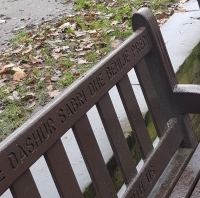
Just before reaching the café, we had been taking exercise in Holland Park. This park, like many others in London, has wooden benches, often inscribed with words to commemorate lost member(s) of a family. I was idly looking at a row of benches opposite the curious “Annunciation” sculpture, a structure consisting of horns and cogs, when I spotted one with words that are not English:

“Detikuar prinderve  tane  te dashur sabri dhe behije preci”

I recognised this as being in Albanian. Google translates this as:

“Dedicated to our dear parents Sabri and Behije Preci”

Until today, I had not seen a park bench with an Albanian dedication. Seeing this typically British form of memorial made me feel that members of communities that have had to flee from their war-torn homes in the Balkans are beginning to feel that Britain is now also a place they can call ‘home’, whose public amenities they are helping to cherish. 

This time last year

WE MARRIED TWICE. That is to say that Lopa and I had a civil marriage in a registry office in October 1993 in London’s Chelsea Town Hall and then a religious marriage in mid-January 1994 in my in-law’s garden in Koramangala, a district south of central Bangalore. Both ceremonies were memorable and meaningful but the one in Bangalore was more colourful, and far lengthier than that in London.

Between November 2019 and the end of February 2020, we were in India. Just before leaving for India in November 2019, we celebrated our English anniversary with our daughter at a French restaurant in London, the Poule au Pot, where one can enjoy typical classic French cuisine in a dimly lit but pleasant environment.

Mid-January 2020 found us near the port of Mandvi in Kutch, formerly an independent princely state, a largely arid, desert region, now part of the Indian State of Gujarat. We were staying with Lopa’s cousin and his wife in their lovely remote and spacious 150-year old farm house, which has been in his family for several generations. Informed of our anniversary, they decided to treat us to dinner at a nearby resort close to the sea. After the meal, we walked to the car under a star-filled clear sky and returned home. There, we sat on the veranda and enjoyed a dessert that Lopa’s cousin’s wife, an accomplished cook, had made specially for us.

A year later, a few days ago, we celebrated our ‘Indian’ anniversary in London. Interestingly, the temperature in wintry London was higher than it was when we were in Kutch (at night), but there was far less sunshine. This year, in the midst of strict ‘lockdown’ conditions necessitated by the covid19 pandemic, we celebrated alone, and not at a restaurant. We had a celebratory cup of coffee outdoors and enjoyed a good home-cooked meal prefaced by gin and tonics. Had we been in India as we often are in January, but not in Gujarat, which is teetotal, we would most probably also have celebrated with ‘g and t’ but sitting outside under the stars on a warm evening in southern India.

Little did we know when we were enjoying ourselves in Kutch last January, that a year later, the idea of visiting India, let alone leaving London, would be out of the question. Well, as my late father used to say, rather annoyingly when misfortune struck:

“Such is life”, or “These things happen.”

A tunnel, a bridge, and a round building

IF THE RAILWAY authorities did not prevent people from wandering along the track as many people do in India (for example), taking a photograph of an amazing construction at the base of London’s Primrose Hill would be simple. But, wisely, they do not encourage people to risk their lives on tracks that carry high speed trains from London’s Euston station to places north of it. The remarkable edifice to which I am referring is the eastern entrance to the Primrose Hill Tunnels that originally carried lines of the London and Birmingham Railway (‘L&BR’) underground between Primrose Hill Road in the east and Finchley Road in the west. Short of trespassing on the tracks, the best place to see the entrance is through the railings on the north side of King Henrys Road a few feet east of Primrose Hill Road.

The Roundhouse

The Primrose Hill tunnels were the first railway tunnels dug in London and some of the first in the United Kingdom (https://historicengland.org.uk/listing/the-list/list-entry/1329904). The tunnels had to be built strong enough to withstand the weight of houses that were to be built above them. The land beneath which the trains pass is part of the Eton Estate (owned by Eton College). When the railway was being laid in the early 19th century, the Estate raised objections initially, worrying that running a railway through a deep cutting would reduce the saleability of the land, the Chalcot Estate owned by Eton, through which it ran. However:

“The L&BR bought off any possible College obstruction by agreeing to put the line in a tunnel through the Chalcots Estate. From an engineering viewpoint this was unnecessary as the rails were never more than 50 ft below the ground surface, and side slopes of 1 on 2 were specified initially. A tunnel had the merit of using no land, the surface being preserved for building …” (http://www.crht1837.org/history/tunnel).

Digging the tunnels was not without danger. Workmen got killed. When this happened, their bodies were taken at first to be laid out in a local hostelry, The Chalk Farm Tavern. This place in Regents Park Road was rebuilt in 1853-54 and its new building is now home to Lemonia, a popular Greek restaurant. So, next time you are enjoying a plate of tzatziki or a souvlaki, just remember that years ago there was a mortuary for railway navvies near your table.

Today, there are two tunnels commencing at Primrose Hill Road. The northern one, nearest Adelaide Road, was the first to be built, in 1837. The southern one, nearest King Henrys Road, was built about 40 years later. Part of Eton College Estate’s requirements of the L&BR was:

“… the mouth of the Tunnel at the eastern end shall be made good and finished with a substantial and ornamental facing of brickwork or masonry to the satisfaction of the Provost and College…” (http://www.crht1837.org/history/tunnel).

The portals at this end of the tunnel, which can just about be seen from King Henrys Road, are grand and impressive examples of neo-classical Italianate masonry. The northern portal, the first to be constructed, was designed by William H Budden, who was appointed as an office assistant to the L&BR in May 1834 (https://etheses.whiterose.ac.uk/16826/1/Railway%20tunnels%20recovered%203.pdf). The newer southern portal is a replica of the earlier one.

The graffiti-covered iron railway bridge that is 530 yards east of the tunnel, quite close to the house on King Henrys Road once occupied by the Indian politician and lawyer Dr Bhimrao Ramji Ambedkar (1891-1956), is easy to see, but far less attractive than the tunnels’ magnificent portals. Now a pedestrian and cycle bridge, it carries the northern section of Regents Park Road across the tracks. The present bridge, made of iron, was constructed in 1846 to replace an earlier one built in brick in 1839 (http://primrosehillhistory.org/?p=388). Until 1992, passengers could board and disembark from trains at a station at the northern end of the bridge. Opened in 1859, this station was named ‘Hampstead Road’, then ‘Chalk Farm’, and finally ‘Primrose Hill’.

Whereas the Primrose Hill Tunnel portals can only be glimpsed with great difficulty, the largely brick-built Roundhouse, a few yards south of Chalk Farm Underground Station, is impossible to miss. Located close to the railway tracks a few yards east of the Regents Park Road footbridge, this circular building was built as a railway locomotive shed in 1846-47. It was designed by Robert Benson Dockray (1811-1871), who had been an Assistant Engineer during the construction of the pioneering Stockton and Darlington Railway in 1835 (https://www.locallocalhistory.co.uk/ctown/p001/pages39-42.htm).  The building was made circular because in its centre there was a turntable for moving the locomotives that were stored on tracks radiating out from it.

In 1967, the then disused Roundhouse was converted into a huge theatre. From the 1970s onwards, I used to attend occasional performances there. Amongst these, I particularly recall a somewhat raunchy show put on by the Grande Magic Circus, a French company, and many years later, an incomprehensible performance of Shakespeare’s “A Midsummers Night Dream”, which was performed in a variety of Indian languages by a troupe of acrobatic gymnasts. In recent years, a sculpture by Antony Gormley has been placed on the roof of a modern annex of the Roundhouse.

Private functions are also held in the Roundhouse. On one occasion, we were invited to a bat-mitzvah held there. Drinks and canapés were served in the circular upper floor gallery that runs around the circular auditorium. I was extremely surprised when one of the other guests came up to me and after looking me up and down, said:

“You must be in the fashion business.”

For a moment I was flattered, then I wondered whether he had had one too many or was visually impaired.

Uganda and me

UGANDA IS ONE OF many countries that I have not yet visited. Yet, I can relate some personal anecdotes related to it.

When we had our Hindu wedding ceremony in Bangalore (India), several of my wife’s aunts, whose families originated in Kutch (now part of Gujarat State in western India) were present and quite concerned that there were elements of Kutchi marriage traditions incorporated into our three-hour long ceremony. I cannot remember what these were. One of the aunts had lived with her family in Uganda until they saw the ‘writing on the wall’ and left for India before Idi Amin forcibly expelled all of the other Asians from his country. Her son, who lives in the UK, introduced me to Uganda’s national alcoholic drink ‘waragi’, brewed from bananas, which did not appeal to me as much as other drinks with 40% alcohol content.

Soon after I went to India for our wedding, I began working in a dental practice near Portobello Road in west London. It was there that I worked with ‘A’, who was the best dental surgery assistant I have ever worked with. She was resourceful, bright, friendly, polite, efficient, and never lost her cool. When equipment went wrong, I used to want to ring Andy, our repairman, but A would say:

“Let me fix it, Mr Yamey, I saw what Andy did last time.”

And usually, she fixed whatever had broken down.

Occasionally, A worked at the reception desk. Patients used to come up to the desk, often impatient and desperate to obtain dental treatment immediately. Instead of getting flustered, as other receptionists might easily have done, she used to say calmly something like:

“Good afternoon, Mr Brown, how are you today? And how is your family?”

When the patient had been calmed down by her questions, she would get down to the business of making arrangements for the patient’s treatment. She had a civilising influence on others.

A was born in Uganda after Idi Amin had given up ruling the country, but she lived through the troubling times that followed his downfall. She told me that she had witnessed a member of her close family being shot while she hid in a bush nearby. On another occasion, she told me:

“I heard some soldiers coming to my home, and, Mr Yamey, I jumped out of a window at the back and ran into the fields. I ran and ran and ran.”

Despite these and other horrific experiences, one would not imagine that A had had such a traumatic childhood.

A was an evangelical Christian. She kept a small edition of the New Testament in one of the drawers in my surgery alongside tubes and bottles of dental materials. It was printed mainly in black but with some words in red. These were, A explained to me, the words that had been uttered by Jesus. Every day, she used to say to me in her gentle voice:

“Mr Yamey, all you need to do to be saved is to accept Jesus into your life.”

This did not bother me, nor did the evangelical Christian radio station that she liked to hear while we were working. However, one day a particularly nervous dental patient, a frequent attender who had been born in the USA, was lying in my treatment chair, when he lifted his hand and said politely:

“There are two things that upset me. One is having dental treatment and the other is having religion thrust down my throat. So, A, will you please turn off the radio now.”

A did as asked, and we never listened to that station again. Often, A encouraged me to try ‘matoke’, a Ugandan dish made from a type of banana. She thought it was delicious, but I have not yet sampled it. I have not seen A for a long time now and hope that she and her husband are thriving and enjoying a life far better than she experienced in Uganda.

Long before I became a dentist, in my teens (in the second half of the 1960s), I loved collecting travel brochures: leaflets, maps, and booklets issued free of charge by travel companies and national tourist offices. My friend ‘F’ shared this passion. One day during the summer holidays, F suggested that we, that is F and his brother, me, and ‘H’, another close friend, should have a brochure collecting competition.  F and H formed one team, and F’s brother and I the other. The plan was that we start together at Oxford Circus and then work our way down to Trafalgar Square, collecting as much free travel literature as we could gather. The winning team would be the one which had collected most material, but taking duplicates was not allowed. Speed was also important, so we tried to waste as little time as possible in each place.

My team entered one travel agent or national tourist office after another, taking whatever was on display and asking the people working in them for any material that was available but not on display. We piled our ‘loot’ into the rucksacks we were carrying and moved from one location to the next. Our loads were quite heavy when F’s brother and I arrived at the locked door of Uganda’s tourist office on the south side of Trafalgar Square. We rang the door and were admitted by a man who led us upstairs to his office. There, we were asked to sit in front of his desk. He chatted to us politely, passing the time of day, whilst we sat there anxiously as the minutes, which we could be using more profitably, slipped past. Eventually, we got around to asking him for travel literature. He handed us three thin coloured brochures, which we considered to be a poor haul given how long we had spent with him.

Passing the Ugandan tourist office, which is still where it was during the 1960s, today in January 2021, soon after a recent election in that country, brought back memories of our brochure collecting dash and made me wonder whether at that time I should have been chasing after girls in my spare time, as many of my schoolmates were doing, rather than picking up leaflets about exotic destinations. By the way, F and H won our competition by a narrow margin.

So, finally, this is almost all I have relate about my somewhat tenuous connections with Uganda. All I wish to add relates to my father’s regular purchases of the satirical magazine “Private Eye”, which gave the term ‘Ugandan discussions’ a new meaning in March 1973. If you do not know what I mean, then I will leave you to search for the term on Google.

The Duke and Dunhill in London’s Mayfair

OUR YEARNING FOR visiting the art galleries in London’s West End is growing daily because the current covid19 lockdown has meant that they are all closed. So, when we read that the Gagosian Gallery on Davies Street, just north of Berkeley Square, had put on an exhibition that could be viewed from the street through its huge plate glass windows, we had to ‘take a gander’. The gallery is displaying some ceramic bowls created by Edmund de Waal until the 30th of January 2021 (https://gagosian.com/exhibitions/2020/edmund-de-waal-some-winter-pots/). Frankly, although they embody great craftsmanship, we were disappointed.  However, across the road, facing the Gagosian, there is a detached house that attracted more of my attention than the bowls. It was not only its antiquity that appealed to me but also some huge, inflated spheres with reflecting surfaces in its courtyard that produced fascinating reflections of the building and those nearby.

Bourdon House, a Georgian mansion completed in 1724, possibly designed by Isaac Ware (1704-1766), is now Dunhill’s exclusive shop for discerning “modern gentlemen”. The current building consists of two sections (www.british-history.ac.uk/survey-london/vol40/pt2/pp69-76#h3-0002):

“On the west, with a return front to Davies Street, is a much-extended and enlarged early Georgian house built in the 1720’s, and to the east and south-east is a substantial Edwardian wing built in a matching style, with fronts to both Bourdon Street and Grosvenor Hill.”

Bourdon after whom the house was named in 1860, lived in the 18th century and was the first occupant of the house. He was a justice of the Peace for Middlesex and held other important positions.

Over the years, numerous people resided in Bourdon House, which underwent modifications as time moved on. In September 1916, Hugh Grosvenor, the 2nd Duke of Westminster (1879-1953) took ownership of the house and lived there from 1917 until he died. When he moved in, his former home Grosvenor House, was being used by the Government in connection with WW1. The Duke liked Bourdon House so much that he decided not to return to Grosvenor House when the Government returned it to him in 1920 (it was demolished in the 1920s). During his occupancy of Bourdon House, the Duke divorced thrice.

On his death, the Duke’s fourth wife, Anne (née Sullivan; 1915-2003), whom he married in 1947, remained in Bourdon House until 1957. After she left, the house began to be used as commercial premises, first becoming an antique shop. In 2008, the house became a luxury emporium for the company of Alfred Dunhill. The company’s founder was Alfred Dunhill (1872-1959), who was a tobacconist, inventor, and entrepreneur. By the early 20th century, he was a pioneer in the creation of the modern luxury goods market. He was a collector of smokers’ pipes and, also, an author, publishing his “The Pipe Book” in 1924, and later “The Gentle Art of Smoking”.

Many years ago, in the late 1960s, one of my cousins visited London from his home overseas. He was on a trip to see the major cities of Europe. While he was in London, I spent a day showing him some of the sights, an activity I enjoyed in my teens. My relative, also in his teens, was very keen to visit one of Dunhill’s London shops, probably the one that was in Duke Street. His desire was to purchase a Dunhill pipe to add to the collection he was making whilst travelling around Europe. It is a shame that when he visited and wanted to buy a pipe, the shop in Bourdon House had not yet been established. I would have enjoyed seeing inside this historic building, but now I will have to wait until the lockdown is over before I can enter it on the pretence that I am considering buying some Dunhill t-shirts, most of which cost well over £200. At least, they are cheaper than the De Waal ceramics that can be purchased from the gallery opposite Bourdon House.

Rambling in Hampstead: Romney to Robeson

AN OLD FIRE STATION with a tall clock tower was built in 1871 and used until 1923. It stands on a corner at the southern end of narrow Holly Hill, opposite Hampstead Underground Station. Let us begin the steep climb up Holly Hill, noting on our right the house (number 16) where the painter Derek Hill (1916-2000) lived between 1947 and his death.  A painter of portraits and landscapes, he was greatly regarded in Ireland.  Close to his home, number 18 Holly Hill is named ‘Sundial House’ and has a heavily painted black sundial attached to its façade.  It was once part of the house owned by Hill.

former Mount Vernon Hospital

A little further up the hill on the same side as Sundial House, there is a large house with white painted weatherboarding, which was the residence of a painter far better-known than Hill, George Romney (1734-1802). Romney bought the property in 1796 and had it redesigned by Samuel Bunce (1765-1802) for use as a studio and gallery in 1797/8. Although Romney had spent a great deal of money to create his Hampstead abode, to which he moved from having lived in Cavendish Square for at least 20 years, he was not entirely happy being so far away from the buzz of central London life.  He sold the house in 1799. In 1807, the house was enlarged and became ‘The Hampstead Assembly Rooms’. Later, in1929/30, the house was remodelled and enlarged by the architect Sir Bertram Clough Williams-Ellis (1883-1978), who created the picturesque village of Portmeirion in western Wales. So, much has happened on this plot of land, which used to be the site of the stables of Cloth Hill, a house that existed in the 17th century.

To the north of Romney’s house is Fenton House, built about 1693, once owned by the Riga merchant PI Fenton, who bought it in 1793, and now owned by the National Trust. It houses a fine collection of old keyboard instruments. In the late 1960s when I first visited it, visitors were free to touch the instruments and make sounds or music with their keyboards. Now, this is forbidden unless you are a musician who has been given special permission to play them. Fenton House is next door to Bolton House and Volta House. These two and another, Windmill House, comprise a terrace constructed 1720-1730 (https://britishlistedbuildings.co.uk/101379202-volta-house-bolton-house-windmill-hill-house-and-enfield-house-hampstead-town-ward#.YAG3W-j7RPY). The poet Joanna Baillie (1762-1851) lived in Bolton House between 1791 and 1851. Her guests at the house included John Constable, Walter Scott, William Wordsworth, Lord Byron, and John Keats. The street on which these buildings and Fenton House stand, Windmill Hill, was named in 1709, probably because there had been a windmill nearby in the 17th century (https://www.british-history.ac.uk/vch/middx/vol9/pp15-33).

Across Holly Hill and high above Romney’s house, a steep footpath reaches Mount Vernon. Just where the small lane makes a right-angle turn, there is a plaque on a high brick wall commemorating the physiologist Sir Henry Dale (1875-1968), who lived nearby. Dale first identified acetylcholine in 1914 and proposed that it might be a neurotransmitter, a substance that allowed nerve cells to communicate with one another. In 1936, he and his collaborator Otto Loewi (1873-1961), whom he met at University College (London), were awarded a Nobel Prize for their work on the role of acetylcholine in neurotransmission.

The wall to which Dale’s plaque is attached is part of that which surrounds the  Mount Vernon House, which is barely visible behind the wall. The house, originally named ‘Windmill House’, was built in about 1728. It has been home to Dale; the surgeon William Pierce (c1706 -1771); General Charles Vernon (died 1810), Lieutenant of the Tower of London from 1763 until 1810, who leased it between 1781 and 1800; and the British landscape painter Edmund John Niemann (1813-1876). Dale and his wife occupied the house from 1919 to 1942.

Immediately north of Dale’s former home, there is a massive Victorian building replete with turrets topped with conical roofs. Now a block of flats, this used to be Mount Vernon Hospital for Tuberculosis and Diseases of the Lungs (https://ezitis.myzen.co.uk/mountvernonhampstead.html). It was built on land owned by General Vernon.  I often wonder what people living in former hospitals like this one and the old Royal Free, also in Hampstead, the former Royal Dental Hospital (now a hotel in Leicester Square), and the former St George’s Hospital (now the luxurious Lanesborough Hotel), think when they consider that parts of their residences might once have been filled with consumptive patients, or the sickly poor, terrified dental patients, and the dying.

Built in 1880 and opened a year later, this hospital was built in faux 17th century French renaissance style. In 1914, the building and its later extensions was sold to the Medical Research Committee and Advisory Council  to house a National Institute for Medical Research. By 1915, it was a hospital again. After WW1, the building reverted to being used for medical research until 1950. According to a watchman at one of the entrances to the former hospital, the place was converted into flats about 25 years ago.

Moving northwards, Holly Hill becomes Frognal Rise, which drops downwards to the east end of Frognal before rising again. Two gate posts marking the beginning of a lane, Oakhill Way, that leads west from the ascending part of Frognal Rise are the entrance to Combe Edge. Along the lane, there is a house with that name, whose gateway bears the date 1878. One of its walls has a plaque commemorating Elisabeth Rundle Charles (1828-1896), who lived there from 1874 to 1896. A writer, Charles is best known for her novel about Martin Luther, “The Chronicles of the Schönberg-Cotta Family”, published in 1862, which can be read online (www.gutenberg.org/ebooks/36433), if you have nothing better to do. But we must move on to our next port of call: Branch Hill House.

The house, formerly called ‘Spedan Tower’, is an ugly brick pile, which looks institutional.  However, its gothic revival gatehouse, built 1868 and designed by SS Teulon (1812-1873) and overlooking a large area of allotments, is attractive. The former care home (built in 1901) was once the home of John Spedan Lewis (1885-1963), founder of the retailing group John Lewis Partnership.  Beneath it in what was once its gardens, there is a modern council estate called Spedan Close. Completed in 1978, it:

“…was, at the time it was built, the most expensive council housing in the country; every property with its own individual roof garden.” (www.theundergroundmap.com/article.html?id=29094).

Returning to Frognal Lane, it becomes Branch Hill a few yards before it joins West Heath Road. Number 1 Branch Hill, a house named ‘The Chestnuts’, was home to the great singer Paul Robeson (1898-1976) from 1929 to 1930. This was after his appearance in “Show Boat” in London in 1928. It was in this show that his famous performance of the song “Ol’ Man River” was first heard. Paul and his wife bought the house in Hampstead, but soon after they divorced, he returned to the USA.

By now, you will have walked not much more than 600 yards, but passed plenty of places of historical interest, which I have mentioned, and others that wait for you to explore.