So near, yet so far

THE FLIGHT FROM BANGALORE to Chennai (Madras) is short: about forty minutes flying time. Some friends collected us from the airport in Chennai, and plied us with a tasty lunch. They recommended hiring an Uber taxi to ferry us from Chennai to Pondicherry (now ‘Puducherry’), a distance of about 100 miles. After three abortive attempts, a fourth driver pitched up and we set off for Pondicherry.

Our Uber driver was excellent and drove carefully. After just over two hour’s journey southwards along the luxuriant, verdant, well cultivated coastal plain, we reached a Pondicherry check post.

From 1674 until 1954, Pondicherry and its environs was a French colony. Occasionally, it was taken over by the British, but most of the time it was part of France. In 1954, a large majority of city elders voted in favour of ceding drom France. That year it became, and remain, an Indian Union Territory, independent of its hige neighbour Tamil Nadu. Old Pondicherry still contains many fine French colonial buildings and the policemen wear képis. Many of the road names are bilingual: Tamil and French. In addition, the town has no shortage of restaurants offering what is described as ‘French cuisine’. Although well populated with both Indian and foreign tourists, Pondicherry is a delightful place to relax and enjoy warm sea breezes.

To enter the Union Territory of Pondicherry, drivers of cars with registration plates from outside Pondicherry have to buy a permit to drive there. Our Uber driver’s car had Tamil Nadu plates. He stopped at the check post, which is about ten minutes drive from the heart of Pondicherry, and told us it would take about five minutes to get the permit. He gathered up his relevant documents and headed inside the checkpost. While we were waiting for our driver, we were parked next to an unpretentious stall serving Bengali food. It bore signs in three scripts: Bangla, English, and Tamil.

Instead of taking five minutes, we sat waiting for him for forty five minutes. This was because he had set out with one document missing. I sat waiting in the car thinking that without the entry permit, we were so near yet so far from our destination.

After some time and several telephone calls, our driver re-entered the checkpost, and emerged with the desired permit. He explained that he had bern sent a photo of the missing document by WhatsApp. This image of the document, rather than the original, satisfied those who issued the entry permit. We continued our journey. Just beyond the checkpost, I saw an obelisc, which looked old enough to have been put up by the French colonial authorities.

After settling into our accommodation, which I will describe at a later date, we took a pre-prandial stroll along the lovely seaside promenade. I was very pleased to discover that a place that had opened on the promenade a few months before our last visit to Pondicherry five years ago was still flourishing.

The Gelateria Montecatini Terme is a superb ice cream shop. It was set up just over five years ago by an Italian who has a business making luxury boats, anything from canoes to millionaires’ yachts. The gelateria is fully equipped with Italian equipment and refrigerated ice cream display counters. Stepping into this popular ice cream parlour in Pondicherry is just like stepping into a gelateria in Italy, and the ice cream is top class. The queues of customers attest that I am not alone in saying that.

The so-called ‘French food’ in Pondicherry is popular, but in no way matches up to the high standards often encountered in France. In contrast, the ice cream served at the Gelateria Montecatini Terme easily rivals the best in Italy. India never fails to be surprising!

Searching for Samsung

ONE OF OUR SAMSUNG mobile phones needed repairing while we were in Bangalore. Using the Google search engine, we discovered that the Samsung Service Centre nearest us is at Jayanagar. We gave the address provided by Google to an autorickshaw driver and after some navigational difficulties we reached the spot. There was no Service Centre but close to where we expected it to be, we found a Samsung showroom. Clearly, there was a mistake on Google.

Jayanagar gets scant mention in a new guidebook to Bangalore, so I turned to the (not always completely reliable) Google search engine to get a bit of background to this district of Bangalore close to the Lalbagh, a historic botanical garden. According to Wikipedia, a good starting place for research, Jayanagar means ‘victory city’. The area was established in 1948, and was one of the first planned suburbs of Bangalore. What little we saw of Jayanagar during our quest for the Samsung Service Centre reveals that the area is well planned in comparison with other areas of Bangalore. It gives the impression of being a prosperous suburb, which it is.

The people working in the Samsung showroom, where we stopped, confirmed that the address given by Google was indeed incorrect. They gave us directio s for finding the Service Centre, which was ten minutes’ walk away. This walk gave us a chance to gain some impressions of Jayanagar.

After walking past several palatial, fancy looking jewellery stores, we entered a long, mainly residential, street. Most of the houses were well spaced from each other, quite unlike the hugger mugger found in, for example, the prosperous but poorly planned suburb of Koramangala. The architecture of the houses along the street (7th Main Road) in Jayanagar is not uniform but interestingly varied. Several of the houses carry rakshasas, grotesque, scary masks to ward off the ‘evil eye’.

An elegant mandir, the Ganesha Vinayaka Temple, stands next to the intersection of 7th Main Road and New Diagonal Road. Established in the late 1970s, this temple attracts many politicians. Those seeking power come to worship at this place.

Beyond the temple, we reached 27th Cross Road. After crossing its central divider, we entered our destination, the Samsung Service Centre.

As with many faults of an electronic nature, when the engineer checked out the problem we were having with the phone, it had disappeared. Our search for the Samsung Service Centre had been unnecessary… so we thought.

PS After we had returned from Jayanagar, we discovered that our phone was repeating the fault which had caused us to make the apparently pointless journey to the pleasant suburb of Jayanagar.

An Indian hero or villain?

VINAYAK DAMODAR SAVARKAR (1883-1966) has been dead for over half a century. Yet, his ideas continue to influence political thinking in India today. A controversial freedom fighter, writer, and politician, he is either admired uncritically by his biographers or damned by them. Vikram Sampath’s recently published book “Savarkar:Echoes from a Forgotten Past 1883-1924″ provides a reasonably balanced story that is neither over critical (as is, for example, AG Noorani) or hagiographic (as are D Keer and J Joglekar).

The period covered in the book by Sampath, 1883 to 1924, is the most important part of his life as far as the present is concerned.

From an early age, Savarkar, who was much influenced by Giuseppe Mazzini, was involved with secret societies and conspiracies, all connected with his desire to rid India of its British imperialist rulers.

In 1906, Savarkar travelled to London to study to become a barrister. He was funded by a scholarship granted by Shyamji Krishnavarma and his wealthy supporters. For most of his stay in London, he resided at India House in Highgate, founded by Krishnavarma (and described in my book “Ideas, Bombs, and Bullets).

Savarkar’s years in London (1906-10) were productive in several ways. He wrote a biography of Mazzini and a history of the First Indian War of Independence (1857-58). Both works reflected his aim of expelling the British from India. In addition to writing, he became deeply involved in: what the British authorities might have called ‘terrorism’; bomb making; smuggling ‘seditious’ literature and weaponry into India; assassinations; and so on. This is all described well and interestingly by Sampath.

The British police and their counterparts in India became desperate to put Savarkar behind bars. He left for France in late 1909 and his freedom fighting friends there, including Krishnavarma and Madam Cama, tried to persuade him not to return to England. However, he did and was arrested.

Savarkar was kept in custody in Brixton prison for months whilst a lengthy case for his extradition to face charges in India, was fought. In the end, he lost and began his long journey to India as a political prisoner.

At Marseilles, Savarkar escaped from the ship and was rearrested on French soil by British police, who had been accompanying him. This arrest on foreign, not British, soil gave rise to an international tribunal in the Hague. However, by the time when the legality of this irregular arrest was decided, Savarkar was in prison in Bombay, being tried without a jury. He was condemned to two terms of life imprisonment (50 years) in the Cellular Jail, a hellhole on the almost inhospitable Andaman Islands. Interestingly, it was the terrible years he spent there that were to lead to his development of important ideas about Hindu Nationalism.

Savarkar underwent unbelievably horrendous experiences in the Cellular Jail. Regarded as highly dangerous by the British, he was singled out for particularly harsh treatment. Despite often being so unwell that he was close to dying, Savarkar survived his prison ordeals. As the years passed, he was able to educate his fellow prisoners and to develop his ideas on the shape of a future India free of British domination. It was while in the Andamans that his views on who could be counted as a ‘true Indian’ began to form in earnest.

Many of Savarkar’s detractors brand him as a coward for having written many petitions for clemency to the British authorities. Sampath shows, as does another recent biographer (V Purandare) that Savarkar was far from being alone amongst the political prisoners in trying to cut short his prison sentence. He made promises to abstain from political activity if his sentence was shortened. In addition to wanting to save himself from future torments, Savarkar believed that a politician behind bars was far less use to his country than outside prison. Sampath shows that both he and the British officials believed that his promises of good behaviour were of questionable value.

Sampath’s description of Savarkar’s time in the Andamans is heavily dependent on Savarkar’s own detailed account of it, which was published a few years after his release. I have read parts of this fascinating story (available in English on savarkar.org). However, one should be a little cautious about its accuracy because I felt that although much of what Savarkar described was probably accurate, he wrote it not only as a piece of personal history but also with political intentions, as was the case with his earlier history of the so-called ‘Indian Mutiny’. That said, any biographer of Savarkar needs to depend heavily on Savarkar’s own story of his imprisonment.

Eventually, Savarkar was moved from the Andamans to prisons on the Indian mainland, and then later was released but confined to living within one district without being allowed to engage in politics. It was in the period following his release from the Andamans and before 1924, when Sampath ends his biography, that Savarkar wrote and published (using a pseudonym) his highly influential book on Hindutva, the ‘highway code’ or ‘road map’ for Hindu nationalism and Hindu nationalists. The ideas contained within the book, which Sampath discusses with clarity, have had great importance in recent Indian politics.

Even though a lengthy volume, I have enjoyed reading Sampath’s detailed, informative, and exciting account of the first part of the life of Savarkar. It is a well written and engaging book, almost a ‘page turner’.

Most importantly, in this age of uncritical damning of people whose political views do not chime with one’s own, Sampath has written a balanced account of a man who until recently has either been described as being purely a hero or a total villain.

I Read Sampath’s book and discovered a man, Savarkar, who, with all fairness, cannot be easily characterised as either good or evil. Instead, Sampath reveals him as being intriguing and multi-faceted: a man who played a not insignificant role in India’s struggle for independence.

I recommend this book by Sampath to all who take an interest in the current Indian political scene and/or the fascinating story of the India’s difficult road to independence.

To Maurice from Bob

THERE WERE AT LEAST 3 JEWISH girls in my wife’s school class in Calcutta during the mid 1960s. Then, the city had a sizeable Jewish community, many of its members and their ancestors having migrated from Iraq, especially Baghdad.

Recently, a friend gave me an old book about the Tollygunge Club in Calcutta. Inside it, there is an undated handwritten inscription: “To Maurice, with love from Bob”.
My friend did not know who Bob is or was, but told me that the book was part of a collection once owned by Dr Maurice Shellim.

Maurice Shellim, a was born in a Baghdadi Jewish family in Shanghai (China) in 1915 and died in London (UK) in 2009 (see: http://www.jewishcalcutta.in/exhibits/show/notable_members/maurice-shellim).

By profession, Maurice was a medical doctor. According to Dalia Ray, writing in her book “The Jews of India”, he was a Member of the Royal College of Surgeons and Physicians (London), having studied medicine at London’s Guys Hospital. Ray also records that he took part in the functioning of a free medical clinic set up by his coreligionist Dr E Musleah.

After buying a painting by Thomas Daniell (19th century painter of Indian scenes), Maurice Shellim became very interested in Daniell and other British painters in India. Eventually, he published a book about Daniell and his nephew William Daniell: “India and the Daniells: Oil Paintings of India and the East”.

Maurice also published a book about the historic Park Street Cemetery in Calcutta. He had devoted much time and energy to conserving this picturesque resting place for the remains of British families.

In his later years, Maurice and his immediate family moved to London, but he often visited Calcutta.

Most of Calcutta’s Jewish people have left the city to settle abroad. Although anti-Semitism has never been a problem in India, many of Calcutta’s Jewish folk chose to leave in the decades following 1947. Probably, many of them left to improve their economic prospects, but Dalia Ray suggests that because most Indian Jews had been pro British they began to feel that they might begin to feel uneasy in independent India. She also wrote that after the establishment of Israel as a sovereign state, many Jews wanted to fulfil their centuries old desire to reach the Promised Land.

Today, there are very few Jewish people left living in Calcutta.

I would not have been likely to have discovered the story of the remarkable, highly cultured Dr Shellim had I not seen that scribbled inscription in an old book.

PS: ‘Bob’ was most probably Bob Wright, a Britisher who lived in Calcutta for over 30 years. He worked for a large company and was involved in the management of the Tolleygunge Club.

A quartet of heroes

MADAM CAMA ROAD IN BOMBAY is so named to commemorate the Indian pro-independence Mme Bikhaiji Cama, a Parsi who was born in Navsari in 1861 and died in 1936 in Bombay. Some of her bold exploits are described in my book “Ideas, Bombs, and Bullets”.

It is appropriate that in the street named after her, there are statues of two men who played significant roles in India’s fight for independence: Mahatma Gandhi and Jawarharlal Nehru.

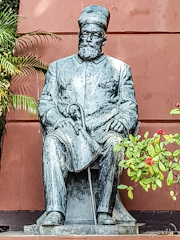
A third statue in the street depicts another eminent Parsi born in Navsari: Jamsetji N Tata (1839-1904). Though not a freedom fighter, he did much to revolutionise industry in India. Starting with the cotton business, he soon became known as “the father of Indian Industry”.

In 1903, Tata opened the now famous Taj Mahal Hotel in Bombay. His successors, members of his family, established the variety of industries now known as the Tata Group. His family also fulfilled his ambition of creating educational institutions in his name with Tata money, for example The Indian Institute of Science in Bangalore.

It is appropriate that the statue of Jamsetji Tata is close to that of other important players in India’s independence movement, Gandhi and Nehru, because Tata was a keen supporter of the Swadeshi movement. That is to say, he encouraged the production of products made in India to reduce or prevent the need to import these same products. In Tata’s case, he set up cotton mills to produce cotton fabrics in India, reducing the need to import them from Manchester.

A plaque at the base of Jamsetji’s statue records that it was unveiled in 1912 by George Clarke (1848-1933), Governor of Bombay between 1907 and 1913. Incidentally, in 1907 he considered Vinayak Savarkar, future Hindu nationalist and father of Hindutva, to have been “one of the most dangerous men that India had ever produced” Clarke was a liberal, but became a supporter of fascism later in life (in the 1930s). I wonder what he thought about the Swadeshi movement as he unveiled the statue.

Madam Cama Road is not very long, yet it commemorates four people who in different ways helped India throw off the yoke of the British Empire.

Islands of worship

IN HYDERABAD, BOMBAY, and Calcutta I have seen mosques or large dargahs (mausoleums) located on islands in the middle of roads. Traffic flows on both sides of the places of worship like river water flowing around a rock.

I mentioned this to my wife, who reminded me that London has at least two churches that stand on islands around which traffic flows. Two of them are on the busy Strand: St Clement Danes and St Mary le Strand. This got me thinking about other places where a place of worship stands in a position that forces traffic to move around it. Only one place springs to mind as I write this. There is a small church in a street leading off Syntagma Square in Athens (Greece) that stands on an island in the middle of a street ( or, at least it did when I last visited the city in 1980).

Why are these places of worship on traffic islands? Maybe, the shrines were built before roads were laid out or perhaps a road was widened leaving the holy places stranded in the middle of the enlarged thoroughfare.

A flight of pigeons

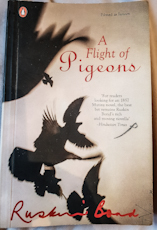
I FOUND MY COPY of “A Flight of Pigeons”, a short novel by Ruskin Bond (born 1934), amongst a collection of books about birds in the gift shop at Sanjay Gandhi National Park just north of Bombay. The book has little or nothing that would be of interest to ornithologists and other nature lovers.

The novel is about some English ladies during the First War of Indian Independence (‘Indian Mutiny’; 1857-58). They are some of the only survivors of an attack by Pathan forces on the town of Shahjahanpur.

The ladies are first given refuge by a Kayasth family, and then by various Pathan families. Having some Indian ancestry and a knowledge of Urdu, these English refugees were more or less successfully accepted into the Muslim Pathan families.

The young daughter, Ruth, becomes the object of the amorous intentions of one of the Pathans, who wants to marry her. Ruth’s mother has to try to prevent this from happening. I will not reveal what happens because I do not want to spoil the enjoyment of the reader of this simply told, compelling short book.

This is the first book I have read by Ruskin Bond. If it is typical of his writing, then I want to read more. Like the Albanian novelist Ismail Kadare, Bond skilfully manages to pack much into his book with great economy of words.

Fashion Street

Some years ago our daughter was in Bombay. She rang us and told us that she was pleased that she was staying within walking distance of Fashion Street.

Imagining that Fashion Street was something like London’s Bond Street or the Rue Faubourg St Honoré in Paris, my heart sank hearing this. Was our daughter going to spend all of her money in Fashion Street, I wondered.

Several months later, I visited Bombay and saw Fashion Street for the first time, and then I realised rapidly that I need not have worried. Fashion Street, unlike Bond Street, is a place to get clothes at very reasonable prices.

Bombay long ago

IN THE TWELFTH CENTURY AD, long before the islands on which Bombay now stands were occupied by the Mughals, then the Portuguese, and then the British, Lakshman Prabhu, a minister in the court of the Sihara Dynasty (8th to 13th centuries AD), built a tank (reservoir) on what is now the elegant residential area known as Malabar Hill. This water body, the Banganga Tank, was rebuilt in 1715 and had been cleaned up recently. Neither my wife nor I had heard of it until a correspondent, Donna Young, suggested we visit it.

The approach road that leads off one of the main roads in Malabar Hill enters an area where on one side of the thoroughfare there are expensive apartment blocks. They face a line of badly built modest homes (slightly better than slum dwellings and some with TV satellite dish aerials) all of which must have great views of the Arabian Sea.

The tank is rectangular in plan and surrounded by steps with wide landings leading down to the water, which enters the pool at one corner at a fast rate of flow. Ducks and geese rest on the steps or swim in the water in the tank.

The tank is surrounded by low buildings, many of which are Hindu temples. Occasional gaps between the buildings have staircases that lead down to the steps surrounding the tank. Some of these gaps are flanked by towers containing many niches for placing diyas (oil lamps). Some of these have become perching places popular with pigeons.

The road running around the tank is the only thoroughfare for the community, mainly Hindus, who live around the tank. This community, though by no means impoverished, is far less prosperous than that which occupies most of Malabar Hill.

Banganga Tank is very picturesque and a complete contrast to its surrounding elegant mansions and apartment blocks built mainly from the 1920s onwards. It is a well preserved early mediaeval environment in the heart of busy, modern Bombay. It should be on tourists’ itineraries, and judging by a group of middle-aged Italian camera toting tourists I saw, I believe it is already.

While I was wandering around exploring, my wife sat on a wall near some parked motorcycles. There were some young men joking amongst each other nearby. One said to another: “You are fourth class fail.” He replied: ”You are second class fail.” At this point, my wife asked if one of the bikes could be moved slightly to give her legs more room. As a third boy shifted the bike, one of the others laughed and said: “Oho, that one is KG fail” (KG is short for kindergarten).

Headquarters of Gandhi in Bombay

MAHATMA GANDHI TRAVELLED much during his life. I have visited several of the places in India, which were important landmarks in his life: Porbandar, Rajkot, Bhavnagar, Ahmedabad, and Bombay. The latter saw much of Gandhi both before and after he had lived, worked, and campaigned in South Africa.

Mani Bhavan, a mansion in Laburnum Road in the Gamdevi district of Bombay, was owned by Revashankar Jagjeevan Jhaveri, a friend of Gandhi. It became Gandhi’s headquarters in Bombay between 1917 and 1934. Now, it is a popular museum dedicated to the history of Gandhi’s eventful life in South Africa, India, and elsewhere.

Most of the exhibits in the Mani Bhavan are photographs, many of which I have seen elsewhere. However, I had never before seen a photo of the Mahatma with his famous admirer Charlie Chaplin. There is also a photograph of the letter that Gandhi wrote to Adolf Hitler on the 27th July 1939, encouraging the German dictator to adopt peaceful methods rather than going to war. The British authorities did not allow this letter to reach Germany, let alone leave India.

There is a room on the second floor in which Gandhi used to spend much time spinning. It contains several of the spinning wheels that he used daily.

On the second floor, there is also a gallery with a series of dioramas, each one illustrating a different episode in the life of Gandhi. One of them shows the future Mahatma being thrown out of a first class railway compartment in Pietermaritzburg Station in Natal, South Africa. Another, shows him at a public burning in Bombay of cloth and clothes imported into India. This occurred in 1921. Gandhi was by no means the first to burn foreign cloth in India. Many years earlier, Vinayak Damodar Savarkar, a father of Hindutva, supervised a bonfire of imported cloth in Nasik.

The well made dioramas reminded me of those I had seen at the Godra Ambe Dham temple complex near Kutch Mandvi. The ones at Ambe Dham are moralistic in content, chronicling the virtues of a healthy Hindu life and the awful consequences of straying from it.

The Mani Bhavan had plenty of foreign visitors, most of whom seemed very interested in what is on display.

Of all the Ghandhian sites I have visited in India so far, the Mani Bhavan has impressed me least. If pressed to say which have impressed and moved me most, I would choose Gandhi’s birthplace in Porbandar, his classroom in what used to be Samaldas College in Bhavnagar, and his first ashram in Ahmedabad, the Kochrab Ashram. Had I not already visited these three places nor seen the superb collection of Ghandian photos in the Gandhi Smrti in Bhavnagar, I think that a visit to the Mani Bhavan would have been more interesting for me than it was. I am pleasrd that I have visited the place because I enjoy following in the footsteps of the life of one of the most intriguing personalities in the history of India, nay the whole world.

However great or small your interest in Gandhi might be, visiting Mani Bhavan brings you to a part of Bombay rich in elegant mansions built by prosperous citizens over 100 years ago.