I HAVE MISLAID my copy of “Noor-un-nisa Inayat Khan” by Jean Overton Fuller (1915 -2009), first published in 1952. Jean was born in England, the only child of an officer in the British Indian Army. She was a friend of the Inayat Khan family, one of whom was Noor-un-nisa Inayat Khan (1914-1944). At the end of WW2, Jean travelled around Europe interviewing people who had been connected with Noor’s activities during WW2.
A few days ago, during a pleasant walk in London’s West End, we stopped near Hyde Park Corner to look at the memorial to those citizens of the Indian subcontinent who had fought for the British Empire during the two World Wars. Part of the memorial is a small pavilion that looks Indian in design. The ceiling of this structure is inscribed with the names of those who were awarded the prestigious George Cross and Victoria Cross awards during the two Wars. We looked up at the names, not expecting to see any that we would recognise, but were both surprised and pleased to see that one of the names is ‘Noor-un-nisa Inayat Khan’, who was awarded the George Cross, posthumously. Noor and her family were not people we knew, but her story was familiar to us.
Noor was born on the first day of 1914 in Moscow, where her father had arrived (from Baroda, now in Gujarat) in 1913 to promote Sufism in the ‘West’. Her father’s family were Muslim nobility, her father’s mother was a descendant of the great Tipu Sultan, who died in 1799, fighting the British. Her mother was an American of European origin. Shortly after Noor’s birth, her family shifted to London, where Noor attended a nursery in Notting Hill. By 1920, the family had moved to Paris. At the outbreak of WW2, the family fled to England, landing at Falmouth in Cornwall.
During WW2, after joining the Women’s Auxiliary Air Force (‘WAAF’), she soon became a member of Special Operations Executive (‘SOE’), where she underwent tough training. Already a trained wireless operator, she had an advantage over other women who were to be ‘courier’s, who worked behind the enemy lines helping to support those resisting the Nazis. Her fluency in French was another advantage that Noor had over many of the other couriers. Also, her appearance was such that it could easily have been considered European.
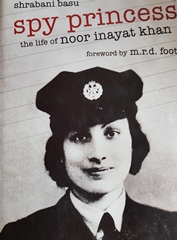
Noor was flown from Britain to Europe on the night of 16th /17th June 1943 and landed in northern France. Her courageous exploits have been well-described in a detailed book by Shrabani Basu, “Spy Princess”, published in 2006. Sadly, her presence in France was betrayed (by one of two Frenchmen), and she was first arrested by the Gestapo on about the 13th of October 1943. After intense interrogation, during which she revealed nothing of use to the Germans and nothing that compromised her comrades, she was shot at dawn in the Dachau concentration camp near Munich in September 1944. In addition to being awarded the George Cross, Noor was also a posthumous recipient of the French Croix-de-Guerre. A commemorative blue plaque on her last home in London, 4 Taviton Street in Bloomsbury, was the first to be put up in honour of a woman of Indian origin.
Michael Richard Daniell (‘MRD’) Foot (1919-2012, the historian and former member of SOE, wrote in his introduction to Basu’s book:
“Holders of the George Cross are out of the common run; Noor Inayat Khan was even farther out of it than most.”
The memorial near Wellington’s triumphal arch at Hyde Park Corner was inaugurated in 2002. In addition to recording Noor’s name, there are over seventy other names of those awarded either the VC or the GC. Many of them have Indian sounding names, such as Noor’s, but a few have names that sound English, such as FC Booth and ECT Wilson. The Indian names suggest a fair mix of Hindu, Muslim, and Sikh recipients of these medals. Of the Indian recipients, or those who have Indian sounding names, of the two honours, the VC and the GC, awarded during WW2, the only one who was involved in behind-the-lines espionage and resistance activities was the young Noor Inayat Khan.
Noor was in favour of Britain giving India her freedom, ending its status as a colony within the British Empire. However, unlike some of the fighters for Indian independence like Subhas Chandra Bose, who favoured an alliance with the enemies of Britain during WW2, she was, to quote Basu:
“… convinced that Indian leaders should not press for independence when Britain had its hands full of fighting the war. She felt that if the Indians backed Britain and won gallantry medals it would create a sense of confidence in them, and the British would readily grant independence to India after the war…”
After WW1, there were 22 Indian recipients of VC and GC, but Britain did not relieve its domination of India. Instead, it began to tighten its grip. Noor and the other awardees of the high honours for bravery as recorded in the monument near Hyde Park Corner demonstrated the gallantry of people from the Indian sub-continent, but I am sure that this was not part of the reason that Britain released its long hold on its prize colonial possession in 1947.
I am sorry that I cannot find my copy of Overton Fuller’s biography of Noor. It is the source of some of the information in Basu’s book, which contains much material that Overton Fuller did not have access to when she wrote her book. When I find it eventually, it will be interesting to compare what the earlier author wrote about Noor with what Basu wrote 54 years later.