Islands of worship

IN HYDERABAD, BOMBAY, and Calcutta I have seen mosques or large dargahs (mausoleums) located on islands in the middle of roads. Traffic flows on both sides of the places of worship like river water flowing around a rock.

I mentioned this to my wife, who reminded me that London has at least two churches that stand on islands around which traffic flows. Two of them are on the busy Strand: St Clement Danes and St Mary le Strand. This got me thinking about other places where a place of worship stands in a position that forces traffic to move around it. Only one place springs to mind as I write this. There is a small church in a street leading off Syntagma Square in Athens (Greece) that stands on an island in the middle of a street ( or, at least it did when I last visited the city in 1980).

Why are these places of worship on traffic islands? Maybe, the shrines were built before roads were laid out or perhaps a road was widened leaving the holy places stranded in the middle of the enlarged thoroughfare.

A flight of pigeons

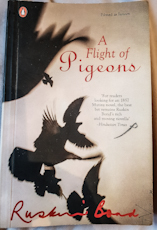
I FOUND MY COPY of “A Flight of Pigeons”, a short novel by Ruskin Bond (born 1934), amongst a collection of books about birds in the gift shop at Sanjay Gandhi National Park just north of Bombay. The book has little or nothing that would be of interest to ornithologists and other nature lovers.

The novel is about some English ladies during the First War of Indian Independence (‘Indian Mutiny’; 1857-58). They are some of the only survivors of an attack by Pathan forces on the town of Shahjahanpur.

The ladies are first given refuge by a Kayasth family, and then by various Pathan families. Having some Indian ancestry and a knowledge of Urdu, these English refugees were more or less successfully accepted into the Muslim Pathan families.

The young daughter, Ruth, becomes the object of the amorous intentions of one of the Pathans, who wants to marry her. Ruth’s mother has to try to prevent this from happening. I will not reveal what happens because I do not want to spoil the enjoyment of the reader of this simply told, compelling short book.

This is the first book I have read by Ruskin Bond. If it is typical of his writing, then I want to read more. Like the Albanian novelist Ismail Kadare, Bond skilfully manages to pack much into his book with great economy of words.

Fashion Street

Some years ago our daughter was in Bombay. She rang us and told us that she was pleased that she was staying within walking distance of Fashion Street.

Imagining that Fashion Street was something like London’s Bond Street or the Rue Faubourg St Honoré in Paris, my heart sank hearing this. Was our daughter going to spend all of her money in Fashion Street, I wondered.

Several months later, I visited Bombay and saw Fashion Street for the first time, and then I realised rapidly that I need not have worried. Fashion Street, unlike Bond Street, is a place to get clothes at very reasonable prices.

Bombay long ago

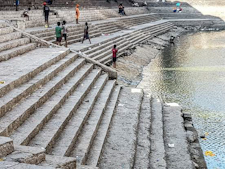
IN THE TWELFTH CENTURY AD, long before the islands on which Bombay now stands were occupied by the Mughals, then the Portuguese, and then the British, Lakshman Prabhu, a minister in the court of the Sihara Dynasty (8th to 13th centuries AD), built a tank (reservoir) on what is now the elegant residential area known as Malabar Hill. This water body, the Banganga Tank, was rebuilt in 1715 and had been cleaned up recently. Neither my wife nor I had heard of it until a correspondent, Donna Young, suggested we visit it.

The approach road that leads off one of the main roads in Malabar Hill enters an area where on one side of the thoroughfare there are expensive apartment blocks. They face a line of badly built modest homes (slightly better than slum dwellings and some with TV satellite dish aerials) all of which must have great views of the Arabian Sea.

The tank is rectangular in plan and surrounded by steps with wide landings leading down to the water, which enters the pool at one corner at a fast rate of flow. Ducks and geese rest on the steps or swim in the water in the tank.

The tank is surrounded by low buildings, many of which are Hindu temples. Occasional gaps between the buildings have staircases that lead down to the steps surrounding the tank. Some of these gaps are flanked by towers containing many niches for placing diyas (oil lamps). Some of these have become perching places popular with pigeons.

The road running around the tank is the only thoroughfare for the community, mainly Hindus, who live around the tank. This community, though by no means impoverished, is far less prosperous than that which occupies most of Malabar Hill.

Banganga Tank is very picturesque and a complete contrast to its surrounding elegant mansions and apartment blocks built mainly from the 1920s onwards. It is a well preserved early mediaeval environment in the heart of busy, modern Bombay. It should be on tourists’ itineraries, and judging by a group of middle-aged Italian camera toting tourists I saw, I believe it is already.

While I was wandering around exploring, my wife sat on a wall near some parked motorcycles. There were some young men joking amongst each other nearby. One said to another: “You are fourth class fail.” He replied: ”You are second class fail.” At this point, my wife asked if one of the bikes could be moved slightly to give her legs more room. As a third boy shifted the bike, one of the others laughed and said: “Oho, that one is KG fail” (KG is short for kindergarten).

Headquarters of Gandhi in Bombay

MAHATMA GANDHI TRAVELLED much during his life. I have visited several of the places in India, which were important landmarks in his life: Porbandar, Rajkot, Bhavnagar, Ahmedabad, and Bombay. The latter saw much of Gandhi both before and after he had lived, worked, and campaigned in South Africa.

Mani Bhavan, a mansion in Laburnum Road in the Gamdevi district of Bombay, was owned by Revashankar Jagjeevan Jhaveri, a friend of Gandhi. It became Gandhi’s headquarters in Bombay between 1917 and 1934. Now, it is a popular museum dedicated to the history of Gandhi’s eventful life in South Africa, India, and elsewhere.

Most of the exhibits in the Mani Bhavan are photographs, many of which I have seen elsewhere. However, I had never before seen a photo of the Mahatma with his famous admirer Charlie Chaplin. There is also a photograph of the letter that Gandhi wrote to Adolf Hitler on the 27th July 1939, encouraging the German dictator to adopt peaceful methods rather than going to war. The British authorities did not allow this letter to reach Germany, let alone leave India.

There is a room on the second floor in which Gandhi used to spend much time spinning. It contains several of the spinning wheels that he used daily.

On the second floor, there is also a gallery with a series of dioramas, each one illustrating a different episode in the life of Gandhi. One of them shows the future Mahatma being thrown out of a first class railway compartment in Pietermaritzburg Station in Natal, South Africa. Another, shows him at a public burning in Bombay of cloth and clothes imported into India. This occurred in 1921. Gandhi was by no means the first to burn foreign cloth in India. Many years earlier, Vinayak Damodar Savarkar, a father of Hindutva, supervised a bonfire of imported cloth in Nasik.

The well made dioramas reminded me of those I had seen at the Godra Ambe Dham temple complex near Kutch Mandvi. The ones at Ambe Dham are moralistic in content, chronicling the virtues of a healthy Hindu life and the awful consequences of straying from it.

The Mani Bhavan had plenty of foreign visitors, most of whom seemed very interested in what is on display.

Of all the Ghandhian sites I have visited in India so far, the Mani Bhavan has impressed me least. If pressed to say which have impressed and moved me most, I would choose Gandhi’s birthplace in Porbandar, his classroom in what used to be Samaldas College in Bhavnagar, and his first ashram in Ahmedabad, the Kochrab Ashram. Had I not already visited these three places nor seen the superb collection of Ghandian photos in the Gandhi Smrti in Bhavnagar, I think that a visit to the Mani Bhavan would have been more interesting for me than it was. I am pleasrd that I have visited the place because I enjoy following in the footsteps of the life of one of the most intriguing personalities in the history of India, nay the whole world.

However great or small your interest in Gandhi might be, visiting Mani Bhavan brings you to a part of Bombay rich in elegant mansions built by prosperous citizens over 100 years ago.

RUDYARD KIPLING IN BOMBAY

KIPLING WAS BORN IN BOMBAY

IN 1857, THE YEAR OF THE FIRST INDIAN War of Independence, the British opened the first school of art in Bombay. It was named the ‘JJ SCHOOL OF ART’ after Sir Jamsethjee Jeejeebhoy, who donated much money towards its establishment.

We were very fortunate that a friend arranged a private tour of the campus for us. It began after we had eaten Yemeni food at the Hotel Stars on Chakala Street near Mohammed Ali Road.

We were shown the workshops and studios, many of which were built at the time of the School’s founding. The standard of work done by the students is high. We visited workshops for printing, textile weaving and printing, sculpture, metalwork, and ceramics. The walls of the largest part of the sculpture department are lined with models of great works by both western and Indian classical sculptors. This large room reminded me of images of how the Royal Academy in London looked long ago. Our guide explained that the JJ was modelled on the Royal College of Art in London.

We ended our tour at a building resembling a large English country house built in the Arts and Crafts Movement style of the late 19th century/early 20th century. This rustic looking edifice, which was built by 1865 long before the Movement flourished, used to be the residence for the deans of the School.

In 1865, Lockwood Kipling(1837-1911) and his new bride arrived in Bombay. Lockwood, an artist who created works in wrought iron, had been appointed Professor of Architectural Sculpture at the JJ. Soon after this, he was appointed Principal of the JJ and took up residence in the house already described. It was in this house that his son, the eminent author Rudyard Kipling(1865-1936), was born. The house is currently being restored beautifully.

The JJ also has a noted School of Architecture. This was founded by the British to train Indians to become architectural draughtsmen rather than architects. Their role was to draught the detailed plans of designs for buildings conceived by British architects. Likewise, the original colonial idea behind the JJ was to train Indians to carry out the ideas formulated by British artists. Today, the JJ no longer trains its students to be technicians to execute the plans of others, but educates them to enhance the creative life of India.

Finally, we learnt that many of the great buildings of British Imperial India were designed by architects in Great Britain, who never ever set foot in India. For example, the Deans’ house, where Rudyard Kipling was born, was built from a plan that was originally drawn up in England for a house that was never built in its intended location. Kipling’s birthplace was built from plans for a caretaker’s lodge for the Viceregal residence in Shimla, which never got built.

Now that I have seen where Rudyard Kipling was born, I feel that it is high tome that I read something he wrote!

A place of refuge

THE ROAD FROM SURAT TO BOMBAY runs through flat terrain with many industrial establishments until it is within a few miles of the border between Gujarat and Maharashtra, a frontier that did not exist before 1960, when the former Bombay State split along linguistic lines into Gujarat and Maharashtra. Beyond the border, the countryside changes suddenly and dramatically, becoming hilly, greener, and much more rustic.

We stopped at Sanjan, a small town near the Arabian Sea and just within Gujarat. In 689 AD, some boatloads of Zoroastrian refugees, fleeing from the Moslems in Iran landed at the, port of Sanjan. The local Indian ruler gave them sanctuary. Thus, began the Parsi community in India.

Sanjan today is a small rather untidy country town surrounded by Arcadian landscape. The modernistic Parsi agiary (fire temple) stands in a walled enclosure at the edge of town close to the Surat to Bombay railway line. It is only open to Parsis.

Close to the agiary and open to the public there is a large enclosure dominated by a tall obelisk surmounted by a gold coloured jar from which gold coloured metal flames are modelled. On three of the four sides of the obelisk there are inscribed plaques: one in an ancient Parsi script (maybe Avestan), another in Gujarati, and the third in English. These notices explain that the obelisk was inaugurated in 1920 by Sir Jamsetji Jeejeebhoy. The column was erected to celebrate the arrival of the first Iranian Zoroastrians at Sanjan and their welcome by the Hindu ruler Jadi Rana.

Next to the obelisk, there is a structure containing a Parsi time capsule placed there in 2000. It contains objects that characterise the past and present of the Indian parsi community. It does not mention when the capsule may be opened.

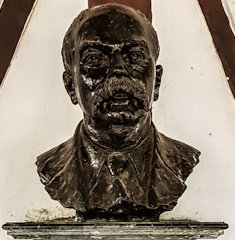
About 50 yards from the monument stands a cluster of buildings. One of them that stands alone is a meeting hall. The other buildings are parts of a hostel (dharamshala) where Parsi pilgrims can stay for 15 rupees per night in simple accommodation. The main room of the hostel contains aging photographs of no doubt eminent Parsis. There is also a bust of Dadabhai Naoroji, one of the founding members of the Indian National Congress.

We left this peaceful flower filled Parsi compound and returned to the National Highway. We stopped for lunch at a roadside restaurant called Atithi (means ‘guest’) and ate a very good mutton dhansak, a Parsi dish containing meat cooked in a gravy rich in dals and spices. We were surprised how excellent it was. A few hours later, we met a Parsi friend in Bombay, who told us that the restaurant is owned by a Parsi.

After crossing the river or large creek near Vasai, which was once a Portuguese possession and port, we entered the region of Greater Bombay. Immediately, the countryside ended and the landscape became urban. We were 70 kilometres from the heart of Bombay. We drove that distance through an uninterrupted built up area containing modern high rise buildings that look over large areas of slums filled with makeshift corrugated iron shacks, most of which have TV satellite dish antennae.

Eventually, we crossed the attractive Rajiv Gandhi Sealink Bridge that connects the suburb of Bandra with the upmarket Worli Seaface. It was not long before we were cruising along Marine Drive, one side of which is the sea and the other a series of buildings that includes many fine examples of Art Deco architecture.

Soon, we became immersed in the social life of Bombay, a tropical version of Manhattan: endlessly fascinating but quite exhausting.

A surprising city

AFTER AN EXCITING DAY exploring Gopipura, an old part of Surat where my wife’s father’s family lived until over 100 years ago, we spent the following day seeing some of the better known historic sights of the city.

The castle on the bank of the River Tapi was built by the Muslim Tughlaq dynasty to defend Surat against attacks by the Bhils. It was later modified by the Mughals, the Dutch, and then the British.

Until the River Tapi silted up, Surat was an important international port city with a very active involvement in import/export activity. The silting up and the British acquisition of what became Bombay led to a decline in Surat’s prosperity. Over the years, its castle gradually fell into great disrepair.

Now, the castle is being painstakingly repaired. About half of it is currently open to visitors. The castle is being reconstructed using materials and techniques that archaeologists have discovered whilst investigating what has been left of the original structure. The result is a brand new version of what was most probably how the castle was before it began to disintegrate.

The rooms inside the castle recreate their original appearanc as deduced from archaeological examination. The rooms house a beautifully displayed collection of items portraying the history of Surat. A magnificent job has been done.

A man at the ticket booth of the castle reccomended downloading an app called “Surat Heritage Walk”, which is a very useful and well designed guide to the historical landmarks of the city.

After viewing the castle from a bridge that crosses the Tapi, which is how trading vessels would have seen it in days of yore, we visited the Christ Church (Church of North India) built in 1824. This simply decorated church has memorials to several Victorians, whi died in Surat.

We drove past the Mughal Sarai constructed in the reign of Shah Jehan. This large building was a hostel where pilgrims travelling between Surat and Mecca could be accommodated. Shah Jehan was first to encourage pilgrims going to Mecca to sail from Surat rather than travel overland or to embark on ships from Persian ports.

The Khudawan Khan Rojo, a mausoleum built in the mid 16th century, is newer than most of the medieval mosques that survive in Ahmedabad but, like them, it is rich in features adopted from Hindu and Jain temple design. The mausoleum contains the grave of its builder, Khudawan Khan, a military commander who was killed while fighting the Portuguese in about 1559/60.

The mausoleum described above is beautiful and impressive, but not ‘over the top’. The mausoleums in the Dutch, Armenian, and English cemeteries, which are close to each other and surrounded by crowded Muslim neighbourhoods, have to be seen to be believed. Many of the mausoleums are flamboyant structures with domes and details suggestive of both the art of India and the orient and also the Greek and Roman empires. These fantastic final resting places of Europeans who became rich in Surat are curiously exotic and ridiculous at the same time. The exuberance of the funerary architecture exceeds that which I have seen in European cemeteries in Calcutta and Fort Cochin. These monuments should not be missed by visitors to Surat.

As we drove between the places described above, we passed numerous old buildings, often in bad states of repair but rich in finely crafted decorative features.

After our tour, we lunched at Shukan, a restaurant that serves vegetarian thalis. As a meat eater I am not usually keen on vegetarian food, but what we were served at Shukan was much to my taste. The chef is a Rajasthani ‘mahraj’ (usually a Brahmin chef). His food was light but well flavoured. Unlike chefs cooking in the Surat traditional way, he used garlic, onions, and crushed peanuts. Yet, his dishes were not sugary as we found in other parts of Gujarat, notably in Ahmedabad and Saurashtra.

Although amongst the larger cities I have visited in Gujarat, Surat has fewer major tourist attractions than others (such as Ahmedabad, Baroda, Junagadh, and Bhuj). However, it has a visually exciting urban texture and vibrancy. The two days we allotted to our first visit to Surat was not long enough. We hope to return for longer in the future.

From revolutionary to saint

On Sunday morning it was Republic Day, the 26th January 2020. The streets in Baroda were quite. Several of the few vehicles we saw carried Indian national flags that fluttered proudly as they sped past us.

It was also quieter than usual at the Sri Aurobindo Nivas, the home where Sri Aurobindo lived while he was an official in the government of the princely state of Baroda and both professor and vice chancellor of what is now Baroda University. Aurobindo lived with his wife, Mrinalini in this house donated by the Gaekwad. After Baroda, Aurobindo and his wife moved to Calcutta. Later, he moved to the French colony of Pondicherry. After he arrived there, his wife followed him but during the journey to join him, she died suddenly of an infection (https://www.boloji.com/articles/13683/mrinalini-sri-aurobindos-forgotten-wife). I have written a bit about Aurobindo in Baroda in my book “Travels through Gujarat, Daman, and Diu” (published in India by pothi.com as “Gujarat Unwrapped). Here is what I wrote:

“Today, Sri Aurobindo is associated with ‘peace and love’ by many people, especially the crowds of Europeans who seek spiritual solace at his ashram in Pondicherry. While Aurobindo was working as a teacher in Baroda in the early 20th century, he was involved in Indian independence movements. Although he espoused peaceful methods, he was not averse to the use of violence. Jyotirmaya Sharma wrote in his book, Hindutva: Exploring the Idea of Hindu Nationalism, wrote: “It was at Baroda that Aurobindo took the first decisive steps into political life … Aurobindo clearly believed in the efficacy of violent revolution and worked towards organizing secret revolutionary activity as a preparatory stage for open revolt and insurrection…” In a biography, Sri Aurobindo for All Ages, its author Nirodbaran, who worked in close contact with the great man for twelve years, wrote: “When we asked him once how he could even conceive of an armed insurrection against the well-equipped British garrisons, he answered: ‘At that time, warfare and weapons had not become so lethal in their effect. Rifles were the main weapons, machine guns were not so effective. India was disarmed, but with foreign help and proper organisation, the difficulty could be overcome; and in view of the vastness of the country and the smallness of the regular British armies, even guerrilla warfare might be effective…”

After a year’s spell in Alipore prison in connection with his alleged involvement with some politically motivated murders in Bengal, Aurobindo settled in Pondicherry, and from then began espousing a spiritual approach to life. While living in that French colony, he continued to contemplate contemporary Indian issues, including that of the relationship between Hindus and Muslims. In late 1909, Aurobindo wrote: “Our ideal therefore is an Indian Nationalism, largely Hindu in its spirit and traditions, because the Hindu made the land and the people and persists, by the greatness of his past, his civilisation and his culture and his invincible virility, in holding it, but wide enough also to include the Moslem and his culture and traditions and absorb them into itself.” Jyotirmaya Sharma wrote: “Savarkar legitimately claimed paternity for the idea of Hindutva; but Hindutva could lay to an equally formidable patrimony in the thought of Dayananda, Vivekananda, and Aurobindo. What binds these four thinkers together is the systematic marshalling of a Hindu identity in the service of Indian nationalism.” Sharma quotes the following passage, written in 1923, from Aurobindo’s India’s Rebirth (a collection of writings): “It is no use ignoring facts; some day the Hindus may have to fight the Muslims and they must prepare for it. Hindu-Muslim unity should not mean the subjection of the Hindus. Every time the mildness of the Hindus has given way. The best solution would be to allow the Hindus to organize themselves and the Hindu-Muslim unity would take care of itself, it would automatically solve the problem.” And, in 1934, Aurobindo wrote: “As for the Hindu-Muslim affair, I saw no reason why the greatness of India’s past or her spirituality should be thrown into the waste paper basket in order to conciliate the Muslims who would not at all be conciliated by such a stupidity.”

The Sri Aurobindo Nivas, where Aurobindo lived until 1906 while he was an esteemed teacher and state official in Baroda, is a two-storey grand, mainly brick bungalow with European-style wooden window shutters. In 1971, the Government of Gujarat handed it over to Baroda’s Sri Aurobindo Society, which promotes the peaceful aspects of Aurobindo’s teachings and philosophy. The house is surrounded by a well-maintained garden. This contains an outdoor stone shrine, a flat marble table with a bas-relief of a lotus flower in its centre. The lotus was surrounded by a flower arrangement consisting of a circle surrounding a six-pointed star. The star with centrally enclosed lotus is a symbol of Sri Aurobindo, whereas the circle is the symbol of his spiritual partner, the Mother, who settled in Pondicherry in 1920. She was born Mira Alfassa (1878-1973) in Paris, of Turkish and Egyptian Jewish parentage. She became the founder of Aurobindo’s ashram in Pondicherry.

The ground floor of this typical colonial-style bungalow contains offices and a library, which was full of people reading at tables. The upper floor has carpeted rooms decorated with relics and portraits of Sri Aurobindo and the Mother. These two people are often depicted in their old age, but here at Aurobindo Nivas we saw a couple of portraits, hung side-by-side, showing both as young people. The rooms on the upper floor are used for silent meditation. People sit cross-legged on the floor and occasionally prostrate themselves, their foreheads touching the floor. Also, they stand up and touch the paintings and photographs of Aurobindo and the Mother in the same way as Hindu worshippers touch idols in temples.

There is a large well-tended lawn behind the bungalow. About twenty-five people were sitting on the grass on rugs, meditating and doing yoga. They were facing a boundary wall on which there is a large outline map of India as it was before Partition in 1947 (including what is now Pakistan and Bangladesh). In the centre of what is now India, there is the circular symbol of the Mother.”

(end of extract).

After spending a pleasant hour in Aurobindo’s former residence, we took refreshments including south Indian filter coffee and dahi vada in the nearby three storey Canara Coffee House (founded 1950). Then we continued our exploration of the Sursagar Lake and looked for picturesque old buildings in the city. Many of the older structures, mostly residential usage, are rich in finely carved wooden decorative features.

By the time we had seen sufficient, the temperature was approaching 30 degrees Celsius – a contrast to the near zero conditions we had encountered earlier on our trip in places like Darjeeling and Mount Abu.

TRAVELS THROUGH GUJARAT DAMAN AND DIU is available from Amazon, lulu.com, and Bookdepository.com

GUJARAT UNWRAPPED , an Indian edition of the above is available from pothi.com (only in India)

Lost property

When we visited the museum at the Harrapan archeological site at Dholavira in Kutch (part of Gujarat, India), we found that there was a sale of guides to various historical sited in India, all published by the Archaeological Survey of India. With the exception of a couple of volumes that were printed in Hindi, we bought one of each, about 18 in all and at radically reduced prices.

After a couple of days in Dholavira, staying at the very overpriced Rann Resort, we travelled to Bhuj, where we stayed before taking a bus to Ahmedabad.

The air conditioned bus, which was not particularly comfortable, took eight hours. It was a part of the fleet of Gujarat State Road Transport (GSRTC). I was very tired when we pulled into the central bus station at Geetamandir in Ahmedabad, and disembarked with our several pieces of luggage.

Several hours later when we were comfortably settled into our hotel, I realised that I had left my cloth bag, containing my collection of books acquired in Dholavira, on the bus. My wife, who is fluent in the Gujarati language, suggested that we return to the bus station to try to recover the bag of books. I agreed, but felt that there was little chance of success.

We were directed to a booth where GSRTC officials in charge of controlling the bus service to and from Bhuj sat. My wife explained the problem and immediately the official began tapping on his keyboard. A screen marked “journey report” appeared. From this, the official was able to get the telephone number of the conductor who had been on our bus. He was off duty and our bus was on its way back to Bhuj. However, he provided the phone number of his colleague, ‘X’, who was now the conductor on ‘our’ bus that was returning to Bhuj.

We rang X, who soon found the book bag on the luggage rack close to where we had been sitting. He told my wife, in Gujarati, that he would be retutning on a bus that would arrive at Ahmedabad central bus station at about 5 pm the next day, and would bring us the bag of books. This sounded promising, but you never can tell what might or might not happen.

As we were setting off for the bus station the next afternoon, X rang us to tell us when he expected to reach it and where we should wait for him. At a few minutes before 5 pm, the bus on which we had travelled the day before pulled into the Geetamandir bus station. Soon X was walking towards us, holding our cloth bag filled with books. My admiration of GSRTC increased immensely.

We offered X some confectionery as a small token of our gratitude. He refused it twice, saying that recovering lost property is part of his duty. When we said that he should give the gift to his family, he accepted it.

Often Asian folk traditionally refuse an offer two or three times out of politeness before accepting. In the case of conductor X, I do not believe it was politeness that he did not accept our small gift immediately. Instead, he was behaving professionally and correctly.

A few hours earlier, we had been shown various interesting features by a guardian in the Jumma Masjid in Ahmedabad. When he had finished, we handed him some Rupees, expecting that he was probably poorly paid, if at all. We were most impressed when he refused the money, which would have been useful for him, and, instead, showed us which charity collection box in which to put it. Like X, the bus conductor, this fellow in the Masjid was too dignified to accept a tip for what he felt it was his duty to do.

Postscript.
The Asian habit of refusing three times can backfire when practised in Europe. A friend of ours of Middle Eastern upbringing became a junior doctor in an English hospital. After a few weeks, he asked an Egyptian colleague how to obtain a cup of tea.
“Simple,” the Egyptian said, “just get it from the lady who pushes the tea trolley around.”
Our friend replied: “Yes, she brings her trolley to me and she offers me a cup and I refuse. And then without even asking me a second or third time, she pushes the trolley away. So, I don’t get a cup of tea.”