Puppies feeding
Mother is vigilant:
A fine family portrait

Puppies feeding
Mother is vigilant:
A fine family portrait

IT WAS ONLY WHEN WE left our accommodation at Dholavira and headed east onto the causeway which connects Khadir Bet to the rest of Kutch (part of Gujarat) that we saw a truly white part of the White Rann (desert). Until then, we had seen small patches of salt crystallising on the surface of what had once been the seabed, an inlet of the Arabian Sea, before seismic activity rendered the sea into a desert.
As we drove across the causeway, we passed larges patches of what looks like freshly fallen snow. This is the salt that has crystallized after the evaporation of rain, which has fallen on the salt laden terrain. The layer of salt looked to be at least an inch or two deep. What we saw is what gives the White Rann its name. It is a truly white desert. We were also fortunate to spot three flamingos searching in a pool of water that had not yet evaporated. They were silhouetted against the morning sunshine.
After crossing the causeway, we drove for several hours towards the outskirts of Bhuj. We stopped for refreshments at Rapar, which looks like an Indian version of a small town in an American cowboy film. A woman in colourful traditional garb disembarked from a motor scooter on which she had been travelling with her husband and son. A cow wandered past her before she crossed the road with her son. A stray dog took a great interest in various used packages I threw in a bin, and then ran off.
At another stop, I drank tea from a saucer as the locals do. By pouring the tea into a saucer, the surface area of the liquid increases and the drink cools quicker than if it is in a cup.
At Bhuj, we headed north on a road that eventually ends abruptly at India’s border with Pakistan. At first, we drove across part of the Great Rann of Kutch. This is a very flat sandy area with sparse scrubby vegetation but no trees. We passed herds of buffaloes grazing in this arid area. Unlike the White Rann, the Great Rann is mostly sand coloured although I did spot occasional salty patches that looked like very light ground frost. The Great Rann is classed as a desert but it is home to a few industrial plants.
Somewhere along the long straight road crossing the Great Rann heading northwards, we passed a sign indicating we had crossed the Tropic of Cancer.
At the tiny village of Bhirindiyara, famed for its fine mawa. This is milk boiled slowly for about four hours and then mixed with sugar. It is a sweet paste faintly resembling vanilla fudge or caramel…delicious but probably not too healthy!
We left the main road leading towards Pakistan and began climbing towards the Black Hills of Kutch. We reached a sign that announced that we had arrived at the “Magnetic Field Area”. Our driver explained that here thrre is a magnetic field strong enough to drag a car. To demonstrate this, he turned off the engine, leaving the gear in neutral. Amazingly, our car began moving uphill without the engine.
We continued on our way into the Black Hills of Kutch, driving through a moonlike, rocky landscape. We drove up a series hairpin bends to Kala Dungar, the highest place in Kutch, 458 metres above the Rann.
The road between Bhuj and the side road to Kala Dungar is the main route to the largest part of the White Rann, where the annual White Rann Utsav (festival) is held in January and February. A huge tent encampment is set up on the salt covered desert and a fairground atmosphere reigns. The Utsav attracts many tourists, both Indian and foreign.
It is interesting to contrast the road from Bhuj to the Utsav with that from Bhuj to Dholavira. The former is highly developed for the large influx of tourists. Unlike many other roads in Gujarat, the one leading to the Utsav has many signs in English and is lined with resorts designed to appeal to visitors. In contrast, the road from Bhuj to Dholavira is like a route into the back of beyond. Apart from a few low-key tourist oriented enterprises near Dholavira, the road from Bhuj to Dholavira makes no concessions to attract tourists. Dholavira, unlike other parts of the White Rann, feels far away from the rest of the world and its few inducements to get tourists to part with money seem charmingly naive. However, in a year or two this is likely to change.
The change will follow the completion of a new road from Bhuj to Dholavira. Unlike the existing road that passes through Bhachau and Rapar, the new road will pass close to Kala Dungar and cross the great Lake of Kutch to Dholavirs on a new causeway. This will shorten the journey time between Bhuj and Dholavira from its present four and a half hours to about an hour and a half. The present remoteness of Dholavira, which is part of its charm, will be lost forever. The area will become much more easily accessible to tourists, and no doubt this will be beneficial for the prosperity of the locals. From a selfish point of view I am pleased that I visited Dholavira before the greater influx of visitors that will surely follow the completion of the new road.
We arrived at our hotel in the bazaar in the old city centre of Bhuj after sunset. After a couple of days in rustic Dholavira and several days in the countryside near Mandvi, the small city of Bhuj seemed to us to feel like a large metropolis.

THE WHITE RANN (desert) is so named because of the layer of white salt crystals that forms on its surface in dry weather. The salt forms when salty water covering the salt flats in Kutch evaporates. We arrived in the area of the White Rann a few days after a downfall of rain. Rain dissolves the salt and the whiteness of the Rann disappears.
One afternoon, I walked across the salt flats behind our hotel. The water on the distant lake shimmered in the bright sunshine. The flat Rann across which I was strolling was greyish yellow with occasional patches of white. The surface of the drying salt was crunchy underfoot and sparkled as the crystals reflected the sun light.
There was no one in sight, no birds or other creatures. There was no sound apart from a gentle warm breeze that was drying the salt covered surface of the completely flat Rann.
By now you might be wondering where all of this salt comes from. A long, long time ago, an inlet of the Arabian Sea separated what is now Kutch from what is now Sindh (in Pakistan). After some seismic activity, the sea bed of the inlet was transformed into a barren desert, the Rann of Kutch. During rainy season, water collects in lakes in the Rann. Salt from the former sea bed dissolves in the water. When this water evaporates in the dry seasons, the salt is precipitated on the shore when the waters recede.
In a couple of days time, the Rann will be snow white again providing there is no more rain.

WHEN I WAS A SMALL CHILD, I used to be taken to see the small menagerie at Golders Hill Park in Northwest London. In addition to wallabies and deer, there used to be, and it is probably still in existence, an enclosure containing a few flamingos. Until a recent visit to Mandvi in Kutch (Gujarat, India), these were the only flamingos I can recall seeing.
Every year, flamingos migrate to Kutch during the winter months to escape from the cold that affects their summer habitats during winter. They might fly in from central Asia, or from parts of India that get particularly cold in winter.
We were keen to see these flamingos in Kutch. A keen bird watcher, who lives in Baroda, told us that flamingos had been sighted at Modhva beach, a few miles east of Kutch Mandvi.
We drove to Modhva beach, arriving there about twenty minutes before sunset. At first, the only birds we could see were seagulls. There were no flamingos to be seen. We asked some local fishermen about them. They pointed at the sea.
Our driver, who must have keen eyesight, pointed at some specks on the surface of sea, maybe more than one hundred yards from the water’s edge. Using the twenty times optical zoom on my digital camera, I could see quite clearly that the specks were flamingos with pink and white plumage.
I managed to take a few photographs before the sun sunk rapidly below the horizon. I had seen flamingos in the wild for the first time in my life. It was an exciting experience.

Are two heads
Better than only one
If you are a tiny squirrel?

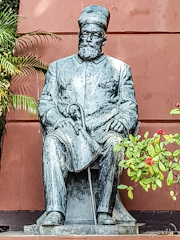
GUJARAT IS THE BIRTHPLACE of several great politicians of India: Mahatma Gandhi, Vallabhbhai Patel, Morarji Desai, and Narendra Modi, to name but a few. Kutch, which until soon after 1947 was an independent princely state, is now part of the State of Gujarat. It was the birthplace of an important, but now largely forgotten, ‘father’ of Indian Independence, Shyamji Krishnavarma (1857-1930).
The house in which Shyamji was born is the heart of the jumble of narrow streets in the old centre of Kutch Mandvi. Unlike the large house in Porbandar where Gandhi was born Shyamji’s birthplace is a very modest dwelling. Shyamji was the son of a poor man, who spent his working life struggling to make a living in Bombay.
We were shown around Shyamji’s birth house by Hriji Karani, who has not only founded a fine school in Mandvi but also instigated the creation of a monument to Shyamji at Kranthi Teerth.
The birthplace is now a museum, which is looked after by an elderly lady. In addition to caring fir the museum she helps her grandson and some of his friends with their schoolwork. Her grandson, aged only three, was able to speak a few words pf English as well as draw the Roman numerals on his slate.
The birthplace is devoid of household effects. Their pace is taken with exhibits, mainly photographs and paintings, relating to Shyamji’s fascinating life. Amongst the photos, there is one of the Middlesex Land Registry document relating to Shyamji’s purchase of a property in London’s Highgate, the building that was known as ‘India House’ between 1905 and 1910. This was the house where Shyamji and his ‘disciples’ including VD Savarkar plotted the downfall of the British in India. There was also a photograph of the block of flats in Geneva on which Shyamji spent the last few years of his life.
Shyamji and his wife died in Geneva. In his will, he had stipulated that his ashes were to remain in Switzerland and not to return to India until the land of his birth, India, became independent of the British.
Although India became independent, free of British domination, in 1947, it was not until 2003 that the ashes of Mr and Mrs Krishnavarma were brought to India. They were collected from Geneva by Narendra Modi, then the Chief Minister of Gujarat, and brought to India. I knew that from 2010, the black marble casks containing the ashes were put on display in a specially built pavilion at Kranthi Teerth, but I had no idea where they were kept before that.
Mr Karani showed us the small room in the birth house where the ashes were kept from 2003 until 2010. This little chamber, like the inner sanctum of a Hindu temple, now contains several photographs and a reproduction of an early flag designed for India by Shyamji’s feisty revolutionary colleague Madame Bhikaiji Cama and VD Savarkar during the brief existence of India House in north London.
A large oil painting depicts Shyamji with Henry Hyndman (1842- 1921), the British socialist whose anti-colonialist ideas strongly influenced Shyamji and his followers. Hyndman delivered a speech at the opening of India House in 1905. In the background of the painting there is a portrait of BG Tilak (1865-1929), one of the most revolutionary of the earliest members of the Indian National Congress and can well described as ‘the father of Indian independence’.
Like many other traditional houses I have visited in Kutch and Gujarat, the wooden staircase leading to the upper storey is incredibly steep, almost a ladder. The upper storey of Shyamji’s birthplace was a single room with more photographs and a tiny balcony that provides a view of backs of the houses on the street below.
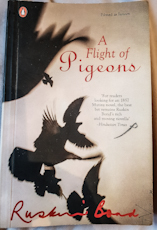
Shyamji left Mandvi to study in Bhuj and then Bombay before setting off for England where he became a barrister in London and a world expert in Sanskrit based at Oxford. It is unlikely that he visited Mandvi much after beginning his impressive career. I have described the remarkable life of this son of Mandvi and esrly advocate of Indian independence in my book, “IDEAS, BOMBS, and BULLETS”
Although I knew that Shyamji was born in Mandvi in a far from well off family, and I had already visited the town once before, seeing his actual birthplace, viewing its surroundings, and entering his childhood home helped me appreciate the ‘rags to riches’ aspect of his life.
IDEAS BOMBS AND BULLETS by Adam Yamey describes the life of Shyamji Krishnavarma and the centre for Indian freedom fighters that he created in North London. It is available from:
Lulu.com
Amazon
Bookdepository.com
Pothi.com (best place to purchase it if in India)
Kindle

Flying high can be fun
But remember, Icarus:
Keep away from the sun
Picture taken at Mandvi Beach in Kutch, Gujarat (western India)

TWO YEARS AGO, we first visited Kranthi Teerth close to Mandvi in Kutch, once an independent kingdom and now a part of the Indian state of Gujarat. Kranthi Teerth is a memorial to Shyamji Krishnavarma (1857-1930) who was born in Mandvi. A brilliant Sanskrit scholar and a barrister, Shyamji became disillusioned with the British and by 1905 was advocating that India should become completely independent of the British Empire.
In 1905, Shyamji bought a large house in Highgate (North London). He converted this into a centre and hostel for Indians studying in London, a place where they could eat Indian food, meet fellow countrymen, and discuss affairs related to India. He called the place ‘India House’. The house still exists in Highgate but is now divided into flats.
Shyamji’s India House in Highate, not to be confused with the building with the same name in the Aldwych, rapidly became a centre for anti-British, anti-colonial activity until its demise by the end of 1909.
In 2009/10, a monument was created near Mandvi to commemorate the long forgotten pioneer of the Indian independence movement, Shyamji Krishnavarma. The monument includes a life size replica of the house in Highgate, which was once ‘India House’. The interior of the replica makes no attempt to copy whatever was inside India House back in the time of Shyamji. Instead, it contains portraits of numerous freedom fighters including some of those who either visited or lived in the house in Highgate when it existed as India House. There is also a collection of portraits of some of the heroes of the Great Rebellion, or First War of Indian Independence, that occurred between 1857 and ’58. One might question one or two omissions amongst the portraits (eg Jawaharlal Nehru and Gokhale), but there is a large selection of freedom fighters remembered here. Apart from the feisty Madame Bhikaiji Cama and Shyamji’s wife Bhanumati, there are no other ladies commemorated.
When I first saw the replica at Kranthi Teerth, which looks very incongruous standing tall in the flat sandy semi desert landscape, I became fascinated by its history. When we returned to London, I began researching the story of India House and its exciting contribution to the independence of India. Last year, I published a book about it: “Ideas, Bombs, and Bullets”. The title encapsulates what happened in India House: ideas were discussed; experiments in bomb making were undertaken; and guns were packed ready to be smuggled into British India.
It was interesting to revisit the portraits on display in the replica of India House after having researched my book. At our first visit, most of the persons portrayed meant nothing to me. However, seeing them again, having learnt about them while writing my book, felt rather like meeting old friends!
Yesterday, we revisited Kranthi Teerth and met Hriji Karali, whose ideas led to Narendra Modi’s encouragement of its construction. I presented the senior officials at Kranthi Teerth with a copy of my book. They appeared to be very pleased because until then they had not seen anything in English about Kranthi Teerth and the person it commemorates. My wife and I were given a warm welcome.
Apart from the replica of house in Highgate, there is a simple but spacious gallery where the irns carrying the ashes of Shyamji and his wife are reverentially displayed. These were brought to India from Geneva, where Mr and Mrs Krishnavarma died in the 1930s, by Narendra Modi in 2003 while he was Chief Minister of Gujarat.
I always enjoy visiting places more than once because each successive visit I discover more about them and thereby appreciate them with greater keenness. This was certainly true of our second visit to Kranthi Teerth.
“Ideas, Bombs, and Bullets” by Adam Yamey is available from:
Lulu.com
Pothi.com (best for purchasers in India)
Amazon
Bookdepository.com
Kindle
Picture shows setting of the replica of India House at Kranthi Teerth
With her two horns
She ambles along the busy road
Mindless of traffic


WE SHOULD NEVER have booked to travel on the 945 am Gujarat State Road Transport Company’s (GSRTC) bus from Ahmedabad to Mandvi in Kutch. The distance between the two towns is about 390 kilometres. According to Google maps, the journey should take seven hours by car. Allowing for stops en-route, a bus should take no more than an hour longer. The 945 bus from Ahmedabad took eleven and a quarter hours, with no more than a total of an hour stoppng at various bus stations along the way. Why, you may wonder, did our bus take so long despite the fact that we encountered no traffic traffic congestion at all and we were not involved in any accidents.
The first three hours of the journey, our bus travelled through small towns in the great plain of Gujarat that were far from the direct and shortest route. Many of these places, such as Lakhatar and Surendranagar contain stretches of largely intact historic city walls. After visiting these places in what was effectively a huge detour, we rejoined the direct highway at Dhranghadra. We had travelled a little under 100 kilometres from Ahmedabad in three hours.
At Surendranagar, the driver and conductor left the bus and were replaced by a new crew. The new driver spent more time chatting to the conductor who was sitting to his left and behind him. Most of the time, the driver had his head turned away from the road to see the conductor. He would take frequent brief glances at the road ahead in between his lengthier glances at the conductor. Despite this seeming lack of concentration on the road, he drove well, something that cannot be said of many of the other road users. Some of the overtaking I observed was just short of suicidal.
For a while, we drove along the very good 6 lane highway barely making any stops to pick up or drop off passengers. We had a ten minute break near Halvad, just long enough to buy some snacks and to use the toilets.
Soon after re-joining the motorway, the bus, which was moving quite fast, was overtaken by a Royal Enfield motorcycle. It was being driven by a young man and a largish lady was sitting side saddle behind him. The cyclist was sounding his horn repeatedly, more than necessary, and the lady was smiling sweetly at our bus. I thought that she was just having fun, but as the bike passed the front of our bus, it swerved in front of it. The bus slowed down and stopped and the smiling lady climbed on board and purchased a ticket. She told us that she had seen our bus leaving from Halvad and chased after it unsuccessfully. The young man had offered to take her on his bike and then chase after the bus that he wanted to catch.
We crossed over the Surajbari river bridge, and entered the former kingdom of Kutch, now part of the State of Gujarat. For several kilometres we drove through an estuarine area with acres of saltpans punctuated by tall white pyramids of freshly harvested sea salt. This area is one of India’s most important salt producers.
The highway, from which, amazingly, we had not yet deviated, was heavily used by large trucks. The flat countryside was filled with industrial plants, some quite large with chimneys belching clouds of smoke which were stirred up into interesting shapes by the strong prevailing wind.
As the sun began sinking into the hazy (polluted?) sky on the western horizon, we pulled into Gandidham. This city, established just after 1947, is built on land donated by the Maharao of Kutch, the last ruler of the Princely State of Kutch. The city became home to many Sindhi Hindus who had fled during the Partition from nearby Sindh when it became incorporated into the newly formed Pakistan. Gandidham is not far from the port of Kandla, about which you can learn much more from my book “Travels through Gujarat, Daman and Diu” (published in India by pothi.com as “Gujarat Unwrapped”). I guessed that the heavy truck presence was because of the industrialisation of this part of Kutch and activities at Kandla.
It was at Kandla where we received information that made our hearts sink. The conductor told us that from Gandidham onwards, it was going to take us another three hours to reach Mandvi. Instead of taking a direct route, our bus had to visit numerous villages to drop off and pick up passengers. He explained that being a state run bus, this service is like a lifeline; it is almost the only way that people could travel between these places by public transport. We trundled through the darkness, stopping here and there. I felt sorry for the driver because many other road users travel along the unlit country roads either without lights or with only dim front lights switched on. Of course, cattle and other animals, who routinely share the road with human traffic, are completely without lighting.
All along our route, we saw animals on the road. Cattle and goats are routinely herded along or across roads of all sorts, even the high speed six lane highways. If my knowledge of ornithology was less rudimentary, I would have been able to describe the rich variety of birds that we saw along our route.
In the road lit up by the lights on our bus, I saw a dog which was lying dead at the side of the road. Another dog, maybe a companion of the dead one, was standing close by looking at it sadly or maybe disbelievingly. It was a tragic sight.
Some weeks earlier we were on a car in Hyderabad when I noticed that drivers were making sudden manoeuvres to avoid something lying in the middle of the road. It was a cat that had been knocked down. Lying on its side, its legs were moving frantically in the air as if it were trying to run away. This fleeting image of an animal in the throes of death affected me greatly. I can still see that poor creature in my mind’s eye.
Eventually, we crossed the River Rukmavati and drove along the riverside next to substantial remains of the impressive wall that used to surround the city of Mandvi. We disembarked at the almost deserted modern bus station. While we waited for the car that was going to collect us, a cow wandered past us investigating bits of rubbish on the floor, hoping to find something worth eating.
Though tiring and exceptionally lengthy, our bus journey through the flat countryside between Ahmedabad and Mandvi was far from dull. Our fellow passengers ranged from westernized Gujaratis in European style clothing to rustic looking folk: women wearing saris and salwar kameez, and men attired in very baggy trousers that resembled dhotis and turbans or headscarves. Mobile phones kept ringing and there were many loud conversations. Outside the bus, we saw many vignettes of small town and village life through the filthy windows of our trusty bus.
Next time we visit Kutch from Ahmedabad, we will follow the advice of our GSRTC bus conductor:
“Go by private bus”.