Little Nell and the British Empire

Here’s poor lil’ Nell

  With a fresh fish under each arm

Crazed, scarred, and cracking

CAN YOU BELIEVE that although we have walked through London’s Hyde Park so many times (in order to take exercise as is recommended by our great leader, a biographer of Winston Churchill, and his government) that there are still many things in it for us to discover? Walking in the southwest corner of the park recently, we saw four man-made items that caught our interest.

An octagonal Victorian bandstand, which was built in 1869 and stood in Kensington Gardens, was moved to its current location in Hyde Park not far from Hyde Park Corner in 1886 (www.royalparks.org.uk/parks/hyde-park/). It is said that this bandstand has good acoustics; I have yet to hear music played here. In the 1890s, concerts were held at the bandstand three times a week. Currently, in normal times, that is when there is no pandemic, the bandstand is used occasionally for concerts and other events as well as becoming part of the annual Winter Wonderland fairground held in Hyde Park.

The bandstand, which was/is often used by military bands, is about 100 feet northwest of a black coloured bronze equestrian statue depicting St George slaying a mammoth dragon. Its coiled, scale covered body, my wife considered accurately, resembles a haphazard pile of discarded lorry tyres. The stone base is surrounded by a frieze depicting cavalrymen in action. The equestrian sculpture stands in front of a low wall which bears the names of cavalry regiments involved in WW1. The monument, though erected before WW2, also those involved those:

“… in the war / 1939-1945 / and on active service thereafter.”

The monument, The Cavalry Memorial, which used to stand nearer Park Lane was unveiled in 1924 by Field Marshal, The Earl of Ypres (formerly Sir John French; 1852-1925) and the Prince of Wales (the future Edward VIII, who reigned for 11 month). The knight on the horse was modelled on:

“…a 1454 effigy of the Earl of Warwick, mounted on horseback holding an uplifted sword, and the horse on a C15 century engraving by Albrecht Dürer.” (https://historicengland.org.uk/listing/the-list/list-entry/1278118).

The sculptor was Captain Adrian Jones (1845-1938). Jones was an army veterinary surgeon between 1867 and 1890. He took up painting and sculpting after he retired, specialising in depicting animals. His best-known work, created in 1912, is not far from the cavalry monument: it is the Quadriga that adorns the top of the Wellington Arch at Hyde Park Corner.

The cavalry monument is a mere 200 yards north by north-east of a modest memorial to a fairly recent tragedy that stands beside the South Carriage Drive. It remembers the eleven soldiers who were killed by a bomb planted by IRA terrorists near this spot on the 20th of July 1982.

Returning to a path that leads north from a spot between the Cavalry Memorial and the bandstand, you will quickly reach a small art-nouveau structure. Formerly a fountain, this is a depiction of an almost naked girl wearing a hat and holding a fish under each of her arms. We asked a gardener working nearby if he knew anything about this curious garden sculpture. He informed us that it was a sculpture of Little Nell, a character in “The Old Curiosity Shop” by Charles Dickens and that it used to stand in Hyde Park’s Rose Garden.

The sculpture, created by William Robert Colton (1867-1921) has been variously known as the ‘Memorial Fountain’, ‘The Mermaid Fountain’, ‘The Colton Memorial’, and, much later, as ‘Little Nell’ (www.victorianweb.org/sculpture/colton/7.html). It is not clear why Colton’s sculpture should be associated with Dicken’s character, Nell.  What we see today is a concrete cast of the original that was made in 1897. It looks as if it could do with a lot of tender love and care as it seems to be crazed, cracked and scarred.

Colton created various public sculptures in London, but his work is found further afield. I read (www.speel.me.uk/sculpt/coltonwr.htm) that:

“Important in his career was a series of Indian portraits in the mid-1900s, including statues and busts of the Maharajah of Mysore and the Dewan of Mysore, and a monument to J. Tata, including allegorical figures, for Bombay.”

I have probably seen some of his Indian works both in Mysore and Bangalore but took little notice of them. A website (http://mysore.ind.in/chamaraja-circle) extolling the virtues of Mysore reveals:

“The French born celebrated sculptor of the time, William Robert Colton was commissioned to execute a statue in memorial of the maharaja. He is the same sculptor who executed many famous sculpture in India including the statue of Sir K Seshadri Iyer, at Cubbon Park in Bangalore, who was the Dewan of Mysore State from 1883 to 1901. Also the 8 bronze tigers of Mysore Palace too are the works of Colton.

He spend[sic] some three months in Mysore during 1912 for the preliminary study for making the statue of Chamaraja Wodeyar. The statue was executed in white Italian marble in England … In the statue the maharaja is portrayed in standing posture in military uniform.

Though Colton was famous for executing lifelike sculptures, one glitch was the in the appearance of the face of the maharaja. There was not much resemblance between face of the maharaja and the face of the statue. When the statue finally arrived in Mysore in 1918, the queen the late maharaja Chamaraja Wodeyar was not happy with this aspect.”

Colton, whose father was an architect, was born in Paris, but was taken to England when he was three years old. He studied art first at the Lambeth School of Art and then at the Royal Academy.

Three of the items, which I have described, have connections with Britain’s former empire. Some of the cavalrymen remembered on the Cavalry Memorial, fought in not only in WW1 but also in Egypt, South Africa, and British India. Several major cavalry units were based in India and included soldiers of Indian origin. The other item with an association with part of the former British Empire is the small lady with two fishes, created by an artist who has sculpted some notable Indians. The bandstand near these two park features is typically Victorian and octagonal, and not markedly different in appearance from one that stands in Cubbon Park in Bangalore (India). And all of these are but a few minutes leisurely stroll from Apsley house, the former home of Arthur Wellesley (1769-1852), who fought in India in the late 18th century.

Spectacles and Mahatma Gandhi

MANY PEOPLE REGRET having to wear spectacles. I am not a part of that crowd.

When I went to school and university, my eyesight was so good that I did not need to consider wearing glasses. However, many of my fellow pupils were not born with such satisfactory vision and were forced to wear spectacles. I felt that those who wore glasses looked far more intelligent than those who did not. I do not know when and from whom I got that rather ridiculous idea. My parents did not wear glasses until they were about 45 years old, by which time I was in my early teenage. Yet, I knew they were both intelligent long before they discovered that they were having to hold their newspapers and books ever increasingly further from their eyes before they finally resorted to wearing spectacles.

I qualified as a dentist in 1982 without needing to wear glasses apart from safety goggles whilst drilling teeth at the dental school. About three years later, I decided it would be a good idea to protect my eyes whilst treating my patients. Instead of goggles such as handymen (and handywomen) use, I decided to ask an optician to make me a pair of ‘specs’ with tough plain lenses. I was extremely pleased with my spectacles. Wearing them, I looked in the mirror and immediately felt more intelligent, however ridiculous this might sound.

As I approached my mid-forties, the plain lenses needed to be replaced with prescription lenses as my eyesight was no longer what it had been. After a year or so, I began noticing two things. First, at night I was seeing three red traffic lights where there was only one. Secondly, when sitting far away from the stage in a theatre, I could hear what was being said or sung but the performers on the stage were barely distinguishable from one another. Watching a play was a bit like watching from afar insects moving about. Enter my new pair of long-distance ‘specs’ and these problems were resolved. But now I had two carry around two pairs of glasses: one for reading and the other for seeing afar. The solution was to try bifocals, which I have grown to like.

My first pair of spectacles was made by an optician’s firm in Kent, near where I worked. Since then, I have had several pairs made extremely competently in Bangalore, India. Most of my Indian ‘specs’ have been made by a company called Lawrence and Mayo (‘L&M’), which has several branches in the city. We favour the branch that used to be on Mahatma Gandhi (‘MG’) Road, but has, since the construction of Bangalore’s metro train system, been located nearby in Barton Tower, which overlooks MG Road. This branch has supplied eye care for several generations of my wife’s family and at least one of the staff has known members of at least four generations.

L & M was founded in Calcutta in 1877 by two Jewish families, the Lawrence’s and the Mayo’s. According to Girish Bhagat (www.scribd.com/document/352875229/1-Case-Study-on-Lawrence-Mayo-2016-Only-Case-Study-Material), the two families:

“…set up optical businesses in two cities simultaneously: London and Kolkata. Later they went on extending their businesses all over the world … After Kolkata, they went ahead in setting up their branches over large cities of India. It soon gained the reputation as being known as authorised opticians to kings and viceroys alike …”

Apart from London and India, the company had branches in Cairo, Spain, Portugal, Colombo, Rangoon, and Singapore.

The families who established L&M were originally named ‘Lazrus’ and ‘Myers’. According to Vivek Mendonca, whose family took over the firm (www.brandyouyear.com/2020/06/dr-vivek-g-mendonsa-group-director-marketing-lawrence-and-mayo.html):

“They were Opticians, Watchmakers and Craftsmen of fine custom made Jewellery, which they used to embellish on customised spectacles for Royal Families, Prince and Princesses based on colour stones based on their coat of arms.”

Of the Lazrus family I found the following information (www.jewishgen.org/jcr-uk/Community/exe/history/lazarus.htm):

“Frank Lazarus (s. of Mathilda Lyon and Lippa Lazarus of Plymouth), who married into a family who were among the founders of the Jewish community of Hartford Conn., USA, and who later returned to England. He was in the optical business and apparently had a business called Lawrence and Mayo, with a branch in India, and which is now one of the biggest and the oldest optical firms in India.”

Of the Myers, I have not yet managed to discover anything about them.

However, I have found that amongst their many customers, the Indian branches have served some well-known people including Mahatma Gandhi, Pandit Nehru, Rabindranath Tagore, and J.R.D. Tata.  As if that were not enough, they have supplied eyewear to:

“…queens, viceroys, barons and other people of high repute chose Lawrence & Mayo as their personal optician. During the Wimbledon Finals of 1923, Queen Mary was spotted styling the Amulet inspired glare protectors from Lawrence & Mayo.” (https://youandeyemag.com/optician/lawrence-mayo/)

Although the quality of the work they have done for me is more than satisfactory, learning about some of their former customers is additionally gratifying.

Today, the 5th of January 2021, about two years since I last obtained a new pair of specs from L&M in Bangalore’s Barton Tower, I picked up a new pair from a local optician, owned by an Indian optometrist in London. I am about to give them a ‘test drive’ and hope that they will be as satisfactory as those made by Gandhi’s erstwhile optician. They are certainly better looking than the glasses that appear in many portrayals of the Mahatma.

Changing travel plans

WE ARRIVED BACK IN LONDON from several months in India on the 27th of February 2020. Since we retired, we have taken to spending a few of the winter months in my wife’s native land, India.

We have often spent Christmas in the south Indian city of Bangalore, where we stay at the long-established ex-colonial Bangalore Club, where the young Winston S Churchill once stayed and then left without settling an outstanding bill. To date, we have settled all our Club bills, you will be pleased to know. However, maybe this is one reason why none of us has ever been elected as Prime Minister of the UK or any other nation.

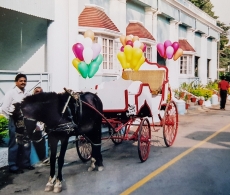
Christmas is celebrated in style at the Club. Strings of tiny lightbulbs are draped all over the establishment’s buildings and the many lovely trees in the Club’s extensive grounds. Shortly before Christmas, there is an outdoor evening carol singing concert that ends with the lighting of a huge bonfire. There is also a lively Christmas party for the members’ children that culminates with the arrival of Father Christmas on a horse-drawn carriage. I always feel a bit sorry for him as he must dress not only in a bushy white beard but also in clothing that is far too warm for the December temperatures in Bangalore, which can be in the high twenties Celsius. On Christmas Day, members and their families, who are not vegetarian as many are in India, queue up for servings of roast Turkey and a wealth of other foods available at a luncheon buffet. There is plenty available for those who prefer not to eat meat. Well, we will be missing all of this in 2020, and a lot more.

Usually, a day or so after we return to London, we visit our travel agent to book tickets for our next ‘Winterreise’ to borrow a title from the composer Franz Peter Schubert. Air tickets become available eleven months before a flight’s departure date. When we were seated at our travel agent’s desk, we told him the dates of our proposed trip. He looked on his system and told us that we could book the outbound flight, but the return flight tickets would not be available for purchase until early April. He advised us to return in April and then book both outward and inbound tickets together. That turned out to be extremely sound advice.

In the middle of March, the UK went into a total ‘lockdown’. It was no longer possible to return to our travel agent or to do much else. In addition, things were deteriorating all over the world as a result of the spreading of covid19 infections. As the weeks went past, it looked increasingly unlikely that we would be making a trip to India at the end of 2020. We were fortunate that we had been advised not to buy our outbound air tickets. Now, having reached December, travel abroad is not advised and currently travel from the UK is being curtailed. Many countries, including India, are banning travel from the UK.

In August, when restrictions on movement were being relaxed, we spent a pleasant week in a rented cottage in Kingsbridge, Devon. We liked the cottage so much that we asked its owner whether we could reserve it over the Christmas/New Year holiday period. She was happy with the idea providing that future ‘lockdown’ rules did not find her trapped there. A couple of months ago, she informed us that the cottage would not be available after all. This was not because of travel restrictions, but because a friend of hers needed temporary accommodation for a few months in winter.

Undismayed, we managed to find another self-catering cottage in the West Country to rent during the Festive Season. Then, London was cast into Tier 3 covid19 preventive measures, which discourage travel outside the Tier 3 restrictions area except between the 23rd and 28th of December. We rang our landlady in the West Country to explain that we would rather not drive so far to spend such a short time and she agreed to rebook us in March 2021.

With the West Country shelved, we decided to stay in a hotel near Cambridge and to spend some ‘socially distanced’ time with one of my cousins, who lives in the area. As the 23rd of December grew nearer, we began planning our festive feasting programme and buying mouth-watering supplies for it. Then, we all learned that the coronavirus had become highly creative and managed to mutate in more ways that most of these bugs can usually manage. This new viral creation is far more efficient at spreading from person to person than its awful ancestors. As a result, and surprisingly sensibly for our strange government, London and much of southeast England was put under stricter restrictions, Tier 4, which include a travel prohibition that forbids travel out of Tier 4 and no relaxation of restrictions during the period that we had planned to spend near Cambridge. So, that was Cambridge ‘out of the window’.

Soon after London was made subject to Tier 4 regulations, we learned that even with the arrival of new vaccines it was likely that the severe restrictions on travel might continue until Easter. So, we reached for the ‘phone and asked our future landlady in the West Country to shift our booking until May 2021. Now, we will make the most of Christmas and New Year without leaving London for any kind of winter journey, let alone India. I hope that all of this does not sound too depressing to you, because we subscribe to the idea that ‘all’s well that ends well’, and we hope that by following the rules, as ad hoc as they might be, we will all keep well.

While we munch our way through all of the festive ‘goodies’ we have accumulated, we will think of you, our friends all over the world, and wish you a prosperous and healthy future.

Double vision and Blenheim Palace

WITHOUT DOUBT, Blenheim Palace (at Woodstock in Oxfordshire) is both impressive and grandiose. Built in the first decades of the 18th century, the Palace was designed by the dramatist and untrained architect John Vanbrugh (c1664-1726) in collaboration with Nicholas Hawksmoor (c1661-1736), who was a trained architect. The result, though magnificent in a monumental way, lacks the fine aesthetics and delicacy of, say, the Palais de Versailles or the Palazzo Pitti. The interiors of Blenheim Palace outshine the building’s rather charmless monumental exterior. That said, a visit to this palace is a must.

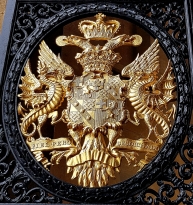
My interest in Blenheim Palace was immediately enhanced when, on arriving, I noticed the coats-of-arms adorning the gates to the visitors’ entrance. I was struck not only by their complexity but also by the presence of the two heads of a double-headed eagle (‘DHE’) prominently peering out of the coronet above the shield on the crest. Although over the years I have casually researched the distribution of the use of the DHE, I had not realised that it also appeared on the crest of the family of which the late Sir Winston Churchill (1874-1965) was a member, and whose life is greatly celebrated at Blenheim Palace and its gift shop. Sir Winston, who was born in Blenheim Palace, was also briefly a member of the Bangalore United Services Club, now the Bangalore Club, of which I am a member.

Getting back to the DHE, which, incidentally, is the symbol of the Indian state of Karnataka in which Bangalore is located, I was curious as to why the Churchill family has it incorporated into its coat-of-arms. Wherever you look on the inside or the outside of Blenheim Palace, you can spot the DHE. It is on external walls, internal furnishings, wall decorations, and even embossed on leather book covers. But why? I asked an official wearing a facemask and transparent plastic visor about it. She explained that it was because of one of the military exploits of John Churchill, 1st Duke of Marlborough (1650-1722), for whom the construction of Blenheim Palace was commissioned. John Churchill was a son of Sir Winston Churchill (1620-1688) and an ancestor of Sir Winston, the 20th century Prime Minister.

Without going into much detail, John Churchill was an important commander in the Battle of Blenheim (in Germany; 13th of August 1704), during which the armies of the Elector of Bavaria and of Marshal Tallard were defeated. This victory during The Spanish War of Succession helped to save the Holy Roman Empire (including Austria and Prussia) from defeat by the armies of Bavaria and France.  For this and other important military assistance, John Churchill was made a prince of The Holy Roman Empire by the Emperor Leopold I (1640-1705). It was because of this, that the DHE can now be found on the arms of the Churchill family.

Another DHE also found its way into the Churchill family by marriage. There is a portrait of Francis, 2nd Earl of Godolphin (1678-1766) by Sir Godfrey Kneller (1646-1723) hanging in Blenheim Palace. Son of Sidney Godolphin (1645-1712), the first Earl of Godolphin, Francis married Henrietta Churchill, 2nd Duchess of Marlborough (1681-1733), a daughter of John Churchill, the hero at the Battle of Blenheim. The Godolphin family were based in Cornwall. Their coat-of-arms contains the DHE. Unlike the Churchills’ use of the DHE, the Godolphin family had been using it heraldically (possibly, much) before the 18th century (www.british-history.ac.uk/magna-britannia/vol3/lxxviii-lxxxix). I do not know for sure but speculate that the DHE that appears in Cornish family crests, like those of the Godolphin and Killigrew families, might have some connection to the fact that for a while Duke Richard of Cornwall (1209-1272), second son of King John of England, was King of the Germans. He was holding that exalted position whilst he was a candidate for becoming the Holy Roman Emperor (he never did achieve that). So much for eagles with two heads and a total of four eyes. Now, I will remark on an exhibition held at Blenheim Palace that makes the viewer look at two disparate sets of images with only one set of eyes.

Blenheim Palace regularly hosts exhibitions of artworks by ‘modern’ or ‘contemporary’ artists. The curators juxtapose the recently created art with the fantastic collection of much older pieces that adorn the rooms of the palace. We had come to see the works of the British artist Cecily Brown, who was born in London in 1969. I must admit that I had never heard of her until our daughter, an accomplished young art historian, said that she was keen to see Brown’s works being exhibited in Blenheim Palace. Cecily Brown, so I have learned, specialises in producing paintings that both reinterpret older artworks and also remind the viewer of the appearances of the originals.

Having spent some time studying the palace and its artworks, Cecily Brown created several (about 25) paintings that in her mind echo what she experienced while looking at them. The paintings and some of her sketchbooks were then arranged amongst the paintings and other objects that decorate the rooms of the palace. Was this a successful idea? My answer is both ‘yes’ and slightly more ‘no’.

The placing of her sketchbooks amongst delicate Meissen and other precious works made of porcelain was highly effective. The placing of her paintings beside paintings of established great masters of European painting was less successful for several reasons. Her paintings are fine examples of semi-abstract modern art, pleasing to the eye and capable of intriguing the viewer. Seen against the plain white walls of a commercial gallery, they would be very impressive.

However, problems begin to arise when these works are placed in rooms full of paintings and other objects of great artistic value. For example, in the Red Drawing Room there is a large picture by Sir Joshua Reynolds (1723-1792) entitled “The 4th Duke of Marlborough and his family”, painted in 1777-78. This painting includes portraits of male and female family members. Cecily Brown has created her own interpretation of this, calling it “The Children of the Fourth Duke”. It is an impressionistic version of the original in which she has omitted the male figures that appear on the original painting by Reynolds. As a painting, Brown’s image is lovely and cannot be faulted. Placing her picture next to a work by the great Reynolds is both interesting and at the same time disappointing. It is interesting to see her interpretation but her painting pales into insignificance next to the original. That said, this is one of the most successful juxtapositions of Brown’s work in the whole exhibition; the others are less so.

There are two problems I have with the exhibition. First, I found that the placing of many, but not all, of Brown’s paintings distracted me and other visitors from seeing the older artworks that live permanently in the palace. Secondly, although it is brave of Brown to place her artistic creations besides those of long-established artists who have stood the test of time, I am not sure that is entirely wise because the average viewer, and that includes me, might find that her works pale in comparison with those of great masters.  Maybe, that is the case, but it has become popular to juxtapose contemporary art and far older works to stimulate the observer into new ways of looking and thinking. I cannot yet decide whether this is a good idea. To be fair, I can think of one successful exhibition where artworks of widely differing eras have been put together harmoniously, and that is in the Cartwright Gallery in Bradford (Yorkshire).

Just as the DHE can look in two directions, or maybe four, at the same time, the exhibition (and previous similar shows) at Blenheim Palace force us to look simultaneously at at least two eras of artistic endeavour separated by time – a kind of double vision, you might say. 

Silence in the tree

IT WAS ONLY WHEN I FIRST visited India (in January 1994) that I first saw animals that I had only ever seen in captivity, in zoos. It amazed me that in the heart of a big city such as Bangalore I could see monkeys running wild, cormorants drying their wings in the sun, and large birds of prey (eg kites) swooping high above the ground and occasionally making brief landings to steal food of outdoor tables.

During our honeymoon in South India we spent a night in the Bandipur National Park (in Karnataka close to its border with Tamil Nadu). While we were there, we were shown the fresh footprint of a tiger and saw elephants. The highlight of our visit to the place was taking a ride on the top of a large elephant. As it padded serenely through the jungle, it snacked on the grasses which it plucked from the ground with its trunk. Our guide on the elephant pointed out wild deer (sambar) that seemed unperturbed by our passing. It was a delightful experience. We also saw termite mounds that were almost six feet high. I had never seen such things before, except in photographs.

The elephants we met in Bandipur and have seen in other places in India are not usually ‘wild’ animals. They are usually beasts of burden in the employ of mankind. It was only when we visited South Africa in 2003 that we saw truly wild elephants. We visited the Addo Elephant National Park, which is not far from the city of Port Elizabeth. For the first hour or more, we drove around the park, not seeing any elephants. We saw plenty of other tourists’ vehicles but no pachyderms. At about one o’clock, lunch time, the other visitors’ cars and camper vans disappeared from the roads in the park. We continued driving, somewhat disappointed to have only briefly glimpsed a few elephants sheltering in a clump of trees some distance away from the road.

We were about to give up on the Addo park when we rounded a curve, and found the roadway blocked by several huge elephants with one baby. A couple of adults were gradually demolishing the foliage on a large tree, and the others were standing around motionless. We stopped our car. One of the elephants looked at us, menacingly so it seemed. We stared at the trunked creatures and some of them stared at us. The roads in the park were one way. The elephants showed no sign of moving away. We knew that we should do nothing to antagonise the beasts, especially as they were likely to have been very protective of the baby. We could not drive forward safely. “What to do?”, as people often say in India.  There was only one practical solution. That was to turn the car around and drive along the one-way road in the wrong direction. We did this without problems because there was no other traffic on the road at that time of the day.

Another of my wild animal encounters also occurred in South Africa, at Boulders Beach close to Cape Town. I was surprised to discover that in this part of Africa, admittedly one of its places nearest to Antarctica, there is a large colony of penguins living in the wild. They are so-called African penguins (Spheniscus demersus). They settled on Boulders Beach as recently as 1982. Other colonies of this species can be found on the southern African coast between Namibia and Algoa Bay (near Port Elizabeth). A raised boardwalk has been constructed at Boulders Beach to allow visitors to wander through the penguins’ habitat without coming into contact with them. It was delightful watching the creatures going about their daily life. However, the fish smell they create is very strong.

In early 1995, a few months before our daughter was born, we visited California, driving to San Francisco along the coast from San Diego. It was in the latter that we encountered another marine creature living in the wild. We stopped at an inlet of the sea favoured by wild seals. Many years later, I enjoyed watching wild seals gambolling near to Smeaton’s Pier in St Ives, Cornwall.

Our friends, who live near to San Francisco, took us out to Point Reyes one afternoon. The aim of the excursion was to watch whales. We were not alone at our destination. I looked out at the choppy ocean and saw nothing but the white crests of waves. Meanwhile, around me people were becoming extremely excited as they saw what they believed to be whales. It was a pleasant place to see, but as for spotting whales, I drew a blank.

Returning to Bangalore in India and sightings of wildlife, let me describe what happened one Sunday afternoon in the southern suburb of Koramangala, where my parents-in-law had a second floor (third if you are from the US) flat. The living room had windows that looked out towards a huge old banyan tree. It was a tree that provided endless entertainment for the observer. It was full of chirruping birds, busy squirrels, and often troupes of monkeys. There was never a dull moment in its complex network of leafy branches.

One Sunday afternoon, my in-laws had invited Dr and Mrs Srinivasan to take tea with us. We sat by the window with our chairs arranged in a semicircle so that we could enjoy the lovely view of the tree. The windows were open. After some time, I noticed that there was no sound coming from the birds in the banyan. The squirrels were not scuttling about in the branches. It was unusually and eerily silent. Then, I noticed it. At the base of the tree, there was a cobra, its head posed as it is depicted in Hindu temple sculptures. The presence of this motionless, almost statuesque, reptile had silenced the birds and stilled the squirrels. Dr Srinivasan and I were spellbound. I did not have my camera with me. I did not want to leave the cobra lest it disappeared and, also, realised that the camera I used then would not have captured the reptile adequately. Eventually, after we had finished our tea and snacks, the snake moved on and normal activity resumed in the branches of the banyan. This experience of wildlife was for me more exciting than the elephants, monkeys, kites, and the penguins.

Tragically, the owners of the land (who should best remain unnamed) on which the banyan tree grew, a protected plant, illegally felled the banyan one night to clear the land for a building project. Fortunately, this happened after my father-in-law had passed away because he would have been heartbroken if he had been alive to see it. The view of the banyan tree is what endeared him to the flat that he and my mother-in-law bought to live the closing years of their life.

Returning to London, another big city, it is not difficult to spot wildlife. After dark, foxes are commonly seen even on streets quite near the centre of the city. Our local open space, Kensington Gardens, is well-populated with green parakeets. They are wild but at the same time very tame. They, like the ubiquitous grey squirrels, are happy to feed from the hands of visitors. Although I have yet to see a truly exotic wild creature in London, plenty of marine fowl take advantage of the rich pickings available in the capital. Years ago, my PhD supervisor, a keen naturalist, explained to me that the vegetation growing on the banks of railway lines serve as corridors or extensions of countryside that reach right into the heart of London. It is along these that wildlife makes its way into the centre of the city.

Although I would not usually go out of my way to visit a nature reserve or safari park, I do get a thrill when I spot a creature that I normally associate with zoos in the wild. I will bring this to an end with one more tale from India.

There is a wildlife reserve close to Mysore in the State of Karnataka. We visited this with our then small daughter and three members of the Karnataka State Forestry Police, who were looking after us as guests of the then Commissioner of this police force. Looking after us was clearly more fun for the three officers than their normal routine. When we entered the reserve, they noticed that a boat was just about to set off for a trip around a lake. It was a large rowing boat already crammed full of Indian tourists. All six of us squeezed into the boat and we cast off. There were no life-jackets on board and the boat was so full that its edge was less than an inch above the surface of the lake. Being of a slightly nervous disposition, my heart was in my mouth as the boat swayed port to starboard and vice-versa. Had I been prone to panic attacks, I would have had one when I realised that what I thought were logs floating on the water were, in fact, crocodiles. Luckily, I survived the trip, but still shudder when I think that we were far closer to the crocs than we were to the fearsome cobra.

One shirt, two pockets

SOME OF YOU WILL KNOW that I am interested in the mythical birds that have one body and two heads (for example, the Russian, Serbian, and Albanian double-headed eagles). Few will know about my interest in shirts with two pockets. Most people are happy if their shirt has only one pocket, but not me. For, I like to keep my mobile telephone in one shirt pocket and my small point and shoot camera in the other.

About twenty years ago, during one of my frequent visits to Bangalore (the capital of an Indian state whose crest bears a double-headed bird), we found a store in the busy Commercial Street that sold short-sleeved (‘half-sleeve’ in Indian English) shirts with two pockets bearing the brand name ‘Camel Classics’. The store no longer exists but was close to another clothing shop called ‘Favourite Shop’ and not far from a Bata shoe shop.  Year after year, I returned to refresh my stock of double-pocketed Camel shirts. Then, some years ago, the assistants, who by then knew me well, informed me that the manufacture of my favourite Camel shirts was about to be discontinued. Hearing this, I bought all the shirts in my size that were available in the shop.

Nothing lasts forever. This was true of my Camel shirts, which I wore almost everyday both when at work and, also, when not working. The collars tended to fray. This could be remedied during our visits to Bangalore when we found various helpful tailors who were happy to turn the collars. Even with these repairs, some of the shirts became to disreputable to wear in public.

It appeared that two-pocketed shirts had become unfashionable and therefore less easy to obtain. My wife came up with the solution to the problem of replenishing my shirt stock.

We spent a fortnight in Panjim (Goa) in April 2018. While wandering about in the steamy heat, we spotted a tailoring shop. The tailor was asked if he could replicate one of my remaining Camel shirts. He said that he was able to do so, and we were to return after a week. When we went back after seven days, he had produced two perfect replicas. We wished that we had asked him to have made more than two, but our time in Panjim was running out.

The following trip to India, we decided to find tailors in Bangalore, who were willing to replicate my favoured shirts. We found two, both in the Commercial Street district of the city. We got each to make one shirt so that we could assess who did the best job. A tailor on Dispensary Road ‘won the contract’. He made me another five Camel-style shirts. My stock of double-pocketed shirts is currently up to date. Given the present covid-19 pandemic is preventing us from returning to India in the foreseeable future, I am pleased that we had so many of these items manufactured.

Discussing my liking of the double-pocketed Camel shirts with friends and their unavailability, one of them looked at my Camel shirt, and then pointed out that the American Wrangler company makes the same shirts, which are still easily available. So, I could have replenished my stock by buying them on-line, but this would have been far less enjoyable than finding and getting to know tailors in India.

No refusal

TAXI NO RESUSAL[2493]


UBER DRIVERS IN MADRAS are, so I have been told, unaware of a customer’s desired destination when they accept a job. It might be a short ride or even an out of town destination. We discovered a consequence of this earlier this year when we were advised that the most reasonable way to make the three-hour journey from Madras to Pondicherry was to hire an Uber cab.

The first three drivers, who offered us rides, phoned us to ask where we wanted to go. When we told them, they cancelled our rides. On our fourth attempt, an Uber arrived. He was happy to drive us to Pondicherry because, as we found out three hours later, he had a friend he wanted to visit there.

In Bombay, the taxis are nicknamed ‘kali pili’, which refers to their black and yellow body paint colours. Most of the cabbies are argumentative and some of them seem reluctant to work, making complaints like “too much traffic” or “that’s too far”. Eventually, one finds a cab that is willing to carry out one’s wishes, often complaining all the way. Maybe, that is because their metered fares are so reasonable for the passenger. Driving in Bombay’s traffic cannot be too much fun, especially if one is getting paid poorly to do so.

Further south in Bangalore, popular transport for those who prefer to avoid using urban buses include Uber and Ola cabs as well as three-wheeled autorickshaws.

Bangalore’s Ubers and Olas are unreliable.  Often, they accept a ride and minutes before they are about to arrive at the pickup point, they cancel. I imagine that often they get stuck in the city’s slow moving or often static congested traffic and feel they are wasting their time trying to reach their passenger waiting beyond the traffic jam. Whatever the reason, these app-linked car services are not nearly as reliable as they are in Bombay or London.

Autorickshaws (‘tuk tuks’) are the best method for getting through the congested thoroughfares of Bangalore.  Their plucky drivers can take risks with their small vehicles that larger cars are unable to attempt. These manoeuvres are daring and can be hair-raising for the passengers, but they get you to your destination relatively quickly. I love the drivers’ sneaky tactics, but others do not. Once, I was travelling in an autorickshaw with two American ladies on a busy main road in the centre of Bangalore. They shrieked with terror as our vehicle sped adventurously between a bus and a heavy lorry that were rapidly moving close together.

One autorickshaw driver, whose command of English was good, told me that he had been a truck driver before driving the three-wheelers to earn his living. He explained that an autorickshaw driver needs to use all of his six senses and to ‘feel the traffic’ with his body. It is my observation that most drivers of these small fragile vehicles have lightning reflexes and nerves of steel. Yet, as they weave effortlessly and excitingly through the traffic, many of them chatter away on their mobile ‘phones.

Hiring an autorickshaw in Bangalore is always an adventure. The vehicles are fitted with taximeters, which are supposed to determine the fair. They are used occasionally but not often. The driver will start by suggesingt an often outrageous fare, which is the starting point for haggling.  Or, some drivers will agree to use the meter determined fare plus some extra Rupees in addition.

Some autorickshaw drivers without much to do will offer foreigners something like:

“Come with me. I’ll take you anywhere for only 10 Rupees.”

Sounds tempting, does it not? Do not succumb to this unbelievable offer because if you do, you will soon discover the catch. The naive passenger will be invited to visit the driver’s friend’s/cousin’s/brother’s  store, where if you buy something, the driver will be rewarded with something like: school books for his children, or a kilo of rice for his starving family, or a new shirt, etc.

Some autorickshaw drivers will set off for a journey in Bangalore, and then after a few minutes, will ask the passenger whether, on the way, they want to do some shopping at a shop the driver recommends. That is, at a shop that will offer the cabbie a commission or a gift when the passenger makes a purchase. A determined refusal is required to ensure that your journey will not include an unwanted, time-wasting detour for shopping.

On the whole, autorickshaws are a great way of getting around Bangalore.

Calcutta is filled with rugged but battered yellow Ambassador taxis. These are slowly being replaced by newer vehicles with blue and white body paint. One thing they share is the wording “No Refusal” painted on the exterior of their doors. The cab driver, who stops to pick up a passenger, is not supposed to refuse to take you wherever you want. Most of the drivers comply with this.

Black Cab taxi drivers in London and other places in the UK are, by law, required to take you anywhere within the area they can legally operate. Like the drivers in Calcutta, the British cabbie is supposed to adhere to the “No Refusal” concept, and often, but by no means always, cabbies comply.

Interesting as all this is, present conditions during the current pandemic mean that not too many cabs are being hailed at the present in London. While the ‘lockdown’ is in force, even in its present slightly diluted form, I feel sorry when I see an empty Black Cab with its ‘For Hire’ sign illuminated cruising the almost empty streets in the hope of finding a customer.

Memorable year endings

NEW YR Turned on palm_1024 BLOG


IN 2019, WE SPENT NEW YEAR’S EVE  in Ahmedabad. This beautiful city filled with history and remarkable monuments is in the Indian state of Gujarat, which is officially teetotal. Although we did consider smuggling some booze into our hotel room, we had an alcohol-free New Years Eve. After clinking glasses of chhaas (buttermilk), we sat in our bedroom listening to firecrackers being let off sporadically in the dark streets nearby. Other New Year’s Eves have been more memorable.

When we were young children, my sister and I used to spend New Year’s Eve with my cousins. Their parents, my uncle and aunt,  used to work hard to host our families and friends on Christmas Day. Their treat was to go out to celebrate the last day of the year. My sister, my cousins, and I were left at home to give company to my uncle’s ageing mother. My aunt and uncle used to get ready to leave and then came to say goodbye to all of us remaining behind. Invariably, my uncle’s mother used to try to guilt trip them by saying:

“How can you think of leaving us alone this  evening, of all evenings?”

This plaintive question was always unsuccessful in getting them to change their plans.

Sometime in the 1980s, I was staying over Christmas and New Year in a remote part of  Cornwall near to Bodmin. On that New Year’s Eve, I drove to Land’s End. That year’s end, Land’s End was enshrouded in thick mist. All I could experience of this famous landmark were, the icy cold air, the sounds of waves and a foghorn that blasted intermittently. I have yet to see Land’s End properly.

In 1994, I visited India for my first time. My wife and I were staying with my in-laws in Bangalore.  They were members of the Bangalore Club, one of the city’s prominent social clubs. Every year, they liked to attend the Club’s New Year’s Party. In the 1990s, these parties were fairly modest affairs. Tables were set up under the stars on a large lawn around an open-air  circular dance floor. The tall trunks of the palm trees surrounding the lawn, were entwined with strings of tiny light bulbs. One of the trees would have the current year displayed with numbers outlined with tiny light bulbs. At midnight, these used to be switched off as soon as the illuminated figures displaying the new year were switched on.

There was dancing on the circular dance floor. A competition was held to find the best dancers of the evening. In the past, my in-laws used to carry away the prize year after year. After some years, the committee asked them to forego the prize so that others could win them. Even as octogenarians, my in-laws were superb dancers.

In the 1990s, the ‘happening’ place for New Year’s Eve parties in Bangalore was the KGA (Karnataka Golf Association). Nowadays, the Bangalore Club is deemed to be the place to be as the year passes through its final hours. The party is now noisier and far more crowded than it used to be when I first experienced it – not my ‘cup of tea’.

One year after my father-in-law had passed away, my wife and I spent the 31st of December at home with my widowed mother-in-law. We ordered a pizza from a well-known chain. When it arrived, it tasted alright although it had a musty odour. We decided not to, or could not manage to, stay awake until midnight. We fell asleep. At three o’clock in the morning our mobile ‘phone woke us. It was our daughter ringing to wish us a happy new year. I must admit that this was the most relaxing New Year’s Eve I can remember.

Some years earlier, in the 1980s, I celebrated New Year’s Eve with my friend Raša in Belgrade,  the capital of the former Yugoslavia. To see the New Year in, we went across the River Sava to a party in a large flat in New Belgrade.

Before we set off in a taxi, Raša warned me to keep away from windows and  balconies. You might wonder why. Many retired military men lived in New Belgrade. A lot of them possessed firearms. At midnight, they celebrated by firing these guns. People outside on balconies or close to windows sometimes got injured by ricocheting bullets. We were not affected. At about 1 am, we left the party and visited some friends who lived on the edge of Belgrade. There, we drank a great deal of alcohol. The rest of that New Year’s Day was lost in an alcoholic haze.

I hope that the end of this tragically troubled year, 2020, will be memorable in a pleasant way. Will we be raising our glasses to digital devices,  or will we be clinking them with those held by our friends and family, maybe with fully extended arms?


Decorated palm tree at the Bangalore Club

Birthday in Kosovo

K1 PROHOR PC 90 Church ext BLOG

MY BIRTHDAY IS on VE Day (8th of May). In 1990, I celebrated it in the former Yugoslavia. I was driving around Serbia in a rented car with my friend from Belgrade, Raša R. His birthday was the day following mine.

Before I rented the car, Raša, a vey wise fellow, advised me to rent a car from one particular company because its cars carried Slovenian registration plates, rather than Serbian. This  proved to be sound advice.

On the seventh of May, we booked into the comfortable accommodation provided at the beautiful Prohor Pčinjski monastery in the hills of southern Serbia. We decided to stay there two nights in order to celebrate our birthdays.

My birthday wish was to drive into the autonomous region of Kosovo and Metohija, which was populated by a high percentage of Albanians. And, then as now, I was greatly interested in all matters connected with Albania and the Albanian diaspora. Both Raša and I had separately visited the area in the 1970s. We were both keen to see it again.

Raša, a Serbian, had some reservations about driving into Kosovo, where there had been some unpleasant violent incidents between the Serbian and Albanian communities some months earlier. However, he decided that he would accompany me for two reasons. One was that our car bore Slovenian plates, not Serbian. The other related to his excellent command of the English language. He said he would only speak in English in Kosovo, not a word of Serbian.

We set off, driving through the relatively empty Serbian countryside. The boundary of Serbia and Kosovo was at the summit of a low mountain pass. As soon as we entered Kosovo,  we discovered that, unlike the part of Serbia we had just left, the countryside of Kosovo was relatively crowded with people, by the road side and in the fields. The landscape was liberally dotted with recently constructed homes and other buildings. This was quite different from what we recalled of our earlier visits.

We drove into Priština (Prishtinë), the capital city of the autonomous region. The main road was filled with a sea of people. We inched forward. The crowds parted slowly to allow us to proceed. Raša advised, nay forbade, me to sound the car’s horn. He did not want to upset anyone. I had never before driven through such crowds. Four years later, I did it again, but in the central market area of Bangalore in India. There, I and other motorists sound horns incessantly, but nobody pays the slightest notice to them.

We parked in the centre of the city in a car park that looked like it was the site of a large demolished building.

I was keen to buy recordings of Kosovan Albanian music for my ever growing collection of music from all over Yugoslavia.  The best supplier turned out to be a kiosk that sold cigarettes, magazines,  and newspapers. I bought about fifteen cassettes, the kiosk’s entire stock, but had no bag to carry my haul. The enterprising shop keeper saw my plight. He opened a couple of cartons that each contained twenty packs of cigarettes and emptied the packs onto his small counter. Then, he carefully packed my cassettes into the cartons.

After lunch in what seemed to be the grandest hotel in the city, we drove to see the beautiful Serbian Orthodox monastery at Gracanica.  Then we wended our way back towards Serbia, stopping for coffee at Gnjilane (Gjilan). There, I spotted a kebab shop that used a logo identical to the well-known McDonalds ‘M’. When I pointed this possible breach of ‘copyright’ to my friend, he shrugged his shoulders and said:

“This is Kosovo. Anything goes.”

We reached Prohor Pčinjski, where we ate a lavish and tasty dinner. The following day, Raša’s birthday trip was a drive through parts of Yugoslavian Macedonia. After passing some rice paddy fields, we were stopped by a policeman with a speed measuring device. He fined me the equivalent of £1 Sterling for speeding. My friend was fined half of that for not wearing a seatbelt. Otherwise, we had a good day, visiting an attractive small town, Kratovo, and the Roman ruins at Stobi on the River Vardar.

The following day, we drove back into Kosovo, stopping at the small town of Prizren. On both the 1990 and my 1975 visits, Prizren captured my heart more than any other place in Kosovo. Recently taken photographs I have seen show that it is still a delightful place.

From Prizren we drove to a dramatic pass that led from Kosovo into south eastern Montenegro.  We spent the night in Rozaje, a small Montenegrin market town. Thus ended a memorable double birthday celebration.

Soon after we visited Kosovo together, it was time for me to fly back to England. Raša accompanied me to Belgrade airport. Just before I entered the secure departure area, I waved to him and experienced a weird sensation. I felt that Raša knew that we would never meet again.

My sensation was not without basis. Soon after I left Yugoslavia,  the country began its painful dismemberment. Visiting my friends in Belgrade and elsewhere in Yugoslavia became inadvisable.  Sadly, by the time that uneasy peace began to reign again in what was once Yugoslavia, Raša had passed away.

VE Day marked the end of hostilities between the Axis and Allied powers in Europe on the day that was to become my birthday a few years later. The imposition of socialist regimes in Central and Eastern Europe that followed  did not put an end to festering sores that had been troubling the Balkans and elsewhere since the decline of the Ottoman and Austro Hungarian empires, which had already begun at the beginning of the twentieth century.  This was certainly the case in what was Yugoslavia. During the ‘reign’ of Marshal Tito, a semblance of unity was achieved in his country. However, after his death, as if recovering from a general anaesthetic, old unresolved conflicts reawakened. President Milošević did little to resolve these, but instead helped to exacerbate hem. Hailed by some Yugoslavs, mostly Serbs, as the new hero of Yugoslavia, this assessment was not shared by many, especially the Albanian folk in Kosovo.

For all the opprobrium that was heaped on Serbia during the 1990s, I cannot forget the warmth, hospitality, and friendship shown to me by ordinary people living in Yugoslavia, Serbians, Croatians, Bosnians, Albanians, and many others during the 1970s and 1980s. They did not deserve what befell them during the 1990s and much of the 20th century.

You can read more about travelling in the former Yugoslavia in “SCRABBLE WITH SLIVOVITZ” by Adam Yamey. This illustrated book is available from:

Amazon

Bookdepository.com

Lulu.com

Kindle

Photo shows Prohor Pčinjski monastery

Himalaya Palace

HIM 1 BLOG


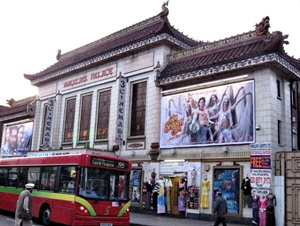
THE HIMALAYA PALACE cinema in the London suburb of Southall, an area where many people of Punjabi descent live, showed only Bollywood films from India, usually the latest releases. Being keen on these films, we often made the long trip from our home to Southall to watch them. During our regular visits to India, always including Bangalore, we take time to see Bollywood films in the country where they are created.

We were in Bangalore in December 2001 when the blockbuster film “Kabhi Khushi Kabhie Gham” (ie ‘sometimes happy, sometimes sad’) was released all over India. We were staying with my in-laws,  and everyone decided that we had to see it.

We chose a cinema near the famous Mavalli Tiffin Rooms (MTR), a long established popular eatery in Bangalore. It was decided that we should have breakfast there before seeing a morning screening of the film. So popular is MTR, that queuing is always required before getting a table. It was my first visit to this highly esteemed place and I hope my last. Everything we were served was almost dripping with ghee, which is part of its attraction for its many fans.

The cinema was a few steps from MTR. After buying tickets, we had to wait in another queue. This one was to await one’s turn to have bags searched by security personnel. I thought this was to prevent weapons and bombs from entering the auditorium, but it was not. The security people were searching for food and drinks. So-called ‘outside food’ could not be brought into the cinema because it risked reducing the sales of overpriced snacks and drinks sold by the cinema.

When we reached our seats, my sister-in-law showed me her basket, lifted a shawl within it, and revealed the sandwiches and other snacks beneath.  So inefficient were the security people that they had not delved into the bag with any seriousness of purpose.

Before the film started, my sister-in-law offered me and the rest of the family rolls of compacted cotton wool rather like those that dentists stuff into patients’ cheeks to dry the mouth. She said we might need them because the volume of the soundtrack would be very high. I declined them, and enjoyed the full impact of the sound.

At the Himalaya in Southall before the start of any film, a sign would be projected. It said something like:

“Please do not talk during the performance.”

This was a pointless exhortation because at the Himalaya the soundtrack was played so loud that even if you screamed at your neighbour, they would not have heard you.

Sadly, the Himalaya Palace (built 1929) is no longer a cinema. It closed in 2010. When we last visited Southall a few years ago, the Chinese style front of the Himalaya, complete with dragons, still existed, but its interior had become a covered market.

Nowadays, well at least before the pandemic arrived,  we watch Bollywood films that are shown regularly (at least one per week) at a Vue cinema in London’s Shepherd Bush.

Providing you miss the Friday and Saturday screenings of the latest releases, the audiences are usually minute, often less than ten people in an auditorium that can seat well over 150 people. Even before the pandemic, social distancing  was the norm during the screenings because empty seats usually greatly outnumbered occupied ones.

Most Bollywood films are long, usually over two and a half hours. So, there is an interval during their screening. The point at which the interval occurs is chosen by the film maker to leave the audience at a point of high suspense in the story.

Once during an interval at a Bollywood screening at the Vue, we sat in the almost empty cinema and heard two ladies, sitting several rows in front of us, chatting in Italian. Out of curiosity,  we asked them in Italian why they had chosen to see a Bollywood film. Their reply surprised us.

The two women were members of an Akshay Kumar fan club in Calabria in the far south of Italy. They had only ever before seen films starring Akshay on video screens.  They were staying far away from Shepherds Bush in Dulwich when, to their delight, they discovered that the film we were watching, starring Akshay, was being screened in Shepherds Bush. They had come to see one of Akshay’s films on the ‘big screen’ for the first time.

Bollywood’s films have captured the hearts of people all over the world. They were even  popular in the former USSR. When we visited Albania in 2016, we discovered that they, as well as Indian TV soap operas, had captured a significantly large audience of Albanians. These films would not have been shown in Albania prior to the downfall of its Stalinist style regime in 1991.

Until it is safe to do so again, my wife and I will have to enjoy armchair screening of our Bollywood DVDs. Enjoyable as these are, they are an incomplete substitute for ‘in your face’ full blast performances in a cinema auditorium.