Polish or Russian

BLOG HOOP 1l Eagle Lodge


THE DOUBLE-HEADED EAGLE, the symbol of Albania, has fascinated me ever since I first became interested in the country in about 1967. This much-employed imaginary creature, whose origins go back at least 3000 years before the birth of Christ, is not only the national symbol of tiny Albania but also of Imperial, and now modern, Russia. A year or so ago, I was walking along Golders Green Road in northwest London, one of my childhood haunts, when I saw something I had never noticed before. It was a block of flats on which I spotted a large sculpture of a double-headed eagle. The building is appropriately named ‘Eagle Lodge’.

According to Pam Fox, author of “The Jewish Community of Golders Green” a detailed and fascinating book published in 2016, Eagle Lodge was one of a number of mansion blocks built on the sites of former large villas with extensive grounds that used to line Golders Green Road. Next to the mention of ‘Eagle Lodge’, Ms Fox refers to her endnote number 1, which reads:

“It was designed by a Polish architect who carved the Polish eagle onto its façade, giving the block its name.”

Although I doubt that Ms Fox’s book attracts many Polish nationalist readers, this footnote would certainly upset them. The Polish eagle used heraldically or as a symbol has only one head. Having been subjected to domination by the Russians for many years, to confuse the single-headed eagle of Poland with the double headed version used by their Russian neighbours would not go down too well amongst the Polish fraternity.

As for the “Polish architect”, there is another problem. Eagle Lodge was, according to the architectural historian Nikolaus Pevsner, designed by MV Braikevitch and built 1935-37. Mikhail Vasilievich Braikevitch (1874-1940) was a Russian engineer and art collector born in the Ukraine. I found an interesting pamphlet published by the London Borough of Barnet, which contains the district of Golders Green. Titled “The 1917 Revolution & Barnet’s Russian Heritage”, it says:

“Possibly the most interesting Russian resident was Mikhail Vladimirovitch Braikevitch of Woodstock Avenue. He had been an important engineer in the construction of the Trans-Siberian Railway, was the mayor of Odessa before the war, and had been a member of the interim government, who ran Russia between February 1917 and the October Revolution. Remarkable as all these things are, it was his art collection which was most important. Having settled in England, he started to collect works of art smuggled out of Russia from fellow refugees – both in London and Paris – and amassed one of the best collections of Russian art outside of Russia itself. On his death in 1940, he left the collection to the Ashmolean Museum in Oxford, but we can imagine an ordinary house in Golders Green with some of the greatest works of Russian art on the walls.”

It was at Braikevitch’s suggestion and following a visit to his home in Golders Green that the undeservedly lesser known but remarkable Russian composer Nicolas Medtner (1880-1951), a contemporary of Rachmaninoff and Scriabin, shifted from Paris to London in 1935.  The composer and his family settled into a new home on Wentworth Road in Golders Green.

Braikevitch, like Medtner, was buried at Hendon Cemetery and Crematorium, not far from Golders Green.  The architect’s funeral was held at St Philip’s Russian church, Buckingham Palace Road, London. So, all things considered, it is highly likely that the architect of the rather unappealing looking Eagle Lodge with its double-headed eagle was not Polish, and that the bird with two heads has nothing to do with Poland as erroneously suggested by Ms Fox in her end note.  

So long Soho

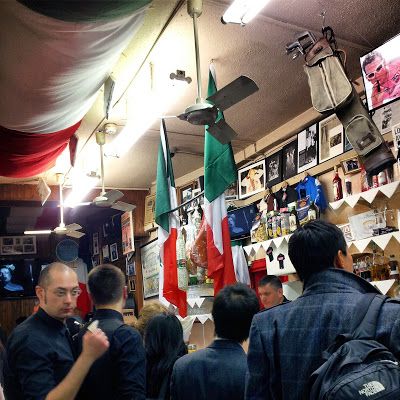
SOHO BAR ITALIA

IN MANY MINDS ‘SOHO’ conjures up sleazy night spots, strip joints, sex shops, and risqué nightlife. For me, Soho contains many memories of my childhood. And before you wonder about what kind of upbringing I had, let me emphasise that these recollections have nothing to do with the seamier side of this colourful district in London’s West End. If you are hoping for something more ‘exciting’, stop reading now to avoid disappointment.

My mother was an artist. Her preferred metier was sculpture. In the 1960s, she used to work in the sculpture workshops at the St Martin’s School of Art on Charing Cross Road. She welded pieces of metal to create artworks. Her companions in the studio included now famous artists such as Philip King and Anthony Caro.

In addition to being a sculptor my mother was acknowledged by friends and family as being a good cook. She was a disciple of the food writer Elizabeth David, who helped introduce French and Italian cuisines into British kitchens. Ms David’s recipes required ingredients and cuts of meat not readily available to British shoppers in the 1960s. However, St Martin’s was close to Soho, in particular Old Compton Street and Brewer Street, where the ‘exotic’ ingredients needed for Ms David’s recipes were easily accessible. These streets contained a variety of shops that catered to French southern European culinary needs.

We lived in Hampstead Garden Suburb, an attractive but, in my opinion, rather dull place. As a youngster, I loved being taken into central London. My mother often took me to the West End. We used to take the ‘tube’ to Oxford Circus Station. Near there, we always entered Dickins and Jones department store. Why, I cannot say, because my mother rarely bought anything there. The ground floor of the shop was dedicated to perfume and other cosmetic sales. Once, one of the salespeople, called to me. Without prompting, she advised me never to use after shave lotions. I was far too young to have begun shaving, but I have followed her unsolicited advice ever since then. I have not yet been brave enough to experiment with these lotions and to discover why she advised against them.

After leaving the department store, we used to visit the Danish Centre in Conduit Street, where I would be treated to an open sandwich and a kransekage, a Danish confection containing marzipan. From there, we used to head for Soho.

Meat was always bought at Benoit Bulcke, a Belgian butcher shop on the corner of Old Compton Street and a smaller side street. According to my mother, only this place knew how to cut meat properly, and she was not someone to argue with. Their motto was “Meat to Please You, Pleased to Meet You”. They moved from Soho to northwest London some years ago. 

Coffee was always purchased at the still extant Algerian Coffee Stores. The shop’s appearance remains unchanged since I was a child. My mother used to choose Mocha Mysore, a name which meant nothing to me as a child. Decades later, when I began visiting India, I got to visit Mysore and also Indian coffee plantations. One innovation at the Algerian Coffee Stores instituted long after my childhood, and well before the Covid-19 crisis, was the inclusion of a small counter where exquisitely made espresso coffee is served.

Other groceries were bought at Lina Stores, still in existence, and Camisa, another Italian grocery nearby. Almost every visit to Soho included a stop at Bar Italia. Founded in 1949, this coffee bar still exists. Entering it is like stepping straight from Soho into a typical bar in Italy. Much of its décor remains as I first remember it, but now the far wall of the café is lined with an enormous TV screen on which Italian football matches can be watched. Whenever we visited Bar Italia, my mother would point at a doorway close to it and tell me that it led to Jimmy’s restaurant. Founded in 1948, it was the first Greek restaurant to be opened in Soho.  Although she always mentioned the place, we never ate there. However, close by in a parallel street there was an Italian restaurant, Otello, which my parents visited often, sometimes taking my sister and me.

One shop that no longer exists was on the short stretch of Old Compton Street between Moor Street and Charing Cross Road. It had trays of vegetables and salad greens on stalls on the pavement outside the front of the store. It was a French run greengrocer, whose name I cannot recall. One of the things my mother bought there was something that sounded to my young ears like ‘mush’ (rhyming with ‘slush’). I had no idea what it was or what it was used for, but I know that my mother prized it greatly. Many, many years later, I realised what she was buying was in fact ‘mache’, also known as ‘lambs lettuce’ or ‘corn salad’, and to botanists as Valerianella locusta. In the 1960s when my mother was buying mache in Soho, hardly anyone in the UK would have heard of it, let alone eaten it. Today, it is a common ingredient of packaged salads found in supermarkets. I had no idea that back in the 1960s, my mother had become a foodie trend-setter by serving us mache in our salads.

My mother died forty years ago, and Soho has changed since then, but much remains that she would have recognised. Whenever I sip coffee at Bar Italia, I raise my tiny cup of strong black coffee to her memory. Mache more than that, I cannot do!

A bookshop in my memory

I HAVE LOVED BOOKSHOPS ever since I can remember. In my teenage years, I used to haunt the shelves of Foyles, a multi-storey bookshop in Tottenham Court Road. The store is named after its founders William and Gilbert Foyle, who established their business at Station Road in Peckham in 1903. A year later, they moved it to Cecil Court, an alley near Leicester Square, which still contains several bookshops. By 1906, Foyle’s had a branch on Charing Cross Road, which is where I got familiar with it.

BLOG FOYLES by Tarquin Binary

In the second half of the 1960s, Foyles was a very well-stocked bookstore even if it seemed a bit confusing to its customers. There were separate departments specialising in various topics distributed over at least three floors. I discovered soon enough that behind the bookshelves in some of the departments there were yet more shelves, and these contained second-hand and remaindered books often at reasonable prices. It was amongst these hidden shelves that I found a rather useless but picturesque road atlas to Bulgaria, published in Bulgarian, and a wonderful detailed street map of East Berlin, “Haupstadt der DDR”. This map carefully avoided mapping the city’s contiguous West Berlin. It gave the impression that East Berlin bordered the edge of an area of uninhabited desert.

The language department was very interesting. It stocked books on every language from A to Z. It was there that I discovered a copy of “A Short Albanian Grammar” by SE Mann, published in 1932. This hardback book with dark green board covers was priced at 15 shillings (i.e. 75 pence). I was particularly excited to find this volume as my interest in Albania was already becoming quite well-developed. However, 15 shillings was way beyond my budget in 1968. That year, I began studying biology for the A-Level examinations that had to be passed to enter university. It was then that a chance to obtain this book arose.  

During the first year of the A-Level course, I entered the school’s Bodkin Prize biology essay competition. I wrote a long treatise on the life of the woodlouse. This was my first ever bit of serious research. I visited the Science Library, which was then housed in a part of the then disused Whitely’s department store in Queensway. There, I translated a long article written in French about the reproductive system of the woodlouse. From what I can remember, the woodlouse can reproduce asexually, a process known as parthenogenesis.  I was awarded the second prize. The only other contestant was my classmate Timothy Clarke, whose older brother, Charles, was to become Home Secretary between 2004 and 2006. Tim won the first prize.

Thesecond prize was 15 shillings to be spent on books. I asked the school to spend that money on procuring me the copy of the Albanian grammar book in Foyles. To my great annoyance, my choice was turned down and I was asked to choose again, making sure that at least one book was a hardback, because it was to be embossed with the school’s crest. I chose two books. One was a costly paperback on genetics and the other was the cheapest hardback I could find. To this day, I still do not possess a copy of Mann’s book.

Returning to Foyle’s, let me tell you about its payment system, which resembled, so I was told, the system adopted by shops in the Soviet Union. First, you had to find a book you wished to purchase. Then, you took it to a desk in the department where it was shelved. A shop assistant took the book and wrote out a paper bill. Next, you had to take the bill to one of the few cash desks in the shop. After queuing, you parted with the correct amount of money and then the paper slip was stamped. Following this, you returned to the department where your book was being held and queued up again to exchange your stamped paper slip for the book, which you were then free to take away. This laborious payment system survives today in the government run khadi (home-spun materials) shops in India. These old-fashioned shops, often smelling of moth balls, are picturesque to say the least.

Foyles was bewildering to the newcomer stepping off the street. Like the tiny alleyways in Venice, it was a great place to lose your way. However, if a customer was looking for something specific, this was not helpful. So, quite sensibly, there used to be staff standing near the entrance to help customers find what they were seeking. Some of these no doubt poorly paid staff had poor command of the English language. On one occasion I heard the following:

“May I help, Sir?” asked a young lady with a strong Eastern European accent.

“I am looking for choral music.”

The assistant hesitated and then pointed at the escalator while saying:

“Please try the engineering department.”

That was long ago, back in the late 1960s.

Foyles moved out of its home on Charing Cross Road in 2011 and occupied another building a short way from it on the same street. Its current premises occupy part of the former St Martin School of Art, where my mother used to work in the sculpture studios in the 1960s. I no longer shop at Foyle’s but remember it fondly.


Picture by Tarquin Binary from Wikipedia

Destroying statues

NOBODY IS PERFECT, and that includes all of those ‘great’ men and women whose lives are remembered with statues. Let me state at the outset that I am against both idolatry and iconoclasm. I do not believe that anyone should be worshipped without questioning (or even after questioning) nor that statues should be destroyed.  Everyone has good and bad points, and that should be remembered always when looking at a statue.

STAT BLOG

Let me state at the outset that I am against both idolatry and iconoclasm. I do not believe that anyone should be worshipped without or with questioning nor that statues should be destroyed. Everyone has good and bad points, and that should be remembered always when looking at a statue.

Consider Cecil Rhodes (1853-1902). He was not a person that I would have enjoyed meeting, even for a brief drink in a pub. From what I know of him, he was power hungry and greedy and would stop at nothing to achieve his goals.

Undoubtedly, money derived from his endeavours has been spent on good works including the famous Rhodes Scholarships, which began funding bright young scholars from 1902 onwards. Many academic and other fine accomplishments have been achieved by the recipients of these awards. However, some of them are now criticising the way that Rhodes exploited/plundered Africa to produce his wealth. Given that these scholarships, funded by what some might describe as ‘dirty money’, are awarded to people with above-average intellectual abilities who could easily have examined Rhodes’ history, I find it strange that the recipients did not question the morality of the origins of what was being offered to them before receiving and spending it. Some recipients justify accepting the scholarships by saying it is a way that Rhodes’ debt to Africa can be partially repaid. Maybe, but would you feel comfortable if, say, the infamous Kray Twins or Al Capone offered to use some of their ill-gotten gains to fund your education? Would you justify accepting their money by saying that although they killed people and committed crimes like theft, it was good that they were using someone else’s wealth to repay their debt to society? Few people would justify erecting statues to either the Kray Twins or Al Capone.

Unlike Capone and the Krays, Rhodes was not breaking any British law when he was plundering Africa to glorify the British Empire and line his own pockets. From the viewpoint of the great majority of ‘white’ British people, his contemporaries, Rhodes was doing a good job during his lifetime for the Empire and his native land, Great Britain. Statues were erected in his memory by those who had benefitted from his life’s work. Those people were mostly, if not all, ‘white’ people. The monuments were put up during an era when racial prejudice went unquestioned and people ‘of colour’ lacked any public influence.

Times have changed. The racial situation, the rights of ‘people of colour’, is also changing, albeit too slowly. Recent and not so recent events across the Atlantic in the “land of the free and the home of the brave” have justifiably heightened popular consciousness and questioning of the worthiness of those, like Rhodes, whose statues adorn our lands.

So as Vladimir Ilych Lenin, discredited by some, and many of whose statues have been toppled, asked in 1902:
“What is to be done?”
What is to be done with the statues of celebrated people with flaws in their personalities? One could pull them down as has been the case with many statues of Stalin, Enver Hoxha, Saddam Hussein, and more recently a slave owner in Bristol. Apart from temporarily assuaging the temper of an assembly of aggrieved folk, the toppling or destruction of a statue might have few or no lasting beneficial effects.

It would be far better to remove the statues from positions of great public prominence to more discreet locations (maybe to museums) and to label their plinths with inscriptions that summarise the subjects’ both good and bad actions. Also, it would be a good idea to educate children and other students to understand that just as there are two competing teams in a football match, there are two sides to a person’s personality: a good one and a bad one. It is the balance of these that needs to be judged. In the case of Rhodes, the bad wins, but in the case of, say Edward Jenner (of smallpox vaccination fame), whose statue can be found in Hyde Park, his good features easily predominate.

Finally, destruction of statues and monuments worries me because they are part of remembering. If we know that a monument commemorates something that should not be repeated, such as slavery, let it remain, suitably labelled, so that we do not run the risk of unpleasant aspects of history repeating themselves. For as the philosopher George Santana (1863-1952) wrote in 1906:
“Those who cannot remember the past are condemned to repeat it.”

Books of choice

Beerwolf_500


I HAVE LOVED READING ever since I was first able to master this skill. During my childhood, we used to drive to Hampstead (in north London) every Saturday morning. We always used to visit the now long-since closed High Hill Bookshop on Rosslyn Hill. Our parents allowed my sister and me to choose one book each Saturday and bought them for us. Week by week, my collection of the adventures of Tintin by Hergé grew until I had all the episodes that had been published in English. There was little, if any, censorship of our choices. However, I had the distinct impression that my parents preferred that we avoided books by Enid Blyton. So, I have not yet had the pleasure of reading any of her extensive literary oeuvre.

I discovered and fell in love with “Mad” magazine, which was not available at High Hill Bookshop. I bought copies of it at a local shop, using my pocket money. My parents appeared not to approve of the magazine, but my father (not my mother) was always happy to read my copies of it when I had finished with them. “Readers Digest”, like Enid Blyton, did not fulfil my parents’ criteria of ‘good’ literature. I enjoyed leafing through this periodical and particularly remember reading and re-reading an article written by someone who was conscious during his brain surgery. I did not need to buy “Readers Digest” at full price as it was possible to buy boxes crammed full of old issues, sold as a job lots for a few pence at local jumble sales.  

There was only one book that was deemed strictly forbidden during my childhood. It was “Struwwelpeter” by Heinrich Hoffman, published in 1845 and reprinted many times since then. It is a series of moral tales about children who misbehave. For example, when Konrad disobeys his mother’s instruction not to suck his thumbs, an itinerant tailor appears and cuts off Konrad’s thumbs. Each tale is illustrated by frighteningly graphic illustrations. On afternoon, my sister and I, who had discovered this book by accident, were interrupted by my mother. She seized the book and tore it into pieces, which she stuffed into the wastepaper basket. Apart from this violent reaction to a book and the hints that Enid Blyton was to be avoided, I could read pretty much anything I wanted.

At school, books were recommended as being worth reading, especially those by famous 19th century British authors. I never read any of these. For some unknown reason, probably contrariness, if someone told me that I ought to read a particular book, this put me off even opening it. I wanted to read what I had chosen myself, not what had been chosen for me because it might be “good for you”. Similarly, if someone tells me that this or that food item is “good for you”, I do not rate that as a positive recommendation.

At Christmas 1963, we were in New York City. A friend of my parents, ‘E’, met us in the book department of FAO Schwarz, a toy store on Fifth Avenue. She wanted her son and me each to choose a book as a gift from her. E showed me a thick encyclopaedia of anthropology, which she had decided either that I would enjoy it or that it would be good for me. Well, I took one look at it and decided to check out the other books on display. I homed in on an illustrated history of the FBI. It was filled with intriguing black and white photographs, some quite gory. I took the book to E, who looked at it disapprovingly and then asked whether I was sure that I did not want the fine book on anthropology. I was sure, and a few minutes later I became the proud owner of the book about the FBI. E’s son, who was clearly more easily influenced by his mother than me, chose to buy the anthropology book. Years later, he qualified as a psychiatrist and I as a dentist. I am not sure what can be concluded from that.

My parents’ suggestion that there was something not quite right about Enid Blyton left a lingering doubt about the author in my mind. In the mid-1990s, I began visiting India regularly. There, I discovered wonderful bookshops, some of which were (and still are) much better stocked than those in London. What surprised me in those shops were the huge numbers of books by Enid Blyton on sale. Clearly, Enid was well-read and her books much purchased in India.  So, when I heard that there was going to be a lecture about Enid Blyton and India at the Nehru Centre in London, I felt that this was not to be missed. The speaker was none other than Enid Blyton’s very articulate daughter. She told us that British educators often frowned upon her mother’s works (just as my parents had done). The reason they were not keen was that it was considered that Enid’s vocabulary was not rich or varied enough. She revealed that when the texts of her mother’s books were analysed numerically, the vocabulary used I them was, in fact, no less rich or varied than that employed by other authors writing for the same age groups.  

In recent years, I have changed. Maybe, I have become a little less stubborn about book recommendations. If someone suggests a book to me, I no longer instantly reject the idea of reading it. There is a good chance that I will look it up to see what others think of it. If it is about a subject that might chime with any of my interests, there is a good chance that I will buy a copy and add it to the ever increasing pile of unopened books waiting to be read by me.  However, you will still not be able to find Dickens, the Brontes, Thomas Hardy, or titles that would “be good for me” on their spines.

From Cuba to Corona

CURRENT AFFAIRS DID NOT interest me when I was a child. I did not read newspapers nor did I listen to the news broadcasts on the radio (we did not have TV at home).The first news item that I can remember hearing my parents talking about was something to do with Cuba. Now, I realise that they must have been discussing the Cuban Missile Crisis that occurred in October 1962 when I was a few months over ten years old. For those who cannot remember this event, it was a dangerous moment for the world because the Soviet Union had placed ballistic missiles in bases on the island of Cuba, which is dangerously close to the USA. These missiles could have been used to drop nuclear weapons on the US. Had that happened, most of us would have been wiped out in a nuclear Armageddon. Luckily, the missiles were removed and a showdown avoided.   


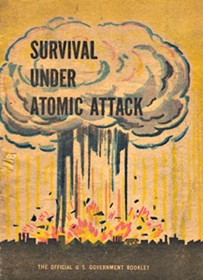
BLOG BOMB handbook wiki


Almost a year later, we lived in Chicago for three months because my father was a visiting academic at the University of Chicago at the end of 1963.  One of my memories of the USA during that time was the preponderance of yellow and black coloured signs indicating the entrances to nuclear bomb (fall out) shelters. The university gave us a flat to live in. This contained a booklet, which fascinated me. It was filled with advice on how to survive a nuclear bomb attack. Two things in that booklet stick in my mind. One was to make sure that you removed your watch if it had a luminescent dial, one which glowed green-ishly in the dark. The other was to crouch under a strong kitchen table. I am not certain how either of these actions would have significantly improved one’s chances of survival.

After we had spent three months living in Chicago, we spent Christmas in New York City. One evening, we visited Steve Rousseas (1921-2012), an economist whom my father knew. He lived in Greenwich Village and was, incidentally, one of the few people who bought any of my mother’s sculptures. As we walked with Steve to a restaurant, he chatted to me. He told me something that made a great impression on my young mind. And, that was if a neutron bomb exploded, most lifeforms would be exterminated, but buildings and other man-made structures would remain intact. I found that idea very eery and quite frightening.

Many years later, I watched a documentary film that graphically portrayed the effects of a nuclear blast. Several aspects of this terrifying film impressed me. First, is that following a blast, there would be a great, powerful wind, which would carry a cloud filled with lethal splinters of glass from windows that had been shattered by the explosion. Secondly, the blast would most probably disable electricity generation and supplies. Thirdly, several species, being relatively insensitive to radiation, would survive the effects of intense radioactivity. These included cockroaches and other vermin.

By 1987, I was well-established in my house in Gillingham, Kent. One night in October of that year, I awoke in the early hours of the morning. It was dark but there was a great noise outside. There was a wild wind blowing. It was so strong that my house swayed slightly as the tempest buffeted against its walls.  I tried to turn on my bedside lamp to see what time it was, but there was no electricity. Then, remembering the documentary, I feared the worst. Was Gillingham being blown by the wind that I had learned from the film would follow a nuclear blast? The failure of the electricity supply confirmed that fear. I lifted the receiver from the telephone by my bed and, to my great relief, I heard a dialling tone. The electricity had gone, but the ‘phone line was still functional. The wind was not due to a nuclear bomb blast but was a fierce storm that devastated many of the trees in the south-east of England. Next morning, I rang my father, who lived sixty miles away in London, and asked him whether his area had been affected by the storm. He asked me:

“What storm?”

When I looked out of my window that overlooked my garden and those of the neighbours, I noticed that all of the greenhouses in my neighbours’ gardens had been flattened by the wind, but not mine. The reason was that my greenhouse had many missing panes of glass, which I had not bothered to replace. So, the wind blew through my green house rather than against it and that left it standing. Another thing I noticed was that the wooden pole in the street from which overhead telephone cables radiated to the surrounding houses had resisted being toppled by the storm. This was not the case for many thousands of lovely old trees all over Kent.  As for the electricity, that returned very soon where I was living but not at the dental surgery where I worked. As a result, the devastating storm provided me with an unexpected day’s holiday.

Now, let us move to the present and the scary pandemic that is affecting the whole world. During, the so-called ‘lockdown’, London became eerily silent. There were few people to be seen out and about and even the main roads were devoid of traffic. One day during a telephone call to a cousin, I was speaking about this weird situation when I suddenly remembered what Steve Rousseas told me long ago one December evening in Greenwich village. The corona virus, as invisible as the neutrons produced by a neutron bomb and almost as lethal, had temporarily rendered London almost devoid of visible human presence. I never would have believed that I would live to experience something like that. Now that the lockdown is easing, London has become noisier and the thoroughfares busier. With good luck and by exercising great caution, we can hope that the virus might well be less successful than neutron bombs in depopulating our world.

It is a long time since the Cubans hosted Soviet missiles. Since then, and especially lately during the pandemic and the Brexit brouhaha that preceded it, from being uninterested in news bulletins I am worried about becoming obsessed by them. As some people say, infuriatingly:

“Such is life” and “these things happen.”


Picture from Wikipedia

Along the canal

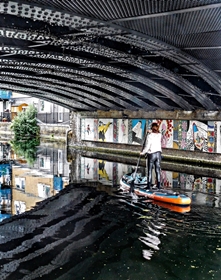
THE PADDINGTON ARM of the Grand Union Canal connects Paddington Basin to Bull’s Bridge at Hayes. It was opened in 1801 and was an important transport route before the growth of railway usage in England. Today, it is used mainly for leisure. People enjoy walking, running, and cycling along its well-maintained towpaths. Others keep long canal boats, known as ‘narrow boats, on the water. Some live in these vessels, others use them to move slowly through Britain’s antique but still usable canal network.


BLOG CANAL


During my teens, I used to explore London with three good friends and an excellent guidebook to London’s quirkier sights, “Nairn’s London” written by Ian Nairn. We walked along the banks of the River Thames, which were undeveloped and somewhat sinister in the late 1960s. In those days, there were stretches of riverside that had barely altered since the era of Charles Dickens.  Nowadays, there are few if any stretches of the Thames in London, which have not been made ‘visitor friendly’.

One day, the four of us decided to walk along the Grand Union Canal, starting our exploration at Camden Lock, now a crowded, popular tourist area. We followed the Regents Canal to the point where it enters the Maida Vale Tunnel, and then re-joined it where it emerged. From Little Venice, we continued westward along the Paddington Arm. For most of the way, we saw nobody else on the towpath. As we headed further west, the canal began running through a dreary semi-industrial neighbourhood. Just before we reached the road bridge that carries Ladbroke Grove over the canal, we saw a gang of young men in leather jackets, who looked at us menacingly. They were busy throwing a motorcycle into the canal. We did not like the look of them and decided that we had seen enough of the canal.

Years later, we joined other friends on a boat trip that began at Camden Lock and continued along the canal to Greenford, a suburb in the far west of London. The trip was very picturesque as far as Ladbroke Grove, but the remaining long stretch was less exciting. West of Ladbroke Grove, the canal winds past industrial buildings and the gardens at the back of residential houses. Later, we accompanied the same friends on a boat trip that took us east from Camden Lock. This was a far more interesting ride as its route includes many fascinating built-up urban areas of east London, which have a richer history than the suburbs of west London. It included a visit to the Olympic Games park that was being constructed at the time.

Today, my wife and I re-visited the Paddington Arm, walking the short stretch between the Harrow Road bridge and the point where, long ago, my friends and I saw the young men throwing a motorbike into the water. We did not see anything like that but had to contend with the almost continuous stream of cyclists sharing the towpath. Most of them were courteous, but a few inconsiderate wildly pedalling folk seemed to think that they were taking part in the Tour de France. Given that it was a Sunday afternoon, it was not too busy to make walking along the towpath anything but enjoyable.

Military disasters

IT IS ALWAYS PLEASING to read about a subject that is new to me. A friend gave me a copy of “Fall of the Double Eagle” by John Schindler. It deals with the conflict between Austria Hungary (‘AH’) and its enemies Russia and Serbia at the beginning of WW1.

BLOG book

Schindler’s book is clearly written and engaging. It reveals a tale of truly lethal incompetence, that of the military leaders of AH during their pointless attacks on Galicia and Serbia. These were confrontations whose aim appeared to be to satisfy the egos of the arrogant leaders of AH’s military.

With the exception of skilful use of radio interception of Russian signals, everything else that the leaders of AH’s military laid their hands on led to the unnecessary deaths and injuries of a horrendously large number of brave and loyal soldiers. These soldiers, drawn from all of the numerous ethnic groups in the AH Empire, were united in their loyalty to their Habsburg rulers and very brave in battle. However, the incompetence of their superiors rendered their bravery pointless and in most cases their actions resembled those of lemmings running towards a lethal ending.

Despite knowledge of recent examples of modern warfare, the Anglo-Boer War, the Russo-Japanese War, the Balkan Wars, the AH high command made little or no attempt to update military equipment and tactics/strategies. Schindler describes this well, and also the unwillingness of the AH government to invest money on bringing the military up to date. Consequently, when the AH armies came into conflict with the Russians and Serbians, courage and bravery were futile in the face of superior artillery and tactics.

What Schindler describes brilliantly in his book is a tragic epic of incompetence. The military leaders of AH should have had, but did not appear to have had, very bad consciences in the light of the number of fatalities caused by their negligence.

Reading Schindler’s fascinating compendium of official arrogance, refusing to learn from experience, and lack of foresight, during the first years of WW1, made me have worrying thoughts about what is going on around us today during the current pandemic.

I recommend Schindler’s book to anyone interested in WW1 and/or the importance of competent planning by governments.

PS: The inclusion of some maps might have been helpful to assist the reader in following the exciting descriptions of some of the campaigns described.

A novel idea

BY 2010, I HAD DONE a great deal of research on the backgrounds of both my parents’ families. I had published a few papers in prestigious genealogical journals, such as the former “Stammbaum” published by the Leo Baeck Institute in New York. I felt that it was time to combine the results of my investigations into a great compendium. I started compiling this with a view to publishing it eventually. After writing a couple of chapters, I sent them to a wise friend to get her reactions to what I had done so far. She wrote back that she was impressed by the research I had done but found that the chapters of my great compendium made for dull reading. She suggested that I should abandon the enterprise and instead choose one of my ancestors and write a novel based on what I had discovered about his or her life. I liked the idea.
ALI BLOG

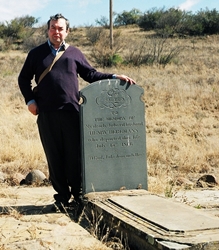
Adam Yamey at the grave of his ancestor Heinrich Bergmann. In Aliwal North, South Africa

I chose Heinrich Bergmann (1831-66), my mother’s grandmother’s cousin. He was the first person to whom I am related to have left Europe for South Africa. He sailed from London to Cape Town in 1849, hoping to meet someone who had migrated from his village in Bavaria to South Africa. That person had left Cape Town by the time Heinrich arrived. He soon became employed by the German Jewish traders, the Mosenthals, and within a year of landing in Africa, he was put in charge of opening and running a branch of the firm in the newly established town of Aliwal North. Within a short time, Heinrich became very wealthy and was regarded by a highly respected banking family in Frankfurt-am-Main as being a suitable bridegroom for their daughter. The happy couple returned to Aliwal North from Germany, after they married. However, Heinrich’s rapid increase in prosperity led to problems that could only be resolved by taking a drastic measure. 

I wrote a novel, “Aliwal”, based on what I knew about Heinrich and the times he lived in. As the cause(s) of his downfall are not clear, I invented a sequence of events to replace the gaps in my knowledge of his short life.  I embarked on my novel-writing not having read a novel for over twenty years. Some people who have read “Aliwal” say that can be seen in my writing and what I produced was more like a narrative than a modern novel. I cannot argue with that. Except for the last few chapters, the denouement, which I invented, what I have written is largely based on historical research. I tried to transport myself back to mid-19th century Germany and South Africa to explore the kind of experiences that my ancestor may have encountered. For example: how did he learn English so quickly? Did he need a passport to travel? How did he find his spouse? What was it like landing in Cape Town in 1849? What was it like travelling through the arid interior of the Cape Colony? How did a young Jewish man interact with the English, the Boers, and the Africans? What was it like doing business in rural communities? I hope that all of these and other matters have been adequately covered in my novel.

When I read through what I wrote 10 years ago, I wondered if it would be worth bringing out a revised edition with a new ending. Let me think about that. Now here is an excerpt from the original version. In it, Heinrich is travelling from Cape Town to Graaff-Reinet in the heart of the Cape Colony soon after landing from London and meeting Mr Caro, with whom he is about to work.

THE EXCERPT FROM “ALIWAL”

They travelled for well over a week, lumbering from one pothole to the next, leaving behind them clouds of dust that hung above the road along which they had come. Heinrich clung onto the bench on which he was perched in order not to be thrown to the ground. This journey was more uncomfortable that any he had made in Europe. He thought that even the worst tracks around Dittenheim were not as bad the one along which they were travelling, and this was the main road to Graaff Reinet! They crossed numerous dried up streams and riverbeds. Most of these were without a bridge. This made the crossings slow and dangerous. The wiry, muscular native helpers sweated profusely as they eased the wagons down one bank of a riverbed, and then steadied them as they were hauled up the other. They had to take care to avoid damaging the wheels and axles of the wagons. Whenever they reached a pool or any other water, Caro ordered the convoy to stop to allow the oxen to rest and drink. Heinrich used these breaks as an opportunity to stretch his legs and give his aching backside a rest.

The days slipped by. They met few other travellers apart from the infrequent wagon trains heading back to the coast, and post carriers who hurried past them on horseback. The few Europeans they encountered were mostly Dutch speakers, eking out a living on their isolated farms. After having drunk coffee with some of these farmers, Heinrich remarked:

“These Afrikaners are friendly, open, and welcoming.”

“Yes, Heinrich, they are, especially to us Jews, because they regard us highly.”

“That makes a change!”

“They welcome us because they read in the Old Testament, whose words they follow closely, that we are God’s ‘Chosen People’, and understand our flight from Egypt.”

“Why?”

“Not so long ago, many of the Dutch fled from the British, whom they regard as oppressors. They piled their possessions in to wagons like ours, and left the Cape, crossing the Orange River – their ‘Red Sea’ – in search of their ‘promised land’. They are trying to live the way they choose, without interference from outsiders. The main thing is, as far as we Jews are concerned, that the Afrikaners respect us as fair and honest people, and like doing business with us.”

“And how do the English regard us?”

Caro did not answer immediately. He looked ahead towards the flat horizon, and then said:

“The English are not easy people. They say one thing, but often mean something else. Mastering their language is one achievement but deciphering what they really mean is quite another. Their attitude towards us is more of tolerance than acceptance. It is odd that the British, who have spread themselves all over the globe, are wary of foreigners and what they consider to be foreign ways. They put up with us Jews because we are useful to them and we don’t make trouble, but they’re not at ease with us.”

He turned away from Heinrich, and, standing precariously on the wagon’s seat that tilted as the vehicle crossed a pothole, ordered the men to stop and set up camp for the night. Then, turning to Heinrich, he said:

“To succeed with the English, we need to try to be, or at least to seem to be, more British than they are. We must emulate their ways when dealing with them, so that they feel that they should treat us as equals rather than ‘inferior foreigners’.”

After the sun had set, Heinrich and Caro sat by the embers of the fire having just eaten tasty steaks from a small hartebeest that Caro had shot earlier that day. They were enjoying a post-prandial brandy when Caro announced:

            “We must do something about your name.”

 “My name, what’s wrong with it?”

 “Even when your accent fades away and your English improves, your name, ‘Heinrich’, will always label you as foreign.”

Heinrich remembered the shipping agent in London: Gladstone, formerly ‘Goldstein’.

Caro plucked a meerschaum pipe from his jacket pocket and lit the tobacco in its ivory bowl carved in the shape of a sheep’s head. His face, barely visible in the dim evening light, brightened for a moment. He sucked on his pipe, and then, after blowing a cloud of smoke towards Heinrich, he coughed, cleared his throat, and said: 

“From now on, you must call yourself ‘Henry’. It is a name which you will share with eight kings of England! Keep ‘Bergmann’, but change the way you pronounce it.”

Heinrich looked puzzled. Caro sucked noisily on his pipe, and then said:

“From now on you are ‘Berg-man’, not ‘Berch mun’ – try to express your name in your mouth, not in your throat!”

Caro looked at Heinrich sternly for a moment, and then asked him his name.

“My name is Henry Berg … mann.”

END OF EXCERPT

ALI cover

In case you feel intrigued and want to read more, my book is available on Amazon: https://www.amazon.co.uk/gp/product/144618322X/ and also on Kindle.