Unknown's avatar

About yamey

Active author and retired dentist. You can discover my books by visiting my website www.adamyamey.co.uk .

To Maurice from Bob

THERE WERE AT LEAST 3 JEWISH girls in my wife’s school class in Calcutta during the mid 1960s. Then, the city had a sizeable Jewish community, many of its members and their ancestors having migrated from Iraq, especially Baghdad.

Recently, a friend gave me an old book about the Tollygunge Club in Calcutta. Inside it, there is an undated handwritten inscription: “To Maurice, with love from Bob”.
My friend did not know who Bob is or was, but told me that the book was part of a collection once owned by Dr Maurice Shellim.

Maurice Shellim, a was born in a Baghdadi Jewish family in Shanghai (China) in 1915 and died in London (UK) in 2009 (see: http://www.jewishcalcutta.in/exhibits/show/notable_members/maurice-shellim).

By profession, Maurice was a medical doctor. According to Dalia Ray, writing in her book “The Jews of India”, he was a Member of the Royal College of Surgeons and Physicians (London), having studied medicine at London’s Guys Hospital. Ray also records that he took part in the functioning of a free medical clinic set up by his coreligionist Dr E Musleah.

After buying a painting by Thomas Daniell (19th century painter of Indian scenes), Maurice Shellim became very interested in Daniell and other British painters in India. Eventually, he published a book about Daniell and his nephew William Daniell: “India and the Daniells: Oil Paintings of India and the East”.

Maurice also published a book about the historic Park Street Cemetery in Calcutta. He had devoted much time and energy to conserving this picturesque resting place for the remains of British families.

In his later years, Maurice and his immediate family moved to London, but he often visited Calcutta.

Most of Calcutta’s Jewish people have left the city to settle abroad. Although anti-Semitism has never been a problem in India, many of Calcutta’s Jewish folk chose to leave in the decades following 1947. Probably, many of them left to improve their economic prospects, but Dalia Ray suggests that because most Indian Jews had been pro British they began to feel that they might begin to feel uneasy in independent India. She also wrote that after the establishment of Israel as a sovereign state, many Jews wanted to fulfil their centuries old desire to reach the Promised Land.

Today, there are very few Jewish people left living in Calcutta.

I would not have been likely to have discovered the story of the remarkable, highly cultured Dr Shellim had I not seen that scribbled inscription in an old book.

PS: ‘Bob’ was most probably Bob Wright, a Britisher who lived in Calcutta for over 30 years. He worked for a large company and was involved in the management of the Tolleygunge Club.
A quartet of heroes

MADAM CAMA ROAD IN BOMBAY is so named to commemorate the Indian pro-independence Mme Bikhaiji Cama, a Parsi who was born in Navsari in 1861 and died in 1936 in Bombay. Some of her bold exploits are described in my book “Ideas, Bombs, and Bullets”.

It is appropriate that in the street named after her, there are statues of two men who played significant roles in India’s fight for independence: Mahatma Gandhi and Jawarharlal Nehru.

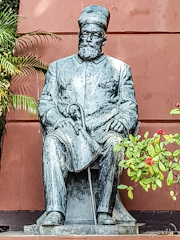
A third statue in the street depicts another eminent Parsi born in Navsari: Jamsetji N Tata (1839-1904). Though not a freedom fighter, he did much to revolutionise industry in India. Starting with the cotton business, he soon became known as “the father of Indian Industry”.

In 1903, Tata opened the now famous Taj Mahal Hotel in Bombay. His successors, members of his family, established the variety of industries now known as the Tata Group. His family also fulfilled his ambition of creating educational institutions in his name with Tata money, for example The Indian Institute of Science in Bangalore.

It is appropriate that the statue of Jamsetji Tata is close to that of other important players in India’s independence movement, Gandhi and Nehru, because Tata was a keen supporter of the Swadeshi movement. That is to say, he encouraged the production of products made in India to reduce or prevent the need to import these same products. In Tata’s case, he set up cotton mills to produce cotton fabrics in India, reducing the need to import them from Manchester.

A plaque at the base of Jamsetji’s statue records that it was unveiled in 1912 by George Clarke (1848-1933), Governor of Bombay between 1907 and 1913. Incidentally, in 1907 he considered Vinayak Savarkar, future Hindu nationalist and father of Hindutva, to have been “one of the most dangerous men that India had ever produced” Clarke was a liberal, but became a supporter of fascism later in life (in the 1930s). I wonder what he thought about the Swadeshi movement as he unveiled the statue.

Madam Cama Road is not very long, yet it commemorates four people who in different ways helped India throw off the yoke of the British Empire.

Islands of worship

IN HYDERABAD, BOMBAY, and Calcutta I have seen mosques or large dargahs (mausoleums) located on islands in the middle of roads. Traffic flows on both sides of the places of worship like river water flowing around a rock.

I mentioned this to my wife, who reminded me that London has at least two churches that stand on islands around which traffic flows. Two of them are on the busy Strand: St Clement Danes and St Mary le Strand. This got me thinking about other places where a place of worship stands in a position that forces traffic to move around it. Only one place springs to mind as I write this. There is a small church in a street leading off Syntagma Square in Athens (Greece) that stands on an island in the middle of a street ( or, at least it did when I last visited the city in 1980).

Why are these places of worship on traffic islands? Maybe, the shrines were built before roads were laid out or perhaps a road was widened leaving the holy places stranded in the middle of the enlarged thoroughfare.

A flight of pigeons

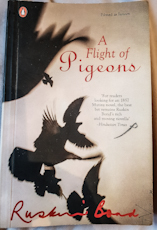
I FOUND MY COPY of “A Flight of Pigeons”, a short novel by Ruskin Bond (born 1934), amongst a collection of books about birds in the gift shop at Sanjay Gandhi National Park just north of Bombay. The book has little or nothing that would be of interest to ornithologists and other nature lovers.

The novel is about some English ladies during the First War of Indian Independence (‘Indian Mutiny’; 1857-58). They are some of the only survivors of an attack by Pathan forces on the town of Shahjahanpur.

The ladies are first given refuge by a Kayasth family, and then by various Pathan families. Having some Indian ancestry and a knowledge of Urdu, these English refugees were more or less successfully accepted into the Muslim Pathan families.

The young daughter, Ruth, becomes the object of the amorous intentions of one of the Pathans, who wants to marry her. Ruth’s mother has to try to prevent this from happening. I will not reveal what happens because I do not want to spoil the enjoyment of the reader of this simply told, compelling short book.

This is the first book I have read by Ruskin Bond. If it is typical of his writing, then I want to read more. Like the Albanian novelist Ismail Kadare, Bond skilfully manages to pack much into his book with great economy of words.

Buttered buns in Bombay

LOOKING A BIT LIKE A GRUBBY SWISS chalet, Yazdani Restaurant and Bakery is in a busy lane within a stone’s throw of Bombay’s elegantly designed Horniman Circle. Named after the Persian city of Yazd, where one of the nine Athash Behrams (the highest grade of Zoroastrian fire temples) still stands, this establishment was founded by a Parsi family in the very early 1950s. It has been suggested that the premises occupied by Yazdani were previously occupied by a Japanese bank.

Yazdani, which looks as if it has not been redecorated for many decades is one of Bombay’s many ‘Irani cafés’, which were founded by Iranian zoroastrian refugees, who had fled to India (in the early 20th century) from other parts of Asia to escape religious persecution. Irani cafés, like Yazdani, retain a nostalgic charm, providing an atmosphere that transports the customer’s imagination back to a gentler and simpler past. Sadly, the number of Irani cafés in Bombay is diminishing.

It was at Yazdani, when I first visited it a year ago, that I bit into my first bun maska. It was love at first bite. What is it, you may well ask, that gave me so much pleasure? It is simply a round bread bun, often very soft, filled with a generous, if not excessive, amount of butter. Some of the buns available at Yazdani contain bits of raisin and others, the brun maska, have crisp crusty coverings (similar to ‘crusty rolls’ available in England).

Bun maska has become popular outside Bombay.For example, I have discovered good ones in Ahmedabad (at Lucky’s and also at the New Irani Restaurant).

In addition to bun maska and brun maska, Yazdani sells bread, apple pie, and a variety of delicious biscuits. Everything is baked on the premises at Yazdani, which calls itself “La Boulangerie”. Tea is served at simple tables within sight of the aging glass fronted cabinets that are constantly being restocked with freshly baked products. It is common for customers to dip bits of bun maska into the tea.

On one wall, there is a large poster in German advertising Bauernbrot. Apparently, Yazdani is popular with German visitors to Bombay. Portraits of various Parsi personalities also hang on the walls.

Unless you are gluten intolerant or trying to lose weight, a visit to Yazdani is a real treat, and not a costly one.

A few footsteps away from Yazdani, stands another treat. This is the Peoples Book House. It is a small extremely well stocked bookshop which supplies mainly, but not exclusively, left wing books. Whatever your political leaning, you are likely to find fascinating books here (in English, Hindi, and Marathi, mainly). In its window, you can spot, for example, “Das Kapital” and books about Karl Marx translated into Marathi. I bought what promises to be an interesting book about the naval mutiny in Bombay that occurred just after the end of WW2 (early 1946), an event that hastened the British decision to quit India for good.

So, visit Yazdani to fill your stomach and Peoples Book House to feed your brain.

Fashion Street

Some years ago our daughter was in Bombay. She rang us and told us that she was pleased that she was staying within walking distance of Fashion Street.

Imagining that Fashion Street was something like London’s Bond Street or the Rue Faubourg St Honoré in Paris, my heart sank hearing this. Was our daughter going to spend all of her money in Fashion Street, I wondered.

Several months later, I visited Bombay and saw Fashion Street for the first time, and then I realised rapidly that I need not have worried. Fashion Street, unlike Bond Street, is a place to get clothes at very reasonable prices.

Bombay long ago

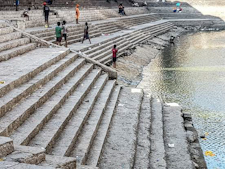
IN THE TWELFTH CENTURY AD, long before the islands on which Bombay now stands were occupied by the Mughals, then the Portuguese, and then the British, Lakshman Prabhu, a minister in the court of the Sihara Dynasty (8th to 13th centuries AD), built a tank (reservoir) on what is now the elegant residential area known as Malabar Hill. This water body, the Banganga Tank, was rebuilt in 1715 and had been cleaned up recently. Neither my wife nor I had heard of it until a correspondent, Donna Young, suggested we visit it.

The approach road that leads off one of the main roads in Malabar Hill enters an area where on one side of the thoroughfare there are expensive apartment blocks. They face a line of badly built modest homes (slightly better than slum dwellings and some with TV satellite dish aerials) all of which must have great views of the Arabian Sea.

The tank is rectangular in plan and surrounded by steps with wide landings leading down to the water, which enters the pool at one corner at a fast rate of flow. Ducks and geese rest on the steps or swim in the water in the tank.

The tank is surrounded by low buildings, many of which are Hindu temples. Occasional gaps between the buildings have staircases that lead down to the steps surrounding the tank. Some of these gaps are flanked by towers containing many niches for placing diyas (oil lamps). Some of these have become perching places popular with pigeons.

The road running around the tank is the only thoroughfare for the community, mainly Hindus, who live around the tank. This community, though by no means impoverished, is far less prosperous than that which occupies most of Malabar Hill.

Banganga Tank is very picturesque and a complete contrast to its surrounding elegant mansions and apartment blocks built mainly from the 1920s onwards. It is a well preserved early mediaeval environment in the heart of busy, modern Bombay. It should be on tourists’ itineraries, and judging by a group of middle-aged Italian camera toting tourists I saw, I believe it is already.

While I was wandering around exploring, my wife sat on a wall near some parked motorcycles. There were some young men joking amongst each other nearby. One said to another: “You are fourth class fail.” He replied: ”You are second class fail.” At this point, my wife asked if one of the bikes could be moved slightly to give her legs more room. As a third boy shifted the bike, one of the others laughed and said: “Oho, that one is KG fail” (KG is short for kindergarten).

Canine celebration

IT IS NOT SO OFTEN that I am invited to a dog’s birthday party in Bombay, let alone anywhere else. Yet, early one Sunday morning this February we were picked up by a friend and driven to Marine Drive with its elegant curving seafront lined with apartment blocks, many of which are designed in the Art Deco style.

We joined a group of our host’s congenial friends, all of whom had brought their dogs to the party. Everyone had arrived with snacks for breakfast. The group meets every Sunday and their dogs greet each other like old friends.

While we humans filled ourselves with sandwiches, patties, samosas, cakes (some eggless for strict vegetarians), biscuits, and hot tea, the dogs lapped up icecream. A few stray dogs joined the party whilst crows looked on enviously. Some of the stray dogs had thin string collars with small labels. These dogs are being considered for adoption by dog lovers. Stray dogs, often intelligent and very ‘street wise’, make good pets once they have had appropriate vaccinations.

We had attended our friend’s dog’s birthday two years ago. It was a relatively quiet occasion because the seashore promenade on Marine Drive had been fairly empty apart from occasional joggers and cyclists. This year it was different.

The promenade was chock full of children out for an early morning charity fun(?) run. Swarms of children of school age were moving along the wide pavement, some bearing banners with the names of their schools. There was much shouting and maasti (fooling around). Most of the children were wearing black tee-shirts with the name of the charity for which they were raising money (Terry Fox Cancer fund). At first glance, this seemingly endless procession of kids with banners looked like a political rally.

Some of the children seemed not to know or care about the direction they were supposed to be running. Many of them stopped to pet the dogs and to take photos of each other with the creatures. We asked some children why they were out running. They answered that they had no idea but their teachers had told them to do it.

While the kids were running or walking past us, they made a great noise as already mentioned but every few minutes this was drowned out by powerful motorcycles racing at high speed along Marine Drive. We were told that this also happens late at night and each year this reckless, careless driving (‘rash driving’ in Indian English) results in many fatalities on Marine Drive.

When we arrived at the party there was a thick mist or haze that almost hid the buildings around and far across the bay. By the time we left, having enjoyed the party and all that was going on around us, visibility had improved and we could see across the bay much more clearly, but not perfectly.

I am looking forward to another doggy birthday party in Bombay next year! Take a lead from me: canine celebrations can be great fun.

Headquarters of Gandhi in Bombay

MAHATMA GANDHI TRAVELLED much during his life. I have visited several of the places in India, which were important landmarks in his life: Porbandar, Rajkot, Bhavnagar, Ahmedabad, and Bombay. The latter saw much of Gandhi both before and after he had lived, worked, and campaigned in South Africa.

Mani Bhavan, a mansion in Laburnum Road in the Gamdevi district of Bombay, was owned by Revashankar Jagjeevan Jhaveri, a friend of Gandhi. It became Gandhi’s headquarters in Bombay between 1917 and 1934. Now, it is a popular museum dedicated to the history of Gandhi’s eventful life in South Africa, India, and elsewhere.

Most of the exhibits in the Mani Bhavan are photographs, many of which I have seen elsewhere. However, I had never before seen a photo of the Mahatma with his famous admirer Charlie Chaplin. There is also a photograph of the letter that Gandhi wrote to Adolf Hitler on the 27th July 1939, encouraging the German dictator to adopt peaceful methods rather than going to war. The British authorities did not allow this letter to reach Germany, let alone leave India.

There is a room on the second floor in which Gandhi used to spend much time spinning. It contains several of the spinning wheels that he used daily.

On the second floor, there is also a gallery with a series of dioramas, each one illustrating a different episode in the life of Gandhi. One of them shows the future Mahatma being thrown out of a first class railway compartment in Pietermaritzburg Station in Natal, South Africa. Another, shows him at a public burning in Bombay of cloth and clothes imported into India. This occurred in 1921. Gandhi was by no means the first to burn foreign cloth in India. Many years earlier, Vinayak Damodar Savarkar, a father of Hindutva, supervised a bonfire of imported cloth in Nasik.

The well made dioramas reminded me of those I had seen at the Godra Ambe Dham temple complex near Kutch Mandvi. The ones at Ambe Dham are moralistic in content, chronicling the virtues of a healthy Hindu life and the awful consequences of straying from it.

The Mani Bhavan had plenty of foreign visitors, most of whom seemed very interested in what is on display.

Of all the Ghandhian sites I have visited in India so far, the Mani Bhavan has impressed me least. If pressed to say which have impressed and moved me most, I would choose Gandhi’s birthplace in Porbandar, his classroom in what used to be Samaldas College in Bhavnagar, and his first ashram in Ahmedabad, the Kochrab Ashram. Had I not already visited these three places nor seen the superb collection of Ghandian photos in the Gandhi Smrti in Bhavnagar, I think that a visit to the Mani Bhavan would have been more interesting for me than it was. I am pleasrd that I have visited the place because I enjoy following in the footsteps of the life of one of the most intriguing personalities in the history of India, nay the whole world.

However great or small your interest in Gandhi might be, visiting Mani Bhavan brings you to a part of Bombay rich in elegant mansions built by prosperous citizens over 100 years ago.

Hollowed out of the rock

WE HAVE VISITED BUDDHIST cave temples carved out of the ‘living’ rock in the following places: Junagadh, Somnath, and Siyot (near Lakhpat in Kutch). A young Dutch tourist, whom we met at Dholavira, showed us his photos of some other spectacular Buddhist rock caves at Kanheri in the heart of the Sanjay Gandhi National Park, which is close to Borivali (about 32 kilometres north of Bombay Churchgate Station).

The 109 caves contain inscriptions dating from the 1st to 11th centuries AD. These help to age their construction. They are carved out of a basalt outcrop about 7 kilometres away from the Park’s main entrance.

We travelled to Borivali on a fast, limited stop train from Churchgate Station. It is lucky we bought first class tickets because the second class sections become very crowded at intermediate stations such as Bombay Central, Dadar, Bandra, and Andheri. We were glad that we had paid the extra fare because the train we took back Bombay was very crowded, but slightly less so in the first class.

A short autorickshaw drive brings one from Borivali station to the entrance of the national park. There, we were badgered by a young man who gave us incorrect and untruthful information about travelling the seven kilometres up the hillside to the caves. He suggested it would be best to hire a car for 1500 Rupees. Otherwise, we would have to wait for two hours before a public bus departed. He was fibbing. In fact, there is a very regular bus, which we boarded, that covers the distance for 10 Rupees per head.

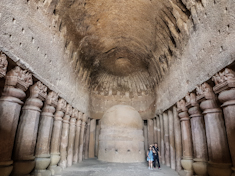
The Kanheri Caves are a paradise for lovers of antiquities and the antics of wild monkeys. There are 109 manmade caves carved out of the rock, but only three of them are visually interesting. Cave number 3 is the most impressive. A ‘vestibule’ flanked by two massive sculptures (standing Buddhas), many times the height of an average human being, contains many other beautifully carved figurative sculptures. The vestibule lead into a huge manmade cave that in many ways resembles a vast romanesque basilica. The walls of this voluminous chamber have pillars carved from the rock as well as other sculptures depicting animals and deities. The pillars line the sides of a central space that resembles the nave of a church. The wall at the far end of this room is curved like the apse of a church. A large cylindrical stone object, of religious significance, sits in the ‘apse’. There is a curved passageway separating this cylindrical stone from the curved wall of the ‘apse’. Compared with other Buddhist cave temples I have seen, this particular cave beats them all in terms of size and beauty.

I clambered up the hillside to see some of the other temples. I saw about ten of them, but none contained any carvings that I could see. Many of them looked manmade and most of them provided shady places for visitors to sit, chat, and take selfies.

I do not know whether it is of any significance but I noticed that many of the caves are carved into the rocks that form a valley for a stream that still contains water. Maybe, the cave carvers chose to make their caves here because of the water supply provided by the stream.

On our way out of the cave area, we stopped to buy some books. This proved to be a lengthy business because it involved much paperwork that involved three officials.

The train journey back to Churchgate was uneventful once we were on board. Waiting for the train was unnecessarily exciting as the platforms at which trains were expected to arrive kept being changed.

Having visited the Kanheri Caves, I can recommend them highly to everyone visiting or living in Bombay (except those who cannot manage stairs).