Unknown's avatar

About yamey

Active author and retired dentist. You can discover my books by visiting my website www.adamyamey.co.uk .

Taking the plunge

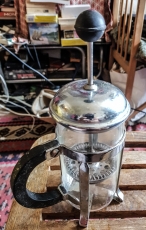
MOST COFFEE DRINKERS will be familiar with the cafetiere or French press (‘caffettiera a stantuffo’ in Italian and ‘Stempelkanne’ in German). The earliest versions of this were patented in the 1920s. For those not familiar with these devices, let me explain how they are used. Coffee grounds and hot water are introduced into an open topped cylindrical vessel, often made in glass but also in metal and plastic. After waiting for the coffee to brew, and people argue how long this should be, a plunger that snugly fits the opening of the vessel is placed on the surface of the hot coffee mixture. The plunger has a metal sieve that does not permit the passage of coffee grounds through it. This plunger is attached to a metal rod, by which pressure can be exerted to drive the sieve through the liquid towards the bottom of the vessel. As it moves downward, the coffee grounds become separated from the liquid (the brewed coffee) above it. Then the coffee, free of grounds, can be served.

BLOG CAF

In the early 1960s, the cafetiere became a fashionable way of preparing and serving coffee. My mother and her sister were quick to buy one for each of their homes. They were elegantly designed with clear glass vessels and shiny steel holders with black handles. And, the coffee they produce is good.

My mother kept using our cafetiere until disaster struck. It did not happen to her but to her brother-in-law. One evening after dinner, my uncle began plunging the filter through the hot coffee when something slipped causing the plunger to descend far too rapidly. As it shot down into the boiling hot coffee, the liquid shot up onto my uncle’s arm and caused him serious burns. Hearing of this unfortunate event, my over-cautious mother decided that far from being useful, the cafetiere was a potentially lethal weapon. So, our cafetiere was decommissioned, never to be used again. My uncle’s family continued to use their cafetiere(s) despite the accident.

Many years later, my wife and I were entertaining guests one evening. My wife had filled a large glass cafetiere with coffee and hot water and told me to plunge the filter whilst she sat down with our friends. Usually when you press the filter plunger into the brew, there is some resistance as the coffee grounds begin the reduce the flow of water through the fine filter mesh. On this occasion, I encountered some resistance as expected but then something unexpected happened. Each time I applied pressure and then released it, the filter disc began rising up towards the opening of the glass vessel. This happened repeatedly and it became increasingly difficult to depress the filter. It seemed as if the coffee was fighting back, pushing the filter plunger upwards.

Eventually, I managed to force the plunger down sufficiently and I served the coffee, somewhat mystified. After the guests had left, I examined our weirdly behaving cafetiere. I removed the plunger and found a deformed stainless-steel spoon amongst the compressed coffee grounds. The formerly straight stem of the spoon had become bent into a ‘U’ shape. I had applied sufficient pressure to the plunger to bend the spoon. I felt as if I had become Uri Geller, famous for his spoon bending tricks. Fortunately, and amazingly, the glass vessel of the cafetiere did not break or even crack.

Breakages are common amongst the glass vessels used in cafetieres. It is not the making of coffee that breaks them but dropping them on hard surfaces does them no good. We now use cafetieres with stainless-steel vessels. Not only do these not break but also many of them have double walls to help keep the coffee warm.

Three towns in Devon

WHEN YOU LEAVE THE A38 road near Buckfastleigh and head southwards, you enter the Devonshire district of South Hams. This picturesque part of southwest England contains three towns that attract many visitors: Dartmouth, Kingsbridge, and Salcombe. Each is located on hilly terrain and has its own distinctive charms. All of them have steep streets that lead to places with great views.

BLOG HAMS 2

Dartmouth, the home of an important large naval college, occupies a position on the estuary of the River Dart. Although it attracts many holidaymakers, it has the feel of a working town. The river is filled with boats, some used by pleasure seekers, and others (including ferry boats and fishing vessels) are working craft.

Salcombe, like Dartmouth, perches on the slopes of the shore of an inlet of the sea. Of the three places mentioned in this essay, it has to win first prize for its setting and attractiveness. I have visited Salcombe both in August (high season) and in May (before the season began). During the high season, the small town is flooded with holidaymakers, day-trippers and those staying in the place (including many owners of second homes). The streets are almost clogged with people. In contrast, when we visited it in May, the tiny town was delightful and relaxing.

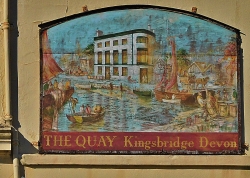
We have just returned from staying in Kingsbridge, which is a few miles up the same inlet as Salcombe. This is, at first sight, the least obviously alluring of the three towns. Hence, it attracts fewer visitors than Dartmouth and Salcombe. However, as you wander around the small streets in the historic centre of the town, its charms reveal themselves to the viewer. The town is rich in buildings from the 18th and early 19th centuries. The Quay, where the tidal inlet meets the town is beautifully landscaped. Visitors tend to congregate here to enjoy paddle-boarding, boating (when the tide is high enough), crab fishing, eating ice cream,and just passing the time of day. Also, the town has several excellent restaurants. Of these, I would single out: The Old Bakery (for well-prepared Mediterranean and Middle-Eastern style food), the Dodbrook Arms (with first-class cod and chips as well as other perfectly prepared dishes), and Woodys, which serves very good locally reared beef. Like Dartmouth, but unlike Salcombe, Kingsbridge gives the feeling of being more than a holiday destination; it is a real working town.

In between the three towns, there are many villages and beaches worthy of exploration. Of the three places, Kingsbridge has become my favourite and we hope to return to it soon to use it as a base to get to better acquainted with South Hams.

A bridge and a king


KINGSBRIDGE IS A SMALL town in South Devon. It lies at the head of an inlet of a ria (a completely submerged river valley) upon which the better-known and more popular resort of Salcombe is also located.

BLOG KING 3

 Many histories of Kingsbridge relate that the town resulted from the union of two neighbouring settlements, the neighbouring royal estates of Alvington and Chillington. Kingsbridge was formed around a bridge (possibly, a draw-bridge) that connected the two at the head of the inlet of the ria. The bridge was built by the 10th century. So far, so good, but today there is no bridge in the town of Kingsbridge.

If you drive from Kingsbridge towards Dartmouth via the A379 road, you will soon arrive at the New Bridge west of the town. This not so new bridge with five arches was built in 1845 and restored several times since then. It crosses Bowcombe Creek, another branch of the ria. This bridge is not, and has never, ben inside the town of Kingsbridge; it is well outside it. It is not, as has been suggested to me by several locals, the bridge that gave the town its name. So, where was the bridge?

By chance, I found a book about the history of Kingsbridge on-line. It is “Kingsbridge and its Surroundings” by SP Fox, published in 1874. This is the only source that I have found so far that mentions the site of the bridge in Kingsbridge. On page 10, the author noted:

“Nearly at the lower end, Fore Street is crossed at angles by Mill Street and Duc’c [now called Duke] Street, the former on the west side, leading to West Alvington and Salcombe; the latter on the east, in the direction of Totnes and Dartmouth, and uniting the towns of Kingsbridge and Dodbrooke by a very small bridge.”

The old bridge mentioned by Fox no longer exists, but the two streets mentioned do. Duke Street, which used to run through from Fore Street to Church Street near to the present Duke of Prussia pub (according to a late 19th century map), is now a cul-de-sac on which you can now find the main entrance to a popular fish and chips shop called ‘The Cod Father’. Mill Street is still a road leading towards West Alvington and Salcombe.

Where Fox describes the bridge, there is no sign of a ditch or stream today. Maybe, long ago there might have been a ditch or stream across which the bridge straddled. At the head of the inlet of the ria in Kingsbridge, there is a small arch, which might be the outlet to a formerly visible stream, which has long since been covered.

To add some complexity to the story, a modern source (https://kingsbridge.gov.uk/wp-content/uploads/2020/01/B13-Kingsbridge_Devon-Historic-Market-and-Coastal-Towns-Survey-Report.pdf) suggested that the bridge after which the town was named was not within the town itself but some way outside it:

“The exact site and function of the bridge is of great interest, as clear documentary evidence for an  Anglo-Saxon bridge in Devon is rare (Henderson and Jervoise 1938, 29; Hoskins 1954, 147), and, in the present context, because the development and character of the town, like its name, can be expected to have been fundamentally linked with that of the bridge and its highway. The attraction and shaping of urban growth to main roads and river crossings is a strong pattern across medieval Devon (Slater 1999). The detailed map analysis for the urban survey indicates that the early bridge may have crossed   the River – between routes later altered to become Love or Boon’s Lane on the west side, and Quay Street on the east – downstream from a tidal ford on the Mill Street-Duke Street route and below the extent of the medieval town…”

So, we cannot be certain of the location of the old bridge.

The coat of arms of Kingsbridge consists of a three-arched bridge surmounted by a royal crown. Whether or not the bridge had three arches is not at all certain, but the fact that it linked two royal estates justifies the presence of the crown. If the bridge was located where Fox believed, there was hardly enough width for a bridge with three arches.

But who was the king? It might well have been King Edgar, ‘The Peaceful’, who reigned from 959 to 975 AD. For, it was during his reign that a charter relating to boundaries dated 962 AD mentions the existence of a ‘king’s bridge’. That could also mean that the bridge was in existence before that king’s reign.

So, regardless of the actual position of the bridge after which Kingsbridge is named, we can be certain that the name is justified as there was a bridge somewhere in or near the town and it had royal connections. Whatever the origin of the name, the town of Kingsbridge is well worth a visit.

A familiar face

THE SCULPTOR ELIZABETH FRINK (1930-1993) was a close friend of my late mother, who was also a sculptor. I do not know how they met at first, but they remained close friends. ‘Liz’ Frink, as I knew her when I was a child, was a regular visitor to our family home in northwest London. After my mother died in 1980, I never saw Liz again. She was born in Suffolk (where one of her pieces stands in the garden of the cathedral of Bury St Edmunds), studied at both Guildford and Chelsea schools of art, and died in Dorset (at Blandford Forum, which is a few miles southwest of Salisbury).

FR 1 BLOG

Walking Madonna

Early in August (2020), we drove from London to Devon via Salisbury. There were two reasons that we chose the less direct route through the city of Salisbury. One was to avoid the motorway system as much as possible and to travel along roads that pass through lovely countryside. The other was to visit Salisbury, especially its cathedral and enclosed environs (the ‘Cathedral Close’). The cathedral, a masterpiece of Gothic architecture built mainly between 1220 and 1320, is worthy of a visit, or as the Michelin “Guides Vert” say in French, ‘vaut le détour’. The splendid architecture was one reason for our latest visit but not the main one. We had come to see an exhibition called “Celebrating 800 Years of Spirit and Endeavour”.

The exhibition consists of 20 works of art, mainly sculptural, displayed within the cathedral and outside it in the Cathedral Close. These works are in addition to the cathedral’s permanent collection of 9 sculptures. My favourites amongst the temporary works were pieces created by: Conrad Shawcross, Danny Lane, Subodh Gupta, Antony Gormley, Tony Cragg, Lynn Chadwick, Daniel Chadwick, and Grayson Perry.

I was intrigued by an electronic sculpture, ‘The Reader’. made in 2015 by an artist named Stanza (born 1962). It depicts a standing man reading a book. The book glows regularly and as it does, LED bulbs in different parts of his body glow for a few moments. The artwork attempts to show, quite successfully, how reading can affect the body and feelings of the reader.

Several of the artworks in the cathedral’s permanent collection particularly impressed me. One of these is a small stone carving by Emily Young, which stands in the cloisters. Also, in the cloisters, there is a large coloured sculpture by Barbara Hepworth, which recalled the works of the Dutch artist Piet Mondrian, a good friend of hers. It is called ‘Construction (Crucifixion’). Generally, I am not enthusiastic about her works, but this one, which is so different from most of her other creations, pleased me greatly.

There is another wonderful part of the permanent collection within the nave of the cathedral. This is a large baptismal font by William Pye. Installed in 2008, this huge vessel is filled to the brim with water which flows from it via four spouts. The surface of the water is perfectly smooth and acts as a mirror in which the architecture of the cathedral is reflected beautifully. It is truly a reflective piece in more than one sense of the adjective.

Outside the cathedral, there is a fine stone carving in white marble, ‘Angels Harmony’, by Helaine Blumenfeld. To me, it seemed to depict drapes being blown around in the wind. I liked this, but what really caught my eye was a rather dreary looking cast bronze sculpture, ‘Walking Madonna’. This life-size piece was made in 1981 by ‘our’ former family friend Liz Frink. At first, I glanced at it quickly, and then, for no special reason, I took a closer look. I experienced a strange feeling of ‘déja vu’ when I looked at the Madonna’s face. For a moment, I felt as if I was looking at Liz Frink’s face. As mentioned already, it is over 40 years since I last saw her. Yet, I had the feeling that I recognised her face. I have since learned that Frink often included her long jawline in the faces she sculpted, but it was not that which gave me the fleeting feeling of recognition. Instead, it was the nose and mouth on the depiction of the Madonna that sparked that momentary sensation that I was looking into Frink’s face. I have since compared photographs of the sculptor with those I took of the work on the lawns outside the cathedral. Comparing them, one cannot entirely rule out the possibility that Liz Frink was influenced by her own face when creating the ‘Walking Madonna’.

Whether or not Frink intended her sculpture to include her own face is up to the viewer, but in any case, I can strongly recommend a visit to Salisbury Cathedral before the enjoyable sculpture exhibition is dismantled.

Career tracking

LIKE MANY OTHER YOUNG BOYS, the idea of being a train driver appealed to me. I am pretty certain that my parents would not have been ecstatic had I ended up in the driving cab of a railway train. Once my father told me that he did not mind what I studied or what profession I took up eventually, so long as it was not economics (he was a professor of economics). He had no need to be concerned about that, as what I could gather about economics made it sound unappealing to me. So, what did I consider after my urge to drive trains diminished?

tracks

From an early age, I used to spend much of my spare time drawing and painting, pursuits encouraged by my mother, who was an accomplished, but lesser known (and not self-promoting) painter and sculptress. In addition, in my early teens, I began to develop an interest in ‘modern’ architects including Le Corbusier, Mies Van der Rohe, and Frank Lloyd Wright. I read books about them and the idea of studying architecture, to become an architect, entered my head. My hope was to create structures as beautiful and innovative as those, which I had read about. After a year or so, I was walking back to school from our dining hall when I was struck by a depressing thought. If I studied architecture for the required seven or so years, there was a good chance that I would not be undertaking major, exciting projects like those which had made my architectural heroes famous. Instead, I might very well have ended up designing loft rooms, domestic garages, garden room extensions, and similar important but mundane structures. This thought dampened my enthusiasm to pursue architecture as a profession.

My next idea was to become a schoolteacher like those who taught me at my secondary school. I am incredibly pleased that this idea was short-lived because over the years the conditions that many schoolteachers have had to endure have deteriorated continuously.

My father, now long retired, was a university teacher (he became a senior professor at the London School of Economics). From my young vantage point, his lifestyle looked good. Despite working hard, which he did, he had lovely colleagues and many pleasant students as well as long holidays. His profession appealed to me and set me on the path of pursuing studies which I hoped would lead to an academic career. After completing my BSc, I worked on a research topic that led to me being awarded a PhD.

As I reached the completion of my doctoral work, two things began to worry me. One was that none the other British-based workers in the field that I was working (connective tissue physiology), whom I met at conferences and seminars, seemed like people with whom I would enjoy working. The prospects for obtaining post-doctoral work abroad were not good, and at that time I had no yearning to live outside the UK.  Another thing that worried me, which I only realised after I left research, was that it was a lonely pursuit.

To cut a long story short, I began studying dentistry. I had an idea that with a clinical qualification, a wider range of research possibilities would become available to me. However, I discovered during the clinical dentistry course that I enjoyed working with people, members of the public, who were willing to risk their teeth in the hands of students. So, when I qualified as a dentist, instead of going back into research and academia, I began working as a practising dentist. I did this for 35 years with varying degrees of enjoyment and satisfaction. Overall, it was a valuable life experience for me, as I hope that it was for my patients.

I have been retired for over two years now and love it. Jokingly, I often tell friends that my main reason for going to work was to retire eventually. But there is an element of truth in this.  Even now, so many decades since my childhood, I still enjoy railways and rail travel. I have not yet completely lost that juvenile desire to drive a train. Maybe someday, I might get to ‘have a go’ at the controls of a train. I have heard that these days drivers of London’s Underground trains make quite a good living. The money would be satisfactory but,  more importantly, the thrill of controlling the train would be a fine reward.

Have you, dear readers, been satisfied with the tracks along which your working lives have travelled?

Life cycle

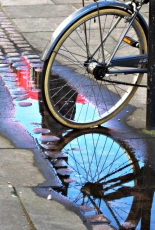
I HAVE OWNED ONLY ONE bicycle. My parents gave it to me as a gift when I was about twelve. My late mother, who was somewhat over-protective of my sister and me, restricted my use of the cycle to our not over large garden in northwest London. Cycling around in this confined face was hardly much fun. The bike fell into disuse.

BIKE 2

In the early 1970s, I met a friend in Luxembourg a few days before he was to be interviewed for a job in the administration of the European Parliament. We spent a night in a youth hostel in Echternach. On the following day, we hired cycles to do some exploring. We cycled over hill and dale, mostly uphill it seemed, through attractive forests until we reached the small town of Vianden about 18 miles away to the north. The bicycle, which I had hired, had a gear change lever attached to its handlebar. I kept fiddling with this as we rode through the summer heat, but it seemed to make no difference to how the vehicle moved.  

When we arrived in Vianden, we headed back on our return journey via a different route. We followed minor roads close to the River Sure, which forms the boundary between Luxembourg and Germany (in those days it was West Germany). There were many small bridges crossing the river and connecting the neighbouring countries. At each bridge, we moved from one country to the other, flitting through short tracts of, say, Germany before the next in Luxembourg. This was long before the Schengen Agreement was signed in 1985, but we were never stopped by border officials on either side of the river. That was lucky because both of us had (maybe unwisely) left our passports with our baggage.

When we got back to Echternach, we were both extremely thirsty and I was exhausted. We found a refreshment place with outdoor seats and tables and ordered chilled beers. I sat down and then promptly stood up again. Having sat on the saddle for so long, my backside had become bruised. It was at least three days after our excursion that sitting became comfortable again. It was only when we returned the cycles to the hire place that I noted that the gear adjuster lever was not connected to anything apart from the handlebar; the bike had no gear mechanism.

A few years later, in the early 1980s, I decided to go to the north of Holland, which was a part of the country I had never visited before. My plan was to cross the sea from Sheerness to Vlissingen on the luxurious Olau Line ferry, and then to travel from nearby Middelburg to various places in the north of Holland. At each place, I had decided to make use of the cycle hire service that was offered at Dutch railway stations. 

My first cycle excursion was around the peninsula on which Middelburg is located. On this first adventure with Dutch Railway cycles, I discovered three important things. First, the bicycles had no gears. This is not in itself a problem because Holland is not a hilly place. Next, the braking system is not operated by leavers on the handlebars. To slow or halt the cycle, the rider must reverse pedal. Thirdly, Holland can be a windy place. Cycling into the wind is as difficult as cycling up a hill. Well, the first outing was a useful learning experience.

Another thing that I learned but did not make use of was the fact that in those days most Dutch people woke up earlier than me. This meant that when I reached the cycle hire offices at railway stations, there were few cycles left for me to select. Most of those available were far too large for me. I was able to ride them, but unable to reach the ground with my feet when I was perched on the saddle. The only way I could cope was to cycle up to a lamp post or telegraph pole, and steady myself by putting one of my hands against it.

I stayed in Leeuwarden in the far north of Holland, a place that I had long wanted to see – why, I cannot recall any longer. I rented a bike to visit the picturesque coastal town of Harlingen. I returned in the early evening and had a brief rest at my hotel. At about 7.30 pm, I decided to look for somewhere to eat. Almost everywhere had stopped serving dinner because people dine early in Leeuwarden. After eating a pizza in a non-descript place, the evening was still young, but the city seemed deserted. Where was everyone, I wondered. Surely, they had not all retired to bed so early. I strolled the empty streets for a while and found a pub that was open. I entered. It was full, but far from lively. People were either chatting quietly or sitting in chairs reading books or newspapers. The pub felt like a rather crowded cosy sitting room.

One highlight of that visit to Holland was cycling along the Afsluitdyk, a man-made causeway constructed between 1927 and 1932. It is over 20 miles long and separates the North Sea from the Ijsselmeer, now an inland lake but once a huge inlet of the sea. The ride, like most others I made in Holland, was windy.

Since my Dutch cycling adventures, I cannot remember pedalling a cycle again until 1993, when I was ‘courting’ my wife. On one occasion when I visited her health club, she encouraged me to try an exercise bike. She sat on the machine next to mine and an athletic fellow sat on one on the other side of mine. My wife pedalled away energetically with the book she was reading balanced on the handlebar. My male neighbour pedalled as furiously as he might have done had he been chased by a cheetah or a jaguar. Meanwhile, yours truly was unable to get the pedals to move at all. Clearly, I had either reached a stage in my life cycle when my strength was ebbing or a previous user of my machine had set the pedal resistance at a very high level (and I had no idea that it was  adjustable).

Me and maps

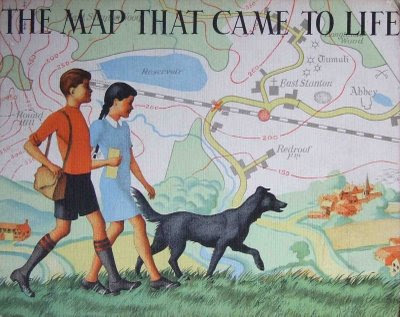
MY LOVE OF MAPS started soon after I was able to read. I was given a book that fascinated me for many years. It was called “The Map that came to Life” by HJ Deverson and R Lampitt. First published in 1948, it follows a couple of children walking through the countryside with their dog, guiding themselves with an Ordinance Survey map. On each page, there is a bit of their map and an illustration showing the terrain which is on that portion of the map. Not only did it teach me something about map reading but it helped me to visualise in three dimensions what is being represented in two dimensions on a map. It was one of my favourite books during my childhood.

MAP 1

From the age of eight years onwards until I was thirteen, I attended the Hall School, which is near to Swiss Cottage (in northwest London). Although there was a lot that I did not like about this academically top-rate establishment, I am grateful for at least one thing. One day when we were learning about Ordinance Survey maps in a geography class, our teacher gave us an exercise that stimulated a hobby that lasted until my late teens. The exercise was to draw an Ordinance Survey map of an imaginary place making correct use of the various symbols that appear on the real maps. Of all the academic tasks I was required to perform at the Hall School, this was the best.

Inadvertently, our geography teacher had sparked off a new craze for me. That was drawing maps of imaginary places. I was inspired not only to emulate Ordinance Survey maps but also to create maps of imaginary places in the styles of the ever-increasing number of maps that I had begun acquiring as a passionate map collector. I drew these maps using pencils, water-colour paints, biros, and fine-tipped Rotring pens (such as are used by architects and technical draftsmen).  Drawing maps occupied much of my precious spare time, time which my friends spent socialising and meeting members of the opposite sex.

After a while, I began drawing maps of an imaginary country, a socialist republic behind the so-called ‘Iron Curtain’. In addition to creating maps of my geographic invention, I produced illustrations, tourist brochures, and so on. Be patient because  I shall say much more about this imagine land in future postings.

When I began studying at university in 1970, my map drawing activities ended. However, my fascination with maps has never diminished. While sorting things at home, I have found the maps and drawings I made during my teenage years. Gradually, I will share some of these with you, dear readers.

I began this piece with a mention of a book that described a map that came to life. It was first published before I was born. Today, the authors’ concept has almost become reality with Google Maps. This useful service provides fairly detailed maps, which at the click of a ‘button’ become aerial views of the area that has been mapped out. At the click of another button, you can travel (virtually) along the streets on the maps and see the buildings and other things along them. While the maps do not really come to life, the Google mapping service has brought us closer to that happening for real. Let us wait and see what the future brings in the way of remote realisation of life in places on the map.

Photographic memories

THERE IS PHOTOGRAPHY IN MY GENES. My great-grandfather, Senator Franz Ginsberg (1862-1936) left his native Prussia to migrate to South Africa in 1880. He arrived in King Williams Town where he and his future bother-in-law Jakob Rindl established a photography studio, one of the first in southern Africa.

HAL 6

I became keen on photography as soon as an uncle, a keen amateur photographer who was closely related to Jakob Rindl and also Franz Ginsberg, had presented me with a simple Kodak Brownie camera when I was about seven years old. It was exciting taking photographs, waiting for the film to be developed at chemist or photography shops, and then opening the packet to discover whether the prints bore any decent looking images. In those early days, there were plenty of dud shots, but also a few decent ones. I graduated from the Brownie to another Kodak model, which had two lens and a viewfinder on top of the device. It was probably a version of the Brownie Reflex camera. It pleased me because it had a few things that could be adjusted whilst taking a picture.

As I got older, maybe over twelve years old, I began buying photography magazines. I soon realised that to achieve interesting results in photography, using a 35mm film camera was essential. I leafed through the issues, reading the reviews of cameras that sounded wonderful but were way beyond my budget. I was so fascinated by these sophisticated devices that I used to draw pictures, fantasising what I would have liked to have owned.

Eventually, there was a review of a camera that almost suited my pocket money budget, and which was likely to satisfy my desire to own a more complicated camera. The camera, which was given an excellent review was made by the Halina company and cost around £12.The Halina models were manufactured in Hong Kong by the Hakin Company. I cannot recall exactly which model was reviewed but it looked similar to the Halina 35x. I do remember that it did not have a built-in exposure meter.

Twelve pounds was a lot of money for me to find in the mid-1960s. I did not expect my parents to donate this sum to me for something they considered unnecessary because they never showed any interest in taking photographs. However, they did offer me a solution: I could earn the money by helping them. The task I was given was to mow the lawn in our garden once a fortnight. Please note that we only possessed a non-motorised human-powered mower. So, the £1 that I received for each quite arduous mowing was not easy money.

Eventually, I amassed the required sum to buy my Halina camera and it leather-like case. Then, I was faced with the problem of determining the appropriate shutter speed and diaphragm settings for my shots. My uncle, the one who had started off my interest in photography, gave me a circular plastic exposure calculator. By twisting the dial to three settings (weather condition, subject matter, film speed), the device produced a recommended combination of exposure time and diaphragm setting (‘f number’). At first, this was quite difficult to use. After a little practice, I became very adept. For example, I could use the calculator to work out the correct exposure settings when taking pictures of landscape from a moving car or bus, and the results were often more than acceptable.

A little more money saving allowed me to have sufficient to buy a highly recommended low-cost electronic exposure meter made by the Boots Company (the famous British pharmaceutical retailer). The meter was far easier to use, and much quicker than, the plastic calculator.

I used the Halina happily for several years until 1967. That year, my parents paid a visit to Japan, where they were hosted by various Japanese people and organizations. Moments before they were about to board the jet that would fly them back to London, their hosts handed them several generous gifts. One of these was a top of the range Canon Rangefinder camera. As mentioned already my parents had no interest in using cameras.

When my parents landed in London, they declared their gifts to a customs officer. Handing the camera to him, my mother said:

“We don’t want this. Take it so that we need not pay duty.”

The officer looked at the fine camera and said:

“The duty is only £3. Anyway, I can’t take it.”

As my parents paid the duty, the officer leant over and whispered to them:

“You’ll get at least £300 for this if you sell it to someone on Oxford Street.”

Fortunately, they did not follow the officer’s advice. Instead, they gave me the superb camera, which I used for many years until I decided to buy a Pentax single lens reflex (‘SLR’) camera. Its excellent lens and accurate built in exposure meter never let me down.

The Pentax was a disaster. I bought it to use during my first visit to what was then Czechoslovakia. A critical part of it broke two or three days into the trip. No one in Prague could fix the thing. So, I purchased another SLR camera. It was an Exacta, which had been made in Eastern Germany shortly before the Berlin Wall was demolished. The Exacta was heavy but solidly built; it was probably indestructible and produced lovely photographs.

That was all long ago. My interest in photography has continued, but it has been several years since I abandoned film cameras for digital devices, both ‘phones and actual cameras. The advent of digital photography and the editing software that can be employed to modify the images captured have eliminated the need for film developing and darkrooms. Modern digital software allows anyone to be able to do what was only possible in darkrooms and much more.

History is bunk

“HISTORY IS BUNK”. So, said Henry Ford in 1916. Although he meant something different to what I understood by those words, I feel that they apply very well to the history lessons that I had to suffer at school until I was about 14 years old. It was not that I had no interest in history when I was a child but the way it was taught at the schools, which I attended, put me off studying the subject any longer than I needed.

bunk 0

Gwyneth K

At the Hall School in Swiss Cottage, which I attended between the ages of 8 and 13, history was one of the subjects that had to be learnt in order to pass the Common Entrance examination that would admit me to a private secondary school. Each school year, we began British history with the arrival of the Romans in Britain and worked through the centuries until we reached the end of the 19th century. The emphasis was on chronology of events rather than what happened, and why it did, and, what were its consequences. We were being trained to answer idiotic examination questions such as:

“Put the following in chronological order: Archbishop Laud, the Corn Laws, Lady Jane Grey, Plassey”

To know their dates was important. To understand their roles in the history of Britain or elsewhere seemed irrelevant. You are probably beginning to get the idea of why history taught like this failed to capture my interest.

Something unpardonable about the teaching of history at the Hall was that although we had to learn the dates of important battles that the British fought overseas, we had no idea of their significance. It was like learning about a series of football or other sporting results. For example, it was long after leaving the school that I began to understand why our ‘team’ was sent abroad to fight Napoleon. It was not simply to notch up yet another British victory at, say, Waterloo, which is what I was led to believe at the Hall, but to combat a force that was invading most of Europe. The same is true of British victories in India and North America. It was vaguely satisfying to know that we had ‘scored’ well at Arcot, Plassey, and Quebec, but I was not aware that the reasons for these battles were ever explained to us.

Well, with the help of my mother, who spent many hours of my spare time cramming the historical facts into my head, I was successful at the Common Entrance examination and gained admission to Highgate School. As far as history was concerned, things did not improve at my new school. Our class was taught by the eminent historian AW Palmer, who eventually gave up teaching to devote his time to writing books on a variety of historical subjects, many of which I now find interesting. However, it was our fate to have to study the history of the USA. We had a textbook with an orange cover, whose title and author I have long forgotten. Neither this nor Mr Palmer managed to excite in me any interest in the undoubtedly exciting history of the USA. So, when we were given the choice of dropping either physics or history, I abandoned the latter. In my time at Highgate, history was alternative to physics, geography to chemistry, and Latin to woodwork. I chose chemistry and Latin in addition to physics.

When I was about 16, I used to walk from our family home to Finchley to visit my father’s colleague Kurt Klappholz and his wife Gwyneth. I was fond of them as well as their two children, one of whom was named after me. Gwyneth taught history at a local school and quickly realised that although I was not taking her subject at school, I was, in fact, quite interested in it. She recommended that I read a series of books written by the historian Alistair Horne. He wrote history in such a way that reading it was as enjoyable as reading a gripping novel. Everything he included in his narratives was reliably sourced. His books are both scholarly and engrossing. Through reading these books and discussions with Gwyneth, my interest in history grew and grew. I am eternally grateful to her for this.

If, God forbid, I should ever decide to study for another degree, I would head for a course in modern history. Far from being ‘bunk’, history is most important. As someone said to me recently:

“The future is a plant that grows in the soil of the past.”

And in the words of the philosopher George Santayana (1863-1952), who influenced Bertrand Russell among others:

“Those who cannot remember the past are condemned to repeat it.”

 I hope that we can learn from the past (by studying history) and avoid repeating the mistakes, which were made then, in the future. But maybe, I am being a little bit over-optimistic.


Umbrella of memory

BUILT BETWEEN 1787 AND 1820, BRIGHTON PAVILION looks less like a hospital than most other buildings. Yet, during the First World War (‘WW1’), this decorative seaside retreat for British royalty was converted into a hospital to treat Indian troops. They had been wounded whilst fighting for the for the British Empire in the battlefields of Flanders. On the 14th of December 1914, the Pavilion was opened as a hospital with 724 beds. According to George Morton-Jack in his book “The Indian Army on the Western Front”, 14,185 wounded Indian troops were brought to Brighton on six “state-of-the-art” hospital ships. They were treated in the Pavilion and other hospitals specially established for the Indian wounded in Brighton and elsewhere. Over 2,300 Indians were treated in the converted Pavilion.
BLOG

The Chattri

A few of the Indians did not survive their injuries. Of those treated at the Pavilion, 18 died, 10 of whom were cremated. Those who died, were given last rites according to their religious beliefs. Moslem corpses were buried in a purpose-built cemetery near the Shah Jehan Mosque at Woking (in Surrey). This mosque was completed in 1889 to the design of Gottlieb William Leitner (1840-1899), an orientalist of Hungarian Jewish heritage. The Hindus and Sikhs who succumbed to their injuries in the hospitals in Brighton were cremated on traditional funeral pyres. Between the 31st of December 1914 and the 30th of December 1915, 53 Sikh and Hindu soldiers were cremated at a specially demarcated spot on Holt Hill (near Patcham) in the South Downs, 500 feet above sea-level and then their ashes were scattered in the sea according to their rites.

Years ago, we used to meet the late General Misra (of the Indian Army) once a year for dinner when he came from India to the UK on his annual visits. He was a jovial gentleman, who seemed to enjoy life. All that we knew about his visits was that during them, he used to make a trip to Sussex to pay his respects to those Indian soldiers who had died during WW1. Apart from knowing him as a pleasant dining companion, we knew nothing else about him apart from the fact that he was related to some close friends of ours. We were not sure exactly why he used to go to Sussex in particular. Also, we were then unaware that our affable old friend had had a formidable military career.

During WW2, the General was attached to the 6th Rajputana Rifle regiment. A report (https://opus.lib.uts.edu.au/bitstream/10453/28086/4/MANIS002.txt) written during the British Indian campaign against the Japanese in Burma noted:

“Expediting the Jap withdrawl from the TENGNOOPAL Ridge and converting his retreat into a rout, the capture of a prominent hill to the east of Sibong, know(n) as Battle Hill, by a battalion of the 6th. Rajputana Rifles enabled us to have a grand-stand view of the retreating Japa on their LOC. The Rajputs singing and shouting made merry here as they sent MAG bursts on the jap LOC. In this battle and from the attack on Lone Tree Hill near Shenam, the Rajrifs [sic] have been commanded by Lt. Col. Dinesh Chandra Misra of Agra and a graduate of the Indian Military Academy.”

On the 5th of October 1944, the London Gazette announced that the then Captain (temporary Major) Misra had been awarded the prestigious Military Cross for his services in Burma. His distinguished military career (with the British before Indian independence) is summarised on the Imperial War Museum website (https://www.iwm.org.uk/collections/item/object/80017253):

“Indian cadet at Indian Military College, Dehra Dum, India, 1933-1935; officer attached to North Staffordshire Regiment in India, 1935-1936; served with 5th Bn Rajputan Rifles in India and Hong Kong, 1937-1941; served with British Army Aid Group Indian Section, China, 1942-1943, served with Rajputan Rifles in India and Burma 1943-1944; student attended Staff College at Camberley, GB, 1944-1945.”

From what my wife and I remember of this affable general, he never mentioned his brave exploits or even hinted at them.

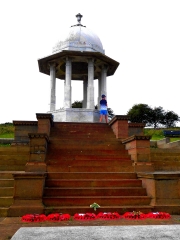
Recently, a friend posted a photograph of a monument that he runs past whilst taking exercise on the South Downs near Hove. This small structure, which looks Indian in design, is what General Misra used to visit on his annual trips to the UK. A few days ago, we visited our friends in Hove and after eating a delicious lunch with them, we drove up on to the Downs near Patcham and walked through a field of well-fed grazing cows to reach a small enclosure containing the Chattri and a monument listing the names of the Hindu and Sikh soldiers who were cremated at this place during WW1.

‘Chattri’ is the Hindustani and Punjabi word for ‘umbrella’. The monument on Holt Hill consists of a small white marble dome supported on eight pillars made of the same material. This stone Chattri stands on a podium with stairs leading up to it from a lower platform on which there are three low granite slabs. The three granite slabs cover the spots where originally there had been three concrete slabs on which the funeral pyres were built and then ignited according to religious tradition. The ‘umbrella’ or ‘chattri’ symbolises, according to a plaque nearby, “the protection offered to the memory of the dead”.

Funded partly by the India Office and Brighton Borough Council, the monument was unveiled by the Prince of Wales in 1921. It was built to the designs of EC Henriques (died 1940, aged 51) a young Indian architect from Bombay. His work was supervised by Sir Samuel Swinton Jacob (1841-1917), an expert in the Indo-Saracenic style of architecture. I have eaten dinner at one of Jacob’s other buildings: Bikaner House, a palace he designed in Mount Abu (Rajasthan), constructed in 1893. Built as a summer palace for a maharajah of Bikaner, it is now a hotel. In January 2020, we ate a poor-quality meal there. We and the other diners sat dressed in padded jackets because the dining room was unheated, and the outside temperature was close to freezing point.

The bases of the eight columns of the Chattri interested me because they bear the same decorative motif seen on the bases of pillars in Hindu temples constructed well before the era of Moslem invasions of India began. The early mosques built in the 15th century in Gujarat (e.g. in Ahmedabad and Champaner), which borrow many structural features of Hindu temples, also contain pillars whose bases are decorated with the same motif seen on the Chattri. The same is true of the capitals of the pillars that support the dome of the Chattri. Also, the domes in those ancient Hindu temples and mediaeval mosques are always supported on eight pillars arranged in an octagon, as is the case at the Chattri.  In brief, the small but elegant Chattri, which looks a little incongruous in West Sussex, would look very much at home in many parts of India.

The Chattri stands high on the South Downs in a pleasingly landscaped garden. It overlooks the surrounding hills and the ribbon of coastal towns including Brighton and Hove, and beyond them the sea. Part of the monument complex is a more recently (2010) erected concrete wall on which are carved the names of the 53 Hindu and Sikh men who were cremated at this spot, as well as their ranks and regiments.

To reach the Chattri, we walked along a path through a field in which cattle were grazing. As I looked at the cows, I thought that most of the Indian men whose lives ended in Brighton and were cremated on the Downs must have often walked amongst cattle in India before they left it to fight in Flanders  for the Empire, which did their fellow countrymen few favours.

During our brief visit to the Chattri, there were a couple of families relaxing around it. Their children were playing cheerfully around the pillars and on its steps, blissfully unaware of what it represented. This did not bother us. We felt that their joy would have been appreciated by the men who sacrificed their lives for the future of families such as these and many others. The wide horizons, the lovely landscape, and the fresh air enveloping the monument, gave the place and its surroundings a special, maybe spiritual, atmosphere, a feeling of the continuum of life and beyond. Who knows, but any of us at the Chattri might possibly be reincarnations of some of the soldiers cremated there.

POSTSCRIPT: INDIAN SOLDIERS ON THE WESTERN FRONT

Many Indian soldiers fought for the British because they believed, or hoped, that by supporting the Empire in its struggle for survival, India would gain at least some autonomy, if not a generous dose of self-rule. In the last years of WW1, even the pacifist Mahatma Gandhi roamed around India encouraging Indians to enrol to fight for the British. Joseph Lelyveld wrote of Gandhi in his book “Great Soul. Mahatma Gandhi and his Struggle with India”:

“He implores wives to send their husbands to sacrifice themselves on behalf of the empire, blithely promising, ‘They will be yours in the next incarnation.’ Fighting for the empire, he now argues, is ‘the straightest way to swaraj’”

The Indian soldiers fought for the empire. Some were killed, others injured, but India did not reach swaraj (i.e. self-government) at the end of WW1. Remember, less than a year after the Great War ended, soldiers commanded by a British general killed at least 379 and wounded over 1000 unarmed Indian civilians in Amritsar in the Punjab, the district of India that supplied many troops to the Western Front and other battlefields. Even Winston Churchill, no lover of India, was genuinely outraged by the horrific nature of this murderous event.

India would have to endure many upheavals and another world war before independence was won.