Mon oncle – My uncle

UNTIL I BEGAN LEARNING LATIN (at eight years old), I used to think that my mother’s brother’s name, Felix, was strange. Then, I learned that ‘felix’ was the Latin word for ‘happy’ or ‘fortunate’. My Uncle Felix lived up to both meanings of his name.

FELIX BLOG

Felix was born in one of the rooms of his grandparents’ house in Maitland Road, in King Williamstown in South Africa. This house was the home of his grandfather Senator Franz Ginsberg and his wife Hedwig. His three full siblings (and maybe also his half-brother) were born in the same room of this house, which still stands today.

On the 9th of May 1920, Clothilde, Felix’s maternal great-grandmother celebrated her 79th birthday at her home in Munich. That day, she wrote in her diary:

“… Ilse my granddaughter came to Munich with her husband and her indescribably sweet child. It so happened that they could celebrate my birthday with me…”

That child was Felix. That indescribable sweetness remained with him throughout his life.

Felix spent his early years in the tiny town Barkly East in the Eastern Cape, where his father, Iwan, born in Germany, was managing director of the family firm S. Seligmann and Company, which was established in 1885 by his uncle Sigmund Seligmann. In the last few years of his life Felix’s father was the highly respected mayor of this small town in the Eastern Cape. Iwan became very wealthy. The family imported luxury goods from Europe, such as the latest fashions from Paris. Felix told me that they used to buy new American cars (costing £2000) every couple of years. On his deathbed, Felix shared with me some memories of his father, who died in 1931. Iwan used to return home at midday for lunch. He would sit down with his feet up to read his post. Felix told me when he was a little boy, he used to open letters for his father. Many of them came from Germany, where, just after the end of the First World War, there was great inflation. Felix remembered the stamps which bore extremely high denominations (millions, or more) of Reichsmark. He also recalled that his father often took walks on the Common near Barkly East with his friend Mr. Nurse, the proprietor of the local newspaper, “The Barkly East Reporter”.

Even as a child, Felix was an avid reader. It was difficult for his mother to detach him from a book. His love of reading continued throughout his life. He read widely: both fiction and non-fiction. His primary education was in Barkly East. Later, he studied, as a boarder, at Dale College in King Williamstown. After Iwan died, his widow, Ilse, remarried. Her second husband Oscar died soon after the birth of their son John. Shortly afterwards, the family moved to Stellenbosch, where Ilse bought a farm called ‘Bantouzel’ (now re-named ‘Mon Repos’), opposite the Stellenbosch Farmer’s Winery. In 1936, Felix entered the University of Cape Town and enrolled on the BCom course. His future brother-in-law, my father Basil Yamey, who began this course at the same time as Felix, remembers being greeted by him. They had met in Tulbagh some years before at the home of the Kupfers, who were friends of the Yamey family and relatives of Oscar. Felix and his siblings stayed for a while with the Kupfers in about 1935 whilst their mother was undergoing an operation. He never completed this degree.

World War 2 (WW2) was declared in 1939. Felix joined the South African Army.  Because his eyesight was too poor to be a soldier, he served as a medical auxiliary and saw action in many of the major North African campaigns, including Mersah Matruh and Tobruk. My uncle’s wartime experiences were especially important for him.  He used to love to tell stories about them. I feel that he looked back on this tough time, which encouraged warm camaraderie amongst the military at the front, with affection.  As the War ended, Felix went with the army to Palestine.  There, he met Reinhold Seligmann (son of Sigmund) and his daughters. One of the daughters, Felicity (now deceased), showed me pictures of my uncle taken in Jerusalem during that visit. From Palestine he reached Europe, where he ended his tour of duty with some well-earned sightseeing. In Zurich, he visited the ageing Benno Seligmann, who had once lived in Barkly East.

On his return to South Africa, Felix re-entered the University of Cape Town, this time to study engineering. His mother became extremely unwell and died in 1948. After her death, Felix became one of the two joint guardians, with his uncle Rudolf Ginsberg, of his half-brother John. By that time, my mother had settled in London.  He and my mother’s sister Marion helped to look after their younger brother John. They did most of the caring for their far younger half-brother. When John and his wife Mickey came to settle in London in the late 1990s, the two brothers spent much time together. Having John in London gave him much pleasure. Felix became close to John’s sons in London, my cousins Arnold and David, when they came from South Africa to settle in London.

Felix did not complete his engineering degree. Instead, he helped to run the farm at Bantouzel, but its land was poor because it did not have its own well. He bought another farm, called ‘Eureka’, near Stellenbosch.  Next, Felix studied agriculture at Elsenburg College in Stellenbosch. Eureka was not a great success: Felix sold it. For a brief time, he worked in a nursery garden run in King Williams Town, one of Rudolf Ginsberg’s many businesses. Then, Felix joined his sisters Helen and Marion in the UK where they were both living.  He arrived there on the 5th October 1955.

Felix had a varied career in the UK. At an early stage he worked in a photographic shop near Holborn. This must have suited him, as he was a keen photographer.

Just after I began studying at the Hall School (1960), Felix came to our house to take pictures of me in my new uniform. He brought with him various special studio lamps with long cables, which had to be set up. I remember my mother’s dismay when these lights succeeded in blowing the electrical fuses of the house.

At various times, Felix had small businesses. I recall two of these. One was a flock factory: flocking is the addition of a furry surface to objects such as wallpaper. Another was his foam rubber business, which was concerned mainly with cutting foam rubber into various shapes for cushions etc.  While this enterprise struggled along, my sister and I would be presented with pieces of oddly shaped foam rubber whenever Felix came to visit our home.

For a long period, he was technically unemployed, but far from inactive. He was involved in helping charities. He and his friend, Patrick, were the co-founders of a shop (in Hampstead) set up to raise money for the charity Shelter. Felix used his car to ferry around stock collected to sell in the shop. Although this must have helped others, it did not help Felix financially. This did not seem to concern him. He enjoyed a frugally bohemian lifestyle,  financed by the not insubstantial inheritances that his father and grandfather had left him (and his siblings; my mother used her share to lay down a deposit for a house and to pay for private schooling for my sister and me). However, eventually, his bank balance became worryingly low.  

In his early fifties, Felix he joined the General Post Office. He became a postman, based at the sorting office at Rathbone Place. His delivery round was part of Crawford Street. He was much loved by his ‘clients’, who showered him with lavish gifts at Christmas time. As in the army, his time with the post office pleased him greatly. His career as a postman was curtailed by ill health: he took early retirement. The income he gained as a postman allowed Felix to buy a house in Hampstead opposite the Royal Free Hospital. This was divided into three flats. He lived at the top of the house until the last two years of his life, when he moved to the ground floor flat. In the early 1980s, a Nigerian moved in as a lodger: Bayo. This tenant became a good friend of my uncle. In the last years Felix’s life, Bayo and his brother, Folo, looked after Felix as if he was their beloved father.

Felix used to visit us frequently. He always came laden with gifts for us children. This, he continued when we grew up. He never came to see us without a bundle of well-chosen gifts for our daughter, and flowers for my wife.  He loved to entertain children. An annual treat at Christmas time was the sculptures he made by tying together inflated balloons. He would create dog-like balloon creatures for our entertainment. On Christmas Day he would punctuate the meal we used to eat at my aunt’s home with recitations of the story of Chicken-Licken and Turkey-Lurkey, and renditions of a song about Figgy Pudding.

One evening, when our young daughter could barely walk, he came over for dinner. Arriving an hour earlier than expected, as he often did, he sat quietly amusing himself and our tiny daughter. He had brought along the balloons that could be tied together, as described already.  He wanted to create balloon toys for our little one while my wife was busy in the kitchen. Suddenly, my wife rushed into our bathroom. She was bleeding profusely because she was beginning to miscarry. She called to me to bring tissues. As I rushed past my uncle, who was oblivious to the recently developed crisis, he called to me:

“Here, just put your finger on this knot while I tie these balloons together.”

It was like a black comedy or an aeroplane disaster film. He was calling for me to help tie balloons whilst my wife was trying desperately to stem her bleeding. I explained the problem to him and said that my wife needed to go to hospital urgently. Sweetly, he offered to look after our infant, but we declined his kind offer. As far as we knew, he had little or, most probably, no experience of looking after all the needs of a child less than two years old. Fortunately, my wife was rescued by the local hospital.

Felix talked to everybody and anybody. This was a trait he shared with my mother and Bobby, his younger brother. Almost without exception people responded well to Felix’s friendliness. He was genuinely interested in everyone with whom he spoke.

When I bought my house in Gillingham (in Kent), Felix was my first visitor. He arrived before the house was furnished, a few days after I had moved in, and was happy to sleep on a mattress on the floor. I remember that as we sat on the wall at the front of my house awaiting a delivery, he greeted every person who walked past, proudly informing them that I was his nephew, and that I had just moved into the area. Although Felix never married, I do not believe that he was felt alone: the whole world was his family!

Felix was full of enthusiasm for a wide range of things. He pursued his interest in photography until the end, graduating, before many other people did, into using the latest digital technology. He was an active member of the Hampstead Photographic Club and made many friends there. In the early 1970s, he and I used to attend bookbinding classes together at the Hampstead Garden Suburb Institute. Later, Felix became interested in pottery. For many years, he produced ceramic objects at a prolific rate, creating a veritable ocean of objects, some useful, but most of them not.  He was full of ideas, which he tried to express in his ceramic art. Everything inspired him. These objects varied greatly in quality of execution, but never lacked in originality. What many might have expressed in poetry, Felix expressed in glazed pottery.

He had a passion for indoor plants. At one stage, half of his large living room floor was covered in flowerpots filled with a variety of plants and much mud that had spilled from the pots on to the carpet: a chaotic indoor nursery. Added to these interests were history, his lifelong love of reading, cooking, and music. Whenever he could do so, Felix travelled: in the UK, Europe and South Africa, where he spent much time with his brother Bobby and his partner Duffy.

Felix was inventive, as already described above. He loved gadgets and creating them. Once when I went to see Felix in hospital a couple of years before he died, I coincided with the visit of a physiotherapist. She asked Felix whether he could walk, and he answered that he could do so with the help of a stick. She asked Felix to show her his walking stick. This consisted of a piece of metal tubing, which Felix had picked up in the street, and to which he had added a wooden umbrella handle. She looked surprised, said that she had never seen this design before, and Felix answered, “I made it myself”.  More than inventive, he was very intelligent and thoughtful.

To the dismay of some of his close family Felix was untidy. Extremely untidy! His flat had to visited to believed. I am sure that the disorder did not bother him at all. Whenever we visited him, he would sweep things aside, so that there would be somewhere to sit down. He would brew up a hot drink, which he would serve in mugs, which did not bear too close an examination. I believe that he had a confidence in himself that stopped him worrying about what others thought of him.

Felix was born on the 31st of December. Whenever I was near to, or in, London, I used to visit him on that day. One year, he greeted me telling me that he had just treated himself to a video cassette player. He asked me whether I would like to watch a film with him. He told me what he had in his small collection of tapes, and I chose to see Ingmar Bergman’s “Magic Flute”. Felix found the box for it, but the cassette was not the one we needed. He rummaged through the other boxes, all of which contained films that differed from the boxes’ labels. In the end, he found a video of the “Three Tenors” and inserted it into the player. The TV monitor screen was not too clean, so Felix picked up a cloth off the floor and began wiping it across the screen, covering it with grey mud.  In his still strong South African accent, he said:

“Ag, sorry, I forgot that this bleddy cloth is the one I use after I have watered my plants.”

Felix loved exploring, or, what most people would describe as ‘fiddling’. He picked up everything around him wherever he was. We often ate with him at his sister’s home. He would pick up the crockery, turn it over to see its makers label, and flick it with his fingernail to discover whether it was made of fine china. Once, when he was at our flat, he noticed one of our wedding presents displayed on a shelf. It was a valuable, delicate Rosenthal vase. We held our breath as he picked it up, turned it upside down, rotated it, and pinged it with his fingernail … before returning it safely.

If Felix spotted something that needed mending, he was quick to offer to repair it. He knew how to mend things, but his repairs lacked finesse. One day, he spotted one of my saucepans with a loose handle. He just happened to have some glue in his pocket and began mending it. Although the handle stuck well to the pot, so did the glue, which he had spilled accidentally inside the pot. My cousin told me that once he had tried to fix his broken Pentax camera, but unfortunately managed to drop strong adhesive onto its shutter, rendering it quite useless. She also related that when she and her brother were clearing Felix’s flat after he had died, they found a drawer filled with broken radios awaiting repair. His intentions were good, but the results were not always optimal.

In about 2002, Felix began to suffer several ailments, which gradually eroded his quality of life. He was constantly in and out of the wards of Royal Free Hospital, a place where for many years he had worked as a highly valued voluntary helper. Despite these ailments, he remained as cheerful and as caring of his family as ever. In Spring 2004, Felix was admitted to hospital yet again. For over three months he remained there, ill and very slowly losing strength. Until his death, despite becoming increasingly more debilitated Felix retained an interest in the lives of his family and his many friends. His love of life and of Africa continued until the very end. On the day before he died, Felix was chatting with a Zimbabwean nurse who looked after him. She offered him a piece of biltong (dried meat), which he was pleased to eat despite his loss of appetite.  Soon after this last taste of his beloved Africa, he passed away on the afternoon of Saturday 19th June 2004.

Felix was passionately fond of his nieces and nephews, and this was reciprocated. He had no children of his own: we were like his children. He had a great rapport with children. In a way, and I mean this in the best way, he was a child at heart. He was also first and foremost a South African. Although he spent much of his life in the UK, he was at heart was an African.

One of my favourite comedy films is ‘Mon Oncle’ (1958), directed, produced, and starring Jacque Tati (1907-1982). It portrays the unemployed Monsieur Hulot, who lives happily and modestly in a ramshackle Parisian neighbourhood and is loved by everyone. His nephew, Gerard, lives in a sterile, modern house fitted out with the latest gadgets. Gerard’s parents lead almost mechanical, dull lives, with a great emphasis on tidiness and minimalism. There is little scope for Hulot’s nephew to enjoy the normal life of a child. Fortunately for him, his uncle, M. Hulot, visits often. Hulot is both bemused and intrigued by the hi-tech aspects of his relatives’ uncomfortable home. Prone to curiosity, he fiddles with the modern gadgetry sometimes causing unexpected chaos.  After watching this film on YouTube recently, it suddenly struck me that the M. Hulot, portrayed by Tati, and my uncle Felix, although not too similar, did share some very loveable characteristics.

Blue notes

I ENJOY ENTERING HOUSES in which famous characters once lived. It gives me a thrill to think that I am entering rooms where, for example Samuel Johnson or Benjamin Franklin, once lived and worked. But, how does one know where these personalities once resided? In London, that is quite easy because the homes and places where famous historical characters lingered are marked with blue (usually) plaques recording their occupation of these buildings. In other parts of the world, signing is often attached to the places which were occupied by well-known or, sometimes once famous, men and women.

BLUE BLOG

In London, many of these plaques which are circular with white writing on a blue background. They are known as “blue plaques”.  According to that font of all knowledge, Wikipedia, the first blue plaque scheme was started by the Society of Arts in 1867. The first of these was installed in 1867 (on a house which has since been demolished). It commemorated the birthplace of Lord Byron. Another early one (in King Street, London SW1) commemorates Napoleon III, who “lived here, 1848”. He lived there from February 1847 until September the following year. It is one of, if not the only, blue plaque to be put up whilst the person named on it was still alive.

We are fortunate to live in a part of London rich in blue plaques and similarly purposed plaques of different colours. Kensington was favoured by the rich and famous (in all fields of activity) and remains so. The names on the plaques differ, and that is not surprising, but so do the words describing the nature of the person’s occupancy of the marked buildings. A small plaque in Sheffield Terrace in Kensington, records that the author GK Chesterton was “born” in a house on that street but gives no indication of how long he stayed in that place. In contrast, there is a house not far away which records that “Dame Agatha Christie … lived here 1934-41”, a good length of time, accurately recorded. Incidentally, I have enjoyed strolling through the rooms of Greenway, the house overlooking the River Dart, which she used to own and occupied during her holidays.

Much vaguer than Agatha’s is the plaque in Palace Court, which reads “ALICE MEYNELL 1847-1922 POET AND ESSAYIST lived here”, because it gives the passer-by no clue as to how long the building was home to Ms Meynell (actually she was ‘Mrs’ but as a promoter of women’s rights, she would have probably liked the title ‘Ms). Not far from this plaque, there is another one in Portobello Road. It informs someone walking past that “George Orwell … lived here.” Again, we are not made privy to how long the author of “Animal Farm” and “1984” lived on this street, which in normal, virus-free times is flooded with tourists heading for the Portobello Road street market. It would fill me with a sense of well-being to know I was sharing the same roof as someone as illustrious as, in this case, George Orwell (the pen name of Eric Blair). And, no doubt it would impress some of my friends and family. However, if they knew that Orwell had only lived there for one winter in 1927, they might be less awed.

One of my favourite composers of western classical music is the Finnish Jean Sibelius (1865-1957). The first classical LP I ever bought was his Second Symphony. So, I was excited to find a blue plaque with his name in Gloucester Walk in Kensington. It is a “lived here” plaque. However, according to the memorial, he only lived in this lovely part of London in 1909.  A little research reveals that it was only a few weeks in that year. I think the wording “stayed here” would have been more appropriate than the wording on display. There is a brown circular plaque in Kensington Square, which reveals that “WM Thackeray … lived here”. This is an honest record because the novelist did live in the house from 1846 until 1854. Close to Thackeray’s former home, we can find a blue plaque recalling “TS Eliot (1888-1965) … lived and died here.” He lived there from 1957 until his death. This is also an honestly worded plaque.

I have long been interested in Hungary and the Hungarians. I was excited to discover recently that the Hungarian patriot Louis Kossuth (1802-1894; ‘Kossuth Lajos’, to use the correct Hungarian version of his name) had spent time near where I live in Kensington. His blue plaque is on a house in Chepstow Villas, not far from Portobello Road. According to the plaque, he “stayed here”, rather than “lived here”. He stayed there in 1851, whilst on a three-week lecture tour in England, during which he spoke to the English about Hungarian independence and his exile. Of these three weeks, maybe only a few nights were spent at this address in Kensington, or, he and his family, who did spend another seven years in England, might have lived in the house in Chepstow Villas. Possibly, the plaque should be worded “lived here”, rather than “stayed here”.

Number 18 Melbury Road, near Holland Park and the oddly-shaped Design Museum (formerly, the Commonwealth Institute), offers us two blue plaques, one a “lived here” and the other a “stayed here”. The pre-Raphaelite painter William Holman Hunt (1827-1910) “Lived and died here”. The other plaque on the building records that Cetshwayo (c. 1832-1884), King of the Zulus, “stayed here in 1882”. When I first spotted this plaque several years ago, I was intrigued, and wrote a little about it (https://londonadam.travellerspoint.com/41/ ) , which I will repeat here:

“Earlier in 1882, this house, built in 1877, hosted a very important guest, King Cetshwayo (Cetshwayo, ka Mpande, c1832-1884), King of the Zulus. After being defeated by the British in the Anglo-Zulu War of 1879, Cetshwayo was held captive in Cape Town. During his exile, he visited London in 1882:

“On his arrival, 18 Melbury Road … was made more appropriate to his needs and those of his chiefs. The beds, for instance, were reduced to floor level. On waking on 5 August, the ex-king ‘made his way through the various rooms of the house, examining them with curiosity’.

Outside, a huge crowd of people had gathered, eager to see Cetshwayo. The Times described how ‘at times the ex-king would appear for a moment at one of the windows, and he was invariably greeted with cheers’. Cetshwayo himself looked upon the throng ‘as a display of friendly feeling towards him’. By the close of his visit, he had become something of a celebrity.

In an interview given while at Melbury Road, Cetshwayo said that he regarded the war as ‘a calamity’. He had made it clear that the purpose of his visit to England was his restoration to the throne, reasoning that his people wanted him and that there would be another war if he didn’t return. Following a meeting with Gladstone and a visit to Queen Victoria at Osborne House, his reinstatement was agreed.”. The British allowed him to return to Zululand in 1883.”

Would the famous artist have met the African king in Melbury Road? I doubt it because Holman Hunt only moved into his final home from 1903 onwards. However, Cetshwayo might have seen or been seen by another artist Colin Hunter (1841-1904), who lived nearby on Melbury Road from 1877 until his death. His home was destroyed by bombing in 1940. Woodsford Court, built on its site, bears a blue plaque, appropriately of the “lived here” variety. By the way, if you are ever near to it, a leisurely stroll along Melbury Road will delight those fascinated by late Victorian domestic architecture.

For my favourite memorial placed on a building to commemorate its occupancy by a notable person, we must transport ourselves to Palermo in Sicily. The island of Sicily is full of plaques celebrating the temporary presence of Giuseppe Garibaldi (1807-1882) in this place or that. This might not be surprising because he did travel a lot around western Sicily while fighting the Bourbons. In a square in Palermo, I spotted a grand marble plaque carved with the words: “In questa illustre casa il 27 Maggio 1860 per sole due ore poso le stanche membra Giuseppe Garibaldi”, which loosely translated means ‘Garibaldi, rested his weary limbs in this illustrious house for only two hours on the 27th of May 1860.” So, it sems that a two-hour stay is enough to bring fame to a building, providing the temporary occupant is worth remembering. I am not sure whether it would be justifiable for one of our local supermarkets used by a former Prime Minister  to put up a plaque with the wording “David Cameron stayed here”, or even “Peter Mandelson shopped here”,  but one can never tell what the future holds.


No refusal

TAXI NO RESUSAL[2493]


UBER DRIVERS IN MADRAS are, so I have been told, unaware of a customer’s desired destination when they accept a job. It might be a short ride or even an out of town destination. We discovered a consequence of this earlier this year when we were advised that the most reasonable way to make the three-hour journey from Madras to Pondicherry was to hire an Uber cab.

The first three drivers, who offered us rides, phoned us to ask where we wanted to go. When we told them, they cancelled our rides. On our fourth attempt, an Uber arrived. He was happy to drive us to Pondicherry because, as we found out three hours later, he had a friend he wanted to visit there.

In Bombay, the taxis are nicknamed ‘kali pili’, which refers to their black and yellow body paint colours. Most of the cabbies are argumentative and some of them seem reluctant to work, making complaints like “too much traffic” or “that’s too far”. Eventually, one finds a cab that is willing to carry out one’s wishes, often complaining all the way. Maybe, that is because their metered fares are so reasonable for the passenger. Driving in Bombay’s traffic cannot be too much fun, especially if one is getting paid poorly to do so.

Further south in Bangalore, popular transport for those who prefer to avoid using urban buses include Uber and Ola cabs as well as three-wheeled autorickshaws.

Bangalore’s Ubers and Olas are unreliable.  Often, they accept a ride and minutes before they are about to arrive at the pickup point, they cancel. I imagine that often they get stuck in the city’s slow moving or often static congested traffic and feel they are wasting their time trying to reach their passenger waiting beyond the traffic jam. Whatever the reason, these app-linked car services are not nearly as reliable as they are in Bombay or London.

Autorickshaws (‘tuk tuks’) are the best method for getting through the congested thoroughfares of Bangalore.  Their plucky drivers can take risks with their small vehicles that larger cars are unable to attempt. These manoeuvres are daring and can be hair-raising for the passengers, but they get you to your destination relatively quickly. I love the drivers’ sneaky tactics, but others do not. Once, I was travelling in an autorickshaw with two American ladies on a busy main road in the centre of Bangalore. They shrieked with terror as our vehicle sped adventurously between a bus and a heavy lorry that were rapidly moving close together.

One autorickshaw driver, whose command of English was good, told me that he had been a truck driver before driving the three-wheelers to earn his living. He explained that an autorickshaw driver needs to use all of his six senses and to ‘feel the traffic’ with his body. It is my observation that most drivers of these small fragile vehicles have lightning reflexes and nerves of steel. Yet, as they weave effortlessly and excitingly through the traffic, many of them chatter away on their mobile ‘phones.

Hiring an autorickshaw in Bangalore is always an adventure. The vehicles are fitted with taximeters, which are supposed to determine the fair. They are used occasionally but not often. The driver will start by suggesingt an often outrageous fare, which is the starting point for haggling.  Or, some drivers will agree to use the meter determined fare plus some extra Rupees in addition.

Some autorickshaw drivers without much to do will offer foreigners something like:

“Come with me. I’ll take you anywhere for only 10 Rupees.”

Sounds tempting, does it not? Do not succumb to this unbelievable offer because if you do, you will soon discover the catch. The naive passenger will be invited to visit the driver’s friend’s/cousin’s/brother’s  store, where if you buy something, the driver will be rewarded with something like: school books for his children, or a kilo of rice for his starving family, or a new shirt, etc.

Some autorickshaw drivers will set off for a journey in Bangalore, and then after a few minutes, will ask the passenger whether, on the way, they want to do some shopping at a shop the driver recommends. That is, at a shop that will offer the cabbie a commission or a gift when the passenger makes a purchase. A determined refusal is required to ensure that your journey will not include an unwanted, time-wasting detour for shopping.

On the whole, autorickshaws are a great way of getting around Bangalore.

Calcutta is filled with rugged but battered yellow Ambassador taxis. These are slowly being replaced by newer vehicles with blue and white body paint. One thing they share is the wording “No Refusal” painted on the exterior of their doors. The cab driver, who stops to pick up a passenger, is not supposed to refuse to take you wherever you want. Most of the drivers comply with this.

Black Cab taxi drivers in London and other places in the UK are, by law, required to take you anywhere within the area they can legally operate. Like the drivers in Calcutta, the British cabbie is supposed to adhere to the “No Refusal” concept, and often, but by no means always, cabbies comply.

Interesting as all this is, present conditions during the current pandemic mean that not too many cabs are being hailed at the present in London. While the ‘lockdown’ is in force, even in its present slightly diluted form, I feel sorry when I see an empty Black Cab with its ‘For Hire’ sign illuminated cruising the almost empty streets in the hope of finding a customer.

Fading with time

SINCE THE IMPOSITION OF ‘LOCKDOWN’ in the UK, use of public transport has been discouraged, as has wandering too far from home when taking exercise. While not exactly ‘confined to barracks’, the distance that we have been allowed to move away from home has been limited, more or less to the amount of distance that we can manage to walk (or, not in my case, cycle) comfortably, without exhausting ourselves. This meant that for many weeks we have been walking around our local area. A friend of ours in Dublin told us, half-jokingly, that during the Irish lockdown, he felt that he had got to know every blade of grass in his neighbourhood. I understood what he was saying.  For me, greater familiarity with our immediate locality has not bred contempt for it, but the opposite. We have been walking along small streets we never knew existed and discovering interesting details in those thoroughfares that we thought we knew so well.

HORNTON 2 BLOG

I have been walking along Sheffield Terrace, which leads off Kensington Church Street, two or three times a week for the last 25 years, yet it was only yesterday that I noticed a small square metal plate on the wall of a house in that thoroughfare. It recorded the fact that the author GK Chesterton was born in that house on the 29th of May 1874. A few doors away on the same street, there is a much larger and far more obvious plaque commemorating that the founder of the Church Army, Prebendary Wilson Carlile (1847-1942) had lived there. I had often noticed this memorial, but I had never noticed the far more discreet memorial to Chesterton, which looks like a simple grey wall tile from a distance.

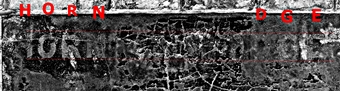
Sheffield Terrace leads to the northern end of Hornton Street, which is marked on 19th century Ordnance Survey maps as ‘Campden House Road’.  Hornton Street leads south and downhill towards High Street Kensington. Once again, this is a street along which I have walked several times a week over a period of at least 25 years. Various roads lead off Hornton Street. The short Pitt Street is one of these. On the corner of Pitt and Hornton Streets, there is a faded rectangular sign that I have always assumed carried the words ‘Hornton Street’. However, I had not looked at it closely enough until yesterday.

I do not know what made me examine the faded sign closely, but I am glad that I did. Some of the letters on it have disappeared. The following are just about visible, and even more so on enhanced digital photographs: H, O, R, N, …, D, G, E. The last three letters are not ‘E, E, T’, which you would expect to see if the sign had read ‘Hornton Street’. I wondered if the sign had originally read ‘Hornton Lodge’. I went home and searched for ‘“Hornton Lodge” Kensington’ on Google.

One of the most useful things that came up amongst the Google search results was an offer on eBay for two pages of the issue of “Country Life” magazine, dated 21st of March 1968. These pages contain an article about Hornton Lodge on Pitt Street. The article bore the title “Serene Vision of a Modern Interior”. It describes the interior of a house built in 1948 on a bomb site and owned by Mr and Mrs James Melvin. The house, a long rectangular building, was called Hornton Lodge. The fading sign is all that remains of the house described in the magazine. Currently, builders are erecting a new building on the part of the plot nearest to the corner where the sign can be found. This new construction is, according to a planning application submitted in December 2019 by Nash Baker Architects, to replace an:

“… early post war semi-detached property … constructed circa 1948-49, on the site of a former villa known as ‘Hornton Lodge’. The architect/owner, James Melvin, was a partner in major architectural firm: Gollins Melvin Ward Partnership. However, at the time it was constructed, the firm was in its infancy, and this project was a modest family home for a young architect and his family; designed with modernist intentions during a time of austerity.”

I found references to a ‘Red House’, also referred to in at least one item, maybe erroneously, as ‘Hornton Lodge’.  The Red House was built by Stephen Bird in 1835. It was also known as ‘Hornton Villa’. This was not the property on Pitt Street demolished by a bomb in WW2 because it stood across Hornton Street opposite the western end of Holland Street, which is south of Pitt Street. A future president of the USA, Herbert Hoover, lived at that address between 1907 and 1918. Hornton Villa, The Red House, was demolished in in the 1970s, and on its site stands the architecturally undistinguished Customer Service Centre of the Royal Borough of Kensington and Chelsea.

There is more evidence of a Hornton Lodge, quite distinct from the Hornton Villa, mentioned above. Joseph Foster’s “Men-at-the-bar : a biographical hand-list of the members of the various Inns of Court, including Her Majesty’s judges, etc.” (published in 1885) published the address of a barrister Richard E Webster (1842-1915; called to the Bar in 1868), Lord Alverstone, as “Hornton Lodge, Pitt Street, Kensington W”. He became Attorney General between 1885 and 1886.  Even earlier than that, “Allens West London Street Directory” (published in 1868) lists a Theodore Aston as living at Hornton Lodge.

Close examination of a sign that I have passed and seen many thousands of times, assuming it bore a simple faded street name, has revealed that I had never looked at it carefully enough before. The constriction of my field of activities to a small part of London has, to my surprise, heightened my powers of observation rather than blunted them, which could have easily happened when visiting the same locality repetitively.

Soon, the faded sign on the corner of Pitt Street will either be removed or become even more illegible. I am glad I noticed its clue to the past before either of those things happen.


A chance meeting

BRIDIE WAS OUR DAUGHTER’S babysitter for several years. She also collected her from school and looked after her until one of us returned from work. Although she was well over 80 when we first employed her, Bridie was a very sprightly, energetic woman.

LondonUnderground_GoldersGreenStation


She had been brought up in the wilds of western Ireland. Every day, she used to walk several miles over the hills to go to school. She moved to England as a very young lady. On arrival in Britain, she was at first given shelter by the Salvation Army. She had to promise them she would become teetotal. She kept this promise.

One day, Bridie told us an interesting story. When she was young before WW2, she worked as a maid for a Jewish family in north London’s Golders Green.  She wore uniform. There was one uniform for daytime and a different one for the evenings.

When Bridie was not working for us or ironing for our friends, the Wilsons who had introduced her to us, she used to roam around London taking advantage of her free bus pass (given to Londoners over 60 years old).

One day, Bridie visited Golders Green. When she was waiting for a bus to take her home, an elderly gentleman in the queue said to her:

“Excuse me, but are you Bridie?”

“I am,” she replied.

“Well, you looked after me when I was a child sixty years ago”

Bridie realised that the man was from the family, for whom she had worked in Golders Green before WW2.

A bus approached. The man asked her:

“Are you getting on?”

Bridie nodded, thinking he had asked a different question. The man jumped on the bus, leaving Bridie standing by the bus stop. Had she heard his question correctly,  he would have waited behind to reminisce with her: an opportunity lost for ever.

Ever since hearing about Bridie’s chance encounter, I have always considered her story as being rather sad.


Picture of Golders Green bus staion (Wikipedia)

A road through my childhood

IT IS BECOMING AN ADDICTION: I must write something every day. It is probably a harmless compulsion, but it gives me great pleasure. Today, I will write about a road that did not exist until 1835. It runs northwards from the centre of London. It was built to bypass the hills on which Hampstead perches. The old route to Finchley and Hendon from central London passed across these hills before Finchley Road, originally a toll road, was constructed. Part of Finchley Road connects the suburb of Golders Green with Swiss Cottage. For five long years I travelled along this stretch.

HALL BLOG

Swiss Cottage is named after a pub, Ye Olde Swiss Cottage, which still resembles many people’s idea of what a Swiss chalet should look like. The pub is a descendant of the Swiss Tavern, built like a Swiss chalet. Opened in 1804, it stood on the same spot as its most recent avatar. It stood on the site near one of the toll booths built for collecting money from people using Finchley Road in earlier times.

There was another toll collecting place at Childs Hill, between Golders Green and Swiss Cottage. This toll gate was next to the now demolished Castle pub. For five years, I passed through Childs Hill on my way to the Hall School near Swiss Cottage.

I attended The Hall between 1960 and 1965. The Hall, founded in 1889 (the year the Eiffel Tower was built) was a private school for boys preparing boys for entry into private secondary schools, misleadingly called ‘public schools’.

During my time at the Hall, several bus routes plied between Golders Green and Swiss Cottage: 2, 2a, 2b, and 13. The fare was five pence (less than 2.5p) for children. I used to say to the conductor: “five-penny half, please”.

The bus journey to and from The Hall was tedious and slow. This was because Finchley Road was being widened. The roadworks began before I entered The Hall and continued after I left it five years later. To widen the road, which was lined by houses and shops all the way between Childs Hill and Swiss Cottage, every garden by the roadside had to be cut short. There was a garden centre in a long greenhouse near Finchley Road Underground station opposite the present O2 Centre.  More than three quarters of its length was demolished to permit road widening. All in all, the long section of road being ‘improved’ caused the rush hour traffic to move sluggishly. After 5 years of enduring this, I used to be able to recite from memory and in the correct geographical order the names of all the shops along Finchley Road. Today, hardly any of them exist. Even the large, still extant department store John Barnes has changed its name to John Lewis. Gone is the remains of the garden centre and the Edwardian Swiss Cottage public swimming pool. During my time at The Hall, this place closed when the then new Swiss Cottage Library and swimming pools opened close to the swiss style pub. Another of many disappearances is that of Cosmo, a restaurant that used to be popular with refugees from Central Europe and later with my wife, who loved the Hungarian cherry soup served there.

The Camden Arts Centre stands at the corner of Arkwright Road and Finchley Road.  The arts centre faces across the main road the start of Lymington Road, which soon runs along the side of a large grassy open space. This is where Hall School boys played football and cricket. We used to walk two by two with one of our teachers from the school to and from the field, a distance of at least a mile.

The Hall School was an ‘elite’ establishment. Almost all the pupils had parents who were listed in “Who’s Who”, or royalty, or were extremely wealthy. Several of my fellow pupils were sons of Greek shipping magnates. One of these used to be driven from the school to Lymington Road in his chauffeur driven Bentley, which he pronounced ‘bantly’. Occasionally, he used to offer teachers a lift in his luxurious vehicle.

The sports field in Lymington Road was opposite a small newsagent-cum-sweetshop. We were not supposed to enter this during school hours, which included time at the sports field. And, because we walked back to school after a sporting session, there was little chance to explore it, but somehow, we managed. The shop was amazingly well-stocked with cheap sweets. I discovered that if I walked from Swiss Cottage to Lymington Road, the fare from there to Golders Green was two pennies (there were 240 old pennies in one Pound) cheaper than from Swiss Cottage. This gave me two pennies on top of what I was given daily to buy snacks (in my case, read ‘sweets’) on the way home.

At Swiss Cottage, there was one sweet shop near my bus stop. It was a branch of Maynard’s inside the subterranean foyer of the Underground station. The sweets it sold were poor value: there was nothing for under three (old) pennies. In contrast, the shop on Lymington Road was full of sweets costing less than one (old) penny. For example, one penny bought four ‘blackjacks’ or a large chewy item called a ‘refresher’. And, for three pence, a ‘Sherbet Fountain’ (still available on the internet for 132 [old] pence or 55p). This used to consist of a paper cylinder containing a fizzy lemon flavoured white powder into which there was a black cylindrical straw made of liquorice (used to suck up the powder). The thing looked just like an unexploded firework. In short, It was worth walking about a mile to save on the bus fare and then to spend it in a place where my money had much better buying power.

At the end of the day, I disembarked at Golders Green near the Underground Station. There used to be many children from other schools mingling there on their journeys home. One incident at this place remains in my mind, but before relating it, you need to know what we wore at The Hall. The colour that predominated in the school uniform was pink, which was considered rather strange for a boys’ school. Blazers and peaked school caps also contained black trimmings. One of these, which was prominently sewn on to our caps and the outer breast pocket of our pink blazers trimmed with black, was a black Maltese cross. The way that the school’s emblem was drawn was closer to the shape of the German Iron Cross than to the real Maltese cross. By the time I was attending The Hall, I had already become interested in the Holocaust (the Shoah). Golders Green had many Jewish people living there and several shelves of its public library were filled with books about the deeds of Hitler and his followers. I borrowed and read many of them. Therefore, I was horrified when I stepped off the bus at Golders Green one afternoon, and then some schoolboys from another school shouted at my friend and me:

“Look, the Nazis have arrived.”

Is it not strange what one cannot forget?


Picture from https://www.uniform4kids.com/ 

.

Eating out remembered

SEEING A PHOTO TAKEN  of La Cage Imaginaire, a restaurant in Hampstead has whet my appetite for writing about some memories of eating in this picturesque part of London long before the current restrictions on individuals’ movements and public gatherings.

COLIN BLOG

My parents used to like dining out at a ‘bistro’ in Church Row, a street lined with lovely old houses. The Cellier du Midi, as its name suggests was in a basement. Long before my mother died in 1980, they dined there often. My sister and I were never taken there. This made me curious about the place and for many years after they stopped going there, I thought it would be fun to try it out. It was only at the beginning of the 21st century that I did. My father’s teacher at the University of Cape Town, and later his colleague at the London School of Economics, Professor William Baxter (1906-2006) and his wife invited my wife and me to have dinner at the Cellier. It was Baxter, who in 1938 encouraged my father’s family to send him to England to continue his studies. I was excited about the prospect of eating in this restaurant at long last. Sadly, by the time we were invited there, the food was far from exceptional. It was far below the quality that would have been acceptable to my late mother, a discerning eater.

My parents ate Indian food occasionally. Their favourite Indian restaurant was the Shahbag in Rosslyn Hill, the continuation of Hampstead High Street. I ate enjoyably there once or twice with friends in the early 1970s but did not return for over 30 years. One evening, we drove up to Hampstead to attend a concert in a church on Rosslyn Hill. We arrived just before the performance was scheduled to start. I was driving. I dropped my wife and a friend at the venue, and then looked for somewhere to park. It took so long for me to find somewhere that I had to miss much of the concert. As the concert was near to the Shahbag and I was also hungry, I decided to miss the music and make a nostalgic trip to the Indian restaurant. I sat down and placed an order. Then, I waited and waited. While I was waiting, I looked at the food being delivered to customers on neighbouring tables. It did not look too appetising; by now, having visited India many times and eaten Indian food cooked in many Indians’ homes, I could distinguish between well and poorly prepared dishes. My appetite diminished. I looked at the time. It was nearly time to collect the rest of my party from the concert. I summoned the waiter and told him that as I was not prepared to wait any longer, he must cancel the order, which he did. I was disappointed that this experience had shattered my nostalgic illusions about this venerable establishment.

After my mother died, I began practising dentistry in a village near Gillingham in Kent. I lived down there during the week and visited my father most weekends. On Sundays, my father and I usually ate lunch out, often in Hampstead. One of our favoured places was the Cage Imaginaire, a tiny French restaurant at the end of Flask Walk furthest from Hampstead High Street. I always associate this restaurant’s name with that of a humorous film, “La Cage aux Folles”, which appeared in 1978. However, the restaurant was/still is a serious eating place. On one occasion when the waiter brought the cheese trolley to our table, I cheekily asked him to point out the cheese whose odour most resembled that of smelly socks. Without batting an eyelid or showing any disdain, he singled out a satisfyingly pungent French cheese.

Gradually, my father and I shifted our allegiance to an Italian restaurant, the Villa Bianca in Perrins Court. Although pricey, the food at this eatery never failed to satisfy. My father, whose mastery of the Italian language is good, enjoyed chatting with the Italian owner and his staff.

During my student days, all twelve years of them, I lived at my family home north of Hampstead, but visited it often. One place in which my parents would never have set foot but was popular with my friends and I was Maxwell’s on Heath Street.  This was Hampstead’s take on the American eating experience. Just up the street from the Pizza Express, Maxwell’s sold good hamburgers and milkshakes. Popular with more than one generation of northwest London’s younger set, this place opened in the 1970s and closed more than 40 years later. Incidentally, Maxwell’s pre-dated the arrival of McDonalds in London.

Almost across the road from Maxwell’s there was and still is a good Japanese restaurant, Jin Kichi, at which I ate several times more than 20 years ago. This was the first place I ever ate sukiyaki, a dish that involves cooking raw meat on a hot plate on the dining table.  Writing about this brings to mind another place, which was not strictly in Hampstead but close by in Swiss Cottage: Benihana.

I have only eaten at a Benihana restaurant once and that was long ago when the girl, who is now my wife, celebrated her birthday at the Swiss Cottage branch. We sat at counters surrounding an open space where our chef cooked, or rather performed, our meal. The chef would pick up a prawn, place it on a hot grill, and then toss it high up in the air, catch it, before placing it back on the grill. This performance of flinging food items up into the air and putting them on and off the grill was impressive in terms of juggling skills but disappointing as a gastronomic technique. By the time a much travelled, burnt, dead acrobatic prawn arrived on my plate, it had lost any appeal for me. However, a good time was had by all, except the prawns and other fragments of food we were served.

Returning to Hampstead proper, there is one restaurant that has been in existence since 1962. This is La Gaffe, which is on the same side of Heath Street as Jin Kichi, but higher up the hill. Although I have passed this place countless numbers of times, I have never entered it.

Heath Street leads down to Hampstead Underground Station and the start of Hampstead High Street. Despite vociferous objections from many of Hampstead’s ‘snobbish’ and ‘cultured’ residents, McDonalds managed to open a branch of their famous fast-food operation a few feet away from the station. It took the company twelve years to fight the objections to their opening.  Although I enjoy ‘haute cuisine’, I have the occasional yearning for a meal at Mcdonalds. The Hampstead branch was perfectly acceptable. However, after 20 years business in Hampstead, the company closed its branch there in 2013. It has been replaced by a branch of another chain, Le Pain Quotidien. I preferred its predecessor.

The Coffee Cup in Hampstead Heath Street is almost as old as I am. It first opened in 1954. Both externally and internally, this has not changed in appearance since my early childhood. When I was at school in the 1960s, this was the place to ‘hang out’. Oddly, I never did. In those days, the café had an exciting reputation. Maybe, I was not exciting enough to pay it a visit. Recently, I have ventured into this relic of the coffee bar era of Hampstead. I enjoyed a satisfactory, but not top class, espresso in its quaint interior, which looks as if it retains the original decor that it had when it first opened. I did not eat anything there, but I watched delicious looking pastries and English Breakfasts being served to other customers. Oozing with nostalgia, this place is as popular now as it was long ago.

Walk up either Perrins Court or Perrins Lane, and you will reach the southern part of Heath Street just before it continues to become Fitzjohns Avenue. On that short stretch of road, stands Louis Hungarian Patisserie. It was opened in 1963 by a Hungarian called Louis Permayer. Like the Coffee Cup, Louis has retained its original appearance. However, although it began as a place purveying Hungarian pastries and cakes, its current owners provide similar items, but not quite as tasty as what the former owner sold. That said, it is a quaint place to sit and chat over a hot beverage and a snack.

Louis has a special place in my memory. When I was an undergraduate in the early 1970s, I met one of my fellow students for a date one afternoon at Louis. My female friend liked the place and we have visited often since she became my wife some years after that afternoon. She recalls that in those long off days when we first met, Louis served coffee with a separate small bowl of whipped cream. Sadly, that tradition has disappeared and the charming Eastern European waitresses now working at the café look uncomprehendingly when you try to get a bowl of this with your coffee.

As soon as it is safe to roam around without risking one’s health excessively, we will head to Hampstead for a not brilliant but romantically nostalgic coffee at Louis, provided it has weathered the pandemic.


Photo of La Cage Imaginaire by Colin Hill


New End new beginning

HAMPS 23 Former New End Hospital BLOG


NEW END HOSPITAL in Hampstead village closed in 1986 and converted into luxury flats. It was opened in 1869 as a workhouse for impoverished folk and in 1931 it became a hospital specialising in endocrine diseases. In that year, a clinic devoted to treating thyroid disorders was established.

On Tuesday afternoons during the years 1968-1970, when I was preparing for university entrance examinations, I helped out in the thyroid department laboratories at New End Hospital.

The labs occupied the dank basement under the Victorian hospital. The outfit was directed by a formidably bright lady scientist. She was assisted by a small friendly team of scientists and technicians.

The first task assigned to me was to make the afternoon tea. I had never made tea before without using a tea bag and with the addition of milk (at home we drank tea without milk). What I served was universally abhorred. That first afternoon, I was given a lesson of how to prepare tea ‘properly’.

The lab I worked in was dedicated to diagnosing and treating thyroid patients with radioactive isotopes of Iodine. Patients were given radioactive iodine to ingest in the ward. Then, they were brought to what looked like a dental chair in our basement. A technician applied a Geiger counter probe to different parts of the patient’s body to determine the distribution of the iodine. From this, diagnostic information could be derived. Today, this manual technique has been replaced with automatic electronic body scanners.

After scanning, the by now radioactive patients were sent back to the ward. There, they waited for their radioactivity levels to drop to safe values or to await further administration of the isotope for therapeutic reasons. In both cases, these patients had to wait until they were no longer emitting harmful rays.

To assess the levels of radioactivity in the patients’ bodies, their urine was collected regularly and stored in brown glass Winchester bottles. These were brought down to be stored in the basement. Each bottle was regularly inserted into a lead covered cylindrical container containing Geiger counters. Apart from white lab coats, we wore no other protective garments.  Often, I helped with this activity. Thinking back, I doubt modern Health and Safety would have sanctioned our working practices in that basement.

At school, I was learning computer programming, and enjoying it. We learnt the principles of programming and how to use them in the recently designed Basic computer language. When the thyroid laboratory bought a programmable desktop Olivetti calculating/computing machine, I was the first person in the lab who knew how to make it work, to programme it.

The lab needed to communicate with the matron in charge of the thyroid ward, but everyone feared her. So, whenever possible if the lab needed to send something to her, they waited for me to arrive on Tuesday afternoons. By some kind of luck, the terrifying matron treated me kindly. I found her to be agreeable but realised that she needed to be treated with ‘kid gloves’.

My experiences at the laboratory under New End Hospital were both fascinating and enjoyable. They were also influential because they instilled in me an interest in physiology, and particularly endocrinology. I am certain that had it not been for those Tuesday afternoons at New End, I might not have gone on to making a new beginning at University College London, studying physiology.


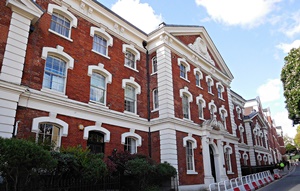
Picture shows the former New End Hospital