Some men of history

HIST 1


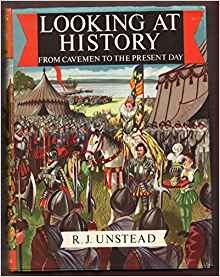
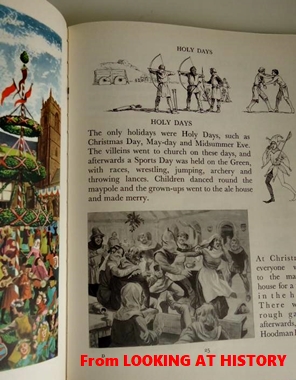
My interest in history began when I was about six years old. I could read well by that age. My parents gave me a book called “Looking at History”. It was a simply written thoroughly informative book with many line drawings illustrating everyday life in the British Isles from earliest times to the twentieth century. The book, published in 1955, was one of my treasures. I loved leafing through it. It was created by the historian RJ Unstead (1915-88). This book kindled my life-long interest in history.  One birthday, my parents gave me another book by Unstead, “People in History: Caractacus to Alexander Fleming”. Published in 1959, it contains a series of simple but informative biographies of important British historical personalities.” This was another book that I read over and over again.
hist 1a

In 1960, I entered The Hall School, a prestigious educational establishment in London’s Swiss Cottage area. This school’s main aim was to educate boys sufficiently well so that they could enter the best private secondary schools. To enter these schools, an examination called ‘Common Entrance’ had to be passed with high marks. One of the papers in this test was history. At The Hall, history was taught with only one goal: passing the Common Entrance. Year after year, our history teachers guided us from Julius Caesar’s arrival in Kent to the end of Queen Victoria’s reign. What seemed to be important was knowing the dates of events rather than the significance of these happenings. History was reduced to monotonous chronology.

hist 00

Things did not improve when I entered my secondary school Highgate (founded 1565). History was compulsory in the first year. It was taught by a well-known historian AW Palmer, who has published many books. For some unaccountable reason we had to study the history of the USA. Palmer managed to make it both incomprehensible and uninteresting. This was one of the many reasons that I gave up history in favour of the school’s alternative to it: physics. In fairness to Palmer, his “A Dictionary of Modern History, 1789-1945” (published in 1964) fascinated me. It covered a period of history that was poorly covered at The Hall and had fascinated me from an early age. I believe that my interest in what Palmer termed as “Modern History” began when I was about twelve. It was then I began looking at the adults’ section of Golders Green’s public library and discovered books about Nazi Germany and the Holocaust.
HIST 2

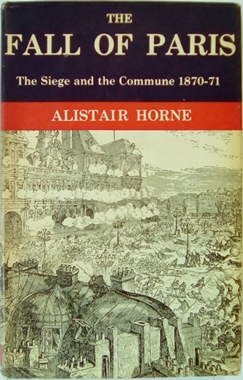
Gwyneth Klappholtz, who was married to Kurt – one of my father’s colleagues at the London School of Economics, taught history at a state school. I used to visit the Klappholtz home regularly in my teens. Gwyneth picked up on my interest in history and recommended me an author whom I feel can write history superbly. The historian Alistair Horne (1925-2017) has written over twenty-six books. I have read several of those. My favourite is “The Fall of Paris: The Siege and the Commune 1870-71” (published 1967, during the time when I used to visit the Klappholz family regularly). Horne writes history as if he were a really good novelist, yet everything he wrote was based on solid, reliable historical research. His books are a joy to read. This is something that the other writers of history, whom I am about to mention, share: an ability to present, often complicated historical situations, in a clear, easily readable form.

hist 3

At about the time I discovered Horne, I found an exciting book amongst my father’s library of mostly erudite books on economics. It was called “The Golden Trade of the Moors”. Written by Edward William Bovill (1892-1966), it describes how the Moors crossed the Sahara with salt to exchange for gold in sub-Saharan Africa, where salt was scarce, and worth its weight in gold. Although I enjoyed this book, I have not read anything else by this author.
hist 4

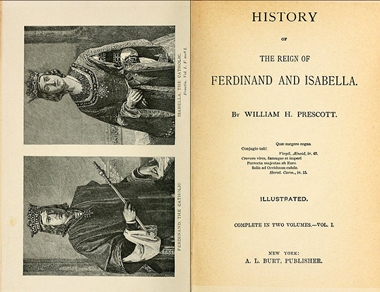
My PhD supervisor, a medical doctor and physiologist, introduced me to another very readable historian, the American William Hickling Prescott (1796-1859). This remarkable historian had very poor eyesight. Often, whist he was doing historical research an assistant was required to read documents and other literature to him. He had a phenomenally good memory, which must have been a great help if he had to perform most of his research through the eyes of another. He wrote mainly about aspects of Spanish and Spanish-American history.
hist 000

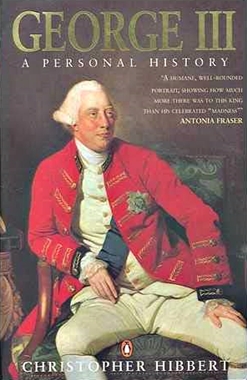
Christopher Hibbert (1924-2008) is another very readable historian. He has written over fifty books, many of which are historical biographies. I have particularly enjoyed his accounts of the lives of King George III and his son King George IV.  Like the other historians I have been describing he combines erudition with literary skill. In 1983, he edited the magisterial, splendid “The London Encylopaedia” with Ben Weinreb.
hist 5

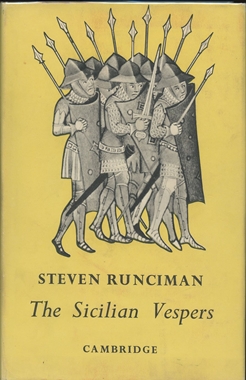
About four years ago just before my first trip to Sicily, I read “The Sicilian Vespers.” This deals with a complex series of events leading up to a revolt of the Sicilians against their French occupiers in 1282. Although the author Steven Runciman (1903-2000) does not make the story appear simple, he skilfully navigates the reader through the complicated intertwining strands of history leading up to the event. Some decades before visiting city, I read Runciman’s “The Fall of Constantinople 1453”, another captivating but historically accurate account of an important turning point in the history of Europe.
hist 6

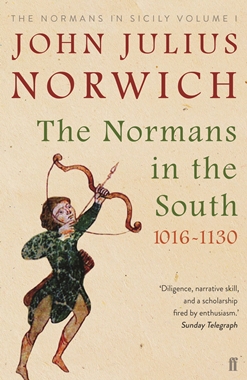
In October 2018, I made another visit to Sicily, mainly Palermo. That city and nearby Cefalu contain buildings erected while the Normans occupied Sicily. They took over the island several years before invading Britain. The Normans in Sicily built fine churches and palaces. Often these buildings contain elements of Arabic architecture. I was intrigued and wanted to know more. The leading account of the Normans in Sicily (and southern Italy) was written by the prolific John Julius Norwich (1929-2018). Although he claimed to be no expert on the subject, his two-volume history of the Normans in Sicily is both scholarly and very readable. As with the works of the other authors mentioned, reading this history is both informative and pleasurable. In addition, Norwich injects humour at appropriate places. I am looking forward to reading other books by him including his highly-rated history of Venice.

Spelling curios

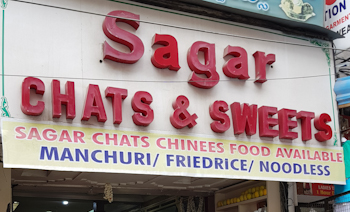
All over India you can see variations in the spelling of English words. Here are some examples I saw today in Bangalore.

Here the word ‘naughty’ has been spelled semi-phonetically.

Here, b and P have been mixed up. The consonants B and P are formed similarly when spoken.

This shop sign demonstrates a variety of different kinds of spelling errors. (By the way, ‘chats’ are slightly cooked vegetables or raw fruits dressed with spicy powders.)

Remember that although English is one of India’s national languages, for many shop owners it is a foreign language. Hence, the diversity of spellings of common English words.

A nest in Macedonia

In about 1977, I travelled to Greece overland with my PhD supervisor (‘Prof) and his wife (‘Wink’). Every year they towed a caravan across Europe to their favourite camping spot near Platamon on the coast of northern Greece. They were averse to camping overnight in campsites. They preferred to camp ‘wild’ at spots of their own choosing. Their journey involved three nights in the former Yugoslavia, a country where camping outside official campsites was against the law. However, over the years they had found several places in Yugoslavia where they could camp ‘wild’. Prof and Wink were always anxious when they travelled through that country, constantly worrying that their illegal camping activities would get them into trouble. Let’s join them on the last few hours before leaving southern Yugoslavia (in what is now Macedonia) and an official campsite, where circumstances forced us to stay one night. Here are two extracts from a book, which I have not yet published.

OHRID 0

Picnic north of Ohrid in Macedonia, 1977. The author is standing

“After lunch, we drove onwards towards the town of Ohrid that lies on the eastern shore of the lake bearing the same name. As the sun began to set, we faced a problem. Prof and Wink had never travelled to Ohrid before and knew of no places where we could camp ‘wild’. Driving along, we could see nowhere suitable to do so. Cautiously, I recommended the town’s campsite. I had stayed there a few years earlier with my friend Hugh. It was a lovely spot next to the lake shore. Reluctantly, Prof agreed that this would have to be where we should spend the night. At the entrance of the camping grounds, we had to surrender our passports in order that the camp could register our presence to the police. Prof was reluctant to let go of his passport, but when the officials assured him that they did not need it for long, he gave in.

While supper was being prepared, I took a stroll around the campsite. An elderly employee of the campsite approached me and greeted me like an old friend. When I shook his outstretched hand, I remembered who he was. I had met him the first time I camped in Ohrid for a week in the late 1960s. On that visit, I used to walk from the campsite to the town in order to do sightseeing or to catch buses from it to other places in the area.  At the end of each day, I used to walk back to the campsite, where Hugh had sunbathed all day. On one of these return journeys, this man, who greeted me so many years later, had seen me on the road and had invited me into his home to meet his family. I was touched that he recognised me…”

OHRID 1 1973

Ohrid in 1973

“… we continued our journey towards Greece on the following morning. We left Ohrid and drove across the mountains east of Lake Ohrid to Resen, where we did not stop. Had we not been in so much of a hurry to leave Yugoslavia – Wink and Prof always felt more than a little uneasy being there – I would loved to have visited the nearby Lake Prespa, which, like Lake Ohrid, shares its waters between Yugoslavia (now Macedonia or FYROM or Northern Macedonia) and Albania. Unlike the bigger Ohrid, Prespa also shares its water with Greece. In fact, the frontiers of the three Balkan countries meet in the middle of the lake. We crossed another mountain pass after leaving Resen, and then descended into the plain in which the town of Bitola stands.

We parked near a large mosque in Bitola, and then began wandering around an open market. Prof stopped by a stall selling green grapes. There were flies crawling all over them. He took out a notebook and pencil, and then pointed at a fly on one of the grapes. He was hoping to learn the local word for that particular kind of fly; he was always trying to improve his vocabulary in the languages that he encountered en-route. He even carried a miniature tape recorder in which he recorded people pronouncing words in, usually, Modern Greek. He used to listen to these recordings and try to repeat them in order to improve his pronunciation. The seller of the grapes, seeing Robert’s interest in his wares, was hoping to make a sale but could not understand what the foreigner was asking. Both parties were left unsatisfied.

OHRID 2 BITOLA 77 Train from Medzhitlija

The road from Bitola to Medzhitilija on the Yugoslav side of the Greek border in 1977

After leaving Bitola we drove southwards across a flat cultivated plain until we reached the Yugoslav customs post at Medzhitilija. We waited in a queue of vehicles until we drove under the wooden canopy over the roadway adjacent to the border officers’ cabin. Before handing our documents to the official waiting alongside the car, Prof looked up into the eaves of the steeply pitched roof and began pointing at something. The customs officer looked up and then at Prof, who was frantically leafing through a small well-worn Serbo-Croatian pocket dictionary.

“I wonder what the Yugos call a house-martin’s nest,” Prof kept muttering.

The officer looked him, puzzled rather than impatient.

“For heaven’s sake, let’s get on,” Wink shouted at her husband from her perch behind us. 

She, even more than Prof, was keen to leave the communist country where, on previous trips, they had had minor though worrying brushes with authority.

Minutes later, we were driving south along a Greek road …”

Riding along in my automobile

I was just nineteen when I took my first driving lesson. I was staying in Harlow (Essex) doing my first holiday job (at Beecham’s pharmaceutical research laboratories). I used to have the lessons after work during the early evenings when there was little or no traffic on the roads.

DRIVING

Driving in Bavaria: my car in 1986

I found it very difficult to coordinate hands and feet, so that gear changing presented me with quite a challenge. I drove slowly, especially when approaching traffic signals when they were turning red.  I could not face the palaver of foot brake, handbrake, clutch, and gear synchronisation that was needed when stopping at a red signal. Occasionally I drove so slowly that the car almost stopped moving. After about six lessons, the instructor said to me:

“You are my first pupil whom I have had to ask to drive faster.”

A couple of lessons later, he told me sadly:

“You are going to take much longer to learn to drive than most other young people.”

I knew he was right, and we agreed not to have any more lessons.

Twelve years after my summer job in Harlow, I began practising dentistry in the Medway Towns (in north Kent). I took up the job there in April 1982. I was still unable to drive. I rented ‘digs’ near the practice. In the evenings after work, there was little in the way of public transport in the area apart from the railway that connects the three main centres of the Medway Towns. I decided that life in this part of the world would be very dull if I did not learn to drive.

One of the dental nurses in the practice recommended a driving instructor, Mr B. I decided to take an intensive course of driving lessons, paying for three or four hours a week. Mr B’s method of instruction suited me well. I learnt in a car with dual controls. My instructor, who sat in the passenger seat beside me, had a clutch and brake pedal that he could operate if necessary. Occasionally, he would operate them, and I would say to him:

“I was just about to brake when you operated your controls.”

Mr B would reply:

“If I need to use the dual controls, then I feel that you did not make the right decision in time.”

After about six weeks, Mr B considered that I was ready to take the Driving Test, which I booked. The test was scheduled for ten o’clock one weekday morning. The Test involved driving the examiner along local roads. During the drive, the candidate is asked to perform several prescribed procedures, such as: reversing around a corner; a hill start; an emergency stop; and parking the car. At the time of day when I took the Test in Gillingham, one of the Medway Towns, there was almost no other traffic on the roads. This made things easier for me. Also, I was able to anticipate when the examiner was going to ask me to perform this or that prescribed manoeuvre. I passed the Test, the last important exam I have ever taken. I attribute my success to two factors. One of them was Mr B’s superb tuition. The other was dentistry. Let me explain.

During the five years prior to my Driving Test, I studied dentistry. Many of the clinical procedures I learnt involved using the dental handpiece (drill). The speed at which the bur (drill bit) rotates is controlled by a foot pedal. Where and how the drill cuts is controlled by hand movements. I had learnt to drive a dental drill. Driving a car, with the feet/hand coordination it involves, became simple for me after my dental training.

Soon after getting my Driving Licence, I bought a second-hand car. On the first day, a Thursday, I drove it to and from the Savacentre, the local supermarket, three miles from my flat. On the Friday evening, I drove through the countryside to Faversham, which was twenty miles from where I lived. On the Saturday, after finishing my morning clinic, I set off for north London, sixty miles away. It was the first time I had driven on a motorway. That was not too bad but driving across the metropolis of London felt like a bad dream. I had never driven in heavy traffic before. By the time I had crossed south London and the River Thames, I had developed a severe headache. When I reached a major, congested traffic intersection in Camden Town, I felt like getting out of the car and abandoning it. Things reached rock bottom, when the driver of a car near to mine leant out of his window and yelled at me:

“Bloody Sunday driver.”

Late on the Sunday night, I set off to drive back to Kent. Being late, there was less traffic than there had been in London on the Saturday afternoon. I had planned to cross the river using the Blackwall Tunnel. However, I missed the turning for it and found myself on a dual-carriageway that led inexorably eastwards away from London. Every now and then the road crossed intersections on steeply humped fly-over bridges. I knew that eventually I would reach the Dartford Tunnel that passes beneath the Thames, but I was getting cold and lonely as I drove through a darkened industrial landscape and then through countryside that seemed featureless late at night.

I drove through the long tunnel beneath the Thames. When I reached the toll-booth on the Kent shore, I paid the toll to a man sitting in a lighted booth and thanked him. It was a relief to be able to talk to someone, even for a few seconds, after the lonely journey I had just made.

The next few journeys I made to London always resulted in me getting a headache, but eventually I began to enjoy driving. I enjoyed it so much that later on I drove several times from England to Hungary and farther afield to the former Yugoslavia, often on my own and enjoyed every minute of the journeys.

Table for two…

I lived and practised dentistry in the Medway Towns (Chatham, Gillingham, and Rochester) for eleven years beginning in 1982. These towns in north Kent coalesce with each other to form a straggling urban belt along the right bank of the River Medway. When I lived in the area, there were many restaurants serving what was described as “Indian food”. Before reaching the area, Indian friends had helped me to appreciate what good Indian food should taste like. None of the many restaurants I tried in the Medway Towns ever provided Indian food that could be described as good. However, as there was not much else to do in the area when I first arrived there, before making friends locally, I sampled many of the eateries that served Indian food.


curry


One autumn evening, I entered a small establishment in Gillingham. I was its only customer for the duration of my meal. The restaurant was literally freezing cold, unheated. It was so cold that I ate my meal without removing my fleece filled anorak. Before the food arrived, the waiter placed a candle-powered plate warmer in the middle of the table to keep my dishes warm and another one in front of me to keep my plate warm while I was eating. The items, which I ordered, had the names of Indian dishes that I had tasted before. Sadly, none of them had any taste at all.

In another Indian restaurant that I visited one evening, I was not the only customer. There was a couple at another table within earshot. While I was eating, I could listen to my neighbours’ conversation. I remember nothing of the food I ate, but I do recall one small snatch of the other customers’ chatting. One of them said:

“… well, of course, you know, Gillingham is the armpit of Kent…”

having recently moved to the town, I was not happy to hear that.

There was an Indian restaurant close to the synagogue in Rochester. This place was slightly superior to the other Indian eateries in the area. One evening, while I was eating there, I was intrigued by the music being played through the establishment’s speaker system. Although I knew nothing about it then, I now realise that they were playing a soundtrack from a Bollywood film. I asked the waiter about the music. He answered:

“It is Indian music”

“I like it,” I told him, “where can you buy it?”

“We borrow the records from the public library, sir.”

Some months later, on a cold winter’s evening, I visited the restaurant near the synagogue with a female cousin and a male friend. We ordered a large meal and were served by only one Asian (Indian or of another sub-continental origin) waiter throughout. We were the only diners that evening. No one else entered the restaurant, even for take-away food. At the end of the meal, my friend went to the toilet. My cousin and I put on our winter coats and waited for him by the entrance door. Within a few seconds of reaching the door, the waiter, who had been serving us all night, came up to us and said:

“Table for two, is it?”

Either the waiter had not looked at us all evening, or all Europeans looked the same to him.

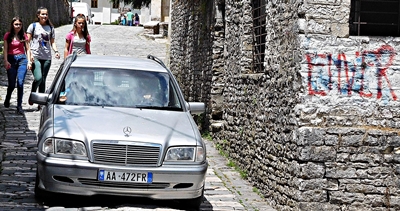
It’s enough to drive you around the Benz

Of my attempts to learn to drive a car, I will write on this subject at another occasion. Suffice it to say that by the summer of 1982, when I had been practising dentistry for several months, I passed the Driving Test at the age of thirty years. I began to enjoy driving and cars in general. I changed my car often. Over a period of eleven years while I practised in Kent, I possessed (in the following order): an Austin Allegro, a Volkswagen Polo, a Volvo 340, then two Volvo 240s, and then a Volvo 850. The last two cars I owned after those were Saabs.


MERC 2


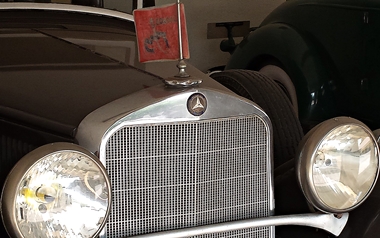
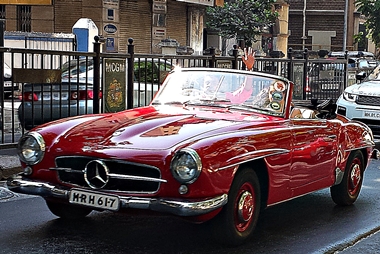
Some time during my eleven year stay in Kent, I fancied owning a Mercedes Benz. In my mind, this make of car rated above all others. Apart from the company’s long heritage (it started in the late 1880s), the cars it produced were reputed to be strong, reliable, and very roadworthy. It is of interest to note that Adolf Hitler rode around in Mercedes cars. I suppose he must have known that the Mercedes in the company’s name was chosen because Mercedes was a daughter of Emil Jellinek (1853-1918), a motor manufacturing entrepreneur who created the Mercedes trade mark in 1901. Emil, the son of a rabbi, was married to Mercedes’ mother Rachel Goggmann Cenrobert, who was of French-Sephardi descent. Therefore, the car Hitler enjoyed was named after a Jewish woman. But I digress.

A new Mercedes Benz dealership opened close to the practice, where I worked. One lunchtime, I drove to the dealership to test drive a Mercedes estate car. A salesman drove me about a mile, and then let me take the wheel on the way back. At a certain stage, I needed to operate the handbrake. I looked for it in the usual place on the central console that separates the two front sets, but it was not there.

“Where is the handbrake?” I asked the salesman.

“I have no idea,” he replied, “I have never driven this model before.”

He thought for a minute, and said:

“Try that handle beside your left leg.”

He was right, but my confidence in him diminished.

When I had driven the car back to the dealership, I asked to be shown some pre-owned cars, as the new ones were way beyond my price-range.

Another digression seems appropriate at this point. Many years after visiting the Mercedes dealership, I hired a car at Heathrow Airport. It was an up to the minute luxurious Vauxhall estate car. A charming young Asian lady handed me the keys and told me where to find the vehicle. I sat in the driver’s seat and started the engine. Immediately, I noticed a warning light telling me that the handbrake was engaged. I looked for the handbrake. It was neither on the central console nor was there a handle near the foot pedals. I was flummoxed. I returned to the car hire office feeling rather foolish and described my problem to the young lady. She smiled before explaining that the handbrake was operated by a small button on the central console near the gear change stick. After returning to the car, I found the button, which was no bigger than the surface of a dice such as is used in board games. It was flush with the rest of the console and looked like a decoration.


MERC 1


I was quite taken with a greenish Mercedes saloon car, which was almost favourably priced, but still some way beyond my reach. The salesman opened the vehicle and invited me to sit in the driver’s seat.

“What do you think?” he asked.

“Very nice,” I replied, “but I’m not so keen on that plastic trim on the central console around the gear stick.”

“Sir,” he exclaimed, affronted, “that’s not plastic. It’s highly polished wood trim. The very best. This is a Mercedes, you know.”

“Sorry,” I replied, not totally convinced, and continuing, “I like the car. Are you prepared to lower the price?”

“Oh no, sir, that is totally against our company policy. The price we offer is the only price. Our company does not haggle.”

Lunchtime was nearly over, so I said that I would think about the car and would let him know my decision soon.

Twenty-four hours later, I was eating my lunch in the practice when the telephone rung. One of my colleagues answered it and then handed me the receiver. It was the salesman, whom I met the day before.

“Mr Yamey,” he said, “I have good news for you. I have spoken with my manager, and he says that we can offer you the car for £1000 less.”

“Thank you,” I replied, “let me think about that.”

Even with the discount, the car was still beyond my means.


merc 3


Twenty-four hours later, two days after visiting the Mercedes dealership, I received another call from the salesman, again whilst I was eating lunch.

“I have more good news for you, My Yamey,” he began, “my manager has authorised a further thousand-pound reduction in the cost of the car you are interested in. That’s a discount of two thousand pounds. Makes the motor very reasonable, don’t you think?”

I told him that I was not sure about buying at that moment, and that I would get back to him if I changed my mind. I had by then decided that not only was the car too expensive even with the unexpected discounts from a firm that never offered discounts, but, also, I was actually happy with the car I already owned.

Good Friday

Years ago, I knew a dentist, who owned his own practice. His residence was in the same building. His patients could ring him any time of the day or night. If there was an urgent out-of-hours problem, he would usually open the surgery and try to help the unfortunate patient. Most of his patients were considerate and did not ring him at inconvenient times. However, once someone rung him at three in the morning. The caller said that his toothache was so bad that he was unable to sleep. My friend, an intelligent man, said to him:

“You come and see me at eight in the morning. That way only one of us will have a sleepless night.”


boy


Occasionally, I had to be ‘on call’ for out-of-hours and weekend emergencies. When I worked in Kent before the widespread use of mobile ‘phones had begun, I had to carry a small radio receiver in my pocket during the hours I was ‘on-call’. If the gadget bleeped, I had to ring the telephone number of some remote call-handling centre. The centre would then provide me with the telephone number of the person in trouble. Usually, the ‘emergency’ turned out to be someone wanting to make or cancel a dental appointment in the middle of the night or on a Sunday or bank holiday. There was little I could do about these abuses of the emergency system.

One Easter weekend, I was contacted by a mother, whose son’s front tooth had snapped off and he was in pain. I asked the caller to bring her son to see me in the surgery, which I opened specially for her son. The boy arrived. The situation was not good. The child had managed to snap off a lateral incisor, leaving the root below gum-level. The tooth was un-saveable and needed to be removed. To extract it, I knew that I would have to perform some minor surgery, lifting the gum and then replacing it (using sutures). It was a job that would have been difficult to perform alone without an assistant. Fortunately, I had the ‘phone number of one of the practice nurses, who lived nearby. Luckily, she was able to come to assist. The operation was done without problem.

When I had finished treating the child, the mother neither thanked my assistant nor me.  She was typical of many National Health Service (‘NHS’) patients, who do not appreciate what is done for them because it is done free of charge. Many of the services provided by the NHS are free, and because of this a proportion of patients show no gratefulness. They take the system for granted, feeling that what is done for them is their birth right.

It was Good Friday morning when this emergency treatment was carried out. The boy’s mother said:

“What a shame that this happened today of all days, Good Friday.”

Silently, I agreed with her. I said:

“Well it’s been a bad Good Friday for your child.”

After a few moments, I added:

“It was also not an awfully good day for Jesus Christ.”

The mother gave me a dirty look, and then took her child home.


[Picture source: “Der Zahnarzt in der Karikatur” by E Henrich (1963)]

The bank manager

I have always had difficulty reproducing my signature. Sometimes, this can create problems.

money

It was a warm day, lunchtime, in Spring 1982 when I walked to the local branch of my bank in the village, where I had just begun practising dentistry in north Kent. I needed some money. I wanted to cash a cheque to obtain ten Pounds.

I filled in one of my cheques, signed it, and handed it along with my bank card to the teller. She looked at the card and the cheque, and then said:

“I am sorry, sir, but your signatures do not match. Please re-sign your cheque.”

I did as was requested. But, the third signature differed significantly from the first two, which also looked unalike.

“Try again, Sir.”

My fourth attempt was yet another variation on a theme. The teller did not approve of it. By now, I was feeling both sweaty and slightly hypoglycaemic. I snatched my cheque and card and stormed out of the bank.

After returning to the dental practice, I calmed down. I still needed that £10. I rang the bank and asked to see the manager immediately. I was asked to return, which I did. On my arrival, the manager, dressed in a smart suit, was summoned to the counter. He said to me:

“How can I help you, sir?”

“I have just begun working as a dentist in the practice up the…”

Before I could finish, the manager invited me into his office. He offered me a chair, and then sat down. I explained what had happened earlier, and that I was concerned about having similar problems in the future as his branch was the most convenient bank to reach on my working days.

“Please give me the cheque, Mr Yamey.”

I handed him my cheque, which was covered with a selection of vaguely similar signatures.

“Please wait a moment,” the manager said, leaving the room.

A couple of minutes later, he returned and then handed me the cash.

I used that branch of the bank for the next eleven years and was never again asked to show my bank card when I wanted to cash a cheque. Such was the respect that the dental profession commanded several decades ago. Since then, I have simplified my signature so that I am able to reproduce it more or less reliably.

Turn it off!

When I first qualified as a dentist and went into practice in 1982, nobody possessed mobile telephones (cell-phones). By the time I retired in 2017, practically all of my patients, even some of the children, carried and used these ‘phones. Believe it or not, my patients often tried using their ‘phones during my appointments.

phon

It was very annoying and ruinous for concentration when a patient stopped me in the midst of performing a delicate operation in his or her mouth in order to answer the ‘phone. Some patients even attempted speaking on their mobiles when their mouths were full of impression materials.


One day, I met my next patient at the reception desk. He had arrived punctually, but had his ‘phone up to his ear. He smiled at me, and then said:

“Give me a minute, I am in the middle of a telephone interview for a job.”

“Ok,” I replied, “come into my surgery when you are finished.”

Ten minutes of his half an hour appointment passed, then fifteen, and then twenty…

At the end of half an hour, I returned to the reception desk. My patient laid down his ‘phone, smiled, and said:

“I’m ready now. My interview is over.”

I replied:

“So is your dental appointment. You had better book another one another day.”

Even more annoying were those who insisted on asking me a question and then, instead of listening to my reply, began sending SMS messages. I recall one lady, who had very complex dental problems, which required much explanation of treatment options before I could proceed any further with helping her. Did she listen to me? Oh, no she did not. For half an hour, she sent a series of SMS messages whilst I spoke. At the end of her appointment, she asked me to repeat what I had been telling her because she had had to send a series of “very important” messages. After that experience, I put up a notice in my surgery, forbidding the use of mobile ‘phones. It was a successful move. Patients would reach for their ‘phones, and then my assistant or I would point at the notice. The patient would then apologise, and turn off the ‘phone.