Death of a theatre

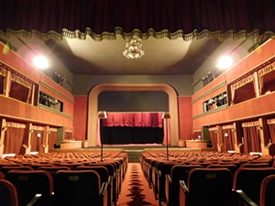
ON SATURDAY THE 17th MAY 2020, an act of cultural barbarism was performed in Tirana, the capital of Albania. The National Theatre of Albania in the heart of the city was demolished. It is unclear who ordered this demolition of a much-loved cultural monument located in a part of the city where property prices are high. The theatre was built in 1939 during the period that the Italians, under Mussolini, were ruling Albania. It was originally a cinema designed by the architect Giulio Berte, but later its screen was replaced by a stage.

TIR 4 BLOG

In 2016, my wife and I visited Tirana and attended a dramatic performance at the National Theatre. I have described this in my book “Rediscovering Albania”:

“…we visited the National Theatre, a building that dates back to before Communist times. A Pirandello play (Play without a Script) was to be performed in Albanian that evening. The charming ladies clustered around the ticket desk assured us that we would enjoy it because it was going to be full of song and dance. We bought a couple of tickets … The rectangular auditorium of the National Theatre was delightfully old-fashioned, with many drapes and an upper gallery that extended around three sides of it. Everything was red including the plush upholstery of the comfortable seats. Although we did not understand a word of it, the Pirandello play was acted beautifully. The expressive acting was so good that we were able to get a rough idea of what was going on. Some years earlier in London, Lopa and I once attended a performance of Gogol’s Government Inspector acted by a Hungarian troupe entirely in Hungarian, and on another occasion a play from Kosovo in Albanian, during the course of which one of the actors threw a fake chicken at me! On both of those occasions and also in Tirana, great acting compensated for our inability to understand the words. If the actions of actors move me more than their words, I feel this is a sign of truly skilful acting. As the great Constantin Stanislavski said: “The language of the body is the key that can unlock the soul”. This is exactly what the actors in Tirana achieved. The audience was appreciative, and, unlike at the opera, hardly anyone used their mobile ‘phones during the show.”

That has now disappeared. So, has also the unusually attractive appearance of Tirana as it was when I first visited it in 1984 during the dictatorship of the faithful follower of Joseph Stalin, Enver Hoxha. In those repressive times, Tirana was a quiet city with only one high-rise building, the 12-storey Hotel Tirana. Of course, back in 1984, times were tough for the average Albanian citizen. They remained quite difficult during the decade following the ending of Communist rule in 1991. Even now, many Albanians prefer to increase their prosperity by seeking work abroad.

When we visited Tirana in 2016, I found it to be a far busier place than it was in 1984. The traffic was busy – a sign that motoring, an option not available to most Albanians during the dictatorship, had become popular and also affordable. Some of the charm of pre-1991 Tirana remained, but many picturesque old buildings, examples of traditional Turkish and Balkan vernacular architecture, had disappeared (or were about to). In their place, there were many high-rise buildings of little or no architectural merit. I suspect that whoever ordered the demolition of Tirana’s historic, much-loved National Theatre has in mind to construct yet another aesthetically unpleasing edifice.

If as Shakespeare said, “All the world is a stage”, then the demolition of this theatre in Tirana is yet another tragedy enacted on that stage.

Park of memory

REGIMES RISE AND FALL, as was the case of the Roman, Ottoman, and British empires. Each has left a physical legacy in the form of buildings, works of art, and a plethora of monuments. In India, a part of the both the former Mughal and British Empires, visitors flock to see their tangible remains.

In the late 1980’s, it was turn of the Soviet Empire to decline and fall. In many of its former ‘colonies’, its citizens hastily tried to erase its physical traces. Statues were toppled and monuments destroyed. Some of these artefacts were removed from public view by governmental authorities (maybe because they feared a possible return of Russian domination?)

For good or evil, the Soviet Empire has had a profound influence on what followed in its wake. Whatever one thinks about the Soviet Empire, it has become a significant part of 20th century history and it is a shame to try to erase memory of it. This was also the opinion of the Hungarian architect Ákos Eliőd, who designed the Szoborpark (Memento Park) in the countryside near Budapest.

The Szoborpark opened to the public in 1993. About 6 years later, we drove to Hungary from London. We stayed with a good friend of ours, Ákos, a pioneer of Hungarian rock music, and his family in his home in the outskirts of the hilly Buda section of Budapest. It was Ákos who alerted us to the existence of the Szoborpark.

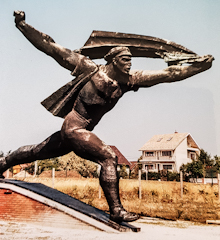
One sunny day, we drove to the park. It was a wonderful place containing a collection of the Soviet era statues and monuments gathered from all over Hungary. It was/is a treasure trove for those who like or are fascinated by socialist realism art forms, an aesthetic that I like. We spent a couple of enthralling hours in the hot sun, wandering about this open air exhibition.

I took many photographs of the Szoborpark, which I have ‘unearthed’ recently. One of them is of wall plaque celebrating Béla Kun (1886-1938) son of Samu Kohn, a non obervant Jewish lawyer. He was the dictator of a short-lived communist regime that terrorised Hungary for a few months in 1919. With its downfall, Kun fled to the USSR, where he organised the Red Terror campaign in the Crimea in 1921. He was executed in 1938, a victim of Stalin’s anti-Trotskyist purges.

Many years after seeing the Szoborpark, my wife and I visited Albania in 2016, more than 3 decades after the downfall of its highly repressive Marxist-Leninist regime piloted for 40 years by its dictator Enver Hoxha.
Interestingly, all over the country there were still numerous monuments erected during the dictatorial era. Many of them were in need of tidying up or cleaning, but they were still there despite being daily reminders of what was a difficult and fearful time for most Albanian citizens.

We believed that the endurance of these monuments erected during difficult times was due to at least two factors. One of these is that many of them were put up to celebrate heroic feats of Albanians carried out against their German invaders during WW2. The other is that despite Hoxha’s repressive regime, many things were done to move Albania from being a Balkan backwater in the former Ottoman Empire to getting nearer to being a 20th century European state.

This is not to say that statues of Enver Hoxha, Lenin, Marx, and Stalin (the mentor and hero of Enver Hoxha) were not pulled down in Albania. They were, but fortunately a few have been preserved by an art gallery in the country’s capital Tirana.

In countries like Hungary and the former Czechoslovakia, the arrival of the Soviet Army and the Russian domination of their countries was not felt by most citizens to have been even remotely beneficial. Obliteration of memories of this era were not surprising in places like these.

To conclude, I am glad that I have neither lost nor obliterated the photographs I took at the Szoborpark so many years ago.

A walk in Greece

LEAR TEMPE BLOG

The River Pineios, which drains into the Aegean Sea near Stomio, runs along a ten kilometre, often very narrow, at times almost a thin cleft, the Vale of Tempe in Central Greece. Ancient legend has it that the valley was cut through the rocks by Poseidon’s trident. The Vale was believed to be the haunt of Apollo and The Muses. Other mythical characters are said to have visited in this valley. Whatever the truth of all these, the mythological associations and beauty of the Vale attracted the attention of the writer/artist Edward Lear (1812-1888), who was touring what is now Greece in May 1849. He was very keen to visit it.

In 1851, Lear published an illustrated account of his travels in the Western Balkans, “Journals of a Landscape Painter in Albania”. Although most know Lear best as a composer of verse, much of it humorous, he regarded himself as a painter primarily. He was without doubt a good painter and sketcher, but this is not what gave him lasting fame. The title of his book included the word ‘Albania’. This is appropriate because much of his travelling in the Balkans was done in what is now Albania and parts of central Greece that used to be important centres of Albanian people during the existence of the Ottoman Empire. Lear’s book on Albania is one of the loveliest books ever written about the country.

After seeing the spectacularly located monasteries at Meteora (close to the River Pineios), Lear wrote on 16th May 1849:

I had been more than half inclined to turn back after having seen the Meteora convents, but improvements in the weather, the inducement of beholding Olympus and Tempe … prevailed to lead me forward.”

On the 18th of May Lear recorded:

“…I set off with Andrea, two horses and a knapsack, and a steeple-hatted Dervish, at whose convent in Baba, at the entrance to the Pass of Tempe, my night’s abode is to be.”

Baba is described in the Seventh Edition of “Handbook for Travellers in Greece” (published by John Murray in 1901) as:

A pretty Turkish village. On the opposite side of the river stands the ruined fort of Gonnos, which commanded the entrance to the defile.”

The village of Gonnoi close to the southern end of the Vale is, I imagine, named after this fort. The long out-of-date guidebook pointed out that in Greek ‘tempe’ means ‘cutting’ or ‘chasm’.

On the next day, Lear noted:

The early morning at Baba is more delightful than can be told. All around is a deep shadow, and the murmuring of doves, the whistling of bee-eaters and the hum of the bees fills this tranquil place.”

After visiting the village of Ampelakia near the southern entrance to Tempe, Lear moved towards his goal, the Vale. He wrote:

“…I went onward into Tempe, and soon entered the celebrated ‘vale’ – of all places in Greece that which I had most desired to see. But it is not a ‘vale’, it is a narrow pass – and although extremely beautiful, on account of the precipitous rocks on each side, the Peneus flowing deep in the midst, between the richest overhanging plane woods, still its character is distinctly that of a ravine or gorge.”

After much wonderful descriptive writing, Lear concluded:

Well might the ancients extol this grand defile, where landscape is so completely different from that of any part of Thessaly, and awakes the most vivid feelings of awe and delight, from its associations with the legendary history and religious rites of Greece.”

Lear continued:

As it was my intention to pursue the route towards Platamona…”

‘Platamona’, or Platamon, to which Lear referred is a small seaside town on the coast of the Aegean Sea. It is overlooked by Mount Olympus and within sight of the mountains Pella and Ossa. It is some miles south of Katerini.  It played an important role in my life.

Every summer, my PhD supervisor Robert Harkness (died 2006) and his wife Margaret (died 2003) drove their caravan across Europe to Platamon, where they camped for about eight weeks on rough ground near the sea. I travelled out from England to Platamon with them on one occasion and did the return journey on another. Travelling via France, Germany, Austria, and the former Yugoslavia, the journey took almost ten days. During one of my visits to Platamon, in 1977, I mentioned that I was keen to follow in Edward Lear’s footsteps by visiting the Vale of Tempe. Robert and Margaret were keen that I should do this.

The modern road along which we drove, the Athens-Thessaloniki National Highway, ran high above the gorge along one of its edges. From this road, there was little if anything that could be seen of the Vale. Looking at today’s maps, it is evident that that road still exists, but a newer highway travels in a straighter route in a long tunnel, marked on the map as “Platamon Tunnel”. The latter only opened in 2017. It shortens the journey from Thessaloniki to Athens by several hours.

Robert and Margaret drove me to a spot near the southern end of the Vale and left me there, planning to meet me again when I reached the northern end of the gorge. I had no idea where exactly the Vale began and if there was a footpath in it that I could walk along. I began walking up through a sloping field to two men who were sitting there looking after their goats.

My Modern Greek was limited to a very rudimentary vocabulary. Using sign language, pointing at my feet, and mentioning the name ‘Tempe’, I managed to convey to these gentlemen my question about how to walk through the Vale. They pointed to a railway embankment high above where we were. I understood, or at least believed I did, that one had to walk along the railway track to see the Vale.

I climbed up to the embankment and began walking on a narrow gravelly path next to the railway track. Soon, a long passenger train with carriages belonging to various different European national railways passed me quite slowly. I could see from signs attached next to the doors of the carriages that this train was an express that connected Athens with Munich.  I continued walking in the direction of the Vale. The track was on an incline and the further I walked, the higher the embankment was above the terrain below it.

Eventually, the track entered a curved cutting lined on each side with jagged rocks. Suddenly, I heard something behind me. I forced myself against the rocky wall of the cutting just in time to avoid being crushed by a diesel locomotive travelling at a high speed. The engine sped past and I continued walking, somewhat nervously.

The track emerged from the cutting and traversed a high sided embankment at the far end of which there was the entrance to a dark tunnel. Seeing that ahead, I decided that it would be dangerously foolish to proceed any further along the track, the main railway line connecting Athens with the rest of Europe.

I stood on the embankment and looked around. To my right, I could see the River Pineios far below in what looked like an attractive narrow valley. I decided that as I was not prepared to risk my life in a dark tunnel, I needed to get off the railway track. So, with some trepidation I sat down and slid down the steep embankment until I reached its base far below.

At the bottom of the embankment, far below the railway line, I found myself on a level footpath that ran along an embankment that led down to the river. It became clear to me that this path was once the foundation for an old railway that had been replaced by the one which I had just left. As I walked along, I realised that this old railway bed was what the two gentlemen had meant by walking along the railway track.  The path wound its way through the depths of the Vale following the course of the river. The scenery down in the valley did not disappoint. It could not have differed much from what it was like when Edward Lear walked along the Vale 129 years earlier.

After a while, I reached what must have once been a railway station. I had arrived at the old railway station of Aghios (Saint) Paraskevi. This was part of a group ecclesiastical buildings. A suspension bridge for pedestrians ran from near it across the river to the other shore. Away from the river, there were some picturesque pools. The whole area was luxuriant with many trees, some with branches hanging over the stream.

The religious compound was not present when Lear walked the Vale. The old railway was built in 1910 as was the present church of Aghios Paraskevi (that stands on the site of a 13th century church). The bridge that I crossed was constructed in the 1960s. Before that, pilgrims could only reach the church by boat (see: https://www.johnsanidopoulos.com/2012/07/st-paraskevi-in-valley-of-tempe.html).

About two kilometres further on, the Vale reached its northern end. I found Robert and Margaret sitting in their Land Rover in a car park, enjoying hot tea from a thermos flask. I cannot remember whether I told them about my lucky escape whilst walking along the railway in the rocky cutting, but if I did not, which is likely because I would not wanted them to have been worried, now it is far too late. My two dear friends are now no more than fond memories, and the Pineios still flows through the Vale of Tempe.

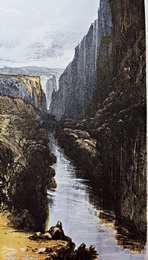
Illustration is one of Lear’s pictures of the Vale of Tempe in 1848

 

One, two, or three heads?

THE HARRAPAN (or Indus Valley) civilisation existed from about 3300 to 1300 BC. Its existence overlapped with that of the ancient civilisation in Mesopotamia (existed approximately 3100 to 539 BC – the fall of Babylon).

Both civilisations used clay to seal closed vessels containing goods. They made identification marks on the clay before it set solid. To do this, they used seals that embossed identifying patterns or marks on the clay. The marks varied greatly.

It is on the ancient Mesopotamian seals that some of the earliest known examples of double-headed birds can be found. Some other Mesopotamian seals depict double-headed horses and other creatures. Whether or not the double-headed eagle of Abania is a descendant of these middle eastern double-headed creatures on sealing rings, I cannot say.

Recently, I visited the Harrapan archaeological site at Dholavira in a remote part of Gujarat close to India’s border with Pakistan. The small museum attached to the site contains several examples of the carved seals used to emboss the wet clay employed to seal close vessels. Knowing about the double-headed birds on the Mesopotamian seals, I was on the look out for similar on the seals excavated at Dholavira.

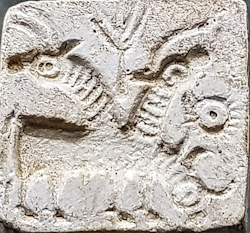
I was very excited to discove one seal that at first sight looked like a double-headed creature. It was not a bird but a four legged animal. Two heads, each on their own striped necks, faced in opposite directions just as seen in the Albanian double-headed eagle.

I showed the picture of this seal to a friend, who pointed out a third striped neck with its own head. The neck was curved downwards. If the other two heads had not been present, the creature would have resembled, say, a horse or cattle grazing.

Did the craftsman who carved this three headed animal intend it to be three headed or did he/she want to depict movement, just as can be seen on the multi limbed depictions of Hindu gods and goddesses? I cannot say, but it raises the question whether the symbolic Albanian eagle has two heads or one that moves from side to side vigilantly surveying its territory.

An afterthought.
Did Cerberus, the three or more headed dog guarding the underworld, have so many heads, or do the many heads seen in depictions of him really represent one head in frenetic motion?

One body with two heads

HAPPY NEW YEAR

THE DOUBLE-HEADED EAGLE (‘DHE’) is a creature with a single body, two wings, and two heads each with its own neck. Of course it does not exist in nature but it is used quite widely as a symbol or emblem. I first became interested in the DHE after I became fascinated by Albania. The DHE has appeared as its national symbol for several centuries. It is also an emblem of Russia, Montenegro, Serbia, and the Indian state of Karnataka. In times past, the DHE was associated with the Hittites, several families in Cornwall, and the Byzantine Empire. It has also been used by some people in pre-Columbian America.

The DHE is an unusual symbol because it required considerable imagination to create it. Symbols like the cross, the crescent, the star, the swastika, and the circle are simple geometric emblems that could have easily arisen from thoughtless doodling. Likewise with emblematic animals like the lion, the eagle (with one head), and other creatures are based on observation of nature. The DHE, on the other hand, is neither an accident of geometry nor based on real life. It is, like the multi-limbed Hindu gods and the Egyptian sphinx, the result of human imagination.

The earliest archaeological evidence of the DHE is on rings used by the ancient Babylonians to mark ownership of containers of oils and other liquid goods. These seals have been dated as having been in existence between two and three millennia before the birth of Christ.

It is interesting to note that the DHE was not the only two headed creature conceive by the ancient Babylonians. There is plenty of archaeological evidence that shows that they created emblems depicting other creatures with a single body, two necks, each supporting a head.

In the future, I hope to explore the origins and the distribution of the DHE in far greater detail, maybe I will make this the subject of a book.

FIRST DAY DAWDLING IN DARJEELING

ISTANBUL AND GJIROKASTER (in Albania) share something in common with Darjeeling. The three places have no shortage of extremely steep inclines. However, Darjeeling beats the other two in steepness. Its footways and streets often seem almost vertical. The thoroughfares are so narrow in many places – wide enough for only one car, and as few of them are one way streets, Darjeeling’s drivers have to be skilled in reversing long distances along them. Driving difficulties are compounded by the oft appalling road surfaces, the steep drops along edges of some streets, and deep gutters.

The Mall and Chowrasta (a square where four roads meet) are vehicle free pedestrian precincts. Some of the buildings in this area are over 100 years old and recall the ‘heyday’ of Darjeeling, when it was a high altitude resort for British colonialists. One of these old structures houses the well stocked Oxford bookshop. It specialises in books about the Himalayas, tea, and natural history.

Two long straggling bazaars start at Chowrasta: the Mall Market that is under a fabric roof supported by bamboo poles, and the Mahakal Market. The latter runs along a path which overlooks a lower part of the town. The Mahakal Temple and a Bhuddist temple perch atop Observatory Hill. These can be reached by walking up a very steep winding path, which was lined by mendicants soliciting alms, often pitifully.

We ate lunch in the very popular Kunga restaurant, which serves Chinese style food. One visit there is enough for me. The restaurant is near a large Victorian gothic edifice with a tall clock tower. Built in 1850, this used to be Darjeeling town hall.

Our quest for a Samsung service centre led us down a long, perilously steep pathway to the busy Chauk Bazaar area. This typical bustling bazaar divided into areas that specialise in one line of business, be it, for example, vegetables or tailoring or sweetmeats or shoes, is laid out higgledy piggledy on an area of level ground that is large by Darjeeling standards.

A taxi conveyed us at great speed up steep winding streets to the huge Sinclairs Hotel where our new friends from Lincolnshire kindly offered us sundowners – well, the sun had actually set long before we reached them.

Returning to our lovely homestay, our young driver forced his poorly powered tiny Suzuki Maruti car along some absolutely appalling roads, which reminded me of some of the worst byways I have experienced in rural Albania and off the beaten track in South Africa.

Houses of Parliament

westmin


Recently, I attended an event, a performance of Albanian polyphonic singing by the ‘Grupi Lab’ ensemble from Vlore (Albania), in a room in the Palace of Westminster in the heart of London. For those who are unfamiliar with the Palace of Westminster, this enormous building contains the two Houses of Parliament.

To enter the Palace, it was neccessary to weave around the barricades put up to limit the activities of the Extinction Rebellion climate change activists. The public entrance is in Cromwell green, close to a statue of Oliver Cromwell. After a series of security checks that resemble those at Heathrow Airport, we followed a path that leads into the huge Westminster Hall. Although restored in parts, this hall dates back to 1097 AD. Its marvellous hammer beam timber roof  was built in the 14th century. Much of the timber is original, but some of it had to be replaced after a bomb struck in 1941.

After the concert, we decided to visit the public gallery of the House of Commons. After a short wait, we were issued with tickets and then escorted to another security check point. The examination here was very thorough. 

The public gallery overlooks the chamber in which Members of Parliament debate and make speeches. When we arrived at about 5.30 pm on the 14th of October (2019), there were more people in the public gallery than in the chamber. A Labour MP was delivering a lengthy, dull speech. Nobody seemed to be paying him the slightest attention.  After what seemed an eternity – actually, about ten minutes – he stopped. He was followed by a Conservative MP, who made an interesting speech, concisely and powerfully phrased. Again, this did not appear to interest anyone else in the chamber. During the couple of speeches we heard, we could see the few other MPs present sitting quietly, many of them fiddling with their mobile telephones or tablets. This, my first ever visit to a sitting of the House of Commons, was interesting but hardly scintillating.

What impressed me most about my visit to the Palace of Westminster was the staff. Everyone we encountered was not only helpful, but also kind and couteous. The ‘pomp and circumstance’ of the Palace did amaze me, but not nearly as much as the superb staff.

An automobile in Albania

KRUJA small

This is an extract from my book “REDISCOVERING ALBANIA” (ISBN: 978-1326807108). The extract describes a visit to a historic town and problems with a rented car.

“When we have hired cars in the past, we have been presented with a car which is almost new and totally flawless. This was not the case with Enterprise at Tirana’s airport. We had ordered a Tata Indica car – I had chosen it because of the price and also because I had not driven an Indian car since 1994, the first and only time that I ever drove in India. Our Tata was distinctly tatty in appearance. It was covered in scratches and dents, all of which were carefully noted and photographed by the Enterprise representative and me. The upholstery was clean but looked well worn. He told us that the car was “quite new”; it had “…only done about 32,000 kilometres”. Dubious at first, I realised later that this unprepossessing vehicle was just the job for the terrain that we were going to traverse.

I had not driven for two years, the last time being when we hired a car in Palermo (Sicily) in 2014. However, I soon got into the swing of driving. I was pleased that we had not hired the car from an office in Tirana, where traffic is heavy, but from the airport where traffic is light. Soon, we left the main Tirana to Shkodër ‘highway’, and then began winding our way uphill to the small town of Krujë, which is where Albania’s hero Skanderbeg had his headquarters while he was combatting the invasion of the Ottomans.

Skanderbeg, the son of a noble-man called Kastrioti, was taken forcibly by the Turks to Turkey as a young boy (as many Christian youths were in that time). He was converted to Islam, educated as a soldier, and became a good fighter in the Ottoman Army. In 1443, aged 38, Skanderbeg along with several other Albanian soldiers abandoned the Turks. Soon, he took command of the Castle at Krujë, which became his headquarters from where he harassed the Ottomans, who were trying to invade what is now Albania. After many military exploits both in Italy and in Albania, Skanderbeg finally succumbed to malaria in 1468. This is a very brief account of the career of a man who saved Western Europe from becoming part of the Ottoman Empire. Albania did become part of the Empire, but in the words of a guidebook published in 1969 by Albturist, the state tourist agency of Albania:

Although their heroic efforts were not crowned with final victory, the Albanian people did not kneel down. Throughout the centuries that followed, our people continued their resistance against the Ottoman feudal regime.”  

The road became steeper and steeper until we entered the town in which level ground is a rarity. We parked the car on a steeply sloping street and made our way to a café, whose terrace provided a great view of the town’s castle, which overlooked us, and the old bazaar, which was several metres below us. From where we were sitting we saw one or two elderly people wearing what looked to us like traditional costumes, but most people were dressed in modern clothing.

We made our way along the shiny cobbled street that runs between the two lines of shops that make up the old bazaar. This has been extended since I saw it in 1984, but the extension has been made to look as if it were original. As in 1984, all of the shops in the bazaar are selling goods aimed at tourists: everything from tasteless ‘tat’ to some very lovely antiques. One particular shop contained superb examples of traditional Albanian handicrafts, some pieces including some wooden cradles for babies were quite old. Some weeks later in Tirana, we met, quite by chance, the shop owner’s cousin, the daughter-in-law of one of Albania’s foremost artists. Although the bazaar resembles what I remembered from my first visit in 1984, the town is filled with new buildings, including mosques and churches, which might have existed before Enver Hoxha destroyed them, but are now reconstructed or entirely new. Many but not all of the old Ottoman era buildings that made Krujë so attractive to me in 1984 have been demolished to make way for newer mostly less-attractive constructions. Nevertheless, Krujë, nestling in the wooded hills that surround it, is still a lovely place to visit.

After stumbling through the cobbled market, we began climbing the path that leads to the castle complex. On our way we passed an old (Ottoman?) structure that housed what must have once been the outlet for a spring. It was filled with fragments of old carvings including an eight-pointed star, and just above the outlet for the water two animals (lions?) facing each other.  Nearby, two young boys selling small round green plums asked where we were from, and then tried to sell us some of their fruit. Just before we reached the entrance to the castle, we came across a man sitting on a wall selling books. He was the author of the various volumes that he had set out for sale. We said hello to him, and told him that we would have a look at his books after we had visited the castle.

Parts of the vast area of the interior of the castle walls are still inhabited. Much of the space is covered with ruins of what had originally been Skanderbeg’s castle and then later the Ottomans’. These ruins include a solitary watchtower and the base of a large minaret. We had read that there was a Bektashi mosque, the Tekke (‘teqe’ in Albanian) of Dollma, in the grounds. A young man offered to guide us to it. Because the way to it was extremely rough and Lopa had a bad ankle, she decided to wait for me while I went to see the mosque. The young man explained to me (in good English) that he is a Bektashi, a member of a ‘sect’ of Muslims (although many Muslims disclaim them) that is halfway between Shia and Sufi. It is particularly popular in Albania, Bulgaria, and Anatolia. Unemployed as so many Albanian graduates are, he spends his time looking after the tekke and its surroundings. On our way along the path to the tekke, we met a woman, aged about 30, with her small child. She spoke some English, but mainly gossiped in Albanian with my new acquaintance. We stood next to what looked to me like an Ottoman hammam or bathhouse. It was, but it has been heavily restored with bright new roof tiles that detract from its character and beauty. After the woman left, he explained that when she had been orphaned, his family had informally adopted her and brought her up as a daughter.

The 18th century tekke is in good state of preservation. By the way, a tekke is a gathering place for Sufi and Bektashi believers. Its interior walls and ceilings are covered with delicately painted frescos and lines of Arabic or Turkish calligraphy. There are several tombs of dervishes within the mosque, and also some outside it in its grounds. Near the tekke, I saw some old stone fragments that looked as if once they had been part of an earlier structure, maybe a church. My guide introduced me to an elder man who lives in a recently built circular meeting place next to the mosque. The old man, I was told, had spent 12 years in prison during the Communist era simply because he was a Bektashi adherent. Some years ago I showed my friend Bejtulla Destani, an academic from Kosovo, pictures in a book by Albert Mahuzier who visited Albania in the early 1960s, in the years before Enver Hoxha outlawed religion. The book included a photograph of the imam or priest of the tekke in Gjirokastër. Without hesitating, Bejtulla said that it was most likely that that man would have been killed by Hoxha’s people soon after 1967.

The visit to the tekke took rather longer than I had anticipated. As we were making our way back to where I had left Lopa, a security man came rushing towards me shouting: “Mister Adam?” I nodded, and he led me not to where I had left my wife, but instead to the Ethnographic Museum, where Lopa was passing the time and also becoming concerned that I might have been kidnapped or worse. After being reunited, I took a look around the museum which was not only interesting on account of its exhibits, but also because it was housed in a very old Ottoman era building.

Our way back to the castle entrance took us past the impressive but incongruous fortress-like building, built in 1982 by the Communists to house a museum or mausoleum to honour Skanderbeg. I did not enter it in 1984, and not on this visit (because it is closed on Mondays). When we emerged from the castle, we stopped by the man selling books. He introduced himself as Professor Baki Dollma (he was related to the Dollma family after whom the tekke is named), a professor of history. Most of his books are in Albanian. We bought a couple that contained some English and were related to the history of Krujë. When he learnt that I also write books, the professor became very friendly, and kept addressing me as ‘Professor’.

We left the amiable professor, and returned to our car. I turned the ignition key, and nothing happened. I tried several times, and then assumed that we had been given a dud hire car. I rang Enterprise, and explained the situation, and was told that someone would ring me back in a few minutes. When this happened, I was asked if I had used the remote control. I told the person on the ‘phone that I had not the remotest idea of what she was talking about. I was told to look under the driver’s seat where I would find a little box on a cable, and that I should always press a blue button on it before starting the car. It worked. However, it would have been helpful to have known about this security feature when we took possession of the vehicle.”


Enjoyed the extract? Then read more!  Buy a copy ofREDISCOVERING ALBANIAby Adam Yamey. It is available from on-line bookstores such as Amazon, bookdepository.com, lulu.com, and as an e-book on Kindle