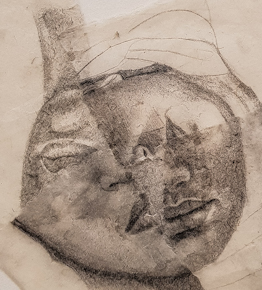
Is it ego that
Plac-es art apart from
Other human pursuits?


Is it ego that
Plac-es art apart from
Other human pursuits?

There is no love sincerer than than the love of food
George Bernard Shaw
Most people think highly of their mother’s cooking. Many people thought highly of my mother’s cooking. She was an early disciple of Elizabeth David, the cookery book writer who introduced Mediterranean cuisine to British kitchens.
My mother regarded our kitchen as her territory. Being highly protective of my sister and me, she would not let us near the cooker nor sharp knives. However, she was quite happy to have us accompany her in the kitchen for two main reasons. One was to give her company while she cooked. Another was to do the washing up of crockery and cutlery. I did not much mind keeping her company, but washing up was not much fun.
Eventually, in the 1960s we acquired a dishwashing machine. This did not prove to be much of a labour saving device because my mother insisted on us, often me, washing every item before putting them in the machine. And, unloading the dishwasher and stacking everything away was as time consuming as washing up manually.
Sadly, my mother died young in 1980. By then, my sister had left home. As my father had no interest in cooking, the kitchen became my own territory. At last, I could begin to use the cooker and all of the kitchen utensils that my poor mother had guarded so jealously. This did not compensate for losing a beloved parent, but it did open a new door in my life experience: the art of food preparation.
My love of cooking commenced. At first, I followed recipes from an excellent series of cookbooks published by the Sainsbury’s supermarket company. Then, I experimented with Indian food guided by a cookbook written by Madhur Jeffrey. Later, I made use of a very practical Chinese recipe book written by Ken Hom and published by the BBC. For middle eastern dishes, I was guided by the well-known Claudia Rosen, who has also written a very good book of Italian recipes, and a superb one by the lesser known Arto Haroutian. For Hungarian food, the book by George Lang is hard to beat. Since marriage, I have been guided in the art of cooking by my wife, who is a superb cook.
I suppose that over the years I have become a ‘foodie’. ‘Foodie-ism’ seems to run in my family. My sister, a very competent cook, ran a restaurant in Italy for about 15 years; she was the chef. My mother’s sister was an excellent chef and her two children, my cousins, have inherited her culinary skills. Our daughter has also inherited the foodie gene, both from me and my wife, both of whose parents had discerning palates.
There are those who consider food simply as fuel. They are missing out on one of the pleasures in life, which I value greatly: the preparation and enjoyment of cooking and eating.
Let me end by wishing you all A DELICIOUSLY HAPPY NEW YEAR!

The Kochi Muziris Art Bienniale is back again. We have attended two of the three previous biennales, those in 2014 and 2016.
The biennales run from mid December to the end of the following March. A joy of this biannual exhibition is that artworks are displayed in many heritage buildings that are not normally accessible to the public. Visitors get a chance to view many fascinating buildings that form part of the history of the port of Cochin.
Today, we visited the main base of the Biennale, which is housed in the buildings of the former Aspinwall company compound.
Works by many artists are on display in the various spaces within the extensive compound. This year most of the works on display are either video installations and/or conceptual art. There are a few works that are otherwise. I was disappointed by this year’s showing as compared with what I saw in previous years’ biennales. The selection of artworks seems unexciting, tired.
However, one work in this year’s show at Aspinwall stands out way ahead of the rest. It is “More Sweetly Play the Dance” made in 2015 by the South African artist William Kentridge.
Moving images are projected onto eight large screens. These images are both drawn (as in cartoons) and photographic. A procession of figures, both drawn and photographed, move from one screen to the next, travelling through a drawn landscape that changes continuously in subtle ways. The motion projected on the screen is accompanied by a brilliant musical soundtrack that is inspired by African music. The result is a spectacular audio visual experience that is both joyous and slightly sinister. I felt that the ‘white’ Kentridge was portraying the experiences of South African Black people, both their joys and their tragedies. His work, on display in a large warehouse with a tiled ceiling at Aspinwall, is truly artistic at all levels of appeal, from the sensual and emotional to the intellectual. It is a positive contrast to much of the other art on display at Aspinwall, which requires explanation before it might possibly be enjoyed.
I look forward to visiting many of the other places connected with the Bienniale. I hope that I will be seeing art that grabs me emotionally as well as intellectually.
PS Since writing this, I have visited many other parts of the Biennale. Some of these, especially the places housing the works of current art students (The Students Biennale) and the artworks in the TKM Warehouse, are outstandingly good. If you are in Cochin for a limited time, skip Aspinwall and head for Mattancherry where the most exciting works are on display.

The French philosopher Voltaire is believed to have written:
” Doctors are men who prescribe medicines of which they know little, to cure diseases of which they know less, for human beings of which they know nothing.”
I was at a party in Athens, Greece, in the early 1980s when I suddenly became aware of bilateral back pain and nausea. Luckily, there was a medical doctor amongst the guests. He diagnosed a kidney or bladder infection and wrote a prescription for bactrim. The tablets were very effective and rapid acting.
A year or so later, I was flying to Greece via Rome in Italy when I experienced a recurrence of the symptoms. As I had quite a long stopover in Rome, I took the opportunity to visit a pharmacy, but this time without a prescription. To my great surprise and relief, the pharmacist sold me some bactrim without requiring a prescription.
In the UK, it is not possible to obtain antibiotics and most other medications without a prescription. There are also rules determining how much non prescription medication can be bought at any one time.
In India, which I visit often, I have never been asked for a prescription to obtain any kind of medication. One just asks for the medicine or tablets required, and then following payment they are handed over the counter. Quite a few of the medications I have needed in India have been clearly marked as prescription only medicines, but these words are ignored by the pharmacy salespeople.
Having been trained as a dentist I have some knowledge of pharmacology. So, I feel that I am unlikely to abuse the ease of obtaining medicines in India, but I worry about others with less knowledge than me.
The freedom of being able to obtain medications without having to first get a prescription has mixed blessings. On the one hand, if you are certain that you need a particular drug or simply need a repeat of what you have been taking, not needing a prescription can save you time and money that visiting a doctor entails. On the other hand, self diagnosis and self treatment is not without risk.
What Voltaire wrote many years ago is less true today than it was then. But, still, even after so many advances have been made in medical science , a great deal of ignorance about the human body remains.

Fans whirling,
Snooker table under wraps:
An ageing colonial club
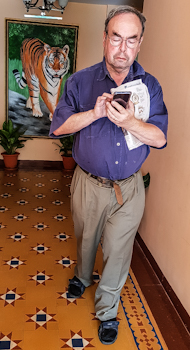
Two of several aspects of contemporary life irritate me. One of them is self-righteous cyclists in London, who disregard red traffic signals and risk fatalities. Another thing I find upsetting is people who walk along in the street with their eyes glued to the screens of their ‘smart’ phones.
Some of these phone obsessed pedestrians catch sight of fellow pavement users and take steps to avoid collisions. Many others do not. They are so very intimately involved with their screens that they seem unaware of their immediate surroundings and other people using the pavement.
Walking along with your eyes focussed on the phone is just like driving a car blindfolded. It is both foolish and selfish. It is foolish because you might trip on an uneven paving stone or fall into a hole. It is selfish because your inattention to fellow human beings causes them inconvenience.
And, what if the thoughtless phone user collides with another pedestrian? The phone user will blame the innocent victim of his or her selfishness for not looking where he or she was going. Actually, it is the phone obsessed pavement hog who is at fault on every occasion.
So, please walk with your eyes on the world around you, and not on the tiny phone screen in your palm.
Here ends my rant!

Bangalore in south India is not blessed with many tourist attractions. I will describe one of them, which gives me great pleasure.
Almost 10 years ago, a branch of the National Gallery of Modern Art (NGMA) opened in Bangalore. Even if you have little interest in modern art this place is worth seeing. Part of the collection, which changes regularly, is housed in the former Manikyavelu Palace, a 19th century edifice which has been superbly restored.
The palace is linked to an elegantly simple contemporary building in which some of the permanent collection is displayed. The collection includes works mainly by Indian artists but there are also a few by European artists. Most of the artworks were created in the 20th and 21st centuries. There is a good selection of paintings by Bengali artists.
The new building also houses well curated temporary exhibitions. Currently, there is a wonderful exhibition of paintings and drawings by the artist Khanderao, who was born in Gulbarga. His early works were beautifully executed topographical scenes. He is also a superp portraitist. Like other great modern artists, for example Picasso, Khanderao has moved into abstraction, which he deals with beautifully.
A water feature separates the palace and its modern extension from another contemporary complex. This includes an auditorium, a library, a café, and a gallery shop.
The verdant gardens of the NGMA contain several modern sculptures.
The NGMA is, in my opinion, one of the loveliest attractions that Bangalore offers visitors and residents alike.

I love cats. I have only ever ‘owned’ one. I named it Crumpet.
I was less than ten years old when Crumpet entered my life. I was lying in bed at home, recovering from a bout of tonsillitis, when my late mother brought Crumpet into my bedroom. She had only just bought the cat at a pet shop to cheer me up.
My mother, who was always nervous about me risking injury, would not allow me to open the tins of cat food that Crumpet enjoyed. She was concerned that I might cut myself on the sharp edges of the open tin lids. So, as my mother did not want to disturb my father, who did much of his academic work at home, she became responsible for feeding Crumpet.
Cats tend to be quite self oriented. They favour the people who feed them. In Crumpet’s case, it was my mother who received much of the cat’s attention. Our cat used to rub herself against my mother’s legs affectionately, especially when my mother was opening the cat food.
Now, here’s the rub. My self sacrifying mother could not bear cats. She put up with Crumpet for my sake.
Crumpet must have realised that my mother was not keen on her because after a few weeks our pussy abandoned our home for another about one hundred yards away from ours.
Since Crumpet deserted us, I have never kept another pet, but my fondness for cats has remained.

Until I was about fifteen, our family usually ate Christmas lunch at my aunt’s home with other relatives and friends. The centrepiece of the meal was often roast goose. My mother’s brother Felix used to try to entertain us youngsters with a story about Turkey Lurkey and his chums Goosey Loosey, Ducky Lucky, and Chicken Licken. He meant well, but his story, repeated annually, elicited groans from young and old alike.
One year, 1963, I was in Manhattan with my sister and parents on Christmas Day. That Christmas, I ate sirloin steak for lunch.
Many times during my late twenties and throughout my thirties, I spent Christmas in the English countryside with my PhD supervisor, his wife, and family. They served turkey for evening dinner on Christmas Day. They used to cook enormous birds capable of generously feeding twenty or more folk, yet there was never more than about ten or eleven of us around the festive table.
Everyone except me preferred white meat. One year, when I was asked my preference, I chose brown meat. My host cut off and then placed a whole turkey leg on my plate. It looked like an enormous club, such as might have been used by Fred Flintstone.
After 1994, I often spent Christmas in India. One Christmas Day, I fancied French onion soup rather than festive fare. A couple of years running, we ate Christmas lunch at Sunnies restaurant, which blazed the trail for fine dining with European food in Bangalore. The Christmas menu included the best turkeys I have ever eaten; they were juicy and very tasty. The turkeys at Sunnies were Butterballs specially imported from the USA.
Finally, I will tell you about an unusual Christmas Day ingredient, which I encountered at a place in Bangalore , which I will not name to save causing embarrassment. Several large roasted turkeys were being served at a buffet lunch. After I had enjoyed a serving of turkey, a friend of mine brought me his daughter’s plate, which contained a sizeable piece of uneaten Turkey meat and … a perfectly roasted large cockroach.
MERRY CHRISTMAS TO YOU ALL!

As in the UK, Japan, South Africa, and Ireland, the rule in India is that one drives on the left side of the road. The steering wheel in four (or more) wheeled vehicles is on the right side of the car, truck, bus etc. In the case of two or three wheeled vehicles, the driver is centrally located. So far so good.
Although the driving on the left rule exists in India, it is regularly ignored.
Unless there is an un-crossable median barrier, turning right is often done as follows in India. The driver eases his or her vehicle into the stream of traffic on the right (I.e. wrong) side of the road into which the turn is being made. With a sea of vehicles approaching in the opposite direction, the driver drifts carefully towards the middle of the road, and then joins the lanes of traffic moving in the same direction as his or her vehicle. Sounds hazardous, does it not?
If you are travelling in an autorickshaw, your driver will often drive down a one way street in the wrong direction in order to make the trip shorter.
On the dual carriageway highway, things get more exciting. The highway provides an opportunity to speed up. But beware; it is not uncommon to come across trucks and other vehicles driving in the wrong direction towards the traffic speeding in the correct direction. Once, I asked a professional driver about this. He told me that it was quite normal for this to happen. By driving down the incorrect lane, a driver can avoid having to travel in the direction opposite to that in which he wishes to travel in order to make a U-turn. That seems quite reasonable but rather dangerous. It is just as dangerous as the herdsmen who choose to move flocks of goats and other animals along the traffic filled lanes of a highway.
Whereas a driver in the UK would be startled by any of the above, Indian drivers take these curious practices in their stride. They expect the unexpected and understand that the rules of the road are, like rules in general, made to be broken.
 yamey
yamey 