Unknown's avatar

About yamey

Active author and retired dentist. You can discover my books by visiting my website www.adamyamey.co.uk .

A writer’s confession

I studied for my O Level examinations at Highgate School in North London. These were important state exams taken at 16 years of age.

My English language teacher was more interested in discussing the poetry of Ted Hughes and Philip Larkin than in teaching us the basics of English Language as required for passing the O Level in that subject. I cannot blame him entirely for what happened when I sat the exam.

My poor ability in written English must have contributed to my failing the exam. The examiners must have been further annoyed by my essay on the subject “Is it fair that nurses get paid less than successful pop singers?”. I wrote that it is, because, I argued back in 1968, a pop singer gives pleasure at any one time to a greater number of people than a nurse.

Fortunately, I have forgotten the name of my of my English language teacher, but I still recall the teacher, Mr George Sellick, who helped me pass my O Level retake.

Sellick taught us advance level biology for the university entrance examinations. Every week we were required to write three essays. On Saturday mornings, we had a long lesson with Sellick. This session was dedicated to discussing the essays that the class had submitted. Our teacher used to read out to us the highlights and lowlights of the week’s essays. He pointed out what was good in essay writing and what was to be avoided. I found these sessions to be very useful.

I retook the English Language exam 6 months after my first attempt and passed quite well, albeit not excellently.

During the last decade or more, I have been writing and publishing a great deal. I now call myself ‘an author’. Whenever I think of myself as an author, I remember my disastrous first attempt at the English O Level, and feel that maybe it is a bit of chutzpah* to take up the same profession as truly great author’s such as Balzac and Dickens.

Although my written English has been gradually improving, I often get my wife, a retired barrister, to read through what I have composed. She is a reader rather than a writer (although she used to write much for her professional work). Unlike me, she got top grades in English Language at school, reads a great deal, and has a superb command of written English. I am enormously grateful to her.

*chutzpah is a Yiddish word implying barefaced cheek

Animal rights

Driving in India may seem somewhat chaotic to visitors from northern Europe including the UK. It might seem less so to visitors from the southern parts of Europe or from Egypt. However, there is some order in the apparent mayhem that can often be observed on Indian roads.

One unwritten rule is that it is advisable to give way to something bigger than you. If you are driving a car, it is best to yield to a lorry or a bus. If a cow or bullock or even an elephant wanders into your path, it is best to avoid it. If you collide with a large beast, your vehicle might suffer greater injury than the beast. Best to give the creature the right of way.

If you should happen to be an autorickshaw (‘tuk tuk’) driver, you are likely to have superbly fast reflexes, the courage of a lion, and nerves of steel. Drivers of these vehicles take risks on the road that sometimes seem suicidal, but overehelmingly they know what they are doing.

One autorickshaw driver in Bangalore once told me that he had been a truck driver before taking up his present occupation. He said that to drive an autorickshaw it was necessary to employ all of the senses. He said that his whole body had to be fully aware of what is going on around him.

However, even the skilfully adventurous autorickshaw drivers will give way to, or avoid cattle in the street. This is not because they hold the cow to be sacred nor because they are believers in animal rights, but because they have a sensible regard for self-preservation.

Seen girl bring ring

Arranged marriages where parents choose the bride and groom are still very common in India. Often the girl and boy hardly know each other, or may have never met, before the wedding ceremony.

In India when a marriage is not ‘arranged’ except by Cupid’s arrow, it is called a ‘love marriage ‘. My wife and I had a love marriage. When our daughter was very young she must have learned about arranged marriages from someone or at school because one day she said to us, assuming that we had had an arranged marriage :

“When I grow up, I am going to marry whoever I like unlike you.” We told her that we had chosen each other.

I am not qualified to discuss the relative merits of love and arranged marriages but both of them can be quite successful. To westerners, arranged marriages might seem strange. The reverse is true for many Indians, for whom the idea of love marriages often seem alien.

Once, I was talking to some young men in a bookshop in Bangalore. When I told them that my wife is Indian, one of them asked me if we had had a love marriage. I said we did have one. They asked me how I felt about love marriage. I told them that I can recommend it.

My in-laws, both Indians, married in India in the late 1940s. In those days, the majority of marriages were arranged. My in-laws were very unusual for that era because they had a love marriage. My father in law and his bride came from different communities. At first, the marriage could not occur because the bride’s family did not want their daughter to marry out of her community. After some time, they softened their views and a very successful married life began.

My wife and I come from different continents, but no objection to us marrying came from any quarter.

Recently, we were chatting with an elderly Indian gentleman, whose story illustrates how little say the participants in an arranged marriage might have. He told us that he had married in the late 1940s. He said that he did not meet his bride until the day he got married. He was working away from his home town when he received a telegram from his mother. It contained the words:

“SEEN GIRL BRING RING”

Bare your feet

In India, I prefer to wear sandals because in so many places it is necessary to remove footwear, and putting on and off sandals is so much easier than doing the same for lace up shoes.

Just in case you are wondering why there is the requirement to bare one’s feet, the reason is to prevent bringing dirt from outside into the place being entered. It is also a mark of respect when entering a religious place such as a mosque, church, temple, or gurdwara.

In some homes, footwear is left by the entrance. This is also the case for some homes that I have visited in the UK. When I went to a junior school in London’s Belsize Park, The Hall School, we left the shoes we had arrived in at the entrance and then replaced them by another pair reserved for use within the school.

When we visited Gulbarga (in North Karnataka, India) recently, we visited what purported to be an Arabic restaurant, Al Makki by name. Its floor was covered with carpets, and guests had to sit on cushions that surrounded very low tables. The owner took one look at my wife and me, and took pity on us. He provided us with a normal height table and chairs. The food was delicious. We ate a mutton “handi”, which is a pilaff flavoured with dried fruit, fried onions, nuts, and mild spices. By now, if you are still reading this, you might well be thinking that I have strayed from my topic. But, you are mistaken. We were not allowed to enter Al Makki until we had removed our footwear.

To conclude, my advice to people visiting India is: wear footwear that is easy to remove and replace.

A bigger audience

During the 1970s and ’80s, I used to take pictures on my film camera using colour slide (diapositive) film. To enjoy these, they were best projected onto a good quality screen

Setting up the projector was quite a nuisance. Finding an audience amongst my friends was not always easy and, if they were willing to watch my slideshows, keeping them awake was also often difficult.

Turning the clock forward to the present era of digital cameras and the internet, the situation has changed. First of all, pictures may be easily uploaded on to the internet. Secondly, the existence of social media websites allows a far larger potential audience for one’s photos than ever before. Pictures can be posted on websites which are viewed by those with special interests or on others, like Instagram and Facebook, which allow the non specialised viewers as well as experts to see the images.

A wonderful thing about uploading one’s photos is that there are opportunities for viewers to comment on the pictures. This, I find to be very valuable. Other people point out things that I had not noticed or understood. I like this.

Unlike slideshows of the past, audiences can enjoy as many or as few of the uploaded pictures as they want without having to look at numerous slides politely whilst dying of boredom!

Nature’s artwork

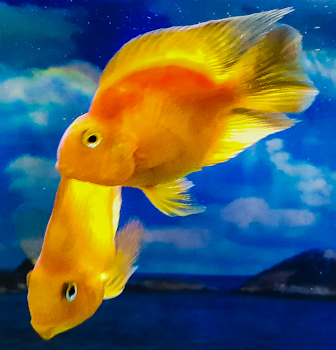
This wonderfully coloured fish was swimming about in a fish tank in the lobby of a hotel in Gulbarga on Karnataka (India). It illustrates the immense variety of the natural colourings of animal life, which rivals the many attempts of artists to produce original creations

A creature of God’s making

Colourful:

Nature’s original art

Overload

“Incredible India” is a tourist promotion slogan. And, it is totally justifiable.

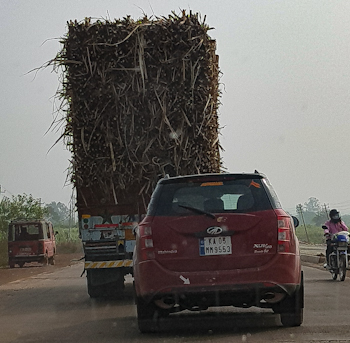
The truck in my picture is not unique. We saw many similarly loaded trucks on a short journey through northern Karnataka, and on many other road trips.

India is not simply incredible because of sights such as overloaded trucks, the wealth of colour, bustle, fantastic food, and the Taj Mahal. It is incredible because of its unending variety and generally very friendly people. Rich in history, the country has a very vibrant present.

Please note that I write this not as a promoter of tourism, but as a lover of a great country that survives despite itself.

On the Indian road

One of the multitude of things that attracts me to India is that often one can see something which remains unchanged over many thousands of years alongside something that has only come into existence very recently.

There is no better place to experience this than on the open road. Bullock carts share the highway with the latest models of automobiles.

In market places, goods are weighed on scales if a design that would not have seemed unfamiliar to people many hundreds of years ago, but the merchant prepares a computerised bill.

You can talk to a scientist who is making ‘cutting edge’ discoveries. During a short conversation, this person will switch with great ease between modern and ancient concepts without any problems.

For me, one of the great joys of India is the seemless coexistence of the past and present in everyday life.