Unknown's avatar

About yamey

Active author and retired dentist. You can discover my books by visiting my website www.adamyamey.co.uk .

Adventures in South Africa

HOG 5 Barkly Pass BLOG


In August 2003, we went on a driving holiday in South Africa, concentrating on visiting places connected with my ancestors who began settling in the country during the nineteenth century. We also saw some places unconnected with my family history. Although the main roads in South Africa were excellent. However, some of the minor roads were adventurous to say the least.

My mother spent the first ten years of her life in a tiny town, Barkly East, in the Eastern Cape. We decided to drive there from Lady Grey, where we had been staying for a couple of nights. My grandfather, my mother’s father, was instrumental in getting the South African government to extend the railway across the mountains from Lady grey to Barkly East. Nelly, a barmaid at the Mountain View Hotel in Lady Grey, told us that the railway no longer ran. About 11 years before we met her, she went on this train along with many other children from Lady Grey on an excursion. Disaster struck. Someone who had had too much to drink took over the running of the train, and it went out of control.  She remembers the train coming to a very sudden halt and being thrown forward. She was lucky only to have received ‘skid-marks’ on her skin: three of her young friends were killed instantly. It would have interesting to have travelled on that line, because like the Darjeeling Himalayan Railway in India’s West Bengal my grandfather’s railway negotiated the steep slopes of the mountains by a series of zig-zags with switchback reverses.

People at the hotel at Lady Grey said that instead of taking a new main road to Barkly East, we should go via the longer but far more picturesque via Joubert’s Pass. This was very scenic but quite hazardous. The road was no wider than our car and covered with loose gravel to which the car’s wheels could hardly grip. I would have enjoyed the spectacular views from the winding road on the way up had I not needed to concentrate so much on keeping the car attached to the road (‘track’ or ‘footpath’ would be a better description of the road). My heart sank when we saw a car approaching us from the opposite direction. The road was so narrow that one of us would have to reverse a long way. Fortunately, the occupants of the approaching car recognised us; they had met us at a barbecue party in Lady Grey on the night before. Kindly, and hazardously, they drove backwards at hair-raising speed along the winding road until they reached a passing place. After the summit of the pass, the road surface improved and we descended into farmland, deserted except for a few sheep and cows. The road wound around following a river, which lay at the bottom of a steep sided canyon. Eventually the road re-joined the main Lady Grey to Barkly East highway.  In a way, this was our ‘baptism of fire’ as far as South African roads are concerned.

Later during our trip, we headed for Hogsback, a quaint place high in the Amathole Mountains about 40 miles northwest of King Williams Town, where my mother and her siblings were born. Some say that Hogsback was the inspiration for his “Lord of the Rings”. However, this is unlikely as Tolkien, who was born far away in Bloemfontein, left South Africa when he was three years old. Whatever the truth of this, we set out for Hogsback from Queenstown in the Eastern Cape. We drove via Whittlesea to the tiny village of Seymour.

My wife, our navigator discovered on the map that there was road – a shortcut, led from Seymour up the side of a mountain to Hogsback. On our detailed map, the thoroughfare was marked as “narrow but with tarmac, not for four-wheel drive vehicles alone”, which we interpreted as meaning that it was suitable for saloon cars such as our hired vehicle. We began driving along it through almost level farmland. We stopped to ask a local whether we were on the road to Hogsback. Somewhat drunkenly, the fellow pointed skywards, and said what sounded like:

Herp, herp, herp.”

This we understood to mean that we had had to go ‘up, up, up’ the hill. Gradually the road began ascending, at first gently. A post-office van passed coming from the opposite direction passed us. This reassured us that the road was motorable. Soon, the road became amazingly steep.

This road, the so-called shortcut, proved to be the worst surface that I have ever driven on. Compared to it, Joubert’s Pass was a motorway. It got progressively worse as we painfully slowly approached Hogsback. The road had everything against it and us. There were potholes, and deep furrows where streams of water had eroded the gravel. Bare rock showed through the road and made steep steps that had to be carefully negotiated. Worst of all were large rounded boulders, which were difficult to drive around as the narrow road was bounded either by ditches or, more often, walls of rock. We were lucky that we neither capsized the car nor grounded it, nor damaged the sump or some other vulnerable part of its under-surface. Negotiating the car safely over some of these boulders reminded me of performing some of my trickiest difficult tooth extractions. In the dental situation, the operator has to avoid cutting the patient’s nerves or large blood vessels. On the way to Hogsback from Seymour, the driver has to avoit severing the fuel line that runs beneath the vehicle. One false move, and we would have been in big trouble, especially as on this lonely road there was neither a mobile telephone signal nor anyone else around.   Hair-raising to say the least: I still shudder when I remember this journey. Things improved at the end of the road. We were amused to see a road sign at the Hogsback end of this road that advised: “Road not recommended for caravans”.

Later, when we returned to Cape Town, I was talking to a cousin about this road. He told me that he had driven along it but managed to ground the car on a rock and sever his car’s fuel line. I have no idea whether this awful road has been improved, but, even if it has, I will not tackle it again.

Hogsback was delightful. However, when we arrived snow began falling in a serious way. The temperature dropped. The cottage we had hired was freezing cold. One tiny heater was provided to try to warm the whole place. It was useless. Hogsback like large parts of India suffers from cold during winter months. Yet, in both places, proper heating seems to be considered unnecessary. Apart from being cold, we enjoyed our brief stay at Hogsback, where we were fed with well-prepared food in a restaurant near our accommodation, run by Dion and Shane.

The two journeys I have described were somewhat risky and adventurous. Writing this reminds me of the parting words of a librarian in, Philippolis (in the Free State), the birth town of Sir Laurence Van Der Post:

Whatever we die of in South Africa, it won’t be boredom.”


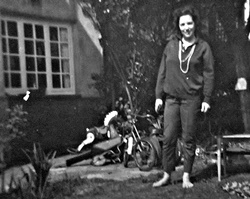
Photo taken in 2003 on the Joubert Pass

The importance of being British

HBY 60s 36 HW BLOG

I HAVE ONLY VISITED CRETE once, and that was in the late 1960s with my parents and sister. We were based in Heraklion and made excursions from there around central Crete, visiting sites including Knossos, Matala, the windmills of Lasithi, Malia, Aghios Nikolaos, and Phaistos. This piece concerns three memories of my late mother on that visit.

The first recollection is of the rather non-descript but very comfortable hotel where we stayed in Heraklion. It had its own swimming pool. My mother, who could not swim, and was always a bad sailor, could not bear to look at the pool; it made her feel seasick seeing its water.

The next memory is of a hot day somewhere in the Cretan countryside. We were all thirsty and ready for a drink. We passed a house with a garden. Some people were sitting at a table sipping the tiny cups of coffee that Greeks favour. They were drinking what many people call ‘Turkish Coffee’, which many Greeks prefer to call ‘Greek Coffee’ or even ‘Byzantine Coffee’.

My mother walked up to the gate leading into the garden and using one of the few words of Greek that she knew, called out:

Kafenion?

Kafenion (καφενεῖον) is the Greek word for ‘café’. Another Greek word she knew well was ‘siga’ (σιγά), which means ‘slowly’. She used it almost in every car that we were being driven in Greece. She was terrified that others driving her would have an accident because as a child in South Africa she had been involved in a dreadful car crash.

Getting back to my story, the coffee drinkers invited us into the garden and asked us to join them. My mother was mildly embarrassed to discover that this was a private house, not a ‘kafenion’. Soon, we were all supplied with Turkish Coffee. One of our hosts spoke rudimentary English. He had been a sailor when younger and excitedly told us that he had been to ‘Kong Kong’, in his own words.

Then, my mother noticed a single brightly coloured flower in the hedge surrounding the garden. She pointed at it, exclaiming “oreia” (ωραία), the Greek word for ‘lovely’. Our hosts burst out laughing. They found my mother’s reaction to the flower hilarious. One of them took Mummy to the flower and showed her it was artificial, attached to the hedge with a fine wire.

The third thing I recall about our Cretan odyssey relates to a commodity that was in great demand recently here in the UK: toilet paper. When we used to visit Greece in the 1960s and 1970s, there were usually people sitting at the entrances to public toilets. These folk, often elderly women, were there to sell sheets of toilet paper to people about to make use of the facilities.

We were in one small Cretan village when my mother needed to answer Nature’s call. We found a public convenience. An elderly toilet paper vendor was sitting by its entrance. My mother rummaged in her handbag for small change. While she was doing this, the lady asked my mother:

“Deutsch? German?”

My mother answered:

“British.”

The lady handed her some toilet paper and would not accept the customary two Drachma payment.

We were in Crete at least twenty years after the German occupation of the island had ended in spring 1945. The Germans had perpetrated many horrific deeds on the Cretan population. The woman outside the toilet was certainly old enough to have had strong memories of that ghastly time. Had my mother been German, she would have had to pay for the toilet paper. Being British, she was like the great writer Patrick Leigh Fermor (1915-2011) who fought the Germans in occupied Crete, a representative of  a nation which helped rid the island of its unwelcome occupiers. This toilet attendant’s small act of kindness towards my mother helped drive home how awful it was to have been occupied by the Germans during WW2.

Eating on a train


OHRID BITOLA 77 Train from Medzhitlija


IN THE SUMMER OF 1973, I was on holiday in Greece. Our family and that of ‘K’, a good friend of mine were guests of an extremely wealthy Greek. We had been put up in luxury hotels. We stayed in the George V Hotel in Athens and K’s family were put up by the sea at a luxurious resort at Vouliagmeni. Before leaving England for our Greek holiday, K agreed to accompany me on an excursion north from Greece to a lake in southern Yugoslavia, Lake Ohrid, a body of water now shared by Northern Macedonia and Albania. I was curious to gaze at the then very mysterious Albania across the water from Yugoslavia and K was just being a ‘good sport’ in agreeing to join me.

One day in Athens, K and I left our very comfortable accommodation and arrived at the railway station from which northbound trains departed. The route between Athens and Thessalonika was long and slow, the train having had to wind its way across mountain ranges.

Every twenty minutes, an attendant arrived at our compartment carrying a tray with pork kebabs, lumps of cooked pork on thin wooden skewers. The barely warm meat was delicious. Each skewer seemed better than the previous one. We kept on buying them each time the attendant arrived.

After several hours and many skewers, K said that he had eaten enough of them and he was not feeling too well. My reaction to this was that being an inexperienced traveller compared to me, his stomach was weak compared to mine. I continued munching the delicious kebabs as the journey continued.

At a small place, which was probably Platy, in northern Greece, our train left the main route and headed along a branch line towards Edessa, where we disembarked. Before leaving the station, we had to have our tickets endorsed by a railway official so that we could continue our journey the following day. As soon as we disembarked, K thrust his ticket into my hand and rushed to evacuate his bowels in a field of ripe corn next to the railway.

We booked into a small hotel, the Olympus, in Edessa, where we paid the Drachma equivalent of £1 Sterling for a room with two beds. I gave K some of my anti-diarrhoea tablets, and he ate some plain yoghurt for supper. At this point, I was still thinking how sad it was that my friend’s stomach was so delicate. Surprised to be hungry after having devoured so many pork ‘souvlaki’ on the train, I ate a normal supper.

The beds in the hotel were very short. My feet projected beyond the bed end. I slept well. The next morning, K was feeling much healthier. However, I was not. I had a terrible pain in my stomach which made it difficult for me to stand up straight. I took some of my tablets and tried without much success to enjoy a bowl of plain yoghurt upon which there was a puddle of oil.

We returned to the railway station and boarded the train which took us westwards to the small town of Florina. We had a short stay, a few hours, in Florina, where I recall buying a roll of toilet paper. The daily train, a single motorised carriage, from Florina to the border with Yugoslavia departed in the early afternoon. K and I were the only passengers. At the border, the Greek carriage drew up next to a Yugoslav motorised train with several carriages on the neighbouring track. A Yugoslav soldier instructed us to move from the Greek to the Yugoslav train and then we set off northwards through southern Yugoslavia, crossing a flat plain with well-tended fields.

We disembarked at Bitola, once known as ‘Monastir’, and transferred to a long-distance bus. As the sun set, this carried us north westward over the mountains towards the historic city of Ohrid on Lake Ohrid.

It was dark by the time we arrived at the campsite on the lakeshore about a mile north of Ohrid city. Both of our stomachs had settled down. For the next few days, I explored the beautiful sights along the lake and enjoyed the local food, much of which was in the form of kebabs. K, having been made wary as a result of our experiences with the Greek railway ‘souvlaki’, avoided this kind of food, preferring to feed himself at our campsite.


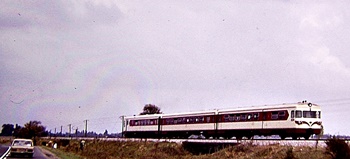
Picture taken in 1977 shows the train in Yugoslavia between the Greek border and Bitola

A picnic to remember


I AM NOT A LOVER OF picnics. My perfect idea of eating outside my home is not squatting on a rug in a picturesque open-air location, but in a restaurant. In contrast, my wife and her parents loved picnics.

Many years ago, when both of my dear in-laws were still alive and healthy, that is well before 2006, we decided to have a picnic at the Big Banyan Tree just outside the city of Bangalore (India). Known in Kannada, the official state language of Karnataka, as ‘Dodda Aalada Mara’ that means ‘Big Banyan Tree’, this huge tree, an example of Ficus benghalensis which is about 400 years old, covers about three acres. It is located about 17 and a half miles west by southwest of the Bangalore Club in central Bangalore.

It is a popular local attraction for picnickers. This being the case and also the fact that I had never been there helped my in-laws decide that we should enjoy a picnic at the Big Banyan Tree. After thermos flasks had been filled, masala omelette sandwiches prepared, blankets packed, puri aloo packaged, bhakri boxed up in cylindrical steel containers with tight fitting lids, we set off: my parents in law, my brother in law and his family, my wife and our very young daughter, and me.

We arrived at the tree, which looked more like a dense, tangled forest than a single tree, but that is what banyan trees become when left to their own devices. After threading our way through the aerial roots hanging down from the tree, we found a small open space that looked nice for a picnic. At least everybody except me, not a lover of picnics, thought so.

We laid out the blanket, and put out the containers of food, and that is about as far our picnic was to resemble a normal meal ‘al fresco’. Moments after setting out the food, swarms of our closely related primates appeared. These monkeys had not come to keep us company or simply to watch their two-legged relatives eating. No, they had arrived to be fed. Their only intentions were far from friendly. They had come to steal our picnic. One by one they dropped out of the trees and approached our food. With great difficulty we were able to ‘shoo’ away these almost fearless raiders. At one stage, I resorted to throwing wet used teabags at them. They were very persistent, in fact so persistent that we decided not to persist with our picnic. We packed everything and made a hasty departure having eaten nothing.

This experience did nothing to remove my long-held prejudice against picnicking. It did the opposite. Wasps and other intruders are bad enough, but monkeys ‘took the biscuit’. Well, metaphorically if not in fact.

Keep your shirt on

My late father in law was enthusiastic about everything new until his very last days. Every day, he scoured the newspapers to discover the latest events happening in Bangalore. If I was visiting the family, I often accompanied him to events that events that caught Daddy’s eye.

For example, I accompanied to the launch of the new Tata Indica car. When we arrived in time for the launch, there was a large crowd waiting for the official launch. When they saw my aged father in law, dressed in a smart suit and wearing a tie, being supported by me and his walking stick, the crowd parted as did the Red Sea when Moses arrived on its shore. We were given the honour of being first to be allowed to sit in the new car model.

On another occasion, Daddy spotted that there was to be a huge shirt sale, at which customers, who brought an old shirt as part exchange, would be able to buy a new one at a substantial discount.

Before we set off, Daddy had to find a shirt that he was willing to part with. This was a lengthy business because he possessed a large collection of shirts, each one of which needed to be examined and considered. This task was difficult because almost all of his shirts were good quality and in good condition.

Eventually, a shirt was selected for sacrifice, and we set off.

There were many people and an enormous number of shirts at the sale. Daddy carefully examined what was on offer and kept selecting shirts and asking my opinion about them, flatteringly but unwisely overestimating my sartorial expertise.

The hours passed and time for eating lunch was approaching rapidly. After giving my opinion about many shirts, all of a lesser quality and beauty to the one he was going to exchange, I told him that the latest one that he was showing me was the one to buy. He bought it and handed his old shirt as part payment.

When we got back home, Daddy showed the family his new shirt. Nobody liked it. They were horrified that I had allowed him to buy such a ghastly shirt. Yet, Daddy loved it. He wore it often. The picture shows him wearing it, sitting with me in 2005 at the Bangalore Club.

A town in California


Just after Christmas in 1994, we flew to San Francisco in California (USA) for a four-week holiday. My wife was in the sixth month of pregnancy. Before booking our trip, we consulted her obstetrician at St Marys Hospital in Paddington, London. We wanted to know whether it was safe for her to travel at this stage in her pregnancy. The obstetrician did not mince her words:

Yes, go ahead, but make sure that you have good travel health insurance because having a premature birth in the United States might well bankrupt you.”

After spending a few days with friends who live across the Golden Gate Bridge in Marin County, we rented a car, an upmarket Toyota, one of the nicest cars I have ever driven. We drove all over California south of San Francisco. Also, we visited the Grand Canyon and saw it under snow. This was a very beautiful sight because the snow had fallen in such a way that the many stepped strata that line the walls of this spectacular gorge were accentuated. We admired this while trudging through very deep snow. In order to enjoy this, we had had to purchase snow chains and to learn how to apply them to the wheels.

One day, we drove south from the snow-covered Grand Canyon to Sedona, a town famed for its vortices of energy. It was a distance of 106 miles. Yet in that short distance the weather had changed from Arctic to summer. And, the following, day we drove further south past Phoenix and Yuma and then through a southern Californian Desert to San Diego. Even though it was freezing up at the Grand Canyon, from Phoenix to San Diego it was so hot that we had to switch on the car’s air-conditioning.

From San Diego, we spent a few days driving along roads close to the Pacific Coast. We visited most of the historic mission stations between San Diego and San Francisco. We also stopped at Nepenthe in Big Sur, where the writer Henry Miller once lived. The building in which the writer lived was open to the public. While we were visiting it, my pregnant wife needed to use a toilet urgently. Without making any fuss, the guardian unlocked the toilet that Miller used to use and allowed my wife to relieve herself.

Being fans of the architect Frank Lloyd Wright, we visited some of the few buildings that the great architect had designed along the route we were taking. One of these, at San Luis Obisco (between Los Angeles and San Francisco), was a particularly lovely medical centre, the Kundert Medical Clinic that was built in 1956.

On the final day of our road trip, I looked at the guidebook and spotted something that I did not want to miss. To reach it, meant adding 60 miles to our already long (300-mile journey) journey. The place that caught my eye was about 90 miles to the east of our destination Marin County on the left bank of the River Sacramento. The small settlement is called Locke.

Locke is in the wetlands of the Sacramento River Delta. In the 1860s, work was undertaken to drain the malarial wetlands. Many poor Chinese labourers were hired to do this work at disgracefully low wages. In about 1912, the settlement of Lockeport, now called ‘Locke’ was established by three local Chinese merchants. Three years later in 1915, the Chinatown in nearby walnut Grove was destroyed by fire. The Chinese community then moved to Locke and a town grew. Because the Californian Alien Land Law of 1913 forbade Asians buying farmland, the Chinese in the area leased the land from a George Locke.

The town’s population reached 1000 to 1500 in its heyday. It acquired a reputation for its gambling halls, opium dens, and brothels. At one point, according to an article in Wikipedia, it became known as ‘California’s Monte Carlo’. In the 1940s and ‘50s, the towns population dwindled because many people migrated from Locke to major American cities. Currently, there are only about ten people living there.

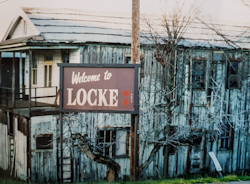
By 1995 when we drove into Locke it was already a ghost town, a lesser-known tourist attraction. However, it did not disappoint us. Most of the main street’s buildings were picturesquely decaying. They were all made of wood, and no doubt highly inflammable. The place looked like a rundown set for a cowboy film, except that it was for real. One of the buildings that had housed a gambling salon, or maybe a brothel or opium den, was open to the public. Its original dingy décor had been preserved. All that was missing was a haze of opium smoke and the poor Chinese workers squandering their hard-earned money.

From Locke we drove west into the setting sun towards Marin County, pleased that we had made the detour to see the fascinating remnant of a far-off era. Our daughter was born three months later, having travelled several thousand miles around the American west in utero.