Travelling beneath Kolkata

THE PRESTIGIOUS TOLLYGUNGE Club, where we are staying in Kolkata, is close to a metro station. The Club’s manager recommended that we used it to reach the city centre quickly rather than taking a much slower taxi into town.

The Kolkata metro, which now has three lines, began operating in 1984.

We travelled from Mahanayak Uttam Kumar Station, which is above ground to Park Street, which is subterranean. At the ticket office each traveller is given a circular plastic counter in exchange for the fare, which depends on the distance to be travelled. At a barrier operated electrically, the counter is placed on a designated panel, and the gate opens to admit the traveller to the platforms.

The clean trains are very efficiently ventilated with an air-conditioning system. There are sections of the carriages for ladies only. Passengers were using their mobile phones in the underground stretches of the journey, which suggests that, unlike in London either broadband or WiFi is available on the train while in a tunnel.

Electronic screens provided information about the journey and the use of the trains in Bangla, English, and Hindi. Announcements made over a loudspeaker system were in Bangla and English.

The train ran smoothly and passengers seemed very calm and polite. The journey was twice as fast as if we had gone by road. Although we travelled at a quiet time of day, the train was quite full. I imagine that during rush hours, we might not have been so comfortable.

All in all, our brief experience of the metro was very satisfactory. After disembarking at Park Street station, we bravely crossed a six lane main road to reach Park Street, which we discovered has now been renamed ‘Mother Teresa Sarani’, but most people still call it by its older name.

Three years later, little has changed…

WHEN WE LANDED at the huge airport that serves Kolkata (Calcutta), it looked much as it did 3 years ago. Only one of the 6 or 7 baggage retrieval conveyor belts was in use and the vast airport seemed almost empty. The situation was the same when we last used it in December 2019.

We made the long ride from the airport to South Kolkata in a vehicle that was not available 3 years ago: an electric taxi. While being driven in this advanced form of vehicle, I wondered whether much else had changed in the city. Although there is much new construction at the periphery, it seems that delightful old Kolkata simply looks a little older.

A visit to the busy New Market (aka ‘SS Hogg Market’) revealed little obvious change. Our first port of call was at the excellently and tastefully stocked Modern Book Depot, where we chatted with the owner and made a few purchases.

Our search for a small funnel took us around the market buildings. A small store crammed full of kitchenware was able to fulfil our quest. We had been looking for this simple item in three other cities – in vain.

To our great relief, Nizam’s restaurant looked much as it has done for many decades, although an additional dining area has been added. The walls of the two older eating areas are decorated with framed theatre (English and Bengali plays) and cinema posters (mainly films made in India).

Nizam’s was founded in 1932, and has been well-known for its tasty kabab (‘kathi’) rolls ever since. A paratha is fried in oil on a tava, and cooked mutton or chicken is placed on it plus or minus a a beaten egg. When the paratha is ready, it and its contents are rolled up and wrapped tightly in paper. According to the customer’s choice, chillies can be added before the paratha is rolled. The management of Nizam’s states that the paper wrapped rolls were invented so that in the era prior to Independence, British men and their casual, temporary, female companions could eat the rolls without getting grease on their fingers. Whatever their history, these kabab rolls are highly enjoyable.

From where we were sitting, we were able to see the paratha dough being strenuously kneaded by a young man rhythmically thrusting his hands into the stiff paste. I was also able to watch other men threading meat onto metal skewers and others grilling the meat on glowing charcoal. The dough is formed into spheres a little smaller than tennis balls . These spheres are then flattened to make circular discs, which are then fried on the tava as already mentioned.

Walking around New Market and driving between it and south Kolkata revealed that the centre of the city I love has not succumbed to the often tasteless modernisation that has affected many other cities. I enjoy the unchanging appearance of Kolkata, but many people who have lived there bemoan the fact that it is a dying city. This is not say that Kolkata lacks vitality. It is still full of life, but as far as business opportunities are concerned, both the present and the future are not looking particularly optimistic.

Charnock, Kolkata, Chennai, and granite

THE CHURCH OF ST MARY in Fort St George in Chennai (Madras) was constructed by 1680, when it was consecrated. It is the oldest Anglican church east of Suez.

The church contains a memorial to the founder of the famous American Yale College – Eliahu Yale. He had been Governor of Chennai’s Fort St George, where the church is located, between 1687 and 1692. He had also been the vestryman and treasurer of St Mary’s church.

The font within the church is made of a form of black granite known as Charnockite. This stone is named after Job Charnock (c 1630-1693). A member of the British East India Company, he is credited with founding a British settlement at a pre-existing village on the bank of the Hooghly River. Although the place had already been settled long before his arrival, Charnock’s establishment grew into what is now Kolkata (Calcutta).

In about 1678, Job entered a romantic relationship with a Hindu woman, whom he called Maria. They produced a son and three daughters. The daughters were baptised in the font in St Mary’s in Chennai in August 1689. A few years later, Job died. His funerary monument is in Kolkata, where he passed away. Like the font in Chennai, Job’s tomb, which is housed in a mausoleum in Kolkata, is made of Charnockite. This form of granite can be found in the south of India. It was local to Chennai but far from Kolkata. This type of rock was first described in Tamil Nadu and was named in honour of Job Charnock.

Apart from the font and the memorial to Yale, the church of St Mary’s has many fascinating sculpted monuments to Britishers who died in India or on their way to or from it.

A house on the Isle of Wight and a plantation in Sri Lanka: chapter 2

THE PHOTOGRAPHER Julia Margaret Cameron (1815-1879; ‘JMC’) was born in the Garden Reach district of Calcutta (now Kolkata in West Bengal). Her father, James Pattle, was a prosperous English official in the East India Company. JMC and her six sisters, the surviving children of James and Adeline Marie Pattle, had a Bengali ancestor, Thérèse Josephe Blin de Grincourt (1768-1866) She was JMC’s maternal grandmother, a Bengali woman who had married a French man, Ambroise Pierre Antoine de l’Étang (1757-1866, whose presence in Bengal was recorded in “The India Office List 1825” as “De l’Étang, Chevalier Antoine, Knt. St Louis, assist. Stud at Poosa, 1796” (Poosa is in what is now Madhya Pradesh). They married in 1788. At that time, it was not uncommon for European men to have lasting relationships with Indian women. This is well-described in William Dalrymple’s book “White Mughals”. Later, in the 19th century, such interracial liaisons were heavily frowned upon. It was expected that ‘white’ men would only marry ‘white’ women. Incidentally, Thérèse was daughter of a French colonist and his Bengali wife.

As with her sisters, JMC was sent to France to be educated. She remained there from 1818 to 1834, when she returned to India.

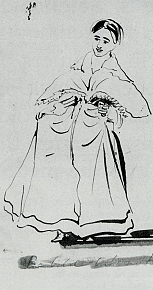
Julia Margaret Cameron by James Prinsep

In 1835, suffering from ill-health, JMC travelled to the Cape of Good Hope. This part of what is now South Africa was favoured as a place to convalesce by Europeans based in India. It was in the Cape that JMC met not only the famous astronomer and an inventor of photography Sir John Herschel (1792-1871), but also the man whom JMC would marry in 1838: Charles Hay Cameron (1795-1880). Charles was in the Cape recovering from a malarial illness. A disciple of the philosopher Jeremy Bentham, he was a reformer of law in India and education, who also invested in coffee plantations (in 1848) in Sri Lanka.

Julia and Charles married in Calcutta, where she became a prominent hostess in the city’s British Indian society. During the 1840s, she corresponded regularly with John Herschel about developments in the science and technology of photography. He sent her two dozen calotypes and daguerreotypes, which were the first photographs he had ever set eyes on. The Camerons raised eleven children: five of their own; five orphans (children of relatives); and an Irish girl named Mary Ryan (whom they found begging on Putney Heath).

The entire Cameron family relocated to England in 1845, possibly because their two older children had settled there, and Charles had retired. They settled in Royal Tunbridge Wells in Kent. They became friendly with one of their neighbours, the poet Henry Taylor (1800-1886), who had worked in the Colonial Office under Robert William Hay (1786-1861), who might well have been related to Charles Hay Cameron’s mother. Later, the Camerons moved to East Sheen, which is closer to London than Tunbridge Wells.

It was through Henry Taylor and Julia’s sister Sara (1816-1887), who was married to Henry Thoby Prinsep (1793-1878), an official in the Indian Civil Service, that JMC was introduced to a set of noteworthy Victorian cultural figures. Henry and Sara had returned to England from India in 1835, and were living in (the now demolished) Little Holland House next to the house of the artist Lord Leighton, near Holland Park in west London. Their home became a meeting place for famous artists, as will be described later. It was here that Sara held a salon for pre-Raphaelite artists, poets, and aristocrats with an interest in artistic activities. At Sara’s home, JMC encountered, amongst other worthy cultural figures, the poet Alfred Tennyson (1809-1892).

Tennyson rented Farringford House in Freshwater Bay on the Isle of Wight (‘IOW’) in 1853, and purchased it three years later. In 1860, after a long visit to Tennyson on the IOW, the Camerons bought a property next door to Tennyson’s and named it Dimbola after one of their (then coffee) plantations in Sri Lanka. TO BE CONTINUED

A house on the Isle of Wight and a plantation in Sri Lanka: chapter 1

OUR CAR FERRY from Lymington docked at Yarmouth on the Isle of Wight after dark on a rainy evening in September 2022. As we drove to our friend’s house in Ventnor, we passed a building whose name, Dimbola, brought back memories of an exotic trip we made 28 years ago.

In February 1994, my wife and I spent a few days in Sri Lanka on our way back from India to London. It was our honeymoon and Sri Lanka was riven by civil war. Our host in Sri Lanka sent a car and driver to Colombo airport, which, despite its excessively high security presence, was attacked by terrorists soon after we departed for London. For several hours, we drove through the countryside after nightfall. Every few miles, we stopped at police check posts. Unlike bus passengers, who were obliged to leave their vehicles at each of these stops, we did not have to disembark. Our car was fitted with a bright lamp that the driver turned on so that the police could see his passengers without them having to leave the vehicle. It was also likely that our driver and his employers were well known to the authorities. About halfway through our long journey, we stopped at a tea stall in a village. The golden tea was fragrant and delicious. Even now, I believe that it was one of the best cups of tea I have drunk during my long life.

We continued driving through the darkened landscape. Every now and then, animals’ eyes reflected the illumination coming from the car’s headlights. It was only when we made the return trip to Colombo in daylight that I realised our driver’s great skill. The narrow road had many potholes and other defects and wound perilously up and down hillsides and close to deep ravines. Eventually, we arrived at the home of the manager of the tea plantation where we were going to spend about a week. We had met him and his wife at the home of a mutual friend, who lives in Ootacamund (‘Ooty’) in south India. This kind couple, having met us only once, had invited us to stay with them in Sri Lanka.

Mr Jain, our host, had been invited by the Sri Lankan government to revitalise a failing tea plantation. Situated about 4 miles northeast of the small town of Hatton, the estate where we stayed was called Dimbula – and still is. Seeing the name Dimbola on the house on the Isle of Wight made me remember Dimbula in Sri Lanka. I wondered whether Dimbola was a name chosen at random, or whether it was in some way related to Dimbula, where we stayed in Sri Lanka.

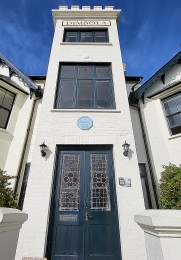
Dimbola house, Freshwater Bay, IOW

On our first full day on the Isle of Wight, the sun shone brightly, and we decided that it was perfect weather to visit Alum Bay to see its famed coloured cliffs and views of the Needles Rocks at the western end of the Isle. To reach this place we drove back along the road we had travelled the previous night. This road runs along clifftops close to the south coast of the island and provides many exciting views. We stopped at a couple of places to enjoy the spectacular coastal scenery, and before reaching Alum Bay, we made yet another stop at Freshwater Bay. By then, we were yearning for mid-morning coffee. Not seeing anywhere open close to the seafront, we drove a little further and noticed that Dimbola has a café.

Dimbola is a two-storey Victorian house with four full height bays, each of which is beneath a roof gable. In the middle of the long southeast-facing façade there is a tall square tower topped with crenellations. This separates the bays into two pairs. The east half of the ground floor houses a second-hand bookshop, which is now closed because its owner does his business on-line only. The west half houses a café, which serves excellent coffee made from beans roasted on the Isle of Wight. Most of the rest of the ground floor and much of the first floor is a museum and its shop. I will go into more detail about this museum soon.

Almost as soon as the waiter came to take our order, I asked him about the name Dimbola. He was not sure, and suggested I asked someone at the museum. After enjoying my coffee – it was so good that we returned for more on a couple of other days – I found someone working in the museum. I told her that I was interested in the similarity of the name of the house and that of the place where we had stayed in Sri Lanka. She told me that a former owner of Dibola had been married to a man who owned coffee (and then later tea) plantations in Sri Lanka when it was British Ceylon, and that the house was named after one of them called Dimbola. I was told that the house at Freshwater Bay was named after the plantation at Dimbula, which is exactly where we stayed in February 1994.

By 1994, Dimbula was a long-established tea plantation. However, it had begun life as a coffee plantation. It had been owned by Mr Charles Hay Cameron (1795-1880). A follower of the great philosopher Jeremy Bentham, Cameron became a barrister, having been called to the bar at Lincoln’s Inn in 1830. In 1835, he went out to India to serve on the Supreme Council of India (which had previously been known as ‘The Council of Bengal’). In 1838, he married Julia Margaret Pattle (1815-1879), whom he met in The Cape of Good Hope (now ‘South Africa’). Their marriage took place in early 1838 in Calcutta (now Kolkata). In 1848, he and his family left India and lived in their homes in London’s Putney and Freshwater Bay on the Isle of Wight. In 1875, he and Julia travelled to Sri Lanka, where Charles owned plantations. They lived there until their deaths. I will return to Mrs Cameron shortly.

The reason that Dimbula now grows tea is that during the 1870s, the market for coffee slumped. The Cameron, both in a poor state of health moved to Sri Lanka because the cost of living there was far lower than in England. During their stay in England, they spent much time at Dimbola between the years 1860 and 1875.

Interesting as was Charles Cameron’s life, that of his wife Julia was exceptionally outstanding. I had never heard of her before having coffee at Dimbola, but our art historian daughter was most excited to learn that we had stumbled upon and visited the former home of the famous photographer, Julia Cameron. TO BE CONTINUED SOON!

What! Why? Is there no Calcutta on the map?

VINCENZO MARIA CORONELLI (1650-1718) who was most likely born in Venice (Italy) was not only a Franciscan friar but also a cartographer. Recently, I spotted one of his maps hanging in a frame in a friend’s home. It is a beautiful work of art, bearing the title (translated from French): “Maritime route from Brest to Siam and from Siam to Brest”. It was made between 1685 and 1686, based on information provided to Coronelli by six Jesuit priests sent out to the Indies by the King of France. Coronelli, based in The Republic of Venice, drew the map.

I was particularly interested to see what of modern India is represented on the map. On the coast of “Guzararatte ou Cambaje” (i.e. Gujarat or Cambay), the Island of Diu, then a Portuguese settlement, is marked, as are “Surate” (Surat) and “Bombaim” and “Chaul” (also  Portuguese settlements). Further south, Goa is marked, and yet further south along the west coast, we can see Calicut and Cochin. On the east coast of India, we can see “Fort S. Thomé” and “Mahapur”, being old names for a place immediately south of Chennai and Mahabalipuram respectively.

The map becomes more interesting when you look at the “Bouches du Gange” (the mouths of the Ganges). Coronelli draws a complex collection of island’s that depict  the Ganges delta, but where one would expect to find Calcutta (Kolkata) on modern maps, there is only a small inset town plan of a place called “Louvo”. This is not a place in India but in modern Thailand (once known as ‘Siam’): its modern name is Lopburi.

The reason that Calcutta is not marked on Coronelli’s map is simple: the place with that name did not exist when the Jesuit priests reported back to Coronelli. Had they made their survey only a little later, they would have been able to report its existence because in August 1686 Job Charnock (c1630-c1692/3) established a trading post (‘factory’) on the River Hooghly, and that became known as Calcutta.  I have visited his grave and mausoleum in central Kolkata.

Rabindranath Tagore in Hove and Hampstead

FROM HOVE TO HAMPSTEAD

THE NOBEL PRIZE winning Rabindranath Tagore (1861-1941) was born in Calcutta (Kolkata). Raised in a culturally rich, wealthy household, he began writing poetry when he was eight years old. His family wanted him to join many of his compatriots, who travelled to England to become barristers. By becoming barristers, many Indian men were able to begin on the pathway to wealth and/or political influence both within the British colonial system, or against it.

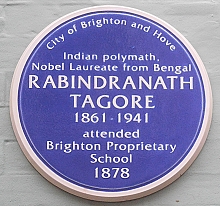
Tagore was enrolled in a school in Brighton in 1878. Whilst there, he resided in Medina Villas in Hove. His biographers, Krishna Dutta and Andrew Robinson, wrote in their book (published 1996) that one of Rabindranath’s (‘Rabi’s’) nieces:

“…retained fresh memories of Rabi Kaka (Uncle Rabi) in the family house at Medina Villas, between Brighton and Hove, where he settled for several months.”

Tagore wrote:

“Our house at Hove is near the sea. 20/25 houses stand in rows and the name of the complex is Medina Villas. When I first heard that we would be living in Medina Villas, I imagined a lot, such as there are gardens, big big trees, flowers, fruits, open space and lakes etc. After coming to my place I found houses, roads, cars, horses and no sign of Villas” (http://rabitalent.blogspot.com/2017/06/rabindranath-in-england.html).

The school that Tagore attended briefly, for about two months, was in Brighton’s Ship Street, close to the town’s famous ‘Lanes’ and a few feet from the seafront. Recently, a commemorative plaque was attached to the building which housed the school and is now part of a hotel, which used to be its neighbour. The plaque named the educational establishment “Brighton Proprietary School”.

I attended a preparatory school before moving on to a high school, but until I saw the plaque in Brighton I had never heard of proprietary schools. It seems as if they were private schools that were run as businesses, rather than not-for-profit organisations. A note on the National Archives website (https://discovery.nationalarchives.gov.uk/details/r/b1c290ea-4580-4c52-962b-10c0d281ac2a) revealed:

“The school was opened on 18 July 1859 under the title of the Brighton Proprietary Grammar and Commercial School for the Sons of Tradesmen. The proprietors … each had a share in the school and were entitled to take up places there. The education given had a Protestant bias and the first headmaster was the Rev John Griffiths, formerly of Brighton College.”

Brighton Proprietary School later became the Brighton, Hove and Sussex Grammar School (www.britishmuseum.org/collection/term/BIOG250324). Dutta and Robinson wrote:

“After spending a short time in a school in Brighton and Christmas with his family, he was taken away to London by a friend of his elder brother, who felt he was making little progress towards becoming a barrister. There he would stay during most of 1879, with a break to visit Devon, where his sister-in-law had taken a house, and, most probably, time spent with some cousins…”

Fast-forwarding to 1912, Tagore, by then a world-famous cultural figure, visited London. During his stay, he resided in Hampstead’s Vale of Health, as I recount in my book “Beneath a Wide Sky: Hampstead and its Environs” (available from  https://www.amazon.co.uk/dp/B09R2WRK92). Here is a brief extract from what I wrote:

“The only vehicular access to the Vale is a winding road leading downhill from East Heath Road. This lane is bordered by dense woodland and by luxuriant banks of stinging nettles in spring and summer. At the bottom of this thoroughfare, there are houses. Most of the expensive cars parked outside them suggest that the Vale is no longer a home for the impoverished. At the bottom end of the road, there two large Victorian buildings whose front doors are framed by gothic-style archways. They have the name ‘Villas on the Heath’. One of them bears a circular blue commemorative plaque, which has leafy creepers growing over it. It states:

“Rabindranath Tagore 1861-1941 Indian poet stayed here in 1912.”

I have visited the palatial Jorasanko where Tagore was brought up in Calcutta. The large (by London standards) ‘villa’ in the Vale is tiny in comparison. An article published in a Calcutta newspaper, The Telegraph, on the 13th of September 2009 reported with some accuracy:

‘In Hampstead, north London, regarded as a cultural “village” today for left-wing but arty champagne socialists, there is a plaque to Rabindranath Tagore at 3 Villas on Vale of Heath.’”

I have known about Tagore’s stay in Hampstead for a long time, but it was only during a recent visit to my wife’s relatives in Hove, that we first learned of the plaque commemorating Tagore’s brief educational experience in Brighton.

No refusal

TAXI NO RESUSAL[2493]


UBER DRIVERS IN MADRAS are, so I have been told, unaware of a customer’s desired destination when they accept a job. It might be a short ride or even an out of town destination. We discovered a consequence of this earlier this year when we were advised that the most reasonable way to make the three-hour journey from Madras to Pondicherry was to hire an Uber cab.

The first three drivers, who offered us rides, phoned us to ask where we wanted to go. When we told them, they cancelled our rides. On our fourth attempt, an Uber arrived. He was happy to drive us to Pondicherry because, as we found out three hours later, he had a friend he wanted to visit there.

In Bombay, the taxis are nicknamed ‘kali pili’, which refers to their black and yellow body paint colours. Most of the cabbies are argumentative and some of them seem reluctant to work, making complaints like “too much traffic” or “that’s too far”. Eventually, one finds a cab that is willing to carry out one’s wishes, often complaining all the way. Maybe, that is because their metered fares are so reasonable for the passenger. Driving in Bombay’s traffic cannot be too much fun, especially if one is getting paid poorly to do so.

Further south in Bangalore, popular transport for those who prefer to avoid using urban buses include Uber and Ola cabs as well as three-wheeled autorickshaws.

Bangalore’s Ubers and Olas are unreliable.  Often, they accept a ride and minutes before they are about to arrive at the pickup point, they cancel. I imagine that often they get stuck in the city’s slow moving or often static congested traffic and feel they are wasting their time trying to reach their passenger waiting beyond the traffic jam. Whatever the reason, these app-linked car services are not nearly as reliable as they are in Bombay or London.

Autorickshaws (‘tuk tuks’) are the best method for getting through the congested thoroughfares of Bangalore.  Their plucky drivers can take risks with their small vehicles that larger cars are unable to attempt. These manoeuvres are daring and can be hair-raising for the passengers, but they get you to your destination relatively quickly. I love the drivers’ sneaky tactics, but others do not. Once, I was travelling in an autorickshaw with two American ladies on a busy main road in the centre of Bangalore. They shrieked with terror as our vehicle sped adventurously between a bus and a heavy lorry that were rapidly moving close together.

One autorickshaw driver, whose command of English was good, told me that he had been a truck driver before driving the three-wheelers to earn his living. He explained that an autorickshaw driver needs to use all of his six senses and to ‘feel the traffic’ with his body. It is my observation that most drivers of these small fragile vehicles have lightning reflexes and nerves of steel. Yet, as they weave effortlessly and excitingly through the traffic, many of them chatter away on their mobile ‘phones.

Hiring an autorickshaw in Bangalore is always an adventure. The vehicles are fitted with taximeters, which are supposed to determine the fair. They are used occasionally but not often. The driver will start by suggesingt an often outrageous fare, which is the starting point for haggling.  Or, some drivers will agree to use the meter determined fare plus some extra Rupees in addition.

Some autorickshaw drivers without much to do will offer foreigners something like:

“Come with me. I’ll take you anywhere for only 10 Rupees.”

Sounds tempting, does it not? Do not succumb to this unbelievable offer because if you do, you will soon discover the catch. The naive passenger will be invited to visit the driver’s friend’s/cousin’s/brother’s  store, where if you buy something, the driver will be rewarded with something like: school books for his children, or a kilo of rice for his starving family, or a new shirt, etc.

Some autorickshaw drivers will set off for a journey in Bangalore, and then after a few minutes, will ask the passenger whether, on the way, they want to do some shopping at a shop the driver recommends. That is, at a shop that will offer the cabbie a commission or a gift when the passenger makes a purchase. A determined refusal is required to ensure that your journey will not include an unwanted, time-wasting detour for shopping.

On the whole, autorickshaws are a great way of getting around Bangalore.

Calcutta is filled with rugged but battered yellow Ambassador taxis. These are slowly being replaced by newer vehicles with blue and white body paint. One thing they share is the wording “No Refusal” painted on the exterior of their doors. The cab driver, who stops to pick up a passenger, is not supposed to refuse to take you wherever you want. Most of the drivers comply with this.

Black Cab taxi drivers in London and other places in the UK are, by law, required to take you anywhere within the area they can legally operate. Like the drivers in Calcutta, the British cabbie is supposed to adhere to the “No Refusal” concept, and often, but by no means always, cabbies comply.

Interesting as all this is, present conditions during the current pandemic mean that not too many cabs are being hailed at the present in London. While the ‘lockdown’ is in force, even in its present slightly diluted form, I feel sorry when I see an empty Black Cab with its ‘For Hire’ sign illuminated cruising the almost empty streets in the hope of finding a customer.

A narrow escape

IN AUGUST 2011, MY WIFE was invited to attend a Loreto House school reunion in Calcutta (Kolkata). As I had never been to the city before, I accompanied her. While my wife took part in the daily activities with some of her former schoolmates, I explored and fell in love with Calcutta.

Throughout our five day visit to the city, the monsoon rain fell heavily and incessantly. I walked around Calcutta, often wading through filthy water that submerged my feet and lapped around my ankles. This hardly affected my enjoyment of the delightful decaying city, in some respects India’s own distinctive version of old Havana in Cuba.

One day, I visited Jorasanko, the palatial residence of the Tagore family, whose members included not only the Nobel Prize winner Rabindranath but also artists such as Abanindranath and Gaganendranath.

After seeing around the fascinating rooms of Jorasanko, I sploshed through the flooded streets towards the Hooghly River. On my way, I walked along a busy street lined with shops and filled with crowds of people. A steady stream of rickshaws pulled by thin sinewy men and each laden with two or three passengers made its way through the busy throng. The huge wheels of these vehicles keep the passengers high above the water flooding the streets.

I noticed that some shops, often clothes and textile merchants, were giving hot food to some passersby. At one of these shops, I asked about the food distribution. It was explained to me that during Ramadan, it was considered to be a virtuous thing to feed the poor.

Eventually, after crossing a wide road clogged with slow moving heavy traffic, I stepped onto the Howrah Bridge, a gigantic steel bridge, a Meccano lovers dream, which traverses the River Hooghly. It was constructed between 1935 and early 1943.

At first, the bridge crosses over a large market that runs along the riverbank. Then, after a few yards, it is over the water. I walked along the downstream facing pedestrian walkway, dodging many porters carrying heavy and bulky loads on their heads. I took numerous photographs until I was two thirds of the way across the bridge and met a policeman with an ancient rifle slung over his back. Politely, he informed me that photography was forbidden on the bridge. By then, I had sufficient images stored in the memory of my camera.

Once over the river, I headed through the streaming rain and thick crowds to a boat station close to the Howrah railway terminus. My plan was to travel on a river bus downstream to a landing stage not far from Park Street.

I bought a ticket which was printed on very poor quality paper, that had to be kept dry to avoid it falling to pieces. I asked someone on the floating platform at the water’s edge if the boat that was approaching was heading for my planned destination. I received what I believed was an affirmative reply, and then boarded a relatively empty boat with plenty of free seats. We set off.

To my surprise, the boat headed upstream rather than downstream. Soon, we passed beneath the Howrah Bridge. We sailed a long way upstream away from the city centre. The banks of the river were lined with unattractive industrial buildings and these were punctuated by occasional bathing ghats.

I disembarked at the boat’s first stop. Had it not been raining so heavily, I would have exited the boat station to take a look around the area. Instead, I bought another flimsy ticket to return to Howrah. This time, I asked several people at which of the two floating embarkation pontoons I should board the downstream boat. I waited close to the water while a large crowd of fellow passengers gathered behind me. I wanted to be sure of embarking first.

The boat approached where we were all standing. I could see from afar that it was packed to the gills with people. When the boat was about 18 inches away from the pontoon, I felt a great push from behind me and I was catapulted across the water towards the approaching vessel. Luckily, I was able to grab something on the boat and this saved me from falling into the water and being crushed between the boat and the pontoon.

The boat was stuffed with people. I am sure that sardines are less tightly packed in tins. I wanted to try to take a photograph to capture an image of this crowd, but I could not because so great was the pressure exerted by those around me that I was unable to raise my hands from beside my body.

I looked around and noticed there were few life saving flotation items. Had our boat sunk, few on board would have survived.

It was a great relief to disembark at Howrah. I was drenched, somewhat shaken, and hungry. I decided to take a taxi to Flurys in Park Street, a European style tea room that served what I was yearning at that moment: toasted club sandwiches.

I boarded a battered yellow Ambassador taxi in a car park near the railway station. We moved forward into a mass of other similar taxis. The crowded taxis were so close to each other that it felt that they were all welded together. It took almost an hour for my driver to skilfully manoeuvre his taxi a couple of hundred yards on to the bridge.

At last, we arrived at Park Street, where, slightly drier because of sitting for ages in the taxi, I settled down at a table in Flurys. I ordered my sandwich and savoured the peaceful atmosphere in the tea room.

On my third visit to Calcutta at the end of 2019, we visited Flurys but, sadly, we were disappointed to find that its food and service was no longer as good as before. Fortunately, the scruffy Nizams at New Market, which serves parathas stuffed with meat and omelettes, remains as good as it was in 2011 and many years before.

Despite my near escape from severe injury or worse, my enthusiasm for Calcutta and its people continues to grow and grow.
To Maurice from Bob

THERE WERE AT LEAST 3 JEWISH girls in my wife’s school class in Calcutta during the mid 1960s. Then, the city had a sizeable Jewish community, many of its members and their ancestors having migrated from Iraq, especially Baghdad.

Recently, a friend gave me an old book about the Tollygunge Club in Calcutta. Inside it, there is an undated handwritten inscription: “To Maurice, with love from Bob”.
My friend did not know who Bob is or was, but told me that the book was part of a collection once owned by Dr Maurice Shellim.

Maurice Shellim, a was born in a Baghdadi Jewish family in Shanghai (China) in 1915 and died in London (UK) in 2009 (see: http://www.jewishcalcutta.in/exhibits/show/notable_members/maurice-shellim).

By profession, Maurice was a medical doctor. According to Dalia Ray, writing in her book “The Jews of India”, he was a Member of the Royal College of Surgeons and Physicians (London), having studied medicine at London’s Guys Hospital. Ray also records that he took part in the functioning of a free medical clinic set up by his coreligionist Dr E Musleah.

After buying a painting by Thomas Daniell (19th century painter of Indian scenes), Maurice Shellim became very interested in Daniell and other British painters in India. Eventually, he published a book about Daniell and his nephew William Daniell: “India and the Daniells: Oil Paintings of India and the East”.

Maurice also published a book about the historic Park Street Cemetery in Calcutta. He had devoted much time and energy to conserving this picturesque resting place for the remains of British families.

In his later years, Maurice and his immediate family moved to London, but he often visited Calcutta.

Most of Calcutta’s Jewish people have left the city to settle abroad. Although anti-Semitism has never been a problem in India, many of Calcutta’s Jewish folk chose to leave in the decades following 1947. Probably, many of them left to improve their economic prospects, but Dalia Ray suggests that because most Indian Jews had been pro British they began to feel that they might begin to feel uneasy in independent India. She also wrote that after the establishment of Israel as a sovereign state, many Jews wanted to fulfil their centuries old desire to reach the Promised Land.

Today, there are very few Jewish people left living in Calcutta.

I would not have been likely to have discovered the story of the remarkable, highly cultured Dr Shellim had I not seen that scribbled inscription in an old book.

PS: ‘Bob’ was most probably Bob Wright, a Britisher who lived in Calcutta for over 30 years. He worked for a large company and was involved in the management of the Tolleygunge Club.