Puncher

THE HUMBLE COCONUT plays an important part in Hindu ceremonies because, to put it very simply, it is a very holy item.


OOTY BLOG

We had a Hindu wedding in Bangalore (India) in January 1994. A most important part of our more than three-hour long ceremony was to do the ‘feras’, that is walk around a sacred fire seven times. My wife, Lopa, and I were attached together with several garlands that had been draped around us earlier in the proceedings. At the end of the religious activities conducted by two pandits (‘priests’) near to the fire, we walked to my in-law’s small Maruti 800 car, a vehicle hardly larger than a Fiat 500. With some difficulty Lopa and I, still attached together by the garlands, squeezed into the back seat of the car. Then my brother-in-law started the engine and drove us forward over a coconut placed under one of the car’s front wheels. The coconut was broken. Breaking coconuts is very auspicious for Hindus and, therefore, a good thing to do at the start of a marriage.

After the lengthier than expected religious ceremony, the reason for its great length is another story, we had lunch in the lovely garden that surrounded my in-laws’ home. Later that day, we enjoyed a formal reception with a buffet vegetarian dinner at the Bangalore Club. As my wife’s grandmother had requested that there be no alcohol on the day of the wedding ceremony, we complied with her wish. So, just after ‘the stroke of the midnight hour’ (to quote the immortal words of Jawaharlal Nehru on the 15th of August 1947) we cracked open bottles of Marquise de Pompadour, an Indian champagne.

The plan was to leave Bangalore on a driving trip on the day following the ceremonies and festivities already mentioned. However, as Robert Burns famously wrote in 1785: “The best-laid schemes o’ mice an’ men Gang aft agley [i.e. The best-laid schemes of mice and men Go often askew]”, so did ours. My in-laws had planned for Lopa and I to go on a driving tour around parts of South India in the Maruti, driven by the family’s driver (chauffeur).  But the driver had other ideas.  On the morning of our departure, we learned that he had quit his employment with the family to take up another post elsewhere. We wondered ‘What to do?’ to use an Indian English set of words that appeals to me.

My wife’s parents made a quick decision. They decided to accompany us as far as Ootacamund (‘Ooty’), a hill station in Tamil Nadu state. From there, we would continue the planned trip using public transport and they would drive the car back home. Maybe, it would not appeal to many just-married couples to take their parents on a honeymoon, but we had no problems with it. Mummy and Daddy packed quickly and had the kitchen staff prepare copious amounts of picnic fare. We all piled into the tiny car with stacks of baggage.

Currently, it takes about eight hours to drive from Bangalore to Ooty without stopping. In 1994, it took longer. We did the journey in two stages, spending a night in the Bandipur nature reserve, currently almost six hours from Bangalore, at the state boundary that separates Karnataka from Tamil Nadu. As I was carrying my International Drivers Permit and I was younger than Lopa’s parents, I volunteered to do the driving. A rash decision, you might be thinking, if you are familiar with driving conditions in today’s India, but it was not. I had already made several driving trips in the crazily crowded central market areas of Bangalore and enjoyed the experience.

We set off and were soon out in the country. Outside Bangalore, there was little traffic on the roads except in the small towns through which we had to pass, there being no by-passes. In 1994, far fewer people had private cars than they do today. So long as one obeyed the informal rule that advised you to give way to cows, who seem oblivious to the dangers of traffic, and to anything larger than one’s own vehicle, there was little that could go wrong.

Well, that is what I thought as we drove along two-lane roads lined with ageing trees with thick trunks and shady foliage and plenty of colourfully dressed pedestrians, many of them carrying loads on their heads. Then, I realised we had had a puncture, or ‘puncher’ as it is often spelled (phonetically) in India. For some reason, we did not resort to using the car’s spare wheel. Instead, we drove a little further and stopped by a wayside ‘puncher’ repairer. This and most others, both then and now, were not what you would expect of a tyre repair station in Western Europe, for example a branch of ATSEuromaster or KwikFit, but something far more modest. Usually located under a tree (for shade), the typical roadside ‘puncher’ repairer consists of a pile of mainly damaged tyres and an assortment of scraps of rubber, once parts of tyres. Despite the unhopeful appearance of these waystations, the people who man them can get you back on the road with a tyre repair within minutes. The only problem, which I discovered soon enough, was that these repairs did not last long. Just in case you are wondering, there were no shops for new tyres along our route back in 1994.

Between Bangalore and our destination at the hill station, we limped along from one ‘puncher’ repairer to another. This problem was a result of the driver having deserted the family. Had he stayed on to drive us, he would have made sure that the vehicle and its tyres were roadworthy before our departure. Apart from the stops for repairing punctures, we arrived at Bandipur safely.

On the following day at Bandipur, we lucky enough to get a ride on a huge elephant. The creature carried us almost noiselessly through the jungle. As it moved, it seemed barely unaware of its passengers. It lumbered along, snacking on tufts of vegetation, which it snatched from the ground with its trunk. The only wildlife I spotted were deer-like creatures, sambars, which were not as exciting as the tigers that we were told lurked in the area. The elephant ride was a complete contrast to the ‘wildlife tour’ we joined at the nature reserve. This consisted of a large single-decker bus with a noisy engine, which was loud enough to frighten even the boldest of wildlife. Our fellow passengers included some boisterous Indian schoolchildren, who were observant enough to spot the occasional monkeys. Apart from them and us, there were some very earnest European tourists armed with costly, sophisticated cameras and telephoto lens. They were very dismayed by the racket being created by the enthusiastic children. At one spot, the bus stopped, and we were all invited to disembark to look at an indistinct footprint in damp mud. This was, we were told, the spoor of a tiger. It did not excite me, but I can still remember it.

We made it to Ooty without mishap. Lopa’s parents stayed in accommodation about a mile from ours. We stayed in an attractive guesthouse built in the British colonial period. Rather inappropriately for a honeymoon suite, it was supplied with the widest bed I have ever seen. Ten people could have slept side-by-side with their arms outstretched without touching each other. Its sheets and blankets must have been made specially for this enormous bed. Maybe, this bed had been constructed with great foresight, with  ‘social distancing’ in mind.

Lopa’s parents stayed on in Ooty after we set off to continue our holiday in Kerala. While they were in Ooty, they had new tyres attached to the Maruti, and then Mummy drove Daddy home.

It is now twenty-six years and a few months since Lopa and I sat in the family Maruti and were driven over the coconut. It is only now as I relate this story that a thought has occurred to me. And that is, I wonder whether one of the tyres was troublesome because it had been damaged by a sharp edge of the shell of the broken coconut.

Himalaya Palace

HIM 1 BLOG


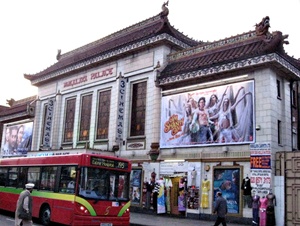
THE HIMALAYA PALACE cinema in the London suburb of Southall, an area where many people of Punjabi descent live, showed only Bollywood films from India, usually the latest releases. Being keen on these films, we often made the long trip from our home to Southall to watch them. During our regular visits to India, always including Bangalore, we take time to see Bollywood films in the country where they are created.

We were in Bangalore in December 2001 when the blockbuster film “Kabhi Khushi Kabhie Gham” (ie ‘sometimes happy, sometimes sad’) was released all over India. We were staying with my in-laws,  and everyone decided that we had to see it.

We chose a cinema near the famous Mavalli Tiffin Rooms (MTR), a long established popular eatery in Bangalore. It was decided that we should have breakfast there before seeing a morning screening of the film. So popular is MTR, that queuing is always required before getting a table. It was my first visit to this highly esteemed place and I hope my last. Everything we were served was almost dripping with ghee, which is part of its attraction for its many fans.

The cinema was a few steps from MTR. After buying tickets, we had to wait in another queue. This one was to await one’s turn to have bags searched by security personnel. I thought this was to prevent weapons and bombs from entering the auditorium, but it was not. The security people were searching for food and drinks. So-called ‘outside food’ could not be brought into the cinema because it risked reducing the sales of overpriced snacks and drinks sold by the cinema.

When we reached our seats, my sister-in-law showed me her basket, lifted a shawl within it, and revealed the sandwiches and other snacks beneath.  So inefficient were the security people that they had not delved into the bag with any seriousness of purpose.

Before the film started, my sister-in-law offered me and the rest of the family rolls of compacted cotton wool rather like those that dentists stuff into patients’ cheeks to dry the mouth. She said we might need them because the volume of the soundtrack would be very high. I declined them, and enjoyed the full impact of the sound.

At the Himalaya in Southall before the start of any film, a sign would be projected. It said something like:

“Please do not talk during the performance.”

This was a pointless exhortation because at the Himalaya the soundtrack was played so loud that even if you screamed at your neighbour, they would not have heard you.

Sadly, the Himalaya Palace (built 1929) is no longer a cinema. It closed in 2010. When we last visited Southall a few years ago, the Chinese style front of the Himalaya, complete with dragons, still existed, but its interior had become a covered market.

Nowadays, well at least before the pandemic arrived,  we watch Bollywood films that are shown regularly (at least one per week) at a Vue cinema in London’s Shepherd Bush.

Providing you miss the Friday and Saturday screenings of the latest releases, the audiences are usually minute, often less than ten people in an auditorium that can seat well over 150 people. Even before the pandemic, social distancing  was the norm during the screenings because empty seats usually greatly outnumbered occupied ones.

Most Bollywood films are long, usually over two and a half hours. So, there is an interval during their screening. The point at which the interval occurs is chosen by the film maker to leave the audience at a point of high suspense in the story.

Once during an interval at a Bollywood screening at the Vue, we sat in the almost empty cinema and heard two ladies, sitting several rows in front of us, chatting in Italian. Out of curiosity,  we asked them in Italian why they had chosen to see a Bollywood film. Their reply surprised us.

The two women were members of an Akshay Kumar fan club in Calabria in the far south of Italy. They had only ever before seen films starring Akshay on video screens.  They were staying far away from Shepherds Bush in Dulwich when, to their delight, they discovered that the film we were watching, starring Akshay, was being screened in Shepherds Bush. They had come to see one of Akshay’s films on the ‘big screen’ for the first time.

Bollywood’s films have captured the hearts of people all over the world. They were even  popular in the former USSR. When we visited Albania in 2016, we discovered that they, as well as Indian TV soap operas, had captured a significantly large audience of Albanians. These films would not have been shown in Albania prior to the downfall of its Stalinist style regime in 1991.

Until it is safe to do so again, my wife and I will have to enjoy armchair screening of our Bollywood DVDs. Enjoyable as these are, they are an incomplete substitute for ‘in your face’ full blast performances in a cinema auditorium.

No refusal

UBER DRIVERS IN MADRAS are, so I have been told, unaware of a potential customer’s desired destination when they accept a job. It might be a short ride or even an out of town destination. We discovered a consequence of this when earlier this year we were advised that the most reasonable way to make the three hour journey from Madras to Pondicherry was to hire an Uber.

The first three drivers, who offered us rides, phoned us to ask where we wanted to go. When we told them, they cancelled our rides. On our fourth attempt, an Uber arrived. He was happy to drive us to Pondicherry because, as we found out three hours later, he had a friend he wanted to visit there.

In Bombay, the taxis are nicknamed ‘kali pili’, which refers to their black and yellow body paint colours. Most of the cabbies are argumentative and some if them seem reluctant to work, making complaints like “too much traffic” or “that’s too far”. Eventually, one finds a cab that is willing to carry out one’s wishes, often complaining all the way.

Further south in Bangalore, popular transport for those who avoid urban buses include Uber and Ola cabs as well as three-wheeled autorickshaws.

Bangalore Ubers and Olas are unreliable. Often they accept a ride and minutes before they are about to arrive at the pickup point, they cancel. I imagine that often they get stuck in the city’s slow moving or often static congested traffic and feel they are wasting their time trying to reach their passenger waiting beyond the traffic jam. Whatever the reason, these app connected car services are not nearly as reliable as they are in Bombay or London.

Autorickshaws are the best method for getting through the congested thoroughfares of Bangalore. Their plucky drivers are able to take risks with their small vehicles that larger cars are unable to attempt. These manoeuvres are daring and can be hair-raising for the passengers but they get you to your destination relatively quickly.

Hiring an autorickshaw in Bangalore is always an adventure. The vehicles are fitted with taximeters, which are supposed to determine the fair. They are used occasionally but not often. The driver will suggest an often outrageous fare, which is the starting point for haggling. Or, some drivers will agree to use the meter determined fare plus some extra Rupees in addition.

Some autorickshaw drivers without much to do will often foreigners something like:
“Come with me. I’ll take you anywhere for only 10 Rupees.”
Sounds tempting, does it not? Do not succumb to this unbelievable offer because if you do, you will soon discover the catch. The naive passenger will be invited to visit the driver’s friend’s/cousin’s/brother’s store, where if you buy something, the driver will be rewarded with something like: school books for his children, or a kilo of rice for his starving family, or a new shirt, or …

Some autorickshaw drivers will set off for a journey in Bangalore, and then after a few minutes, will ask the passenger whether, on the way, they want to do some shopping at a shop the driver recommends. A determined refusal is required to ensure that your journey will not include an unwanted detour for shopping.

On the whole, autorickshaws are a great way of getting around Bangalore.

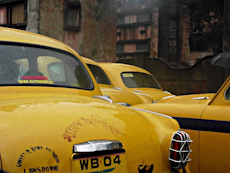
Calcutta is filled with rugged but battered yellow Ambassador taxis. These are slowly being replaced by newer vehicles with blue and white body paint. One thing they share in common is the wording “No Refusal” printed on the exterior of their doors. The cab driver, who stop to pick up a passenger, are not supposed to refuse to take you wherever you want. Most of the drivers comply with this.

Taxi drivers in London and other places in the UK are, by law, required to take you anywhere within the area they are allowed to operate. Like the drivers in Calcutta, the British cabbie is supposed to adhere to the “No Refusal” concept, and often, cabbies, but by no means always, comply.

Interesting as all this is, present conditions during the current pandemic mean that not too many cabs are being hailed at the present.

Picture: Taxis in Calcutta

The kiss

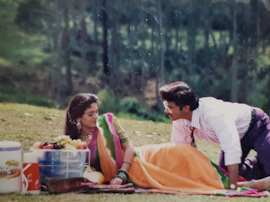
SHE LAY ON A RUG on the well-trimmed lawn of the Ootacamund (Ooty) Golf Club, propped up by one of her elbows. Dressed in a colourful sari, her long black hair was partly hidden by a picnic box filled to the brim with fruit. There was a thermos flask and a cylindrical container for warm food next to and in line with the fruit filled box.

Soon, a bespectacled young man with well coiffured hair and dressed in a white shirt with brown trousers began crawling towards the lady’s feet. Then, he manoeuvred his body over her knees and towards her face. Then, just as he was about to kiss her, both of these figures lowered themselves so that their heads were hidden from view by the picnic box, the hot food storage and the thermos flask.

This amorous couple were neither alone nor unobserved. Apart from my wife and me, local women carrying unwieldy bundles of wood on their heads passed by. Also, the couple were surrounded by a large film crew with lights and cameras.

Soon after their heads disappeared from sight, they reappeared as the film director came running towards them. He talked to them and they repeated what we had just watched after a man with a clapperboard bearing the film name “Andaz” had stood close to them for a few seconds.

“Andaz”, a Bollywood film, was released in April 1994. By chance we had stumbled on this outdoor film shooting in January 1994 during our honeymoon, part of which was spent in Ooty.

In 1994, and certainly until quite recently, intimate displays of affection were not included in Bollywood and other Indian films. What we saw in rehearsal was one of many ways from which film audiences would be saved from seeing an intimate moment. At the moment the audience would expect the male actor was about to plant a kiss on the young lady, they disappear from sight behind the picnic items. Nowadays, the audiences in India get to watch the intimate moment, often in surprising detail for someone, like me, used to watching the older more prudish Bollywood productions.

Although my love of Bollywood films began around 1994, seeing this scene being shot only increased my affection for them. My addiction to Bollywood films began in 1993 when in London some Maharashtrian friends of my wife-to-be insisted that watching the Bollywood film “Sholay” (1975) was important for acclimatising me to the Indian milieu I was about to marry into.

Although many of the latest Bollywood films are extremely good, my preferences is for the older ones. Though often with very complex plots, they have, I believe, an enjoyable innocence that transports the audience temporarily away from the harsh realities of the world beyond the walls of the cinema. Many of the more recent films do the opposite: they remind the audience of the problems they are facing.

A narrow escape

IN AUGUST 2011, MY WIFE was invited to attend a Loreto House school reunion in Calcutta (Kolkata). As I had never been to the city before, I accompanied her. While my wife took part in the daily activities with some of her former schoolmates, I explored and fell in love with Calcutta.

Throughout our five day visit to the city, the monsoon rain fell heavily and incessantly. I walked around Calcutta, often wading through filthy water that submerged my feet and lapped around my ankles. This hardly affected my enjoyment of the delightful decaying city, in some respects India’s own distinctive version of old Havana in Cuba.

One day, I visited Jorasanko, the palatial residence of the Tagore family, whose members included not only the Nobel Prize winner Rabindranath but also artists such as Abanindranath and Gaganendranath.

After seeing around the fascinating rooms of Jorasanko, I sploshed through the flooded streets towards the Hooghly River. On my way, I walked along a busy street lined with shops and filled with crowds of people. A steady stream of rickshaws pulled by thin sinewy men and each laden with two or three passengers made its way through the busy throng. The huge wheels of these vehicles keep the passengers high above the water flooding the streets.

I noticed that some shops, often clothes and textile merchants, were giving hot food to some passersby. At one of these shops, I asked about the food distribution. It was explained to me that during Ramadan, it was considered to be a virtuous thing to feed the poor.

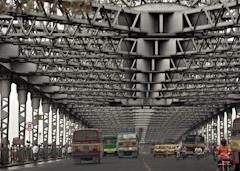
Eventually, after crossing a wide road clogged with slow moving heavy traffic, I stepped onto the Howrah Bridge, a gigantic steel bridge, a Meccano lovers dream, which traverses the River Hooghly. It was constructed between 1935 and early 1943.

At first, the bridge crosses over a large market that runs along the riverbank. Then, after a few yards, it is over the water. I walked along the downstream facing pedestrian walkway, dodging many porters carrying heavy and bulky loads on their heads. I took numerous photographs until I was two thirds of the way across the bridge and met a policeman with an ancient rifle slung over his back. Politely, he informed me that photography was forbidden on the bridge. By then, I had sufficient images stored in the memory of my camera.

Once over the river, I headed through the streaming rain and thick crowds to a boat station close to the Howrah railway terminus. My plan was to travel on a river bus downstream to a landing stage not far from Park Street.

I bought a ticket which was printed on very poor quality paper, that had to be kept dry to avoid it falling to pieces. I asked someone on the floating platform at the water’s edge if the boat that was approaching was heading for my planned destination. I received what I believed was an affirmative reply, and then boarded a relatively empty boat with plenty of free seats. We set off.

To my surprise, the boat headed upstream rather than downstream. Soon, we passed beneath the Howrah Bridge. We sailed a long way upstream away from the city centre. The banks of the river were lined with unattractive industrial buildings and these were punctuated by occasional bathing ghats.

I disembarked at the boat’s first stop. Had it not been raining so heavily, I would have exited the boat station to take a look around the area. Instead, I bought another flimsy ticket to return to Howrah. This time, I asked several people at which of the two floating embarkation pontoons I should board the downstream boat. I waited close to the water while a large crowd of fellow passengers gathered behind me. I wanted to be sure of embarking first.

The boat approached where we were all standing. I could see from afar that it was packed to the gills with people. When the boat was about 18 inches away from the pontoon, I felt a great push from behind me and I was catapulted across the water towards the approaching vessel. Luckily, I was able to grab something on the boat and this saved me from falling into the water and being crushed between the boat and the pontoon.

The boat was stuffed with people. I am sure that sardines are less tightly packed in tins. I wanted to try to take a photograph to capture an image of this crowd, but I could not because so great was the pressure exerted by those around me that I was unable to raise my hands from beside my body.

I looked around and noticed there were few life saving flotation items. Had our boat sunk, few on board would have survived.

It was a great relief to disembark at Howrah. I was drenched, somewhat shaken, and hungry. I decided to take a taxi to Flurys in Park Street, a European style tea room that served what I was yearning at that moment: toasted club sandwiches.

I boarded a battered yellow Ambassador taxi in a car park near the railway station. We moved forward into a mass of other similar taxis. The crowded taxis were so close to each other that it felt that they were all welded together. It took almost an hour for my driver to skilfully manoeuvre his taxi a couple of hundred yards on to the bridge.

At last, we arrived at Park Street, where, slightly drier because of sitting for ages in the taxi, I settled down at a table in Flurys. I ordered my sandwich and savoured the peaceful atmosphere in the tea room.

On my third visit to Calcutta at the end of 2019, we visited Flurys but, sadly, we were disappointed to find that its food and service was no longer as good as before. Fortunately, the scruffy Nizams at New Market, which serves parathas stuffed with meat and omelettes, remains as good as it was in 2011 and many years before.

Despite my near escape from severe injury or worse, my enthusiasm for Calcutta and its people continues to grow and grow.

Park of memory

REGIMES RISE AND FALL, as was the case of the Roman, Ottoman, and British empires. Each has left a physical legacy in the form of buildings, works of art, and a plethora of monuments. In India, a part of the both the former Mughal and British Empires, visitors flock to see their tangible remains.

In the late 1980’s, it was turn of the Soviet Empire to decline and fall. In many of its former ‘colonies’, its citizens hastily tried to erase its physical traces. Statues were toppled and monuments destroyed. Some of these artefacts were removed from public view by governmental authorities (maybe because they feared a possible return of Russian domination?)

For good or evil, the Soviet Empire has had a profound influence on what followed in its wake. Whatever one thinks about the Soviet Empire, it has become a significant part of 20th century history and it is a shame to try to erase memory of it. This was also the opinion of the Hungarian architect Ákos Eliőd, who designed the Szoborpark (Memento Park) in the countryside near Budapest.

The Szoborpark opened to the public in 1993. About 6 years later, we drove to Hungary from London. We stayed with a good friend of ours, Ákos, a pioneer of Hungarian rock music, and his family in his home in the outskirts of the hilly Buda section of Budapest. It was Ákos who alerted us to the existence of the Szoborpark.

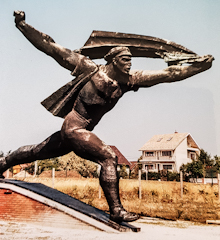
One sunny day, we drove to the park. It was a wonderful place containing a collection of the Soviet era statues and monuments gathered from all over Hungary. It was/is a treasure trove for those who like or are fascinated by socialist realism art forms, an aesthetic that I like. We spent a couple of enthralling hours in the hot sun, wandering about this open air exhibition.

I took many photographs of the Szoborpark, which I have ‘unearthed’ recently. One of them is of wall plaque celebrating Béla Kun (1886-1938) son of Samu Kohn, a non obervant Jewish lawyer. He was the dictator of a short-lived communist regime that terrorised Hungary for a few months in 1919. With its downfall, Kun fled to the USSR, where he organised the Red Terror campaign in the Crimea in 1921. He was executed in 1938, a victim of Stalin’s anti-Trotskyist purges.

Many years after seeing the Szoborpark, my wife and I visited Albania in 2016, more than 3 decades after the downfall of its highly repressive Marxist-Leninist regime piloted for 40 years by its dictator Enver Hoxha.
Interestingly, all over the country there were still numerous monuments erected during the dictatorial era. Many of them were in need of tidying up or cleaning, but they were still there despite being daily reminders of what was a difficult and fearful time for most Albanian citizens.

We believed that the endurance of these monuments erected during difficult times was due to at least two factors. One of these is that many of them were put up to celebrate heroic feats of Albanians carried out against their German invaders during WW2. The other is that despite Hoxha’s repressive regime, many things were done to move Albania from being a Balkan backwater in the former Ottoman Empire to getting nearer to being a 20th century European state.

This is not to say that statues of Enver Hoxha, Lenin, Marx, and Stalin (the mentor and hero of Enver Hoxha) were not pulled down in Albania. They were, but fortunately a few have been preserved by an art gallery in the country’s capital Tirana.

In countries like Hungary and the former Czechoslovakia, the arrival of the Soviet Army and the Russian domination of their countries was not felt by most citizens to have been even remotely beneficial. Obliteration of memories of this era were not surprising in places like these.

To conclude, I am glad that I have neither lost nor obliterated the photographs I took at the Szoborpark so many years ago.

Adventurous crossing

BEST TO WATCH THE SHORT VIDEO (1 minute) FILMED IN BANGALORE (India) BEFORE READING THIS!

Watch here:  https://vimeo.com/409423869

SINCE THE ‘LOCKDOWN’, and the worldwide decline in road usage, what is written below has temporarily become historical.

Crossing main roads in Bangalore and many other Indian cities requires an act of faith and is quite an adventure. There are, of course, some pedestrian crossings controlled by traffic signals that are usually but not always obeyed. Once we were in an autorickshaw in Ahmedabad. The driver hardly ever stopped at red signals. When we asked him about this, he told us that there was no need to stop at red lights unless there was a policeman nearby.

Despite the availability of controlled pedestrian crossings in Bangalore, most people cross busy roads wherever they feel like and however hectic the traffic, putting life and limb at risk every time.

Now, I do not want you to think that I am singling out Indian road users including pedestrians for their exciting approach to road safety.

Long ago in Rome, I got the feeling that pedestrians who expected motorists to stop at pedestrian crossings mostly stimulated drivers to drive more rashly when they were trying to cross the road.

In another former imperial city, Istanbul, which I visited in 2010, motorists drove fast and recklessly. When drivers paused at pedestrian crossings, it was only briefly. They were like energetic dogs straining on their stretched leashes. I had the feeling that at any moment cars would charge forward to crush the people scurrying across the road.

Indian drivers, although seemingly undisciplined, expect anything to happen on the road, be it a cow that suddenly strays onto the carriageway to vehicles driving in the opposite direction to the rest of the traffic and people who have decided to dry their grains on a sun drenched flat road surface. Most Indian drivers, expecting the unexpected, seem to have good reflexes. So, pedestrians wandering across the road wherever and whenever they feel like it do not pose a great problem for drivers. That said, I feel that crossing busy roads in Bangalore requires much courage and faith in the skill and care of drivers.

My approach to crossing busy roads in Bangalore is as follows. Quite simply, I look for someone else nearby who wants to cross. As these strangers are often locals, I assume, perhaps naively, that they are experienced in crossing the road. I join them to take advantage of their supposed experience and because any sensible motorist would rather injure one pedestrian rather than several at once. Foolish reasoning, maybe, but apart from making long detours to find allegedly controlled crossings, I will willingly accept better suggestions.

Well, at the moment (April 2020), the streets of Bangalore and London, where I live, are pleasantly devoid of traffic apart from occasional cars, delivery motor bikes and public service vehicles.

Even in London, where drivers are not mentally prepared for pedestrians wandering into their paths away from controlled crossings, traversing the street ‘Bangalore style’ has become possible. My worry is that when ‘lockdown’ is unlocked, will people in London be able to get out of their newly acquired habit of crossing wherever and whenever they feel like it?

Unsuitable for the elderly

I HAVE ONLY VISITED Nandi Hills once. That was in 1994. My wife’s grandmother was approaching the age of 97.

We were staying with my in-laws in their two storey house in Koramangala in the south of Bangalore. One day, it was decided that a visit to the Nandi Hills would be fun.

Nandi Hills is about two hour’s drive north of Koramangala. Perched on the summit of a steep hill, Nandi Hills used to be a summer fortress of the great Tipu Sultan, whose life ended at the end of the 18th century.

Given that at our excursion destination there would be steep paths and uneven ground, it was sensibly considered that it would not be a good place to take a frail 97 year old.

My wife’s grandmother (‘Granny’), who was fully alert intellectually, was not at all happy with the idea of missing the trip.

While the family was assembling the copious amounts of food to eat during the journey and at our destination, several of us noticed Granny, who usually never left the ground floor, sprinting up and down the stairs leading to the first floor.

When Granny had completed her athletic feat, she came up to us and said:
“See? I can easily manage the stairs. So, I can join you on the trip to Nandi Hills”
My parents in-law employed a great deal of tact tinged with a modicum of firmness to get Granny to agree, somewhat reluctantly, to remain at home.

The road that ascended from the plain up to the fort at the summit of the Nandi Hills was spectacular. It had at least twelve extremely tight hairpin bends, each one numbered.

We spent a pleasant couple of hours picnicking in the garden amongst rusty old cannons near the fort. My wife and I walked to some stone Hindu temples overlooking a sharp cliff-like drop down to the plain far below. One of the temples housed a large stone carving of a Nandi Bull, a creature found in many Hindu temples.

I suppose that once travel becomes safely feasible again, I would love to pay another visit to Nandi Hills.

A picnic to remember


I AM NOT A LOVER OF picnics. My perfect idea of eating outside my home is not squatting on a rug in a picturesque open-air location, but in a restaurant. In contrast, my wife and her parents loved picnics.

Many years ago, when both of my dear in-laws were still alive and healthy, that is well before 2006, we decided to have a picnic at the Big Banyan Tree just outside the city of Bangalore (India). Known in Kannada, the official state language of Karnataka, as ‘Dodda Aalada Mara’ that means ‘Big Banyan Tree’, this huge tree, an example of Ficus benghalensis which is about 400 years old, covers about three acres. It is located about 17 and a half miles west by southwest of the Bangalore Club in central Bangalore.

It is a popular local attraction for picnickers. This being the case and also the fact that I had never been there helped my in-laws decide that we should enjoy a picnic at the Big Banyan Tree. After thermos flasks had been filled, masala omelette sandwiches prepared, blankets packed, puri aloo packaged, bhakri boxed up in cylindrical steel containers with tight fitting lids, we set off: my parents in law, my brother in law and his family, my wife and our very young daughter, and me.

We arrived at the tree, which looked more like a dense, tangled forest than a single tree, but that is what banyan trees become when left to their own devices. After threading our way through the aerial roots hanging down from the tree, we found a small open space that looked nice for a picnic. At least everybody except me, not a lover of picnics, thought so.

We laid out the blanket, and put out the containers of food, and that is about as far our picnic was to resemble a normal meal ‘al fresco’. Moments after setting out the food, swarms of our closely related primates appeared. These monkeys had not come to keep us company or simply to watch their two-legged relatives eating. No, they had arrived to be fed. Their only intentions were far from friendly. They had come to steal our picnic. One by one they dropped out of the trees and approached our food. With great difficulty we were able to ‘shoo’ away these almost fearless raiders. At one stage, I resorted to throwing wet used teabags at them. They were very persistent, in fact so persistent that we decided not to persist with our picnic. We packed everything and made a hasty departure having eaten nothing.

This experience did nothing to remove my long-held prejudice against picnicking. It did the opposite. Wasps and other intruders are bad enough, but monkeys ‘took the biscuit’. Well, metaphorically if not in fact.

Keep your shirt on

My late father in law was enthusiastic about everything new until his very last days. Every day, he scoured the newspapers to discover the latest events happening in Bangalore. If I was visiting the family, I often accompanied him to events that events that caught Daddy’s eye.

For example, I accompanied to the launch of the new Tata Indica car. When we arrived in time for the launch, there was a large crowd waiting for the official launch. When they saw my aged father in law, dressed in a smart suit and wearing a tie, being supported by me and his walking stick, the crowd parted as did the Red Sea when Moses arrived on its shore. We were given the honour of being first to be allowed to sit in the new car model.

On another occasion, Daddy spotted that there was to be a huge shirt sale, at which customers, who brought an old shirt as part exchange, would be able to buy a new one at a substantial discount.

Before we set off, Daddy had to find a shirt that he was willing to part with. This was a lengthy business because he possessed a large collection of shirts, each one of which needed to be examined and considered. This task was difficult because almost all of his shirts were good quality and in good condition.

Eventually, a shirt was selected for sacrifice, and we set off.

There were many people and an enormous number of shirts at the sale. Daddy carefully examined what was on offer and kept selecting shirts and asking my opinion about them, flatteringly but unwisely overestimating my sartorial expertise.

The hours passed and time for eating lunch was approaching rapidly. After giving my opinion about many shirts, all of a lesser quality and beauty to the one he was going to exchange, I told him that the latest one that he was showing me was the one to buy. He bought it and handed his old shirt as part payment.

When we got back home, Daddy showed the family his new shirt. Nobody liked it. They were horrified that I had allowed him to buy such a ghastly shirt. Yet, Daddy loved it. He wore it often. The picture shows him wearing it, sitting with me in 2005 at the Bangalore Club.