MENTION ‘DENVER’ and most people will immediately think of a city close to the Rocky Mountains in the American state of Colorado. Recently, we visited Denver, not the city in the USA but a village in the English county of Norfolk. This small settlement lies a few yards west of the A10 road between Ely and Kings Lynn, immediately south of Downham Market. Norfolk’s Denver derives its name from the Anglo-Saxon words, ‘Dena fær’, meaning ‘the ford or passage of the Danes’. This name dates from the time that the Danes and Vikings were invading Britain after the Romans had abandoned it. Denver is located close to the River Great Ouse that flows into The Wash at Kings Lynn. It was this river that the Danish invaders needed to cross as they headed on their way to invading parts of England.
Denver windmill
The village of Denver is attractive and is arranged around its parish church of St Mary. Surrounded by its graveyard, the walls of this mainly mediaeval edifice, mostly 13th to 15th century, are made of large irregularly shaped boulders held together with mortar and trimmed with carved stone. Many of the village’s other buildings have walls constructed similarly, a feature that we observed in several other north Norfolk villages. St Mary’s has a square tower at its western end. Inside, its nave has a wonderful timber barrel vault ceiling decorated with carved features typical of gothic design. Otherwise, the church’s interior is simple without being plain. We could not spend too much time examining the place because we did not want to disturb a small group of elderly people praying aloud.
Denver has a tall historic windmill. This is on the western edge of the village and was built by John Porter in 1835 to replace an earlier mill on the same site. In 1863, a steam powered mill was erected next to the windmill. Further modernisation followed that. The large sails of the mill have gone, but the small fantail remains. The mill forms the centrepiece of a small complex of commercial enterprises housed in buildings that were formerly part of the mill compound. These include a café and a coiffure, aptly named ‘The Hair Mill’. Denver Mill is one of several lovely old windmills we saw dotted around northern Norfolk.
A narrow thoroughfare, Sluice Road, leads west from Denver towards the River Great Ouse, which is about 1.6 miles away. The road reaches a complex of sluice gates that regulate the levels of water in the river and other waterways including the River Wissey and the New Bedford River (man-made) that meet here. Now managed by The Environmental Agency, this set of sluice gates was first established, albeit in a simpler form, in 1651 by the Dutch engineer Cornelius Vermuyden (1595-1677). It was he who introduced Dutch land reclamation methods to England, mostly in East Anglia and the Lincolnshire Fens. He married an English woman, Katherine Lapps, and his descendants remained in England, having changed their surname to ‘Youdan’. In 1647, Vermuyden lived in Maiden Lane in London’s Covent Garden.
There are at least five modern, electrically operated sluice gates at Denver. By operating them judiciously, water levels in much of Norfolk and its surroundings can be regulated. The Duke of Bedford River was built by Vermuyden to shorten the distance that water had to travel to and from Bedfordshire. According to the season, this was either flood water or water needed for agricultural purposes. The system of rivers and canals regulated by the sluices at Denver is far from simple. So, I will not attempt to explain it, but visitors to this impressive water-controlling complex can read all about it on a series of informative panels posted next to the sluices.
Sluice Road crosses the River Great Ouse and other streams along bridges to which some of the sluice gate mechanisms are attached. Although the river system would have been quite different when the Danes invaded England, it is possible that where Vermuyden built his first sluice might be close to where the invaders forded the Great Ouse and lent their name to Norfolk’s village of Denver.
MANY CHURCHES IN NORFOLK have circular towers. Actually, there are 124 of them in the county. Here is one example, St Mary’s in tiny Titchwell, near the north Norfolk coast. The small spire that tops the round tower dates to the 14th century. The foundation of this church was much earlier.
By the way, the name ‘Titchwell’ is derived from an Old English word meaning ‘ kid (young goat)’ and an Anglian word meaning ‘spring or well’.
SPLIT IN FORMER Yugoslavia, now in Croatia, is a city that developed in the ruins of a great establishment, the Roman Diocletian’s Palace. Likewise with the city of Ely in Cambridgeshire: it developed within the remains of another great establishment, the large Abbey of Ely, which was dissolved by King Henry VIII in 1539. By 1541, after having its charter renewed by the king, its then bishop, Thomas Goodrich (1494-1554), instigated an orgy of iconoclasm, to which I will return soon.
In 1975, I visited the city of Prizren in the former Yugoslavia, now in Kosovo (Kosova). I was impressed by what I saw in one of the place’s fine mediaeval churches. The caretaker showed me that the frescos on the walls inside the building were badly damaged, but only up to a certain height above the ground, Above this, they were as intact as one could hope for paintings of that age. He explained to me that many centuries ago, the Ottoman soldiers were ordered to destroy the figurative images depicted on the walls. They used the tips of their spears to do the job, but they only destroyed what they could reach from the ground (i.e., without using ladders). Sadly, the iconoclasts working under the orders of Henry VIII and Bishop Goodrich were more diligent in their destructive activities.
Under Goodrich’s orders, first the shrines to Anglo-Saxon saints were mutilated. Then, the vandals attacked all the stained glass and many of the statues in the cathedral, before getting to work on the large Lady Chapel on the north side of the body of the church.
The spacious, airy, light-filled, Lady Chapel is at first glance a magnificent example of 14th century gothic architecture, which was created in 1321. The excellent article in Wikipedia (https://en.wikipedia.org/wiki/Ely_Cathedral) describes an important and interesting aspect of the chapel:
“Below the window line, and running round three sides of the chapel is an arcade of richly decorated ‘nodding ogees’, with Purbeck marble pillars, creating scooped out seating booths. There are three arches per bay plus a grander one for each main pillar, each with a projecting pointed arch covering a subdividing column topped by a statue of a bishop or king. Above each arch is a pair of spandrels containing carved scenes which create a cycle of 93 carved relief sculptures of the life and miracles of the Virgin Mary. The carvings and sculptures would all have been painted.”
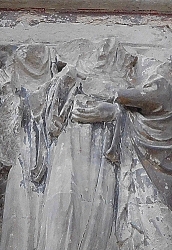
When we entered the Lady Chapel, we were in so much awe of its beauty that we did not at first notice something, which a church official soon pointed out to us. In each of the booths or alcoves lining the walls, the statues are either missing their heads or their faces have ben erased crudely. The deliberate damage to these statues was ordered by Bishop Thomas Goodrich. He also removed some of the larger statues that once adorned this fine chapel. It was seeing this destruction that reminded me of my trip to Prizren so long ago.
After looking at the Lady Chapel, we explored other parts of the cathedral, where I found other examples of statues that had lost either their faces or their heads. The iconoclasm that occurred in the so-called Reformation, which began in the 1530s, can be seen in many English churches, especially with regard to the acres of stained glass that were wantonly destroyed during that period of religious reform. Maybe, this destructive era should also be known as the ‘de-formation’. Some valuable examples of the pre-Reformation stained-glass can be seen in Ely Cathedral’s fascinating Stained-Glass Museum, which is well worth visiting. Incidentally, apart from European stained glass from across the centuries, the museum has recently acquired a fine example of stained glass from the USA, depicting a black African American.
Although I have concentrated on aspects of destruction, there is plenty of Ely Cathedral left for the visitor to enjoy, including fine gothic and pre-gothic (Norman) architecture. Many mediaeval and Tudor buildings that were once part of the abbey still exist and are now part of the daily life of modern Ely, just as some parts of Diocletian’s Palace in Split are still in use today. Some of these buildings in Ely are used by Kings School Ely, which was one of about 12 schools founded by Henry VIII. These few schools were the only part realised of a more ambitious plan to build many more schools and other new establishments.
We spent a whole day in Ely but could easily have stayed longer without being able to see all of its attractions. Prior to our departure for the city, a friend had told us that it was an unlikeable place not worth visiting. We discovered how wrong he was.
IN A COUNTRY SUCH AS ENGLAND, the profusion of sundials seems almost ironic given how often the sky is grey and the sun is hidden. Since the year 2000, the average monthly sunshine ranges from less than 50 hours to a little over 250 hours per month (https://www.statista.com/statistics/584898/monthly-hours-of-sunlight-in-uk/), the variation reflecting the different seasons of the year. The average number of daylight hours varies from 8 in January to 16.5 in July (http://projectbritain.com/weather/sunshine.htm). Using these figures and a bit of basic arithmetic, one can estimate that there is sunshine for about 20% of the daylight hours on an average January day, and about 89% of the daylight hours on an average July day. Roughly speaking, a sundial, which can only be of use when the sun is shining, is likely to be helpful for telling the time in England between 20% and 89% of daylight hours on an average day. Nevertheless, there is a great number of these partially usable timepieces in existence in gardens and on buildings in England. The figures I have calculated make the words of my opening sentence only slightly less drastic than they seem. Yet, relying on sundials as timepieces is, as my wife pointed out, a good interpretation of the words of Samuel Johnson (1709-1784), quoted by his biographer James Boswell (1740-1795):
“The triumph of hope over experience.”
This was not said in relation to sundials, but to:
In other words, enjoy the sight of sundials in their many shapes and sizes but do not become wedded to them if knowing the time is of importance to you.
IF YOUR TRAIN FROM CAMBRIDGE to London stops at Shepreth and Meldreth, you can be sure that you are in for a longish journey because only the slower trains halt at these stations. Over the course of many years, we have been travelling to and from Cambridge by train and as I enjoy looking out of the window, I have always noticed this pair of oddly named stations. Only recently, we visited both places by car and took a look around these lovely villages between Cambridge and Royston and close to the A10 road, which runs from London Bridge to Kings Lynn via Cambridge.
The ‘reth’ suffix in the two villages names means ‘stream’. Shepreth means ‘sheep stream’ and Meldreth means ‘mill stream’. There is archaeological evidence of settlements in both places long before the Romans invaded England. The Romans may have occupied part of the parish of Shepreth and their successors, the Saxons, developed the village of Meldreth. Both villages are listed in the Domesday Book (1086). Little appears to have been recorded in the history books about events in tiny Shepreth. The larger village of Meldreth also played no great role in the history of England but, in the 16th century, Christ College of Cambridge moved to its estate near the village to escape from the plague. Members of the Meldreth Local History Group might disagree with my assessment of Meldreth’s place in British history. Their superb website (meldrethhistory.org.uk/) details many aspects of the place’s past, but most of them are about the village rather than the wider world.
I imagine that the building and opening of railway stations in the two villages in 1851 were major events in their history and development. Currently, the stations are served by Thameslink trains. The villages are popular places for commuters to both London and Cambridge.
Both villages are rich in historic buildings of great beauty. Many features of vernacular architecture can be found including many fine thatched roofs. A particularly charming old, thatched edifice In Shepreth is Corner Cottage, which is close to a more aristocratic looking building, Docwra House. This former manor house was built in the 17th century and then provided with later additions (www.docwrasmanorgarden.co.uk/history.htm). The village sign at Shepreth is suitably adorned with sheep, bales of fleece, a stream, a bridge, a water mill, and a leaping fish. The bridge, which we did not see, was built in the 17th century. It crossed the River Rhee, a tributary of the River Cam, in which sheep were washed, and was used by farmers taking sheep to the market in Cambridge.
At Meldreth, through which flows the tiny River Mel, a tributary of the Cam, we entered the parish church of Holy Trinity, whose construction began in the mid-12th century on the site of an 8th century church. Its square tower, nave, and chancel were all constructed in the 12th century. The church contains some fine brass chandeliers; an elaborately carved pulpit and choir stalls with wooden carvings; fragments of pre-Reformation frescoes; a lovely timber beam ceiling; some heavily whitewashed carvings supporting some of the ceiling timbers; and a mediaeval parish chest. The latter is one of about 150 surviving examples. It was made in Baltic pine with iron bands between about 1400 and 1420 and was used for securely storing valuable liturgical items (e.g., silverware, books, and vestments). In addition to visiting the church, we drove through long village to its station, which up until our visit by car, we had only ever seen whilst speeding through it by train. However, we did not see any mills as suggested by the meaning of the name Meldreth.
We did not spend nearly enough time in the two villages as we fitted them into an already busy day of sightseeing. However, having sampled them, we feel that they merit a longer visit in the future. Once again, these places provide good examples of the wealth of historical features to be discovered in England’s rural areas.
KEEN READERS OF NOVELS by Georgette Heyer (1902-1974) will have come across the name ‘Hitchin’ in several of her stories. For example, in “The Foundling”, Belinda sighs, and then says:
“She went to a place called Hitchin, but I don’t know where it is, and I only recall it because it sounds like kitchen, and I think that is very droll, don’t you, sir?”
She receives the reply:
“But Hitchin lies only a few miles from here! I daresay no more than six or seven, perhaps not as much! If you think you would like to visit this friend, I will take you there tomorrow! Do you know her direction?”
Later in the story, there are frequent mentions of Hitchin and a ‘Sun Inn’ in the town. There used to be an inn with that name on Sun Street, where currently, there is a Sun Hotel. In another novel, “The Reluctant Widow”, Hitchin is the name of the landlord of an inn, ‘The Bull’ in Wisborough Green, a village in West Sussex.
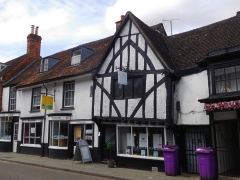
Old world in central Hitchin
It is only in recent years that I have begun to read the wonderfully crafted historical novels by Heyer, but I was aware of Hitchin even as a young child. In those now far-off days, when I lived near Golders Green in north London, I was a collector of bus and train maps and an enthusiastic observer of buses. One of the buses that passed through Golders Green and along Finchley Road was the Green Line route number 716 that travelled all the way from Chertsey in southwest London to … you have probably guessed … Hitchin, far north of London in Hertfordshire. It was only today (11th of May 2021) that I finally got to visit Hitchin. I had read that it has a picturesque historic town centre and what we found surpassed all expectations.
A 7th century document states that Hitchin was the centre of the Hicce people, ‘hicce’ being Old English for ‘the people of the horse’. By 1086, when the Domesday Book was compiled, Hitchin was described as a ‘Royal Manor’. The town’s name is also associated with the River Hiz (pronounced ‘hitch’ by some), a short stretch of which flows in front of the eastern end of the centrally located St Mary’s Church, which is mostly 15th century with an 11th century tower. Later, the town thrived because of the wool trade; vellum and parchment making; tanning; rope-making; malting; and its coaching inns, such as that mentioned in Heyer’s novel. Hitchin was a staging post for coaches travelling between London and what road signs in the south of England call ‘The North’. The town is not far from the current A1 trunk road. Many of the inns have long since closed, but their picturesque buildings, most of which look mediaeval, or at least pre-Georgian, still stand and can often be identified by the large archways leading from the street into yards behind them. Grain trading was another important activity in the town. Its former Corn Exchange still stands in the Market Square, but its use is no longer what it was built for.
Despite the 20th century improvements in transport links to London, making Hitchin into a convenient place for commuters, the historic town centre contains a remarkably high number of old buildings lining its mediaeval street lay-out. These old throughfares surround the lovely, large Market Square, which like many towns and cities in mainland Europe, was filled with tables and chairs for people to enjoy refreshments from the many eateries that surround it. A covered arcade leads off the square and provides a weather-proof place for refreshments. Nearby, there is a modern market area with stalls with conical roofs. We were fortunate to have arrived on a day, Tuesday, when this market is working.
Our first impression of Hitchin was extremely favourable, but because we had planned to do so much more sightseeing that day, we did not spend nearly enough time there. We hope to revisit this place again soon. I can strongly recommend the Hitchin to anyone who wants to get a flavour of ‘Ye Olde England’ without having to travel too far from London.
THE PARISH CHURCH in Thaxted, Essex, which was built in the English Perpendicular Style between about 1380 and 1510, is at first sight simply an impressive, attractive, typical example of this era of church construction. Recently, we were able to enter it and the lady who showed us around revealed that this was no ordinary, ‘common or garden’ church. During the early 20th century, it had been home to activity that you might not expect in a building such as this.
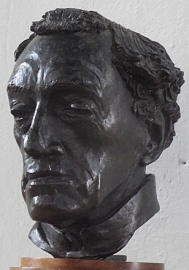
Conrad Noel
Within the church, there is a bronze sculpture by Gertrude Hermes (1901-1983). Mounted on a small wooden shelf, it depicts the head of Conrad Noel (1869-1942), who was the vicar at Thaxted from 1910 until his death.
Conrad was the grandson of the Earl of Gainsborough and son of Roden Noel (1834-1894), a Groom in the Privy Chamber, who left his exalted position after discovering radicalism. It was Roden who translated the words of “The Red Flag” into English. As a student at Cambridge, he had been a Cambridge Apostle. Conrad’s mother Alice (née de Broe) was daughter of a banker. Conrad was sent to school first at Wellington College and then at Cheltenham College. Then he entered Corpus Christi College Cambridge but failed to complete his course. After leaving Cambridge, he studied at Chichester Theological College, a high church Anglican establishment (https://en.wikipedia.org/wiki/Chichester_Theological_College). It was here that Conrad began to conceive his unique ideas about socialist Anglo-Catholicism. By 1893, he defined his theology as ‘Liberal Catholic’, which Edward Poole explained in “Troublesome Priests: Christianity and Marxism in the Church of England, 1906-1969”, his master’s thesis in 2014, was:
“…a theology that looks to the orthodox teaching of the Christian Church, that of Jesus and the Early Fathers, combined with a democratic approach to churchmanship and the active participation of the congregation in worship.”
At first, Conrad found it difficult to become ordained because of his radical, socialist ideas. In 1894, the Bishop of Chester ordained him, and he became a curate in Salford, where Poole related:
“Noel began giving lectures on Catholic Socialism which were boycotted by the ordinary congregation but … were successful in drawing in large numbers of working people who had never attended Church. The indignant Church Wardens referred the matter to Bishop Jayne, resulting in an acrimonious interview between Curate and Bishop. Jayne accused Noel of having no respect for the long-standing congregation, and of irreverence by encouraging attendees to ask questions about Christianity in Church. Noel reminded Jayne of Jesus’ invitation to ‘all and sundry’, but Jayne dismissed the argument.”
Conrad married Miriam Greenwood in 1894.
Jumping ahead, in 1910 the socialist cleric, Conrad, was appointed Vicar of the Parish Church in Thaxted. His appointment to this position was offered to him by a local aristocrat, a former mistress of King Edward VII, Frances Evelyn (‘Daisy Greville’), Countess of Warwick (1861-1938), who had become to quote Christopher Hibbert in his biography of Edward VII: “… a dedicated socialist…” by 1906. Thaxted’s new vicar began revolutionising his parish almost as soon as he accepted the post. Mark Chapman, author of “Liturgy, Socialism, and Life” wrote that Conrad’s: “…first great battle was over the bible boxes, which were used by the richer parishioners to reserve their places in church, and which deprived many of the poorer members of the congregation of the best seats.”
Actions such as these caused some of the wealthier members to leave the congregation, but this did not worry Conrad. He made many changes in the church and its liturgical practices in order to democratise his parish church. He wanted the church to be for all, for the common people, a recreation of the spirit of the earliest Christians. To do this, he introduced music and dancing and folkloric activities. John Millbank wrote in relation to this:
“The joy of Thaxted was a wise joy. The liturgy and the music and the dancing were as essential to Christian socialism as work amongst the poor” (quoted from Chapman).
Conrad had a strong disregard for the church hierarchy, who, on the whole, disapproved of his methods of helping people to believe they were an integral part of Christianity rather than only its recipients.
Socialism flowed through Conrad’s veins. In 1918, he set up the ‘Catholic Crusade’, which was a socialist movement that would:
“… work through the Church for a new economic society basing itself on the laws and principles of the gospels and the prophets. “(Chapman).
In addition, Conrad was strongly against imperialism, especially the British Empire, and also firmly in favour of reviving the Arts and Craft aspects of the socialism of William Morris and John Ruskin. The latter could be seen in many of the activities organised under his guidance at Thaxted.
Poole explains that Conrad’s socialism was based on Marxism and he was in favour of public ownership of the means of production, distribution, and exchange. His formation of the Catholic Crusade in 1918 followed the Bolshevik Revolution of 1917, which Poole notes:
“Noel saw the Revolutions… which brought the Bolsheviks to power, as evidence of a spiritual revival in Russia.”
Conrad hoped that a similar revolution would soon happen in the UK. Poole relates that later Conrad met Ivy Litvinov, wife of the Soviet Ambassador in London. She:
“…expressed to Noel surprise that a clergyman would celebrate the Bolsheviks despite their professed atheism. Noel responded that “dialectical materialism gave no true inspiration for the revolution, and that it was in spite of Marxist philosophy, rather than because of it, that those changes had taken place.”
Later when writing his autobiography, Conrad explained:
“I believe that the mystical element in the Russian people was much more the inspiration of the Russian Revolution than the appeal to the Marxian dialectic.”
By then, although still a socialist at heart, he was appalled by the Stalin-Trotsky split in about 1936 and he joined other clerics in the formation of the Anti-Stalinist Order of the Church Militant.
There is much more that could be discussed regarding Conrad’s idiosyncratic take on Socaialism and the Church, but I will concentrate on an incident that brought his church in Thaxted into the news in 1921. He had placed three flags in his chancel: the flag of St George, the tricolour of the Irish Sinn Fein, and the Red Flag of Communism. Students from Cambridge and also the ecclesiastical courts tried to remove them, but in vain. He preferred the flag of St George to the Union Jack, because the latter, he felt, ignored England and favoured plutocracy and British imperialism. As for the Irish flag, Chapman explained that it emphasised Conrad’s anti-colonialist ideals and the rights of national self-determination, for which WW1 had been fought. The Red Flag was chosen by Conrad because he felt that it:
“… was there to serve as a pointer to something more universal than a nation … it emphasised the notion of God as fellowship, and of the commonwealth and democracy of nations, none of which could be allowed to exist as an isolated entity…” (Chapman).
Poole noted:
“During the First World War, Noel displayed the flags of the Allies in Thaxted Church. After the Russian Revolutions, he added a plain red flag to represent the workers of the world, and by 1921, it hung with the cross of St. George and the Sinn Fein tricolour on the chancel arch, and on May Day that year it was paraded in the church. By the following morning it, and the tricolour, had been stolen by Cambridge University students, leading Noel to place a notice outside reading “Stolen! Two flags from Thaxted church and two universities (Oxford and Cambridge) from the people by the rich.””
The flags chosen by Conrad caused great strife (known as the ‘Battle of the Flags’) in Thaxted, as Poole describes:
“On 24 May, Empire Day, some residents hung the churchyard with Union flags, which Noel then replaced with ‘mutilated’ versions in which St Patrick’s cross had been removed. At a meeting at the Thaxted Guildhall, protestors demanded that Noel cease preaching political and seditious themes. A crowd gathered outside the Church, and fights broke out between them and former policemen defending the church. Noel’s friends called on him to leave Thaxted for his own safety, but he refused. After a night of unrest, Noel wrote to his wife to describe the excitement of the evening, and to reassure her that “the flags of our religion are still flying.” Further scuffles followed when protestors tried to remove a new flag on 20 June, and on 26 June when demonstrators successfully burnt the red flag and hung more Union flags in the church. In July the red flag was burnt again, but local moderates finally took control of the opposition to prevent further violence. In January 1922, a petition calling for the removal of the flags was sent to Chelmsford consistory court and Noel defended his right to fly the flags, but by July he was instructed to remove them, and complied.”
Many years later, when WW2 was declared, Conrad:
“…mused on the irony that the flag that had been so reviled by his parishioners was cheerfully displayed alongside the Union flag as Britain and the Soviet Union fought Nazi Germany. In his view, “the very people who opposed it are now grateful that the USSR is pulling our chestnuts out of the fire”” (Poole).
The only flag of note that we noticed during our visit to Thaxted’s church is a banner sewn in 1917 by Conrad’s wife Miriam. It bears some words of JS Bach that were chosen by the composer Gustav Holst who had a house in Thaxted (I will discuss Holt’s involvement with Thaxted in a future essay).
When visiting Thaxted and its lovely church, it is hard to imagine that the place was once the location of so much violence and controversy. I am glad to see that Thaxted’s highly original parish priest is remembered respectfully within his church. A plaque next to his sculpted head reads:
“Conrad Noel. Vicar of Thaxted 1910-1942. He loved justice and hated oppression.”
These are fitting words by which to remember an unusual man who espoused both Communism and Christianity, who saw no incompatibility between these two belief systems that many others believe to mutually opposed. To summarise, quoting Mark Chapman:
“… it seems to me that Noel was a genuine visionary, although his practical solutions may have neglected some or even most of the complexities or realpolitik, he nevertheless sought to make the church an expression of the kingdom of righteousness, justice, and equality and thus a beacon in a desperate world.”