CLEOPATRA’S NEEDLE IS a familiar landmark in London. It was originally erected at Heliopolis in Ancient Egypt in about 1450 BC and brought to London in about 1877. Less well-known is another hieroglyph covered obelisk in the gardens of Kingston Lacy near Wimborne in Dorset.
The pink granite obelisk at Kingston Lacy arrived in the grounds of this rich family’s dwelling in about 1827. Like Cleopatra’s Needle, this monument is inscribed with hieroglyphics. Because there is a mixture of Greek words and hieroglyphics, the obelisk, discovered on an island in the River Nile, became important in the early attempts to decipher the Ancient Egyptian writing.
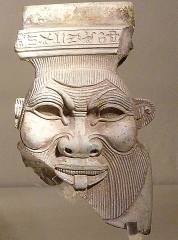
In Banke’s collection of Egyptian artefacts at Kingston Lacy
Kingston Lacy has been owned by successive generations of the Bankes family since the 1660s, when John Bankes (1589-1644) took possession of the estate and built the present grand house. One of his descendants, William John Bankes (1786-1855), who met Lord Byron when they were both studying at Cambridge University, first travelled in Spain and collected a vast number of Spanish paintings, many of which are hanging within Kingston Lacy House. Later, during the early part of the 19th century, William travelled extensively in the Middle East and along The Nile. During his travels, he collected many valuable Ancient Egyptian artefacts, some of which are beautifully displayed in a former billiards room within Kingston Lacy House.
“… record a petition by the Egyptian priests at Philae and the favourable response by Ptolemy VIII Euergetes and queens Cleopatra II and Cleopatra III, who reigned together from 144-132 BC and again from 126-116 BC. The priests sought financial aid to help them deal with the large numbers of pilgrims visiting their sanctuary and the king and queens granted the sanctuary a tax exemption.”
Both the Greek and the Egyptian inscriptions deal with the same topic but are not direct translations of each other.
BULL HOUSE STANDS on the High Street immediately beneath the remain of the castle that dominates the Sussex town of Lewes near Brighton. Its neighbour is an older, half-timbered edifice that now houses The Fifteenth Century Bookshop, a supplier of second-hand books, which was unfortunately closed when we passed it on a Sunday morning.
In the year 1768, the owner of Bull House, a tobacconist named Samuel Ollive, and his wife Esther, took in a lodger, who had arrived in the town. This man was an excise officer aged about 31. His name was Thomas (‘Tom’) Paine (1737-1809). 1n 1771, Paine, already a widower, married Elizabeth Ollive, daughter of Samuel and Esther. At of that time, he became involved in the Ollive’s tobacco business as well as the administrative affairs of the town of Lewes. A year later, as part of a campaign to improve the remuneration of excise officers, he published a pamphlet. “The Case of the Officers of Excise”. Tom enjoyed lively discussions and debates at the town’s ‘Headstrong Club’, which met at the White Hart Inn on the High Street. This hostelry can still be seen today.
The year 1774 found Tom in trouble. He had been accused of being absent without permission from his position as excise officer. Also, his marriage failed, and he separated from his wife Elizabeth. To avoid a spell in a debtors’ prison, he sold all his possessions. He left Lewes and went to London, where he was introduced to the revolutionary Benjamin Franklin (1706-1790), who recommended that Tom should emigrate to North America. Tom set sail from England and arrived in Philadelphia in November 1774.
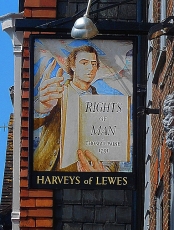
The pamphlet that Paine wrote in Lewes was followed by many more published writings. Amongst these is his best known, “The Rights of Man”, published in 1791, in London, England, where Tom had returned in 1787. This work is described in a guidebook to Lewes as “…the bible of English-speaking radicals.” Whether Tom ever returned to Lewes after his first excursion to what is now the USA, I do not know. If it ever occurred, it is not mentioned in my guidebook, and I have not found any reference to it.
MANY SMALL PLACES in East Anglia have disproportionately large churches. Cley-Next-The-Sea (‘Cley’) is no exception. Its parish church of St Margaret of Antioch is one of the largest in northern Norfolk. It stands atop a hillock, which used to be an island only reachable by boat. The boats that reached Cley were not only those of locals but also foreign vessels bringing valuable cargos to Cley. According to Marjorie Missen, who has written a detailed guide to the church, it was at Cley:
“… that strong links were made with Hanseatic traders and it was in some measure due to their wealth that today we are able to wonder at the size and magnificence of St Margaret’s.”
Without doubt, this church is both impressive in size and contains much of remarkable beauty. Most of the church was built during the 14th and 15th centuries. Its external walls are of flint with stone dressing. Amongst the things that caught my eye during our first and, as yet, only visit to the church were the beautiful, vaulted ceiling of its south porch; the stone carvings on the 15th century font: they depict aspects of the Sacrament; the wood carvings on some of the choir stalls (miserichords); and stone carvings of musicians on the tops of columns lining the nave. However, what first attracted my attention to this church was part of its exterior.
A roofless gothic structure projects from the south side of the church at the place where one would expect a transept. This structure is affixed to the main body of the church but is blocked off from it. Once upon a time, this might have been accessible from within the church when or if it it formed the south transept. I have so far been unable to find any definitive explanation for the abandonment of the south transept and its decay. Ms Missen wrote:
“The large scale work on the transepts and nave are unlikely to have begun before about 1315, or even later. Although the transepts have been in ruins for some centuries the delicacy and tracery of the south window can still be appreciated.”
Interesting as this is, it does not provide any reason why the south transept and the north have been blocked off from the church and allowed to become dilapidated. It has been suggested by Simon Knott (http://www.norfolkchurches.co.uk/cley/cley.htm) that the transepts, whose construction began in the early 14th century, were never completed because of The Black Death, which reached Norfolk in 1349:
“The most beautiful is that in the south transept, elegant lights that build to a cluster of vast quatrefoils. This was competed on the eve of the Black Death, and is probably at the very apex of English artistic endeavour. But I think that it was never filled with glass. I can see no evidence that the transepts were completed in time for their use before the pestilence, or that there was ever a need to use them after the recovery from it. And, then, of course, the Reformation intervened.”
This seems a quite reasonable theory. Yet, it is only a hypothesis, and so the mystery lives on. Is the south transept a ruin or an uncompleted building? That is the question.
MENTION ‘DENVER’ and most people will immediately think of a city close to the Rocky Mountains in the American state of Colorado. Recently, we visited Denver, not the city in the USA but a village in the English county of Norfolk. This small settlement lies a few yards west of the A10 road between Ely and Kings Lynn, immediately south of Downham Market. Norfolk’s Denver derives its name from the Anglo-Saxon words, ‘Dena fær’, meaning ‘the ford or passage of the Danes’. This name dates from the time that the Danes and Vikings were invading Britain after the Romans had abandoned it. Denver is located close to the River Great Ouse that flows into The Wash at Kings Lynn. It was this river that the Danish invaders needed to cross as they headed on their way to invading parts of England.
Denver windmill
The village of Denver is attractive and is arranged around its parish church of St Mary. Surrounded by its graveyard, the walls of this mainly mediaeval edifice, mostly 13th to 15th century, are made of large irregularly shaped boulders held together with mortar and trimmed with carved stone. Many of the village’s other buildings have walls constructed similarly, a feature that we observed in several other north Norfolk villages. St Mary’s has a square tower at its western end. Inside, its nave has a wonderful timber barrel vault ceiling decorated with carved features typical of gothic design. Otherwise, the church’s interior is simple without being plain. We could not spend too much time examining the place because we did not want to disturb a small group of elderly people praying aloud.
Denver has a tall historic windmill. This is on the western edge of the village and was built by John Porter in 1835 to replace an earlier mill on the same site. In 1863, a steam powered mill was erected next to the windmill. Further modernisation followed that. The large sails of the mill have gone, but the small fantail remains. The mill forms the centrepiece of a small complex of commercial enterprises housed in buildings that were formerly part of the mill compound. These include a café and a coiffure, aptly named ‘The Hair Mill’. Denver Mill is one of several lovely old windmills we saw dotted around northern Norfolk.
A narrow thoroughfare, Sluice Road, leads west from Denver towards the River Great Ouse, which is about 1.6 miles away. The road reaches a complex of sluice gates that regulate the levels of water in the river and other waterways including the River Wissey and the New Bedford River (man-made) that meet here. Now managed by The Environmental Agency, this set of sluice gates was first established, albeit in a simpler form, in 1651 by the Dutch engineer Cornelius Vermuyden (1595-1677). It was he who introduced Dutch land reclamation methods to England, mostly in East Anglia and the Lincolnshire Fens. He married an English woman, Katherine Lapps, and his descendants remained in England, having changed their surname to ‘Youdan’. In 1647, Vermuyden lived in Maiden Lane in London’s Covent Garden.
There are at least five modern, electrically operated sluice gates at Denver. By operating them judiciously, water levels in much of Norfolk and its surroundings can be regulated. The Duke of Bedford River was built by Vermuyden to shorten the distance that water had to travel to and from Bedfordshire. According to the season, this was either flood water or water needed for agricultural purposes. The system of rivers and canals regulated by the sluices at Denver is far from simple. So, I will not attempt to explain it, but visitors to this impressive water-controlling complex can read all about it on a series of informative panels posted next to the sluices.
Sluice Road crosses the River Great Ouse and other streams along bridges to which some of the sluice gate mechanisms are attached. Although the river system would have been quite different when the Danes invaded England, it is possible that where Vermuyden built his first sluice might be close to where the invaders forded the Great Ouse and lent their name to Norfolk’s village of Denver.
MANY CHURCHES IN NORFOLK have circular towers. Actually, there are 124 of them in the county. Here is one example, St Mary’s in tiny Titchwell, near the north Norfolk coast. The small spire that tops the round tower dates to the 14th century. The foundation of this church was much earlier.
By the way, the name ‘Titchwell’ is derived from an Old English word meaning ‘ kid (young goat)’ and an Anglian word meaning ‘spring or well’.
SPLIT IN FORMER Yugoslavia, now in Croatia, is a city that developed in the ruins of a great establishment, the Roman Diocletian’s Palace. Likewise with the city of Ely in Cambridgeshire: it developed within the remains of another great establishment, the large Abbey of Ely, which was dissolved by King Henry VIII in 1539. By 1541, after having its charter renewed by the king, its then bishop, Thomas Goodrich (1494-1554), instigated an orgy of iconoclasm, to which I will return soon.
In 1975, I visited the city of Prizren in the former Yugoslavia, now in Kosovo (Kosova). I was impressed by what I saw in one of the place’s fine mediaeval churches. The caretaker showed me that the frescos on the walls inside the building were badly damaged, but only up to a certain height above the ground, Above this, they were as intact as one could hope for paintings of that age. He explained to me that many centuries ago, the Ottoman soldiers were ordered to destroy the figurative images depicted on the walls. They used the tips of their spears to do the job, but they only destroyed what they could reach from the ground (i.e., without using ladders). Sadly, the iconoclasts working under the orders of Henry VIII and Bishop Goodrich were more diligent in their destructive activities.
Under Goodrich’s orders, first the shrines to Anglo-Saxon saints were mutilated. Then, the vandals attacked all the stained glass and many of the statues in the cathedral, before getting to work on the large Lady Chapel on the north side of the body of the church.
The spacious, airy, light-filled, Lady Chapel is at first glance a magnificent example of 14th century gothic architecture, which was created in 1321. The excellent article in Wikipedia (https://en.wikipedia.org/wiki/Ely_Cathedral) describes an important and interesting aspect of the chapel:
“Below the window line, and running round three sides of the chapel is an arcade of richly decorated ‘nodding ogees’, with Purbeck marble pillars, creating scooped out seating booths. There are three arches per bay plus a grander one for each main pillar, each with a projecting pointed arch covering a subdividing column topped by a statue of a bishop or king. Above each arch is a pair of spandrels containing carved scenes which create a cycle of 93 carved relief sculptures of the life and miracles of the Virgin Mary. The carvings and sculptures would all have been painted.”
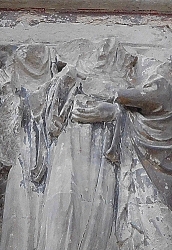
When we entered the Lady Chapel, we were in so much awe of its beauty that we did not at first notice something, which a church official soon pointed out to us. In each of the booths or alcoves lining the walls, the statues are either missing their heads or their faces have ben erased crudely. The deliberate damage to these statues was ordered by Bishop Thomas Goodrich. He also removed some of the larger statues that once adorned this fine chapel. It was seeing this destruction that reminded me of my trip to Prizren so long ago.
After looking at the Lady Chapel, we explored other parts of the cathedral, where I found other examples of statues that had lost either their faces or their heads. The iconoclasm that occurred in the so-called Reformation, which began in the 1530s, can be seen in many English churches, especially with regard to the acres of stained glass that were wantonly destroyed during that period of religious reform. Maybe, this destructive era should also be known as the ‘de-formation’. Some valuable examples of the pre-Reformation stained-glass can be seen in Ely Cathedral’s fascinating Stained-Glass Museum, which is well worth visiting. Incidentally, apart from European stained glass from across the centuries, the museum has recently acquired a fine example of stained glass from the USA, depicting a black African American.
Although I have concentrated on aspects of destruction, there is plenty of Ely Cathedral left for the visitor to enjoy, including fine gothic and pre-gothic (Norman) architecture. Many mediaeval and Tudor buildings that were once part of the abbey still exist and are now part of the daily life of modern Ely, just as some parts of Diocletian’s Palace in Split are still in use today. Some of these buildings in Ely are used by Kings School Ely, which was one of about 12 schools founded by Henry VIII. These few schools were the only part realised of a more ambitious plan to build many more schools and other new establishments.
We spent a whole day in Ely but could easily have stayed longer without being able to see all of its attractions. Prior to our departure for the city, a friend had told us that it was an unlikeable place not worth visiting. We discovered how wrong he was.
IN A COUNTRY SUCH AS ENGLAND, the profusion of sundials seems almost ironic given how often the sky is grey and the sun is hidden. Since the year 2000, the average monthly sunshine ranges from less than 50 hours to a little over 250 hours per month (https://www.statista.com/statistics/584898/monthly-hours-of-sunlight-in-uk/), the variation reflecting the different seasons of the year. The average number of daylight hours varies from 8 in January to 16.5 in July (http://projectbritain.com/weather/sunshine.htm). Using these figures and a bit of basic arithmetic, one can estimate that there is sunshine for about 20% of the daylight hours on an average January day, and about 89% of the daylight hours on an average July day. Roughly speaking, a sundial, which can only be of use when the sun is shining, is likely to be helpful for telling the time in England between 20% and 89% of daylight hours on an average day. Nevertheless, there is a great number of these partially usable timepieces in existence in gardens and on buildings in England. The figures I have calculated make the words of my opening sentence only slightly less drastic than they seem. Yet, relying on sundials as timepieces is, as my wife pointed out, a good interpretation of the words of Samuel Johnson (1709-1784), quoted by his biographer James Boswell (1740-1795):
“The triumph of hope over experience.”
This was not said in relation to sundials, but to:
In other words, enjoy the sight of sundials in their many shapes and sizes but do not become wedded to them if knowing the time is of importance to you.





 yamey
yamey 