Welcomed to India with coffee

BECAUSE OF THE COVID19 pandemic, we had not stepped onto Indian soil for two years and nine months. This was unusual for us because after we married in early 1984, we have been visiting India on average twice a year. For family related reasons, we have almost always landed in Bangalore.
When a new international airport was opened near Devanahalli village (at the northern edge of Bangalore) a few years ago, a line of eateries and cafés opened alongside the main landside of the terminal building. Being outside the terminal, which can only be entered by holders of air tickets, these outlets can be used by passengers and those who are not travelling by air.

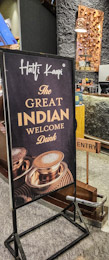
One of these stalls is a grand affair partly decorated with copper sheeting. It is called Hatti Kaapi. The ‘kaapi’ in the name refers to the way local Bangaloreans pronounce ‘coffee’. This particular coffee stand provides excellent quality South Indian filter coffee. It is so wonderful that whenever we visit the airport, either arriving (from the UK or from places elsewhere in India) or departing, we always make time to drink a coffee served by this superb stall.

So, after what was for us an abnormally long absence from India and what has been a disastrous period for everyone, it was wonderful to discover that it was ‘business as usual’ at Hatti Kaapi. And since our last trip 2 ¾ years ago, a new sign has appeared at Hatti Kaapi. It reads:
“HATTI KAAPI The great Indian welcome drink.”


Seeing that sign after 2 ¾ years made us feel much more welcome than its designers could have ever imagined.

Retreating from the pandemic misery

FOR SEVERAL MONTHS following March 2020, movement was restricted to within a short distance of home because of rules that were supposed to limit the spread of covid19 infections. Almost everything except food stores was closed. Socialising was frowned upon. And travel for leisure was not possible. Around about June 2020, things eased up just a little bit, and travelling became possible once more, albeit subject to various rules and precautionary measures. It was then we decided to buy a car to travel around without risking infection by using public transport.

After collecting our (pre-loved) car from a garage on the Edgware Road, we decided to drive up to see my wife’s cousin in Baldock (Hertfordshire). We asked him to recommend a nice country pub where we might be able to get something for lunch. He suggested that we tried Ashwell, which is about 4 miles northwest of Baldock. This pretty village has three pubs. Two of these were closed, and the remaining one did not serve food. We asked the rather melancholic barman to suggest somewhere else in the area. He pointed at the pub’s only customer, a gentleman seated at a table, and said:
“You could try his place at Abington Piggotts – it’s only just up the road.”
The man, Mick, told us that his pub was open and serving food. So, we drove a few miles to tiny Abington Piggotts, which is 3 ½ miles northeast of Royston. With about 80 households, the village has one pub, a free house called The Pig and Abbot. Housed in a century’s old building, this hostelry is a lovely example of an unspoilt country pub. We were given a warm welcome. We enjoyed a small snack and a drink and decided to return at a later date for a proper meal.

We returned and enjoyed excellently cooked food prepared by Mick’s wife Pat. It was so good that we began returning at regular intervals to enjoy Pat’s cooking. The Pig and Abbot, like all other pubs and restaurants, was subject to compulsory closures during the various ‘lockdowns’ that were imposed by the government, yet it has remained in business despite these interruptions. I am not sure how many times we have visited the Pig and Abbot, but each time has been as least as enjoyable as the others. It was not long before we began regarding Mick and Pat as good friends. Whenever we visit the pub, Pat gives us all a great hug when she sees us. Especially during the periods when lockdown restrictions were only partly eased, a visit to the Pig and Abbot provided a welcome respite from the gloomy atmosphere during the height of the pandemic. Whenever we drive along the country lanes leading to Abington Piggott, I have a warm feeling of gratitude because it was this countryside that lightened our lives during two years of covid-related misery.

Recently, we booked for Sunday lunch at the pub. Several days before we were due to eat at the pub, Pat rang. At first, we thought she was going to cancel us for some reason, but it was worse than that. She rang to tell us that Mick had died suddenly and completely unexpectedly. We felt devastated by this news. When we asked her whether she wanted us to cancel, she said ‘definitely not’. She had decided she must continue, and she wanted to see us. When we arrived for our lunch, the pub was full, Pat greeted us warmly, and her food was as excellent as usual. We will greatly miss Mick, and we wish Pat all the very best for the future.

The artist’s son in her Majesty’s Indian Navy

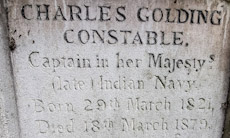
ENCLOSED BY IRON railings, the grave of the artist John Constable (1776-1837) stands at the southern edge of the old part of the churchyard of St John’s Church in Hampstead. The famous painter does not lie alone. He is buried with some other members of his family. One of these people is his second son Charles Golding Constable (1821-1879). I became interested in him when I noticed the words “Captain in her Majesty’s (late) Indian Navy”. The inclusion of the word ‘late’ and its position in the inscription puzzles me.

Charles went to sea as a midshipman in the British East India Company’s navy when he was about 14 years old. According to a genealogical website (www.bomford.net/IrishBomfords/Chapters/Chapter33/chapter33.htm/), he:
“…took to the sea, joined the Indian Marine and eventually became a Captain. Around 1836 he left on his first voyage to China and did not return until after his father’s death so missed his large funeral in London. During the 1850s he gained a place in the reference books for having conducted the first survey of the Persian Gulf. He had to struggle with navigation as a youth so he must have shown considerable determination to be entrusted with this survey. Shortly before his survey the Arab sheikhs bordering the southern end of the Gulf gained their income largely by piracy; this was ended by a treaty or truce arranged by the British, and the Sheikhdoms that signed the truce have been called ever since the Trucial States.” A paragraph in the book “Journey to the East” (published by Daniel Crouch Rare Books Ltd.) related this in some detail:
“Commander Charles Constable, son of the painter John Constable, was attached to the Persian Expeditionary Force, as a surveyor aboard the ship Euphrates. On the conclusion of the war [the First Anglo-Persian War: 1856/57], Constable was ordered to survey the Arabian Gulf, which occupied him from April 1857 to March 1860, with Lieutenant Stiffe as assistant surveyor. The survey (Nos. 2837a and 2837b) which contains the first detailed survey of Abu Dhabi, would become the standard work well into the twentieth century. During the time that Constable was surveying the Gulf, the Suez Canal, one of the greatest civil engineering feats of the nineteenth century was under construction.”
Charles was made a Fellow of the Royal Geographical Society.

While ‘surfing the net’, I found out that sketches made by Charles during his travels have been on sale from time to time in auction houses. His drawings were competent but no match for those executed elsewhere by his famous father.

When John Constable died, his eldest son John Charles Constable became responsible for dealing with his father’s estate. He was then a medical student as well as having studied under the scientist Michael Faraday. According to a website concerning his college in Cambridge (Jesus), John Charles, died suddenly in 1839 after contracting scarlet fever at a lecture in Cambridge’s Addenbrooke’s Hospital, at which a patient suffering this disease was being examined. After his father died, he was left “… numerous paintings and works of art, some of which were known to have adorned his rooms in College.” (www.jesus.cam.ac.uk/articles/archive-month-constable-chapel).
In his will, John Charles left his collection of drawings, paintings, and prints to his younger brother Charles Golding Constable. In 1847/48, Charles was responsible for supervising the dispersal of his father’s studio collection of artworks.

Like the rest of his family, parents and siblings, Charles had lived at several different addresses in Hampstead. Although he was buried with other members of the family in Hampstead, I have not yet found out where he resided at the end of his life.

William Kentridge at the Royal Academy of Art in London

THE ARTIST WILLIAM Kentridge (born 1955), son of a prominent lawyer, is a South African. His creations are usually highly imaginative and often politically challenging and critical of the subjugation of non-European African people. This is fascinating given his privileged background – having been brought up in a South Africa where the ‘white’ people were a highly advantaged section of the population until the ending of the apartheid regime (and maybe even now to some extent).

His artworks are frequently dramatic, often employing cinematographic and sometimes theatrical techniques. The messages they convey to the viewers can be both disturbing and humorous, sometimes both simultaneously. Whenever I have seen them, I have been both fascinated visually as well as moved emotionally.

The Royal Academy of Art in London’s Piccadilly has a large retrospective exhibition of Kentridge’s work until the 11th of December 2022. Apart from numerous drawings, tapestries, and other static artworks, there are plenty of his cinematographic installations on display. In fact, there are too many of these installations. Each one is amazing to see, but having so many together in one place spoiled their intended impact. Just as the first chocolate from a box is wonderful, eating all of them at once gives one indigestion, and this was the case with the Royal Academy’s crowded assemblage of Kentridge’s works. Too much was crammed together in insufficient space. To be fully enjoyed, each of his installations should be seen on their own in a sufficiently spacious environment – they need ample room to breathe and express themselves.This overcrowding was a pity because the exhibition does not allow his works to shine in their full glory.

A Turkish delight in London’s Dalston

KINGSLAND ROAD AND nearby in London’s Dalston area is rich in restaurants and other eateries serving Turkish food. Early in this century, “Time Out” magazine rated the Mangal Ocakbasi (now called ‘Mangal 1’) restaurant at number 10 Arcola Street as being one of London’s best Turkish restaurants. For those who do not know, ‘ocakbasi’ means ‘fireside’ and ‘mangal’ means ‘barbecue’ or ‘grill’. When we first went to Mangal, and for many years after that, there were tables alongside the long rectangular pit filled hot charcoal, upon which meat and vegetables are grilled. Recently, the restaurant has been redesigned and the grilling area is no longer alongside the tables.

Lokma

The meat served is top quality. It seems far better than that served in the many other Turkish restaurants we have tried in London. Although there is a wide variety of main courses on offer, the range of ‘starter’ dishes on the menu is not as great as at some other restaurants. If it is starters and meze that you are after, the nearby Umut 2000 (on Crossway) is worth visiting. However, their main meat dishes are not nearly as tasty as those at Mangal in Arcola Street. Having said that, Mangal does serve an excellent freshly grilled aubergine hors d’oeuvre. Desserts are not available, but there are plenty of places along Kingsland Road offering a wide range of very sweet but tasty confectionery.

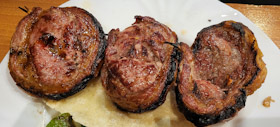
Our favourite dishes at Mangal are lokma, which is grilled rolled fillet of lamb, and yorgutlu Adana, which is pieces of semi-spicy Adana kebab in a yogurt and tomato sauce with lumps of Turkish bread. The lokma and other kebab dishes are served with generous quantities of fresh mixed salad containing many ingredients. As for drinks, you can bring your own alcohol or buy it from the restaurant. If I order a drink apart from water, I always go for Şalgam, which is a purple-coloured drink containing fermented turnip. This has a deliciously sour taste.

We first ate at Mangal in the early 2000s, when we attended a play in which one of my dental patients was acting. The theatre, The Arcola, was across the road from the restaurant, but has now shifted to larger premises on nearby Ashwin Street (close to Dalston Junction station). We loved the food at Mangal from the very first bite. We have been eating there occasionally ever since then, and the quality of the food has never once faltered. We have been there so often that the older members of its staff recognise us, welcome us warmly, and remember what we like eating. Even though this Turkish delight, frequently patronised by the artists Gilbert and George, is far from where we live in Kensington, it is well worth ‘trekking’ across London to get there.

Our local library saved from closure

THE NOTTING HILL GATE public library is close to where we live. It consists of three main rooms. Two of them have beautiful painted stucco ceilings. The third, which might have once had such a ceiling, does not have one now. However, it retains some wood panelling with an upper carved wooden margin. Each of the rooms retains the remnants of fine stucco work on their walls. The library occupies much of the ground floor of a large house at the corner where Pembridge Square meets Pembridge Road.

I asked one of the librarians about the history of the building housing the library. She believed that it had once been a large private residence, which the last owner had given the local authority many years ago. She told me that in addition to the library, the house has fats on its upper floors. Sadly, the ceilings have to be restored often because there are often water leaks from the upper floors.

A few years ago, there was a real risk that this branch library would be closed by the local Council (The Royal Borough of Kensington and Chelsea). Vigorous protests by the branch library’s many users and other locals saved the place from closure. To reduce running costs, the library is not always open, but access is possible at odd times almost every day of the week except Sunday.

Dr Who and me

CHICAGO WAS MY HOME for the last few months of 1963. My father was a visiting professor at the University of Chicago during that period. While we were in Chicago, President John F Kennedy was assassinated. However, that was not the only momentous event that I recall from that time,

My best friend in London, whom I had known for about seven years, Nicholas Gilks who is no longer alive, sent me an airletter in which he wrote that he could not wait for me to come back to London, not because he was just missing me, but because he wanted me to watch the new, exciting television programme that had begun whilst I was away. The programme, which still runs today in 2022, was “Dr Who”. It was first broadcast on the 23rd of November, the day after Kennedy was shot.

Well, “Dr Who” was certainly a fine programme. I used to watch it at the Gilks’s home because we did not have television at our family home, and never ever did. To reach my friend’s home, I walked. On the way, I used an unlit pathway that runs between Hampstead Way and Temple Fortune Lane, where Nicholas lived. Frankly, the ominous Daleks that starred in the programmes every week terrified me so much so that I was afraid of walking home along that pathway in the dark. So, Dr Gilks, my friend’s father, used to accompany me to that dark passageway and waited till I reached the far end of it. For this, I was very grateful.

Today, a sunny Sunday morning, the 20th of November 2022 (almost 59 years after Kennedy’s death), we walked along the Hammersmith riverside and reached the Riverside Studios, where we stopped for a coffee in its superb new café. Standing next to the doorway and pointing its weapons at the tables in the café stands a real-life Dalek. Why is it there you might ask. The answer is that between 1964 and 1968, “Dr Who” was filmed in the Riverside Studios, which was then a BBC studio complex. Furthermore, and worryingly, it was from the water beneath the nearby Hammersmith Bridge that the Daleks commenced their attempt to invade the Earth.

Luckily, the sun was shining brightly and there were plenty of people out and about. So, there was little chance that my childhood fears about the robotic Daleks would be awakened.

A quirky little open space in North Kensington

OVERLOOKED BY GOLDFINGER’S brutalist block of flats and hemmed in by Elkstone Road, Golborne Road, and the tracks of the Great Western Railway, there is a small patch of ground that serves as a little haven. Usually occupied by a few local characters, this space measures about 40 by 13 yards. It is The Elkstone Road Garden Oasis.

A curved wall at its northern end is covered with well painted murals depicting musicians and other figures, who I guess might be portraits of people well-known to those who use the garden. There are plenty of plants in this little oasis. Some of them are plastic artificial flowers picturesquely positioned. Others are real. Some of them have little notices next to them, identifying and explaining something about them. There are also printed notices that contain worthy thoughts about life. Amongst the rather tatty chairs, tables, and a small bookshelf, there is a wooden bench with a label stating that it was donated to a parochial organisation by the Chelsea Physic Garden. An online article published in 2018 (https://communityreporter.net/story/oasis-north-kensington-4-jun-2018-1249) revealed:


“The Elkstone Road Garden Oasis in fact, a small strip of land with a history of being neglected and abused. Originally rescued by the work of MIND volunteers the Oasis is now being managed by the Chelsea Physic Garden, which enjoys a somewhat longer history being created in 1683. Building on the work completed by MIND the Physic Garden, with grants from the Royal Borough of Kensington and Chelsea, Band Trust, City Bridge Trust and Turning Point, seeks to provide the local community with a beautiful space, in which the people who live in this area, adults and children, can enjoy being involved in the world of plants and wildlife. Colville Primary school are already participating in developing the garden, with visits every Thursday by Year three pupils. This is a popular activity and always provides a healthy injection of enthusiasm into the Garden.”

Long before Trellick Tower was constructed in the early 1970s and when Elkstone Road was named ‘Southam Street’, the area now occupied by the open space and that where Trellick Tower now stands was covered with rows of small, terraced houses. Unlike the nearby Meanwhile Garden (running alongside the Grand Union Canal), which is well-documented, the small, rather quirky open space I have described above seems to be slightly ‘off the radar’.

A thatched church and Alfred Lord Tennyson

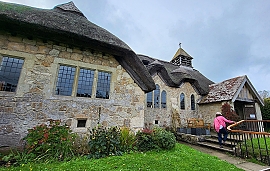
THE POET ALFRED TENNYSON made his home in the village of Freshwater Bay on the Isle of Wight (‘IOW’) from 1853 until his death. His presence there attracted many Victorian cultural figures to the village either as residents or as his visitors. In 1907, fifteen years after Tennyson died, the Bishop of Winchester visited Freshwater and decided that the village needed a better church than the rather primitive one being used at the time. The Reverend AJ Robertson, who was Rector of Freshwater in 1907, made a watercolour painting of the type of church he hoped would be built. It included a thatched roof. Such a church as he had envisaged was designed by the architect Isaac Jones of Herne Hill in London, and constructed on land donated by Tennyson’s eldest son Hallam, Lord Tennyson (1852-1928). It was Hallam’s wife Lady Emily (1853-1931; née Prinsep), who gifted the new church’s porch and suggested that the church be dedicated to St Agnes.

St Agnes is the only church on the IOW to have a thatched roof. Much of the building was built using stones from what had once been the home of the scientist Robert Hooke (1635-1703). The use of old stones makes some people believe that the church is older than it really is. One of the old stones has the date 1694 inscribed on it, a reminder of the origin of the stonework. The interior of the building is well lit by natural light through its many windows. The timber framed ceiling is fine as is the beautifully carved chancel screen. The screen with delicate bas-relief carvings of plants was created by the Reverend Thomas Gardner Devitt, who was curate of St Agnes between 1942 and 1946.

In brief, this thatched church is charming. In appearance, it manages to combine a feeling of mediaeval antiquity with the aesthetics of the Arts and Crafts Movement, which was in its heyday when St Agnes was built. Seeing it was one of many delightful experiences we enjoyed whilst spending a week on the IOW.