DURING A RECENT VISIT to the Wellcome Collection in London’s Euston Road, I saw some artworks that both captured my imagination and were aesthetically pleasing. It was an exhibit by the Moroccan artist Batoul S’Himi (born 1974). Her work in the Wellcome Collection, THE WORLD UNDER PRESSURE, consists of two gas cylinders like those that are used in kitchens around the world, and a commonly used cooking utensil – a pressure cooker. Each of the three objects is empty, and each of them have bits shaped like the map of the continents of the world carefully cut out of them.
According to the label beside the exhibit: “Common yet dangerous objects in Moroccan kitchens, these gas cylinders and pressure cooker are carved with a map of the world. Here, global anxiety intrudes into the home. The artist’s use of domestic objects hints at the unequal burden of climate breakdown, hitting vulnerable people hardest, including women and children. But perhaps there is also hope, as families start to recognise their global impact.” This is what the artist is portraying, but I believe that along with its title, the artwork, which uses containers designed to withstand high pressures, is a great visual metaphor for the myriad of pressures the world faces today. Simple though it is, Ms S’Himi’s work is highly effective and beautifully concise in its messaging.
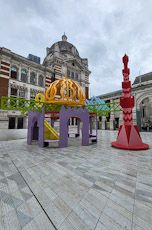
IN 2023 RAMADAN WILL occur between about the 22nd of March and the 21st of April. To celebrate this holy Islamic month, a colourful pavilion has been erected in the courtyard of the Exhibition Road entrance to the Victoria and Albert (‘V&A’) museum. It has been designed by Shahed Saleem and set up by The Ramadan Tent Project and the V&A. According to the museum’s webpage (www.vam.ac.uk/event/ok1kLZm29xJ/ramadan-pavilion-march-may-2023), the pavilion: “…draws inspiration from the V&A’s Prints and Drawings collection to represent the history of the mosque and Muslims in Britain.”
Another webpage (https://www.vam.ac.uk/blog/museum-life/the-ramadan-pavilion-by-shahed-saleem) contains some interesting information about the history of Islamic edifices in the UK. The first mosque in Britain was built in 1889 in Liverpool by 20 British converts to Islam. It was housed in a Georgian terraced house. Since the arrival of many Muslim migrants in the UK im the 1950s and ‘60s, there is now a sizeable Muslim population in the country, and they worship in Britain’s approximately 1800 mosques. The earliest of these were in converted buildings, but now there are plenty of purpose-built mosques. Of these, one of the most beautiful and original is the mosque in Mill Road, Cambridge.
Shahed Saleem is an architect who specialises in designing mosques. Apparently, his pavilion at the V&A is the result of years spent studying mosques in Britain. With his Ramadan Pavilion, Saleem hopes that it will encourage people, who have never entered mosques, to explore mosque architecture and encourage them to enter these holy places to discover more about them. Well, that is an admirable aim, but from what I have seen of the pavilion, it is unlikely to fulfil that aim.
Undoubtedly, Saleem’s pavilion incorporates elements of mosque architecture and design. Sadly, it looks to me more like a children’s play area than a homage to Islamic architecture. I love Islamic architecture, but feel that the multi-coloured pavilion, which resembles something made with over-sized Lego bricks, does not respect the great beauty, delicacy, and intricateness that can be found in mosques both old and modern.
LONDON IS RICH in memorials. Some of them commemorate well-known figures and events and others make the observer aware of lesser-known aspects of history. One of these obscurer memorials is on number 218 Sussex Gardens, next to St James Church and not far from Paddington Station. It was placed on the building, which was rented by the Ukrainian Canadian Servicemen’s Association (UCSA) [Союз Українських Канадійських Вояків] in 1943.
According to an informative website (www.ukrainiansintheuk.info/eng/03/ucsa-e.htm), the UCSA was: “…formed on 7 January 1943 in Manchester, to cater for the social and cultural needs of Ukrainian Canadians serving overseas. Initially the association had 37 members. By the end of the war there were 1,500 active members and over 3,000 additional names on the association’s mailing list.” That is clear enough, but I wondered about the story of the Ukrainian Canadians. In 2016, there were more than 1.4 million Canadians with Ukrainian ancestry. Canada has the third largest population of Ukrainians after Russia and Ukraine. Almost certainly, 1891 marked the start of the migration of significant numbers of Ukrainians to Canada. Back in those days, the territory, which is now the republic of Ukraine was divided between the Austro-Hungarian and Russian Empires. They were welcomed in Canada as the country needed workers to populate and cultivate the prairies.
The UCSA occupied the house in Sussex Gardens from late 1943 until early 1946. The website quoted above revealed that the UCSA: “… organised social gatherings, or “get-togethers”, for its members, initially in Manchester and later also in London. A choir and a dance orchestra were organised at the London club, and a library and reading room were maintained there. The association’s activities also included visiting sick and wounded Ukrainian Canadians, compiling lists of those who had died or were taken prisoner, and looking after the graves of the dead (at various cemeteries in the UK, including Brookwood Military Cemetery near Woking, Surrey). From September 1943 the association published an UCSA Newsletter.” As WW2 drew to a close, the UCSA also provided assistance to Ukrainian displaced persons and refugees from mainland Europe.
The memorial plaque on 218 Sussex Gardens was placed in September 1995, long before Russia began its current conflict with Ukraine. Unlike the statue of the Ukrainian Saint Volodmyr, which stands in Holland Park Avenue, the building near Paddington did not have any pro-Ukraine flags or other patriotic items affixed to it. The plaque is a discrete memorial to an aspect of the history of WW2, about which I knew nothing until today.
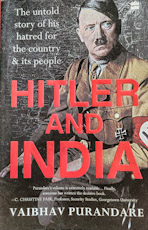
MANY BOOKSHOPS IN INDIA carry copies of “Mein Kampf” by Adolf Hitler, translated into English. They are not hidden away from view but are displayed openly in bookshelves alongside books with less offensive texts. The books are not old and tatty, but look brand new, suggesting that they are bought frequently and replaced by new stock. Why this book should still be on the shelves in India so many decades after it was first published has always puzzled me. So, when I saw a book “Hitler and India” published by the historian Vaibhav Purandare in 2021, I bought a copy. I was hoping that it might help me understand the prevalence of “Mein Kampf” in Indian bookshops.
Purandare’s book is an easy read and quite interesting. He points out very effectively that Hitler had no love for Indians. Furthermore, he felt that it was right that the British rather the Indians than should rule India. And, in his opinion, he felt that should Germany ever rule India, the Indians would yearn for the return of what he considered to be the too lenient rule of the British. Hitler wrote that: “I would, despite everything, still far rather see India under English than under some other rule …” Hitler had no desire to support those fighting for the freedom of India because, believe it or not, prior to WW2 he hoped that Britain and Germany might eventually become allies. Purandare also details how Indians in Germany suffered at the hands of the Nazis and their security forces. It was only after Britain and the Soviet Union became enemies of Germany that he entertained the idea of providing limited assistance to those, like Subhas Chandra Bose, who were fighting to free India from the British. Even then, the assistance he authorised was very limited. He did ship Bose out to Japan, but there was little more to his help than that. It must be remembered that he only did this as a way to undermine the British war effort; he did not believe that an independent India was either feasible or desirable. All of the foregoing is well described in the book.
Unfortunately, what the book failed to do is what I hoped when I purchased it. It brings me no closer to understanding why “Mein Kampf” appears in so many Indian bookshops, and evidently sells. What Purandare does make clear is that Hitler’s book contains passages that are insulting to Indians. As for its appeal to Indian bookshop browsers, his book has not brought me any closer to understanding it.
MAHATMA GANDHI IS commemorated by a statue in Tavistock Square in London’s Bloomsbury. He is probably the most famous of three Indians with statues in Bloomsbury. Crafted by the sculptor Fredda Brilliant and presented by the Indian High Commission, it was unveiled by Prime Minister Harold Wilson in 1967.
The next most famous Indian represented by a sculpture in Bloomsbury is a Nobel Prize winner, the celebrated writer and polymath from Kolkata (Calcutta), Rabimdranath Tagore (1861-1941). The memorial depicts Tagore’s head. It was created by the sculptor Shenda Armery, and unveiled by the Prince of Wales, now King Charles III, on Tagore’s 150th birth anniversary year in July 2011. The bust stands in Gordon Square, close to University College London, where Tagore studied law briefly. His face looks away from the college towards the southeast. – towards India, his homeland. On one side of the plinth, there are some words written in Bengali script. On another side, there is a translation of this brief text (by Tagore) in English: “Thou hast made me endless, such is thy pleasure. This frail vessel thou emptiest again and again, and fillest it ever with fresher life. This little flute of a reed thou hast carried over hills and dales and hast breathed through it melodies eternally new. At the immortal touch of thy hands my little heart loses its limits in a great joy and gives birth to utterance ineffable. Thy infinite gifts come to me only on these very small hands of mine. Ages pass and still thou pourest and still there is room to fill.” This is from Tagore’s collection of poems – “Gitanjali”, translated into English from Bengali by the author in 1913. It was this collection that led to Tagore being awarded the Nobel Prize for Literature in 1913. In 1915, King George V awarded him a knighthood, but following the Jallianwala Bagh massacre of 1919, he renounced his knighthood to express his horror at the murders that had been perpetrated on innocent Indians by British troops in the Punjab.
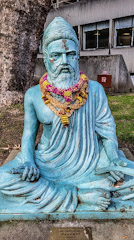
Thiruvalluvar
Call me ignorant but I had never heard of Thiruvalluvar, whose bust stands in a garden next to the School of Oriental and African Studies in Bloomsbury. According to a plaque next to the bust, this man was author of “Thirukkural”, which was a classic of Tamil philosophy and ethics. The bust was donated by the Governent of Tamil Nadu in 1996, and unveiled by the then Indian High Commissioner Dr ML Singhvi. Celebrated as he is in Tamil Nadu, little is known about his life. It is possible that he was born or lived in Mylapore (now a district of Chennai) in the south of India. According to Wikipedia: “His work Tirukkuṟaḷ has been dated variously from 300 BCE to about the sixth century CE.” As for his great work “Thirukkural”, the online version of Encyclopaedia Britannica remarked: “…Tirukkural (“Sacred Couplets”), considered a masterpiece of human thought, compared in India and abroad to the Bible, John Milton’s Paradise Lost, and the works of Plato.”
I have described monuments to three notable men from India, but omitted one woman, whose memorial is close to those already described. The WW2 heroine Noor Inayat Khan (1914-1944) is commemorated by a bust, which, surprisingly, I have never noticed, in Gordon Square. Sculpted by Karen Newman, it was placed in the square in 2012. This artist also sculpted a bust of Violette Szabo (1921-1945), which is on the embankment of the Thames near Lambeth Palace. Both Noor and Violette worked for the British SOE, and perished in Nazi concentration camps. Once the epicentre of the British Empire, it is not at all surprising that one comes across memorials to notable Indians whilst wandering about in London and other places in the UK.
KAYAL ISLAND RETREAT is a small but tastefully luxurious resort on the east coast of the long thin Kakkathuruthu Island in the backwaters of Kerala, not far from Alappuzha (Aleppey). Our friend who owns it kindly invited us to spend an afternoon there. During our stay, we were taken on a delightful boat trip through the peaceful backwaters. After that, the resort’s manager took us on a walk through the rustic tropical landscape from the resort to a nearby small ferry landing stage on the west side of the island. We followed him along a winding path that threaded its way between small farmhouses, fields, fish farms, ponds, and reed beds.
All along the path, there was a series of concrete poles that supported overhead electricity cables. On almost every one of them there was red painted graffiti. Many of the poles were daubed with the initials ‘DYFI’, which stands for the Democratic Youth Federation of India, which is affiliated to the CPI(M) – the Communist Party of India (Marxist). Some of the poles also had depictions of the head of Che Guevara and five-pointed red stars or the letters ‘CPIM’. One pole had “Viva Revolution” on it and some others were daubed with the names of countries including Mexico and Bolivia, At least one house along our route had a large hammer and sickle painted on it. With the exception of the country names, all of these manifestations of Communism are frequently seen all over Kerala, which at times has been ruled by Communist governments,
At the small ferry landing stage, we watched some women and schoolchildren disembark from the ferry – a small boat with an outboard motor. Overlooking the simple wooden landing stage, there was a tall metal pole with the letters BJP on top of it. The pole supported two cords from which BJP flags were fluttering. The BJP (Bharatiya Janata Party) is currently in power as the Government of India.
I asked our guide how the locals tended to vote on the island. He believed that most of them would probably vote for the Communists or some other Socialist party, rather than for the BJP. As we walked along in the hot humid air, I mused upon the contrast between the wealthy holiday makers enjoying our friend’s resort and the relatively poor inhabitants of the island with leftward leaning political sympathies, who might, in theory at least, be antipathetic to the idea of outsiders relaxing luxuriously on their island whilst they slog away in the hot sun. Whatever they believe, the resort does bring additional employment opportunities close to their homes – almost all the staff are from the island.
FORT KOCHI IN Kerala was occupied by three European powers: first by Portugal, then ny the Netherlands, and then by the British until 1947. It was whilst the British were in charge that a small jail was built on what is now Tower Road. Next to a police station and close to a string of roadside seafood restaurants, there is a gate that leads into the Jail of the Freedom Struggle. This prison was built by the British at a forgotten date during the 19th century. One clue to its age is that some of its roof tiles can be dated to 1865. The prison has a row of eight cells, each equipped with a 6 foot long concrete bed.
The prison, which might have been used as a transit establishment for prisoners waiting to be taken elsewhere, is said to have held leading freedom fighters such as Mohammed Rehman, Accamma Cherian, and K J Herschel, A K Gopalan, E M S Namboothiripad, and Abdurahiman Sahib. However, this is not known for certain. The prison, which had become disused and dilapidated, was restored in 2009, and opened as a museum.
In February 2023, we visited Fort Kochi to explore the 2022 Kochi Muziris Art Biennale. Unconnected with this major event, we visited an exhibition of artworks being displayed in the former prison. This included both paintings and sculptures. What made it an usual exhibition is that the exhibits are all contained within the cells behind strong iron doors with vertical bars. The doors that once prevented the prisoners from leaving the cells now prevent visitors from entering them.
MANY INDIANS STRIVE to gain a Master of Business Administration (‘MBA’) degree. I can say little or nothing about the merits of this academic qualification, but know many friends who have been awarded it.
A long time ago, soon after we married in Bangalore, we attended an engagement party held for one of our friends. During the evening, the priest who would eventually officiate at the marriage gave a speech. He spoke in English with a strong South Indian accent. He introduced the couple as follows: “These two dear people are well-matched. He has a yem bee yay. And she has a yem bee yay…” Just in case you did not make sense of that, ‘yem bee yay’, it is the way that many Bangaloreans would pronounce ‘MBA ‘.
This distant memory of our friends’ engagement party was prompted by noticing a tea shop on Bangalore’s St Marks Road. It is named “MBA CHAI WALA”. Above the name are the words “India’s Most Iconic Chai Wala”. As we were in a hurry on our last day in Bangalore, we had neither the chance to sample a cup of tea nor to discover whether the place had anything to do with the MBA degree. On our next trip to Bangalore, I will investigate and get back to you.






 yamey
yamey 