Eating on a train


OHRID BITOLA 77 Train from Medzhitlija


IN THE SUMMER OF 1973, I was on holiday in Greece. Our family and that of ‘K’, a good friend of mine were guests of an extremely wealthy Greek. We had been put up in luxury hotels. We stayed in the George V Hotel in Athens and K’s family were put up by the sea at a luxurious resort at Vouliagmeni. Before leaving England for our Greek holiday, K agreed to accompany me on an excursion north from Greece to a lake in southern Yugoslavia, Lake Ohrid, a body of water now shared by Northern Macedonia and Albania. I was curious to gaze at the then very mysterious Albania across the water from Yugoslavia and K was just being a ‘good sport’ in agreeing to join me.

One day in Athens, K and I left our very comfortable accommodation and arrived at the railway station from which northbound trains departed. The route between Athens and Thessalonika was long and slow, the train having had to wind its way across mountain ranges.

Every twenty minutes, an attendant arrived at our compartment carrying a tray with pork kebabs, lumps of cooked pork on thin wooden skewers. The barely warm meat was delicious. Each skewer seemed better than the previous one. We kept on buying them each time the attendant arrived.

After several hours and many skewers, K said that he had eaten enough of them and he was not feeling too well. My reaction to this was that being an inexperienced traveller compared to me, his stomach was weak compared to mine. I continued munching the delicious kebabs as the journey continued.

At a small place, which was probably Platy, in northern Greece, our train left the main route and headed along a branch line towards Edessa, where we disembarked. Before leaving the station, we had to have our tickets endorsed by a railway official so that we could continue our journey the following day. As soon as we disembarked, K thrust his ticket into my hand and rushed to evacuate his bowels in a field of ripe corn next to the railway.

We booked into a small hotel, the Olympus, in Edessa, where we paid the Drachma equivalent of £1 Sterling for a room with two beds. I gave K some of my anti-diarrhoea tablets, and he ate some plain yoghurt for supper. At this point, I was still thinking how sad it was that my friend’s stomach was so delicate. Surprised to be hungry after having devoured so many pork ‘souvlaki’ on the train, I ate a normal supper.

The beds in the hotel were very short. My feet projected beyond the bed end. I slept well. The next morning, K was feeling much healthier. However, I was not. I had a terrible pain in my stomach which made it difficult for me to stand up straight. I took some of my tablets and tried without much success to enjoy a bowl of plain yoghurt upon which there was a puddle of oil.

We returned to the railway station and boarded the train which took us westwards to the small town of Florina. We had a short stay, a few hours, in Florina, where I recall buying a roll of toilet paper. The daily train, a single motorised carriage, from Florina to the border with Yugoslavia departed in the early afternoon. K and I were the only passengers. At the border, the Greek carriage drew up next to a Yugoslav motorised train with several carriages on the neighbouring track. A Yugoslav soldier instructed us to move from the Greek to the Yugoslav train and then we set off northwards through southern Yugoslavia, crossing a flat plain with well-tended fields.

We disembarked at Bitola, once known as ‘Monastir’, and transferred to a long-distance bus. As the sun set, this carried us north westward over the mountains towards the historic city of Ohrid on Lake Ohrid.

It was dark by the time we arrived at the campsite on the lakeshore about a mile north of Ohrid city. Both of our stomachs had settled down. For the next few days, I explored the beautiful sights along the lake and enjoyed the local food, much of which was in the form of kebabs. K, having been made wary as a result of our experiences with the Greek railway ‘souvlaki’, avoided this kind of food, preferring to feed himself at our campsite.


Picture taken in 1977 shows the train in Yugoslavia between the Greek border and Bitola

A picnic to remember


I AM NOT A LOVER OF picnics. My perfect idea of eating outside my home is not squatting on a rug in a picturesque open-air location, but in a restaurant. In contrast, my wife and her parents loved picnics.

Many years ago, when both of my dear in-laws were still alive and healthy, that is well before 2006, we decided to have a picnic at the Big Banyan Tree just outside the city of Bangalore (India). Known in Kannada, the official state language of Karnataka, as ‘Dodda Aalada Mara’ that means ‘Big Banyan Tree’, this huge tree, an example of Ficus benghalensis which is about 400 years old, covers about three acres. It is located about 17 and a half miles west by southwest of the Bangalore Club in central Bangalore.

It is a popular local attraction for picnickers. This being the case and also the fact that I had never been there helped my in-laws decide that we should enjoy a picnic at the Big Banyan Tree. After thermos flasks had been filled, masala omelette sandwiches prepared, blankets packed, puri aloo packaged, bhakri boxed up in cylindrical steel containers with tight fitting lids, we set off: my parents in law, my brother in law and his family, my wife and our very young daughter, and me.

We arrived at the tree, which looked more like a dense, tangled forest than a single tree, but that is what banyan trees become when left to their own devices. After threading our way through the aerial roots hanging down from the tree, we found a small open space that looked nice for a picnic. At least everybody except me, not a lover of picnics, thought so.

We laid out the blanket, and put out the containers of food, and that is about as far our picnic was to resemble a normal meal ‘al fresco’. Moments after setting out the food, swarms of our closely related primates appeared. These monkeys had not come to keep us company or simply to watch their two-legged relatives eating. No, they had arrived to be fed. Their only intentions were far from friendly. They had come to steal our picnic. One by one they dropped out of the trees and approached our food. With great difficulty we were able to ‘shoo’ away these almost fearless raiders. At one stage, I resorted to throwing wet used teabags at them. They were very persistent, in fact so persistent that we decided not to persist with our picnic. We packed everything and made a hasty departure having eaten nothing.

This experience did nothing to remove my long-held prejudice against picnicking. It did the opposite. Wasps and other intruders are bad enough, but monkeys ‘took the biscuit’. Well, metaphorically if not in fact.

Keep your shirt on

My late father in law was enthusiastic about everything new until his very last days. Every day, he scoured the newspapers to discover the latest events happening in Bangalore. If I was visiting the family, I often accompanied him to events that events that caught Daddy’s eye.

For example, I accompanied to the launch of the new Tata Indica car. When we arrived in time for the launch, there was a large crowd waiting for the official launch. When they saw my aged father in law, dressed in a smart suit and wearing a tie, being supported by me and his walking stick, the crowd parted as did the Red Sea when Moses arrived on its shore. We were given the honour of being first to be allowed to sit in the new car model.

On another occasion, Daddy spotted that there was to be a huge shirt sale, at which customers, who brought an old shirt as part exchange, would be able to buy a new one at a substantial discount.

Before we set off, Daddy had to find a shirt that he was willing to part with. This was a lengthy business because he possessed a large collection of shirts, each one of which needed to be examined and considered. This task was difficult because almost all of his shirts were good quality and in good condition.

Eventually, a shirt was selected for sacrifice, and we set off.

There were many people and an enormous number of shirts at the sale. Daddy carefully examined what was on offer and kept selecting shirts and asking my opinion about them, flatteringly but unwisely overestimating my sartorial expertise.

The hours passed and time for eating lunch was approaching rapidly. After giving my opinion about many shirts, all of a lesser quality and beauty to the one he was going to exchange, I told him that the latest one that he was showing me was the one to buy. He bought it and handed his old shirt as part payment.

When we got back home, Daddy showed the family his new shirt. Nobody liked it. They were horrified that I had allowed him to buy such a ghastly shirt. Yet, Daddy loved it. He wore it often. The picture shows him wearing it, sitting with me in 2005 at the Bangalore Club.

A town in California


Just after Christmas in 1994, we flew to San Francisco in California (USA) for a four-week holiday. My wife was in the sixth month of pregnancy. Before booking our trip, we consulted her obstetrician at St Marys Hospital in Paddington, London. We wanted to know whether it was safe for her to travel at this stage in her pregnancy. The obstetrician did not mince her words:

Yes, go ahead, but make sure that you have good travel health insurance because having a premature birth in the United States might well bankrupt you.”

After spending a few days with friends who live across the Golden Gate Bridge in Marin County, we rented a car, an upmarket Toyota, one of the nicest cars I have ever driven. We drove all over California south of San Francisco. Also, we visited the Grand Canyon and saw it under snow. This was a very beautiful sight because the snow had fallen in such a way that the many stepped strata that line the walls of this spectacular gorge were accentuated. We admired this while trudging through very deep snow. In order to enjoy this, we had had to purchase snow chains and to learn how to apply them to the wheels.

One day, we drove south from the snow-covered Grand Canyon to Sedona, a town famed for its vortices of energy. It was a distance of 106 miles. Yet in that short distance the weather had changed from Arctic to summer. And, the following, day we drove further south past Phoenix and Yuma and then through a southern Californian Desert to San Diego. Even though it was freezing up at the Grand Canyon, from Phoenix to San Diego it was so hot that we had to switch on the car’s air-conditioning.

From San Diego, we spent a few days driving along roads close to the Pacific Coast. We visited most of the historic mission stations between San Diego and San Francisco. We also stopped at Nepenthe in Big Sur, where the writer Henry Miller once lived. The building in which the writer lived was open to the public. While we were visiting it, my pregnant wife needed to use a toilet urgently. Without making any fuss, the guardian unlocked the toilet that Miller used to use and allowed my wife to relieve herself.

Being fans of the architect Frank Lloyd Wright, we visited some of the few buildings that the great architect had designed along the route we were taking. One of these, at San Luis Obisco (between Los Angeles and San Francisco), was a particularly lovely medical centre, the Kundert Medical Clinic that was built in 1956.

On the final day of our road trip, I looked at the guidebook and spotted something that I did not want to miss. To reach it, meant adding 60 miles to our already long (300-mile journey) journey. The place that caught my eye was about 90 miles to the east of our destination Marin County on the left bank of the River Sacramento. The small settlement is called Locke.

Locke is in the wetlands of the Sacramento River Delta. In the 1860s, work was undertaken to drain the malarial wetlands. Many poor Chinese labourers were hired to do this work at disgracefully low wages. In about 1912, the settlement of Lockeport, now called ‘Locke’ was established by three local Chinese merchants. Three years later in 1915, the Chinatown in nearby walnut Grove was destroyed by fire. The Chinese community then moved to Locke and a town grew. Because the Californian Alien Land Law of 1913 forbade Asians buying farmland, the Chinese in the area leased the land from a George Locke.

The town’s population reached 1000 to 1500 in its heyday. It acquired a reputation for its gambling halls, opium dens, and brothels. At one point, according to an article in Wikipedia, it became known as ‘California’s Monte Carlo’. In the 1940s and ‘50s, the towns population dwindled because many people migrated from Locke to major American cities. Currently, there are only about ten people living there.

By 1995 when we drove into Locke it was already a ghost town, a lesser-known tourist attraction. However, it did not disappoint us. Most of the main street’s buildings were picturesquely decaying. They were all made of wood, and no doubt highly inflammable. The place looked like a rundown set for a cowboy film, except that it was for real. One of the buildings that had housed a gambling salon, or maybe a brothel or opium den, was open to the public. Its original dingy décor had been preserved. All that was missing was a haze of opium smoke and the poor Chinese workers squandering their hard-earned money.

From Locke we drove west into the setting sun towards Marin County, pleased that we had made the detour to see the fascinating remnant of a far-off era. Our daughter was born three months later, having travelled several thousand miles around the American west in utero.

A hidden gem

SOMETIMES, IT PAYS TO BE “ECONOMICAL WITH THE TRUTH”, to rephrase the words used by Edmund Burke in his book “Letters on a Regicide Peace”, published in 1796, in which he wrote:

“Falsehood and delusion are allowed in no case whatever: But, as in the exercise of all the virtues, there is an œconomy of truth.”

HYD 4 real

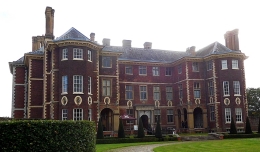
The Residency in Hyderabad was built for the British Resident (for the Princely State of Hyderabad) James Achilles Kirkpatrick (1764-1805) in the style of a Palladian villa in about 1798. As described in an excellent book, the “White Mughals” by William Dalrymple, Kirkpatrick, like many other pre-Victorian Europeans in India, adopted local Indian ways of life. This Resident went so far as to marry (not too publicly) a local aristocratic woman from Hyderabad, Khair-un-Nissa (1786-1813). She remained in purdah and lived in a zenana, a ladies’ quarter, in the garden of the Residency but quite separate from it.  

The Residency was used for its original purpose by British Residents of Hyderabad until India became independent in 1947. In 1949, it became a building within the confines of the Osmania University College for Women (founded 1924).

Having read Dalrymple’s book back in 2011 just before visiting Hyderabad, I was keen to see the Palladian style Residency. With great difficulty our driver (from Bangalore) managed to discover the whereabouts of the Osmania university. We drove up to the gate and were stopped by a security guard, who would not admit us until we revealed (somewhat deviously) that the Director was expecting us. We entered the grounds and found the Director’s office. We suggested to her that I might be a relative of Dalrymple’s and that I was keen to see the building he had written about.


The Director assigned a member of her office team to take us to the old building, adding that it was not wise to enter it as it was in a perilous condition. What we saw, although in a very poor state of repair, was a magnificent, elegant neo-classical building. If it had been in the UK and restored considerably, it would have outshined many of the great houses built in the same era, which are open to the public. Ignoring the advice of the Director, we entered the crumbling structure and viewed its wonderful twin curving staircases and glamorous rooms. Although the place was in a parlous condition, its former glory was still very evident.

We left the former Residency without any of it collapsing on to our heads and feeling very pleased that we had ‘blagged’ our way into seeing this gem hidden from the public.

Foot and mouth

Wales 1 SMALL

Before she died in 2012, we used to make annual visits to a dear friend, whom I had known since my childhood, in South Wales. She used to live in London, but when she retired, she moved to a village in the Brecon Beacons, near the River Usk. We stayed in her cottage but were encouraged to leave her in peace from after breakfast until about four in the afternoon. We did not mind this because there is plenty to explore in the area and often the weather was good at the times of the year that we visited her.

In 2001, disaster hit Wales in the form of a vicious outbreak of foot and mouth disease. In order to prevent its spread, all footpaths and many open spaces were closed to visitors. This and the appalling rain that fell relentlessly during our visit, restricted what we could do while we were allowing our guest a few hours relief from her guests. We drove around the countryside not particularly having much fun.

One day, we arrived at a small town with a name I am unable to pronounce correctly:  Llanwrtyd Wells. It was lunch time. We parked outside a hotel near the town centre. The floor of the lobby was covered with a grubby, well-worn carpet. We were shown into an unattractive dining room. Our hopes for having a decent meal fell as we surveyed the room’s dingy uninviting décor. The sight of incessant rain falling outside did little to enhance the dreary mood that this unappealing room was inducing.

The hotel’s owner brought us menus. We asked what he recommended. He said “steaks” and showed us the large range of meats listed in the menu. We asked his advice about which steak to choose. Then, he did something that transformed the dingy place for us.

He gave us a ‘tutorial’ about the relative merits of different kinds of beefsteak and their tastes. The least tasty, in his opinion, was the costliest cut, fillet steak. Sirloin steak was, he advised us, tastier and cheaper than fillet. However, he considered that the tastiest cut was rib-eye. He explained that the latter was marbled with fine streaks of fat, and it was this that gives it its superior taste. We ordered it and discovered he was right. He regretted that he was unable to serve the local, and in his view far superior, Black Mountain beef. This was because of the problems connected with the foot and mouth outbreak.

Whenever I buy steak, I look for rib-eye first, and if this is not available, I go for sirloin. Whenever I think of beefsteak, I always remember that dreary eatery in Llanwrtyd Wells and its helpful landlord. For a long time, I could not remember in which town in Wales, we were given our tutorial about steaks. Recently, I discovered some photographs I had taken there almost twenty years ago. In one of them, there was a pub sign that read “Neuadd Arms Hotel”. Seeing this helped me discover where we had been.

Onion on top

ONION DOME SMALL

This piece, which is about onion shaped domes on some churches, was inspired by a chance discovery of a photograph of a church (see illustration) that I took somewhere in Slovenia about twenty years ago.

In the summer of 1975, I accompanied my PhD supervisor, Robert Harkness, and his wife, Margaret, both now no longer living, on their annual drive from Buckinghamshire in the UK to Platamon on the Aegean coast of northern Greece. It took about nine days in their Land Rover, which was towing a caravan that was to become their home in Greece for up to two months. Robert, a well-regarded physiologist, was also a keen naturalist as well as being interested in many other things. This excerpt from an unfinished biography of the Harkness’s that I began writing over a decade ago illustrate one of the varied interests that kept Robert happy.

Soon after we left our camping site on the following morning, we crossed the River Rhine and entered West Germany, where we began driving along its Autobahns. After some hours, we spotted the first of the many onion-domed church towers typical of southern Germany.

Robert speculated that there must be a line of places north and west of which it is almost impossible to find onion domed church towers. This idea made him think that there must also be an olive line north of which no olive trees grew, and a ‘karpousi’ (καρπούζι: Greek for watermelon) line below which watermelons grew. Original as this might seem, Robert’s concept of boundaries based on the presence of this or that particular item was apparently proposed earlier by a French author – it might have been Stendhal – who was writing about those nations whose inhabitants favour eating Brussels sprouts.

The leaning tree

LATE 18 leaf

“A PICTURE IS WORTH A THOUSAND WORDS” It is not known exactly when this well-known sentence was first used, but an article in Wikipedia suggests that one of the first times it appeared in print was in an advertisement for a Texan newspaper, the “San Antonio Light”, in 1918. I do not know whether I can write a thousand words to put the attached picture in context, so you will have to make do with what I am able muster.

Just over a year ago, my wife and I were ‘wintering’ in India. We left our daughter looking after our flat in Kensington. One day, she sent us a message informing us that one of the old trees in our street had toppled over in the middle of the night.

The tree that fell always looked precarious as its trunk leaned over the road at quite a sharp angle, making it tricky to park a car next to it. A neighbour told us that it had done so for well over a century. His evidence was that the very same tree can be seen leaning over the road in an old photograph of our street taken about 150 years ago. So, the tree was not inherently unstable.

Many years ago, while walking through woods with my old PhD supervisor (and by then a close friend), he pointed out the variety of shapes and inclinations of the tree trunks around us. He wondered how a tree ‘knew’ how to grow in various directions whilst maintaining a centre of gravity that stopped it toppling over. Clearly, our late lamented leaning tree ‘knew what it was doing as it had been leaning seemingly precariously for at least a century and a half.

After we returned from India, there was a bare patch where the tree had stood for so long. A neighbour, who makes it his business to find out in detail what happens in our small street told us what befell our tree. The local council decided to move the position of the curb and so to widen the pavement around the tree, the idea being to narrow the road at that point and thereby prevent parking next to the tree.

Unfortunately, the workmen assigned to carry out this job managed to cut through part of the tree’s root system. This destabilised the tree, which then fell over across the street. While falling, the tree damaged a first-floor balustrade and terrace on a building across the street. Luckily, there were no human casualties.

For some months, the site of the fallen tree remained treeless. Then, a small tree with a slender trunk, a sapling, was planted by the council. Day by day, we watched it producing leaves. These changed colour in the autumn, looked sickly, and fell off, leaving a sad looking spindly tree. Then, we spent another winter in India.

When we returned in late February this year (2020), the young tree was still standing and still looking lifeless. As the weeks passed, we were very pleased to see buds forming on its slender branches. These buds have grown in size and are, at last, unfurling to reveal the tiny leaves seen in the photograph.

It is pleasing to see that even in these troubled times, nature has something positive to lift our spirits.

Well, I have reached about 580 words, not quite a thousand. However, as the saying goes, I hope my photo is worth at least a thousand words and is something to enjoy.