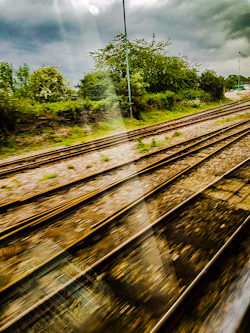
Rails of solid steel extend
From place to place
Past countryside we speed

Rails of solid steel extend
From place to place
Past countryside we speed

The first time I encountered the term ‘fire plug’ was when I was researching the life of my great grandfather Franz Ginsberg, who died in 1936. As an 18 year old, he went from his home in the German Empire to the South African town of King Williams Town in 1880. By 1885, he had established a factory for making matches. Such factories are full of raw materials that are prone to catching fire. As his business grew, so did his need for a reliable water supply for dealing with fires.
Water in the Eastern Cape was expensive in the late 19th century. Franz had to apply to the town council for permission to increase the supply of water to his factory. He also needed permission to install more fire plugs. In my published biography of my great grandfather, I wrote:
“Almost a decade later, in 1898, Franz and his brother-in-law Mr Siegfried Salomon (who married Franz’s sister Ida and was a Town Councillor for a while) both applied to the Town Council to have ‘fireplugs’ placed on their premises. This was allowed on condition that the applicants paid the expense of placing them there; and that they would be liable to other charges including a fine of £25 if they used the water from these for any purpose other than the extinction of fire.”
Recently, I visited Windsor Castle, where I saw several signs such as is shown in the illustration to this blog article. They indicate the locations of fire plugs in the castle. Had I not seen the term ‘fire plug’ before while writing about my ancestor, I might not have noticed these small old-fashioned signs.
So, what, you might be wondering, is or was a fire plug? The modern term for them is ‘fire hydrant’. The fire plugs, which were precursors of fire hydrants were simply holes made in the water mains pipe, which were blocked with a plug. The plug could be removed when water was required to extinguish fires.
I suspect that you are by now asking yourself if Franz ever had to make use of the plugs he had requested. Well, he did occasionally:
“In February 1893, the Cape Mercury newspaper published a long article about Franz’s match factory. It begins with a spark of humour:
‘In December last an unusual illumination made a “King” industry more widely known than before. A fire broke out in, and consumed the drying shed at Messrs. Ginsberg & Co.’s Lucifer Match Factory, which is situated in Victoria Street. The loss was not great, but the advertisement was extensive – and cheap – for it was gratuitous.’”
If you want to know more about my ancestor who went to South Africa in search of prosperity and later became a senator in that country, please read:
“Soap to Senate: A German Jew at the dawn of apartheid”
by Adam Yamey.
It is available from: lulu.com, Amazon, bookdepository.com and Kindle

Waiting for a train
Training with a weight:
Sounds same, but meanings differ
When two words have the same spelling or same pronunciation, they are called ‘homonyms’
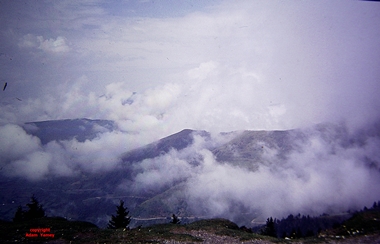
A chance encounter in the former Yugoslavia has stuck in my memory
Sometime in 1975, I travelled from Peć (now in Kosovo) to Titograd (now in Montenegro) by bus. I chose to take the route that went via the wild and difficult Ĉakor Pass that traverses the mountain range shared by northern Albania and Montenegro, where I was heading. We reached the highest point on the pass after driving around a seemingly endless series of tight hairpin bends, and stopped there to give the driver a break.
While I was wandering around the treeless, grassy summit, admiring the views into the valley into which we would be descending, a grubby little boy approached me. He said something to me in a language, which I did not recognise as being Serbo-Croat. It was probably Albanian. Somehow, he made it clear to me that he wanted foreign coins. I thought that he was either a beggar, or more likely, just a curious youngster pleased to have chanced upon a foreigner. I gave him a few British coins, and then he rummaged around in his pocket. After a moment, he handed me a few Yugoslav Dinar coins, and left. He was no beggar, after all, but simply a young fellow with a well-developed sense of fairness.
After leaving the Ĉakor, we wound through the mountains to Andrijevica, a small Montenegrin town, which was enshrouded in rain and mist. Then, we descended gradually via a series of deep wooded canyons towards Titograd. All I saw of the town on that occasion was its bus station.
Picture shows view from the summit of the Ĉakor Pass
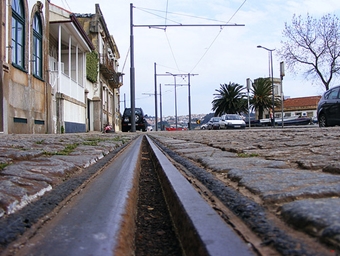
Lines parallel
Meeting at infinity
Only in your mind’s eye

Non-violent Gandhi
Beside three leading men
Who faced fate with force
This mantle-piece at Shaw Corner, the home of George Bernard Shaw at Ayot St Lawence in Hertfordshire, bears the portraits of (from left to right) Mahatma Gandhi, Felix Dzerzhinsky, Vladimir Lenin, and Josef Stalin. Shaw met all of these men.
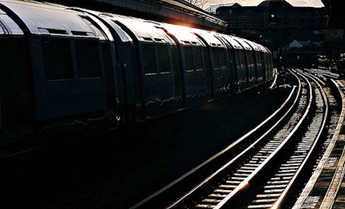
When I was a child, our local Underground station was Golders Green on the Edgware branch of the Northern Line. It was the first station on the stretch of the line, which remains open air, above ground, between Golders Green and Edgware. As a small child, I yearned to know what lay beyond Golders Green, where we always disembarked, but my parents did not share my yearning.
Long ago in the 1960s, the trains bound for Edgware stopped at Golders Green on a stretch of line that ran between two platforms. The doors would open on both sides of the train. The platform on the left side of the train gave easy access to the centre of Golders Green and its large bus terminus. The right side, which we always used, led to an entrance that was on the way to Hampstead Garden Suburb, where our family home was located.
One day, my father and I arrived at Golders Green after having spent some time in central London. As usual, we waited alongside a door on the right side of the train when we stopped in the station. Unusually, the doors on the right side of the train did not open, but those on the left did. By the time we realised that the right side doors were not going to open, the doors on the left side had closed, and we were beginning to travel beyond Golders Green above ground to Brent, the next station. My father was not happy, but I was delighted to be travelling along a stretch of the line that I had always wanted to see.
Since that time, I have always been excited at the prospect of travelling to the ends of the London Underground lines. Yesterday, I travelled to Watford, the terminus of one branch of the Metropolitan Line, and enjoyed it as much as I would have done when aged about ten!
Some famous vegetarians…
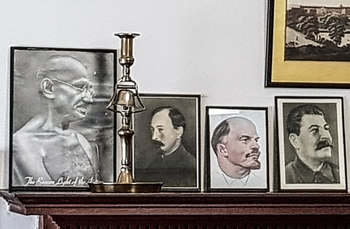
A photograph of Mahatma Gandhi stands above a fire place in the home of the great paywright George Bernard Shaw at Ayot St Lawrence in Hertfordshire. Gandhi, born in Porbandar in Gujarat, met Shaw in London in 1931.
Both of these great men were vegetarians. Shaw said: “Animals are my friends . . . and I don’t eat my friends.” And Gandhi said: “To my mind, the life of a lamb is no less precious than that of a human being. I should be unwilling to take the life of a lamb for the sake of the human body“.
While Gandhi never visited Shaw at his home, Jawaharlal Nehru did in 1950.
In the UK, Jeremy Corbyn, the Labour politician, is also a vegetarian. I wonder what Shaw would have thought of him and whether he would have put Corbyn’s photograph on his mantle-piece.
Quotes from https://shawsociety.org/Sri.htm

Fading letters on a wall:
Memories evoked
Of times long ago
Picture taken in the midst of the area of London where the annual Notting Hill Carnival takes place
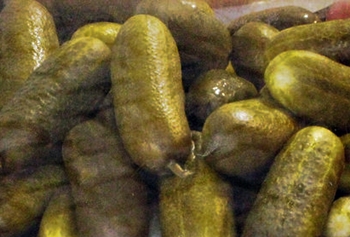
As a child and teenager, I did not like gherkins (pickled cucumbers). My parents ate them, but refused to buy them if they were made behind the Iron Curtain, for example in Bulgaria, Czechoslovakia, Hungary, or Poland. They would only by jars of these green, wet vegetables if they were made in Western Europe, say in West Germany or Holland. You may well wonder why my parents were so fussy about the origin of their gherkins. The answer is simple. They were unwilling to buy anything from Soviet-dominated parts of the world because they felt, rightly or wrongly, that every penny they paid for goods from these areas would help the Soviet Union pay for yet another atomic bomb or some other military equipment that could be used against the West.
I did not worry me where my parent’s gherkins were grown and bottled, as I did not eat them. This was true until the late 1970s when McDonalds opened a branch of their hamburger restaurant chain in London’s Haymarket.
At first, I felt that I was too superior to enter a McDonalds, and developed an irrational prejudice against the company. Eventually, some friends decided to eat at the Haymarket branch andas I was with them and also a little curious about McDonalds, I joined them. I cannot recall which burger I ordered, but whatever it was, it contained slices of gherkin. I did not remove the gherkin as I might have done had I been served it a few years earlier. I bit into the burger and realised that it was the gherkin that made the rest of the burger sandwich delicious. From that moment onwards, I have become a gherkin afficionado.
I am happy eating gherkins anywhere. However, some of the nicest gherkins that I have found are those often served in fish and chips shops. These large, very tasty specimens often come Holland. Served from large glass jars, these gherkins are often known as ‘wallys’ (pronounced ‘wollees’) in London and South-East England.
Finally, here is something that you might not know about gherkins. The south of India, which I visit often, hasbeen a major producer and exporter of gherkins since the early 1990s. The soil condition in that region are perfect for growing the cucumbers that will be pickled. For more information, see: http://igea.in/. Had these been around in the days before the fall of the Iron Curtain, I wonder whether my parents would have bought them.

 yamey
yamey 