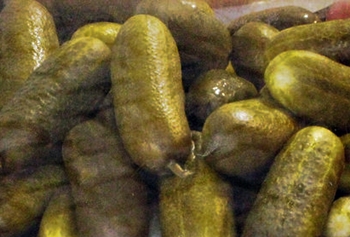
I was an unadventurous eater when I was a child. So, I never tried any of the pickled gherkins, a food which my father enjoyed eating. A visit to McDonald’s changed my approach to these pickled cucumbers …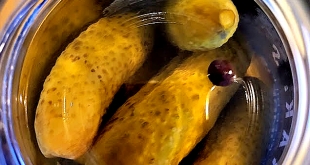
Believe it or not, there was a political aspect to my father’s consumption of pickled gherkins. My parents did all they could to avoid supporting dictatorial regimes. They would not visit Franco’s Spain or any of the Communist countries behind the so-called ‘Iron Curtain’. Many good, pickled gherkins were, and are still, produced in countries that were once dominated by the USSR. My parents were against buying these because they felt that with each purchase, they would be contributing a little money that might be used to finance a Russian nuclear weapon that might be used to attack ‘The West’. Therefore, the only gherkins my father ate prior to 1990 were those manufactured in Holland and West Germany. During my childhood and teenage years, I became fascinated by the countries in the Soviet Bloc, and wished my parents would have purchased gherkins from these places. If they had, I might possibly have tried one, but they stuck to their purchasing principles.
When McDonald’s came to England in 1974, I was, for some now forgotten reason, against entering one of the company’s restaurants. It was only later in the 1970s when I first entered a McDonald’s – the one in London’s Haymarket – with a group of friends. I ordered a Big Mac, and it was love at first bite.
In case you did not know, the Big Mac contains a slice of pickled gherkin. While eating my first one, I noticed the slice, and tasted it separately from the rest of the burger. The gherkin’s taste appealed to me, and I wondered why I had avoided sampling one for so many years. Now, I am not exactly addicted to pickled gherkins, but I cannot resist eating them often.
Since I began visiting India in the 1990s, I have discovered that although they are not on most Indians’ menus, pickled gherkins are manufactured in India – and very good ones they are. For example, there is a company called Unpick, which has been producing them since 1994 – the first year I visited India. Based near Bangalore, they export their gherkins to over 56 countries. Some of their gherkins are produced under the supervision of Orthodox Jewish food inspectors, and are certified as being Kosher.
Currently, when at home in England, we prefer to buy the gherkins produced by the Polish company Krakus. They supply a variety of different types of gherkins. Of these, our favourites are the Kashubian style, which are bottled along with strips of red bell pepper, white onion slices, dill, and whole spices including: mustard seeds, allspice, and bay leaves.
To conclude, thanks to McDonald’s, I now count pickled gherkins amongst my favourite food items. And other pickled vegetables are also very much to my taste.