I wonder if you know…

I do not know how many millions of people live in Calcutta, but I know it is well in excess of 14 million.

One day, a friend, M, met us in London. He told us that a mutual friend, D, was married to a woman born in Calcutta. As my wife went to school in that city, M said to her: ” You might know D’s wife.”

My wife replied: “Do you realise how many people live in Calcutta, M?”

Then after a moment, she asked; “What is her name?”

M mentioned a name. Hearing this, my wife answered: “She was a year junior to me at school.”

I thought it was amazing how small the world can seem even when a city as huge as Calcutta is being discussed.

Dinner dates

A few days ago, some friends invited us to visit them one evening. We sat with them for several hours, drinking and eating light snacks. As time passed, my stomach began rumbling and I wondered when we were going to eat dinner. This reminded me of an evening many years ago when I lived in Kent (UK).

Some Americans invited me to dinner. To reach them, I had to drive through the countryside for two hours. When I arrived at about 7 pm, I was offered a sandwich. I refused this, muttering that I would wait for dinner.

Another guest arrived. We sat talking and the time passed pleasurably. However, there was no mention of dinner or any food at all during the rest of the evening. At 10 pm, I began my two hour return journey without having eaten. As I drove home, it dawned on me that the sandwich I had been offered was actually the only evening meal that my hosts were planning to serve.

When I reached home at midnight, starving, I prepared a hasty snack.

On reflection, on the recent occasion, we had visited our friends assuming that we would have a pre-dinner drink before going out to dinner. In reality, they had only invited us for a drink; they had not mentioned dinner.

Moral: don’t assume anything!

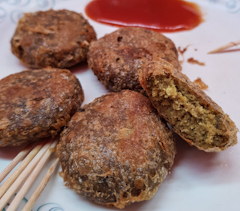
Photo of shaami kebabs

DisCONCERTing

I have attended concerts at BBC recording studios. Before the performance begins, the audience, members of the public, are asked to be very still and silent, so as not to spoil the recording or live broadcast. The audience is politely requested to be so silent that one feels that even the sound of breathing might disturb the event.

With the exception of one western classical music concert in Bombay, audience disturbance is well tolerated at concerts I have attended in India. Pepole arrive and leave the auditorium whenever they feel like. They chat and take photos and often mover from one part of the auditorium to another.

Once, I attended a musical performance that was being relayed ‘live’ on All India Radio. Unlike the BBC recordings and live broadcasts, the audience was far from placid. Throughout the event, there were disturbances as described above, but no one seemed in the slightest disconcerted .

But, all is no longer well with British audiences. Recently, I have been to a few classical music performances in London, at which there has been applause at inappropriate places in the music. An example of this is clapping at the end of a movement of a symphony, rather than at its ending. Maybe, orchestras are getting used to this, but I find it a bit disconcerting.

New York! New York!

Brooklyn Bdg_240


In 1992, I decided to visit New York City (‘NYC’). I had a week available and did not want to waste a minute of that precious time.

In order to make efficient use of my time in NYC, I bought several guidebooks. I spent several weeks studying them in my spare time. I wanted to make sure that I did not miss seeing anything that seemed likely to be of interest to me.

As I turned the pages of these books, something began to worry me and nearly made me want to cancel my trip. Each of the books had sections on dangers in the city including ‘mugging’. What worried me most was not that these books warned of the risks of being mugged, BUT what to do when you are mugged, rather than if you are unlucky enough to be mugged. The implication seemed to me to be that getting mugged was inevitable. That was what got me worried.

Well, I decided, if I was going to be mugged, I had better be prepared for it. Had the situation arrived, which (thank heavens) it did not, I was going to hand over my wallet politely without attempting a struggle. However, I was not prepared to hand over all my cash to any old criminal. To avoid this, I carried a useful nmber of US Dollars in my socks beneath the soles of my feet.

As it turned out, my week in NYC was not only free of unpleasant surprises but also highly enjoyable. 

The streets of NYC in 1992 were far more exciting and ‘edgy’ than when I returned for another visit in 2007. Between those two visits, Manhattan seemed to have been socially ‘sanitized’. The sense of excitement and uncertainty that I felt in 1992  had been replaced by an almost dull genteelness. Manhattan had been transformed from an electrifyingly live place to something like an urban theme park. No doubt, those who live there find it an improvement over what it was back in 1992, but I was a little disappointed.

Departure angst

Take off_240


Ever since I can remember, I have always enjoyed travelling.

Yet, as long as I can recall, I have always experienced  nervousness for a few days before my departure. When I was a child and even in my twenties, I used to feel positively nauseous during the last few hours before setting off. Nowadays, I still feel anxious a few days before leaving on a trip, but I no longer have that sensation of nausea.

The cause of my anxiety is probably a mixture of concern that all will go according to plan and excitement at the prospect of travelling and new experiences.

Whatever the reason for my pre-travel ‘neurosis’, the problem evaporates once I set off on my travels.

Am I alone in this needless worry before departure, or do others feel the same way?

Roll out the barrel

barrel


It always amazes me how often one misses the obvious when wandering around London. A few days ago, my friend, the author Roy Moxham, took us to a delightful pub, The Angel, near to Tottenham Court Road Station in central London. 

Just before we entered the pub, Roy pointed at a stretch of pavement outside it. The usual paving stones had been replaced by granite slabs surrounded by granite cobble stones (see illustration above).

The reason for these harder stones is that they are less likely than paving stones to be damaged when heavy barrels are dropped on to them by the men delivering beer to the pub.

Since having been shown this localised special surface outside The Angel, I have checked outside other pubs and seen the same thing. For over 25 years (maybe over 7000 times) I have walked past the Churchill Arms in Kensington and NEVER noticed that it also has this arrangement, an area of tough stones close to the pavement entrance of its cellar. And, I consider myself to be more observant than average! It pays to keep your eyes open and to be curious – you never know what you might discover!

Triumph of the ego

jinnah

Mohammed Ali Jinnah (1876-1948) saw the realisation of his ambition, the formation  of a sovereign nation for Indian Muslims: Pakistan, a year before he died as its supreme leader. Jinnah was a brilliant barrister and orator. His brilliance is described by Rafiq Zakaria in his book “The Man who divided India“. The author, clearly recognising his subject’s skills, does not rate him highly as an individual. His lucid, well-reasoned text makes this very clear.

At first, Jinnah, who was always attracted to politics, strove for Hindu-Muslim unity/harmony in pre-independence India. Various factors, including his disapproval of the anti-British Khilafat uprisings of India’s Muslims following WW1, led to him being sidelined by both the Indian National Congress and the main Indian Muslim political groupings. This led to him leaving India and establishing a legal practice in London and also attempting (in vain) to become involved in British parliamentary politics. 

Returning to India after a few years in London, Jinnah recommenced his struggle to become prominent in the Indian polical scene. To do this, he abandoned the idea of working for Hindu-Muslim unity for the opposite – the alienation of India’s Muslims. This proved successful. Under his leadership of the Muslim League, he promoted the idea of a separate sovereign state for India’s Muslims by indoctrinating his followers to believe that as the Congress became more powerful and when the British left India, Muslims would be at the very least dominated by the Hindus. By 1947, when the British gave up their hold on India, the formation of Pakistan, a sovereign state for Indian Muslims, was guaranteed.

The formation of Pakistan was associated with mass movements of people: Muslims into Pakistan, Hindus and Sikhs out of the newly created country. During this ‘Partition’, there was massive loss of life and much irreversible misery both in Pakistan and India. Furthermore, Pakistan was not one contiguous territory, but two widely separated portions: West Pakistan and East Pakistan (now Bangladesh).

Zakaria describes how Jinnah, the great leader of the  Muslims, was really a very unobservant Muslim. Throughout his life, Jinnah ate pork, enjoyed alcohol, hardly knew the Koran, and never learnt Urdu, the language of the Muslims of the Indian subcontinent. According to Zakaria, Jinnah did not hold his fellow Muslims in high regard, to put it mildly. It appeared to me while reading the book that Jinnah took advantage of Muslim fears of possible domination by the Hindus to further his ambitions of achieving political prominence, which were indeed successful.

Zakaria uses the last few chapters of his fascinating book to discuss the legacy of Jinnah’s creation, Pakistan. He paints a gloomy picture. Having espoused the idea of the separateness of the Muslims, and promoted the idea that the Indian Muslims were a ‘race’ or ‘nation’ separate from their non-Muslim Indian neighbours, Jinnah, like his hero the Turkish leader Kemal Ataturk in Turkey, decided that Pakistan should become a ‘modern’ secular state rather than some kind of Islamic entity. He wanted to govern Pakistan using the model of British imperialism, which the Indian subcontinent had just freed itself. This has not happened in Pakistan; it is now an Islamic state.

Zakaria emphasises that far from unifying India’s Muslims, Jinnah’s creation of Pakistan has achieved the very opposite. The Muslims of the subcontinent are now divided between Pakistan, India, and Bangladesh. Many families have members now separated by international borders. Many Muslims in India continue to live with the fear that they are somehow threatened by the Hindu majority in the country.  In addition, within Pakistan itself, different factions of Muslims (Sunnis, Shias, and others) are in permanent conflict with each other. In Bangladesh, there are also problems. And, if that were not bad enough, the political situation in modern Pakistan is extremely unstable and life there is far from peaceful. From what I have read in Zakaria’s interesting and highly readable book, Jinnah’s dream of unifying India’s Muslims has turned into a nightmare.

To conclude, it should be mentioned that Zakaria, an Indian Muslim, has served the Indian Congress Party, which opposed Jinnah in the years before independence,  as a high-ranking official. Despite that, I felt that his book attempts quite successfully to give a balanced view of Jinnah and his politics without concealing his own views.


Sailing small-scale

boats


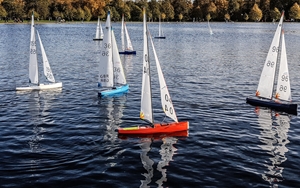
At first glance, you might be confused. The water of the Round Pond in London’s Kensington Gardens is crowded with sailing boats that are little bigger than the swans sailing amongst them. No, it is not your eyesight failing, but you are watching miniature sailing boats that are guided from the shore by ageing men holding remote control radio transmitters. And, it is likely to be a Sunday that you are seeing this.

The boats belong to the London Model Yacht Club (‘LMYC’), which was established in 1876 and renamed in 1884. It is the oldest model yacht club in the UK. Its ‘ancestry’ and full history may be read HERE.  It seems that the Round Pond began to be used for its activities from by the late 1880s. 

Sunday meetings begin at 10.30 am, and there are frequent racing events, which the members take very seriously. For those who know about boats, currently the Club favours: “Radio Controlled 10-Raters, International OneMetres, DragonFlite95s, and Vintage Model Yachts“.  

Whether or not you are a fan of boating (model or full-size), it is well worth seeing this example of English originality in Kensington Gardens one Sunday morning. I often wonder what, if anything, the swans make of this peculiar activity.