Unknown's avatar

About yamey

Active author and retired dentist. You can discover my books by visiting my website www.adamyamey.co.uk .

Eye wash in Sarajevo

In the late 1970s and throughout the 1980s, I used to visit the former Yugoslavia, where I had and still have many friends. Often, I stayed in Sarajevo (now in the Republic of Bosnia and Hercegovina), with Marija and her family. Here is something that happened on one of my visits. The account comes from my book about Yugoslavia, “SCRABBLE WITH SLIVOVITZ”.

Cross eyed_500

Marija, my host in Sarajevo, lived alone in her flat. Her husband, although an ardent communist, had fallen foul of Tito’s regime. Since the late 1940s, he had spent most of his life in prison. Many years after my last visit to Sarajevo, Liljana told me that her father used to be released from jail occasionally for short periods only to be re-arrested and re-incarcerated soon after. I was not clear about what he had done to deserve this. He must have been the ‘wrong kind’ of communist. Maybe, he had been a Stalinist and/or a supporter of Cominform. This organisation’s headquarters were in Belgrade from 1947 until 1948, the year when Yugoslavia’s relationship with Stalin’s Soviet Union began to go sour and the country was expelled from Cominform. It is possible that it was Stalin’s militant antagonism to Yugoslavia in the late 1940s that helped Tito to unify his ethnically diverse population.

During one of my visits Sarajevo, I noticed that the white part of one of my eyes had become completely red. It was a little uncomfortable as well. I hoped that no one would notice it; I wanted to avoid any fuss. So, I set off one morning to find a pharmacy, hoping to buy an eyewash, something like the British product ‘Optrex’.

As there was no way that I could possibly have explained what I wanted using my rudimentary knowledge of Serbo-Croatian, I decided that I would have to try to act out what I wanted. I wandered along the chilly snow covered streets, puzzling over how to do this. In the end, I felt too shy to try to attempt the necessary charade. I hoped that with the passage of time my eye would heal.

When I returned to Marija’s flat that evening, she immediately noticed my eye. In French, and sounding worried, she said that I might have caught something that sounded to me like ‘retinit’, a disorder about which I knew nothing. She succeeded in alarming me greatly by saying that there was an epidemic of whatever this was in Sarajevo, and that many people were being blinded by it. Next morning, she told me, she would take me to see a friend of hers, an ophthalmic specialist, at the university hospital. This also worried me. I remembered the depressing looking hospital that I had seen many years earlier when I was visiting Peć in Kosovo. My enduring image of that place was of its pyjama-clad inmates leaning out of upper-floor windows and hauling baskets of food up on ropes from their relatives, who were waiting outside the building on the ground below. The hospital in Sarajevo was nothinglike that.

I was introduced to the lady ophthalmologist, who then seated me in a special high-backed chair. A white-coated nurse approached me, carrying a syringe fitted with a long, broad-gauge needle. I must have winced in anticipation because Marija said,
Ne t’inquiétes pas. C’est seulement une piqûre.” (Don’t worry. It’s only an injection)
An injection … in my eye: I did not like the thought of that. She
laughed again, and said,
Regardez, le dentiste a peur d’avoir une piqûre!” (See, the dentist is afraid of having an injection)

Eventually, the nurse managed to squirt some liquid onto the surface of my eye, rather than into its interior, as I had feared was going to happen. The ophthalmologist examined it with her special equipment. It turned out, to my great relief, that I had an attack of conjunctivitis, which could be easily cured with the eye-drops that she gave me. After the clinical examination, we retired into her office. She rang for an assistant, who returned with cups of Turkish coffee and a dish filled with little cubes of lokum (Turkish delight).


I have lost touch with Marija and her family. All I know is that her daughter and son-in-law along with their child emigrated to the Seychelles shortly before Yugoslavia erupted into a self-destructing civil war.

Watching

It gives me great pleasure and sense of wellbeing watching the ducks, moorhens, geese, swans, seagulls, and other fowl, swimming in or sitting close to the water bodies on London’s parks.

Sometimes, I have spotted rarer birds such as herons, cormorants, and pelicans (in St James Park). Golders Hill Park in northwest London used to have flamingos. I do not know if they are still there.

I often wonder what the birds think about the humans, who come to visit them, that is if they think at all. Are we good company for them or simply an occasional source of welcome food waste?

It does not matter to me whether or not they think, so long as they are there to give us all a pleasurable experience and that they are enjoying life in an avian kind of way.

A walk in Greece

LEAR TEMPE BLOG

The River Pineios, which drains into the Aegean Sea near Stomio, runs along a ten kilometre, often very narrow, at times almost a thin cleft, the Vale of Tempe in Central Greece. Ancient legend has it that the valley was cut through the rocks by Poseidon’s trident. The Vale was believed to be the haunt of Apollo and The Muses. Other mythical characters are said to have visited in this valley. Whatever the truth of all these, the mythological associations and beauty of the Vale attracted the attention of the writer/artist Edward Lear (1812-1888), who was touring what is now Greece in May 1849. He was very keen to visit it.

In 1851, Lear published an illustrated account of his travels in the Western Balkans, “Journals of a Landscape Painter in Albania”. Although most know Lear best as a composer of verse, much of it humorous, he regarded himself as a painter primarily. He was without doubt a good painter and sketcher, but this is not what gave him lasting fame. The title of his book included the word ‘Albania’. This is appropriate because much of his travelling in the Balkans was done in what is now Albania and parts of central Greece that used to be important centres of Albanian people during the existence of the Ottoman Empire. Lear’s book on Albania is one of the loveliest books ever written about the country.

After seeing the spectacularly located monasteries at Meteora (close to the River Pineios), Lear wrote on 16th May 1849:

I had been more than half inclined to turn back after having seen the Meteora convents, but improvements in the weather, the inducement of beholding Olympus and Tempe … prevailed to lead me forward.”

On the 18th of May Lear recorded:

“…I set off with Andrea, two horses and a knapsack, and a steeple-hatted Dervish, at whose convent in Baba, at the entrance to the Pass of Tempe, my night’s abode is to be.”

Baba is described in the Seventh Edition of “Handbook for Travellers in Greece” (published by John Murray in 1901) as:

A pretty Turkish village. On the opposite side of the river stands the ruined fort of Gonnos, which commanded the entrance to the defile.”

The village of Gonnoi close to the southern end of the Vale is, I imagine, named after this fort. The long out-of-date guidebook pointed out that in Greek ‘tempe’ means ‘cutting’ or ‘chasm’.

On the next day, Lear noted:

The early morning at Baba is more delightful than can be told. All around is a deep shadow, and the murmuring of doves, the whistling of bee-eaters and the hum of the bees fills this tranquil place.”

After visiting the village of Ampelakia near the southern entrance to Tempe, Lear moved towards his goal, the Vale. He wrote:

“…I went onward into Tempe, and soon entered the celebrated ‘vale’ – of all places in Greece that which I had most desired to see. But it is not a ‘vale’, it is a narrow pass – and although extremely beautiful, on account of the precipitous rocks on each side, the Peneus flowing deep in the midst, between the richest overhanging plane woods, still its character is distinctly that of a ravine or gorge.”

After much wonderful descriptive writing, Lear concluded:

Well might the ancients extol this grand defile, where landscape is so completely different from that of any part of Thessaly, and awakes the most vivid feelings of awe and delight, from its associations with the legendary history and religious rites of Greece.”

Lear continued:

As it was my intention to pursue the route towards Platamona…”

‘Platamona’, or Platamon, to which Lear referred is a small seaside town on the coast of the Aegean Sea. It is overlooked by Mount Olympus and within sight of the mountains Pella and Ossa. It is some miles south of Katerini.  It played an important role in my life.

Every summer, my PhD supervisor Robert Harkness (died 2006) and his wife Margaret (died 2003) drove their caravan across Europe to Platamon, where they camped for about eight weeks on rough ground near the sea. I travelled out from England to Platamon with them on one occasion and did the return journey on another. Travelling via France, Germany, Austria, and the former Yugoslavia, the journey took almost ten days. During one of my visits to Platamon, in 1977, I mentioned that I was keen to follow in Edward Lear’s footsteps by visiting the Vale of Tempe. Robert and Margaret were keen that I should do this.

The modern road along which we drove, the Athens-Thessaloniki National Highway, ran high above the gorge along one of its edges. From this road, there was little if anything that could be seen of the Vale. Looking at today’s maps, it is evident that that road still exists, but a newer highway travels in a straighter route in a long tunnel, marked on the map as “Platamon Tunnel”. The latter only opened in 2017. It shortens the journey from Thessaloniki to Athens by several hours.

Robert and Margaret drove me to a spot near the southern end of the Vale and left me there, planning to meet me again when I reached the northern end of the gorge. I had no idea where exactly the Vale began and if there was a footpath in it that I could walk along. I began walking up through a sloping field to two men who were sitting there looking after their goats.

My Modern Greek was limited to a very rudimentary vocabulary. Using sign language, pointing at my feet, and mentioning the name ‘Tempe’, I managed to convey to these gentlemen my question about how to walk through the Vale. They pointed to a railway embankment high above where we were. I understood, or at least believed I did, that one had to walk along the railway track to see the Vale.

I climbed up to the embankment and began walking on a narrow gravelly path next to the railway track. Soon, a long passenger train with carriages belonging to various different European national railways passed me quite slowly. I could see from signs attached next to the doors of the carriages that this train was an express that connected Athens with Munich.  I continued walking in the direction of the Vale. The track was on an incline and the further I walked, the higher the embankment was above the terrain below it.

Eventually, the track entered a curved cutting lined on each side with jagged rocks. Suddenly, I heard something behind me. I forced myself against the rocky wall of the cutting just in time to avoid being crushed by a diesel locomotive travelling at a high speed. The engine sped past and I continued walking, somewhat nervously.

The track emerged from the cutting and traversed a high sided embankment at the far end of which there was the entrance to a dark tunnel. Seeing that ahead, I decided that it would be dangerously foolish to proceed any further along the track, the main railway line connecting Athens with the rest of Europe.

I stood on the embankment and looked around. To my right, I could see the River Pineios far below in what looked like an attractive narrow valley. I decided that as I was not prepared to risk my life in a dark tunnel, I needed to get off the railway track. So, with some trepidation I sat down and slid down the steep embankment until I reached its base far below.

At the bottom of the embankment, far below the railway line, I found myself on a level footpath that ran along an embankment that led down to the river. It became clear to me that this path was once the foundation for an old railway that had been replaced by the one which I had just left. As I walked along, I realised that this old railway bed was what the two gentlemen had meant by walking along the railway track.  The path wound its way through the depths of the Vale following the course of the river. The scenery down in the valley did not disappoint. It could not have differed much from what it was like when Edward Lear walked along the Vale 129 years earlier.

After a while, I reached what must have once been a railway station. I had arrived at the old railway station of Aghios (Saint) Paraskevi. This was part of a group ecclesiastical buildings. A suspension bridge for pedestrians ran from near it across the river to the other shore. Away from the river, there were some picturesque pools. The whole area was luxuriant with many trees, some with branches hanging over the stream.

The religious compound was not present when Lear walked the Vale. The old railway was built in 1910 as was the present church of Aghios Paraskevi (that stands on the site of a 13th century church). The bridge that I crossed was constructed in the 1960s. Before that, pilgrims could only reach the church by boat (see: https://www.johnsanidopoulos.com/2012/07/st-paraskevi-in-valley-of-tempe.html).

About two kilometres further on, the Vale reached its northern end. I found Robert and Margaret sitting in their Land Rover in a car park, enjoying hot tea from a thermos flask. I cannot remember whether I told them about my lucky escape whilst walking along the railway in the rocky cutting, but if I did not, which is likely because I would not wanted them to have been worried, now it is far too late. My two dear friends are now no more than fond memories, and the Pineios still flows through the Vale of Tempe.

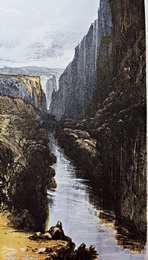
Illustration is one of Lear’s pictures of the Vale of Tempe in 1848

 

Something I am missing

BOOKS

During this time of avoiding other people for very good health reasons, many of the pleasures of normal life have become temporarily unavailable. Theatres, museums, pubs, restaurants, and  travel (foreign or local), are things we will only be able to enjoy again in some distant future.

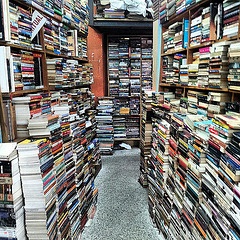
Even though I am surrounded by, nay drowning in, more than enough unread books for several long lifetimes, I miss browsing in the local second-hand bookshops. I do not actually need to buy another book, but I know I will be purchasing many more, most of which might never be read for many years to come. 

I have an urge to browse regularly in bookshops. It does not matter if I come out of a shop empty-handed, because running my eyes along the shelf gives me an enormous amount of satisfaction. Yes, I need my regular fix of bookshelf browsing. Let it not be long before I can resume this enjoyable activity.

Impatience

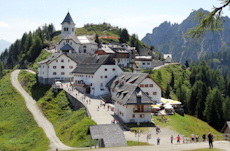
Several decades ago long before mobile telephones existed, I was staying with friends in #Friuli Venezia Giulia, the most north eastern province of Italy. They suggested that I made an excursion to a mountain in the area, The peak of Monte Santo di #Lussari is 1790 metres above sea level and about 900 metres above the village of Valbruna. My friends left meat a cable car station near Valbruna (according to Google Maps, this cable car station no longer functions).

There was a long queue of people waiting to get a ride up the mountain using the cable car. I took one look at the line of people and decided I was not going to wait. Armed with my detailed walking map, I decided to climb up to the summit under my own steam.

It soon became obvious to me that my map reading skills were non-existent. I could not match what I saw around me with what was printed on my very detailed map. So, I decided that the best thing to do was to scramble upwards as best I could manage. As I could not find a path, I just crawled up the steep slopes gripping onto roots and branches and any other anchored vegetation that I could find. It was hard work!

After a while, I left the vegetation and entered a sparsely vegetated area of gravelly slopes. I looked up and discovered that high above me the carriages of the cable car were gliding along their cables. Anyone looking down might have spotted me, but from that height I would have seemed as small as an ant. The cable cars traversed the open slopes up which I was crawling on all fours. The cable car station high above me was one of a group of picturesque buildings at the summit of the mountain. If a casual observer had looked down from the terrace at the upper cable car station, he or she might have wondered if I had jumped from or fallen out of one of the aerial conveyances.

Finally, after at least two hours struggle, I reached the small village at the summit of the mountain. My hosts had recommended that I sample the special mountain tea at one of the inns on the summit. This proved to be a good suggestion. The hot herbal concoction tasted good and left me feeling light-headed. Most likely, it contained alcohol.

I set off to walk along the ridge towards another cable car station that would have brought me down to Camporosso, a village just north of Valbruna. The terrain was more or less level and pleasantly wooded. The mountain tea put me in a good mood. I felt as if I was a sylvan character in some idyllic film set in the mountains like “Heidi” or “The sound of Music”

I reached the distant cable car station, where I was hoping to make my descent more easily and comfortably than my arduous ascent. To my great disappointment and annoyance, the cable car was out of service. It was used only in busy periods, but I had arrived at a very slack time. What was I to do? It was getting late and it was a long way back to the other cable car station, which might well have been closed for the day. I looked down the steep slope and saw Camporosso laid out like far below, looking from my elevated position like a map rather than a village.

There was nothing else I could do but attempt to lower myself down the mountain slope where there were no footpaths to be seen. My mountaineering skills were non-existent. I descended by sitting down and sliding down hill towards the nearest tree below me. After this arrested my descent, I repeated the operation and slid to the next tree below me. By this means, I reached the bottom of the mountain slope and the road that ran from Camporosso to Valbruna. I am amazed that the series of slides did not cause any holes to form in my trousers.

When I reached my friend’s home, they were very worried about my prolonged absence, and were about to alert the local mountain rescue service. I hate to admit it but my impatience seeing the queue at the first (and functioning) cable car station might have led to a less satisfactory conclusion to my day out at Monte Santo di Lussari.

[Picture source: Wikimedia Commons]

A city divided

GORIZIA 90 onion domes

In August 1990 before the downfall of Yugoslavia, I made one of my many visits to Italy. On this particular visit, I stayed with  Italian friends, who lived in Tolmezzo in the north-east corner of Italy close to its borders with Austria and Slovenia, which in those far off days was part of Yugoslavia.

There was a town near to Tolmezzo that had interested me for a long time because the border between Italy and Yugoslavia ran through it dividing it into the Italian town of Gorizia and the Yugoslav town of Nova Gorica. Prior to the end of WW2, the place was entirely in Italy because Italy included a large part of what was to become the Yugoslav republic of Slovenia. I was curious to see this divided town.

I drove into central Gorizia and discovered a typical small north-eastern Italian city – attractive, but unexceptional. I wandered amongst the city’s back streets trying to see where they ended and then became part of Yugoslavia. My quest was disappointing because the border ran through eastern suburban districts of Gorizia, beyond which there was open countryside.

After looking at the Italian part of the city, I drove south of it to the nearest border crossing, which was located in the middle of open country away from Gorizia. I parked my car and strolled up to the Italian border post, who showed no interest in me or my passport. 

I walked across a short stretch of no-mans-land to the Yugoslav checkpoint, where my passport was stamped and I was waved on. I had arrived in the middle of nowhere, it seemed. I spotted a bus stop and asked people waiting there if the bus would take me to Nova Gorica. I was told it would.

When the local bus arrived, I was able to buy a ticket with money I had kept after previous holidays in Yugoslavia. 

We drove what seemed like a long way through the country side, eventually arriving in the aesthetically unexceptional centre of Nova Gorica. Unlike attractive Gorizia, which was established many centuries ago, the relatively unnattractive Nova Gorica was established as a new town in 1947 after the Paris Peace Treaty left the important market town of Gorizia outside the border of Yugoslavia. The new town had been built a little away from the border, which is why I did not find any streets in Gorizia that ran into Nova Gorica. It was not like Berlin, where the Wall sliced through pre-existing streets, bringing them to a sudden dead end. 

I disembarked, found a coin-operated telephone box and made a quick call to one of my many good friends in far-off Belgrade. Then, with some of my remaining Yugoslav money, I purchased a box of the superb cherry brandy chocolates called ‘Griotte’, which used to be made in Croatia by the Kraš confectionery company, and are still made today. I wanted to give them to my hosts in Tolmezzo.

I returned to the bus stop and travelled back to the Yugoslav  border post. Both the Yugoslav and the Italian border officials waved me and my box of chocolates from one country to the next without any problems.

Thinking back on this brief international journey lasting no more than two hours, I realise that it was the very last time that I visited Yugoslavia. I had visited Serbia (and other parts of Yugoslavia) earlier in 1990, which is why I still had some Yugoslav Dinars. Since then, I have made one trip to Slovenia, several years after the break up of the Yugoslav Federation.


Picture shows central Gorizia (Italy)


Hair cut in Italy

Sometime in the 1980s, I was visiting Italy in order to see my sister who lives in the Emilia Romagna region. I landed at Milan and rented a car.

HAIR BLOG

The SEAT vehicle which I hired was tiny and very basic and seemed to lack many items that can be found in other low-cost cars. However, I benefitted from it because it did not consume fuel at a high rate. This was lucky because in those days fuel was extremely expensive in Italy as compared with other countries in Europe. In those days, the petrol price in the UK had just exceeded £1 per GALLON (4.5 litres). In Italy, at the same time, petrol was available at about 1600 Lire per LITRE, and the exchange rate was about 1570 Lire to the Pound Sterling. Nevertheless, I ‘beetled’ around Italy visiting various friends in different places. 

Driving practices in Italy differed from those in the UK. One day, I gave a lift to some Italian friends. At each village or small settlement on the Strada Statale (main road, not a motorway or highway) there were traffic signals at intersections. At one of these, I began to slow down because I could see that the signal was about to turn red. My friends said:

“What are you doing? Why are you slowing down?”

“The signal is turning red,” I replied.

“Don’t be silly, speed up. Don’t let the signal hold us up!”

I cannot remember what I did, but I have lived to tell the tale.

A day or so before I was due to meet my sister, I decided that I ought to have a haircut in order to look presentable. I stopped in a village, where I had spotted a barber shop as I was driving past.

I entered to smart looking salon, and sat amongst three or four other gentlemen awaiting the caring hands of the barber.Eventually, I was invited onto the barber’s throne. I explained what I wanted as best I could with my very rudimentary Italian. However, the barber, a true experienced professional, knew what was needed. 

He began rummaging around in the mop of hair on my head, and then suddenly stepped back as if he had been confronted by a deadly poisonous snake. He raised his hands high above his head, and shouted:

“Forfora”

The other men in the salon shrank back, one or two of them hiding their heads under the newspapers that they were reading. I sat, amazed and wondering about the meaning of ‘forfora’ and why it had caused such alarm.

Then it dawned on me. The barber had discovered dandruff in my hair. He explained something to me that I worked out meant that he needed to apply a special treatment to my hair.  I told him to go ahead. He rubbed some oily liquid into my hair. After a moment, I felt a strong burning sensation. It felt as if something was burrowing down the roots of my hair and into my scalp. As it worked, I thought that whatever had been applied felt as if it was strng enough to kill anything. I just prayed that my hair would not fall as a result of this terrific chemical onslaught.

After a short time, my head began to feel normal, and the barber carried out my haircut. I do not remember how much my cut cost, but I do remember having to pay an extra 5000 Lire for the special treatment.

I doubt that I will ever forget the Italian word for ‘dandruff’, but how often I will make use of this knowledge is questionable.


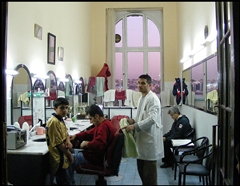
Photo: a hairdresser in Istanbul

Gandhi and the plague

GANDHI BLOG

IN THE CURRENT CORONAVIRUS OUTBREAK, infection is spread from person to person in close contact with one another. Isolation and quarantine are likely to be effective in eventually reducing the rate of infection.

At the end of the 19th century and beginning of the 20th, another deadly pandemic, the bubonic plague, spread around the world. It was then believed that separating people from each other was likely to help arrest the plague. It was not because bubonic plague is rarely contagious, but usually transmitted by a vector.

While researching the life of my great grandfather, Franz Ginsberg, sometime Mayor of King Williams Town and later a South African Senator, I needed to explore the history of bubonic plague in South Africa. While doing so, I discovered that the young Indian lawyer, Mahatma Gandhi, also entered the story. The following is extracted from my article that was published in a South African medical journal back in 2008:

INVISIBLE INVADERS

When the Boer forces, provoked by the British, started invading the Cape Colony in 1899, another invasion, covert in nature, was also beginning to threaten the area. The hidden enemy, a bacterium, lives in the blood of fleas and the rats (and other rodents) whose blood they ingest. These fleas are also partial to feeding off the blood of humans. When an infected flea feeds off the blood of a susceptible human, that person runs the risk of developing an often fatal illness known as ‘bubonic plague’. When my great-grandfather Councillor Franz Ginsberg (1862-1933) was serving on the Borough Council of King William’s Town in 1899, little was known about the transmission of the plague, even in the scientific world, except that its causativeagent was the bacterium Yersinia pestis (Y.pestis). This ‘bug’ is named after one of its discoverers Alexandre Yersin (1863-1943).

PESTILENT FLEAS

Today, much is known about the mechanism of transmission of Y. pestis. Bubonic plague is an example of a zoonosis: a disease that normally exists in other animals, but also infects humans. The danger to humans is that the bacterium is carried in the blood of certain kinds of rat, and that these rats often live in close proximity to humans. The rats serve as a mobile reservoir for this pest, but they are susceptible to its ill-effects. When a flea bites an infected rat, it ingests the blood of the rat and some of the bacteria living in it and the bacteria multiply within the flea’s digestive tract, causing considerable harm to the flea itself. If this same flea should bite a human, the human victim will receive some of the bacteria from the flea because the flea, while feeding, regurgitates some of its Yersinia-infected stomach contents into its human victim, who may then begin to exhibit the symptoms of bubonic plague. The plague can produce numbers of victims in epidemic or pandemic proportions. The Black Death, also known as ‘The Second Pandemic’, killed between one third and one half of the population of Europe and Asia between 1347 and 1351. It is thought by some to have been a pandemic of (bacterial) bubonic plague but others feel that it was a viral infection. The ‘Third Pandemic’ began in China’s Yunnan Province in 1855, and is known to have been caused by Y.pestis. Its dissemination around the world in the decades that followed was facilitated by global shipping. Rats and their fleas were frequent stowaways on ships, and as infected rats moved from port to port so did the bubonic plague.

AN UNWELCOME IMPORT

In September 1896, the bubonic plague reached India (most probably from Hong Kong) and had claimed its first of many victims in the port of Bombay. News of the plague spread faster that the plague itself. In 1896, the Natal Medical Council discussed the bubonic plague – by then well-established in India – and its relevance to Natal. The Council decided that the whole of India should be regarded as an infected area, and that all ships entering the ports on the coast of Natal should be quarantined.

In January 1897, an anti-Indian demonstration was held in Durban to protest against the landing of ‘asiatics’ on board two Indian-owned ships which arrived there in mid-December 1896. The ships had been held in quarantine for 25 days. A group of Indians in Durban, including Mohanlal K Gandhi (later to be known as ‘Mahatma Gandhi’) who had just arrived in Durban on one of these two ships, the ‘Courland’, sent a long ‘memorial’ protesting against this to the Secretary of State for the Colonies in London. Its authors shrewdly noted:

‘…that the quarantine was more a political move against the Indians than a safeguard against the introduction of the bubonic plague into the Colony’,

and they provided evidence that the measures taken to effect quarantine were done ineffectively and too late to have been of any practical use. Despite measures such as these, bubonic plague reached South Africa sometime between 1899 and 1901.

The Natal medical community had some grounds for its fears that the plague might arrive from India. At a meeting of the Borough Council of King William’s Town in February 1899,13 it was announced that the bubonic plague had arrived in Port Louis on the island of Mauritius (a place that ships sailing from India to South Africa may have visited occasionally), and the Council had received a letter from the Town Office of Port Elizabeth, asking for the support of King William’s Town in their request for the government to enforce quarantine regulations (the Transvaal and Orange Free State prohibited entry to Indians in early 1899).

My great-grandfather, Franz Ginsberg, moved that the Council of his town should cooperate with that of Port Elizabeth. Although fear of importing the dreaded plague was the cause of an anti-Indian demonstration in this port as early as about 1897, the disease only began to occur in the town in April 1901 –soon after its arrival in grand style in Cape Town in March 1900 (having possibly arrived on board a ship from plague infested Rosario in Argentina). As early as November 1900, a doctor in King William’s Town reported eight cases of bubonic plague amongst Africans, three of these leading to death. By early 1901, the inhabitants of King William’s Town had good reason to worry about the plague.