Threatened by Heathrow Airport

THE PARISH CHURCH of Harmondsworth is about 1.7 miles northwest of Heathrow Airport’s Terminal 1, yet it feels as if it were much further from it, maybe in the heart of the countryside. What was once a small village in rural Middlesex has now been engulfed by London’s westward spread. However, the old village green retains a certain rustic charm.

The name of the place derives from the name of a person, ‘Hermode’ or ‘Harmond’ and the Anglo-Saxon word ‘worth’ meaning a farm or enclosure. Set in what was once fertile farmland that provided corn and green crops for the London markets, it is now a mainly residential area. Writing in 1876 in his “Handbook to the Environs of London”, James Thorne remarked:

“The village of Harmondsworth is small and not remarkable …”

Writing 146 years later, I must disagree. The place is remarkable for retaining some of its rural atmosphere. The village green is surrounded by a row of picturesque old cottages, a slightly newer-looking village store (Gable Stores), and two pubs (The Crown and The Five Bells [formerly ‘The Sun’]), and the entrance to the churchyard of the parish church of St Mary.

The vicar of St Mary kindly unlocked the church for us. According to a history of the church by Douglas M Rust, it is probably located near the site of a pagan place of worship on one of the quintarial lines defined by Roman surveyors’ landmarks. The archaeologist Montagu Sharpe, writing in volume 33 of the “English Historical Review”, published in 1918, observed:

“Two curious discoveries came to light after the quintarial cross-lines had been drawn, making each pagus appear like a gigantic chequer-board. The first was, that 47 out of 56 mother churches of parishes in Middlesex were situated upon one or other of these lines, the apparent explanation being that Romano-British chapels (compita) adjoined the principal rural ways, which were designed to follow the quintarial lines. In the next age these little edifices were adopted by missionaries for Christian worship, following the astute and well-known direction of Pope Gregory to utilize the pagan sacra where the people had been accustomed to assemble. If so, then such sites have been associated with public worship, first pagan, then Christian, for nearly 2,000 years.”

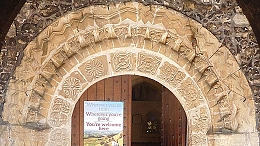
Be that as it may, the present parish church in Harmondsworth was constructed from the 12th century onwards, much of it before the 16th century. In the 18th century, a cupola was added to the bell tower. In the following century, repairs and restoration was undertaken. The south entrance has a decorated carved stone Norman archway. The carved capitals of the pillars on the south side of the nave are 12th century. The westernmost pillars on the north side of the nave are 13th century, whereas the four pillars to the east of these are 16th century. The chancel, which is supported by the newer pillars was constructed later than the nave. Where the newer part was joined to the older, there is a discontinuity in the stonework of the arch that joins the nave to the chancel: the two halves of the arch do not match each other. The pointed arches along the north side of the nave are Perpendicular gothic in style, whereas those north of the chancel are a Tudor design.

The tower of the flint covered church used to be the tallest building in Harmondsworth until the control tower at nearby Heathrow Airport was constructed, Douglas Dark mentioned of the church:

“Little did the early builders realise that their church was later to become the parish church of the manor where many visitors to Britain first arrive.”

A few yards northwest of the church, there is another treat awaiting visitors to Harmondsworth. This is the Harmondsworth Barn, which was constructed 1425-27 on land bought in 1391 by William of Wykeham (c 1320-1404), Bishop of Winchester, to endow Winchester College. It is now maintained by English Heritage, from whose website I gleaned the following information:

“Used mainly to store cereal crops before threshing, it remained in agricultural use until the 1970s. At 58 metres (192 ft) long and 11.4 metres (37 ft 6 in) wide, the barn is one of the largest ever known to have been built in the British Isles, and the largest intact medieval timber-framed barn in England.”

The barn’s main purpose was to store locally grown cereals (e.g., wheat, barley, and oats) and was still in use during the 1970s. Its interior is a fine example of well-preserved mediaeval carpentry. The barn is located on the eastern edge of what was once Manor Farm, through which a stream of the River Colne flowed. The erstwhile farm covered the probable site of a long-since demolished Benedictine Priory.

James Thorne noted that the barn had once been ‘L’ shaped, rather than rectangular as it is today. The part of it that had made it shaped like an ‘L’ was taken away and relocated elsewhere. To quote Thorne:

“This wing was taken down about the same time as the Manor House and rebuilt at Heath Row, 1 ½ miles S.E. of Harmondsworth church. This, which is known as the Tithe Barn, exactly resembles the Manor Barn in structure, except the walls are of brick…”

Well, ‘Heath Row’ is now ‘Heathrow’ and this fragment removed from the barn at Harmondsworth no longer exists. I located it on a map surveyed in 1862. It then stood on a road or lane that ran south from the Bath Road to Perry Oaks Farm on the western edge of Heathrow village. This land is now covered by the airport terminals (1,2, and 3).

Harmondsworth village has a few other old buildings apart from those already mentioned. One of them is Harmondsworth Hall, which Wendy Tibbits described in her blog (www.wendytibbitts.info) as follows:

“This grand-sounding building was built in the early 1700s, but still has elements of a fire-damaged Tudor building which was on this site. The central chimney and a fireplace are remnants of the former hous. … In 1910 this house was the first house in Harmondsworth to have its own electricity supply.”

Both Ms Tibbits and the vicar of the parish church fear for the future of Harmondsworth should plans to extend Heathrow Airport are carried out. Most of the old village will be demolished, leaving the church and the barn. Ms Tibbits noted:

“If the London Airport Expansion plans go ahead eleven listed buildings in Longford, and twelve in Harmondsworth will be demolished, along with hundreds of other homes. Only Harmondsworth medieval Great Barn and its Norman church will survive the destruction, but who will want to visit them when they will be meters from the airport’s perimeter fence?”

Although extending the airport might benefit the country, it would be sad to lose yet more of Britain’s heritage.

A perfect pub

IT MIGHT BE OBVIOUS to many that the village pub is, along with the local parish church, often the social hub of small settlements all over England. Since the outbreak of the covid19 pandemic, we have not made our usual annual long trip to India. Instead, when public health regulations have permitted, we have been taking the opportunity better our knowledge of the country where we live, England, by making frequent trips to different parts of the land. On all these excursions, we have stopped for food and drink at pubs in many small places. Some of these pubs have become more like restaurants than traditional village social centres, but many still act as communal living rooms where local people gather to drink and chat together.

Inside the Pig and Abbot

In Cavendish, a small village in Suffolk, there are two pubs. One is more of a restaurant than a traditional pub. By the way, it serves very excellent food. The other pub serves no food except packets of potato crisps. When we visited it, we were told that it only offers drinks. This pub was full of locals talking to each other quite animatedly. One, whom we overheard, claimed to be having a fantastic sexual relationship with a French lesbian, in whose house he had done some plumbing work.

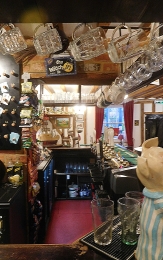
One pub, which we have visited more than half a dozen times since early 2020, is in south Cambridgeshire. The Pig and Abbot at Abingdon Piggots, a village with about 60 households not far from Royston, successfully combines being a meeting place for locals with being a place where very well prepared, tasty food may be enjoyed, either in a small restaurant area or at tables near the centrally located bar.

The current owners, Mick and Pat, have owned the pub for almost 20 years. Pat is a superb cook and warm hostess, and Mick is a knowledgeable and charming host. He told us that the early 18th century building in which his pub is located used to be the local dower house, in which the wife of the lord of the manor lived after she was widowed. Back in those days, women usually outlived their husbands. The dower house was far from being a peaceful retirement home for widows of lords of the manor. It was a hive of activity. It was in the dower house at Abingdon Piggots that bread was baked, and other food prepared, not only for the manor house, but also for all the local families that worked for the lord of the manor. The manor, which had been in the Piggott family, many of whom have memorials in the local church, ended up in the hands of the De Courcy-Ireland family. In the early 20th century, a descendant of the Piggott family, who had inherited the manor married the Reverend Magens De Courcy-Ireland (died 1955). Mick told us that the dower house became a pub during the second half of the 19th century.

While we were enjoying a superb lunch during a recent visit to the Pig and Abbot, we asked Nick how many of the local villagers used the pub regularly. He told us that of the 60 households, 10 were regulars. We wondered whether we were amongst his customers who lived furthest away from the village. He said that we are, but his furthest customer, a former resident in the village, a biologist, now lives in Fairbanks, Alaska. However, whenever he is in England, he makes a point of visiting the Pig and Abbot. Despite this outlier and us, most of the regulars do not come from afar, and I noticed that Nick seems to know most of his customers by their first names.

Of the many pubs that we have visited during our extensive roaming around the English countryside, the Pig and Abbot has become our favourite. From its warm welcoming staff, to its great food and drink, to its range of well-chosen decorations, and to its lovely wood burning fireplaces, it ticks all the boxes, making it a perfect pub. Visiting the Pig and Abbot gives one a wonderful idea of what has made the English country pub such a successful institution over many centuries.

Only the name is the same

AFTER A SUNNY DAY spent at Whitby in North Yorkshire, we stopped for a drink at sundown in a small pub for a pre-prandial alcoholic beverage. Behind and slightly above the pub, we could see a well-maintained 12th century parish church with later modifications and a square tower. Below the pub, a narrow stream, lined with bushes and trees, ran alongside the main road. Apart from the infrequent passing car, the place was silent except for some pleasant birdsong. From where we sat on the terrace of the hostelry, we could see a small, sloping village square with a simple war memorial, some parked cars, and a small post box. At first, I did not realise where we had stopped. Then, I noticed that the village is called Kilburn.

Kilburn, North Yorkshire

There is another Kilburn about 215 miles south of the lovely village where we stopped for an evening drink. The latter is in North Yorkshire and the place with the same name many miles south of it is in north London. Apart from sharing the same name, London’s Kilburn is anything but rustic and peaceful, as many Londoners will know. London’s Kilburn is not really picturesque in conventional people’s eyes; it might appeal to lovers of urban sprawl.  It is a crowded metropolitan area with much commercial activity and a racial profile infinitely more diverse than that of the village in North Yorkshire.

I am not sure which of the two Kilburns is the oldest. North Yorkshire’s village was mentioned in the Domesday Book of 1086 and named ‘Chileburne’. London’s Kilburn was a settlement on an ancient Celtic route, a track between the places now known as St Albans and Canterbury. A priory was constructed on a stream that flowed through where London’s Kilburn now stands. The stream was known variously as ‘Cuneburna’, ‘Kelebourne’, and ‘Cyebourne’.

Whatever the origins of these two Kilburns, I know which of them is the place where I would prefer to linger in front of a glass of bitter.

At the end of the runway at Heathrow Airport

TODAY THE MAIN roads leading from London west, the A4 and the M4, run more or less parallel from Hammersmith west towards Slough and then beyond. Before these roads were modernised, or in the case of the M4 and, existed, the old road from London to Slough and points further west ran through the village of Colnbrook, and onwards to Bath. This was long before London’s Heathrow Airport came into existence. Today, the centre of Colnbrook, bypassed by both the A4 and the M4, lies 1.2 miles west of the western perimeter of the airport. Aeroplanes coming into land fly low over Colnbrook because they are within a minute or two of touching down on the runways. Despite being sandwiched between the airport and the ever-expanding town of Slough and having some new housing, Colnbrook retains many features of a rural English village.

With a bridge crossing the River Colne, a tributary of the Thames, Colnbrook was an important staging post on the coach road between London and the west. An old milestone near The Ostrich pub marks the halfway point between Hounslow (west London) and Maidenhead. A modern sign next to it informs that the toll-road through the village was known as the Colnbrook Turnpike. Writing in 1876, James Thorne noted that during the coaching era, Colnbrook:

“… retained something of its ancient noise and stir; it is now a dull, sleepy, roadside village of a long main street and 2 or 3 shabby offshoots, the many inns testifying to its old character.”

No doubt, the advent of the railways put pay to much of the traffic through the village. It is still rather sleepy if you disregard the ‘planes passing overhead every few minutes. But it is not shabby in my opinion. It has maintained a certain rustic charm and a few of its inns or pubs. Many other buildings in the place have tall archways that might well have led into coaching yards of former hostelries.

A well-restored brick and stone bridge crosses one of the streams of the River Colne. The stonework that lines the tops of the walls of the crossing have carved lettering that shows that the centre of the span was the boundary between Middlesex and Buckinghamshire and that the bridge was built in 1777. A large building with an archway that would have admitted stagecoaches at the eastern entrance to Colnbrook bears the name ‘White Hart House’. When Thorne was writing about the village in 1876, he noted that this was an inn:

“… a good house, with bowling green, and grounds, much in favour for trade dinners and pleasure parties…”

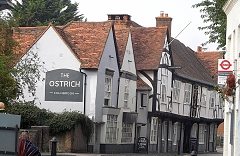
The George Inn, unlike the White Hart, is still in business. It is said that Princess Elizabeth, the future Queen Elizabeth I, might have spent a night there when being taken as a prisoner from Woodstock to Hampton Court in 1588. The pub was first established in the reign of Henry VIII. Its present façade is 18th century (www.sloughhistoryonline.org.uk). Other royal visitors to Colnbrook included the Black Prince with his prisoner King John of France, who were met here by King Edward III (reigned 1327-1377).   The half-timbered Ostrich Inn, almost opposite the George, is far older and has a less salubrious history. Its foundations were laid in 1106 but much of its present construction is 16th century. Its name, the Ostrich, might well be a corruption of an earlier name, ‘the Hospice’.

During the 17th century, the Ostrich had an extremely dodgy landlord called Jarman. The pub’s website (https://ostrichcolnbrook.co.uk/history.html) describes his activities well. Here are some extracts from it. Jarman:

“…with his wife made a very profitable sideline by murdering their guests after they had retired for the night.

They had a trap door built into the floor of one of their bedrooms and when a suitably rich candidate arrived Jarman would inform his wife that a fat pig was available if she wanted one! She would reply by asking her husband to put him in the sty for till the morrow. The bedstead was hinged and they would tip the sleeping victim into a vat of boiling liquid immediately below, thus killing him.”

All went well for the Jarmans until they chose a clothier from Reading, named Thomas Cole:

“After persuading him to make his will before he retired, Jarman killed Cole. Unfortunately Cole’s horse was found wandering the streets nearby and caused a search for his owner who had been last seen entering The Ostrich! His body was found some time later in a nearby brook and some say that this Cole-in-the-brook is how Colnbrook got its name. It’s a nice story but whether it is true or not, who’s to say!”

You might be interested to learn that the Ostrich still offers rooms for guests to stay overnight. We met four men, who had done so, sitting quite contentedly in the morning sun that was flooding into the pub’s pleasant courtyard. Despite the story of Thomas Cole, it is far mor likely that the village was originally called ‘Colebroc’ (in 1107) and later ‘Colebrok’ (by 1222).

We visited the parish church of St Thomas just as guest were arriving at a christening. We were given a warm welcome by a female cleric dressed in white with a colourful stole, which she told us that she was wearing at such a happy occasion. The church, a Victorian gothic edifice, was designed by an architect who specialised in Gothic Revival, Benjamin Ferrey (1810-1880). Built between 1849 and 1852, it has walls containing flints. A north aisle, designed by a great practitioner of the Gothic Revival style, George Edmund Street (1824-1881), was added to the church in 1862.

Streams of the River Colne run through parts of the village. In some places their banks are lined with old houses, some half-timbered. Colnbrook, over which millions of people have flown since Heathrow was opened as Great west Aerodrome in 1929 and then as a much larger establishment, now known as London Heathrow, since 1946, is visited by few except mainly locals. Bypassed by major roads and not on the railway, the village has a picturesqueness that rivals many much more frequented places deep in the English countryside. Yet, Colnbrook is a short bus ride from Slough’s railway station and about 40 to 50 minutes’ drive from Hyde Park Corner. Visit the place and be surprised by its charm.

A conspiracy at the crossroads

DUNCHURCH IN WARWICKSHIRE is located where the old road between Oxford and Leicester crosses that between London and Holyhead. This charming village was a place where, in its heyday, up to forty carriages a day stopped to change their horses for a fresh team. This was done at the various coaching inns in the village. One of these hostelries, which is still in business today, is The Dun Cow, where we ate a good English breakfast. Some of this inn’s previous guests included the engineer George Stephenson (1781-1848) and his son, another engineer, Robert (1803-1859), who dined at the hotel on the 23rd of December 1837. Their dinner was to celebrate the completion of the Kilsby Tunnel on the Birmingham to London Railway, a project supervised by Robert.

While we were wandering around the graveyard of Dunchurch’s St Peters Church, which dates back to the 12th century, we asked a gardener working there about where one of Dunchurch’s former famous characters had once stayed. He told us that he had no idea. Half-jokingly but with some earnestness, he added: “…we could do with another one like him.”

Guy Fawkes House in Dunchurch

The man about whom we were asking had associates, who were staying at the village’s former inn, The Lion Inn, in the early 17th century, the year 1605 to be exact. It was in early November of that year that those waiting at The Lion in Dunchurch were wondering about their colleague who was 79 miles away in London.

The fellows at The Lion were waiting to hear whether their co-conspirator Guy (Guido) Fawkes (1570-1606) had been successful in blowing up the House of Lords in London. He was not, and the conspirators waiting in Dunchurch were arrested. Had the plot to blow up Parliament and along with it the Protestant King James I succeeded, the men at The Lion were to have travelled to nearby Combe Abbey to seize Princess Elizabeth (1596-1662), who became Queen of Bohemia. As an informative website (www.ourwarwickshire.org.uk/content/article/rugby-school-science-teaching-around-1900-2) explains:

“In 1605 the monarch was James I; the Princess Elizabeth was his eldest daughter and sister to the future Charles I. In 1605 she was nine and being educated by Lord Harington at Coombe Abbey. She wasn’t a Catholic, but the conspirators planned to convert her and use her as their figurehead … Her main importance with regard to British history is that one of her grandsons (the son of her youngest daughter Sophia of Hanover) became King George I.”

The man about whom we were chatting with the gardener was neither of the Stephensons, who dined at The Dun Cow, nor the Duke of Wellington, who also stayed in the village, nor Lord John Douglas-Montagu-Scott (1809 – 1860), whose statue stands facing The Dun Cow. He was referring to Guy Fawkes, but this time a Guy Fawkes who completes the job before being arrested!

The former inn, a lovely half-timbered edifice is now a private house, named ‘Guy Fawkes House’, even though the famous man never lived there. The rest of the village contains several old thatched cottages, a thatched bus shelter, and the old village stocks. Close to the town of Rugby, this village is well worth a visit.

Lost and found … in Cornwall

MY COUSINS IN CORNWALL live not far from a place called Withiel. The mainline train from London to Penzance usually stops at a station called Lostwithiel. The latter is just over 7 miles southeast of Withiel as the crow flies. Yesterday, the 26th of July 2021, we decided to visit both Withiel and Lostwithiel. Despite its name, Lostwithiel on the River Fowey is much easier to access than Withiel, which is deep in the Cornish countryside.

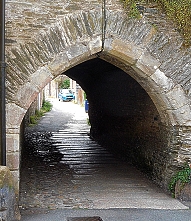
Mediaeval arch in Lostwithiel

The ‘lost’ in Lostwithiel has little if anything to do with being unable to be found. There is agreement that ‘lost’ is the Cornish word for ‘tail’. It is likely that Lostwithiel derived from the Cornish ‘Lost Gwydhyel’, meaning ‘tail end of woodland’. The village of Withiel is known as ‘Egloswydhyel’ in the Cornish language. This means ‘church in woodland’. Having found out that Lostwithiel is not actually lost nor ever has been, I will compare the two places.

Withiel, far smaller than Lostwithiel, is small village with a fine old church, St Clements and a few, about twenty at most, houses arranged around a rectangular open space. The parish church, which I have yet to enter, originated in the 13th century. It was rebuilt in granite in the 15th and 16th centuries and looks far too large for such a small village and its neighbouring communities including one called Withielgoose. The rebuilding was instigated by Thomas Vyvyan (late 1470s – 1533), the penultimate Prior of Bodmin before the Reformation. He was a Cornishman educated at Exeter College (Oxford), who was instituted in the rectory of Withiel in 1523,  and then at St Endellion Church in 1524.  Withielgoose, which is tiny place that includes the word ‘withiel’, has nothing to do with geese. The name derives from the Cornish words ‘gwyth’, meaning trees; ‘yel’, of unknown meaning; and ‘coes’, meaning ‘wood’.

Tiny Withiel has at least one interesting historical figure apart from Thomas Vyvyan, Sir Bevile Grenville (1594/95-1643). Educated at Exeter College (Oxford), he was a Member of Parliament and a Royalist. He was killed at The Battle of Lansdown (5th of July 1643) in the English Civil War. The historian of the Civil War Edward Hyde, 1st Earl of Clarendon (1609-1674), who served the Royalists during the conflict, wrote of Sir Bevile:

“…to the universal grief of the army, and, indeed, of all who knew him. He was a gallant and a sprightly gentleman, of the greatest reputation and interest in Cornwall, and had most contributed to all the service that had been done there.”

From small Withiel, we move to the town of Lostwithiel, an attractive place that seems not to have become as great a tourist attraction as have many other picturesque places in Cornwall. The town was established in the early 12th century by Norman lords, who constructed Restormel Castle nearby. It was a stannary town, which meant that it could manage the collection of ‘tin coinage’, a duty payable on tin mined in Cornwall. Most of what was collected entered the coffers of the Duchy of Cornwall.

In the 13th century, Edmund, 2nd Earl of Cornwall (‘Edmund of Almain’; 1249-1300) built both the Great Hall in Lostwithiel and the town’s church tower. Edmund was son of Richard of Cornwall, 1st Earl of Cornwall and King of the Romans (king, not emperor, of the Holy Roman Empire) between 1257 and 1272.  The tower is still standing as are also the remains of the Great Hall, built between about 1265 and 1300, making it one of the oldest non-ecclesiastical buildings in Cornwall. It was a large complex of buildings, which was badly damaged during the English Civil War. What remains is an interesting set of mediaeval buildings and the old Exchequer Hall, now known as ‘The Duchy Palace’. Later used as a Masonic Hall, some of its windows contain six-pointed stars as used by the Masons. A crest on one of its walls is the earliest version of that of the Duchy of Cornwall, which has long since been replaced by the plume of feathers used today. The Cornish born (in St Austell) and world-renowned historian Alfred Leslie Rowse (1903-1997) wrote that in the mediaeval era:

“… the real centre of Duchy administration was Lostwithiel; here the various offices, the shire hall where the county court met, the exchequer of the Duchy, the Coinage Hall for the stannaries’ and the stannary jail, were housed in the fine range of buildings built by Edmund, Earl of Cornwall…”

So, Lostwithiel was once important as an administrative centre, but it has now lost this role.

The River Fowey flows through Lostwithiel, passing meadows where people picnic, and children play. The river, though wide, is shallow enough for youngsters to play in safely. The river is crossed by a magnificent multi-arched, stone bridge, which is so narrow that it is only wide enough for one single motor vehicle. The crossing has six pointed arches. It was constructed in the mid-15th century. Its parapets were built in the 16th century and an additional flood arch was added in the 18th century (https://historicengland.org.uk/listing/the-list/list-entry/1327324).

We wandered around Lostwithiel for a while and saw many fine old buildings apart from those already mentioned. One of them is the Museum, housed in the former Corn Exchange (a Georgian building), and the former Grammar School. We also spotted an ancient Cornish cross in the parish churchyard. Lostwithiel is a place to which I hope to return to spend more time there. In comparison to Withiel that is far more lost from sight, Lostwithiel has plenty to interest the visitor.

An actress on the village green

SHE SITS THERE MOTIONLESS, day after day and year after year, watching the traffic on Westway either rushing past or crawling along in a traffic jam. In her heyday, before being captured in stone, instead of the noise of motor vehicles, she would have enjoyed the sound of the applause given by audiences in dimly lit theatres. She was the actress Mrs Sarah Siddons (1755-1831), and her carved stone statue stands facing the elevated Westway in Paddington Green, just west of the Edgware Road.

Mrs Siddons

Paddington Green used to be part of an expanse of ancient wasteland located in an area now bounded by the Regents Canal, the Paddington Arm of the Grand Union Canal, and Edgware Road, but now much of this wasteland has been built upon. Writing in 1867, John Timbs noted:

“Paddington Green, now inclosed and iron-bound, was the green of the villagers, shown in all its rural beauty in prints of 1750 and 1783. Upon a portion of it were built the Almshouses, in 1714; their neat little flower-gardens have disappeared. South of the green is the new Vestry -hall. At Dudley Grove was modelled and cast, by Matthew Cotes Wyatt, the colossal bronze statue of the Duke of Wellington … it is thirty feet high, and was conveyed from the foundry, upon a car, drawn by 29 horses, Sept. 29, 1846, to Hyde Park Corner.”

Dudley Grove was in Paddington. What is now left of the wasteland consists of St Mary’s churchyard and next to it a small grassy area, still known as ‘Paddington Green’, and marked as such on a map drawn in 1815. It contains the statue of Mrs Siddons. The first written record of the Green is dated 1549. The Green contained a mediaeval chapel, now long-since gone. It has been replaced by St Mary’s Church, which was built in the Georgian style, in 1788. It was designed by John Plaw (1745-1820), who emigrated from London to the North American Colony of Prince Edward Island in 1807. His church in Paddington was later modified in the 19th century but restored to its original shape (a Greek Cross in plan) in 1970 under the guidance of the architect Raymond Erith (1904-1973), amongst whose other creations was the current form of the Jack Straws Castle pub in Hampstead.

The present church is the third in the area, which was halfway between the ancient villages of Paddington and Lilestone. The old Manor of Lilestone (or ‘Lilystone’) included the present Lisson Grove and extended as far as Hampstead. The earliest church was taken down in about 1678. The second church, which replaced it, can be seen in old drawings. It was a simple edifice with a single aisle and a small bell tower at one end. Edward Walford, writing in the 1880s, described it as:

“… not unlike the type of country churches in Sussex…”

The poet and preacher John Donne (1572-1631) preached his first sermon in the first church in 1615 and the painter William Hogarth (1697-1764) was married to Jane Thornhill (c1709-1789) in the second in 1729 without her parents’ knowledge.

Next to the western end of the church there is a single-storied rectangular, brick building decorated with trompe-l’oeil grisailles, one of which depicts Mrs Siddons. Today, this houses the Phileas Fox Nursery School. Built on the site of the old, now demolished, vestry hall (parish council meeting place), this building, the  church hall,  in a late Georgian style was designed by John Quinlan Terry (born 1937), an architect of the ‘New Classical’ style favoured by Prince Charles, and built in 1978-81.

Apart from the statue of Mrs Siddons on Paddington Green, most of it is surrounded by buildings or roads built either at the end of the 19th century or long after. At the eastern side of the Green there is what looks like a pair of either early 19th or possibly 18th century houses. The reason Mrs Siddons is commemorated on the Green is that she is buried in the adjoining St Mary’s Churchyard. Her gravestone is contained within a cast-iron enclosure that looks like a small cage. For some time, the actress lived in Paddington in a house which used to stand in the area around Westbourne Green, which is near the current Westbourne Park Underground station.  

Mrs Siddons was highly acclaimed as an actress by many. The critic James Henry Leigh Hunt (1784-1859) had reservations as he remarked in his autobiography:

“Want of genius could not be imputed to his sister, Mrs Siddons. I did not see her, I believe, in her best days; but she must always have been a somewhat masculine beauty; and she had no love in her, apart from other passions. She was a mistress, however, of lofty, of queenly, and of appalling tragic effect. Nevertheless, I could not but think that something of too much art was apparent even in Mrs Siddons; and she failed in the highest points of refinement.”

Although the poet and playwright Joanna Baillie (1762-1851), shared Hunt’s opinion about her, others held her in higher regard.

The statue of Mrs Siddon in Paddington Green was sculpted by the French sculptor Léon-Joseph Chavalliaud (1858-1919). In the 1880s, he moved to London from France and lived south of the Thames in Brixton. His Mrs Siddons, based on a portrait by Sir Joshua Reynolds, was unveiled by the actor Sir Henry Irving (1838-1905) in 1897. It was the first statue of a woman, who was not royal, to be put up in London.

Paddington Green, like its close neighbour Paddington Station, figures in the history of London’s transportation. For, it was from here that the coachbuilder George Shillibeer (1797-1866) ran London’s first omnibus service to The Bank of England in 1829. He had got the idea from Paris, where he had been asked to design carriages that could carry up to 24 passengers at any one time.

The Paddington Green police station building stands a few yards east of Paddington Green. Constructed in 1971, this used to provide local policing services as well as an interrogation centre for terrorist suspects. Suspects accused of terrorist activities were brought here for questioning from all over the UK. Although it was refurbished in 2009, the station was closed in 2018. The building’s future is in the hands of property developers, who plan to build new housing on its site.  

Until the beginning of the 19th century, Paddington Green was a bucolic environment on the edge of what was then London. Now, surrounded by buildings and highways, it is a green but noisy oasis in a highly urbanised area.

Growing in the village stream

MANY PEOPLE ENJOY eating watercress. I quite like it, but it is not my favourite.  I prefer eating its close and more piquant relatives: mustard and wasabi. As its name suggests, watercress is an aquatic plant that lives in a watery environment. It could almost be considered an edible water weed. This April (2021) we visited Ewelme, a small village in Oxfordshire, where watercress is cultivated in the river that runs through it. We had come to Ewelme to see its alms-houses and school, which were built in about 1437 and are still being used for their original purposes. I will relate more about these in the future.

On our way to the village, we met some cyclists, who told us about the watercress cultivation in Ewelme and recommended that we took a look at the set-up. I was interested to see it as I had never (knowingly) seen watercress growing. Also, I was curious because I have often walked past Willow Cottages on Willow Road in Hampstead. It was in this row of dwellings that Hampstead’s watercress pickers lived many years ago. They gathered the crop from streams flowing on nearby Hampstead Heath.

The name Ewelme is derived from the Old English ‘Ae-whylme’ meaning ‘waters whelming’ or ‘source of a stream or river’. In the early 13th century, the place was known as ‘Eawelma’. The spring after which the village is named is just north of Ewelme. Water from the spring that flows through the village is in Ewelme Brook, which is a short tributary of the nearby River Thames. It meets the Thames 1.2 miles upstream from Wallingford Bridge. Watercress grows best in alkaline water such as flows in Ewelme Brook, which rises in the chalky Chiltern Hills.

The watercress beds can be found in Ewelme near the northern end of the High Street, northwest of the attractive village pond that forms a part of the Brook. They were established in the 19th century. Watercress from Ewelme was taken to Wallingford from where it was carried further afield by train. In 1881, the idea of a rail link between Ewelme and Wallingford was mooted, but the line was never built. It was in that year that:

“…Smiths of Lewknor and South Weston, who were established at Brownings by 1881, and created cress beds along the roadside stream probably in stages. The business continued until 1988, with cress initially transported from Watlington station for sale in the Midlands, Covent Garden, and Oxford.” (www.british-history.ac.uk/vch/oxon/vol18/pp192-234)

The Ewelme watercress beds were abandoned in 1988 but restored by the Chiltern Society after 1999. This organization continues to look after them (https://chilternsociety.org.uk/event/chiltern-society-ewelme-watercress-beds-conservation-volunteers-6/2019-02-02/).

The watercress beds at Ewelme are a series of rectangular enclosures in a widened part of the stream. The cress grows, floating on the water in the enclosures. Pairs of enclosures are arranged sequentially like shallow steps in a staircase. The shallow water flows rapidly from one enclosure to the next through small gaps in the stone barriers that demarcate them. Swarms of watercress leaves on their stems almost fill each of the enclosures, deriving nutrients and water from the continuously changing water flowing through their roots. I imagine that picking the crop involves wading in the watery watercress beds.

Although Oxfordshire is no longer one of the major counties for watercress cultivation, what can be seen at Ewelme is pleasing to the eye. The counties where most of this plant is now grown include Hampshire, Dorset, Wiltshire, and Hertfordshire (https://en.wikipedia.org/wiki/Watercress). Alresford in Hampshire, near Winchester, is known as the UK’s watercress capital.

Although I am not keen on raw watercress, I prefer it served in a soup. My late aunt used to make a superb watercress soup using fresh watercress added at the last minute to a homemade vegetable stock. We have tried making it with meat stock, but this was not nearly as nice because the fresh taste of the almost uncooked watercress gets masked by the flavour of the stock.  With this small bit of culinary advice, I will leave the watercress beds of Ewelme and wish you “bon appetit”.

Trouble in the village

TOLLESBURY IS A TINY village on the estuary of the River Blackwater in the English county of Essex, famed for its oysters, nature reserve, and sailing facilities. It is not far from Colchester and the smaller Tiptree famed for its jam manufacture.  Tiny though it is, Tollesbury appears in the Domesday Book, with the name ‘Tolesberia’ and in 1218 as ‘Tolesbir’. It is possible that the ‘Toll’ part of the name refers to a person who lived many centuries ago. The Church of St Mary the Virgin that stands at one end of the central village square was built in about 1090, possibly incorporating material from an earlier Saxon Church.

At the southern edge of the square, close to the northern boundary of the churchyard there stands a small wooden hut with a pyramidical tiled roof and one door with a small, barred window. It looks a bit like a garden shed but it was not built for storing tools and so on. For, this was the village lockup or ‘cage’. Built in 1700, it seems in remarkably good condition. The lockup, as its name suggests, was where local miscreants were locked up. It was a tiny prison. The reason that it is in a good state despite its age is that it has:

“…C20 waney weatherboarding, roofed with handmade red clay plain tiles and C20 hip tiles.” (www.prisonhistory.org/lockup/tollesbury-lock-up/)

Essex is home to plenty of village lockups. Apart the lockup from at Tollesbury, you can see village lockups at, for example, Great Bardfield, Thaxted, Canewdon, Great Dunmow, Orsett, Braintree, Roydon, and Steeple Bumpstead (hwww.essex.police.uk/SysSiteAssets/media/downloads/essex/about-us/museum/research/history-notebooks/66.pdf).  

These miniature jails were:

“… used in the eighteenth and nineteenth centuries to house criminals who were apprehended on suspicion of committing petty crime … Lock-ups were only temporary forms of imprisonment, usually for one or two people, before the local authorities of the day decided how to deal with the offender. Criminals could be released or sent to the closest large town for trial.” (www.essexlive.news/news/essex-news/historic-jails-essex-you-can-3227277)

Our friend, who lives in Tollesbury, suggested that probably the lockup was often used to house people who had drunk too much and needed to sober up. This not an unreasonable idea considering that at one time the village had six pubs.

Although there is much more that could be written about Tollesbury, I hope to do this after a future visit to this charming little place.